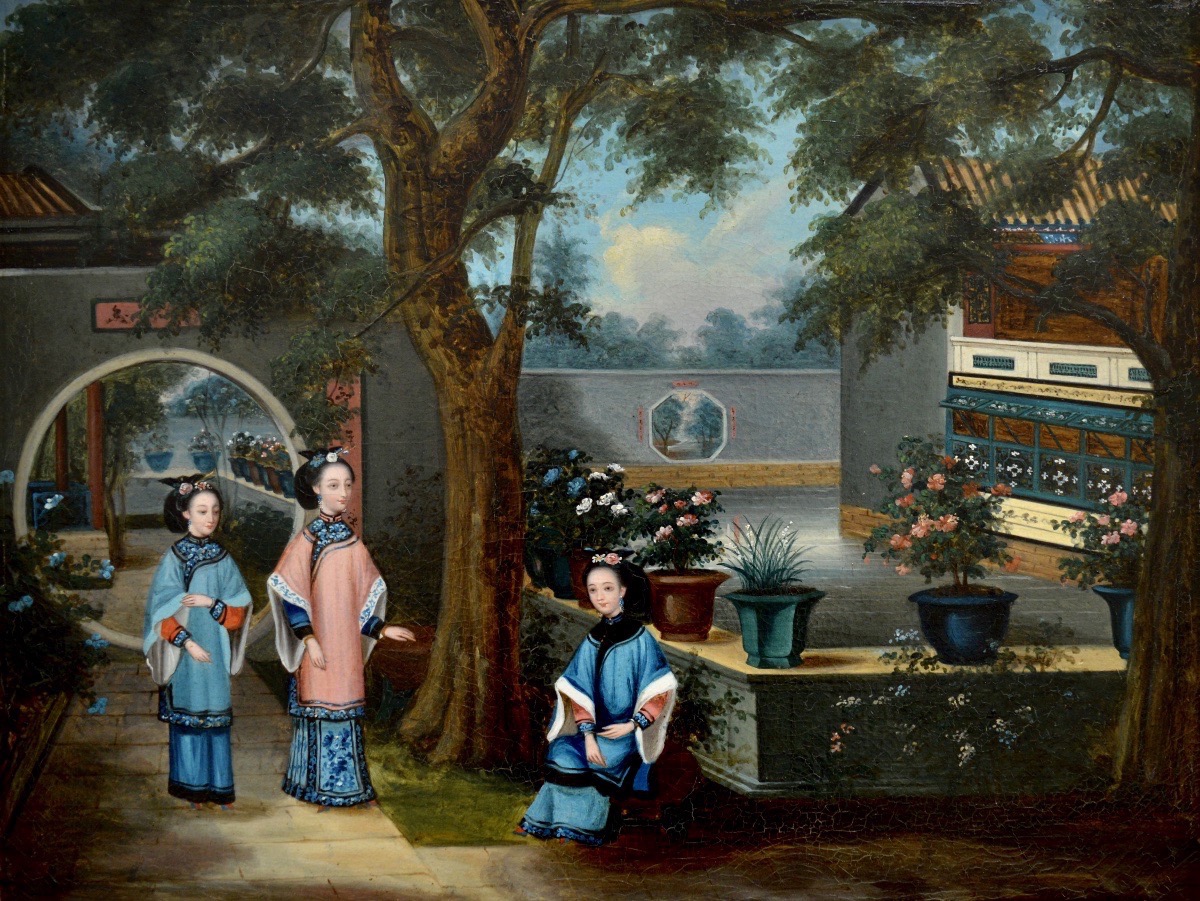



Youqua (active 1840–1880) And His Studio, “women In A Chinese Garden,” Canton, China, Chinnery
Artist: Youqua (act. 1840-1880) Et Son Atelier
YOUQUA (act. 1840-1880) and his workshop
« Women in a Chinese garden »
Original oil on canvas,
Provenance: Private French collection
We can compare our work to other creations by the artist Youqua on this theme, and notably to the exceptional series of 18 Chinese paintings found in the Museum's storerooms in 2005 by Geneviève Lacambre. Preserved today at the Musée d'Art et d'Histoire in La Rochelle, these completely unpublished works are attributed to Youqua, a 19th-century artist considered one of the most talented painters of the export trade.
A book titled "De couleurs et d'Encre, Oeuvres restaurées par le Musée d'art et d'histoire de La Rochelle", retracing this discovery and the restoration of the artist's paintings, will be provided.
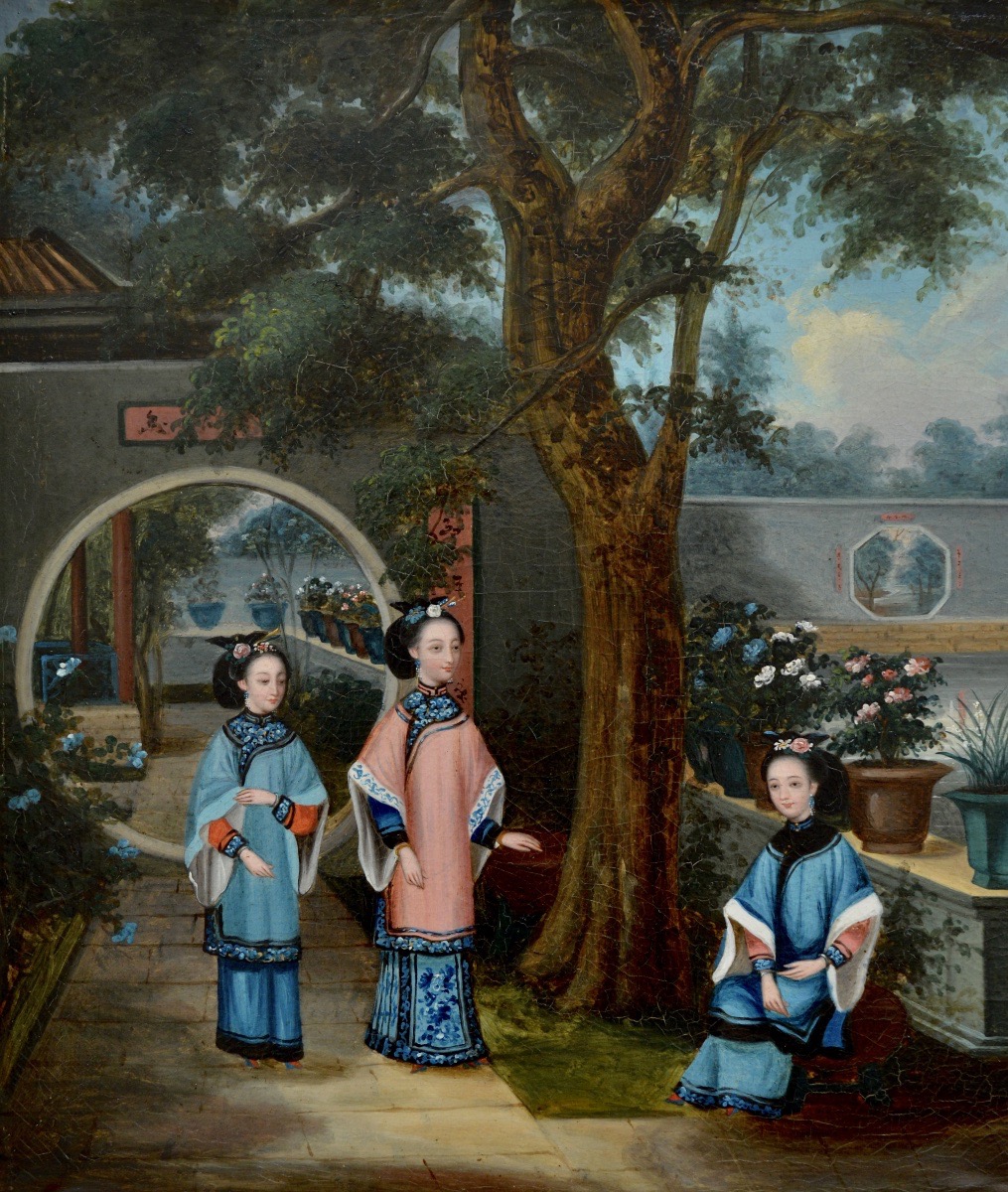
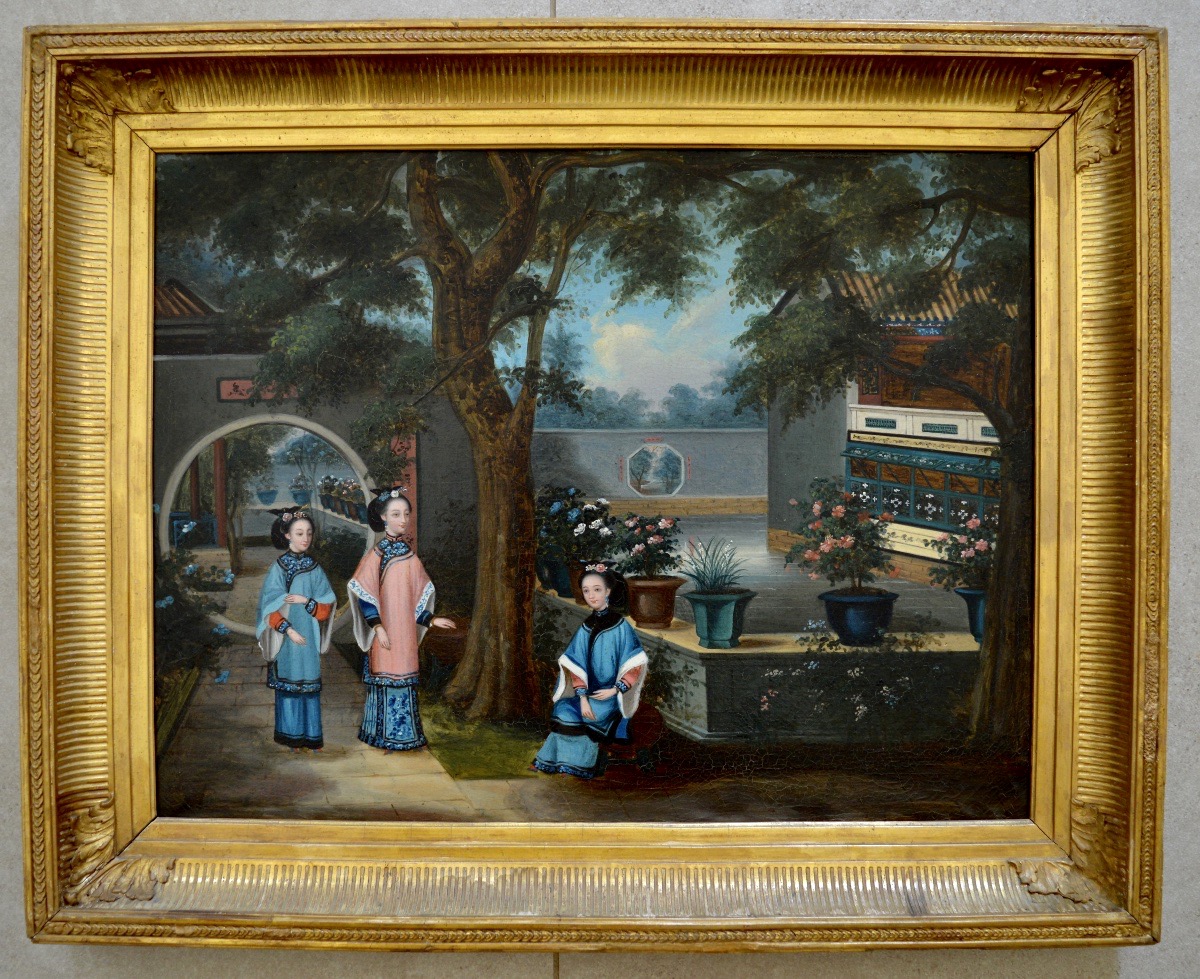
Exceptional work circa 1850 by the Chinese painter Youqua and his workshop, representing three elegant women of the Qing dynasty in a traditional inner courtyard. On the left, a female trio features one wearing a delicate pink tunic, while the other two women wear turquoise outfits. One of these women is depicted sitting on a garden seat in a reflective posture. Her blue attire is distinguished by wide white and pink lapels. The colors of the clothing seem to indicate a distinction of status within the family.
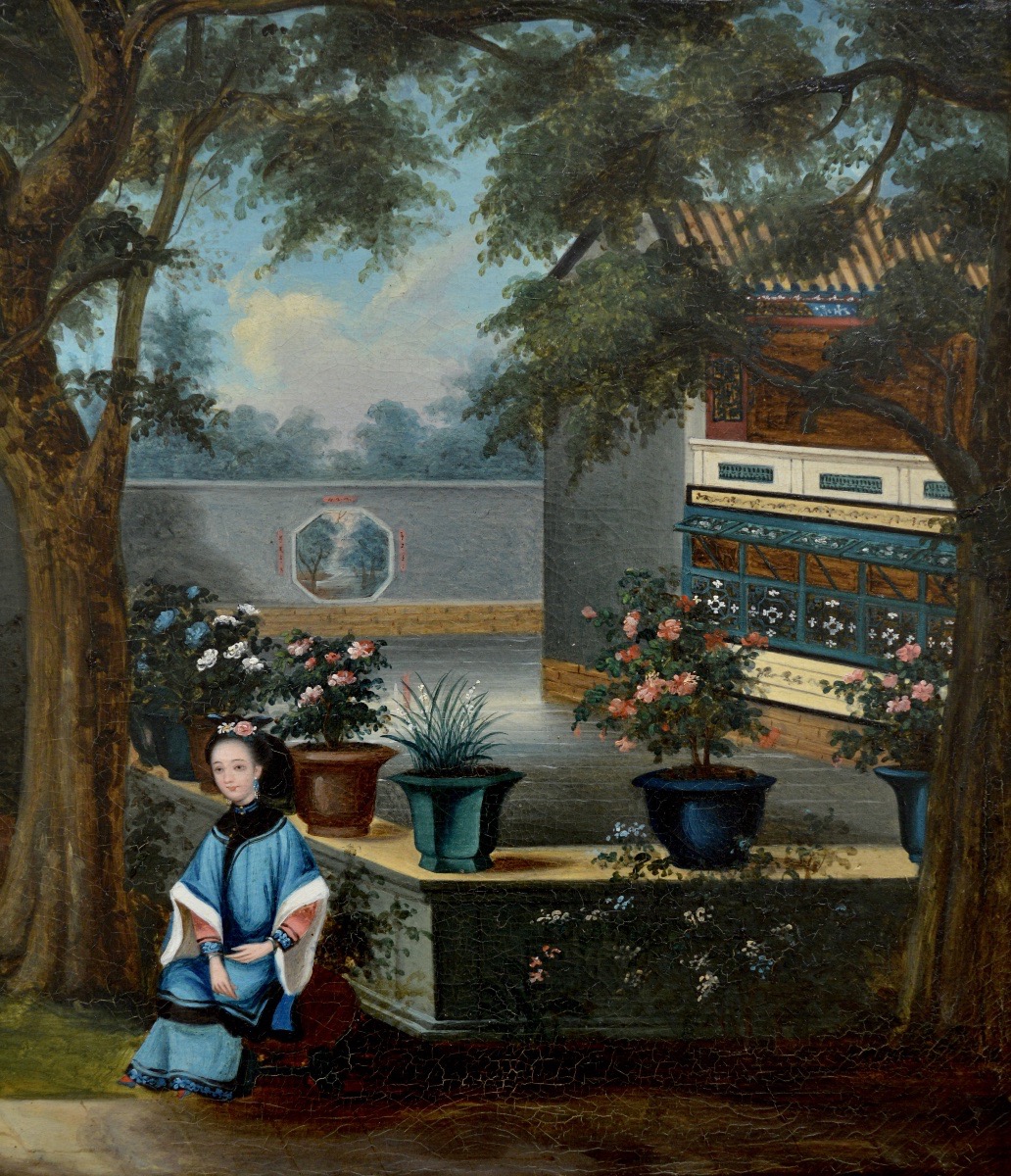
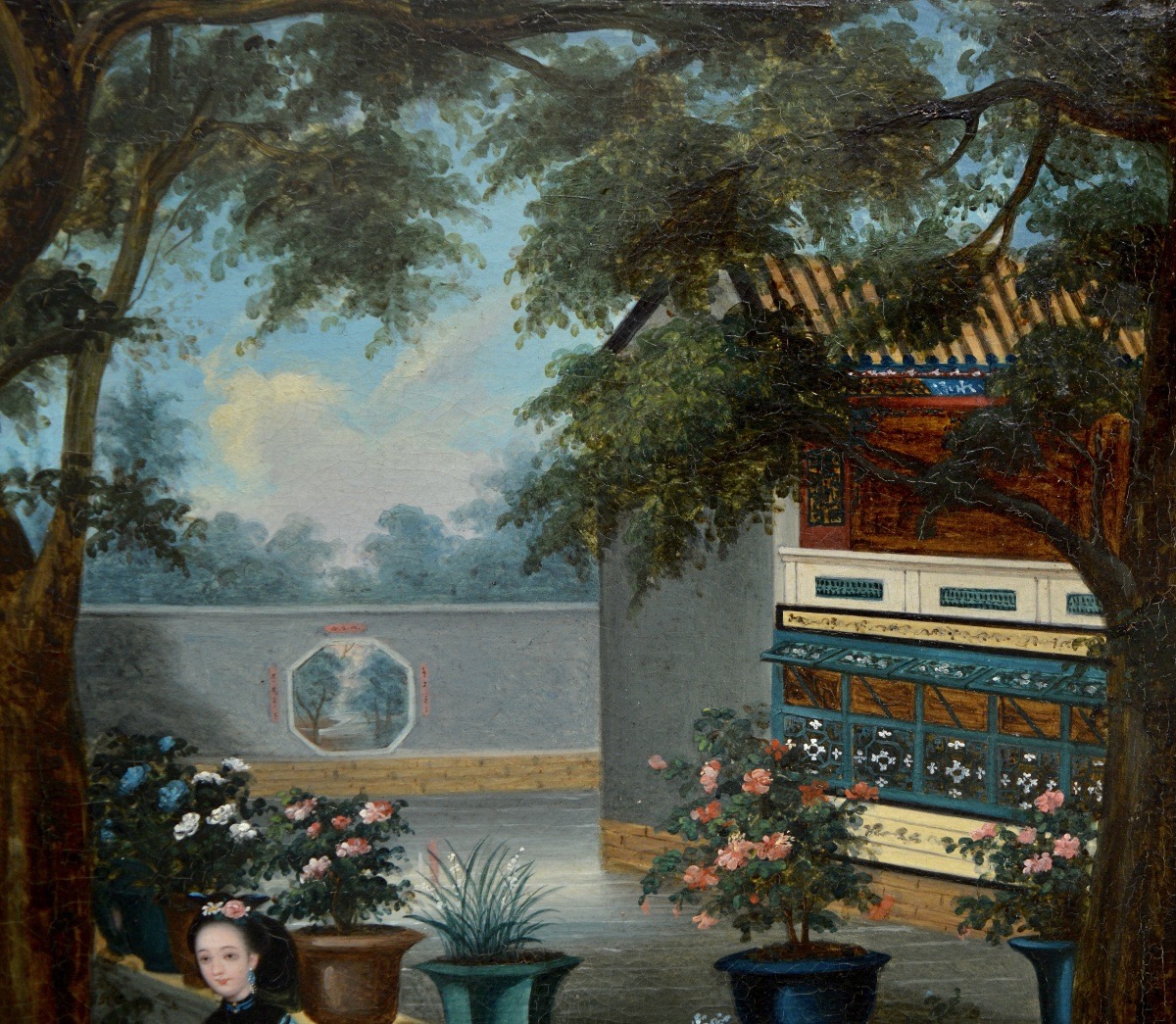
The landscape is structured around a large central tree that visually divides the composition. In the background, a geometric opening pierced through the surrounding wall offers a glimpse into the extension of the estate under a clear sky. In the foreground, the three female figures surround a low stone wall. This wall holds a row of large ceramic pots where colorful flowers and various types of green plants bloom. This low wall separates the garden path from the pond.
This work bears witness to the encounter between Asian pictorial traditions and 19th-century European artistic codes. Here, Youqua uses oil painting, a Western technique learned from figures like George Chinnery. There is also a notable application of three-dimensional perspective for structures, alongside precise work on shadows and volumes. Despite these external contributions, the general aesthetic, furnishings, and refinement of the garments remain deeply rooted in Chinese culture. Youqua is one of the most emblematic 19th-century painters in the field of Chinese export painting, an artistic movement that embodies the unique cultural and commercial encounter between Asia and the West at the heart of southern China's ports. As was often the case for artisans of this era, his personal biography remains largely unknown, and his studio name likely stems from a commercial combination pairing part of his given name with the honorific suffix commonly used by Cantonese merchants in contact with foreigners.
His artistic activity is formally documented between 1840 and 1870, a pivotal period marked by major geopolitical mutations and the forced opening of new trading posts. Demonstrating a keen business sense, the artist first established his main shop in the heart of Canton's Western factories, on the famous Old China Street, before becoming one of the very first creators to expand his activities by opening a prosperous branch on Queen's Road in Hong Kong.
This dual location allowed his workshop to gain immense renown among European and American merchants and ship captains, who quickly came to regard it as the best establishment in the region.
Behind the global signature of Youqua lies, in reality, a highly organized artisanal structure where the master supervised a team of specialized assistants and apprentices. This collective production method made it possible to efficiently meet the heavy demand from travelers while maintaining an exceptional standard of quality, visible in the mastery of varied techniques such as gouache on pith paper or oil painting on canvas. Heavily influenced by Western methods introduced by European artists like George Chinnery, the workshop virtuously integrated three-dimensional perspective, the play of cast shadows, and the realistic rendering of volumes, while retaining a theme deeply rooted in Chinese iconography.
The house's productions are distinguished by an incredible delicacy in portraits of high-society women, the refinement of traditional garments, as well as a surgical precision in harbor or botanical landscapes.
Today, the works originating from his studio are celebrated as precious historical and artistic testimonies.
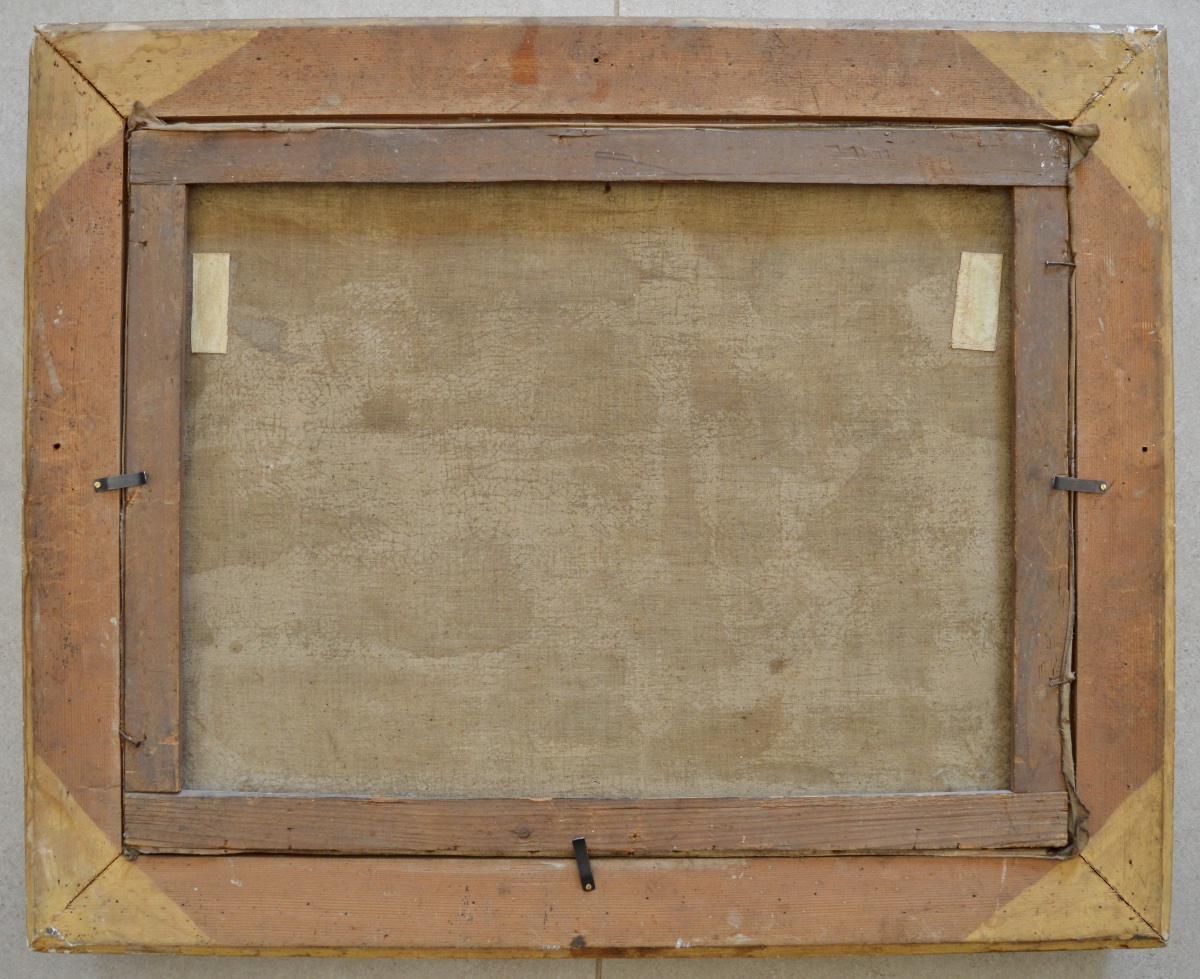
Note: Old minor restorations, without consequence, are to be noted and are visible on the back of the canvas.
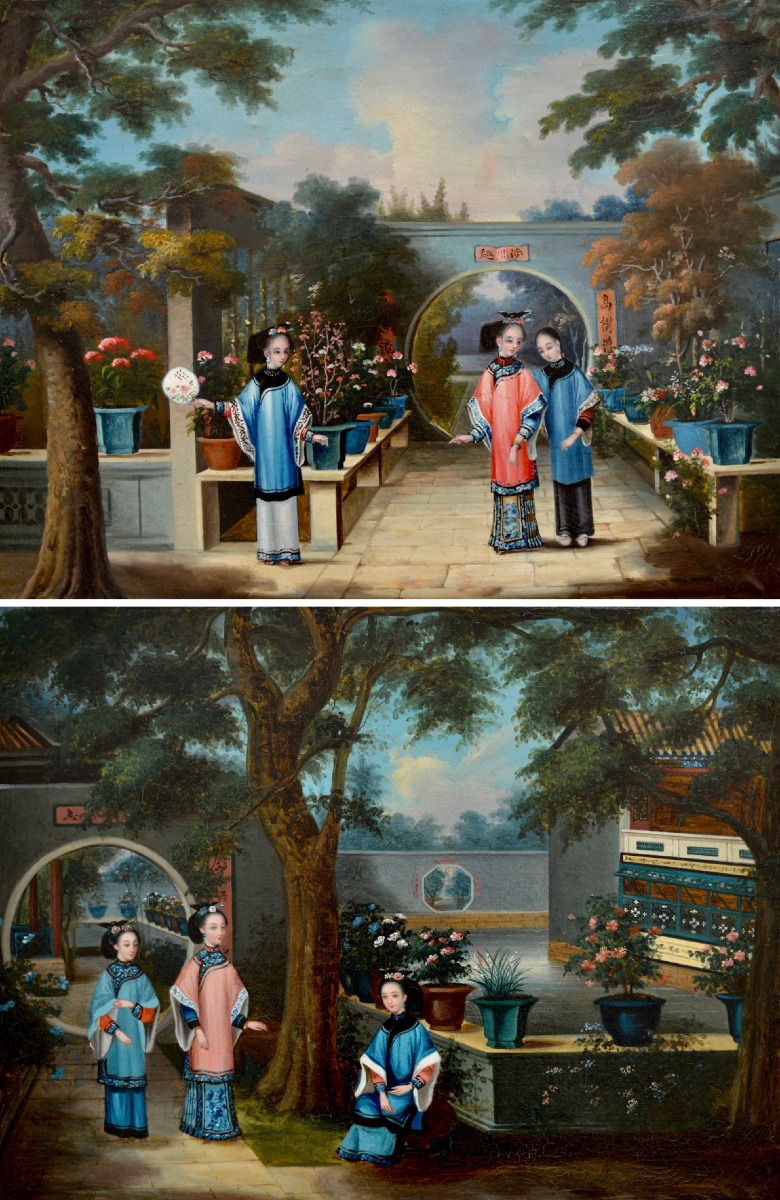
Our work can form a pendant with the artist's second work currently for sale, as they share the same theme, the same provenance, the same dimensions, and the same framing.
Dimensions: 46 x 60 cm without frame and 60 x 74 cm with its original carved and gilded wood frame.
A few minor damages and restorations are to be noted on the frame.
For more information, please contact us.
5 800 €
Period: 19th century
Style: Asian art
Condition: Good condition
Material: Oil painting
Reference (ID): 1841314
Availability: In stock
Print