



Jean Cluseau-lanauve (1914–1997) The New Streets In Périgueux, Dordogne
Artist: Jean Cluseau-lanauve
Jean CLUSEAU-LANAUVE
(Périgueux 1914 – Paris 1997)
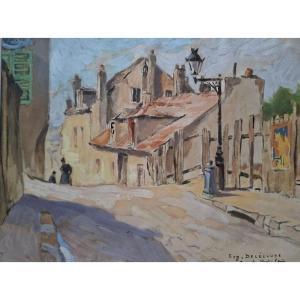
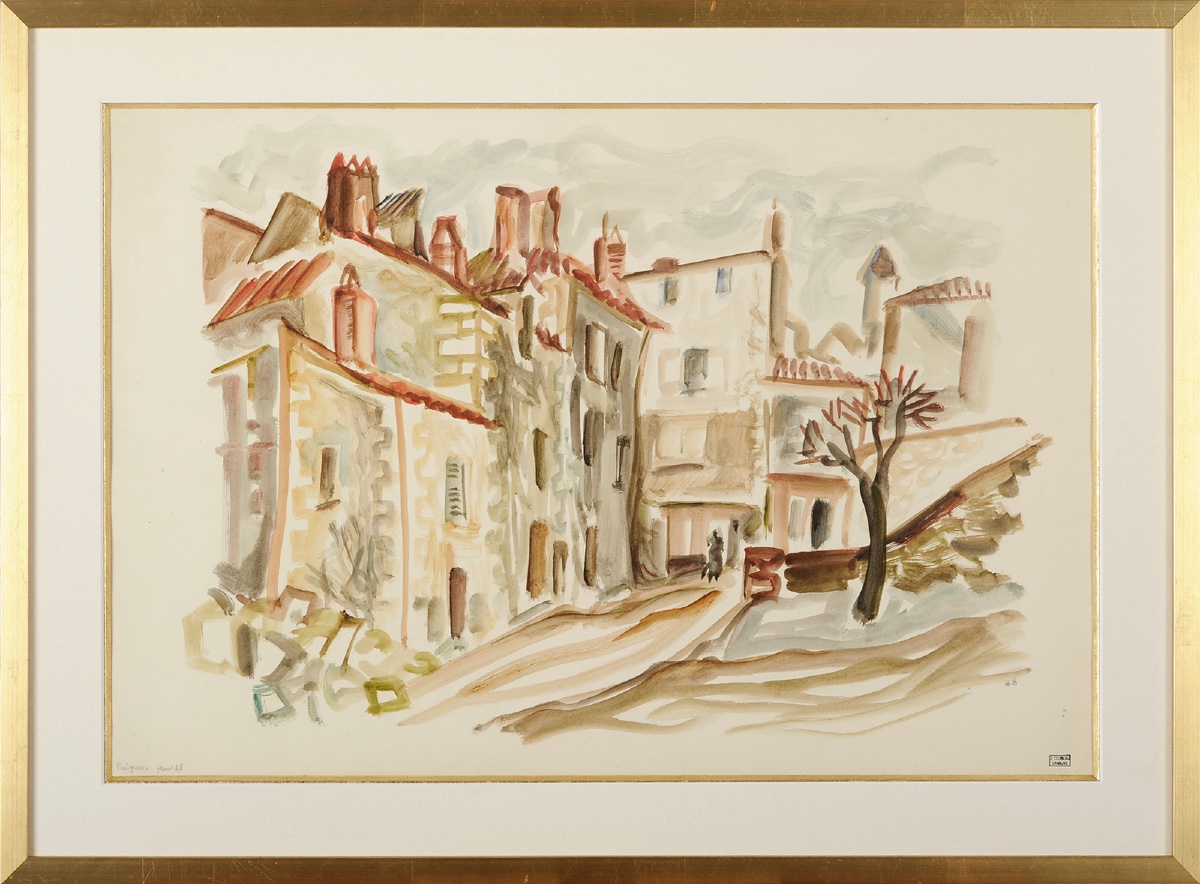
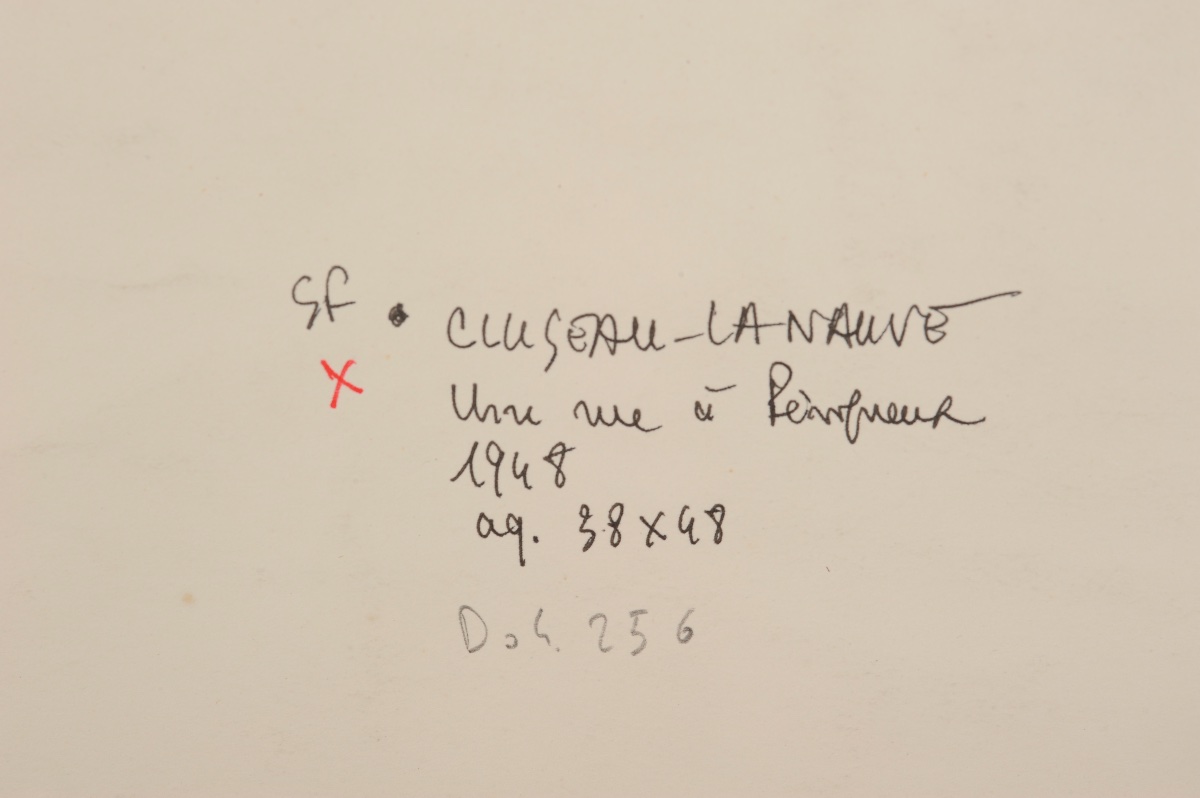
The New Streets in Périgueux
Watercolor
H. 380 mm; W. 480 mm
Signed and dated lower left, studio stamp lower right.
Provenance: Artist’s studio
Jean Cluseau-Lanauve was born in 1914 in Périgueux to a family native to the department. It was here that he “discovered” the arts, encouraged by his parents to pursue this path, before leaving to study them in Paris, where he would eventually settle. He enrolled in 1933 but left shortly before the war, during which he was taken prisoner in Germany. His training as a lithographer and draftsman shaped the early stages of his career, and from the 1950s through the 1980s, he became a figure recognized both by his fellow artists and by a devoted clientele.
Although a leading figure in the postwar School of Paris, Cluseau-Lanauve never abandoned his native Périgord. There, he owned a house near Les Eyzies, where he set up a small studio offering a view of the colors of this land he loved so dearly. His first painting exhibited at the Salon des Artistes Français, in 1935, was a Périgord Landscape. It was later purchased by the French government.
Cluseau-Lanauve constantly brought his beloved Périgord back into his works, which he created from sketches made on location. Many of the sketchbooks containing these drawings have been scattered since his death and are now appearing on the art market, sheet by sheet. His oil paintings, which took on a Cubist style as early as the 1950s, are images with clean lines that seek only to highlight the idealized subject through luminous facets.
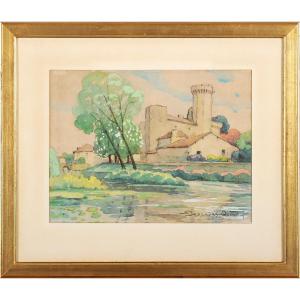
This watercolor, painted on site in Périgueux, was most certainly created near Saint-Front Cathedral, near the former Place de la Mission. The Rues Neuves neighborhood, which bordered the Isle River, was a very poor area that was demolished between the 1950s and 1970s to make way for modern buildings… Period photographs are the most important records of this vanished place, but many artists created striking works there. Here, Cluseau-Lanauve depicts, with the palette and brushstrokes characteristic of his early period, a tranquil town bathed in brown hues.
(Périgueux 1914 – Paris 1997)
The New Streets in Périgueux
Watercolor
H. 380 mm; W. 480 mm
Signed and dated lower left, studio stamp lower right.
Provenance: Artist’s studio
Jean Cluseau-Lanauve was born in 1914 in Périgueux to a family native to the department. It was here that he “discovered” the arts, encouraged by his parents to pursue this path, before leaving to study them in Paris, where he would eventually settle. He enrolled in 1933 but left shortly before the war, during which he was taken prisoner in Germany. His training as a lithographer and draftsman shaped the early stages of his career, and from the 1950s through the 1980s, he became a figure recognized both by his fellow artists and by a devoted clientele.
Although a leading figure in the postwar School of Paris, Cluseau-Lanauve never abandoned his native Périgord. There, he owned a house near Les Eyzies, where he set up a small studio offering a view of the colors of this land he loved so dearly. His first painting exhibited at the Salon des Artistes Français, in 1935, was a Périgord Landscape. It was later purchased by the French government.
Cluseau-Lanauve constantly brought his beloved Périgord back into his works, which he created from sketches made on location. Many of the sketchbooks containing these drawings have been scattered since his death and are now appearing on the art market, sheet by sheet. His oil paintings, which took on a Cubist style as early as the 1950s, are images with clean lines that seek only to highlight the idealized subject through luminous facets.
This watercolor, painted on site in Périgueux, was most certainly created near Saint-Front Cathedral, near the former Place de la Mission. The Rues Neuves neighborhood, which bordered the Isle River, was a very poor area that was demolished between the 1950s and 1970s to make way for modern buildings… Period photographs are the most important records of this vanished place, but many artists created striking works there. Here, Cluseau-Lanauve depicts, with the palette and brushstrokes characteristic of his early period, a tranquil town bathed in brown hues.
460 €
Period: 20th century
Style: Modern Art
Condition: Perfect condition
Material: Water color
Length: 38 cm hors cadre
Width: 48 cm hors cadre
Reference (ID): 1834143
Availability: In stock
Print