

Rabiat Frères - Empire-period Lyre Clock In Gilded Bronze And Sea Green Marble, Circa 1816
Les Frères Rabiat – Exceptional Large Lyre Clock with Jupiter – Gilt Bronze – Paris, circa 1816-1818
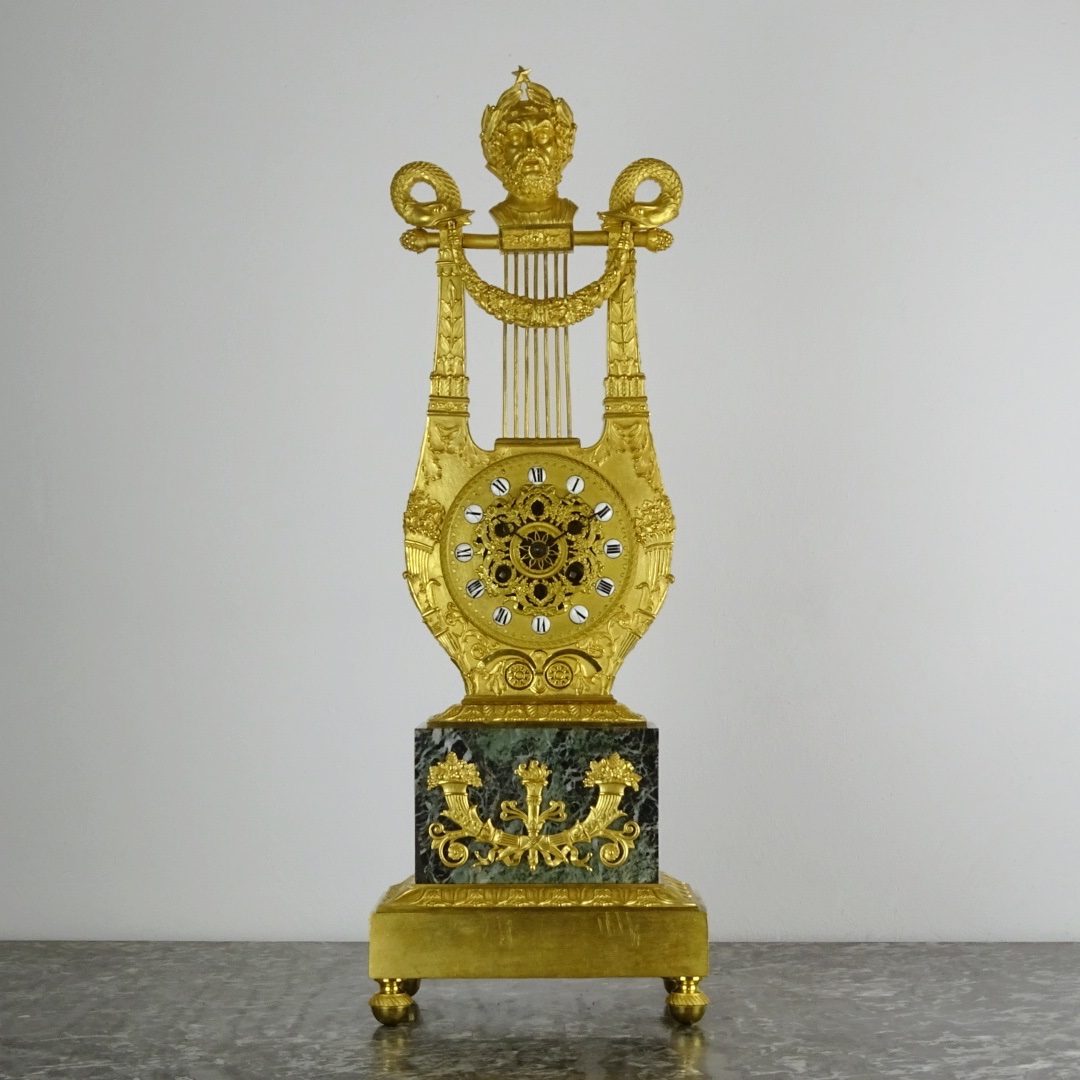
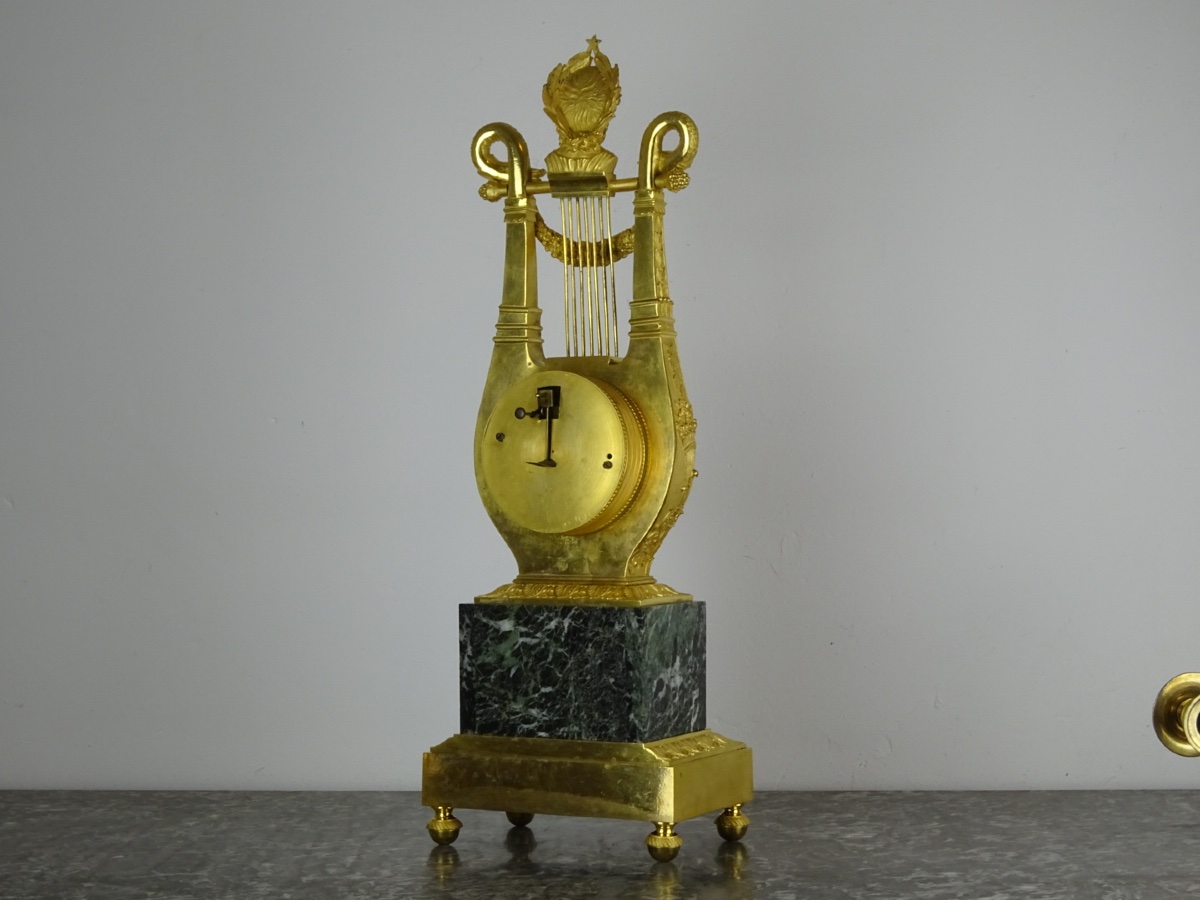
Exceptional large lyre-shaped mantel clock in finely chased and gilt bronze, resting on a green marble base and bearing the signature “LES FRÈRES RABIAT”.
Paris, circa 1816-1818.
Standing 53 cm high, this remarkable clock is distinguished by the elegance and originality of its architecture, the richness of its Neoclassical ornamentation and, above all, by the exceptional quality of its bronzes, evident in the precision of the casting and chasing as well as in the superb execution of the gilding.
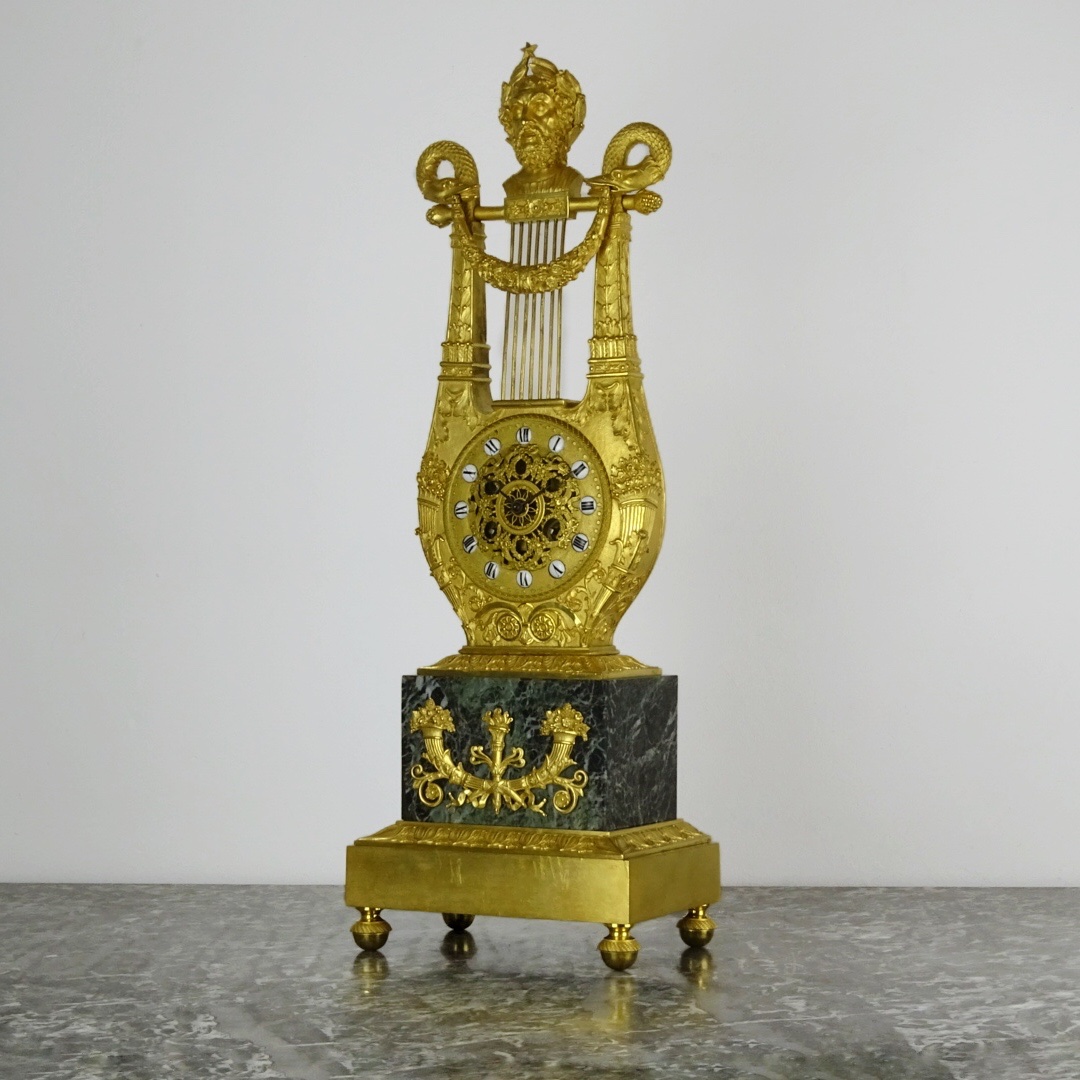
The case takes the form of a majestic antique lyre. Its two slender uprights, joined by the strings of the instrument, are richly decorated with finely chased palmettes, foliage and Neoclassical motifs. Despite the abundance of its ornamentation and its substantial dimensions, the composition retains remarkable lightness and perfectly balanced proportions.
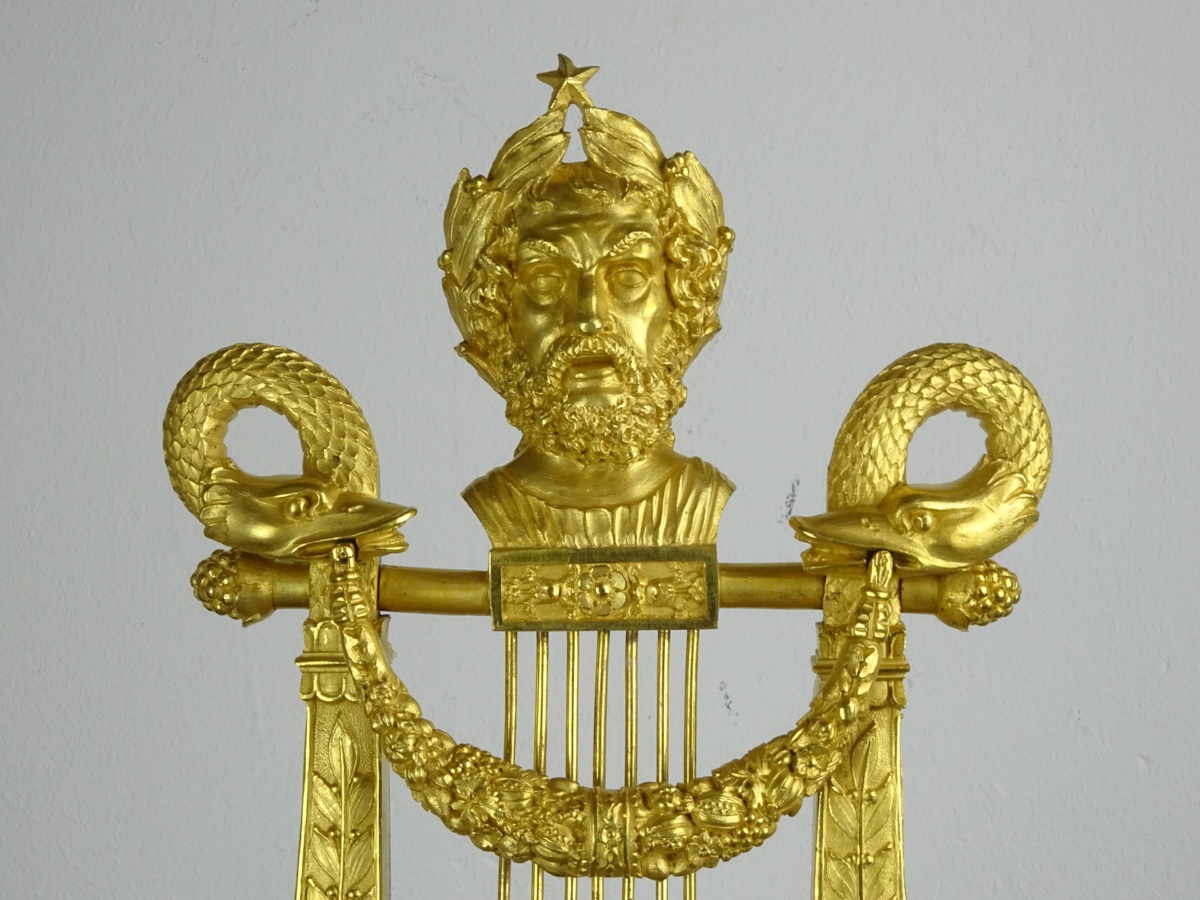
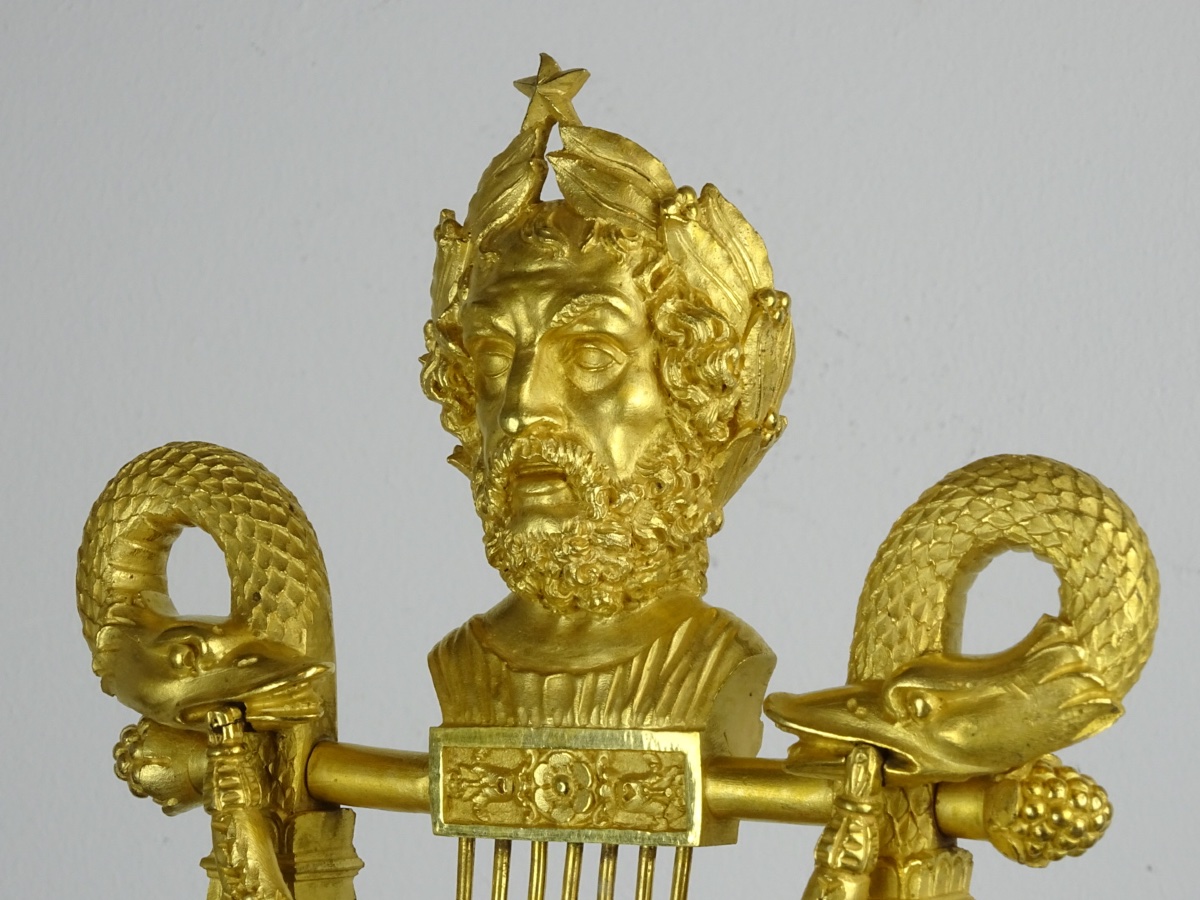
The clock is crowned by a spectacular head of Jupiter, sovereign of the Olympian gods, recognizable by his powerful bearded features and abundant hair. Treated with genuine sculptural vigour, the mask dominates the composition and constitutes one of the most striking elements of the clock.
On either side are two coiled serpents, symmetrically arranged at the ends of the upper section. Beneath Jupiter, a delicate garland of flowers and foliage extends between the two arms of the lyre, introducing a graceful counterpoint to the architectural rigour of the composition.
A remarkable openwork dial
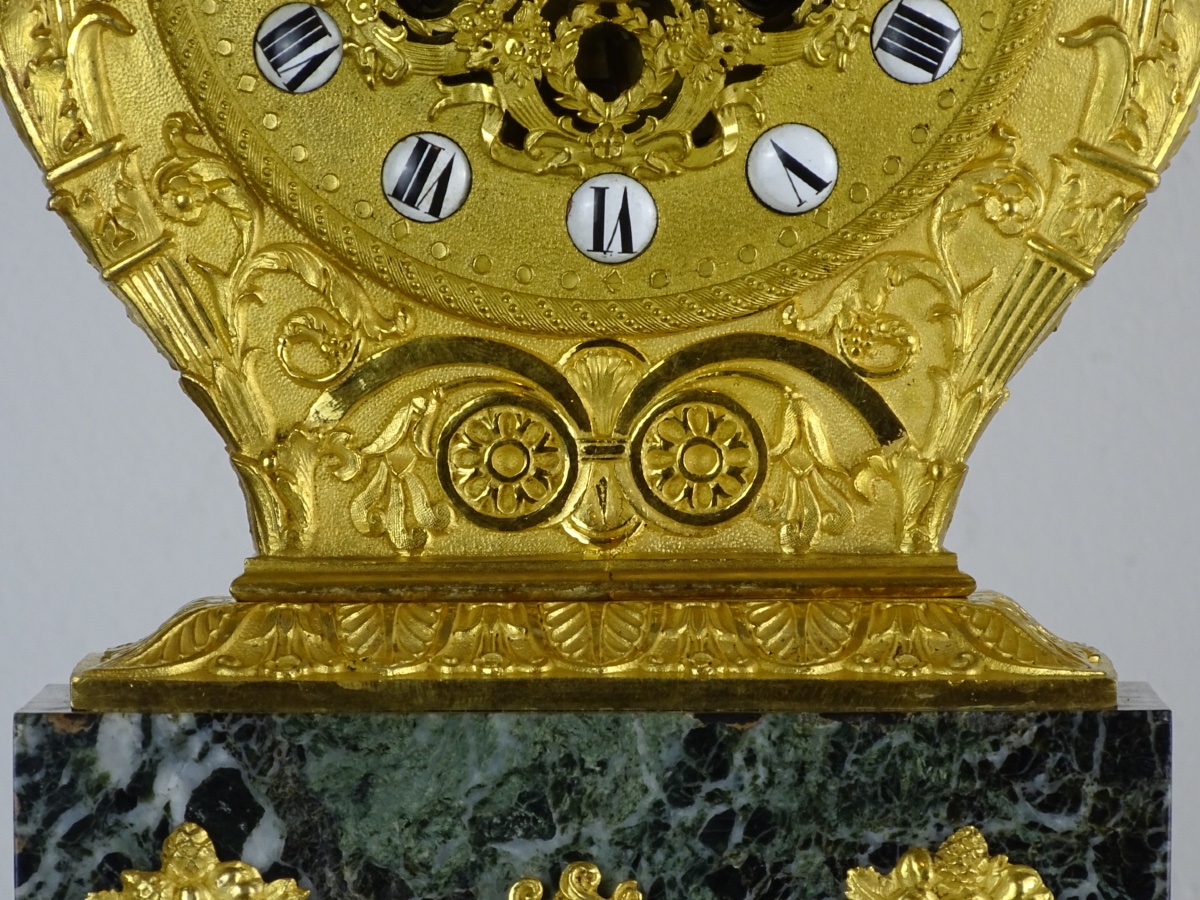
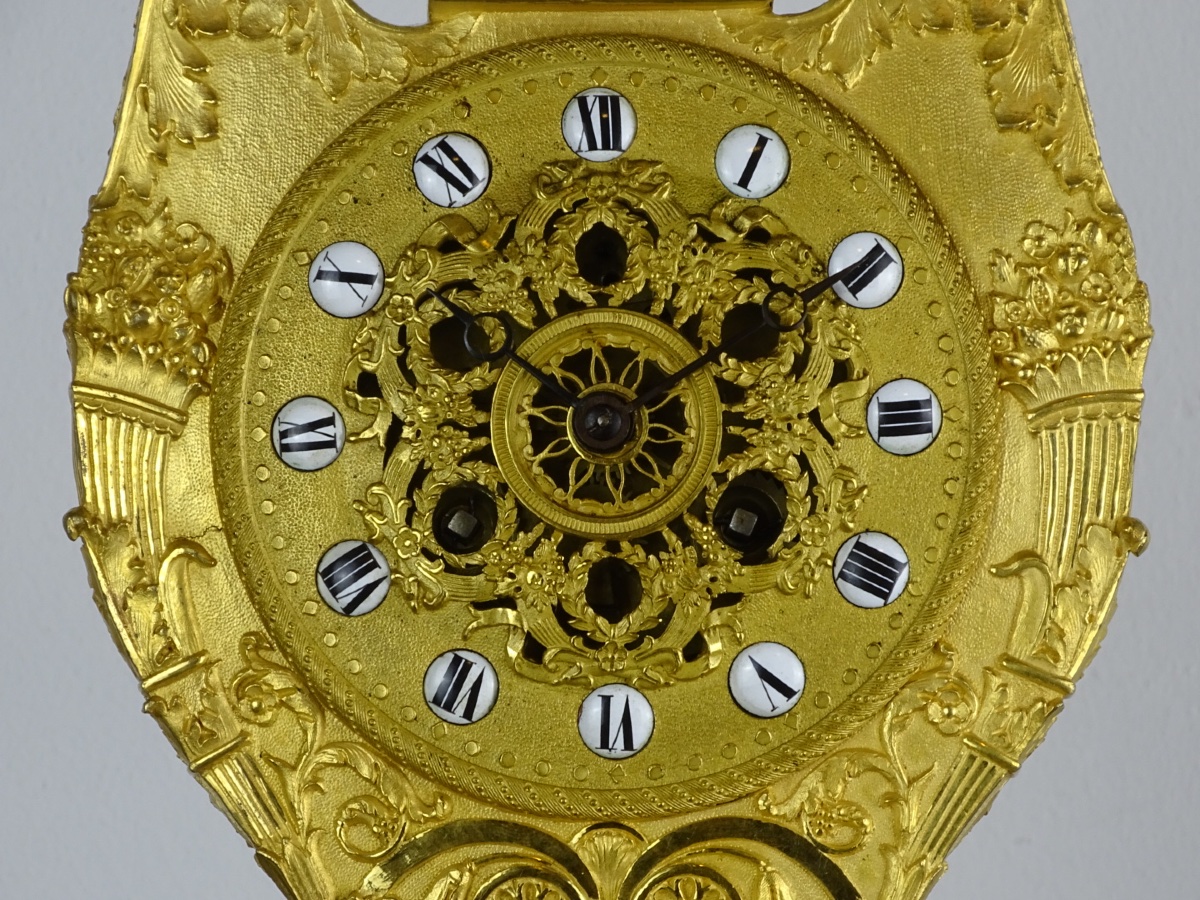
At the centre of the lyre is a particularly refined openwork dial, subtly pierced to reveal portions of the movement and its mechanism without fully exposing it.
The hours are indicated by twelve individual white enamel cartouches with Roman numerals, arranged around a richly chased and pierced gilt-bronze framework.
These openings create a remarkable sense of depth, allowing glimpses of the mechanical elements behind the dial. Unlike a true skeleton clock, the movement does not become the principal decorative feature, but rather reveals itself discreetly through the openwork ornamentation.
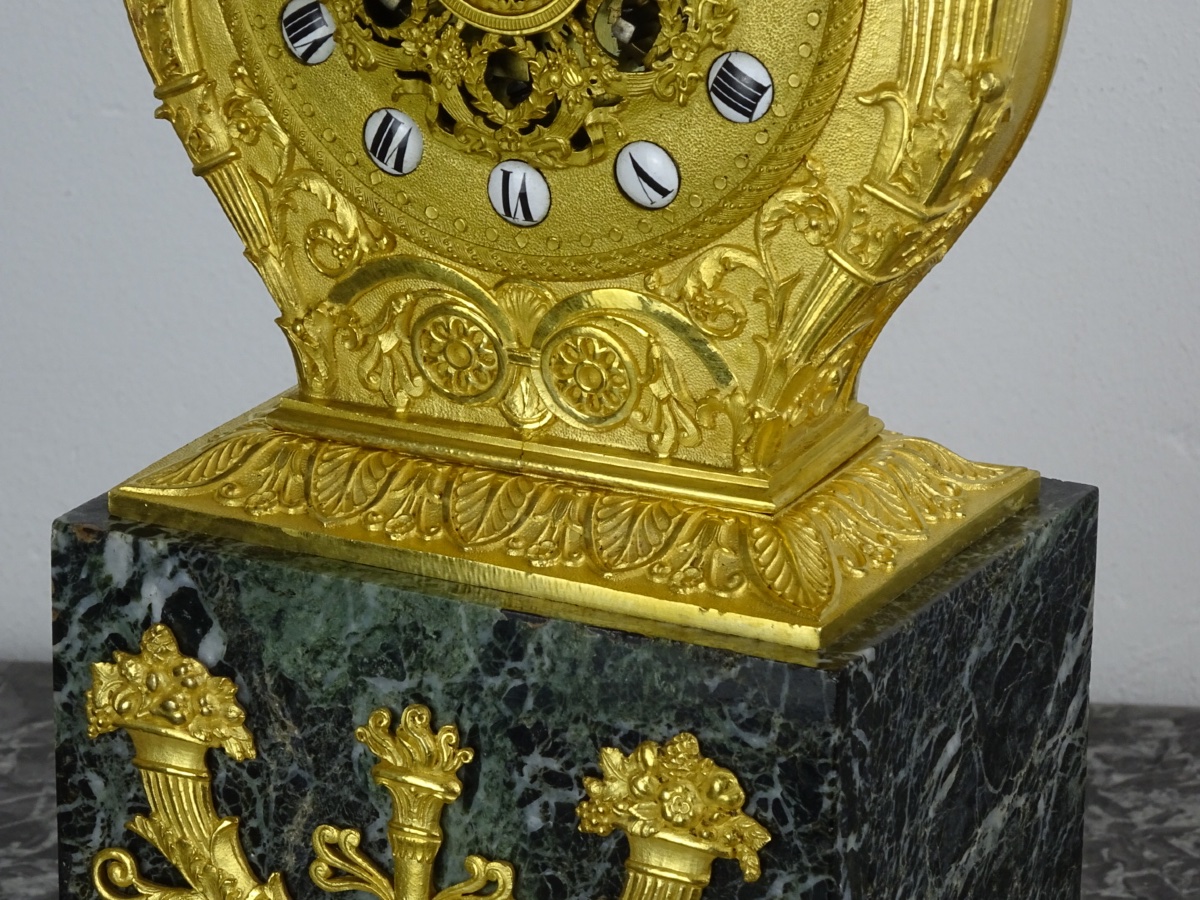
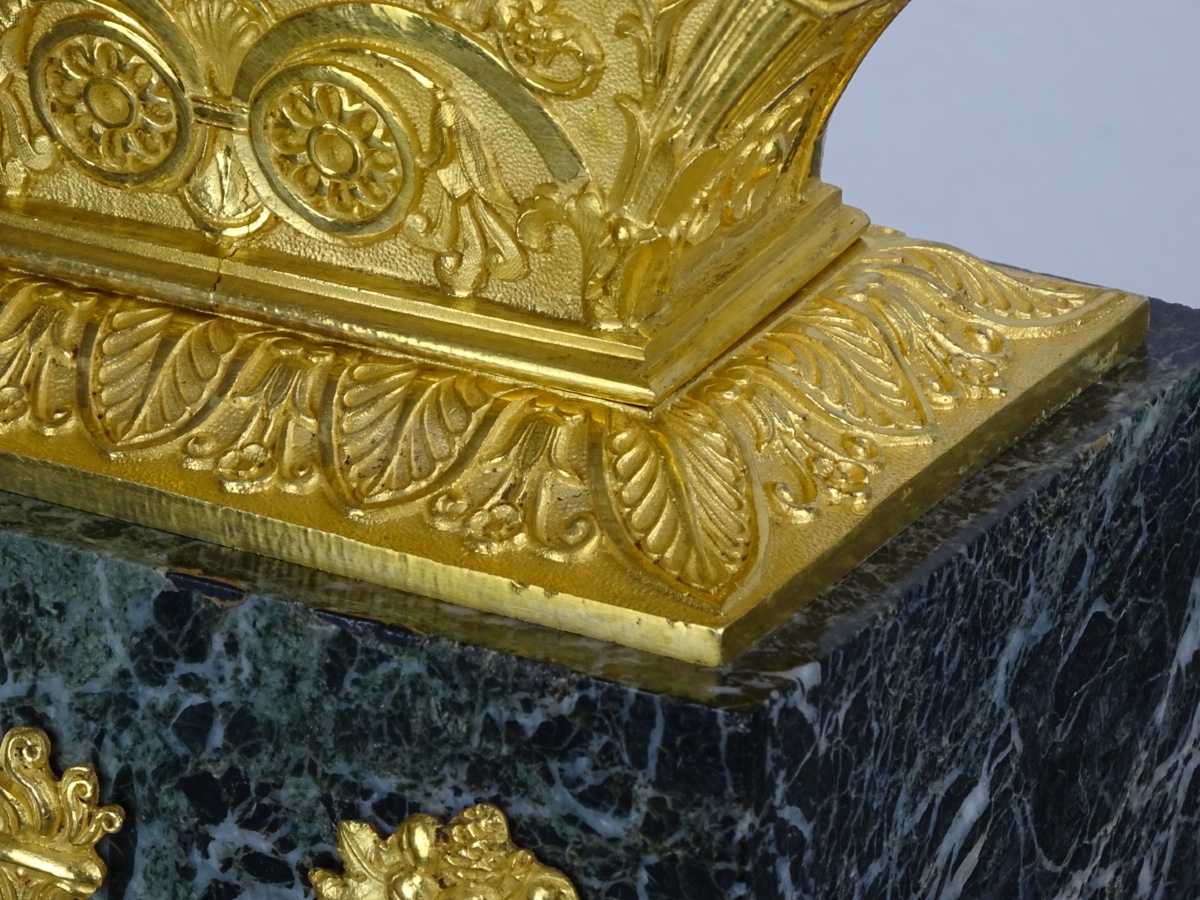
The lower section of the lyre is equally richly worked. Scrolls, palmettes, rosettes and foliage are executed with great precision, demonstrating the exceptional attention devoted to even the smallest details.
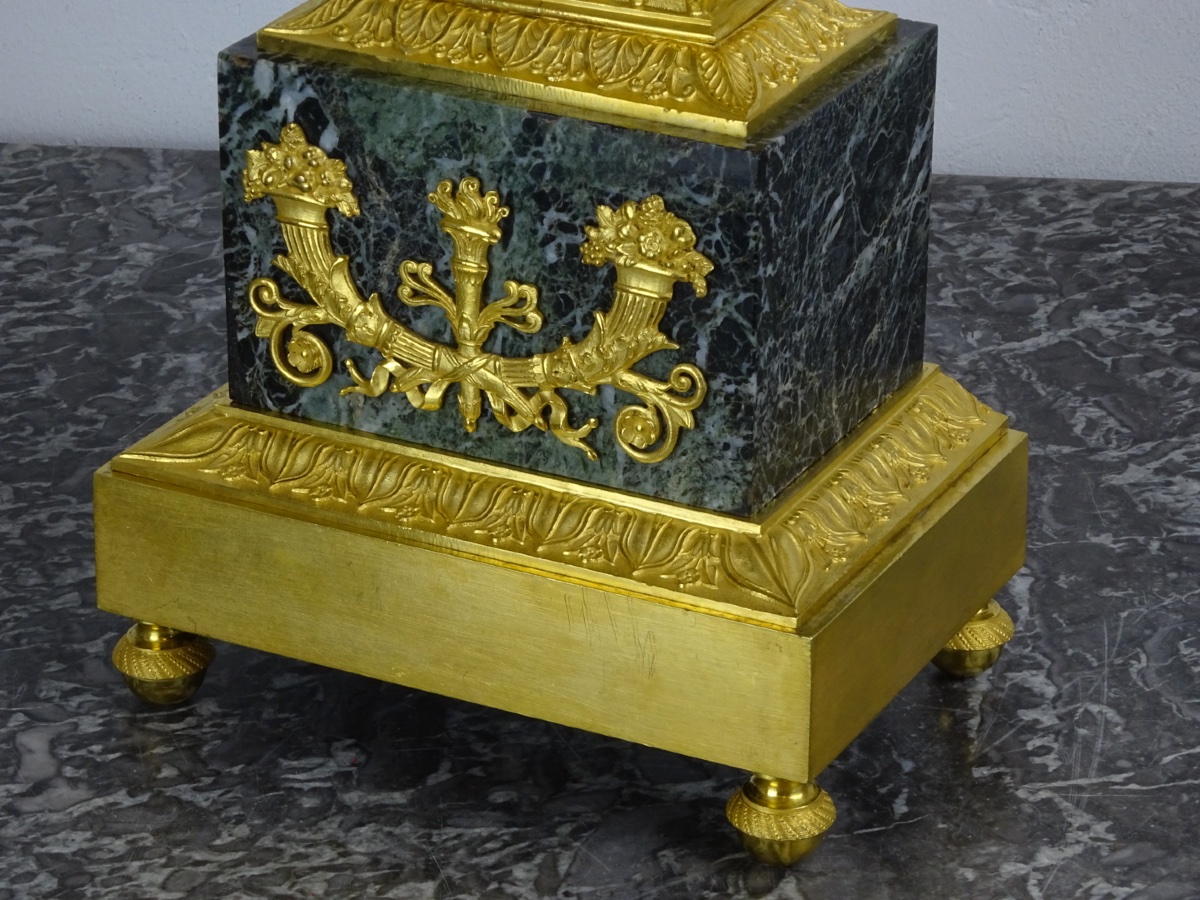
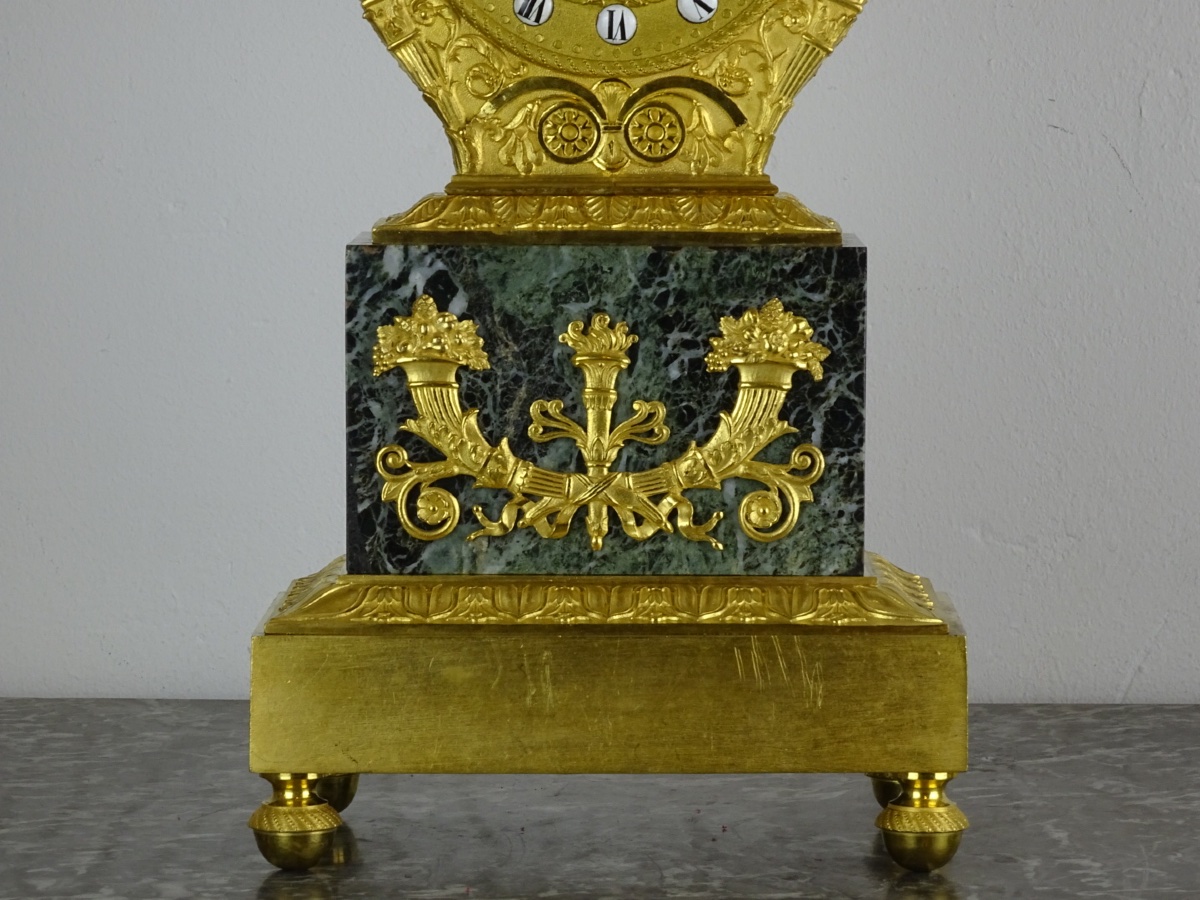
The whole rests upon an elegant green marble plinth, enriched on the front with an important gilt-bronze mount composed of two confronting cornucopias overflowing with flowers, symmetrically arranged around a central vegetal motif.
A rectangular gilt-bronze base, bordered by a finely chased frieze and raised on four spherical feet, completes this particularly accomplished composition.
Les Frères Rabiat, heirs to Claude-François Rabiat
The signature “LES FRÈRES RABIAT” is of particular importance, allowing the clock to be placed within a brief and fascinating chapter in the history of one of the notable Parisian bronze-making workshops of the early 19th century.
Claude-François Rabiat (1756-1815), who became a master in 1778, directed an important Parisian workshop specializing in furnishing bronzes. Active from the final decades of the Ancien Régime through the Empire period, he supplied bronzes to several of the leading makers and clockmakers of his time.
Following his death in 1815, his three sons, who had been trained within the environment of their father’s workshop, continued the family business. In 1816, they entered into partnership under a common name, before their association was dissolved at the end of 1818.
The signature “LES FRÈRES RABIAT” therefore associates the present clock with this particularly brief period in the history of the workshop and allows it to be closely dated to circa 1816-1818.
Even more significantly, documentation relating to Claude-François Rabiat’s workshop records among its stock of models lyre-shaped clock cases as well as compositions incorporating Classical heads, notably that of Jupiter.
The present clock, combining precisely the form of the lyre with the figure of Jupiter, therefore corresponds particularly closely with the decorative repertoire developed by Claude-François Rabiat and subsequently inherited by his sons when they continued the family workshop.
It thus represents a remarkable testimony to the continuity of the models, techniques and craftsmanship of the Rabiat family immediately following the death of its founder.
Between the Empire and the Restoration
Executed circa 1816-1818, the clock chronologically belongs to the opening years of the Bourbon Restoration, while remaining deeply rooted in the aesthetic vocabulary developed during the Empire period.
The antique lyre, Jupiter, serpents, palmettes, cornucopias and rigorous symmetry of the composition all belong to the great Neoclassical repertoire that dominated the Parisian decorative arts of the early 19th century.
The persistence of this aesthetic after 1815 reflects the continuity of the great Parisian workshops, their models and their craftsmanship despite the change of political regime.
Despite the richness of its ornamentation, the clock retains remarkable architectural elegance. The slender uprights, the strings of the lyre and the pierced dial visually lighten its silhouette, while the contrast between the brilliance of the gilt bronze and the depth of the green marble beautifully emphasizes its architecture.
Exceptional state of preservation
The clock has survived in an exceptional state of preservation.
The gilding retains a superb brilliance, allowing the remarkable precision of the chasing to be fully appreciated. Jupiter’s beard and hair, the serpents, garlands, palmettes, foliage and numerous ornamental details remain exceptionally crisp.
The marble, bronzes and enamel hour cartouches are likewise remarkably well preserved.
With its impressive height of 53 cm, the rarity of its “LES FRÈRES RABIAT” signature, its particularly narrow dating, its iconography dominated by Jupiter, its refined openwork dial and, above all, the exceptional quality of its chasing and gilding, this clock constitutes a remarkable example of the excellence of Parisian bronze work in the early 19th century, as well as an important testimony to the continuation of Claude-François Rabiat’s prestigious workshop under his sons.
Les Frères Rabiat
Large lyre clock with Jupiter
Paris, circa 1816-1818
Period: early Restoration, retaining the grand Empire aesthetic
Finely chased and gilt bronze, green marble and enamel
Height: 53 cm
Signed “LES FRÈRES RABIAT”
Exceptional state of preservation
Professional packing and delivery available upon request. Worldwide shipping possible.
Period: 19th century
Style: Consulat, Empire
Condition: Excellent condition
Material: Bronze
Height: 53 cm
Reference (ID): 1833552
Availability: In stock