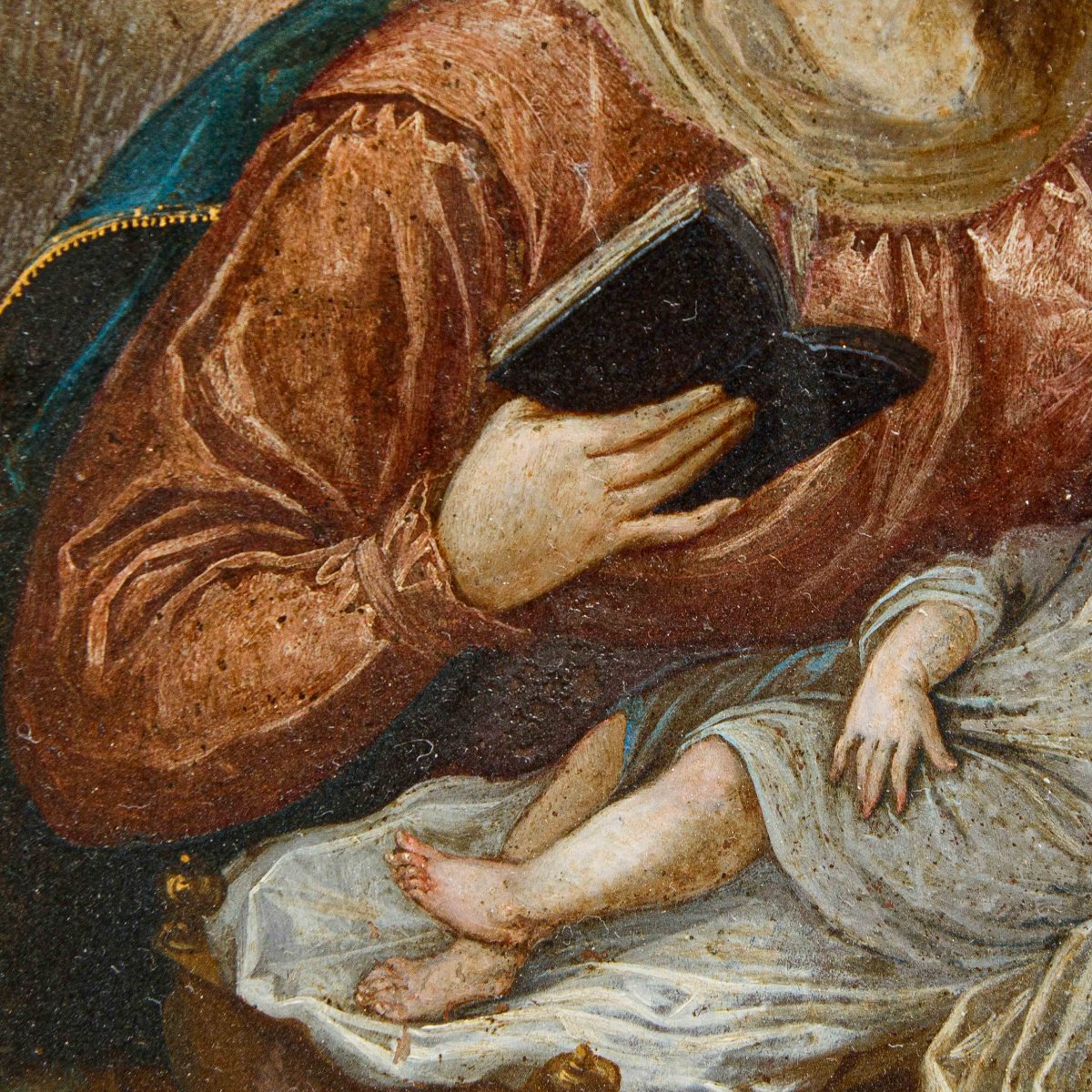


17th-century Spanish-flemish School, Madonna And Child
17th-century Spanish-Flemish school
Madonna and Child
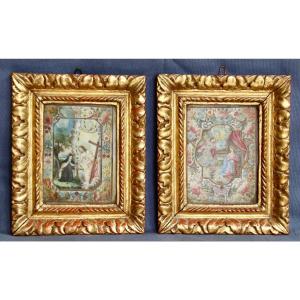
Oil on copper, 15 x 23 cm – with frame, 41 x 28 cm
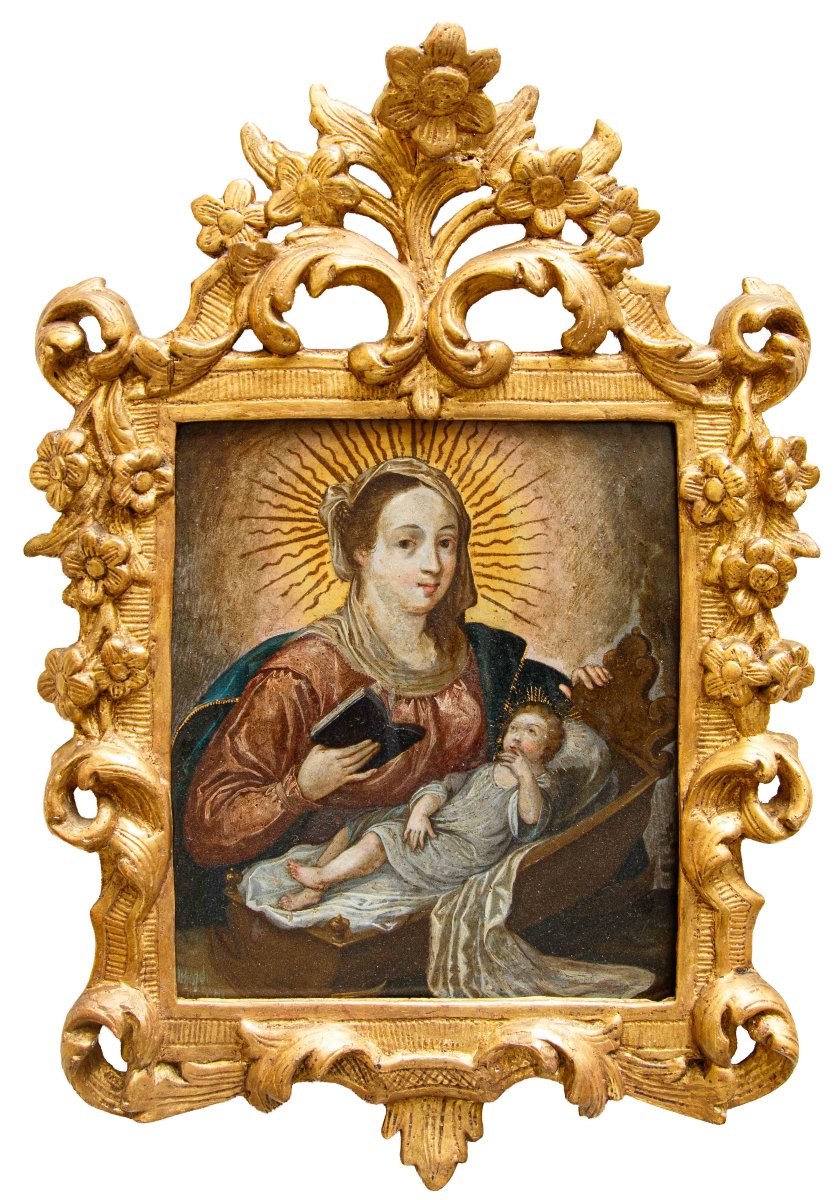
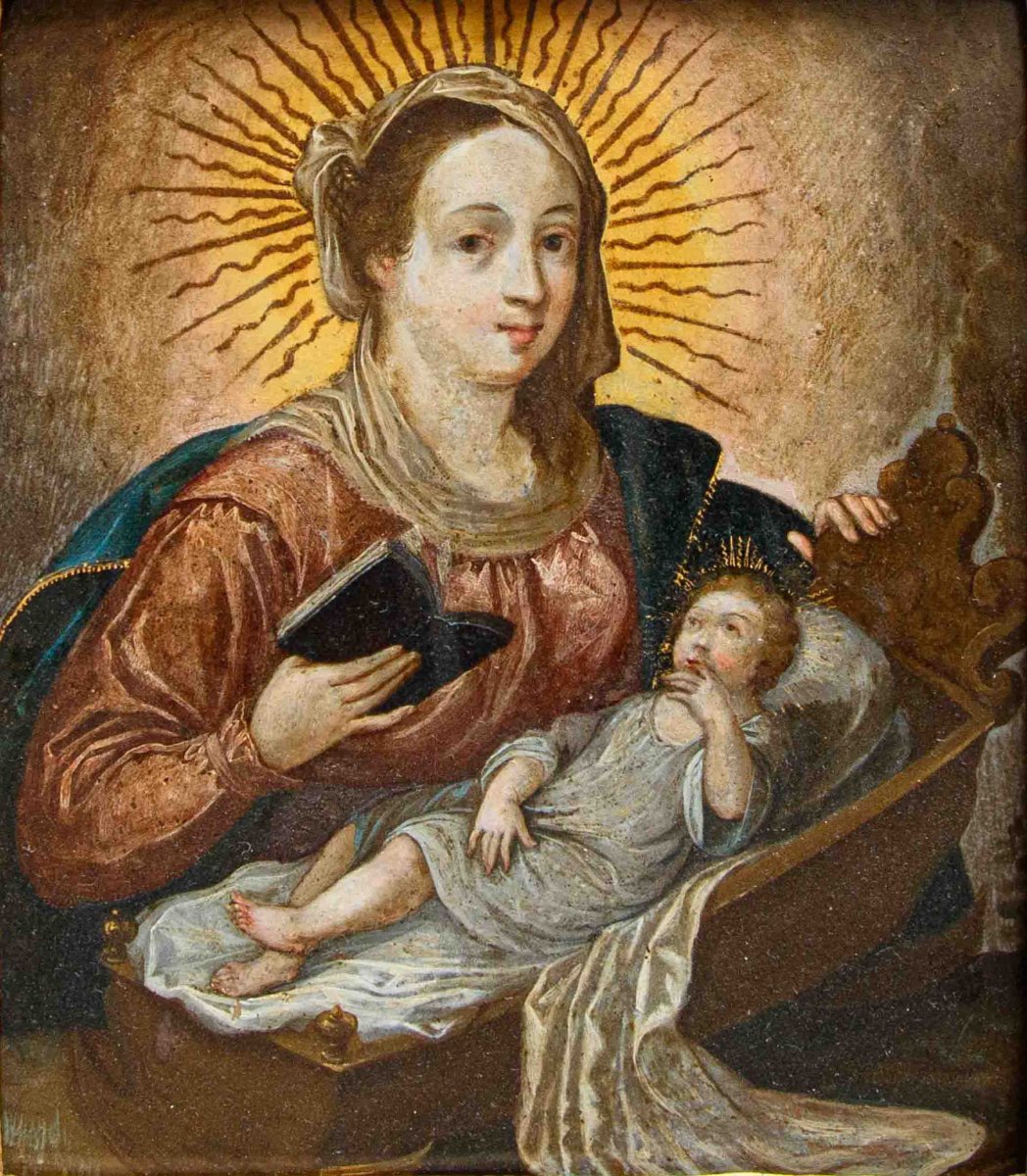
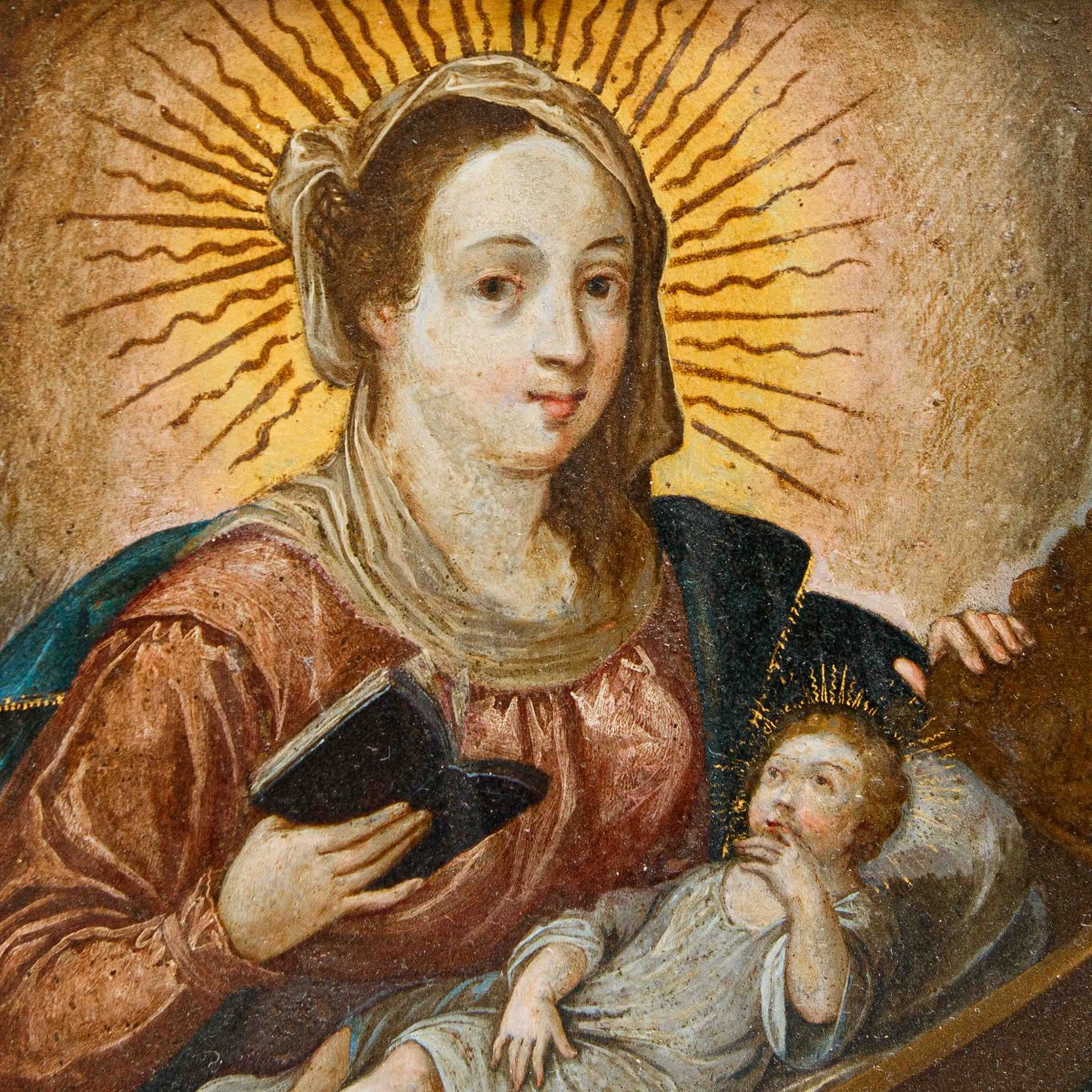
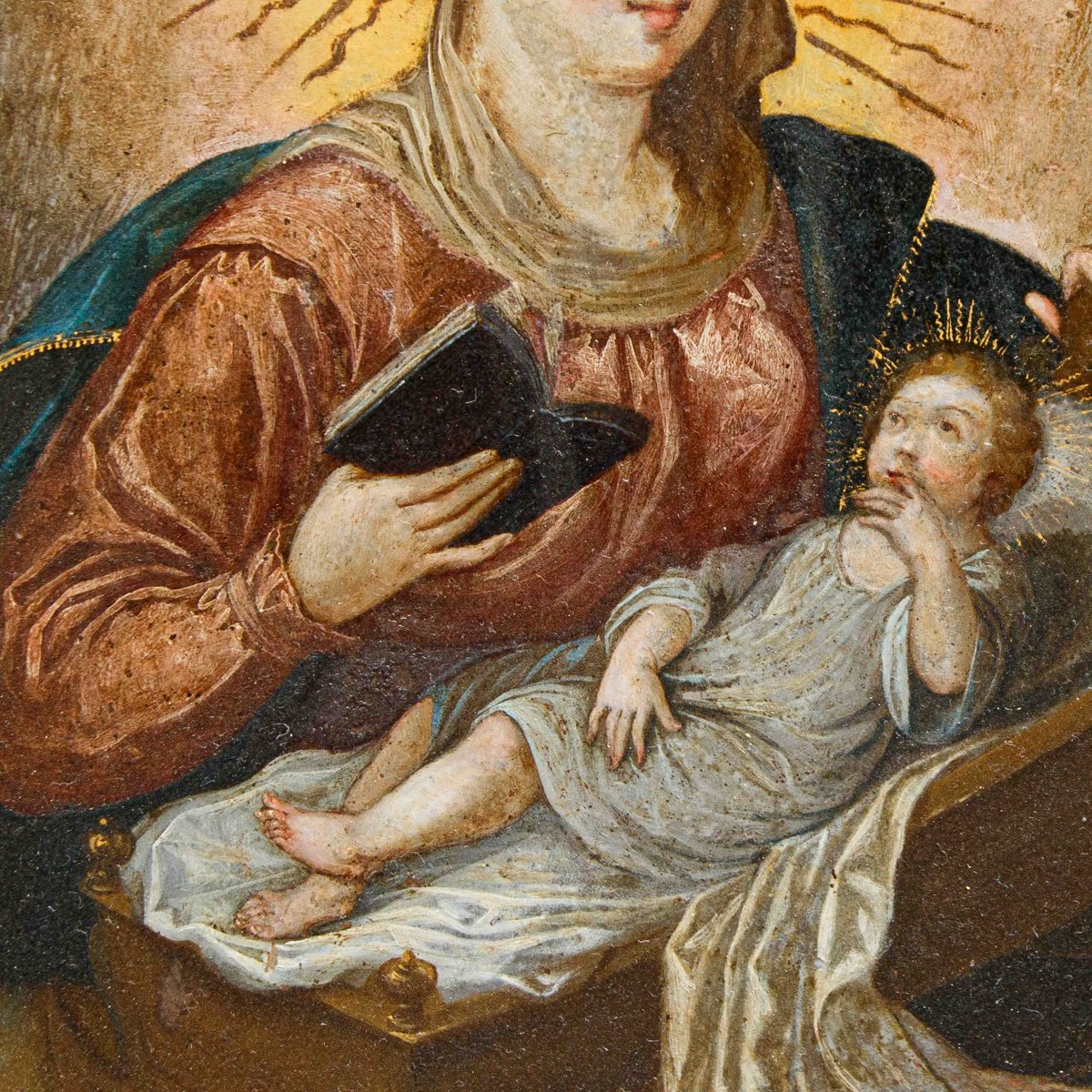
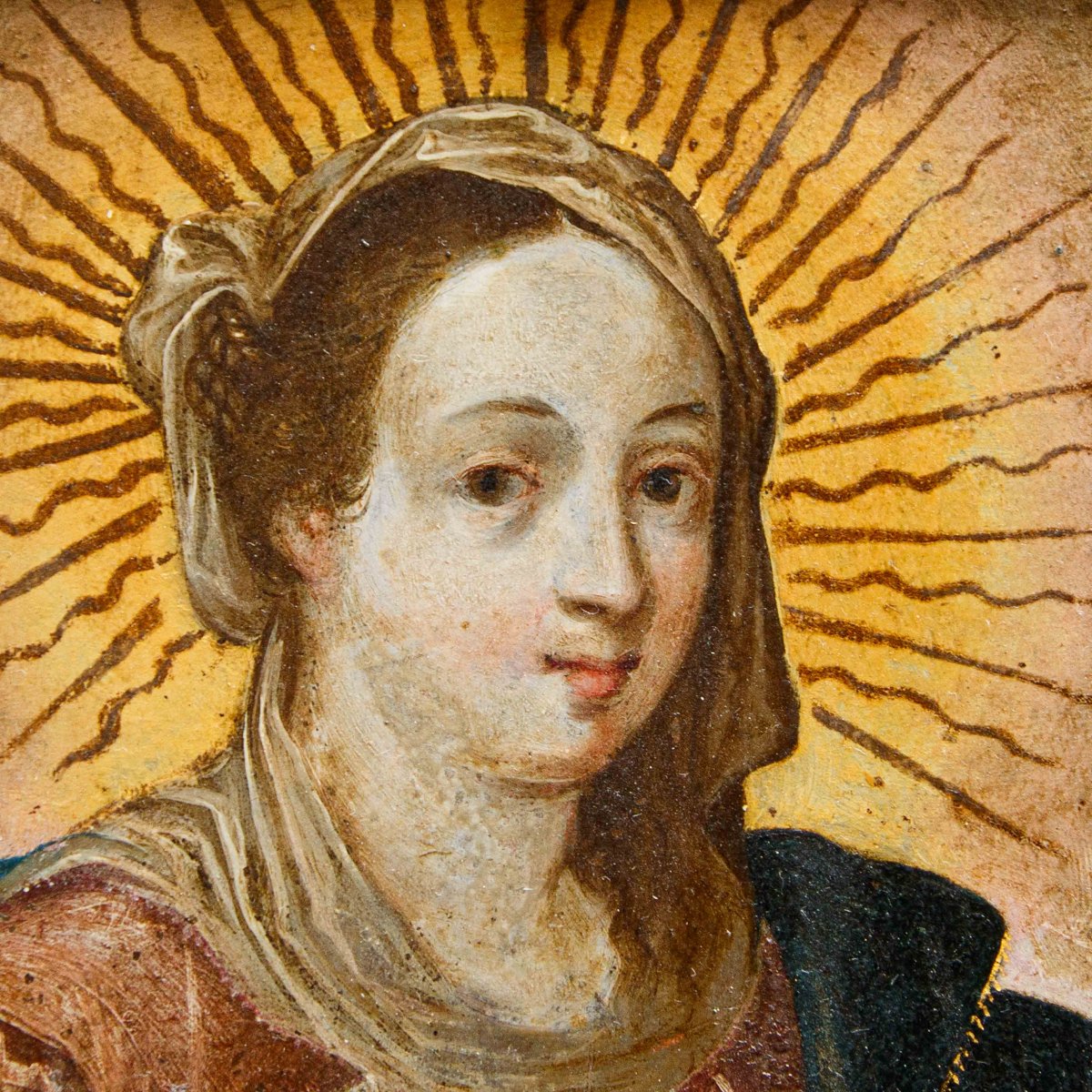
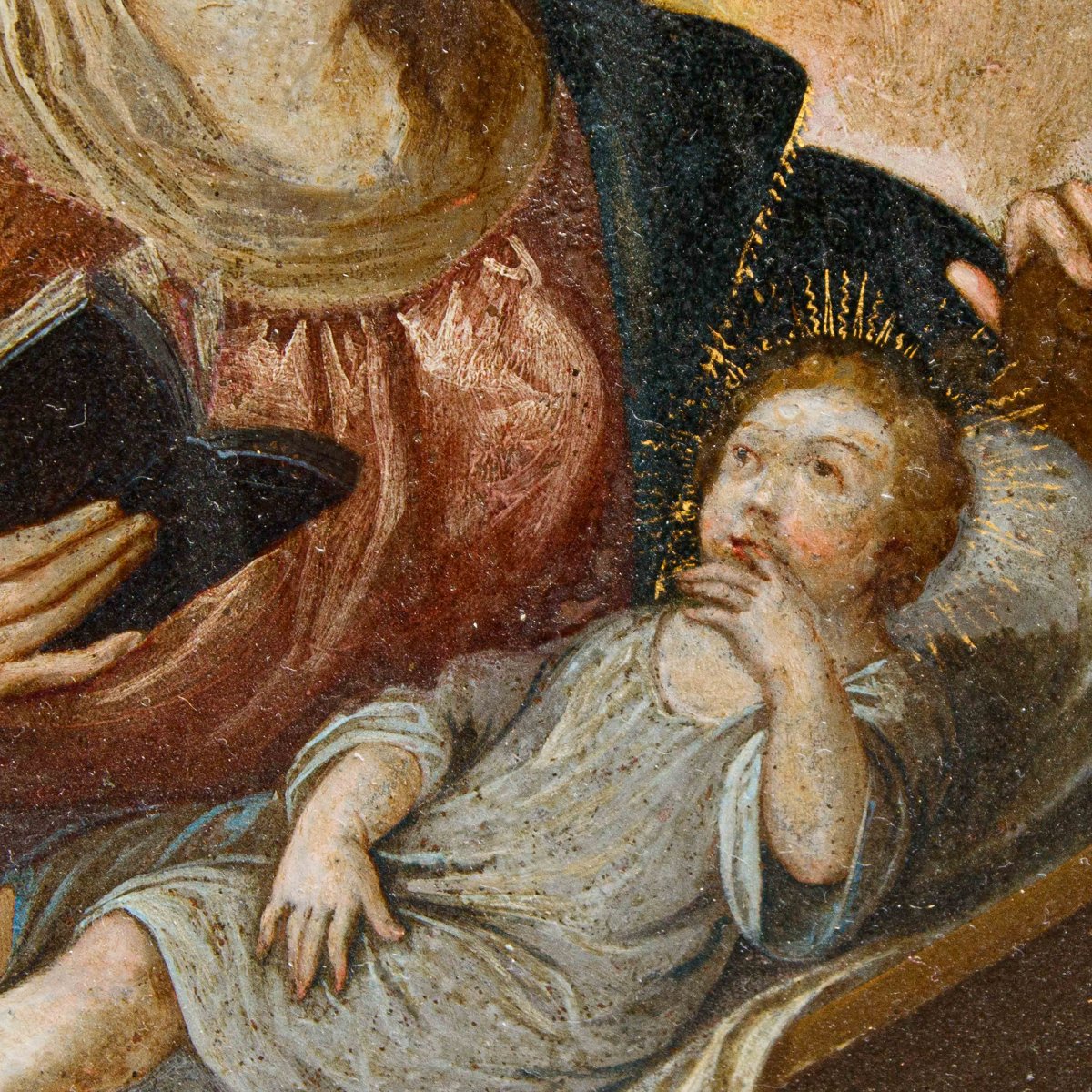
In this small oil on copper, the richly dressed Virgin, holding the Book of the Holy Scriptures in her hands, watches over the docile Child, who is asleep and lying in an elaborate wooden cradle.
The practice of painting on copper became established, in tandem with the Mannerist style, at the dawn of the 16th century. During the same years that saw the spread of engraving for the production of prints and the refinement of the technique of painted enamels, many painters began to paint landscapes, still lifes, religious and mythological subjects, battle scenes, and genre scenes on copper. Copper is a more precious medium than ordinary canvases and panels and aligns with the pursuit of preciousness characteristic of the Mannerist style. This technique was cultivated by great artists such as Domenichino, Guercino, Guido Reni, Caravaggio, Sebastiano del Piombo, and Bronzino, as well as by numerous Flemish painters, both well-known and lesser-known. The invention of rolled copper made it possible to produce, quickly and without smelting, very smooth surfaces through specifically developed techniques that sometimes involved coating the metal with additional alloys. We do not know who first introduced the technique of painting on copper to Europe; what is clear is that, from the mid-16th century onward, this support was widely used in Italy, Germany, and the Netherlands as a new and valuable medium for small, refined paintings. Guido Reni, for example, who learned the technique of painting on copper from the Flemish artist Denys Calvaert, would cover the copper panel with thin sheets of silver, gold, or a metal resembling tin, in order to achieve an effect of extreme luminosity. Oil painting on copper-plated sheet metal, vivid and brilliant, proved ideal for depicting both sacred and secular subjects. From the second half of the 17th century onward, the technique began to decline due to problems related to metal corrosion, the perishable nature of the works, and the difficulty of creating large-scale pieces.
The iconography of the Virgin with the Book of Holy Scripture was already widespread in the Florentine area as early as the late 15th century, as demonstrated by Sandro Botticelli’s *Madonna and Child Reading* in the Poldi Pezzoli Museum and Giorgione’s *Madonna Reading* in the Ashmolean Museum in Oxford. Starting in the 16th century, this motif also spread to Spain, as evidenced by the painting by the Master of Santa Inés at the Galdiano Museum in Madrid.
The depiction of the Infant Jesus in a cradle, on the other hand, is more characteristic of Northern Europe: this depiction, which is entirely uncommon in Italian art, can be found in some 17th-century Flemish paintings; a famous example is Rembrandt’s *Holy Family with Angels*, now in the Hermitage in St. Petersburg.
The Virgin’s radiating halo is linked to Spanish models from the late 16th century.
Period: 17th century
Style: Other Style
Condition: Good condition
Material: Oil painting on copper
Width: 23
Height: 15
Reference (ID): 1831008
Availability: In stock