





Umbrian Sculptor From The Mid-13th Century, Madonna Sedes
Umbrian sculptor from the mid-13th century
Madonna Sedes
Painted wood, cm 118 x 30 x 34
Origin: Pietro Accorsi Gallery, Turin
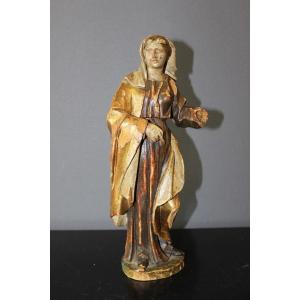
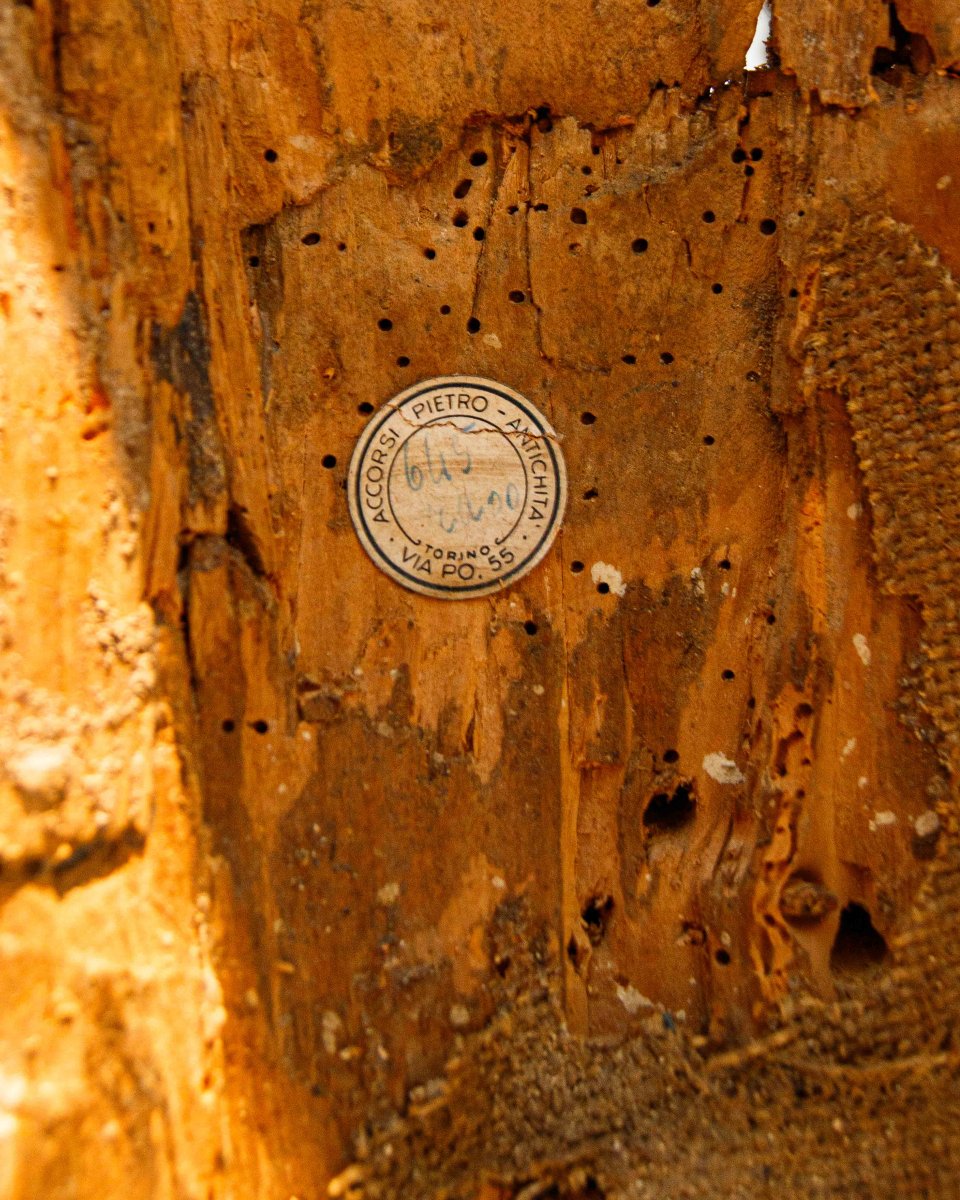
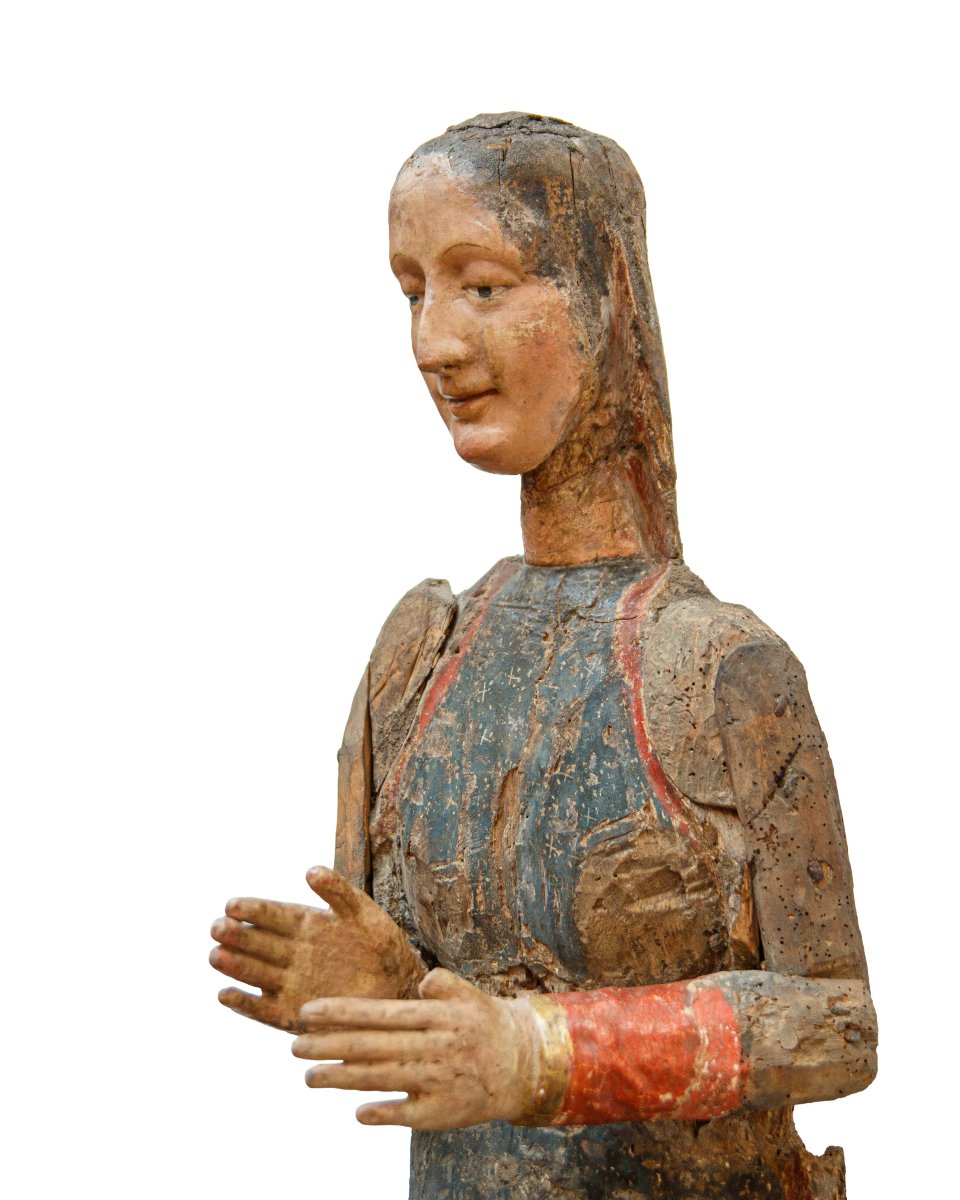
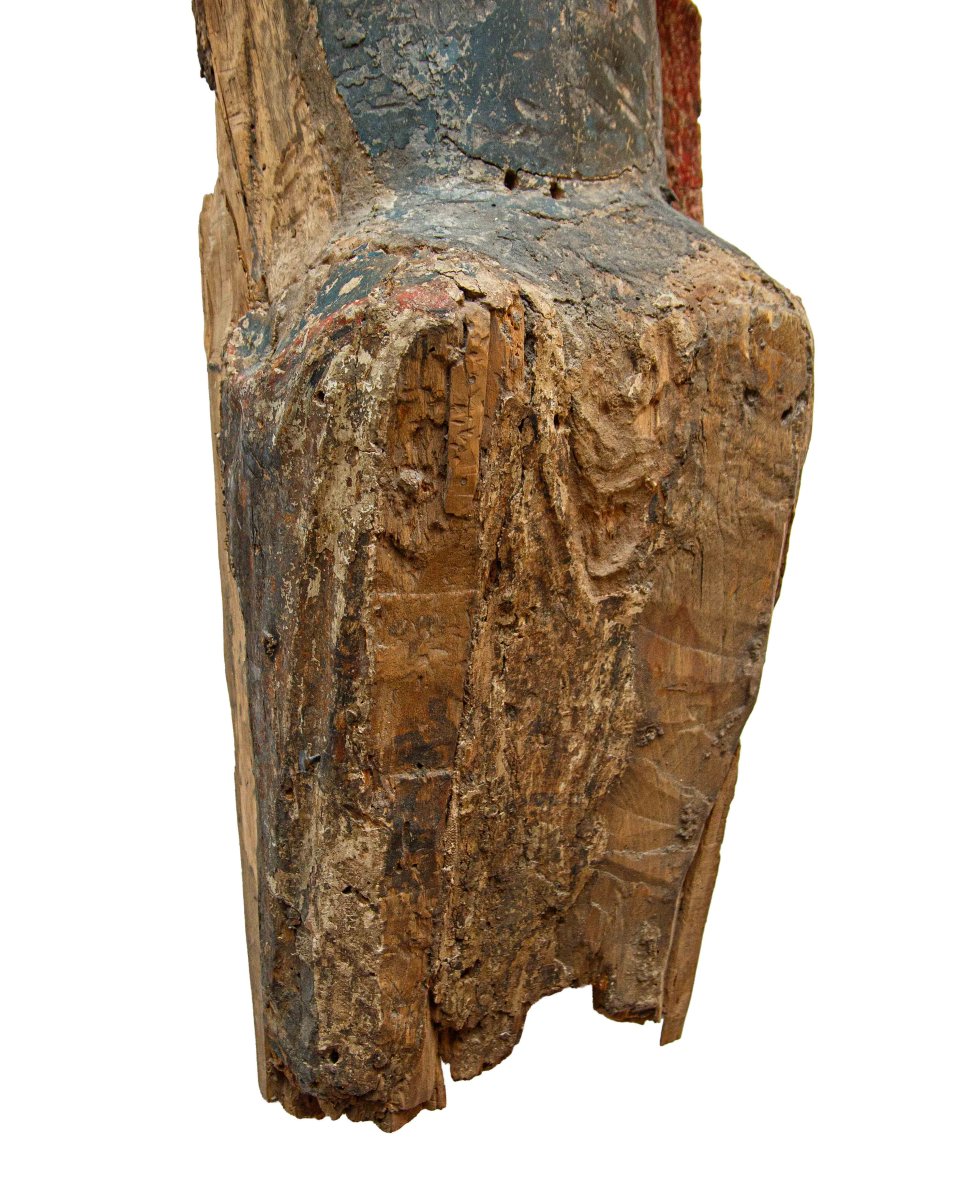
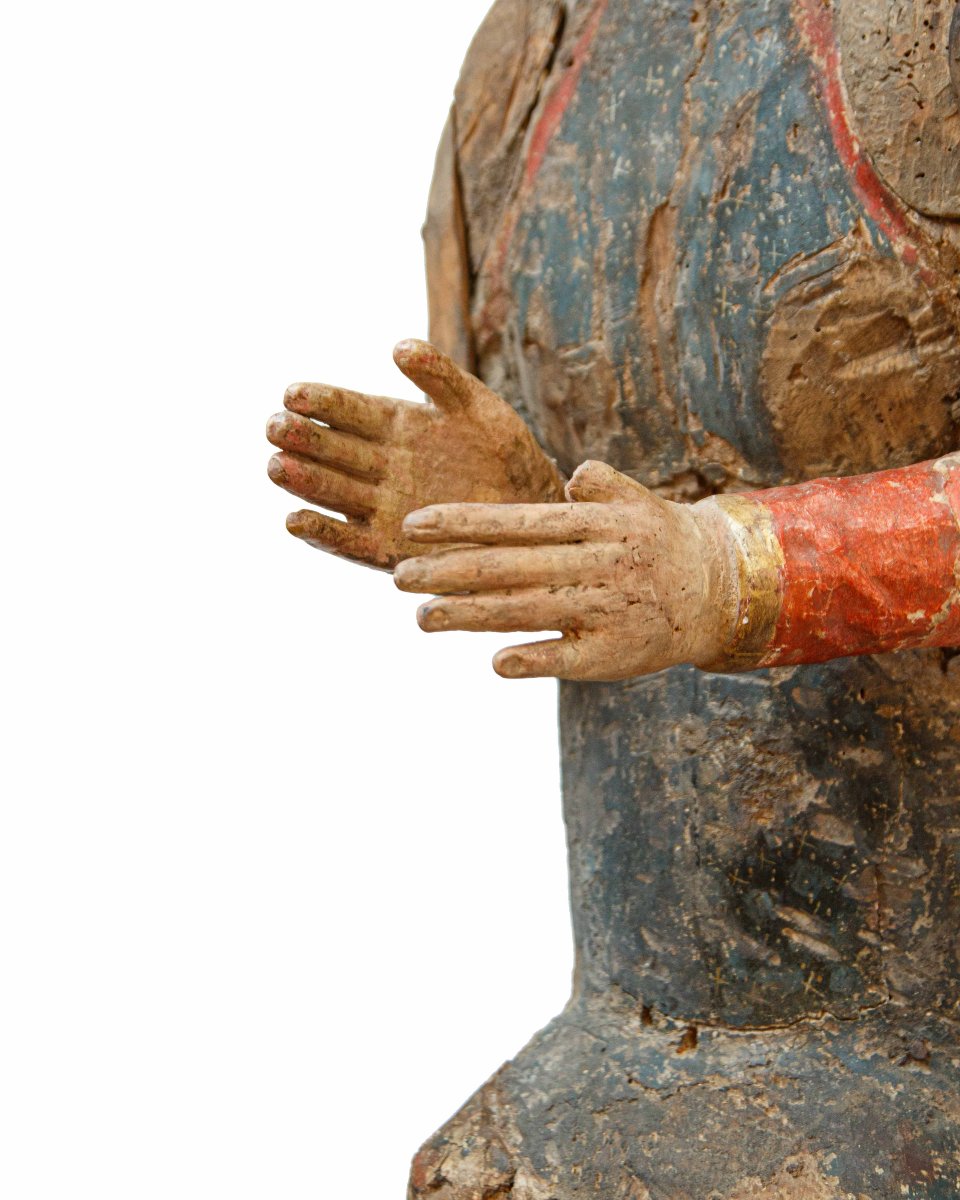
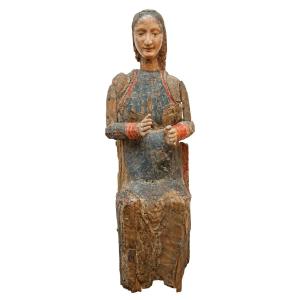
The wooden sculpture depicting the Madonna considered here constitutes a significant testimony to Umbrian plastic production in the mid-13th century, a field in which painted wooden sculpture had a wide and lasting diffusion, especially in rural devotional and monastic contexts. The work, today devoid of some fundamental elements, nevertheless retains a strong formal and iconographic legibility, which allows for a convincing historical-artistic framework. The Virgin is depicted according to the Sedes Sapientiae type: seated frontally, with her torso erect and her hands originally set to welcome the Child on her knees. The latter, now lost, must have been fixed with wooden or metal pins, as clearly attested by the holes still visible at the height of the Madonna's basin. The Virgin's face, oval and elongated, has softened features, with slightly lowered almond-shaped eyes and a barely perceptible hint of smile, far from both the more archaic Romanesque rigidity and the Gothic openings. This formal balance suggests a dating during the 13th century. The rendering of the wooden surfaces, still legible despite the gaps, shows a sober but careful workmanship, while the residual polychromy - with the cloak in dark shades and the sleeves decorated with red bands - confirms the original importance of the pictorial apparatus in strengthening the symbolic and liturgical value of the image. From a stylistic and typological point of view, the work lends itself to specific comparisons with other wooden Madonnas from central Italy. In particular, the comparisons with the Madonna of Cancanelle, now in the National Museum of Abruzzo, with the Madonna of Vallinfante in the Diocesan Museum of Camerino and with the Madonna and Child in the collegiate church of Orticoli are illuminating. In all these sculptures we find a similar frontal approach, a monumental conception of the Marian figure and a still hierarchical, rather than affective, relationship between Mother and Son. These affinities confirm the work's belonging to a figurative language shared between Umbria and surrounding areas, characterized by a diffusion of common models reinterpreted by local masters. Of particular historical and collecting importance is the presence, on the back of the sculpture, of a label from the Pietro Accorsi Antichità gallery in Turin. Pietro Accorsi was one of the most important Italian antiquarians of the first half of the twentieth century, known not only for his critical acumen but also for the famous Trivulzio Case, which led to the sale of part of the Milanese collection of Prince Luigi Alberico Trivulzio di Belgioioso and the entry into Turin's public collections of masterpieces such as Antonello da Messina's Portrait of a Man and a precious 15th-century illuminated Book of Hours with some illustrations attributed to Jan van Eyck. The presence of the mark therefore certifies the quality of the work and attests that it must have aroused the interest of a very high-level expert, who most likely marketed it during the last century.
Madonna Sedes
Painted wood, cm 118 x 30 x 34
Origin: Pietro Accorsi Gallery, Turin
The wooden sculpture depicting the Madonna considered here constitutes a significant testimony to Umbrian plastic production in the mid-13th century, a field in which painted wooden sculpture had a wide and lasting diffusion, especially in rural devotional and monastic contexts. The work, today devoid of some fundamental elements, nevertheless retains a strong formal and iconographic legibility, which allows for a convincing historical-artistic framework. The Virgin is depicted according to the Sedes Sapientiae type: seated frontally, with her torso erect and her hands originally set to welcome the Child on her knees. The latter, now lost, must have been fixed with wooden or metal pins, as clearly attested by the holes still visible at the height of the Madonna's basin. The Virgin's face, oval and elongated, has softened features, with slightly lowered almond-shaped eyes and a barely perceptible hint of smile, far from both the more archaic Romanesque rigidity and the Gothic openings. This formal balance suggests a dating during the 13th century. The rendering of the wooden surfaces, still legible despite the gaps, shows a sober but careful workmanship, while the residual polychromy - with the cloak in dark shades and the sleeves decorated with red bands - confirms the original importance of the pictorial apparatus in strengthening the symbolic and liturgical value of the image. From a stylistic and typological point of view, the work lends itself to specific comparisons with other wooden Madonnas from central Italy. In particular, the comparisons with the Madonna of Cancanelle, now in the National Museum of Abruzzo, with the Madonna of Vallinfante in the Diocesan Museum of Camerino and with the Madonna and Child in the collegiate church of Orticoli are illuminating. In all these sculptures we find a similar frontal approach, a monumental conception of the Marian figure and a still hierarchical, rather than affective, relationship between Mother and Son. These affinities confirm the work's belonging to a figurative language shared between Umbria and surrounding areas, characterized by a diffusion of common models reinterpreted by local masters. Of particular historical and collecting importance is the presence, on the back of the sculpture, of a label from the Pietro Accorsi Antichità gallery in Turin. Pietro Accorsi was one of the most important Italian antiquarians of the first half of the twentieth century, known not only for his critical acumen but also for the famous Trivulzio Case, which led to the sale of part of the Milanese collection of Prince Luigi Alberico Trivulzio di Belgioioso and the entry into Turin's public collections of masterpieces such as Antonello da Messina's Portrait of a Man and a precious 15th-century illuminated Book of Hours with some illustrations attributed to Jan van Eyck. The presence of the mark therefore certifies the quality of the work and attests that it must have aroused the interest of a very high-level expert, who most likely marketed it during the last century.
14 000 €
Period: Before 16th century
Style: Other Style
Condition: Good condition
Material: Painted wood
Width: 30
Height: 118
Depth: 34
Reference (ID): 1706265
Availability: In stock
Print