

Portrait Of Elizabeth Rooper, Lady Dryden In A Blue Wrap, Exceptional Carved Frame C.1725-30
Artist: Entourage De Charles Jervas (vers 1675-1739)
Portrait of Elizabeth Rooper, later Lady Dryden in a Vivid Blue Mantle, Exceptional Carved Frame c.1725-30
Circle of Charles Jervas (c.1675-1739)
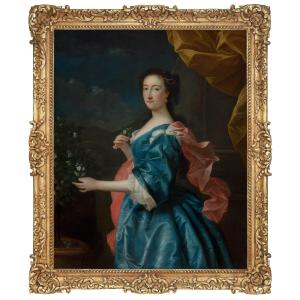
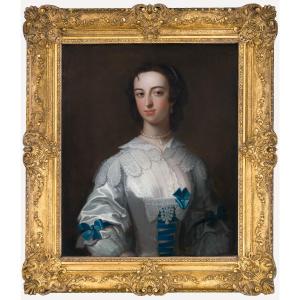
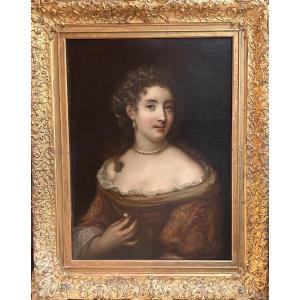
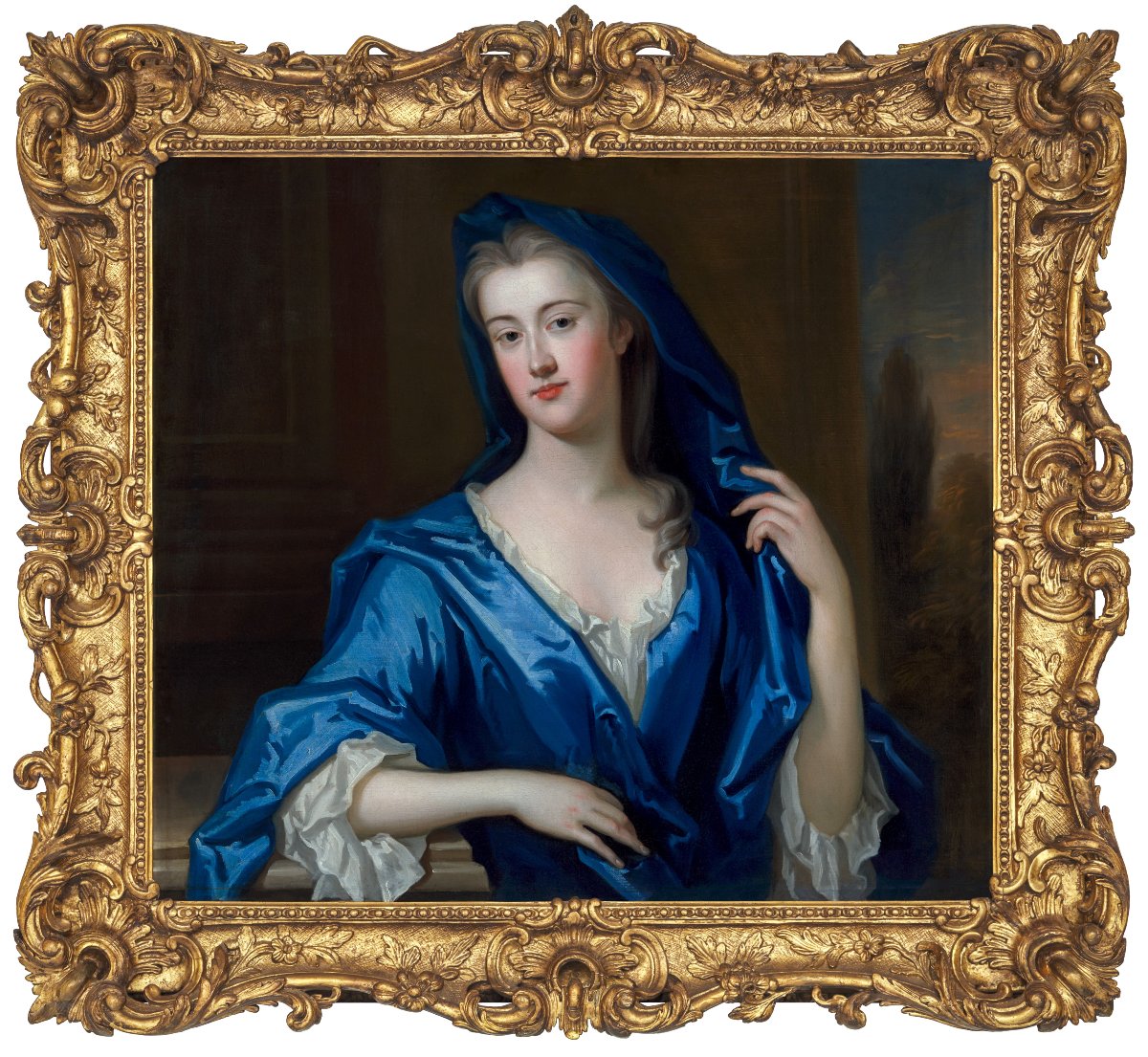
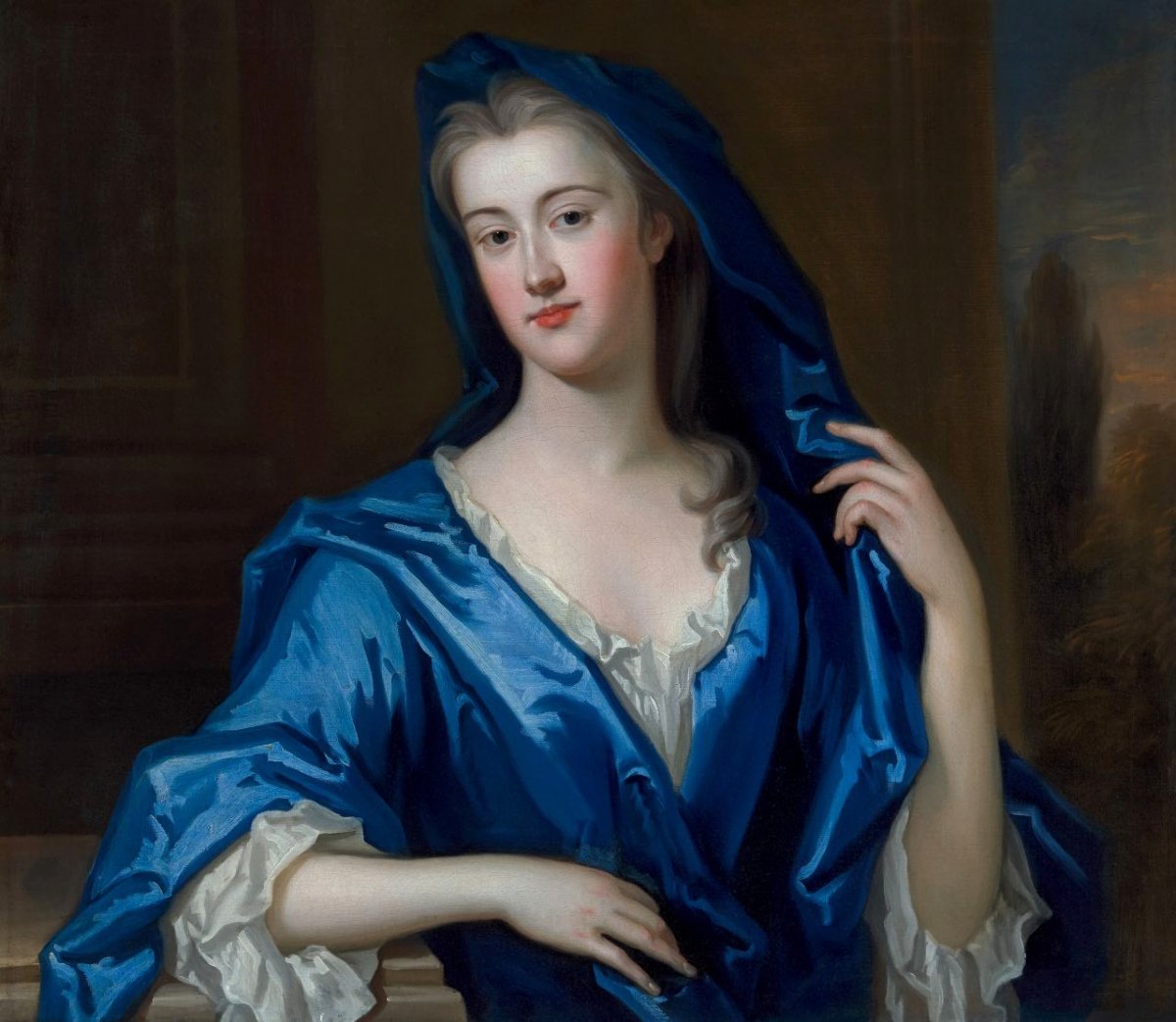
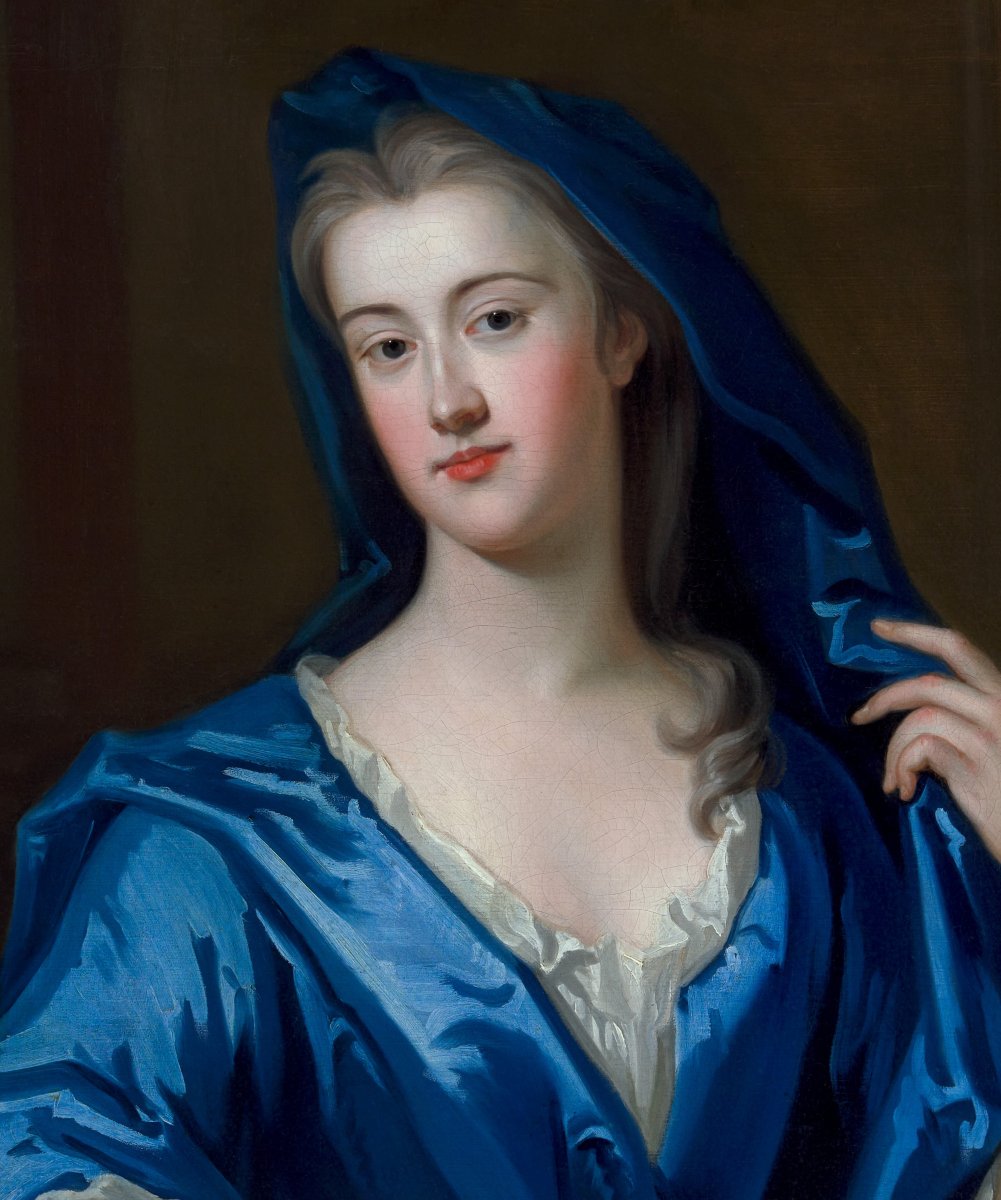
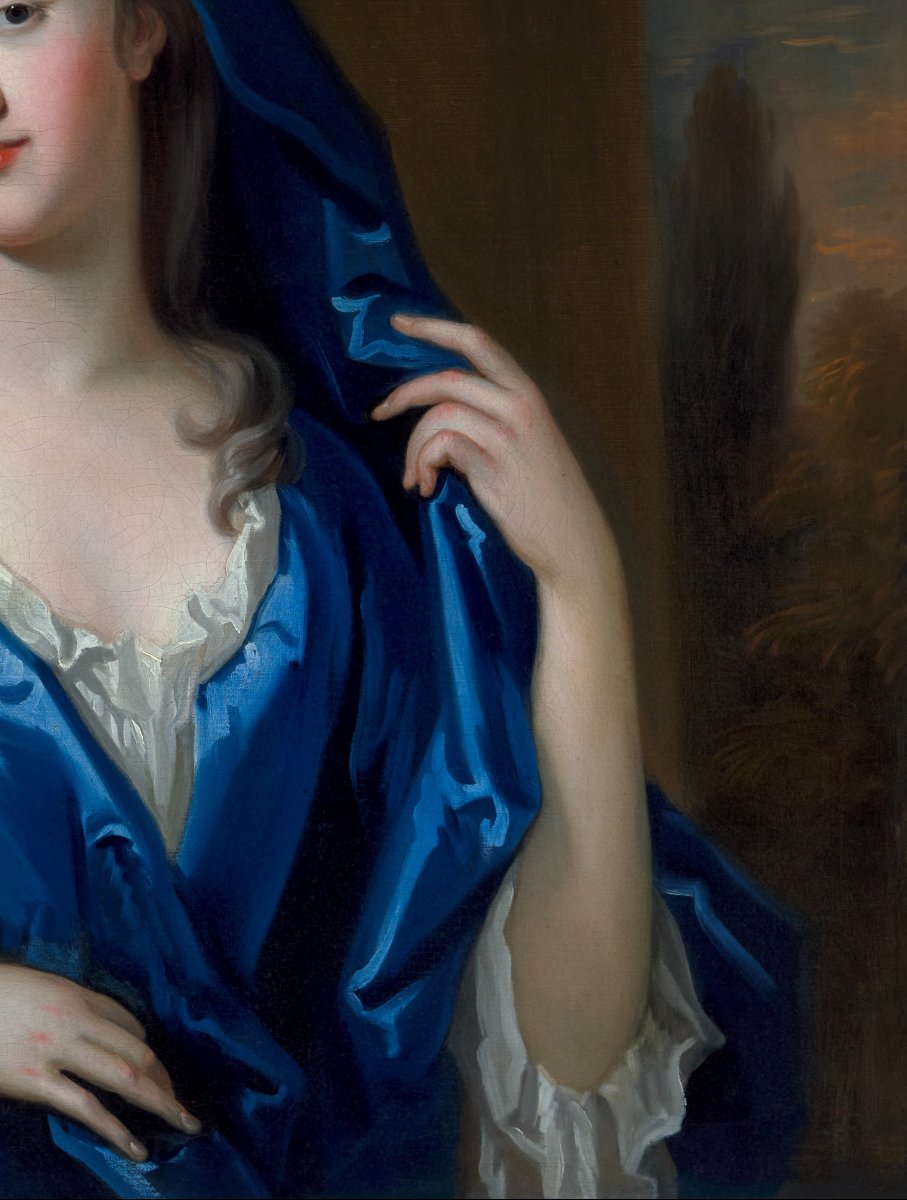
Few English portraits of the early Georgian period possess this combination of visual drama, elegance and historical character. A young woman emerges from a shadowed interior wrapped in an extraordinary mantle of brilliant blue, one hand raised to gather the fabric beside her face while an opening beyond reveals a distant landscape. Preserved in excellent condition and housed in a magnificent eighteenth-century carved and gilded frame, the portrait has the presence of a far grander-scale picture while retaining an unusual intimacy.
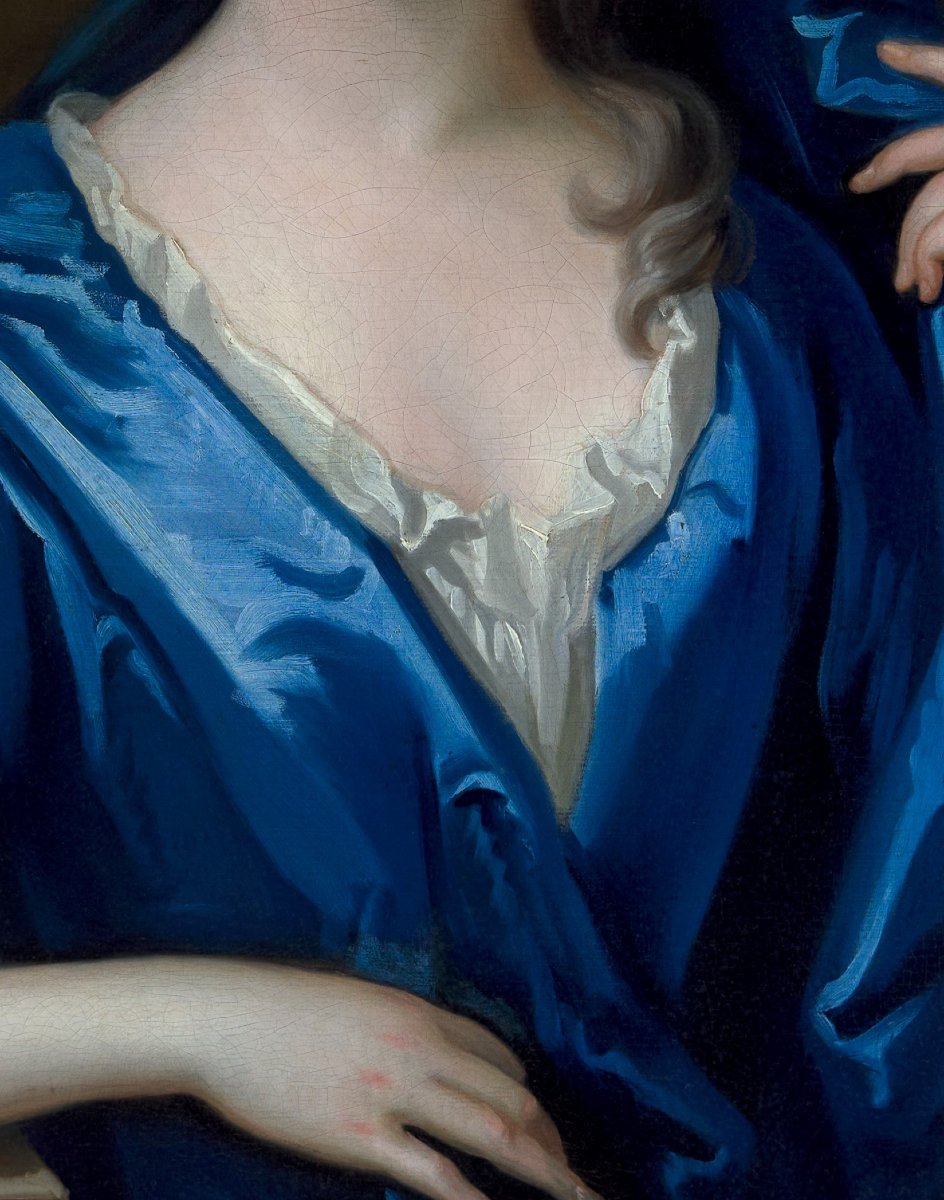
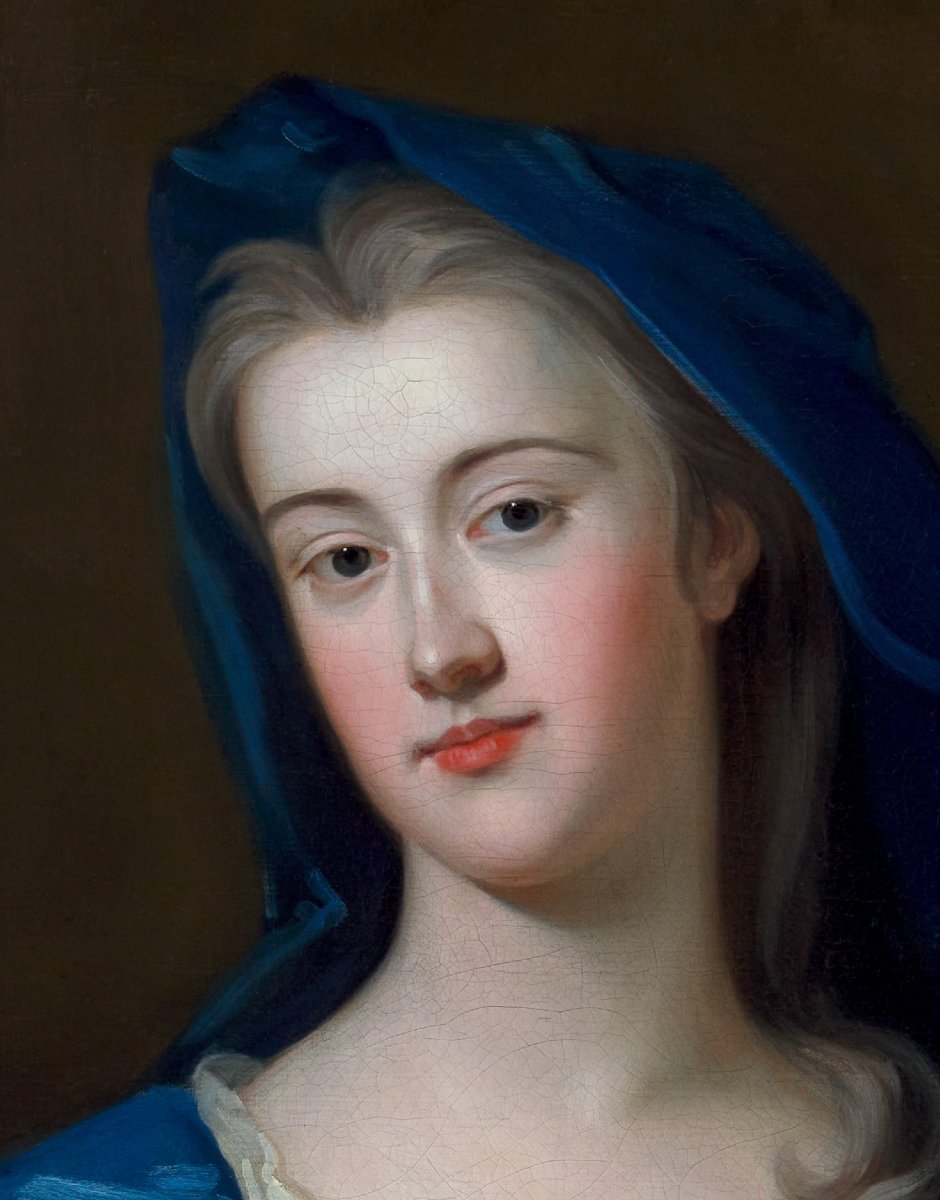
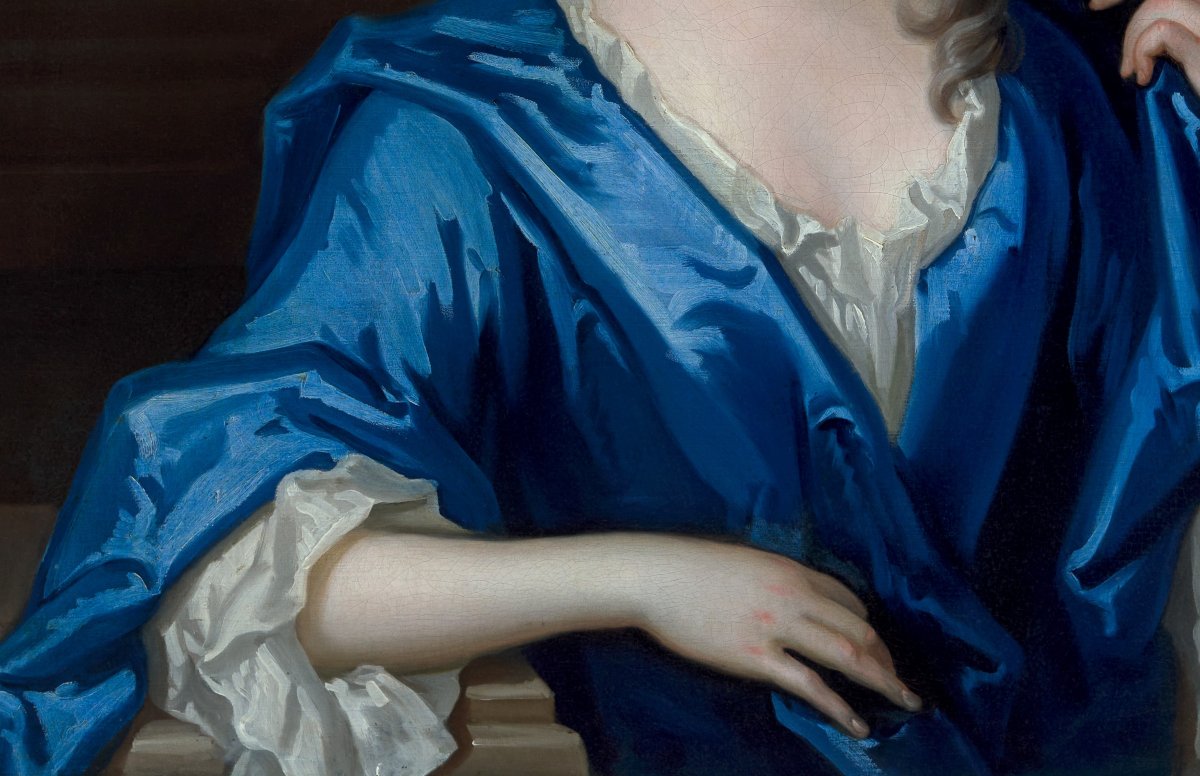
The effect depends upon colour and gesture. Against the deep brown background, the blue mantle forms a sweeping arc around the sitter, framing the pale oval of her face before cascading across her body in broad folds. Crisp white linen appears at her décolletage and sleeves; warm flesh tones animate the face and hands. Most memorable is the raised hand, apparently caught in the act of drawing the mantle around her head. It introduces a sense of movement rarely encountered in the more static conventions of early eighteenth-century portraiture.
The sitter is said to be Elizabeth Rooper (d.1791), Lady Dryden, whose marriage in 1726 brought her to Canons Ashby, the ancient Northamptonshire seat of the Dryden family. The identification is particularly compelling in its chronology: the costume and pictorial language independently suggest a date around 1725–30, precisely the years in which Elizabeth became Lady Dryden. Moreover, surviving records demonstrate that portraiture played a significant role within her family and that Elizabeth herself was painted on more than one occasion.
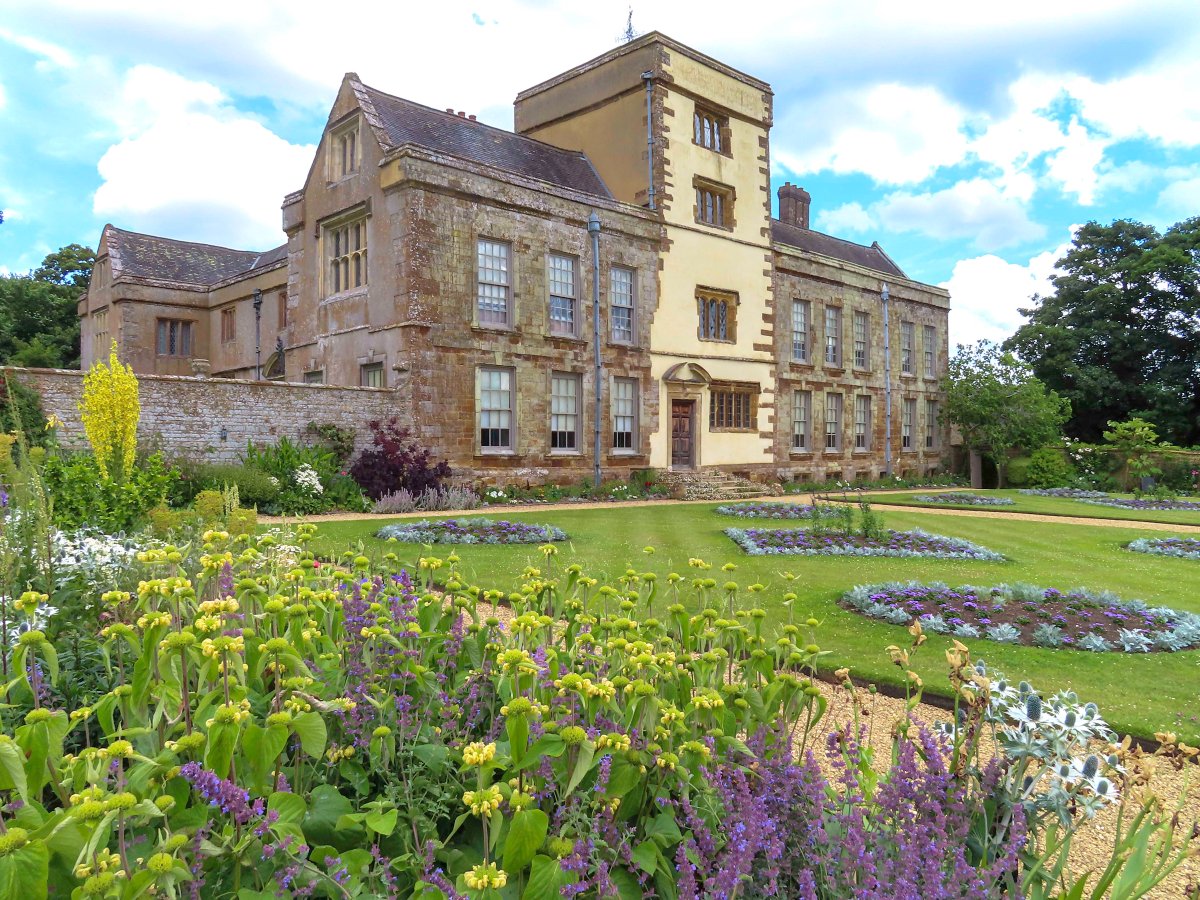
The young woman before us was entering a remarkable world. Canons Ashby was not simply a country house but the physical expression of several centuries of Dryden family history—a rambling Elizabethan mansion transformed for Georgian life, filled with family portraits, tapestries, carved panelling and inherited objects, and surrounded by formal gardens. Elizabeth would remain associated with this house for more than sixty years, living long enough to see the England of Queen Anne and George I transformed into the very different country of George III.
Elizabeth was born into a family already connected with courtly life. Her father, John Rooper, of Berkhamsted Castle and Bloomsbury, held the office of Deputy Cofferer in the household of Queen Anne. Her mother, Philippa Allen, belonged to the Allen family of Bibsworth, Finchley. Through the Allen family Elizabeth was already closely connected to the man she would marry: Philippa Allen and the mother of Sir John Dryden were sisters, making Elizabeth and Sir John first cousins. Such marriages were by no means exceptional among landed families, where kinship, property and established networks frequently intersected.
On 22 September 1726 Elizabeth married Sir John Dryden, 7th Baronet, becoming his second wife and Lady Dryden. Her arrival at Canons Ashby coincided with a particularly interesting moment in the family's fortunes. The Drydens had endured considerable financial difficulties, but by the 1720s the estate had recovered through careful management, investments and property transactions—assisted, remarkably, by a substantial lottery win. Sir John inherited the baronetcy and estate in 1718 and served as High Sheriff of Northamptonshire in 1727. The marriage of 1726 therefore occurred at a moment of renewed confidence and prosperity.
That circumstance offers a persuasive context for the present portrait. Marriage portraits were not merely records of appearance. They announced a woman's new social identity, preserved dynastic alliances and became part of the visual genealogy of the country house. A portrait of Elizabeth made around 1726 would commemorate her transformation from Miss Rooper into Lady Dryden and her arrival as mistress of Canons Ashby. The unusually relaxed costume need not contradict such a purpose. On the contrary, the flowing mantle and white chemise belong to the fashionable language of aristocratic portrait “undress”, in which apparently informal clothing suggested refinement and natural elegance rather than literal everyday dress.
There is particularly valuable evidence within the historic Canons Ashby collection. Inventories record a substantial group of family portraits including Sir John Dryden, Elizabeth's father Mr Rooper and two portraits of Lady Dryden. Two portraits identified as Elizabeth remain associated with Canons Ashby today, confirming that she sat for her portrait more than once. One is dated to around 1726—the very year of her marriage—while another is associated with Joseph Highmore. The existence of several images of Elizabeth is significant: it demonstrates that her portrait formed an established part of the family's visual history and leaves entirely credible the possibility that further versions or independent portraits were made for members of the interconnected Rooper and Dryden families.
Elizabeth's life at Canons Ashby appears to have been materially comfortable and culturally engaged. Research into the household inventories has revealed an environment rich in pictures and fashionable prints, alongside the accumulated furnishings and ancestral possessions of an old landed family. The portraits were not casual decoration: displayed together, they mapped relationships between generations and between the Dryden and Rooper families. Elizabeth's own father was represented among them, allowing the house to preserve the ancestry she had brought into the marriage as well as that of her husband.
The marriage produced no children. Instead, Sir John and Elizabeth adopted a niece, Elizabeth Dryden, who would eventually inherit Canons Ashby. Sir John died in 1770, bringing the first Dryden baronetcy to an end, but Lady Dryden survived him for more than two decades. She died on 7 May 1791, having spent the greater part of her adult life associated with Canons Ashby. Her lifetime therefore spanned an extraordinary period: from the last years of the Stuart world and the establishment of the Hanoverian dynasty through Walpole's England, the Seven Years' War, and into the reign of George III.
The portrait belongs to the beginning of that long story. Britain in the later 1720s was becoming wealthier and increasingly confident. George I died in 1727 and was succeeded by George II, while Sir Robert Walpole dominated political life. London supported a flourishing luxury economy in which painters, silversmiths, cabinetmakers, engravers and specialist craftsmen supplied an aristocracy increasingly conscious of fashion and display. Portraiture occupied a particularly important position in this market: for families such as the Drydens it combined personal commemoration with the assertion of lineage, property and social connection.
Stylistically the painting belongs within the orbit of Charles Jervas (c.1675–1739) and is appropriately described as Circle of Charles Jervas. Jervas had trained under Sir Godfrey Kneller before travelling to Paris and Rome, and on his return established himself among the leading portrait painters of early Georgian Britain. In 1723 he succeeded Kneller as Principal Painter to George I and retained the position under George II. His patrons included members of the highest political and aristocratic circles, while his friendships with Alexander Pope, Jonathan Swift and other writers placed him at the centre of the literary as well as the artistic culture of his age.
Jervas was particularly successful as a painter of women. His portraits softened the imposing formality inherited from Kneller, favouring graceful gestures, luminous flesh, rich passages of drapery and a cultivated air of fashionable ease. Contemporary commentators noticed his inventiveness in the treatment of women's costume. Those characteristics provide the relevant context for the present picture: the enveloping blue mantle, exposed white chemise, delicate hand gesture, softly modelled features and glimpse of landscape all belong naturally to the sophisticated portrait vocabulary surrounding Jervas during the 1720s. “Circle of Charles Jervas” nevertheless remains the careful attribution, acknowledging the close stylistic relationship without claiming the hand of Jervas himself in the absence of documentary or technical evidence sufficient to do so.
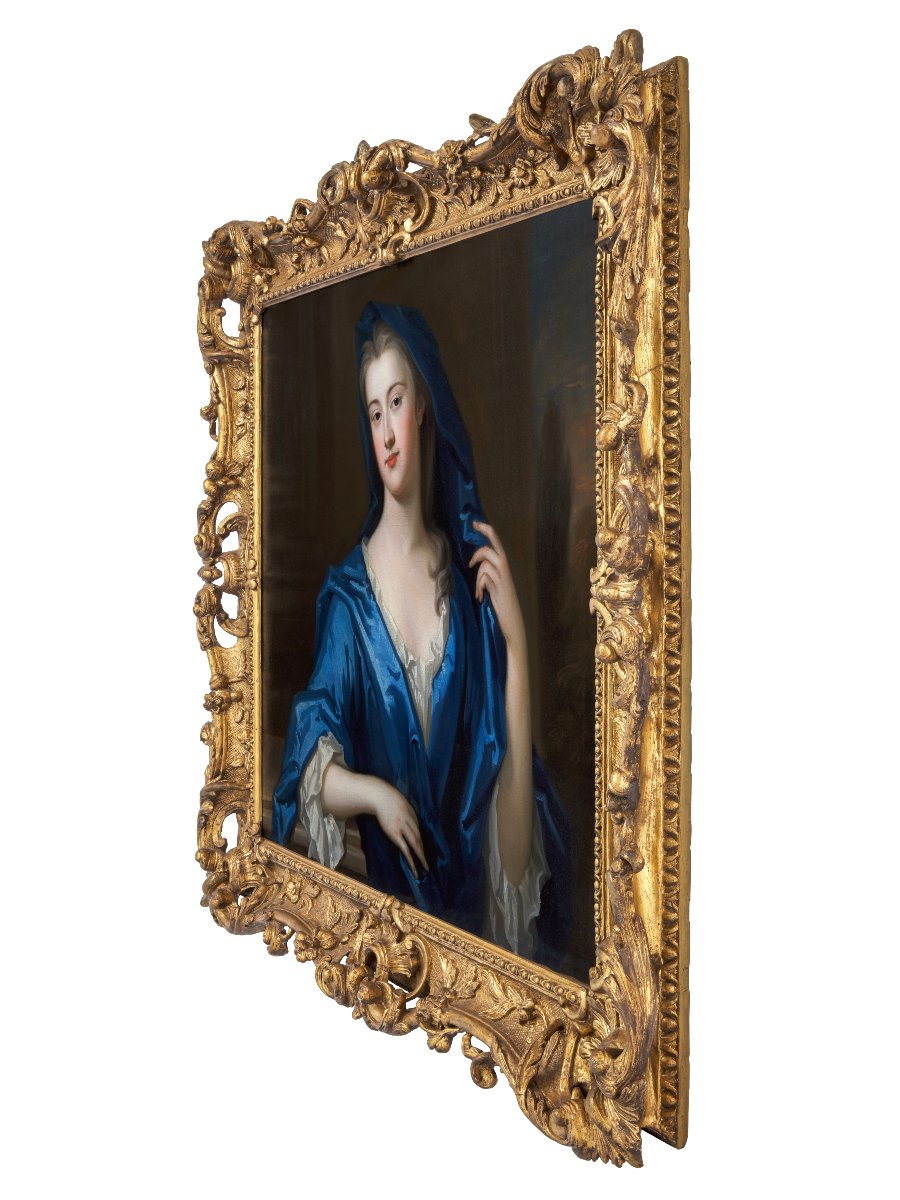
The frame considerably enhances the painting's effect. Richly carved and gilded, it is constructed around vigorous scrolling foliage, pierced ornament, shells and floral forms, with pronounced corner and centre decoration. Its sculptural silhouette turns the portrait into an architectural object in its own right, while the warmth of the gilding provides a particularly effective counterpoint to the intense blue of the sitter's mantle. Painting and frame together possess the decorative authority expected of a portrait intended for an important Georgian interior.
Ultimately, however, it is the possibility of recovering the sitter's identity that distinguishes this painting from the many anonymous portraits of the period. Rather than simply “Portrait of a Lady”, it can plausibly be connected with Elizabeth Rooper, Lady Dryden: daughter of a member of Queen Anne's household; wife and first cousin of Sir John Dryden; mistress for decades of one of Northamptonshire's most evocative country houses; participant in a family culture in which portraits were consciously collected and displayed; and a woman whose long life stretched from the world of the late Stuarts almost to the French Revolution.
With its unusually animated composition, spectacular blue drapery, excellent state of preservation, handsome scale and superb carved giltwood frame, the portrait is an exceptionally complete example of early Georgian portraiture. Its proposed association with Elizabeth Rooper gives those visual qualities a compelling human dimension: the image becomes not simply the likeness of an elegant young woman, but the possible record of a bride at the beginning of more than sixty years connected with Canons Ashby—a portrait in which beauty, family history and the culture of the Georgian country house meet.
Measurements: Height 98 cm, Width 105 cm framed (Height 38.5”, Width 41.25” framed)
Circle of Charles Jervas (c.1675-1739)
Few English portraits of the early Georgian period possess this combination of visual drama, elegance and historical character. A young woman emerges from a shadowed interior wrapped in an extraordinary mantle of brilliant blue, one hand raised to gather the fabric beside her face while an opening beyond reveals a distant landscape. Preserved in excellent condition and housed in a magnificent eighteenth-century carved and gilded frame, the portrait has the presence of a far grander-scale picture while retaining an unusual intimacy.
The effect depends upon colour and gesture. Against the deep brown background, the blue mantle forms a sweeping arc around the sitter, framing the pale oval of her face before cascading across her body in broad folds. Crisp white linen appears at her décolletage and sleeves; warm flesh tones animate the face and hands. Most memorable is the raised hand, apparently caught in the act of drawing the mantle around her head. It introduces a sense of movement rarely encountered in the more static conventions of early eighteenth-century portraiture.
The sitter is said to be Elizabeth Rooper (d.1791), Lady Dryden, whose marriage in 1726 brought her to Canons Ashby, the ancient Northamptonshire seat of the Dryden family. The identification is particularly compelling in its chronology: the costume and pictorial language independently suggest a date around 1725–30, precisely the years in which Elizabeth became Lady Dryden. Moreover, surviving records demonstrate that portraiture played a significant role within her family and that Elizabeth herself was painted on more than one occasion.
The young woman before us was entering a remarkable world. Canons Ashby was not simply a country house but the physical expression of several centuries of Dryden family history—a rambling Elizabethan mansion transformed for Georgian life, filled with family portraits, tapestries, carved panelling and inherited objects, and surrounded by formal gardens. Elizabeth would remain associated with this house for more than sixty years, living long enough to see the England of Queen Anne and George I transformed into the very different country of George III.
Elizabeth was born into a family already connected with courtly life. Her father, John Rooper, of Berkhamsted Castle and Bloomsbury, held the office of Deputy Cofferer in the household of Queen Anne. Her mother, Philippa Allen, belonged to the Allen family of Bibsworth, Finchley. Through the Allen family Elizabeth was already closely connected to the man she would marry: Philippa Allen and the mother of Sir John Dryden were sisters, making Elizabeth and Sir John first cousins. Such marriages were by no means exceptional among landed families, where kinship, property and established networks frequently intersected.
On 22 September 1726 Elizabeth married Sir John Dryden, 7th Baronet, becoming his second wife and Lady Dryden. Her arrival at Canons Ashby coincided with a particularly interesting moment in the family's fortunes. The Drydens had endured considerable financial difficulties, but by the 1720s the estate had recovered through careful management, investments and property transactions—assisted, remarkably, by a substantial lottery win. Sir John inherited the baronetcy and estate in 1718 and served as High Sheriff of Northamptonshire in 1727. The marriage of 1726 therefore occurred at a moment of renewed confidence and prosperity.
That circumstance offers a persuasive context for the present portrait. Marriage portraits were not merely records of appearance. They announced a woman's new social identity, preserved dynastic alliances and became part of the visual genealogy of the country house. A portrait of Elizabeth made around 1726 would commemorate her transformation from Miss Rooper into Lady Dryden and her arrival as mistress of Canons Ashby. The unusually relaxed costume need not contradict such a purpose. On the contrary, the flowing mantle and white chemise belong to the fashionable language of aristocratic portrait “undress”, in which apparently informal clothing suggested refinement and natural elegance rather than literal everyday dress.
There is particularly valuable evidence within the historic Canons Ashby collection. Inventories record a substantial group of family portraits including Sir John Dryden, Elizabeth's father Mr Rooper and two portraits of Lady Dryden. Two portraits identified as Elizabeth remain associated with Canons Ashby today, confirming that she sat for her portrait more than once. One is dated to around 1726—the very year of her marriage—while another is associated with Joseph Highmore. The existence of several images of Elizabeth is significant: it demonstrates that her portrait formed an established part of the family's visual history and leaves entirely credible the possibility that further versions or independent portraits were made for members of the interconnected Rooper and Dryden families.
Elizabeth's life at Canons Ashby appears to have been materially comfortable and culturally engaged. Research into the household inventories has revealed an environment rich in pictures and fashionable prints, alongside the accumulated furnishings and ancestral possessions of an old landed family. The portraits were not casual decoration: displayed together, they mapped relationships between generations and between the Dryden and Rooper families. Elizabeth's own father was represented among them, allowing the house to preserve the ancestry she had brought into the marriage as well as that of her husband.
The marriage produced no children. Instead, Sir John and Elizabeth adopted a niece, Elizabeth Dryden, who would eventually inherit Canons Ashby. Sir John died in 1770, bringing the first Dryden baronetcy to an end, but Lady Dryden survived him for more than two decades. She died on 7 May 1791, having spent the greater part of her adult life associated with Canons Ashby. Her lifetime therefore spanned an extraordinary period: from the last years of the Stuart world and the establishment of the Hanoverian dynasty through Walpole's England, the Seven Years' War, and into the reign of George III.
The portrait belongs to the beginning of that long story. Britain in the later 1720s was becoming wealthier and increasingly confident. George I died in 1727 and was succeeded by George II, while Sir Robert Walpole dominated political life. London supported a flourishing luxury economy in which painters, silversmiths, cabinetmakers, engravers and specialist craftsmen supplied an aristocracy increasingly conscious of fashion and display. Portraiture occupied a particularly important position in this market: for families such as the Drydens it combined personal commemoration with the assertion of lineage, property and social connection.
Stylistically the painting belongs within the orbit of Charles Jervas (c.1675–1739) and is appropriately described as Circle of Charles Jervas. Jervas had trained under Sir Godfrey Kneller before travelling to Paris and Rome, and on his return established himself among the leading portrait painters of early Georgian Britain. In 1723 he succeeded Kneller as Principal Painter to George I and retained the position under George II. His patrons included members of the highest political and aristocratic circles, while his friendships with Alexander Pope, Jonathan Swift and other writers placed him at the centre of the literary as well as the artistic culture of his age.
Jervas was particularly successful as a painter of women. His portraits softened the imposing formality inherited from Kneller, favouring graceful gestures, luminous flesh, rich passages of drapery and a cultivated air of fashionable ease. Contemporary commentators noticed his inventiveness in the treatment of women's costume. Those characteristics provide the relevant context for the present picture: the enveloping blue mantle, exposed white chemise, delicate hand gesture, softly modelled features and glimpse of landscape all belong naturally to the sophisticated portrait vocabulary surrounding Jervas during the 1720s. “Circle of Charles Jervas” nevertheless remains the careful attribution, acknowledging the close stylistic relationship without claiming the hand of Jervas himself in the absence of documentary or technical evidence sufficient to do so.
The frame considerably enhances the painting's effect. Richly carved and gilded, it is constructed around vigorous scrolling foliage, pierced ornament, shells and floral forms, with pronounced corner and centre decoration. Its sculptural silhouette turns the portrait into an architectural object in its own right, while the warmth of the gilding provides a particularly effective counterpoint to the intense blue of the sitter's mantle. Painting and frame together possess the decorative authority expected of a portrait intended for an important Georgian interior.
Ultimately, however, it is the possibility of recovering the sitter's identity that distinguishes this painting from the many anonymous portraits of the period. Rather than simply “Portrait of a Lady”, it can plausibly be connected with Elizabeth Rooper, Lady Dryden: daughter of a member of Queen Anne's household; wife and first cousin of Sir John Dryden; mistress for decades of one of Northamptonshire's most evocative country houses; participant in a family culture in which portraits were consciously collected and displayed; and a woman whose long life stretched from the world of the late Stuarts almost to the French Revolution.
With its unusually animated composition, spectacular blue drapery, excellent state of preservation, handsome scale and superb carved giltwood frame, the portrait is an exceptionally complete example of early Georgian portraiture. Its proposed association with Elizabeth Rooper gives those visual qualities a compelling human dimension: the image becomes not simply the likeness of an elegant young woman, but the possible record of a bride at the beginning of more than sixty years connected with Canons Ashby—a portrait in which beauty, family history and the culture of the Georgian country house meet.
Measurements: Height 98 cm, Width 105 cm framed (Height 38.5”, Width 41.25” framed)
9 450 €
Period: 18th century
Style: Louis 15th - Transition
Condition: Excellent condition
Material: Oil painting
Width: 105
Height: 98
Depth: 10
Reference (ID): 1830782
Availability: In stock
Print