





17th-century Italian Stiletto Dagger
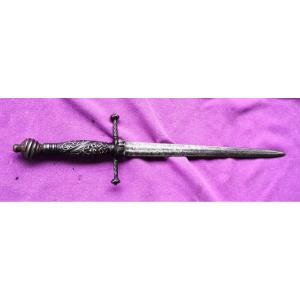
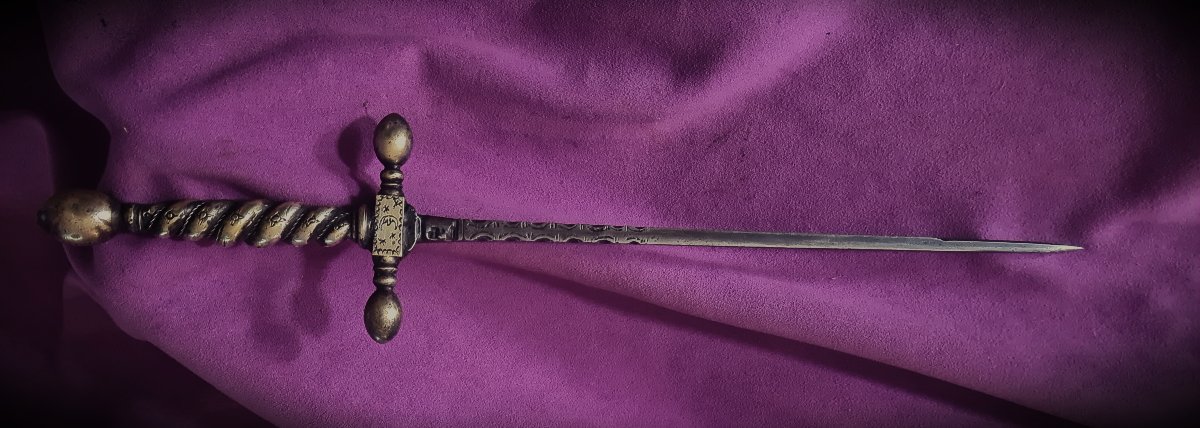
This stiletto is probably Italian, although a Spanish origin is also possible. It can be dated to the 17th century
Stilettos first appeared in southern Spain in the early 16th century. They quickly became popular, first in Italy, and then spread through out Europe. Antonio Manciolino, in his *Opera Nova*—a treatise on fencing from the Bologna school, published in 1531—already discusses stiletto fencing. These weapons were designed to inflict deep wounds that were difficult to treat, and to be able to pass through the rings of chain mail.
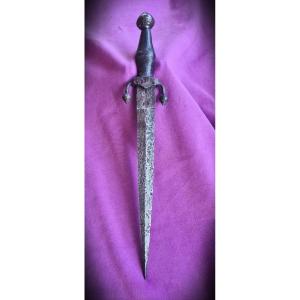
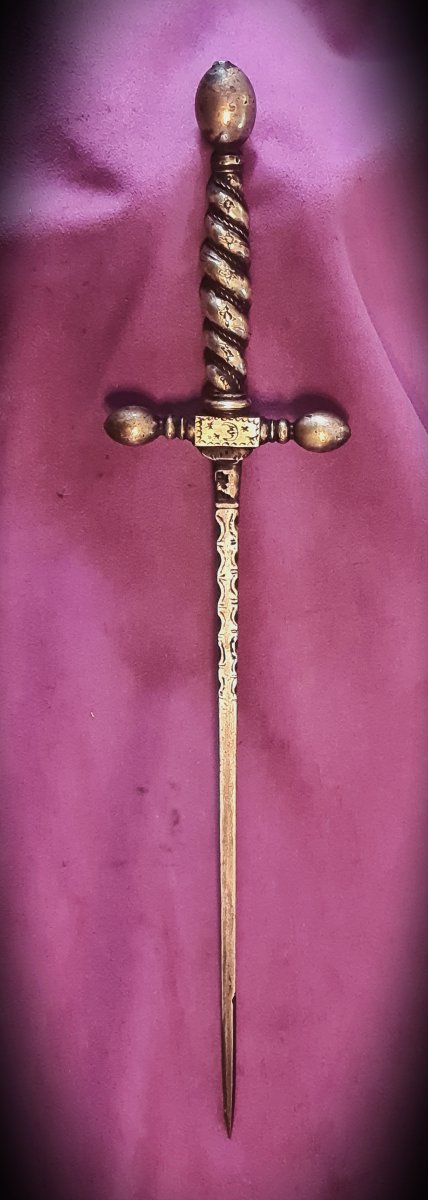
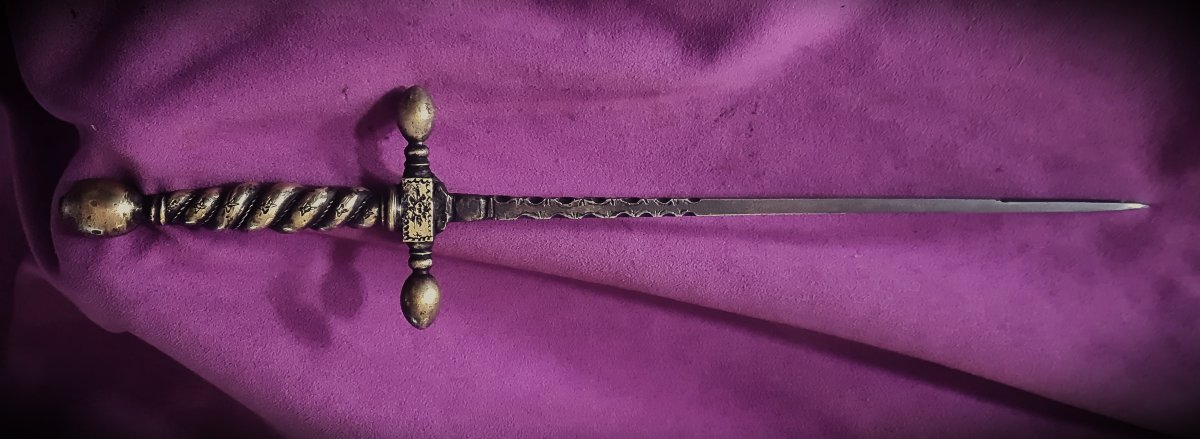
Its particularly sharp blade, with two “false edges” at the tip, is perfectly suited to this purpose of passing through the rings o fchain mail. The overall style of the mount, more finely decorated than that of “basic” stilettos, seems to indicate that this weapon belonged to a person of high standing.
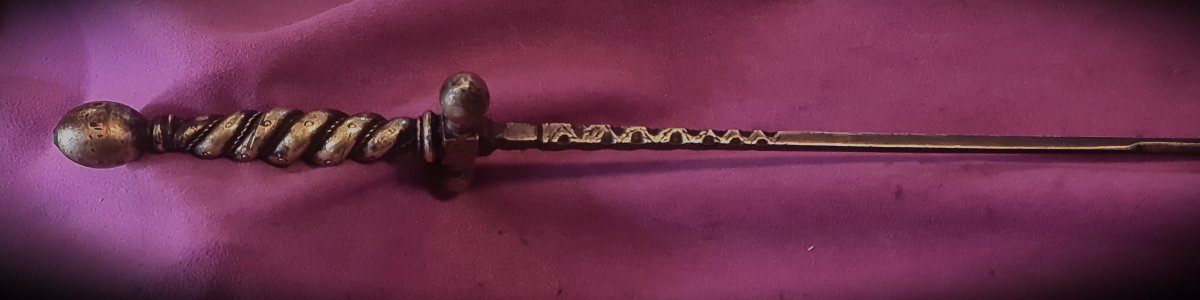
Unlike19th-century examples, the hilt here is clearly composed of three separate elements—guard, grip, and pommel—and the blade tang passes completely through this hilt, ending riveted to the pommel.
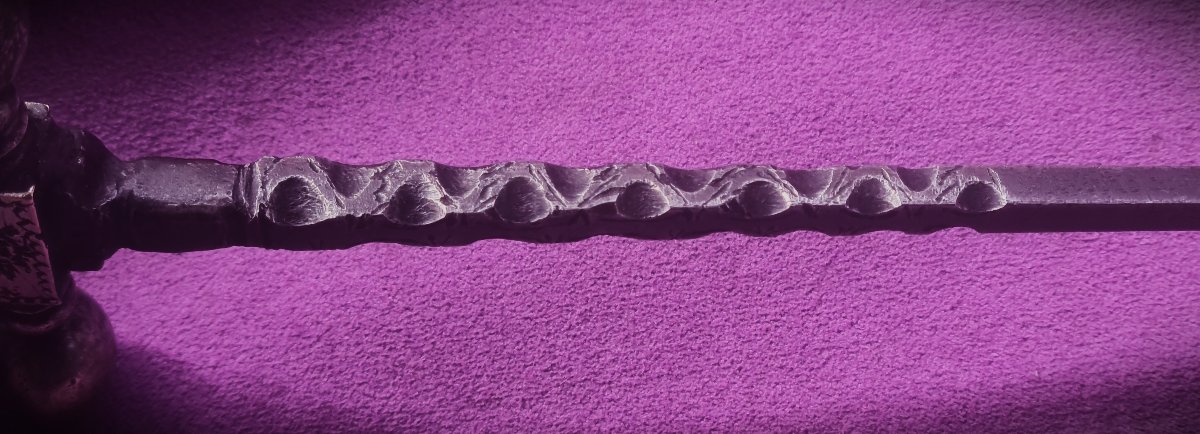
BLADE: Curiously, it begins with a trapezoidal shoulder resting on the guard. This feature is intended to reinforce the blade-to-handle joint. Next, a small rectangular baluster bearing a maker’s mark forms the junction with the rest of the blade, which has a rectangular cross-section and is decorated with Spanish-style intaglio guilloché on the first third.
In the last 5 centimeters near the tip, two small additional facets known as “false edges” transform the cross-section into a 6-sided point. These additional facets were intended to facilitate penetration through chain mail. This feature is found on certain 16th-century Spanish stilettos.
Blade length = 24.2 cm, width near the heel9.3 mm, thickness near the shoulder= 7.2 mm
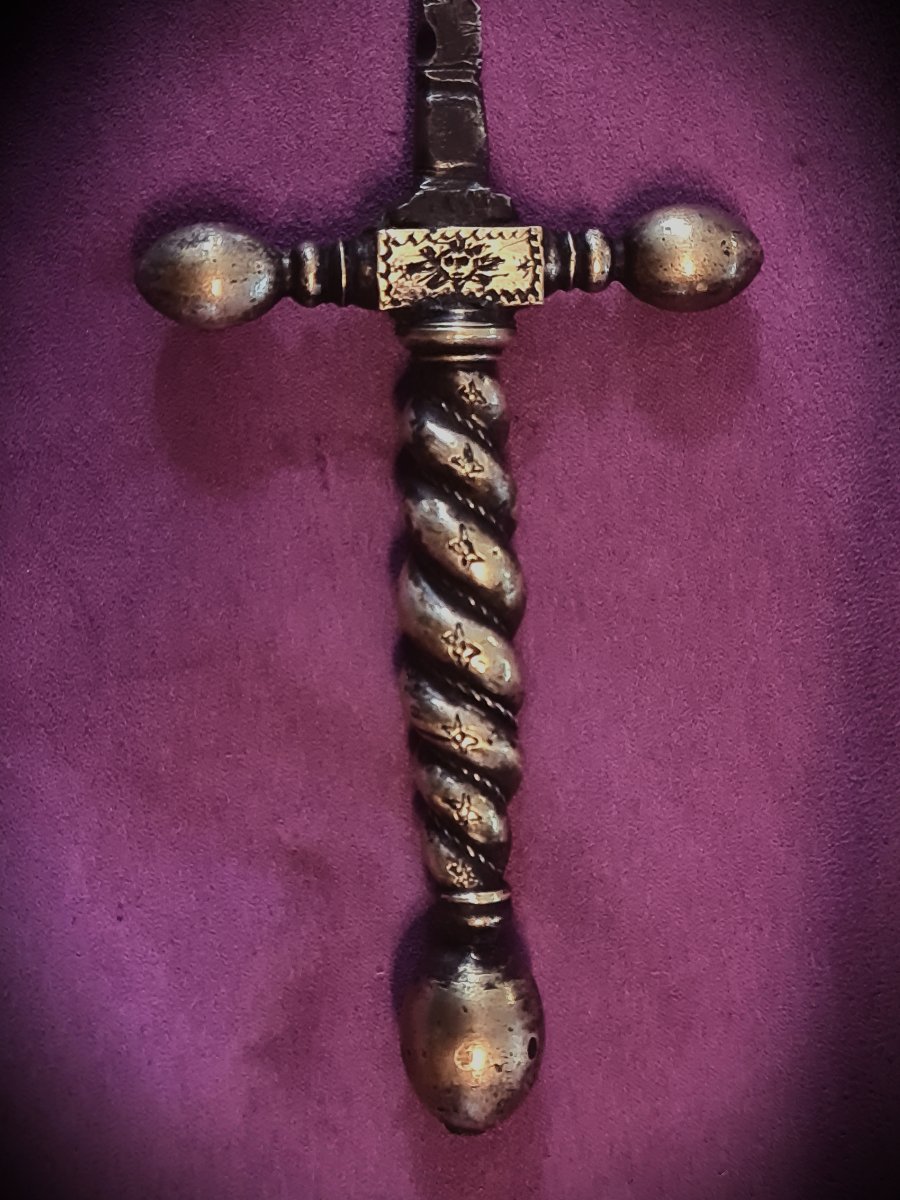
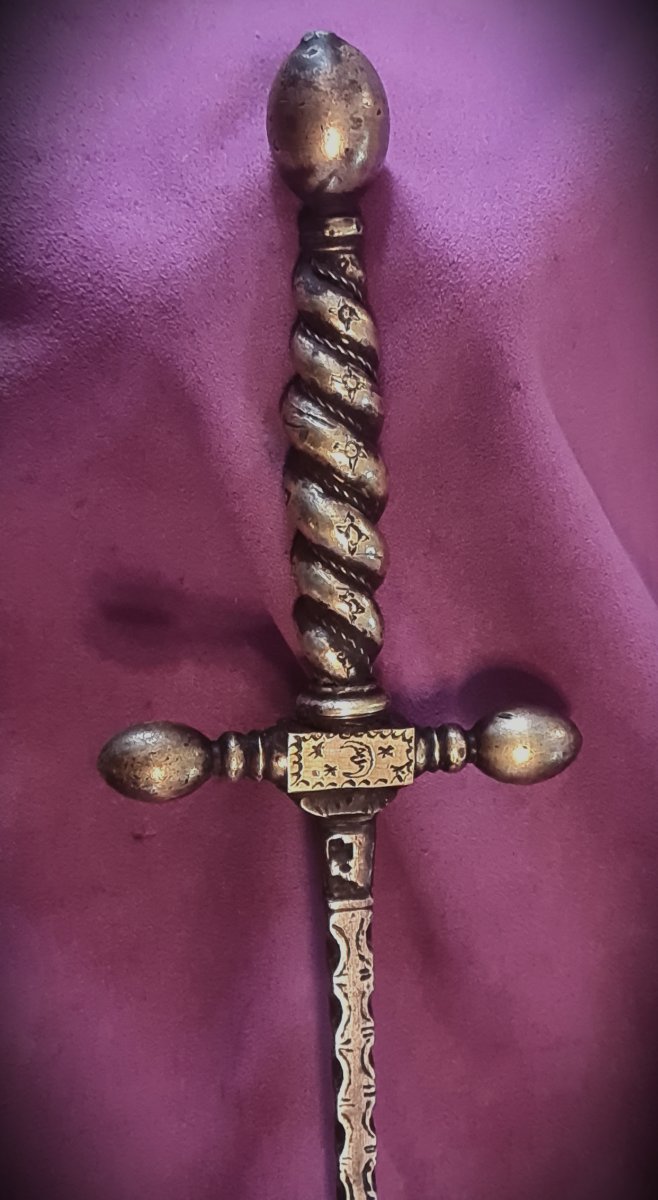
GUARD: It is made of brass, featuring in the center of a rectangle decorated on one side with a face in the sun and on the other side with a face in the moon and stars.The guard is completed by two olive-shaped quillons.
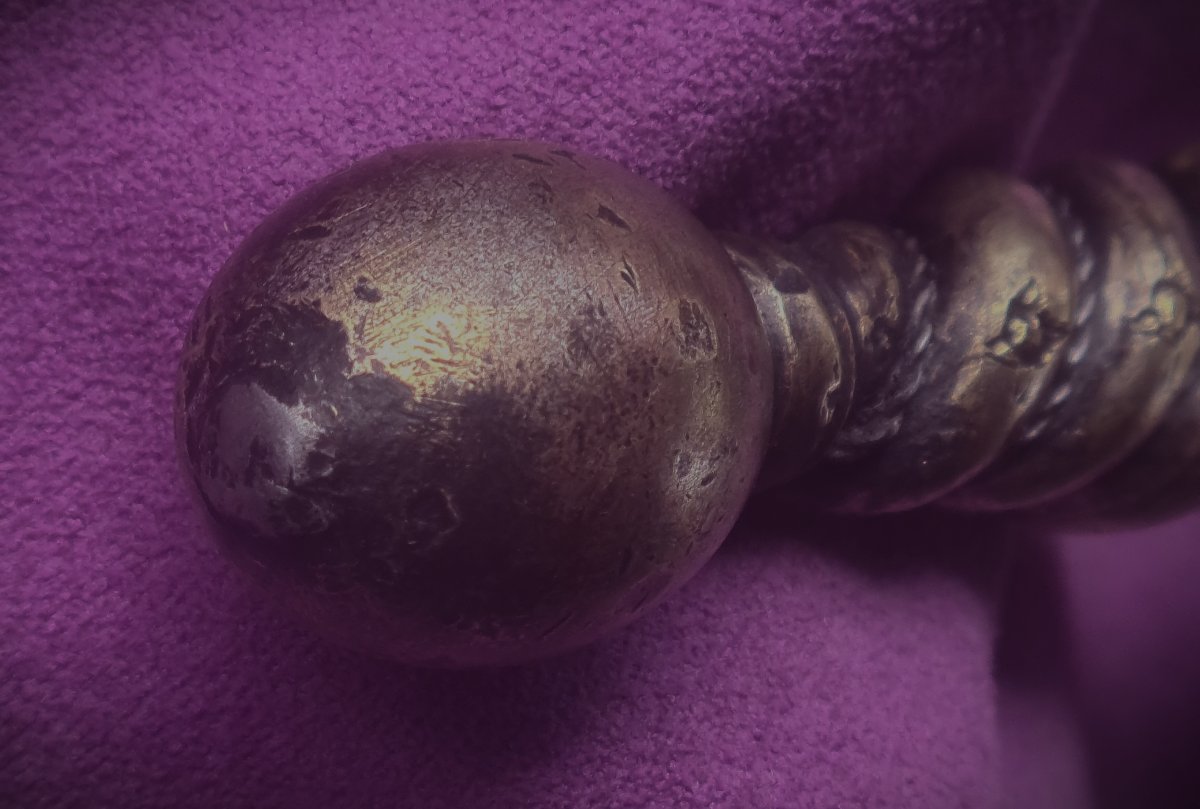
POMMEL : it is shaped like an elongated olive, resting on a small baluster. The blade tang is directly riveted to the pommel
GRIP : it has a distinctive shape, twisted in the form of two intertwined strands, yet also spindle-shaped, with a central section that is more bulging than the ends. The outer parts of the strands are engraved with small motifs, and in the hollows between the strands,there is a twisted iron wire binding—a feature rarely seen on this type of weapon-.
Shipping fee contribution = France and Europe: 20€
Ref X3Y-2442
Stilettos first appeared in southern Spain in the early 16th century. They quickly became popular, first in Italy, and then spread through out Europe. Antonio Manciolino, in his *Opera Nova*—a treatise on fencing from the Bologna school, published in 1531—already discusses stiletto fencing. These weapons were designed to inflict deep wounds that were difficult to treat, and to be able to pass through the rings of chain mail.
Its particularly sharp blade, with two “false edges” at the tip, is perfectly suited to this purpose of passing through the rings o fchain mail. The overall style of the mount, more finely decorated than that of “basic” stilettos, seems to indicate that this weapon belonged to a person of high standing.
Unlike19th-century examples, the hilt here is clearly composed of three separate elements—guard, grip, and pommel—and the blade tang passes completely through this hilt, ending riveted to the pommel.
BLADE: Curiously, it begins with a trapezoidal shoulder resting on the guard. This feature is intended to reinforce the blade-to-handle joint. Next, a small rectangular baluster bearing a maker’s mark forms the junction with the rest of the blade, which has a rectangular cross-section and is decorated with Spanish-style intaglio guilloché on the first third.
In the last 5 centimeters near the tip, two small additional facets known as “false edges” transform the cross-section into a 6-sided point. These additional facets were intended to facilitate penetration through chain mail. This feature is found on certain 16th-century Spanish stilettos.
Blade length = 24.2 cm, width near the heel9.3 mm, thickness near the shoulder= 7.2 mm
GUARD: It is made of brass, featuring in the center of a rectangle decorated on one side with a face in the sun and on the other side with a face in the moon and stars.The guard is completed by two olive-shaped quillons.
POMMEL : it is shaped like an elongated olive, resting on a small baluster. The blade tang is directly riveted to the pommel
GRIP : it has a distinctive shape, twisted in the form of two intertwined strands, yet also spindle-shaped, with a central section that is more bulging than the ends. The outer parts of the strands are engraved with small motifs, and in the hollows between the strands,there is a twisted iron wire binding—a feature rarely seen on this type of weapon-.
Shipping fee contribution = France and Europe: 20€
Ref X3Y-2442
1 100 €
Period: 17th century
Style: Renaissance, Louis 13th
Condition: Excellent condition
Material: Other
Length: 35.8 cm
Width: aux quillons 7.7 cm
Reference (ID): 1818953
Availability: In stock
Print