

Louis Mathieu Verdilhan (1875–1928) Lively Village Square
Artist: Louis Mathieu Verdilhan (1875-1928)
“I’ll eventually leave everything out, and what remainswill be the essential”—these are the words of Mathieu Verdilhan, who sought to eliminate the superfluous and go straight to the heart of the matter.
Mission accomplished in most of his works from the 1920s, and one can imagine that he would have dabbled in abstraction had death not cut him down at the age of 53.
An incredible innovator, capable of moving from Impressionism to Fauvism and then to broad swaths of color outlined in black that give structure to the villages and figures, reminiscent of the technique of cloisonnisme.
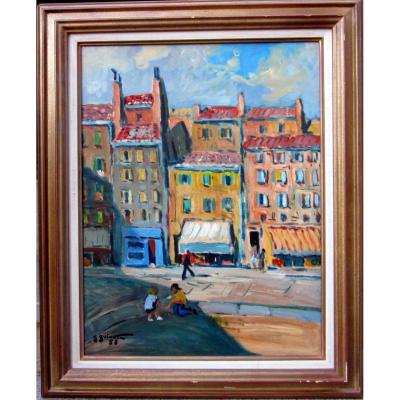
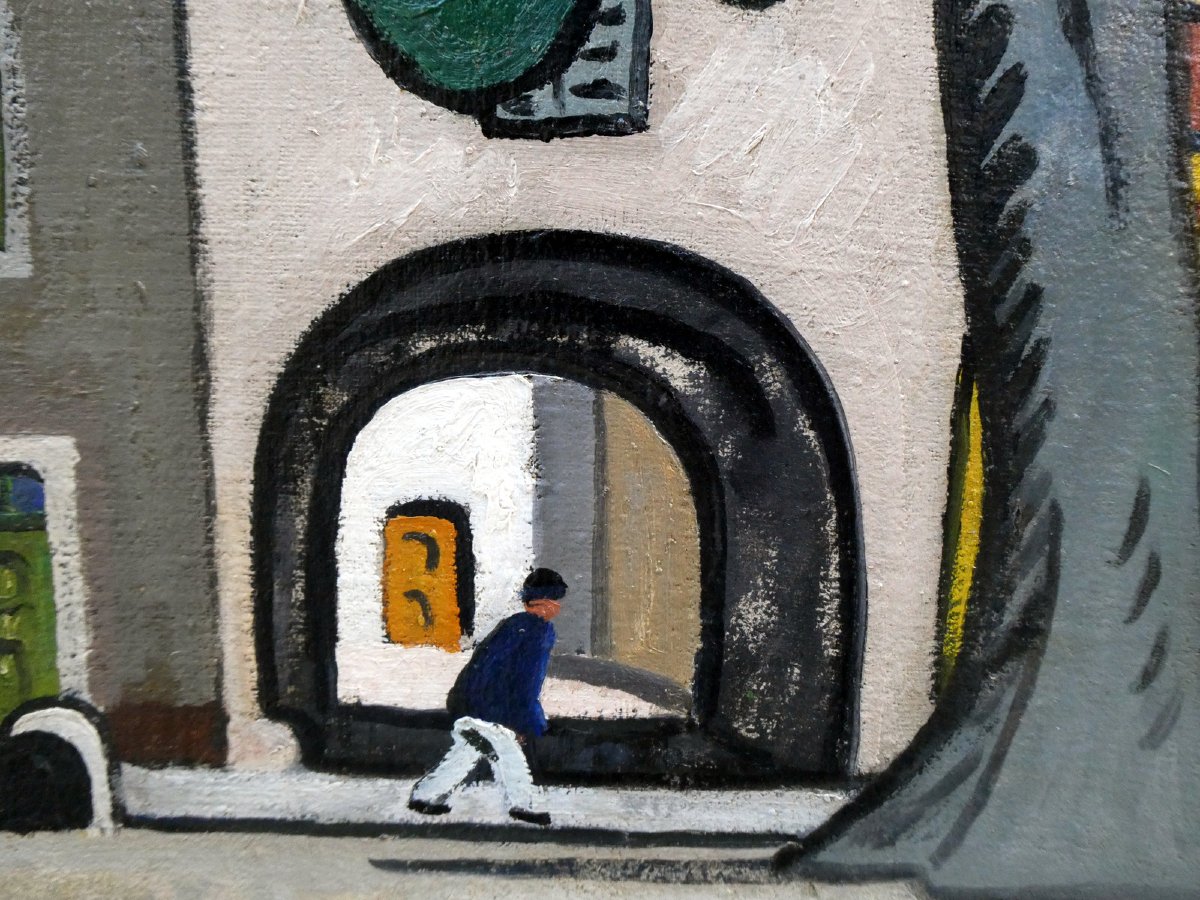
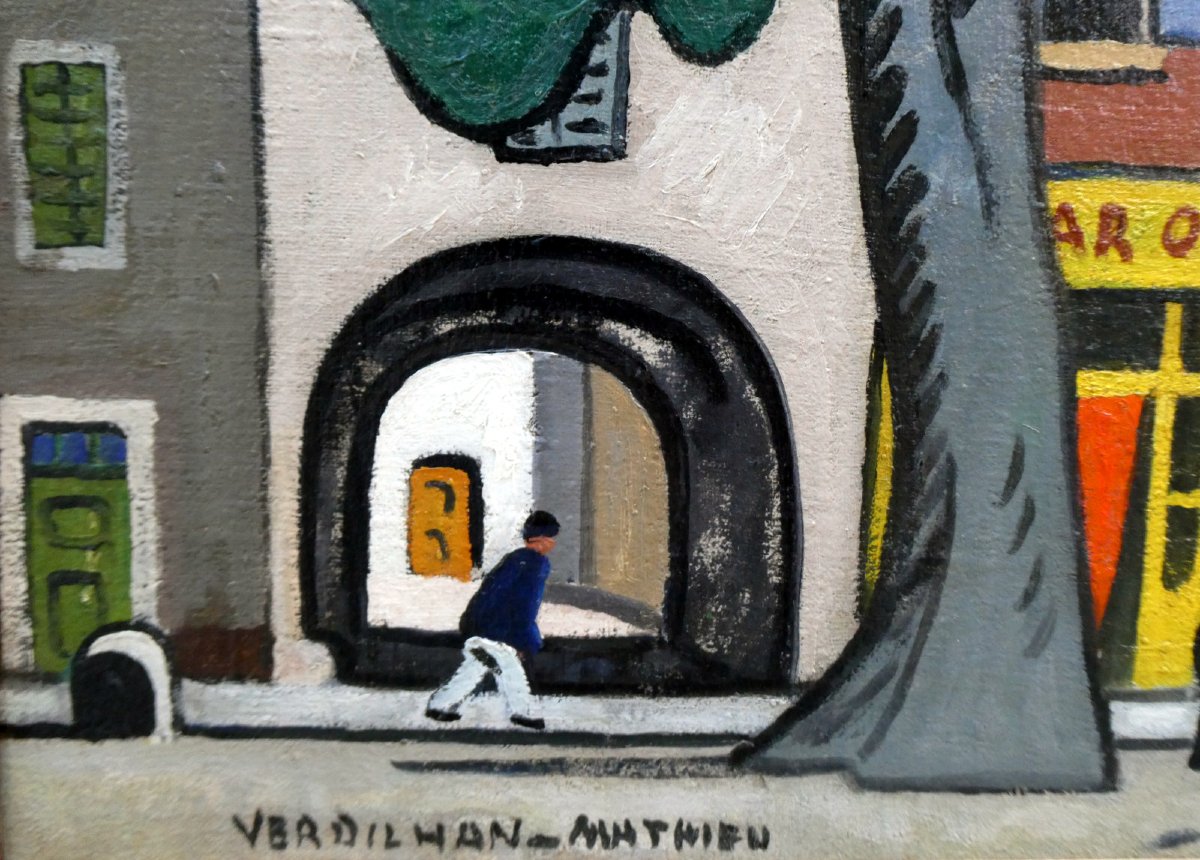
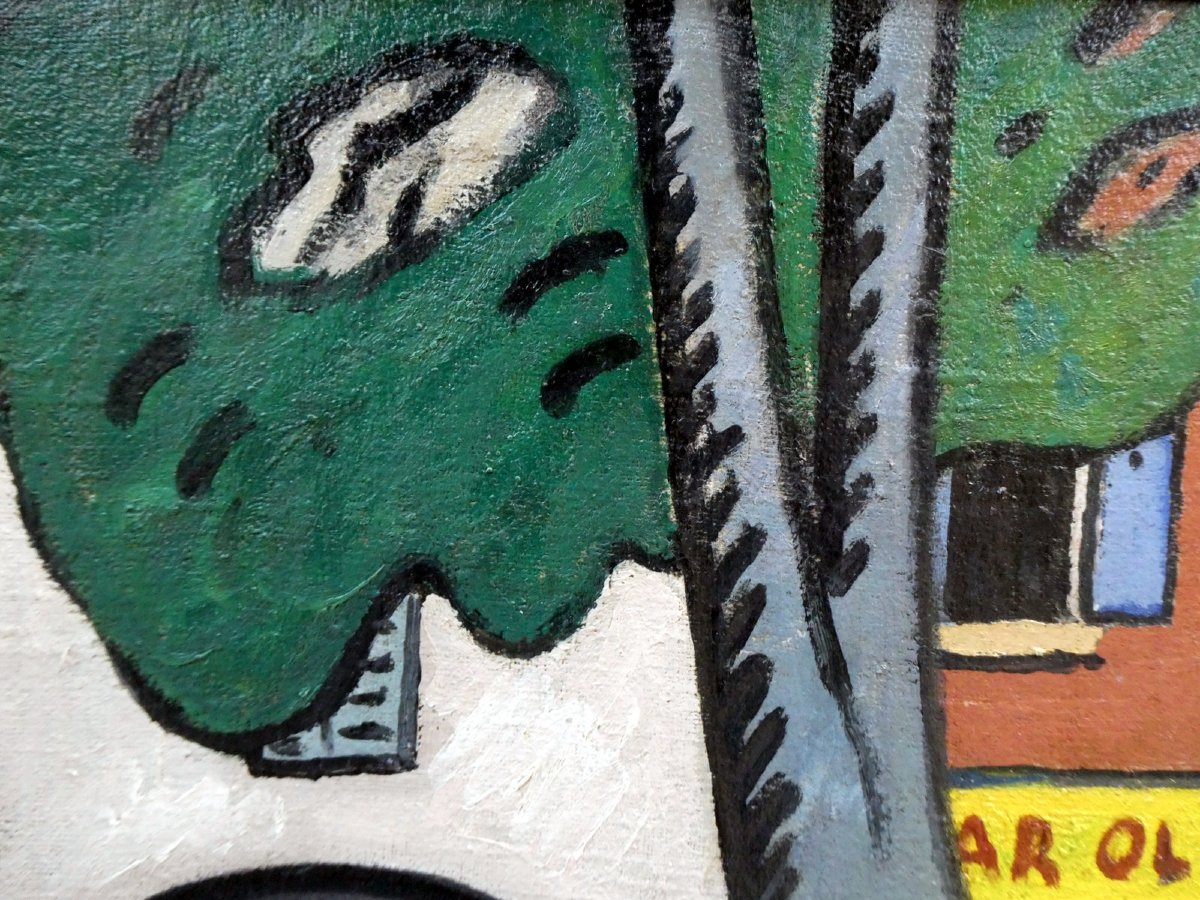
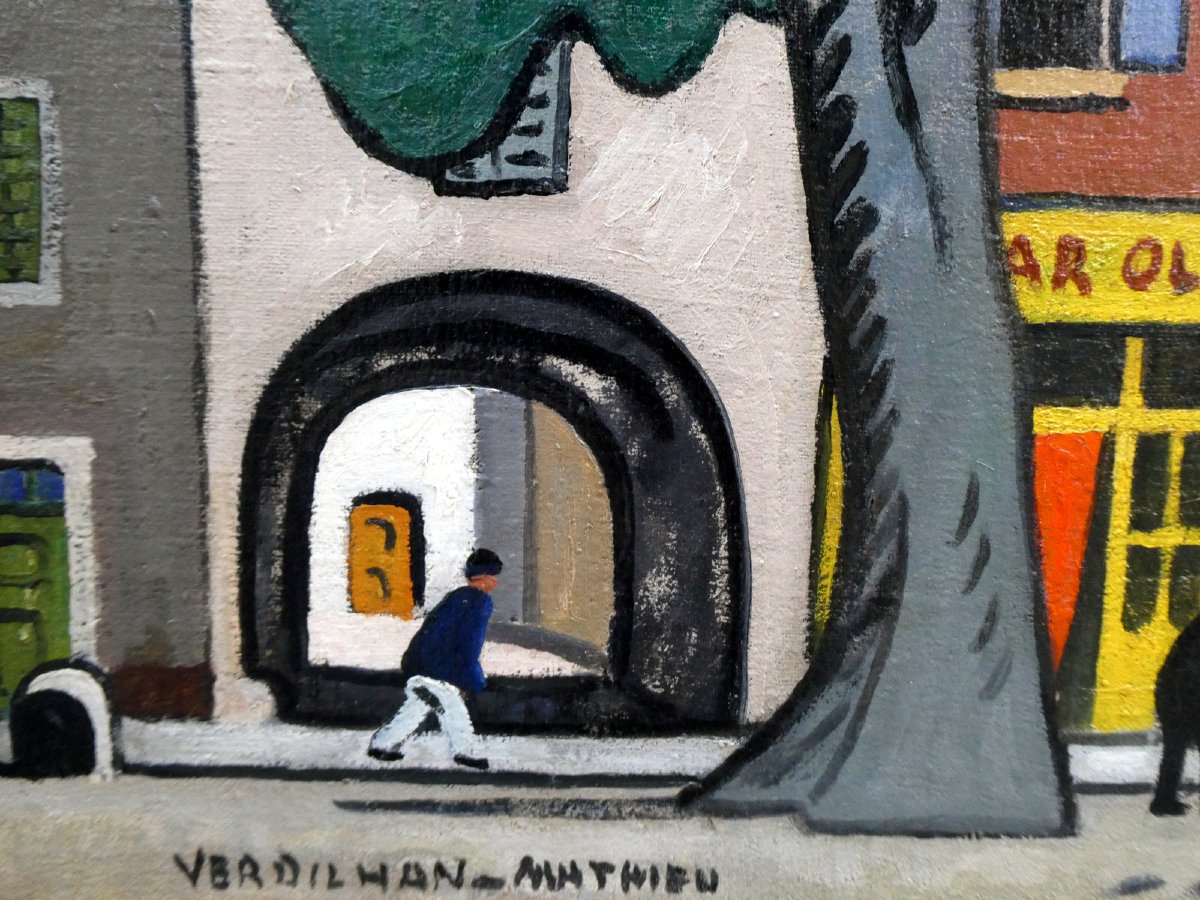
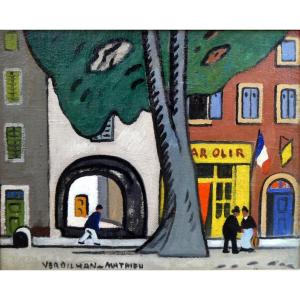
The paint is impasto in places, as on this white wall on the left, which adds texture and prevents the painting from appearing flat.
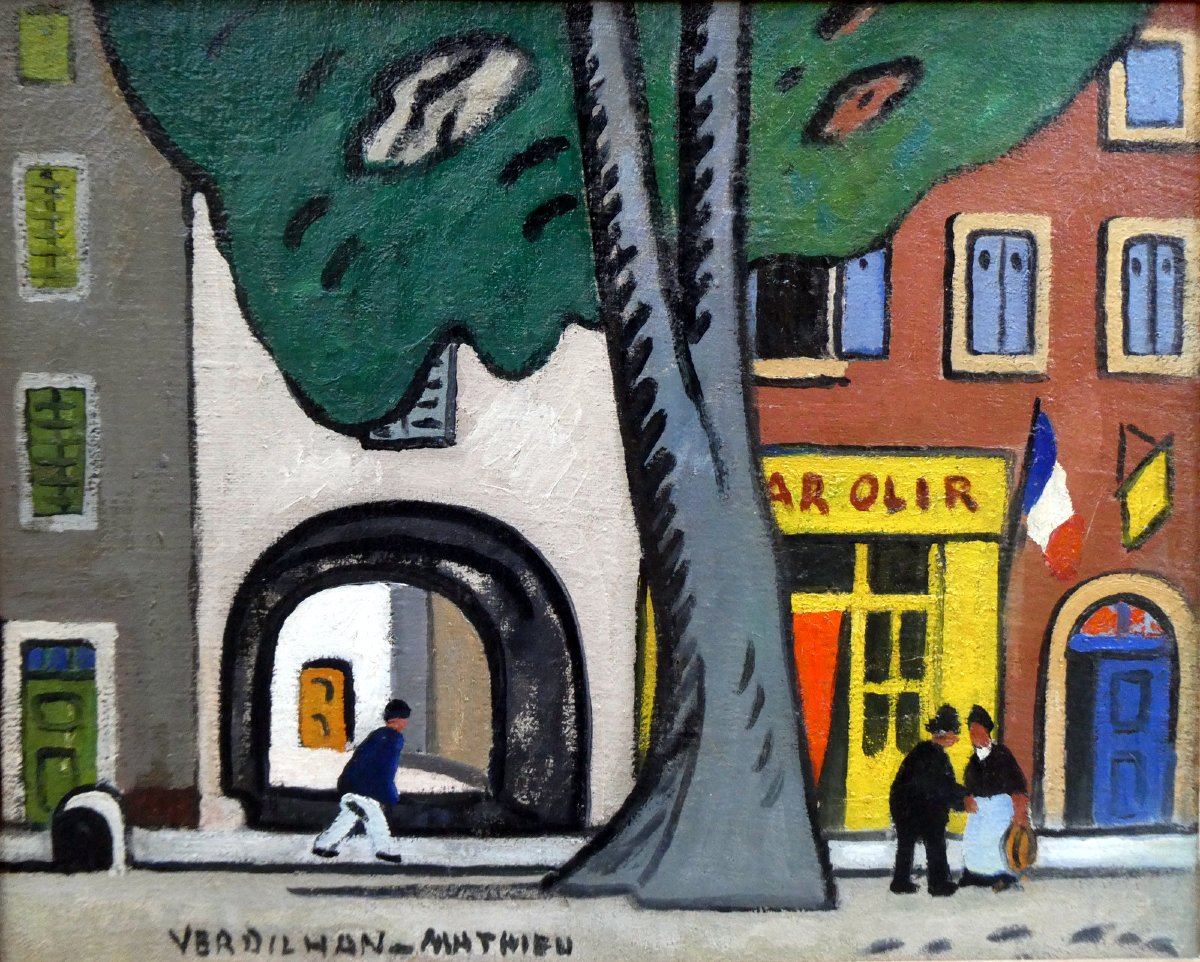
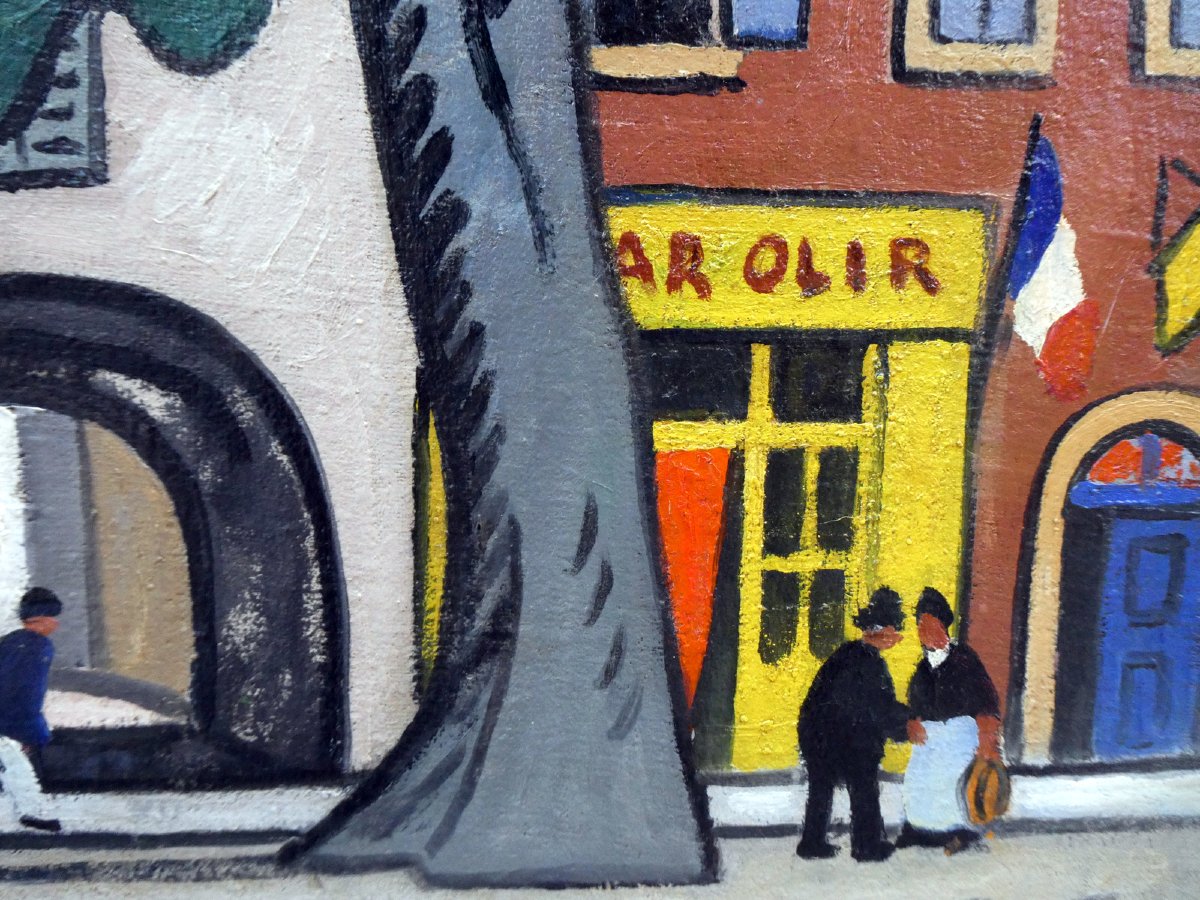
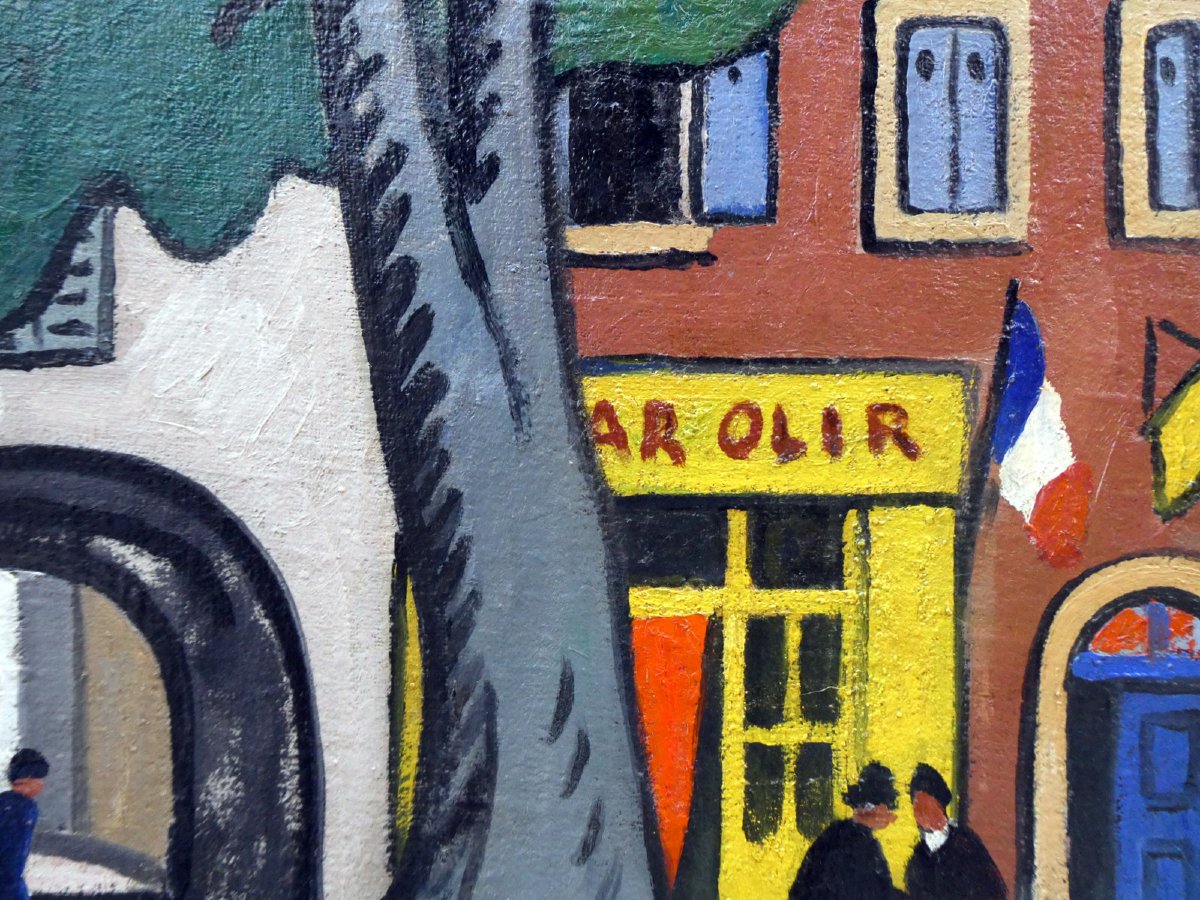
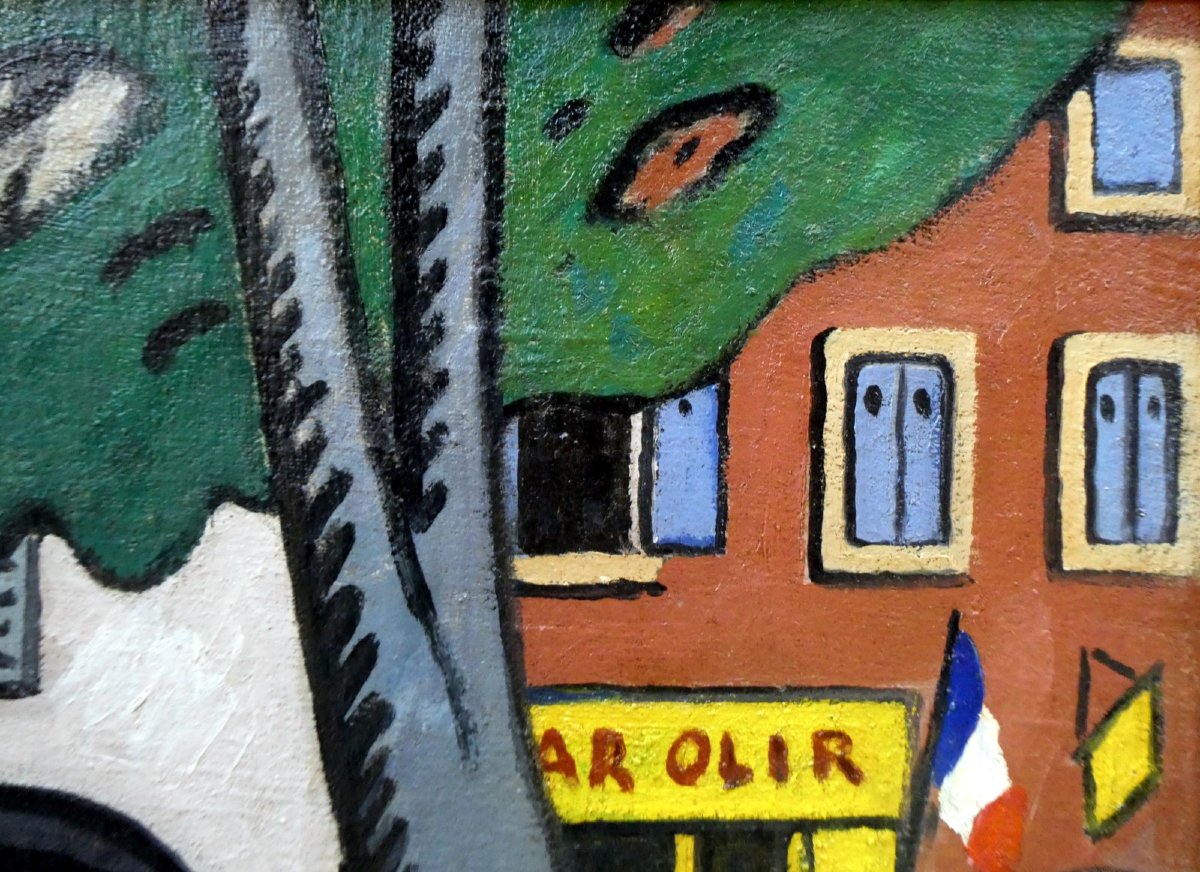
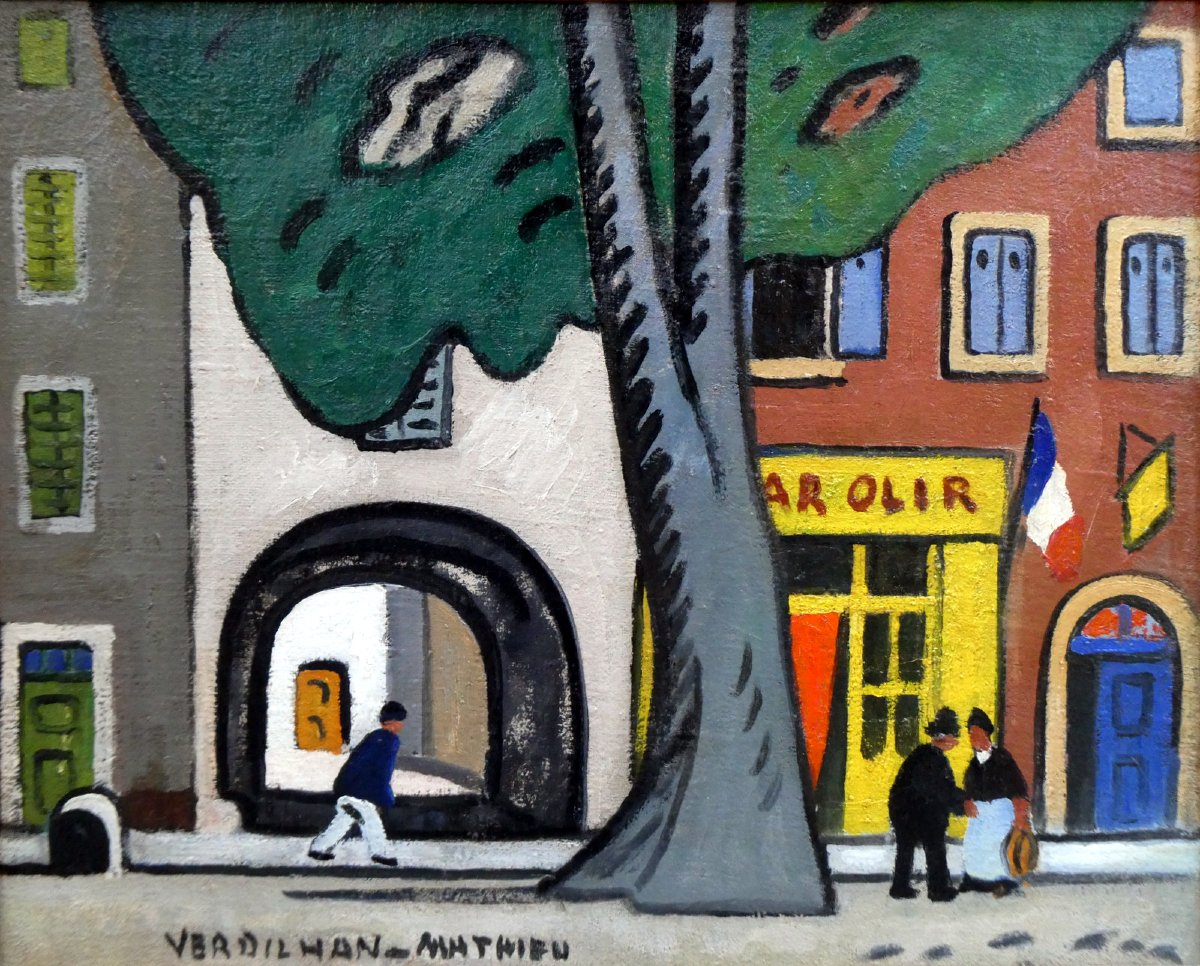
The green of the foliage, the blue of the shutters, the yellow of the storefront, and the brick-red of the wall are applied in distinct blocks, without gradations or shading.
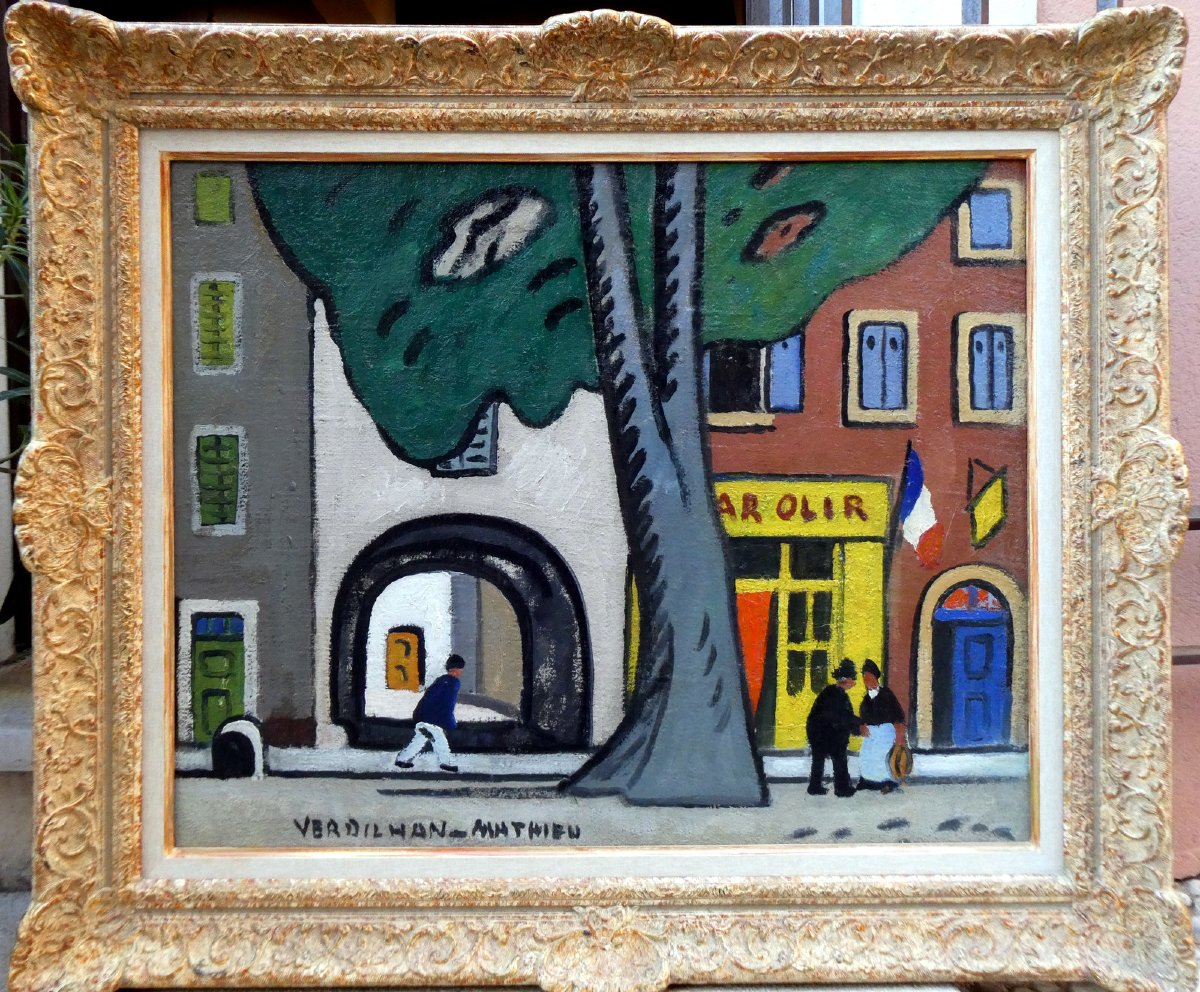
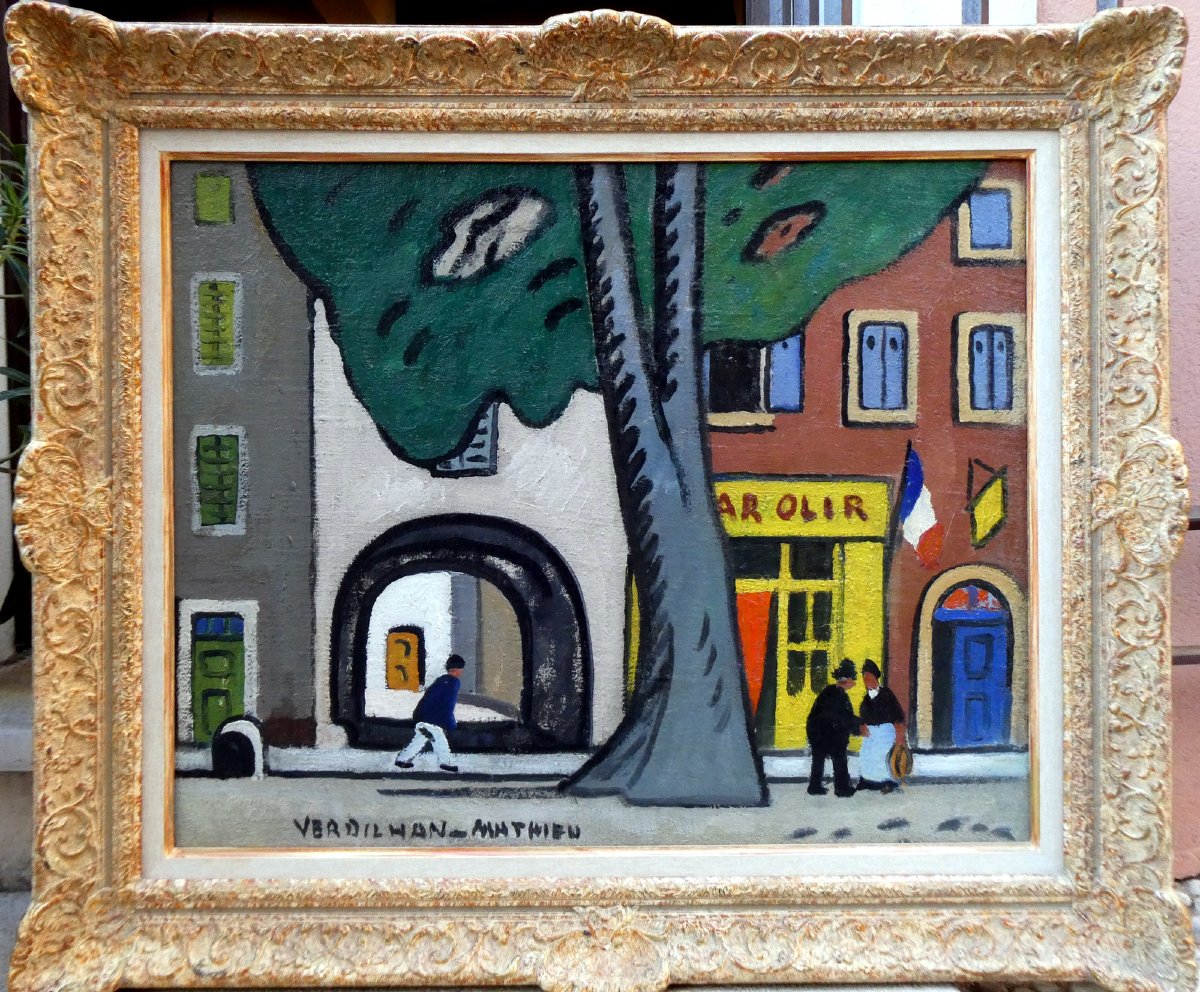
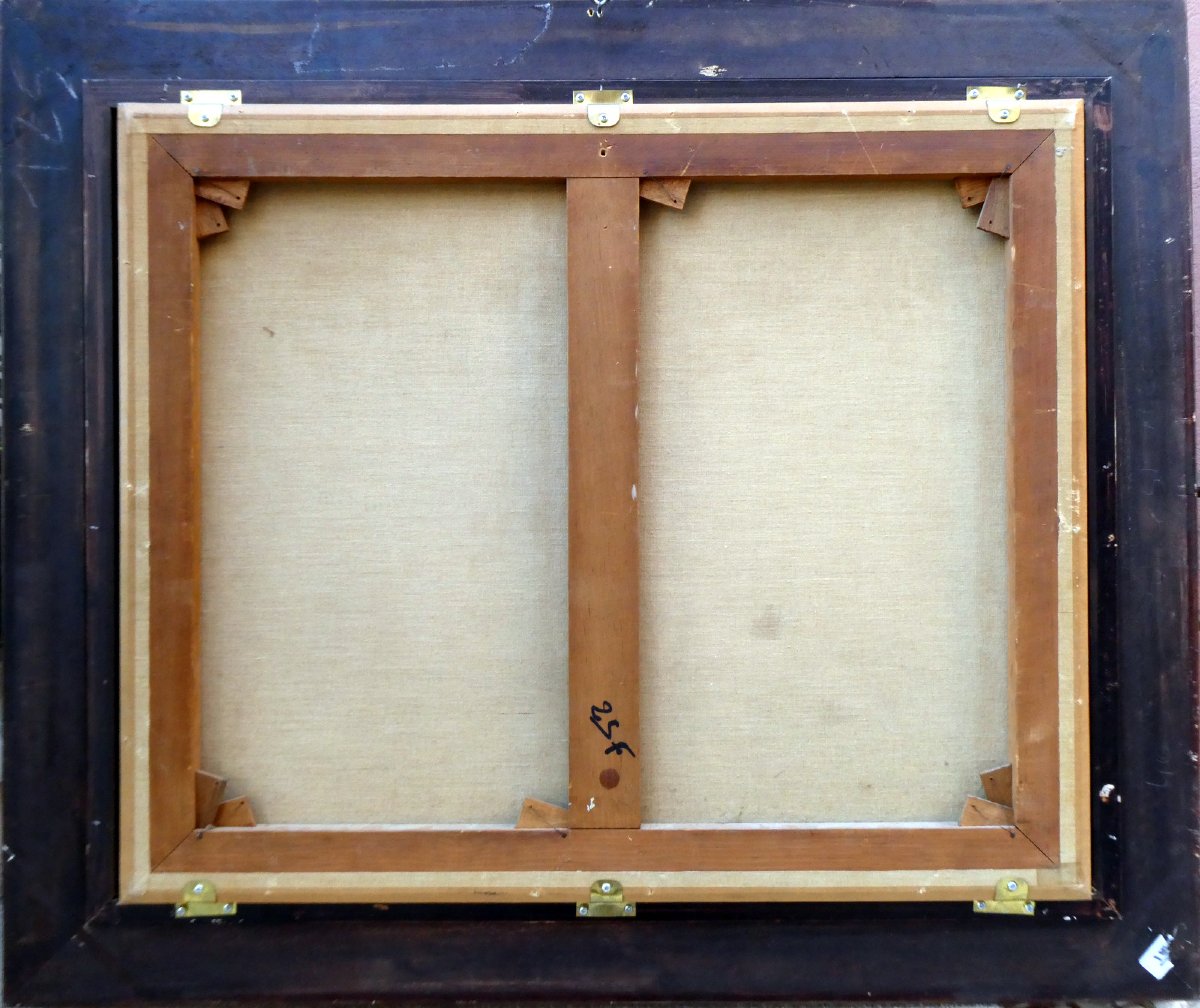
The work is presented in a beautiful Louis XIV-style frame from RG, measuring 87 cm by 103 cm, with the canvas itself measuring 66 cm by 81 cm.
In very good condition, the work is signed in the lower left corner.
It depicts a typical Provençal street scene, likely in a village near Sainte-Baume such as Roquevaire or Trets, where the artist worked;
the Provençal shutters and the tricolor flag on the café’s façade are very characteristic.
The composition is divided in two by the tree’s massive trunk: on the left, a gray and white facade with a black arched passageway in front of which a man is walking; on the right, ared-ochre house with the yellow facade of a bar, the Bar Olir—likely “BAR OLIVE,” which the artist, unfortunately illiterate, may have miss pelled—and in front of which two figures are chatting: a man in black and a woman carrying a basket.
Ever bold, Verdilhan presents the central treeas a backbone that structures the entire image, somewhat in the manner of a two-panel altarpiece.
The two halves of the painting echo each other while contrasting—on the left, a muted palette of gray, off-white, and a narrative void: the street and the shadow of the porch; and on the right, an explosion of colors—ochre, bright yellow, blue—and social life, with the café and passersby.
Cutting the composition in half with this tree is a bold move andavoids a banal “postcard” view; Verdilhan juxtaposes the anonymous street with the hub of social life.
Louis Mathieu Verdilhan's family settled in the Chartreux district of Marseille in1877. Coming from a poor family, he apprenticed with a building painter in 1890but began drawing with the support of the artist.
Marseille painter EugèneGiraud (Marseille 1848-1937).
In 1895, he opened a workshop that he kept allhis life, at n° 12 rue Fort-Notre-Dame.
In 1898, he went to Paris for thefirst time and worked for the decorator Adrien Karbowsky in charge of part ofthe ornamentation of the Salon du bois of the Pavilion of Decorative Arts forthe Universal Exhibition of 1900, then returned the following year inMarseille.
In 1902, he lost his left eye, which did not prevent him frompainting.
His artistic career began in 1902 in Marseille with an exhibition on rueSaint-Ferréol then, in 1905, an exhibition at the Palais des Architectes onAvenue du Prado.
He also exhibited in Paris from 1906 at the Salon desIndépendants: Fields of Poppies (1906), Priest and Altar Boy (1910), Place del'Horloge (1911), House with the Almond Tree (1913), The Flower Jug (1914) ...From 1908 he also participated in the Salon d'Automne.
In 1909, he spent sixmonths in Versailles where he created numerous paintings.
From 1910 to 1914 heoccupied a workshop at n° 12 quai de Rive Neuve, in warehouses where thepainters Girieud and Lombard were already installed (premises which would laterbe, from 1946 to 1993, the workshop of the painter François Diana).
Mobilized inToulon during the First World War, Louis Mathieu Verdilhan rubbed shoulderswith Albert Marquet, whose influence he was influenced by, as well as AndréSuarès and Antoine Bourdelle.
After the war, he lived successively in Aix-en-Provence, Cassis and Toulon.
OnMarch 16, 1919, he married Hélène Casile, youngest daughter of the painterAlfred Casile.
His notoriety increased and he exhibited as far as New York atthe Kraushaar gallery.
He painted a panel for the Marseille Opera for the cityof Marseille: this canvas represents the July 14 celebration in Marseille andwas widely criticized during the inauguration of the opera.
Passionate about the Old Port, he performed more than 130 times between 1913and 1920.
He died of laryngeal cancer on December 15, 1928.
His widow remarried apolytechnic engineer, Gaston Vanneufville, and had a daughter: the actressGeneviève Casile.
His works can be seen in many museums and public collections:
Albi, Toulouse-Lautrec museum: Boat at the dock
Avignon, Calvet museum: View of the Old Port inMarseille
Granville, Richard Anacreon modern art museum:Provençal landscape
Grenoble, museum: Portrait of a man
Marseille: Museum of Fine Arts : Viewof the port of Marseille Townhall on the coast
Cantini museum: Self-portrait Theold Port Thebestiary Thetransporter bridge Townhall on the coast Viewof the port of Marseille
Martigues, Ziem museum: The great bulwark in the portof Marseille The Old Port in Marseille 1927 The Colonies Bar in Toulon
Paris, museum of modern art of the city of Paris: Lunch, sepia Marseille, boats in port
Toulon, Toulon art museum: Park corner, circa 1911, oilon canvas, 80 × 105 cm Var coastline, circa 1907, oilon canvas, 70 × 91 cm Village of Provence, oil oncanvas, 80 × 150 cm
Mission accomplished in most of his works from the 1920s, and one can imagine that he would have dabbled in abstraction had death not cut him down at the age of 53.
An incredible innovator, capable of moving from Impressionism to Fauvism and then to broad swaths of color outlined in black that give structure to the villages and figures, reminiscent of the technique of cloisonnisme.
The paint is impasto in places, as on this white wall on the left, which adds texture and prevents the painting from appearing flat.
The green of the foliage, the blue of the shutters, the yellow of the storefront, and the brick-red of the wall are applied in distinct blocks, without gradations or shading.
The work is presented in a beautiful Louis XIV-style frame from RG, measuring 87 cm by 103 cm, with the canvas itself measuring 66 cm by 81 cm.
In very good condition, the work is signed in the lower left corner.
It depicts a typical Provençal street scene, likely in a village near Sainte-Baume such as Roquevaire or Trets, where the artist worked;
the Provençal shutters and the tricolor flag on the café’s façade are very characteristic.
The composition is divided in two by the tree’s massive trunk: on the left, a gray and white facade with a black arched passageway in front of which a man is walking; on the right, ared-ochre house with the yellow facade of a bar, the Bar Olir—likely “BAR OLIVE,” which the artist, unfortunately illiterate, may have miss pelled—and in front of which two figures are chatting: a man in black and a woman carrying a basket.
Ever bold, Verdilhan presents the central treeas a backbone that structures the entire image, somewhat in the manner of a two-panel altarpiece.
The two halves of the painting echo each other while contrasting—on the left, a muted palette of gray, off-white, and a narrative void: the street and the shadow of the porch; and on the right, an explosion of colors—ochre, bright yellow, blue—and social life, with the café and passersby.
Cutting the composition in half with this tree is a bold move andavoids a banal “postcard” view; Verdilhan juxtaposes the anonymous street with the hub of social life.
Louis Mathieu Verdilhan's family settled in the Chartreux district of Marseille in1877. Coming from a poor family, he apprenticed with a building painter in 1890but began drawing with the support of the artist.
Marseille painter EugèneGiraud (Marseille 1848-1937).
In 1895, he opened a workshop that he kept allhis life, at n° 12 rue Fort-Notre-Dame.
In 1898, he went to Paris for thefirst time and worked for the decorator Adrien Karbowsky in charge of part ofthe ornamentation of the Salon du bois of the Pavilion of Decorative Arts forthe Universal Exhibition of 1900, then returned the following year inMarseille.
In 1902, he lost his left eye, which did not prevent him frompainting.
His artistic career began in 1902 in Marseille with an exhibition on rueSaint-Ferréol then, in 1905, an exhibition at the Palais des Architectes onAvenue du Prado.
He also exhibited in Paris from 1906 at the Salon desIndépendants: Fields of Poppies (1906), Priest and Altar Boy (1910), Place del'Horloge (1911), House with the Almond Tree (1913), The Flower Jug (1914) ...From 1908 he also participated in the Salon d'Automne.
In 1909, he spent sixmonths in Versailles where he created numerous paintings.
From 1910 to 1914 heoccupied a workshop at n° 12 quai de Rive Neuve, in warehouses where thepainters Girieud and Lombard were already installed (premises which would laterbe, from 1946 to 1993, the workshop of the painter François Diana).
Mobilized inToulon during the First World War, Louis Mathieu Verdilhan rubbed shoulderswith Albert Marquet, whose influence he was influenced by, as well as AndréSuarès and Antoine Bourdelle.
After the war, he lived successively in Aix-en-Provence, Cassis and Toulon.
OnMarch 16, 1919, he married Hélène Casile, youngest daughter of the painterAlfred Casile.
His notoriety increased and he exhibited as far as New York atthe Kraushaar gallery.
He painted a panel for the Marseille Opera for the cityof Marseille: this canvas represents the July 14 celebration in Marseille andwas widely criticized during the inauguration of the opera.
Passionate about the Old Port, he performed more than 130 times between 1913and 1920.
He died of laryngeal cancer on December 15, 1928.
His widow remarried apolytechnic engineer, Gaston Vanneufville, and had a daughter: the actressGeneviève Casile.
His works can be seen in many museums and public collections:
Albi, Toulouse-Lautrec museum: Boat at the dock
Avignon, Calvet museum: View of the Old Port inMarseille
Granville, Richard Anacreon modern art museum:Provençal landscape
Grenoble, museum: Portrait of a man
Marseille: Museum of Fine Arts : Viewof the port of Marseille Townhall on the coast
Cantini museum: Self-portrait Theold Port Thebestiary Thetransporter bridge Townhall on the coast Viewof the port of Marseille
Martigues, Ziem museum: The great bulwark in the portof Marseille The Old Port in Marseille 1927 The Colonies Bar in Toulon
Paris, museum of modern art of the city of Paris: Lunch, sepia Marseille, boats in port
Toulon, Toulon art museum: Park corner, circa 1911, oilon canvas, 80 × 105 cm Var coastline, circa 1907, oilon canvas, 70 × 91 cm Village of Provence, oil oncanvas, 80 × 150 cm
30 000 €
Period: 20th century
Style: Other Style
Condition: Excellent condition
Material: Oil painting
Length: 81 cm
Height: 66 cm
Reference (ID): 1817288
Availability: In stock
Print