THIS OBJECT WAS SOLD
Large Tapestry-style Painting Depicting A Romantic Scene – *l’escarpolette*, Circa 1880–1910.
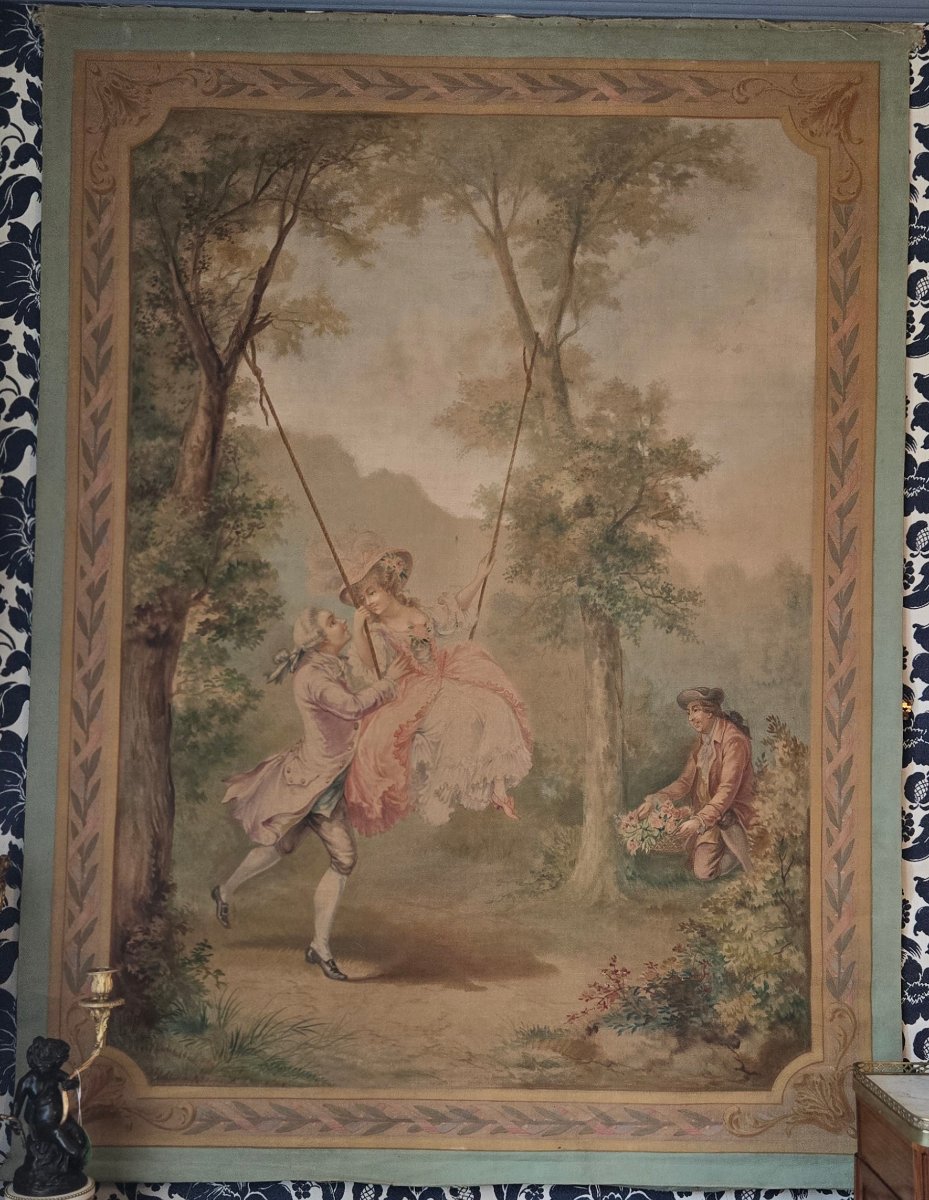


A large decorative tapestry depicting a romantic scene on a swing, inspired by the 18th-century French tradition of rural pastimes.
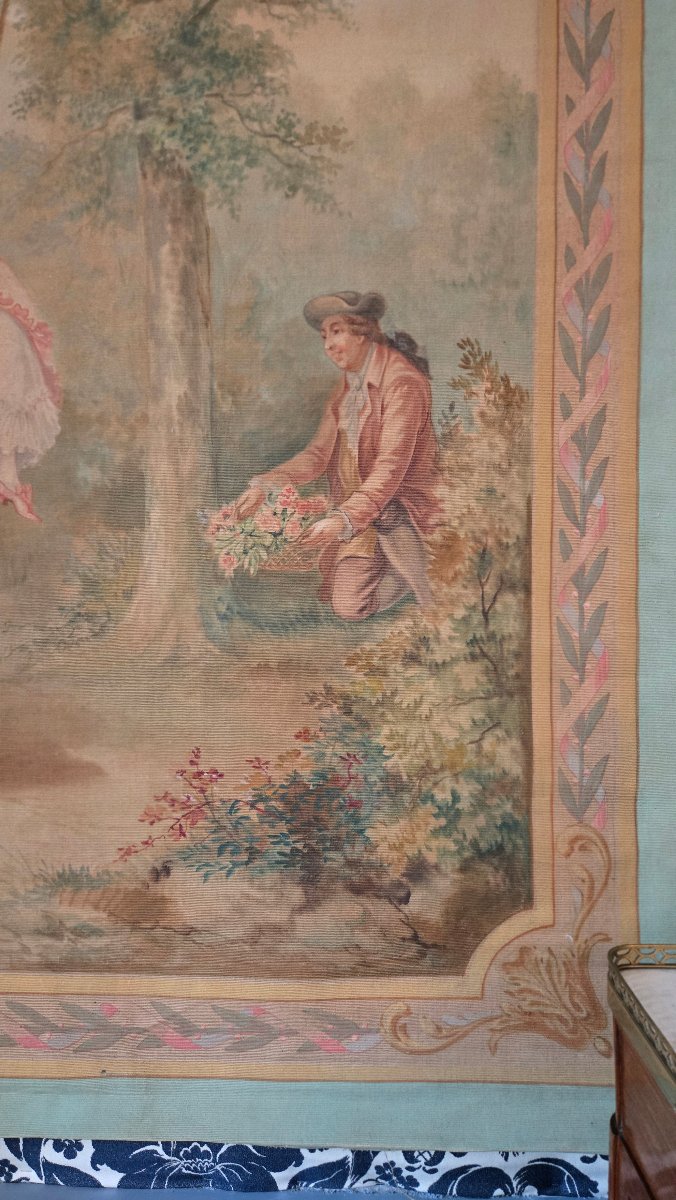
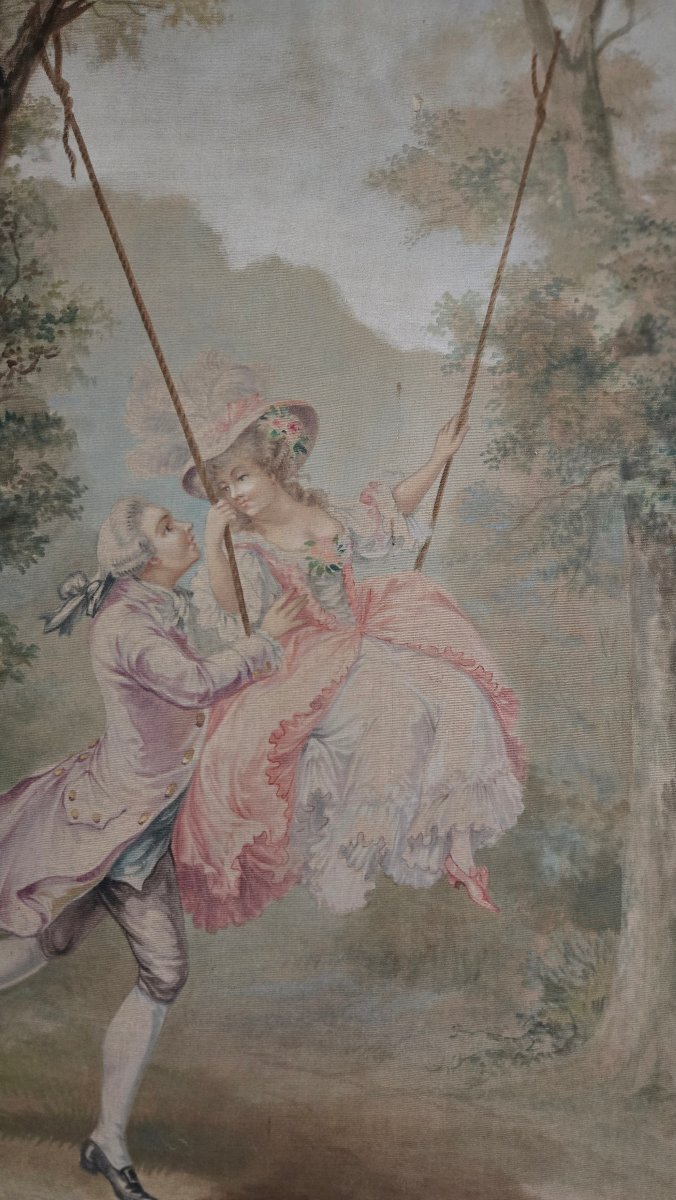
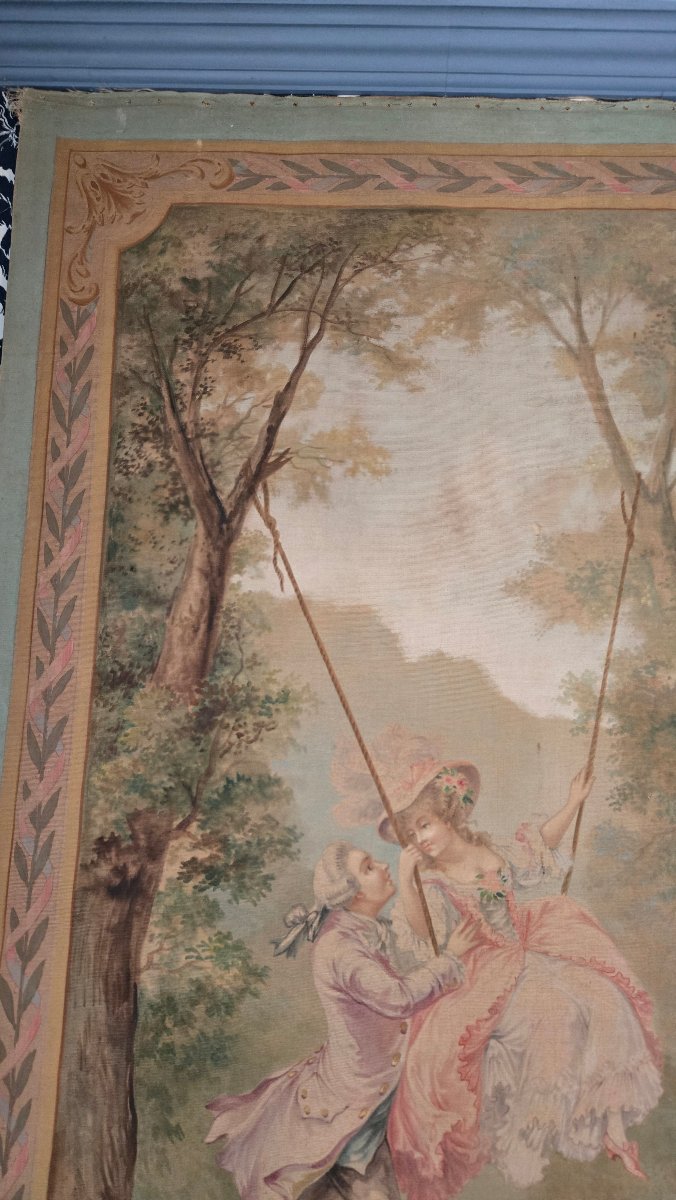
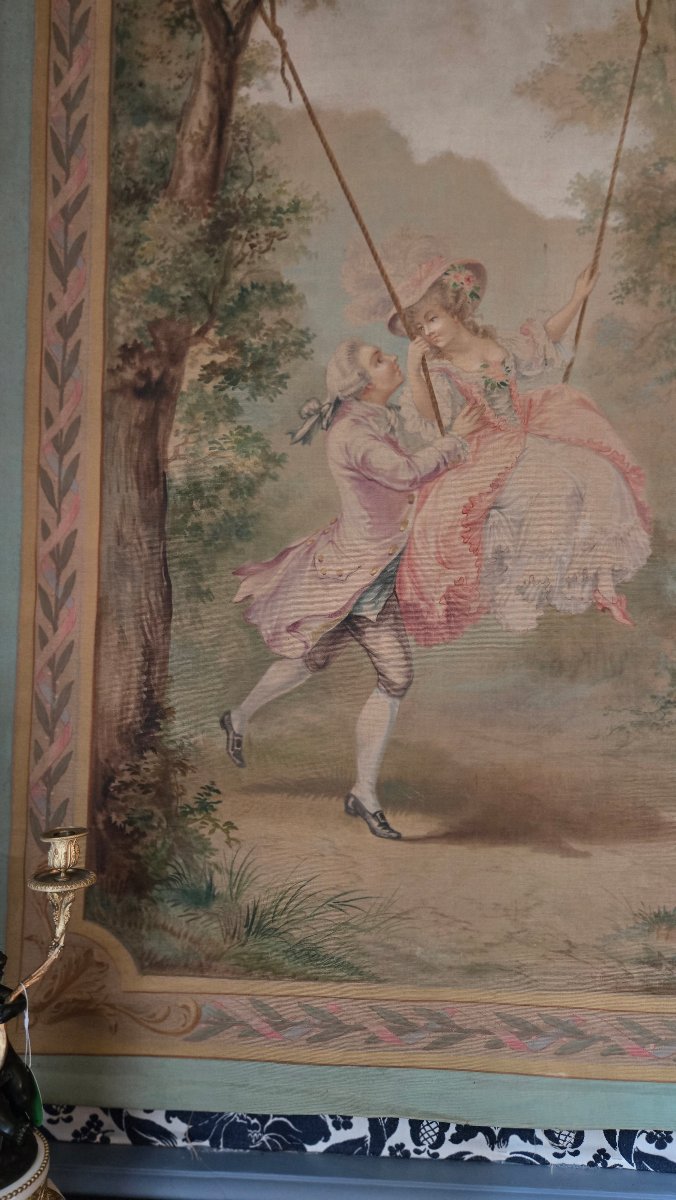
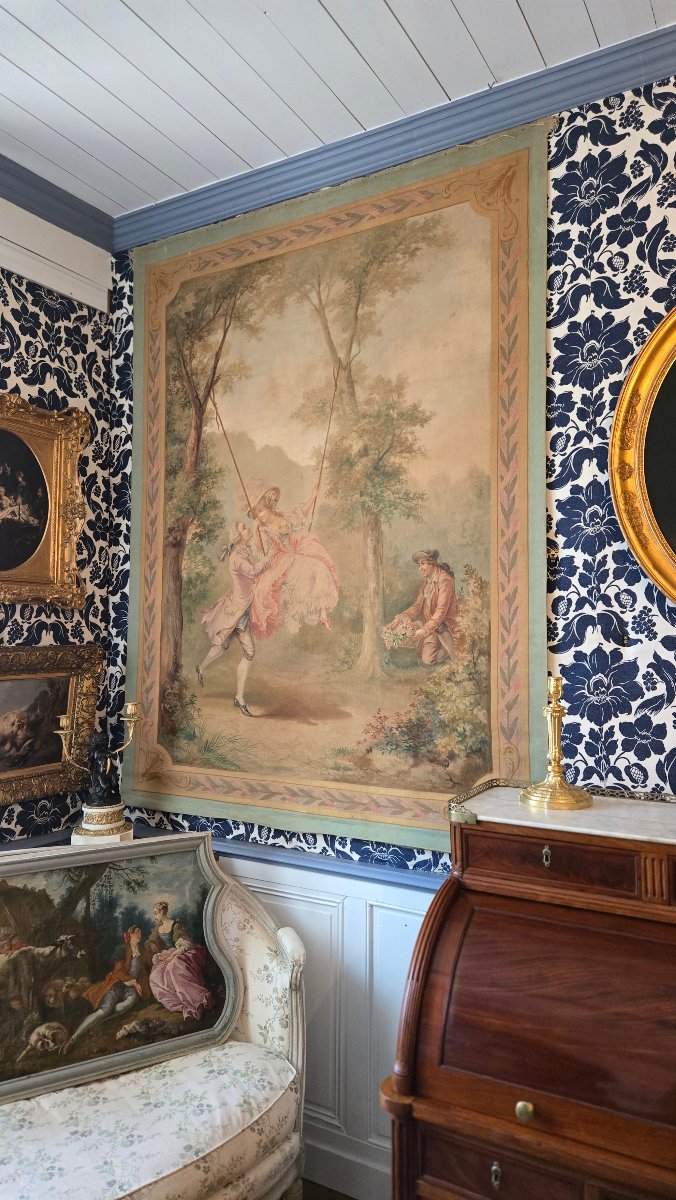
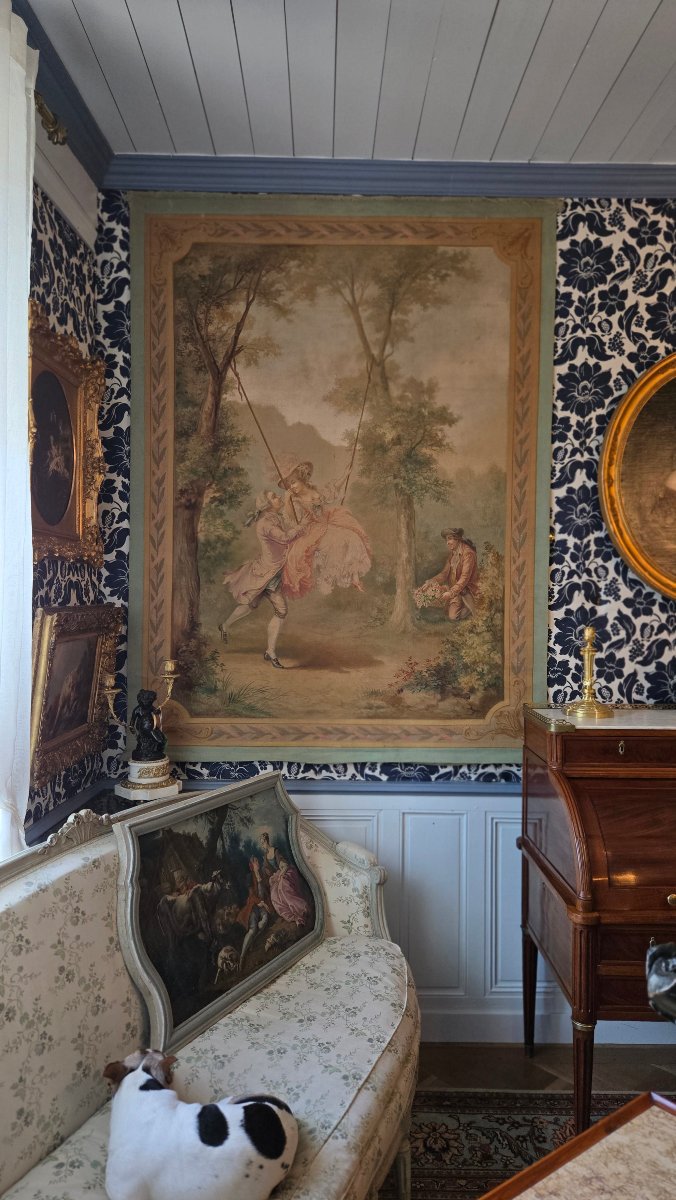
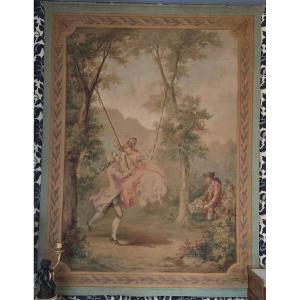
In a vast wooded landscape, a young woman elegantly dressed in a flowing pink gown swings on a swing suspended from the branches of tall trees. A young man standing beside her follows her movements and gazes at her lovingly, while a gardener kneeling some distance away arranges flowers in a basket. The scene unfolds amid lush vegetation, punctuated by flowerbeds, and opens in the distance to a mountainous landscape rendered in soft, misty tones.
The composition is fully in keeping with the style of gallant festivities and amorous games popularized in the 18th century by Watteau, Boucher, and Fragonard, with the swing itself constituting one of the emblematic themes of this iconography.
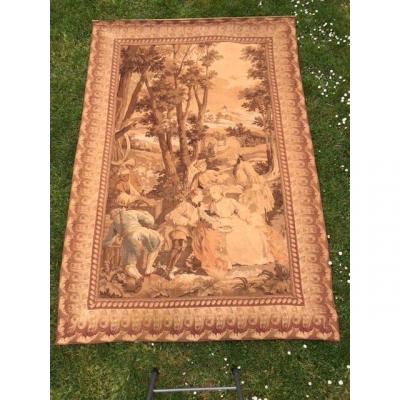
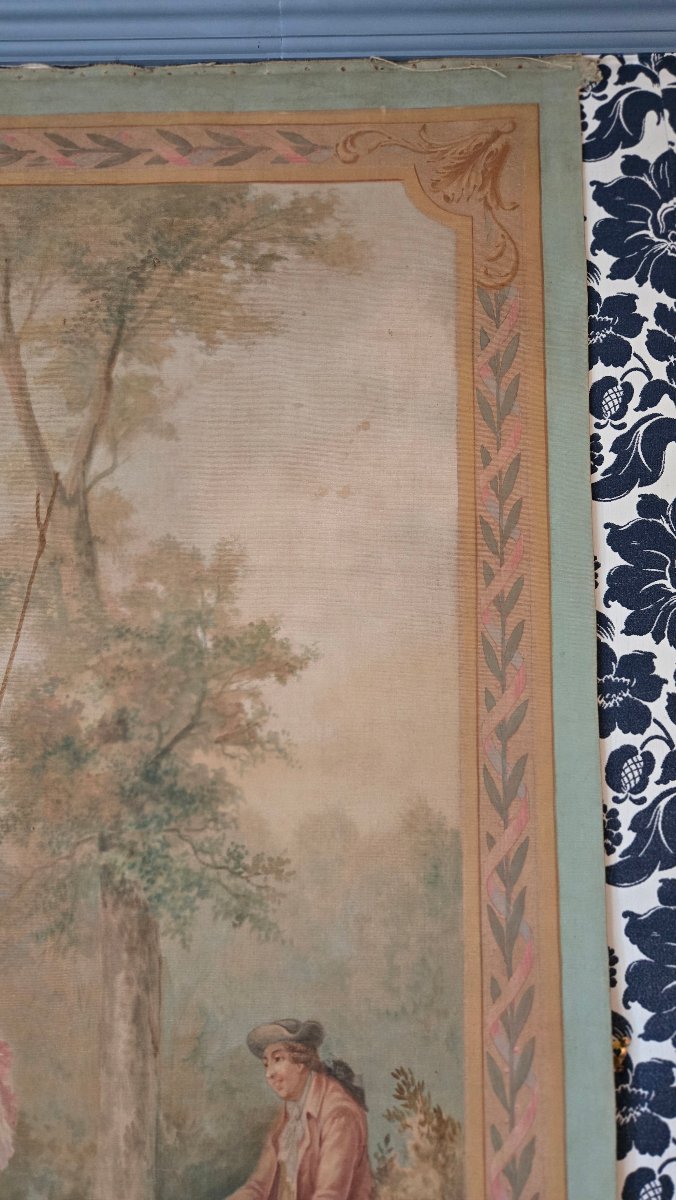
The entire scene is surrounded by a wide border painted on the same fabric, adorned with a frieze of gray-green lanceolate leaves intertwined with a pink ribbon, finished at the corners with foliage motifs and framed by a wide celadon-green border.
A Unique Technique: Tapestry Painting
The design is not woven but painted directly onto a coarse-weave fabric, whose particularly pronounced weave is intentionally left visible beneath the colors. This texture of the support contributes to the desired effect: from a distance, the work takes on the appearance of a tapestry, while closer inspection reveals the pictorial work.
This technique underwent significant development in the last third of the 19th century. As early as the 1860s, the Binant company in Paris began marketing canvases specially adapted for decorative painting and the imitation of tapestries. The process was subsequently described by Julien Godon, particularly for reproducing through painting the appearance of tapestries from Flanders, the Gobelins, Beauvais, or Aubusson. At the 1900 Paris World’s Fair, this type of work constituted a recognized category known as “hand-painted tapestries,” created on coarse-weave fabrics. Similar works are also documented in Belgium during the same period.
There are no markings linking our textile to the Binant company or to a specific workshop; these elements therefore constitute technical and historical parallels that allow us to place the work within the context of this decorative production, which was in vogue at the time.
The old folds along the edges retain numerous stitching holes, attesting to a former mounting in which the fabric was stretched and nailed to a frame. Combined with the work’s monumental size, this arrangement very likely indicates that it was intended as a panel in a decorative ensemble, probably integrated into wood paneling.
This painting is part of a set of three panels from the same provenance, executed using the same technique and featuring an identical border. The other two compositions are offered separately.
Original condition, with patina, discoloration, small spots, and isolated signs of wear consistent with its age, as well as traces of the original mounting. A beautiful harmony of soft, muted tones.
Dimensions: H. 203 × W. 151 cm.
In a vast wooded landscape, a young woman elegantly dressed in a flowing pink gown swings on a swing suspended from the branches of tall trees. A young man standing beside her follows her movements and gazes at her lovingly, while a gardener kneeling some distance away arranges flowers in a basket. The scene unfolds amid lush vegetation, punctuated by flowerbeds, and opens in the distance to a mountainous landscape rendered in soft, misty tones.
The composition is fully in keeping with the style of gallant festivities and amorous games popularized in the 18th century by Watteau, Boucher, and Fragonard, with the swing itself constituting one of the emblematic themes of this iconography.
The entire scene is surrounded by a wide border painted on the same fabric, adorned with a frieze of gray-green lanceolate leaves intertwined with a pink ribbon, finished at the corners with foliage motifs and framed by a wide celadon-green border.
A Unique Technique: Tapestry Painting
The design is not woven but painted directly onto a coarse-weave fabric, whose particularly pronounced weave is intentionally left visible beneath the colors. This texture of the support contributes to the desired effect: from a distance, the work takes on the appearance of a tapestry, while closer inspection reveals the pictorial work.
This technique underwent significant development in the last third of the 19th century. As early as the 1860s, the Binant company in Paris began marketing canvases specially adapted for decorative painting and the imitation of tapestries. The process was subsequently described by Julien Godon, particularly for reproducing through painting the appearance of tapestries from Flanders, the Gobelins, Beauvais, or Aubusson. At the 1900 Paris World’s Fair, this type of work constituted a recognized category known as “hand-painted tapestries,” created on coarse-weave fabrics. Similar works are also documented in Belgium during the same period.
There are no markings linking our textile to the Binant company or to a specific workshop; these elements therefore constitute technical and historical parallels that allow us to place the work within the context of this decorative production, which was in vogue at the time.
The old folds along the edges retain numerous stitching holes, attesting to a former mounting in which the fabric was stretched and nailed to a frame. Combined with the work’s monumental size, this arrangement very likely indicates that it was intended as a panel in a decorative ensemble, probably integrated into wood paneling.
This painting is part of a set of three panels from the same provenance, executed using the same technique and featuring an identical border. The other two compositions are offered separately.
Original condition, with patina, discoloration, small spots, and isolated signs of wear consistent with its age, as well as traces of the original mounting. A beautiful harmony of soft, muted tones.
Dimensions: H. 203 × W. 151 cm.
Explore similar pieces and discover your ideal find:
tapestries