

Antique Portrait From The 18th-century French School
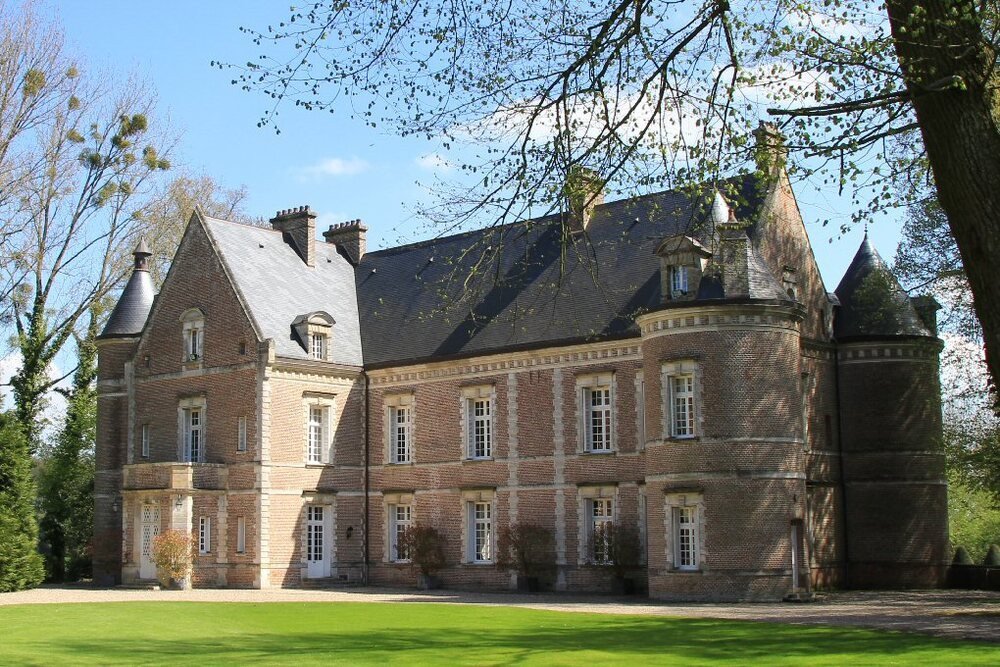
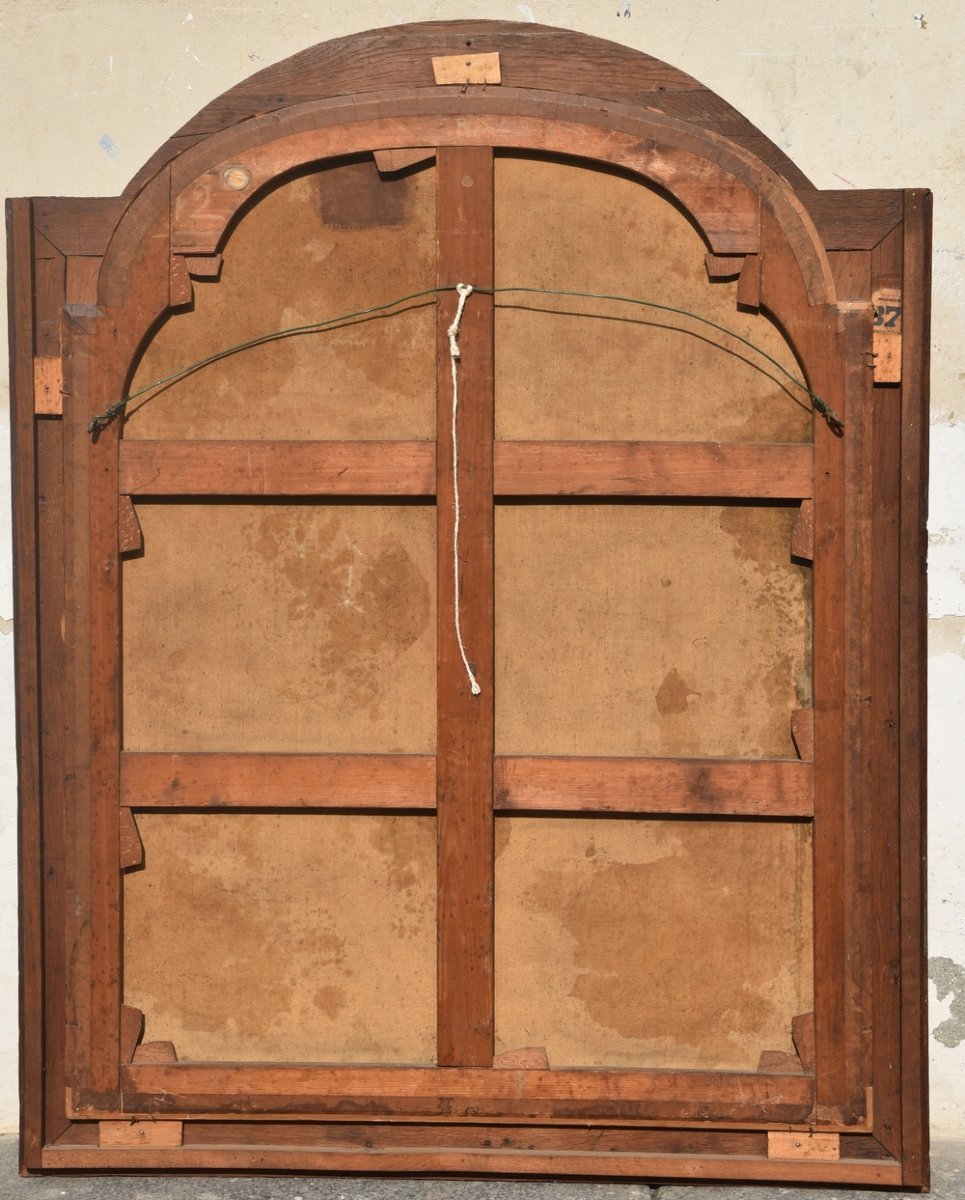
OIL ON CANVAS Dimensions: 155 x 120 cm Provenance: Huppy Castle Collection (France)
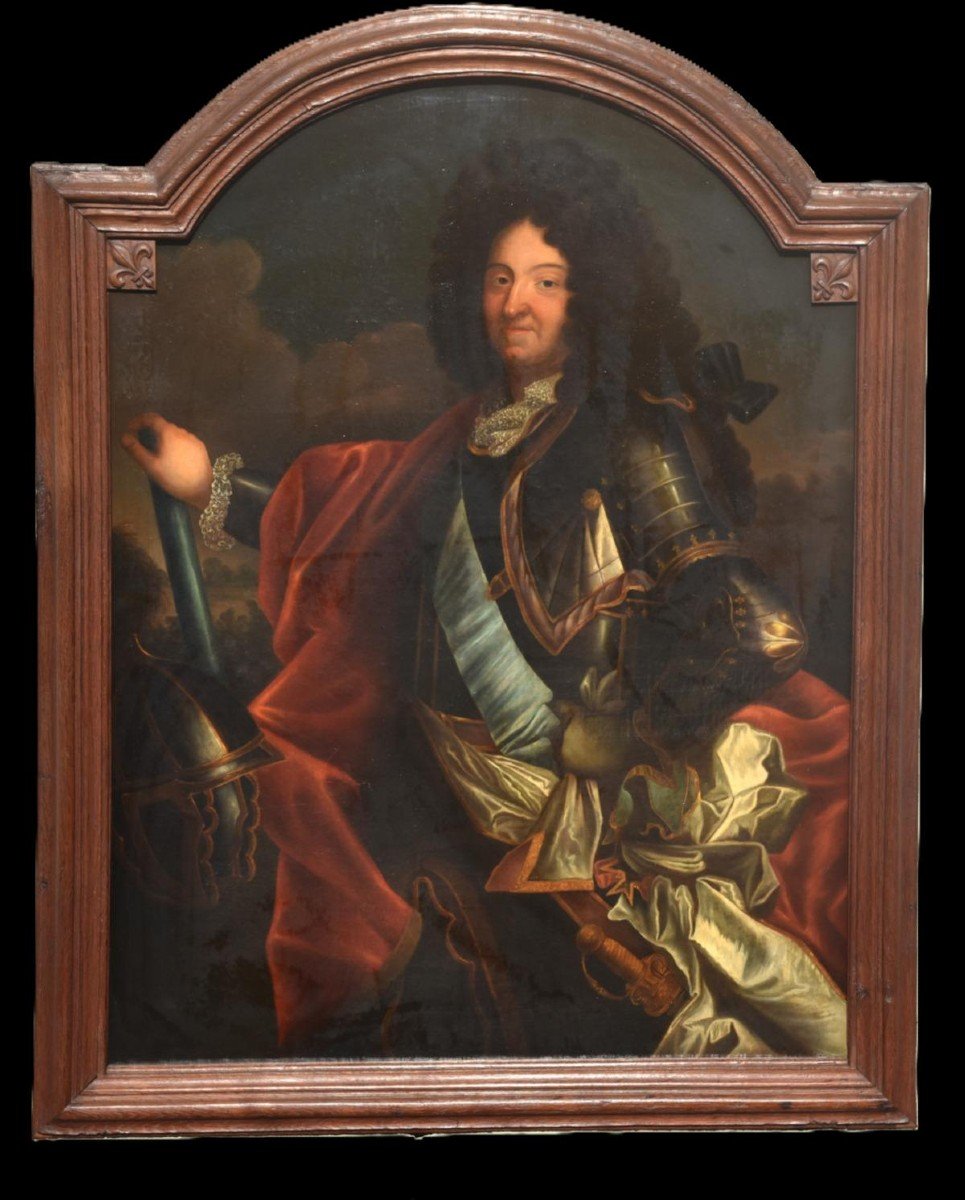
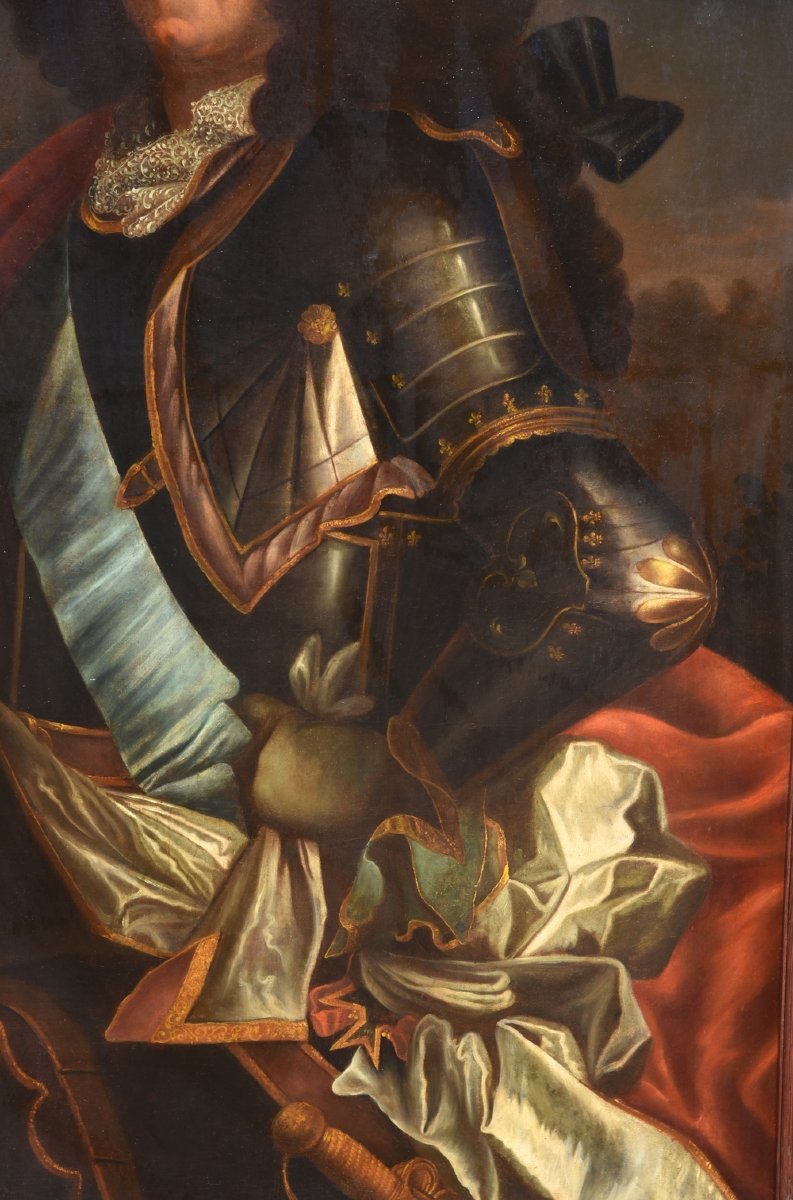
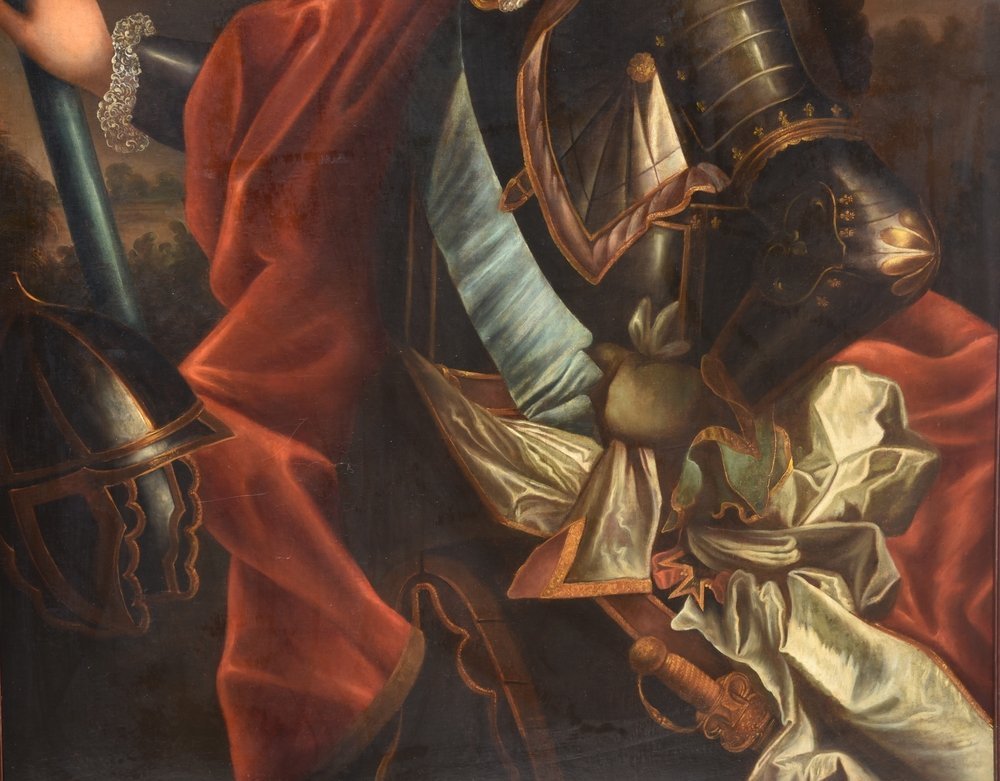
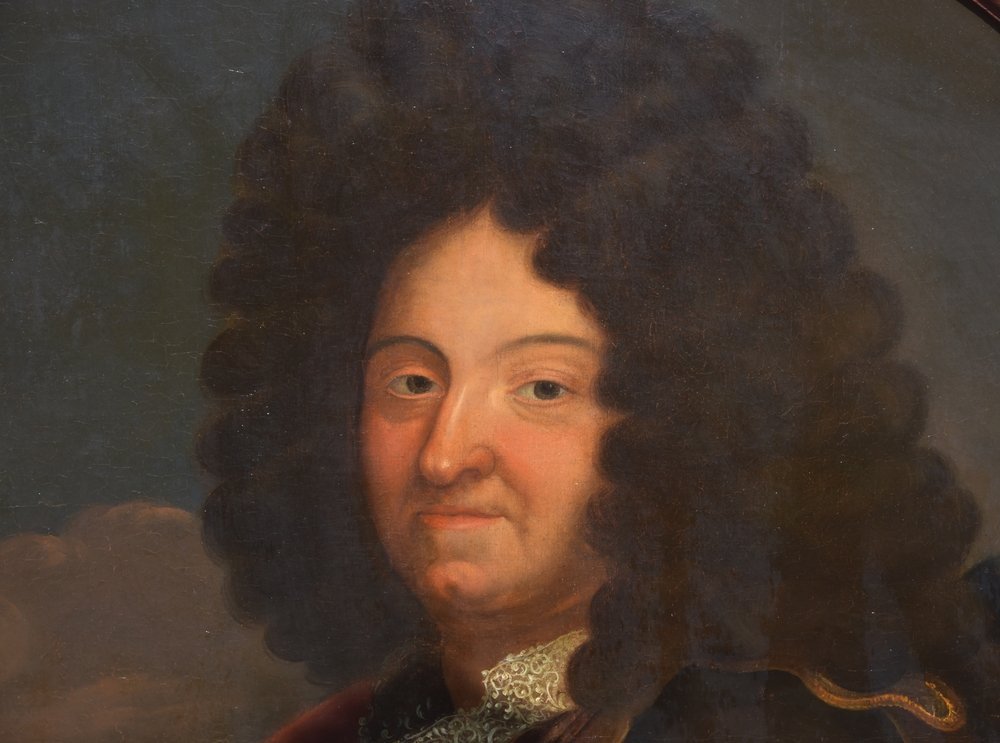
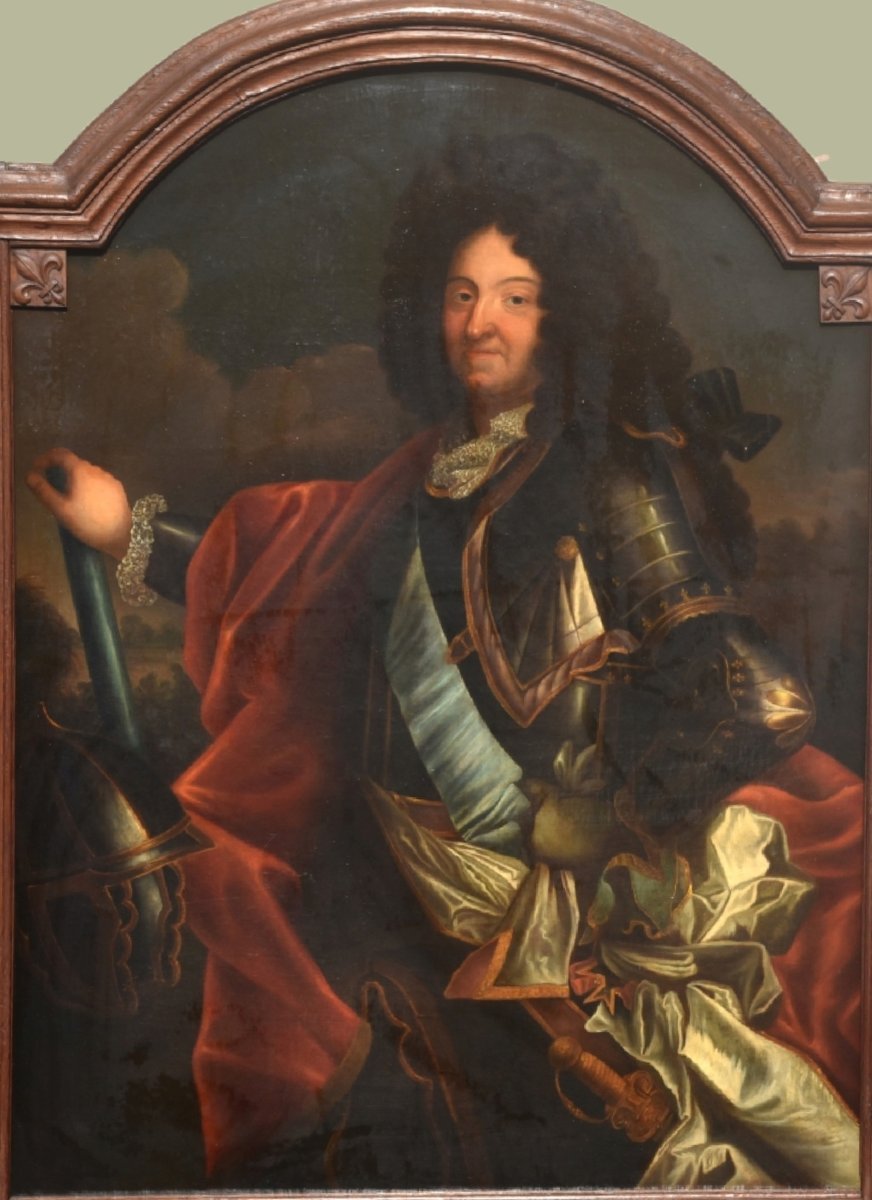
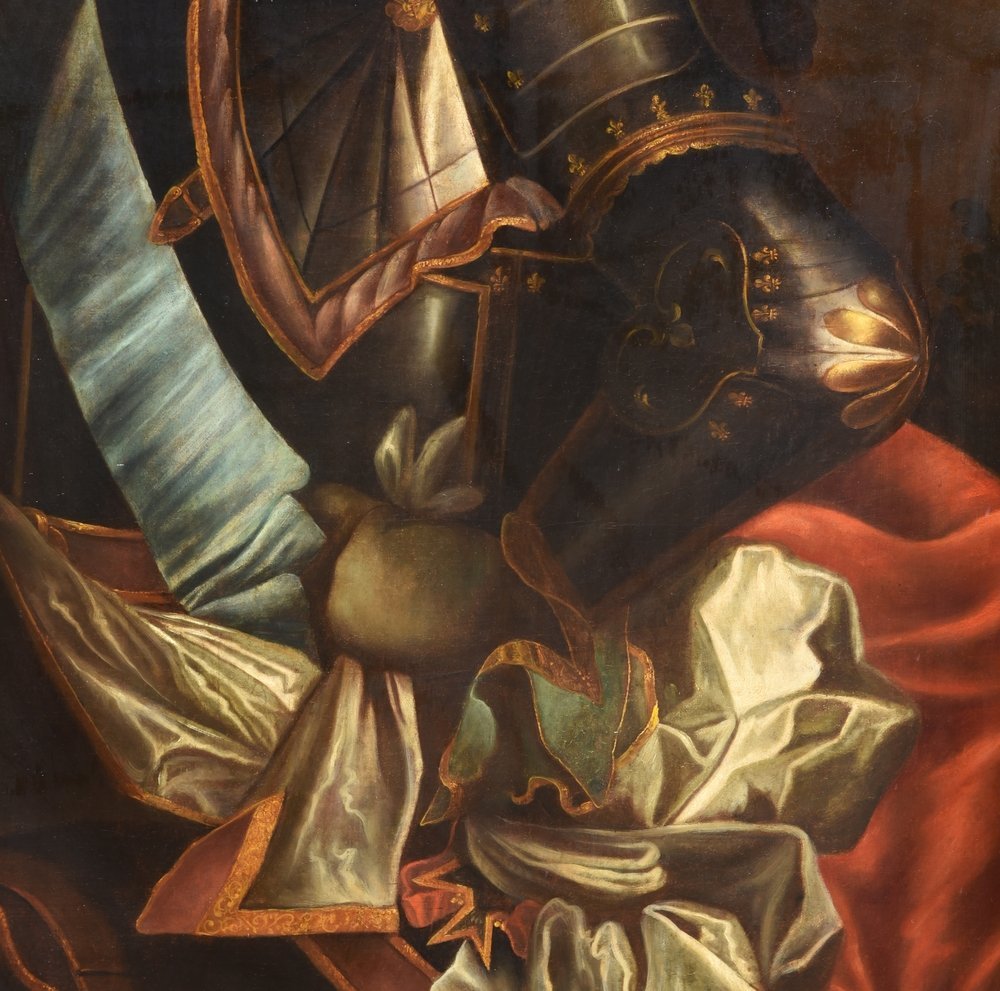
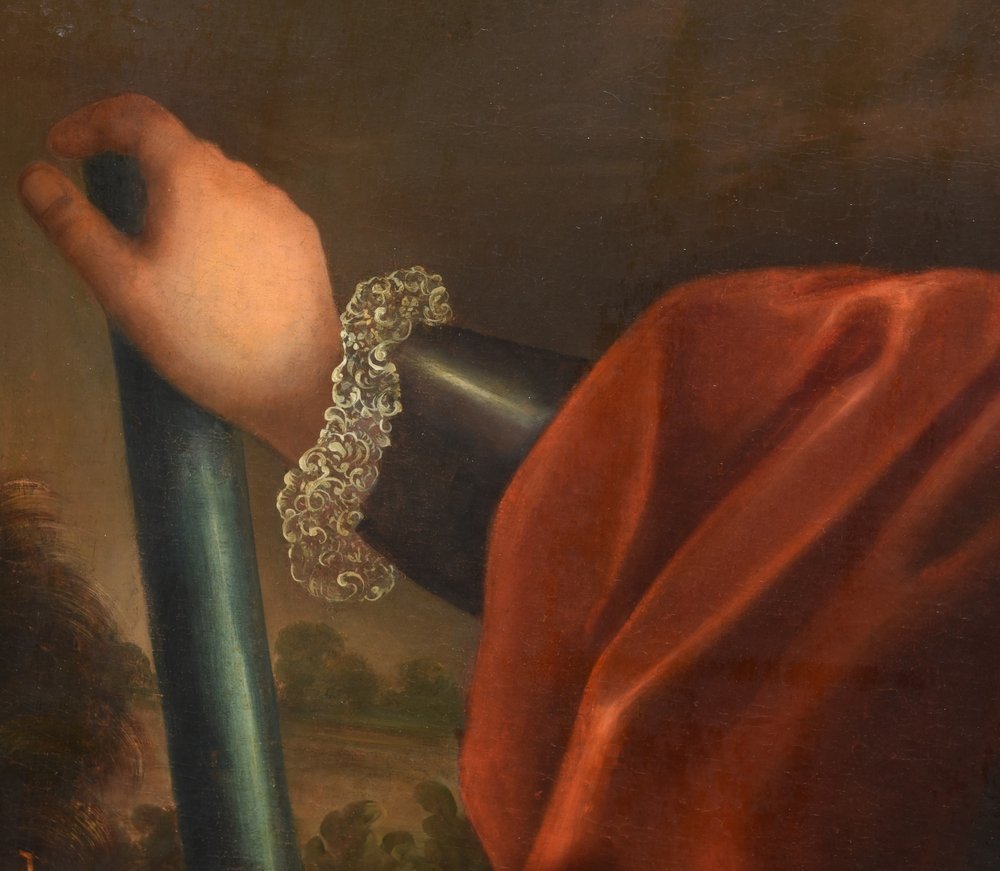
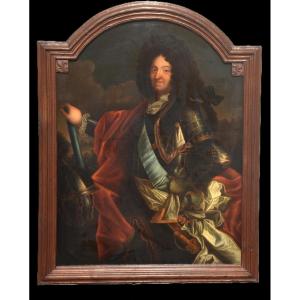
DESCRIPTION OF THE WORK In a three-quarter-length portrait set against what appears to be a battlefield, the French monarch Louis XIV poses proudly and confidently, wearing gleaming, polished armor. In the 18th century, military attire evolved into a full-fledged parade uniform, comparable to the elegant court attire. Refined, colorful details adorn the armor: the two breastplates and the white gauntlets feature slits at the wrists, and a lace jabot is tied around the neck. The gleaming armor, studded with ornate lilies, and the equally resplendent helmet lend the figure a military bearing. The rhetoric of royal power shines through in the portrait: the blue ribbon across the chest is a tribute to the Order of Saint-Esprit, to which the sovereign belongs; the golden lilies engraved on the elbows are the heraldic symbol of the Bourbons; and his right hand grasps a scepter and rests on a discarded helmet. The sovereign’s enormous wig (“the most Baroque expression of the Baroque”). At the back, a black bow gently ties the curls that fall down his back. To emphasize the wig so strongly, the hairdressers at Versailles required the cheeks and face to be completely shaved. The refined painterly quality and attention to detail place this painting in the workshop of the famous court portraitist Hyacinthe Rigaud. Louis XIV (Louis Dieudonné; September 5, 1638 – September 1, 1715), also known as Louis the Great (Louis le Grand) or the Sun King (le Roi Soleil), was King of France from May 14, 1643, until his death in 1715. His reign, which lasted 72 years and 110 days, is the longest ever recorded for a monarch of a sovereign state. The France of Louis XIV was emblematic of the era of absolutism in Europe. The king surrounded himself with a variety of prominent political, military, and cultural figures, such as Mazarin, Colbert, Louvois, the Grand Condé, Turenne, Vauban, Boulle, Molière, Racine, Boileau, La Fontaine, Lully, Charpentier, Marais, Le Brun, Rigaud, Bossuet, Le Vau, Mansart, Charles Perrault, Claude Perrault, and Le Nôtre. During the long reign of Louis XIV, France emerged as the leading European power and regularly demonstrated its military strength. Conflict with Spain marked his entire childhood, and during his reign, the kingdom took part in three major continental conflicts, each against powerful foreign alliances: the Franco-Dutch War, the War of the League of Augsburg, and the War of the Spanish Succession. France also fought shorter wars, such as the War of Devolution and the War of Réunion. War defined Louis XIV’s foreign policy, and his personality shaped his approach to it. Driven by “a mixture of self-interest, revenge, and resentment,” he believed that war was the ideal means of enhancing his own glory. In peacetime, he focused on preparing for the next war. He taught his diplomats that their task was to create tactical and strategic advantages for the French army. Upon his death in 1715, Louis XIV left his great-grandson and successor, Louis XV, a powerful kingdom, though one that was heavily in debt following the 13-year War of the Spanish Succession.
Hyacinthe Rigaud (July 18, 1659, Perpignan, France – December 29, 1743, Paris, France) was one of the most important portrait painters during the reign of Louis XIV. His instinct for imposing poses and grandiose depictions was perfectly suited to the tastes of the royalty, ambassadors, clergy, courtiers, and financiers who posed for him. Rigaud owes his fame to the loyal support he received from the four generations of Bourbons whose portraits he painted: King Louis XIV, then his son Louis, the Grand Dauphin, then the king’s grandson (son of the Grand Dauphin) Louis, Duke of Burgundy (also known as the Little Dauphin), and finally the Great Dauphin’s grandson (the Little Dauphin’s son), who became the next king: Louis XV, who succeeded his great-grandfather Louis XIV in 1715. His clientele consisted primarily of the wealthiest circles, as well as the bourgeoisie, financiers, nobles, industrialists, and government ministers; he also courted all the major ambassadors of the era and several European monarchs. His body of work presents itself as a nearly complete gallery of portraits of the leading French figures from 1680 to 1740. The work will be shipped in a wooden case and will be accompanied by a certificate of authenticity.
DESCRIPTION OF THE WORK In a three-quarter-length portrait set against what appears to be a battlefield, the French monarch Louis XIV poses proudly and confidently, wearing gleaming, polished armor. In the 18th century, military attire evolved into a full-fledged parade uniform, comparable to the elegant court attire. Refined, colorful details adorn the armor: the two breastplates and the white gauntlets feature slits at the wrists, and a lace jabot is tied around the neck. The gleaming armor, studded with ornate lilies, and the equally resplendent helmet lend the figure a military bearing. The rhetoric of royal power shines through in the portrait: the blue ribbon across the chest is a tribute to the Order of Saint-Esprit, to which the sovereign belongs; the golden lilies engraved on the elbows are the heraldic symbol of the Bourbons; and his right hand grasps a scepter and rests on a discarded helmet. The sovereign’s enormous wig (“the most Baroque expression of the Baroque”). At the back, a black bow gently ties the curls that fall down his back. To emphasize the wig so strongly, the hairdressers at Versailles required the cheeks and face to be completely shaved. The refined painterly quality and attention to detail place this painting in the workshop of the famous court portraitist Hyacinthe Rigaud. Louis XIV (Louis Dieudonné; September 5, 1638 – September 1, 1715), also known as Louis the Great (Louis le Grand) or the Sun King (le Roi Soleil), was King of France from May 14, 1643, until his death in 1715. His reign, which lasted 72 years and 110 days, is the longest ever recorded for a monarch of a sovereign state. The France of Louis XIV was emblematic of the era of absolutism in Europe. The king surrounded himself with a variety of prominent political, military, and cultural figures, such as Mazarin, Colbert, Louvois, the Grand Condé, Turenne, Vauban, Boulle, Molière, Racine, Boileau, La Fontaine, Lully, Charpentier, Marais, Le Brun, Rigaud, Bossuet, Le Vau, Mansart, Charles Perrault, Claude Perrault, and Le Nôtre. During the long reign of Louis XIV, France emerged as the leading European power and regularly demonstrated its military strength. Conflict with Spain marked his entire childhood, and during his reign, the kingdom took part in three major continental conflicts, each against powerful foreign alliances: the Franco-Dutch War, the War of the League of Augsburg, and the War of the Spanish Succession. France also fought shorter wars, such as the War of Devolution and the War of Réunion. War defined Louis XIV’s foreign policy, and his personality shaped his approach to it. Driven by “a mixture of self-interest, revenge, and resentment,” he believed that war was the ideal means of enhancing his own glory. In peacetime, he focused on preparing for the next war. He taught his diplomats that their task was to create tactical and strategic advantages for the French army. Upon his death in 1715, Louis XIV left his great-grandson and successor, Louis XV, a powerful kingdom, though one that was heavily in debt following the 13-year War of the Spanish Succession.
Hyacinthe Rigaud (July 18, 1659, Perpignan, France – December 29, 1743, Paris, France) was one of the most important portrait painters during the reign of Louis XIV. His instinct for imposing poses and grandiose depictions was perfectly suited to the tastes of the royalty, ambassadors, clergy, courtiers, and financiers who posed for him. Rigaud owes his fame to the loyal support he received from the four generations of Bourbons whose portraits he painted: King Louis XIV, then his son Louis, the Grand Dauphin, then the king’s grandson (son of the Grand Dauphin) Louis, Duke of Burgundy (also known as the Little Dauphin), and finally the Great Dauphin’s grandson (the Little Dauphin’s son), who became the next king: Louis XV, who succeeded his great-grandfather Louis XIV in 1715. His clientele consisted primarily of the wealthiest circles, as well as the bourgeoisie, financiers, nobles, industrialists, and government ministers; he also courted all the major ambassadors of the era and several European monarchs. His body of work presents itself as a nearly complete gallery of portraits of the leading French figures from 1680 to 1740. The work will be shipped in a wooden case and will be accompanied by a certificate of authenticity.
11 500 €
Period: 18th century
Style: Louis 14th, Regency
Condition: Excellent condition
Material: Oil painting
Width: 120
Height: 155
Reference (ID): 1808702
Availability: In stock
Print