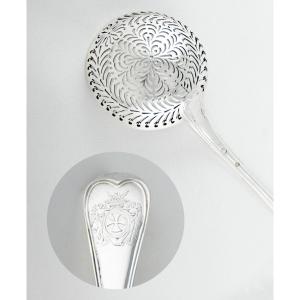


Paris, 1810–1819 – Solid Silver Sugar Sifter Spoon With Cumont Arms, By Andrieu
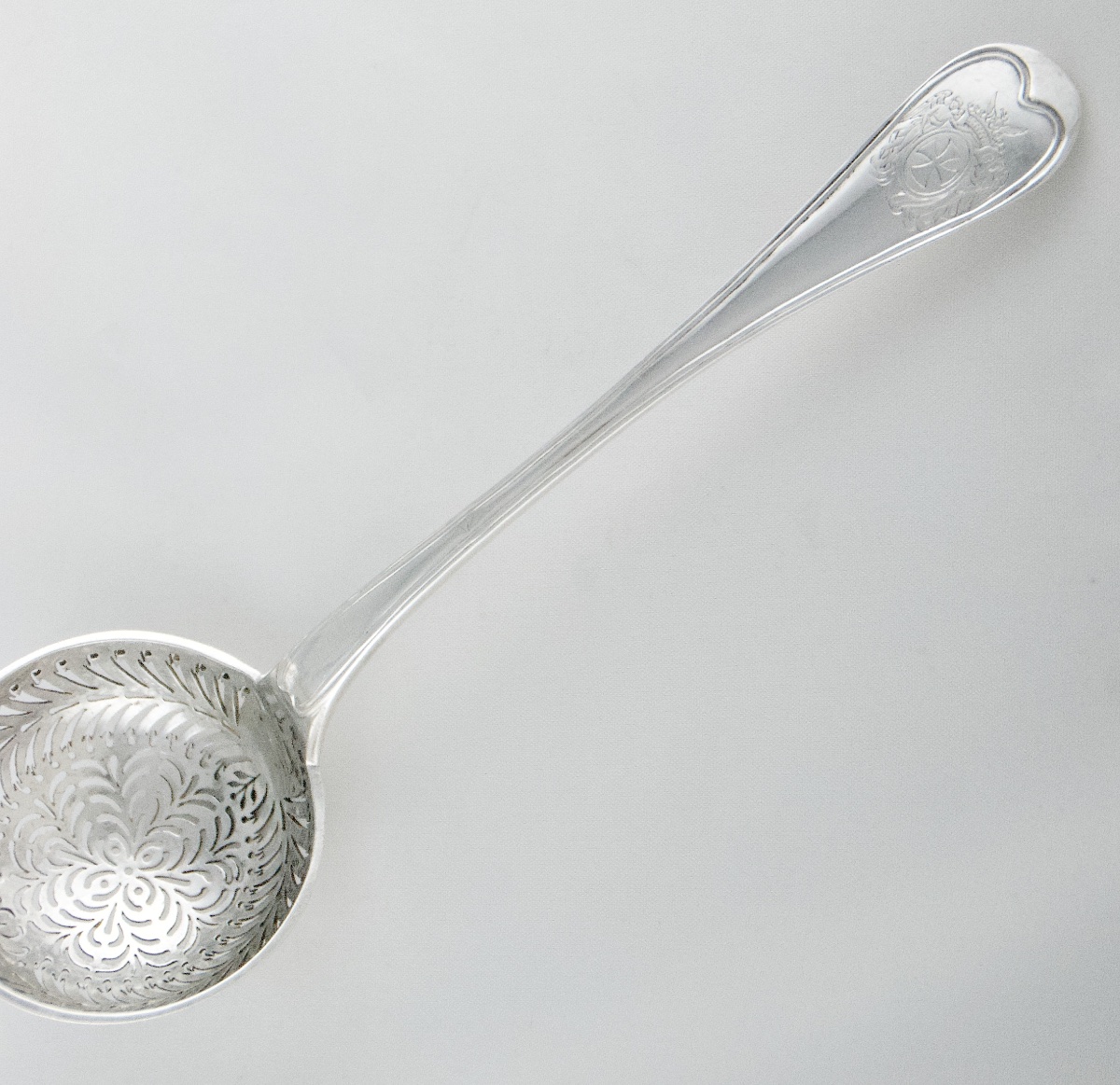
Elegant first-standard solid silver sugar sifter spoon (950/1000 fineness), made in Paris between 1810 and 1819 by the silversmith E.-P. ANDRIEU.
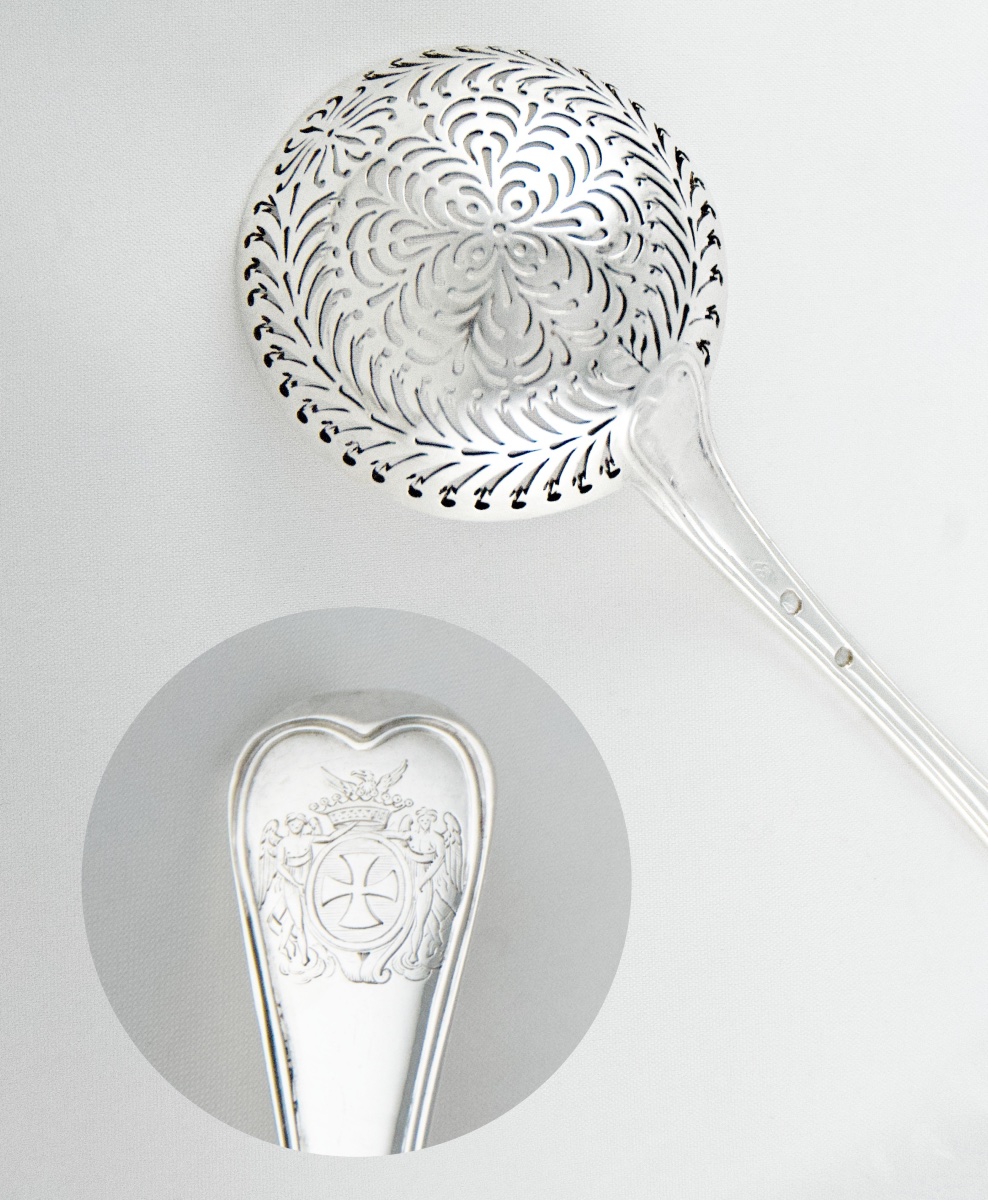
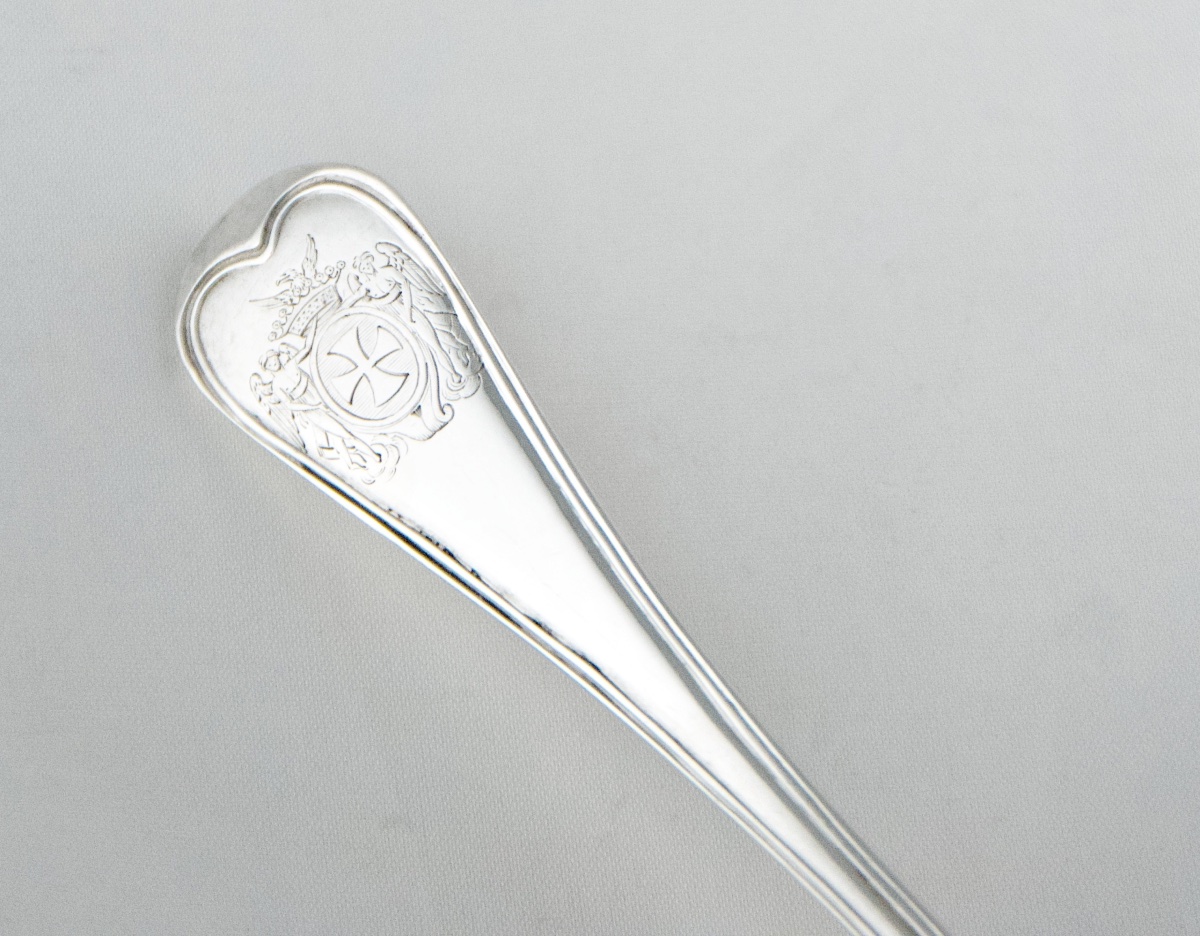
The handle, fashioned in the thread pattern, has a gently curved stem bordered by mouldings which flow gracefully towards the terminal, ending in a delicately notched outline.
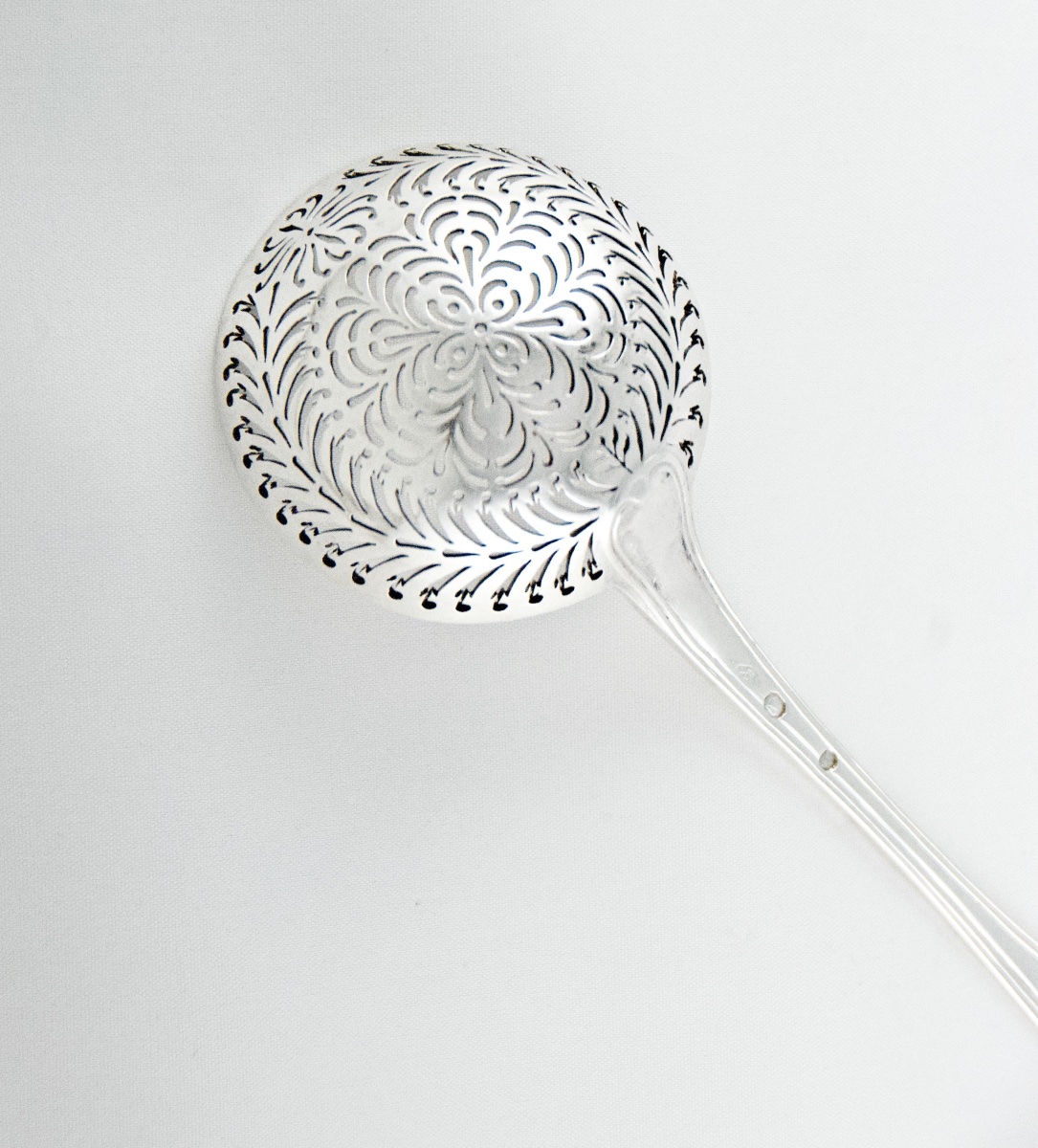
The deep, circular bowl is finely pierced throughout with an elaborate foliate design. At its centre is a large radiating rosette composed of palmettes and stylised leaves. It is surrounded by a network of lanceolate foliage and small palmettes forming a regular border around the edge. The delicacy and density of the piercing create an elegant lace-like effect.
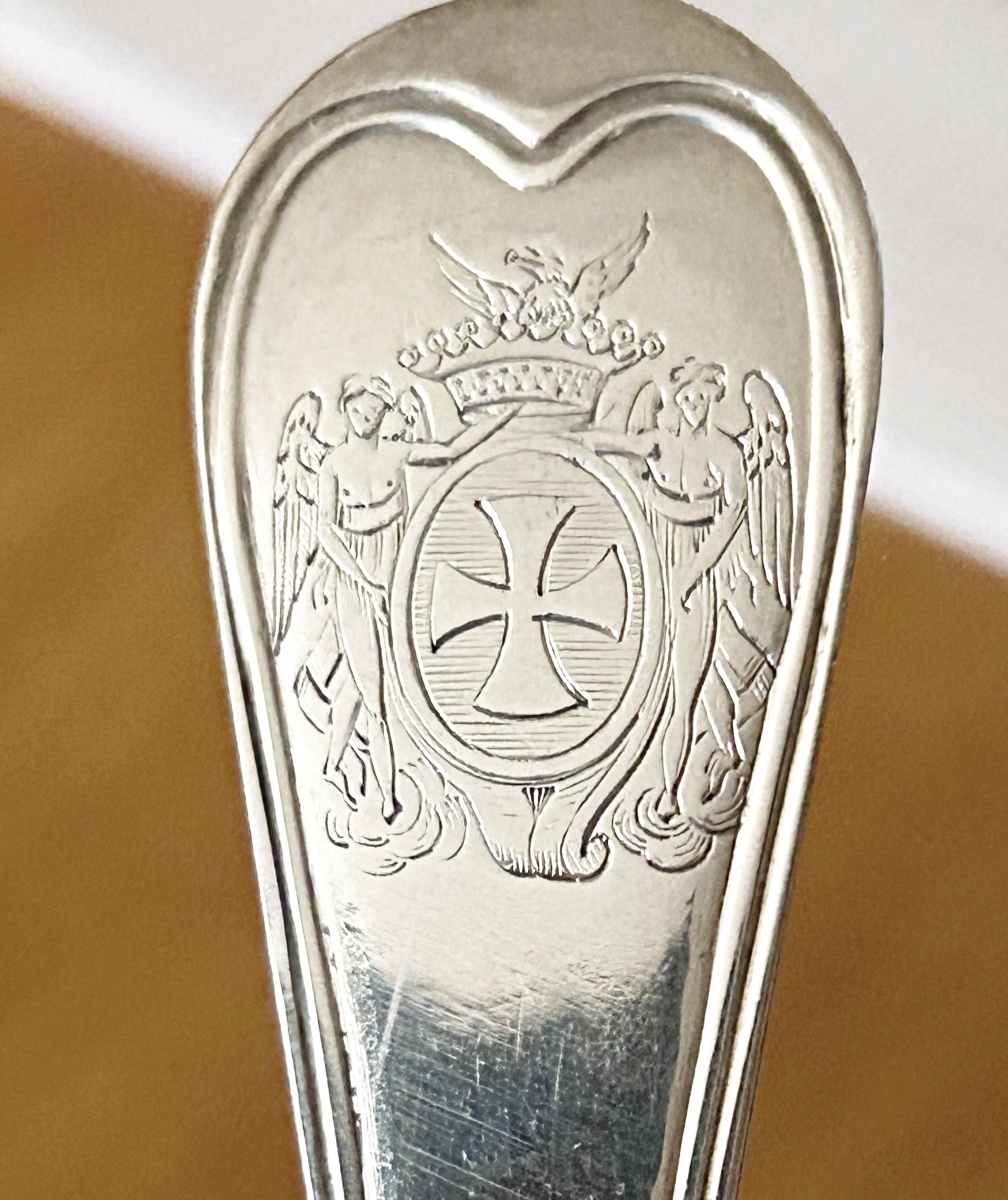
The terminal is engraved with a coat of arms attributed to the CUMONT family: Azure, a cross pattée couped Argent. The oval shield, set within a cartouche, is held by two angels and surmounted by a count’s coronet beneath an eagle rising.
Empire period or early years of the Bourbon Restoration.
Hallmarks
- Second Rooster, first standard: Paris hallmark for 950/1000 silver, used between 1809 and 1819.
- Paris guarantee mark.
- Maker’s mark: E.P.A. with two crossed spoons, for E.-P. ANDRIEU.
Dimensions
- Length: 20.8 cm (8.19 in).
- Bowl diameter: 6 cm (2.36 in).
Weight: 69.31 grams (2.23 troy oz).
Condition report:
Very fine condition. Light surface scratches consistent with age and use. The pierced decoration and heraldic engraving are well preserved.
The delicacy and regularity of the piercing, the care devoted to the heraldic engraving and the harmonious proportions make this spoon a particularly fine example of Parisian silverwork from the late Empire period or the early years of the Bourbon Restoration.
HISTORY
E.-P. ANDRIEU registered his maker’s mark in Paris in 1810. At that time, he was established at 29 place Thionville, now place Dauphine, and was subsequently recorded in 1813 at 6 cour Lamoignon. His activity is documented in Parisian almanacs until at least 1821.
The coat of arms engraved on the terminal is attributed to the CUMONT family, an old noble family originating in Périgord, several branches of which later settled in Poitou, Saintonge and Anjou. The family appears to have been documented from the 14th century onwards: Hugues de CUMONT, a knight, is mentioned in 1340, while Giraud de CUMONT, an esquire, is recorded in 1351. A seal dated 1340 already bears a cross pattée, demonstrating the early use of this family emblem.
The family’s arms were registered in 1698 in the Armorial général de France, in the register for the généralité of La Rochelle. Alfred de FROIDEFOND DE BOULAZAC and Henri JOUGLA DE MORENAS blazon them as: Azure, a cross pattée couped Argent. Some cadet branches are thought to have adopted three crosses pattée as a mark of difference. The single cross engraved on the present spoon therefore corresponds to the arms traditionally associated with the senior branch.
At the time the spoon was made, Louis-Timothée-Charles-François de CUMONT (1765–1852), known as the Count de Cumont, was still living. The chronological correspondence and the presence of a count’s coronet suggest that the arms may relate to him or to a member of his family. In the absence of a documented provenance or another object bearing an identical heraldic composition, however, this identification must remain hypothetical.
BIBLIOGRAPHY
· Archive de la Garantie, Paris, hallmark plates nos. 15 and 19.
· Almanach Azur. 1811–1821.
· Almanach du Commerce 1813, 1815.
· ARMINJON C. et al., Dictionnaire des poinçons de fabricants d’ouvrages d’or et d’argent de Paris et de la Seine, 1798–1838, Paris, 1991.
· FILLEAU, H., Dictionnaire historique, biographique et généalogique des familles de l’ancien Poitou. Volume II.
· FROIDEFOND DE BOULAZAC, A. de, Armorial de la noblesse du Périgord, Vol. I, Périgueux, 1891.
· JOUGLA DE MORENAS, H., Grand Armorial deFrance, Vol. III, Paris, 1938.
Period: 19th century
Style: Consulat, Empire
Condition: Good condition
Material: Sterling silver
Length: 20,8 cm
Diameter: 6 cm
Reference (ID): 1804294
Availability: In stock