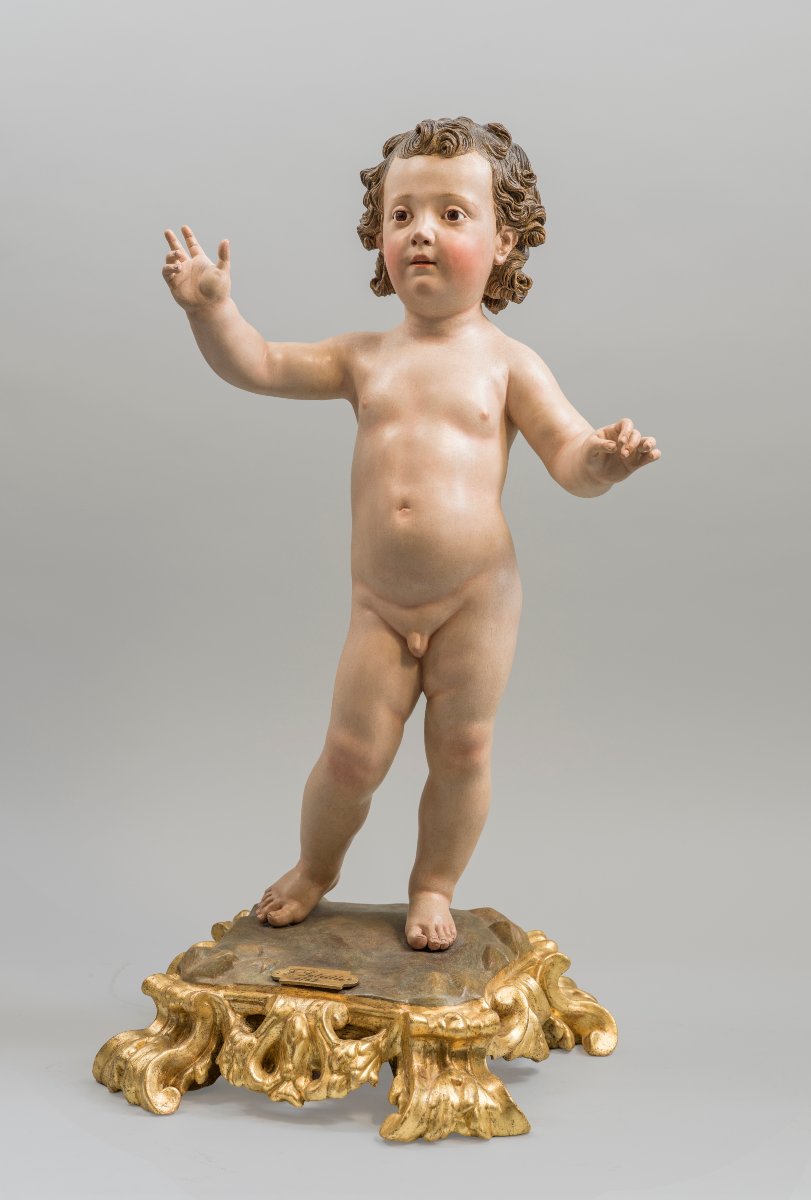


'baby Jesus. Carved And Polychrome Wood, Metal. Attributed To Francisco Salzillo'
'Infant Jesus.' Carved and polychrome wood, metal. Attributed to Francisco SALZILLO (Murcia, 1707–1783), 1762.
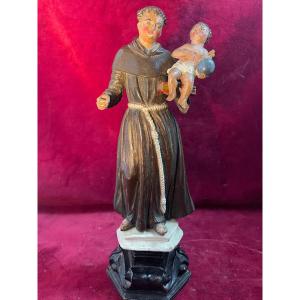
A carved and polychrome wooden sculpture depicting the Child Jesus standing, raising his right arm and extending his left arm, fingers joined. It rests on a gilded pedestal adorned with volutes, architectural elements, and foliage on the front, and whose polychrome upper section evokes a dirt floor strewn with stones. The front features a cartouche, likely added after the sculpture was completed, bearing the inscription (F. Salzillo / 1762). Francisco Salzillo y Alcaraz was a sculptor from Murcia who ran the family workshop (his father was an Italian sculptor), in which some of his brothers also worked. Over time, his reputation grew, as did the number of commissions. In 1755, he was appointed “official sculptor of the Murcia City Council and inspector of painting and sculpture,” director of the Patriotic School of Drawing, and so on. His personal style became clearly evident in his work beginning in 1740, with pieces such as the Pietà commissioned by the Servite Brotherhood of the Parish of San Bartolomé in Murcia. Beginning in 1765, with the arrival of Roque López (his principal disciple) in the workshop, experts generally note a more industrialized production process. A shift in his work can be observed starting in 1776, with the incorporation of certain neoclassical details (the float “Christ in the Praetorium” at the Casa de Pilatos for the Brotherhood of the Ecce Homo in Orihuela). This Infant Jesus bears a strong resemblance to the one housed at the Frédéric Marès Museum in Barcelona, Spain, which dates from 1750 to 1770 and is considered to belong to the “Child of the Passion” type. According to records, this figure of Jesus came from the Rebagliato family: Don Andrés Rebagliato y Pescetto was the father of Montserrate Rebagliato y Sorzano de Tejada, who married Mr. Carlos Coig O’Donnell y Macé, owner of the La Coronela estate (also known as Torresella) as well as the Rebolledo estate and its hermitage, and who later sold that estate. The Infant Jesus was originally located in the estate’s oratory, from where it was transferred to the estate in Torrejón de Ardoz (the Cutoli-Sandoval manor and its surroundings, where Doña Beatriz Coig y Rebagliato, O’Donnell y Sorzano de Tejada. She married Don Salvador de Sandoval y Cútoli, who was born in Torrejón de Ardoz, at La Coronela in 1910). A descendant of this family, Don Evaristo Martín de Sandoval y Freire, presented the statue to his wife, Doña Carmen Travesedo Colón de Carvajal, as a wedding gift in 1972. She had it restored after it had sustained damage during the Spanish Civil War. ·
Dimensions: 42 x 36 x 76 cm. Height of the child without the base: 65 cm
A carved and polychrome wooden sculpture depicting the Child Jesus standing, raising his right arm and extending his left arm, fingers joined. It rests on a gilded pedestal adorned with volutes, architectural elements, and foliage on the front, and whose polychrome upper section evokes a dirt floor strewn with stones. The front features a cartouche, likely added after the sculpture was completed, bearing the inscription (F. Salzillo / 1762). Francisco Salzillo y Alcaraz was a sculptor from Murcia who ran the family workshop (his father was an Italian sculptor), in which some of his brothers also worked. Over time, his reputation grew, as did the number of commissions. In 1755, he was appointed “official sculptor of the Murcia City Council and inspector of painting and sculpture,” director of the Patriotic School of Drawing, and so on. His personal style became clearly evident in his work beginning in 1740, with pieces such as the Pietà commissioned by the Servite Brotherhood of the Parish of San Bartolomé in Murcia. Beginning in 1765, with the arrival of Roque López (his principal disciple) in the workshop, experts generally note a more industrialized production process. A shift in his work can be observed starting in 1776, with the incorporation of certain neoclassical details (the float “Christ in the Praetorium” at the Casa de Pilatos for the Brotherhood of the Ecce Homo in Orihuela). This Infant Jesus bears a strong resemblance to the one housed at the Frédéric Marès Museum in Barcelona, Spain, which dates from 1750 to 1770 and is considered to belong to the “Child of the Passion” type. According to records, this figure of Jesus came from the Rebagliato family: Don Andrés Rebagliato y Pescetto was the father of Montserrate Rebagliato y Sorzano de Tejada, who married Mr. Carlos Coig O’Donnell y Macé, owner of the La Coronela estate (also known as Torresella) as well as the Rebolledo estate and its hermitage, and who later sold that estate. The Infant Jesus was originally located in the estate’s oratory, from where it was transferred to the estate in Torrejón de Ardoz (the Cutoli-Sandoval manor and its surroundings, where Doña Beatriz Coig y Rebagliato, O’Donnell y Sorzano de Tejada. She married Don Salvador de Sandoval y Cútoli, who was born in Torrejón de Ardoz, at La Coronela in 1910). A descendant of this family, Don Evaristo Martín de Sandoval y Freire, presented the statue to his wife, Doña Carmen Travesedo Colón de Carvajal, as a wedding gift in 1972. She had it restored after it had sustained damage during the Spanish Civil War. ·
Dimensions: 42 x 36 x 76 cm. Height of the child without the base: 65 cm
30 000 €
Period: 17th century
Style: Other Style
Condition: En l'etat
Material: Painted wood
Width: 42 cm
Height: 76 cm
Depth: 36 cm
Reference (ID): 1802424
Availability: In stock
Print