
Sculpted Lintel With Heraldic Motifs, Pietra Serena Florence, It — 2nd Half Of The 15th Century
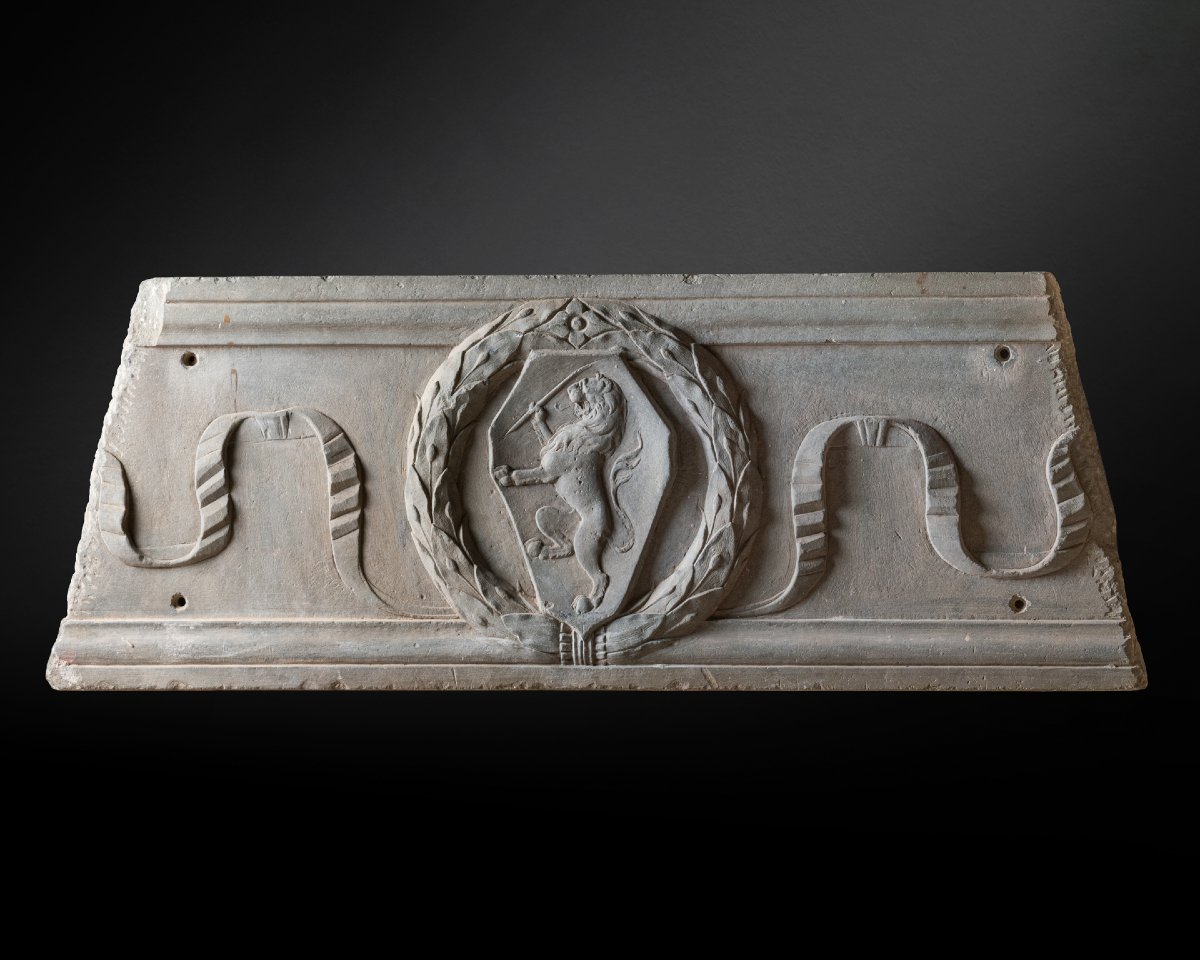
This
pietra serena lintel is carved in bas-relief with a ribbon motif and is
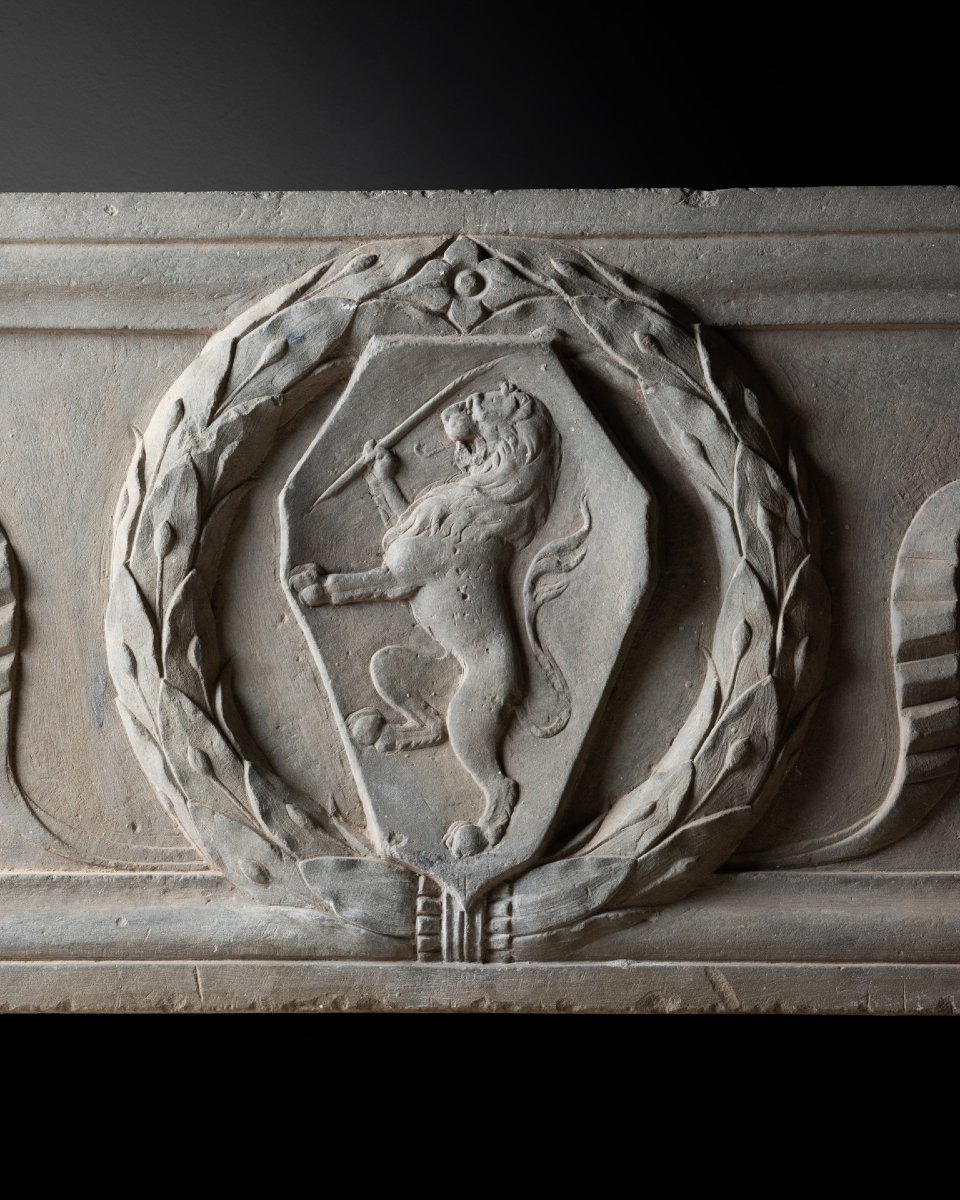
adorned in the centre with a medallion in the shape of a wreath of intertwined
laurel branches. In the centre is a medieval-style heraldic shield. It features
a heraldic design, comprising a lion standing on one paw and delicately holding
a stem; the lion is a common figure in heraldry. It is framed, at the top and
bottom, by a decoration of broad, flat mouldings. Originally, it probably
adorned a door lintel or a fireplace. The lintel has four holes for fixing it
in place; these holes were probably made when the lintel was repositioned on a
wall later.
Pietra serena is a type of limestone characteristic of the Florence region. During the Renaissance, it was widely used in sculpture, notably by Donatello (1386-1466) for the Relief of the Annunciation in the Church of Santa Croce in Florence. It was also used by Gregorio di Lorenzo (active in Tuscany between 1470 and 1500), who employed it for his relief portraits, such as the Ideal Portrait of Emperor Galba, now housed in the Louvre. Pietra serena was also used for architectural decoration in Florence and the surrounding region, primarily during the Renaissance. Filippo Brunelleschi (13771446) made extensive use of it in his various architectural works: the Ospedale degli Innocenti, the Basilica of Santo Spirito, the Pazzi Chapel, and so on.
Here, the sculptor demonstrates his skill through the delicate interplay of the ribbon, which bends and folds throughout the bas-relief, which is less than a centimetre thick. The central medallion features a braided laurel wreath, typical of the second half of the 15th century. As for the rearing lion, masterfully executed, it elegantly forms the centre of the medallion. These two elements - the wreath and the lion - are also found on two pietra serena lintels still preserved in Florence. One is at the Convent of San Marco, where only a lion’s paw is depicted within a laurel wreath, whilst a ribbon runs on either side of the central motif. In the second, attributed to Ferrucci Francesco di Simone (1437-1493), the central motif is surrounded by two putti delicately holding the wreath.
The composition of our lintel - symmetrical and clear, without excessive ornamentation - proves to be particularly attractive and refined, typical of Tuscan production in the second half of the fifteenth century.
Pietra serena is a type of limestone characteristic of the Florence region. During the Renaissance, it was widely used in sculpture, notably by Donatello (1386-1466) for the Relief of the Annunciation in the Church of Santa Croce in Florence. It was also used by Gregorio di Lorenzo (active in Tuscany between 1470 and 1500), who employed it for his relief portraits, such as the Ideal Portrait of Emperor Galba, now housed in the Louvre. Pietra serena was also used for architectural decoration in Florence and the surrounding region, primarily during the Renaissance. Filippo Brunelleschi (13771446) made extensive use of it in his various architectural works: the Ospedale degli Innocenti, the Basilica of Santo Spirito, the Pazzi Chapel, and so on.
Here, the sculptor demonstrates his skill through the delicate interplay of the ribbon, which bends and folds throughout the bas-relief, which is less than a centimetre thick. The central medallion features a braided laurel wreath, typical of the second half of the 15th century. As for the rearing lion, masterfully executed, it elegantly forms the centre of the medallion. These two elements - the wreath and the lion - are also found on two pietra serena lintels still preserved in Florence. One is at the Convent of San Marco, where only a lion’s paw is depicted within a laurel wreath, whilst a ribbon runs on either side of the central motif. In the second, attributed to Ferrucci Francesco di Simone (1437-1493), the central motif is surrounded by two putti delicately holding the wreath.
The composition of our lintel - symmetrical and clear, without excessive ornamentation - proves to be particularly attractive and refined, typical of Tuscan production in the second half of the fifteenth century.
12 000 €
Period: Before 16th century
Style: Renaissance, Louis 13th
Condition: Good condition
Length: 97
Height: 37
Depth: 5
Reference (ID): 1800885
Availability: In stock
Print