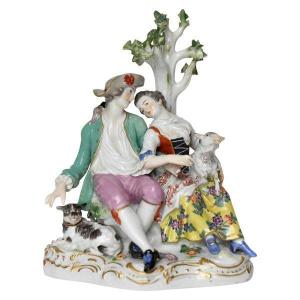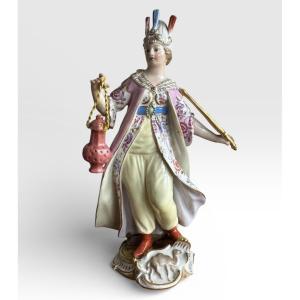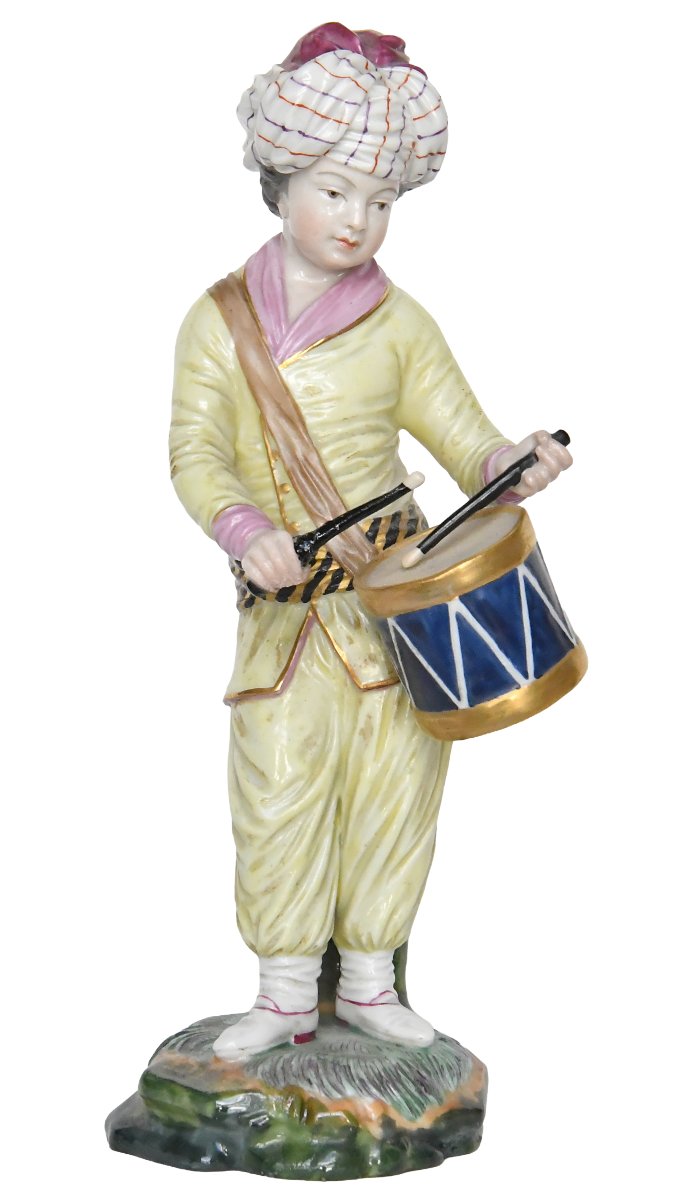
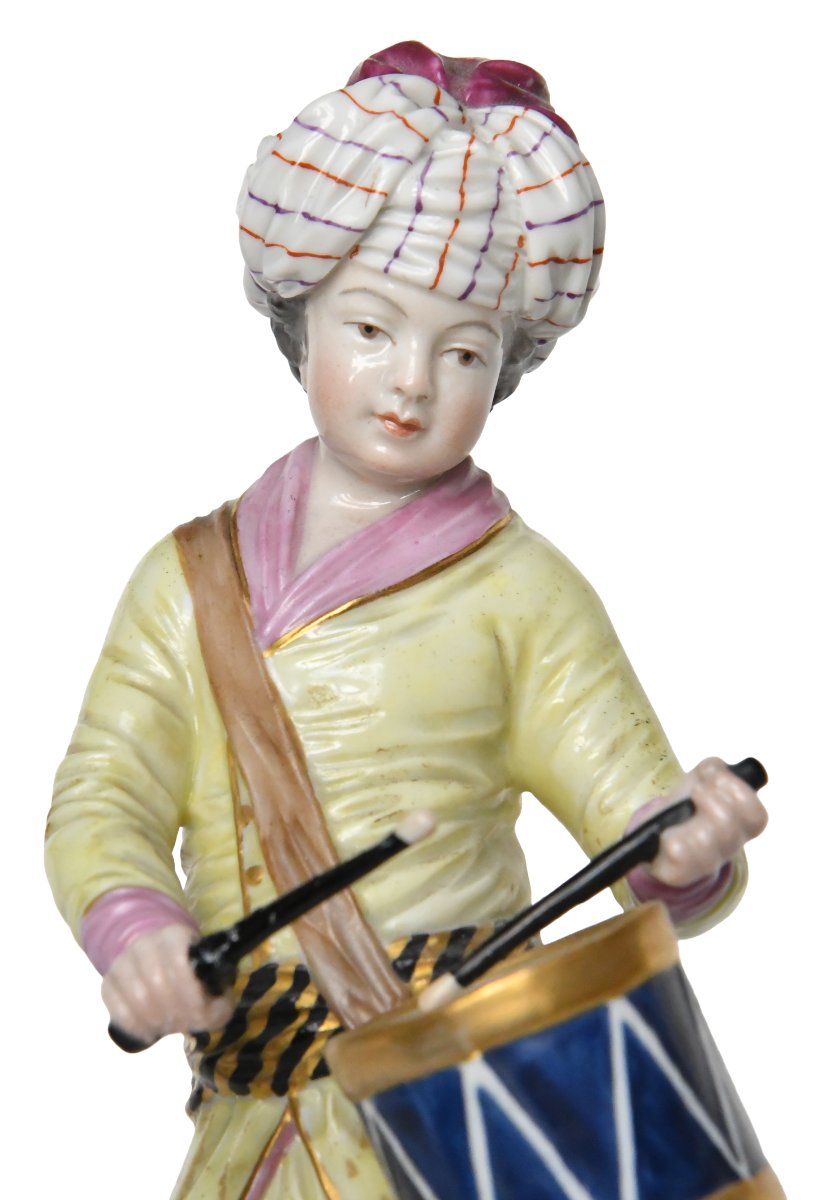
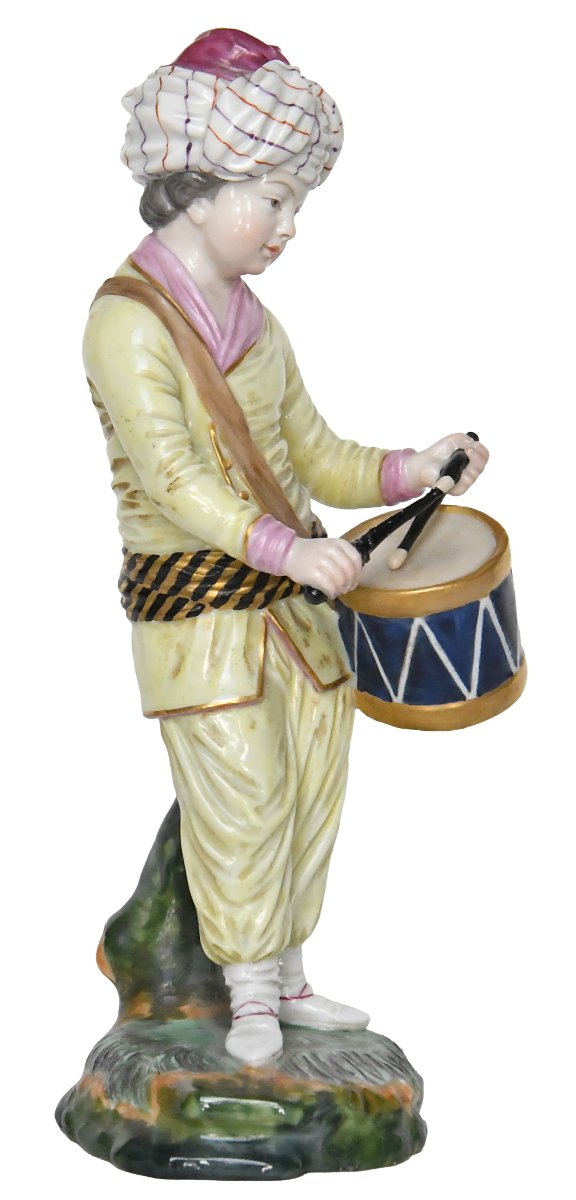
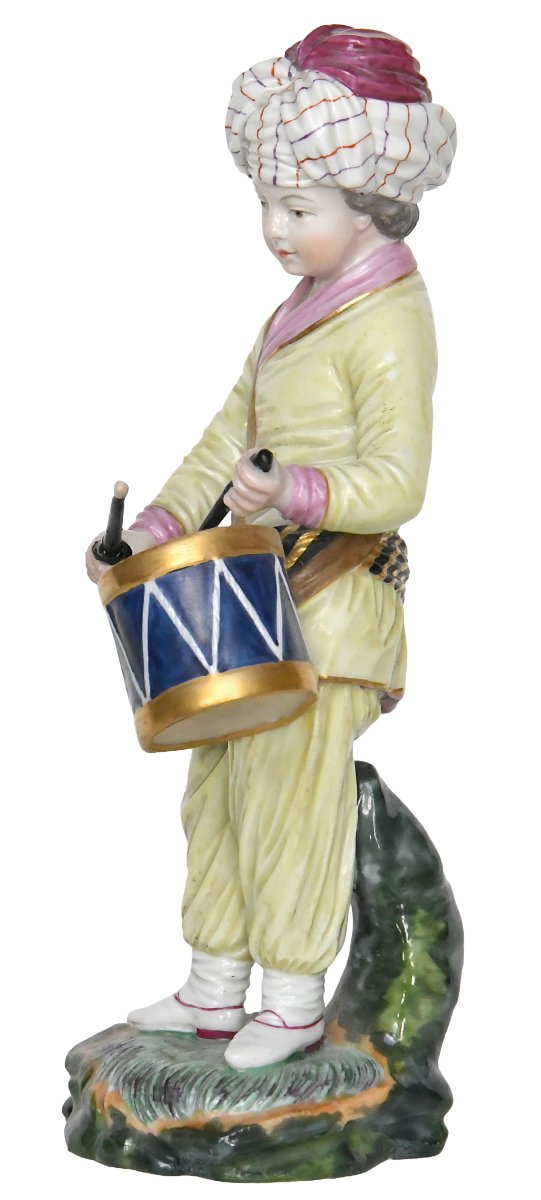
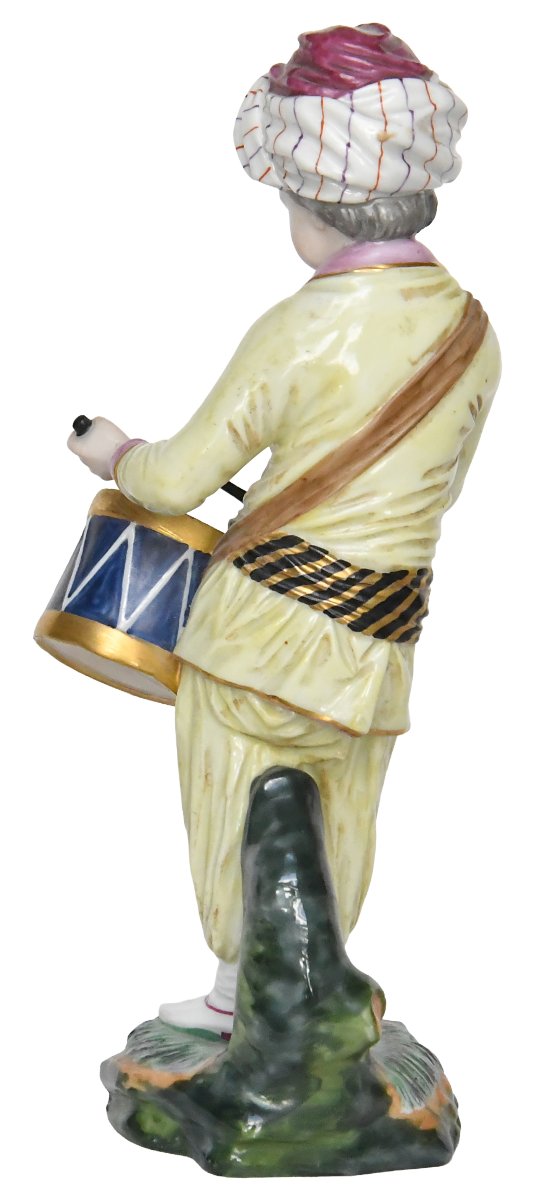
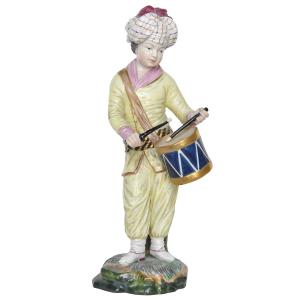


Höchst Passau Porcelain Figurine, Drummer From The "turkish Orchestra" Series
Porcelain figurine from Höchst Passau depicting a drummer from the "Turkish Orchestra" series
Designed by Johann Peter Melchior (circa 1779)
Late 19th / early 20th century
Height: 17 cm
The Höchst porcelain manufactory in Hesse (Germany) is known for the variety of its figurines, which were created by numerous designers over the course of its 50-year production run. These were often inspired by Meissen models, which they either imitated or adapted. However, models unique to Höchst were also designed based on drawings. They were also produced as bisque figurines, to be sold either unpainted or painted.
After the Höchst porcelain manufactory—located in a district of Frankfurt am Main in the German state of Hesse—closed in 1796, the factory and its inventory were sold at auction in 1798.
In 1840, Daniel Ernst Müller acquired the old figurine models for the fine earthenware factory he had founded in Damm, a district of Aschaffenburg, a city in Lower Franconia in the Free State of Bavaria within the Federal Republic of Germany, sometimes called “the Bavarian Nice” because of its relatively mild climate. Molds were created based on these original 18th-century porcelain figurines from the Höchst manufactory. Until 1884, versions of these highly popular figurines were thus produced in fine earthenware—sometimes partially retouched—and, sporadically, in porcelain.
In 1886–1887, the molds were in the possession of the Franz Anton Mehlem fine earthenware factory in Poppelsdorf, a former village that is now a district of the city of Bonn in the German state of North Rhine-Westphalia, but they were not used.
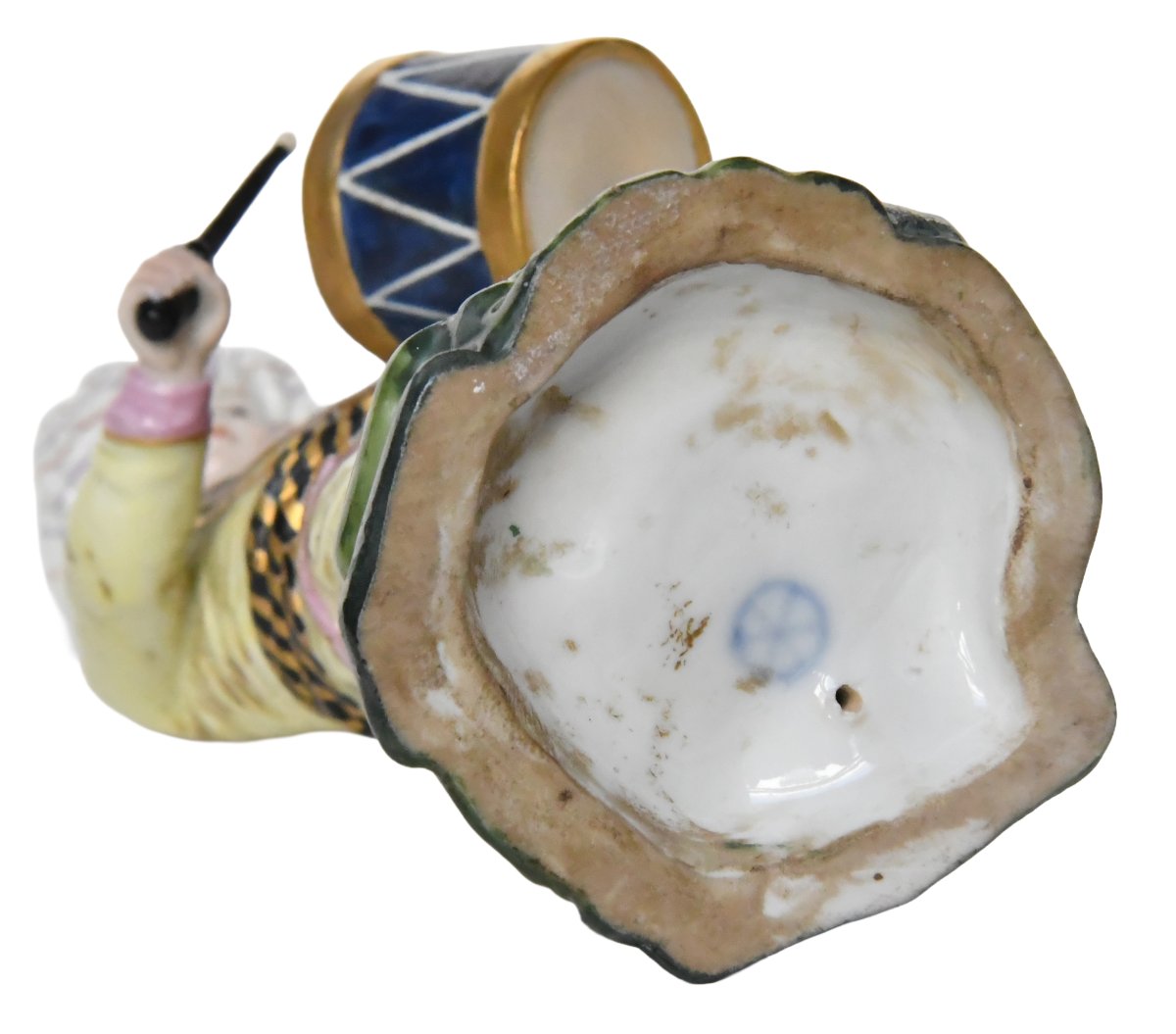
In 1903, the molds were acquired by the Dressel, Kister and Cie porcelain manufactory in Passau, in the German district of Lower Bavaria, where they were once again retouched and used for the production of porcelain figurines. Whether in Damm-Aschaffenburg or Passau, the new figurines were almost always marked with the wheel symbol used in the 18th century by the Höchst factory, sometimes combined with the letter “D” for Damm, and sometimes with a bishop’s crozier for Passau (From 739 onward, Passau became an episcopal see. By the end of the 10th century, the bishops ruled the city before becoming Imperial Princes in 1217, transforming the city into a Fürstbistum, an independent episcopal principality. The influence of the Prince-Bishops of Passau was then comparable to that of the Archbishops of Salzburg: they ruled a vast diocese that, until the 15th century, encompassed the entire Austrian Danube Valley, including Vienna).
In 1919, the company was sold and renamed “Aelteste Volkstedter Porzellanfabrik AG, Zweigniederlassung Passau—the Oldest Volkstedt Porcelain Factory, Inc., Passau Branch ” until its bankruptcy in 1936 (Volkstedt is a village in Thuringia, incorporated into the city of Rudolstadt in 1921, approximately 400 km north of Passau). In 1927, before it was incorporated into Frankfurt, the town of Höchst commissioned a complete set of copies of all the surviving molds from the Höchst Porcelain Manufactory. The approximately 350 reproductions of “Old Höchst” are still on display today in the reception rooms of the Bolongaro Palace in Frankfurt-Höchst and are under the responsibility and scientific supervision of the Frankfurt History Museum.
From 1937 to 1942, production continued under the name “Passau Porcelain Factory” before the factory was destroyed and looted at the end of World War II. Until the start of World War II, it is likely that the “Vieux-Höchst” reproductions were ultimately produced using the molds that were still located at the Dressel, Kister and Cie Porcelain Manufactory in Passau.
Some of these molds were sent to the “Oberhausmuseum – Museum of the Upper House” in Passau and, during its restructuring, were sold to a private individual who resold them to the Frankenthal Porcelain Manufactory, a German city in the state of Rhineland-Palatinate, south of Frankfurt. After the factory closed around 1950, all trace of the molds was lost.
Designed by Johann Peter Melchior (circa 1779)
Late 19th / early 20th century
Height: 17 cm
The Höchst porcelain manufactory in Hesse (Germany) is known for the variety of its figurines, which were created by numerous designers over the course of its 50-year production run. These were often inspired by Meissen models, which they either imitated or adapted. However, models unique to Höchst were also designed based on drawings. They were also produced as bisque figurines, to be sold either unpainted or painted.
After the Höchst porcelain manufactory—located in a district of Frankfurt am Main in the German state of Hesse—closed in 1796, the factory and its inventory were sold at auction in 1798.
In 1840, Daniel Ernst Müller acquired the old figurine models for the fine earthenware factory he had founded in Damm, a district of Aschaffenburg, a city in Lower Franconia in the Free State of Bavaria within the Federal Republic of Germany, sometimes called “the Bavarian Nice” because of its relatively mild climate. Molds were created based on these original 18th-century porcelain figurines from the Höchst manufactory. Until 1884, versions of these highly popular figurines were thus produced in fine earthenware—sometimes partially retouched—and, sporadically, in porcelain.
In 1886–1887, the molds were in the possession of the Franz Anton Mehlem fine earthenware factory in Poppelsdorf, a former village that is now a district of the city of Bonn in the German state of North Rhine-Westphalia, but they were not used.
In 1903, the molds were acquired by the Dressel, Kister and Cie porcelain manufactory in Passau, in the German district of Lower Bavaria, where they were once again retouched and used for the production of porcelain figurines. Whether in Damm-Aschaffenburg or Passau, the new figurines were almost always marked with the wheel symbol used in the 18th century by the Höchst factory, sometimes combined with the letter “D” for Damm, and sometimes with a bishop’s crozier for Passau (From 739 onward, Passau became an episcopal see. By the end of the 10th century, the bishops ruled the city before becoming Imperial Princes in 1217, transforming the city into a Fürstbistum, an independent episcopal principality. The influence of the Prince-Bishops of Passau was then comparable to that of the Archbishops of Salzburg: they ruled a vast diocese that, until the 15th century, encompassed the entire Austrian Danube Valley, including Vienna).
In 1919, the company was sold and renamed “Aelteste Volkstedter Porzellanfabrik AG, Zweigniederlassung Passau—the Oldest Volkstedt Porcelain Factory, Inc., Passau Branch ” until its bankruptcy in 1936 (Volkstedt is a village in Thuringia, incorporated into the city of Rudolstadt in 1921, approximately 400 km north of Passau). In 1927, before it was incorporated into Frankfurt, the town of Höchst commissioned a complete set of copies of all the surviving molds from the Höchst Porcelain Manufactory. The approximately 350 reproductions of “Old Höchst” are still on display today in the reception rooms of the Bolongaro Palace in Frankfurt-Höchst and are under the responsibility and scientific supervision of the Frankfurt History Museum.
From 1937 to 1942, production continued under the name “Passau Porcelain Factory” before the factory was destroyed and looted at the end of World War II. Until the start of World War II, it is likely that the “Vieux-Höchst” reproductions were ultimately produced using the molds that were still located at the Dressel, Kister and Cie Porcelain Manufactory in Passau.
Some of these molds were sent to the “Oberhausmuseum – Museum of the Upper House” in Passau and, during its restructuring, were sold to a private individual who resold them to the Frankenthal Porcelain Manufactory, a German city in the state of Rhineland-Palatinate, south of Frankfurt. After the factory closed around 1950, all trace of the molds was lost.
480 €
Period: 19th century
Style: Other Style
Condition: Good condition
Material: Porcelain
Height: 17
Reference (ID): 1798209
Availability: In stock
Print