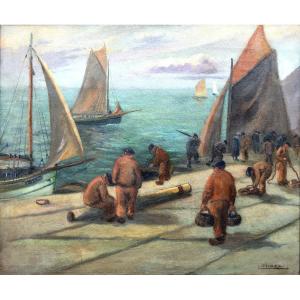


A. Godien - Loading Sand On The Rhône River Quays At Dusk - Signed
Artist: Godien Adrien (1873 – 1949)
Adrien GODIEN (1873–1949)
Loading Sand on the Banks of the Rhône at Dusk
Oil on canvas
109 × 50 cm — 121 × 63 cm (framed)
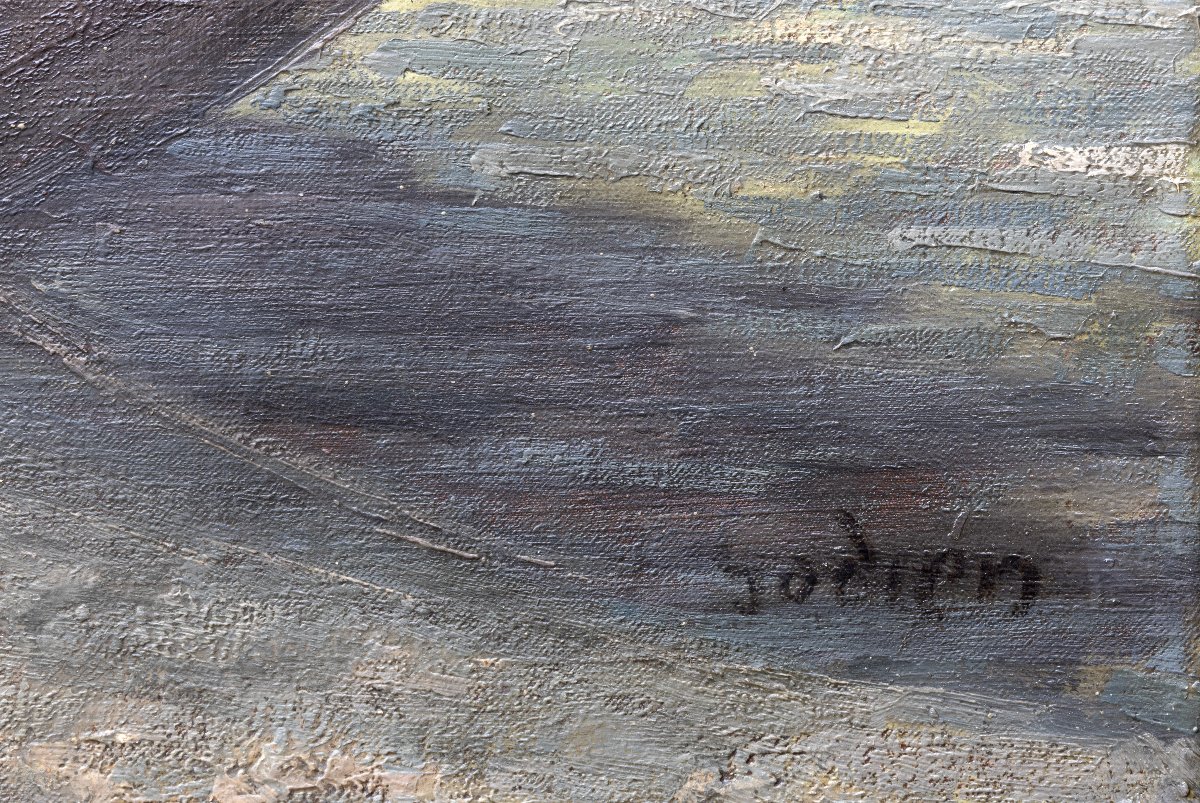
Signed lower right
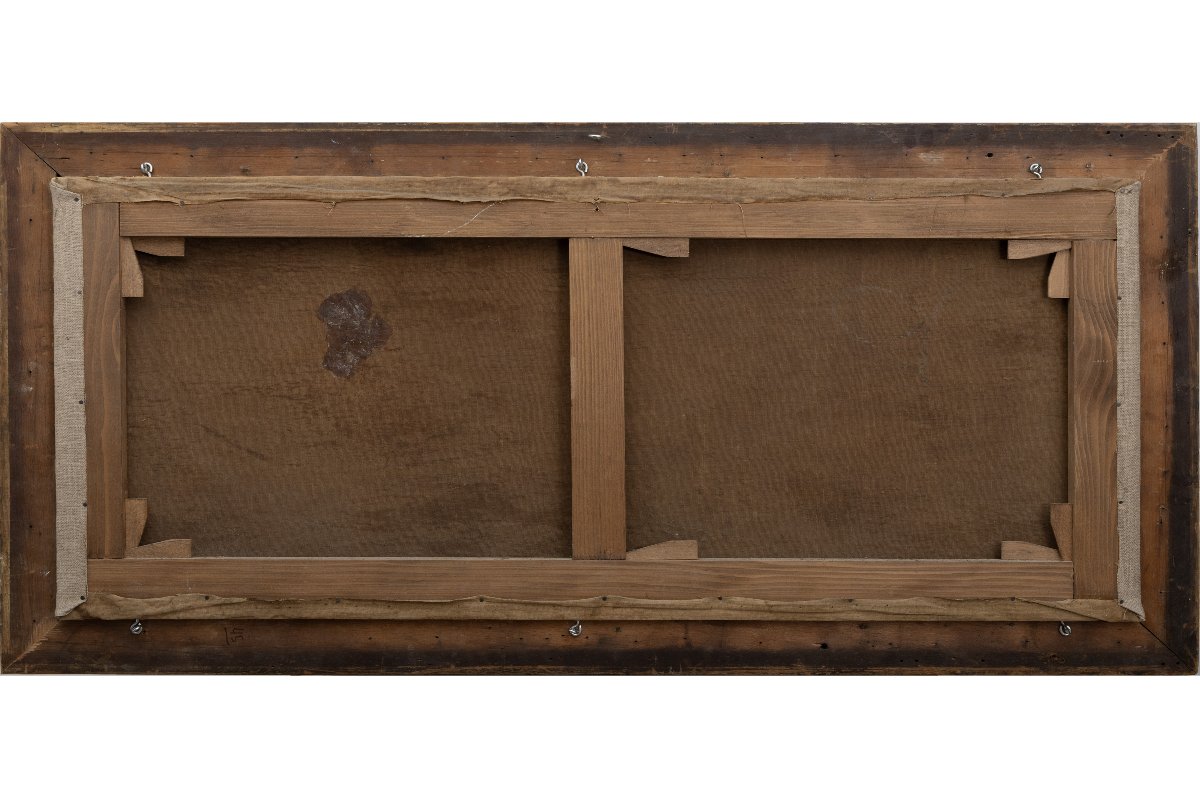
1 visible repair on the back
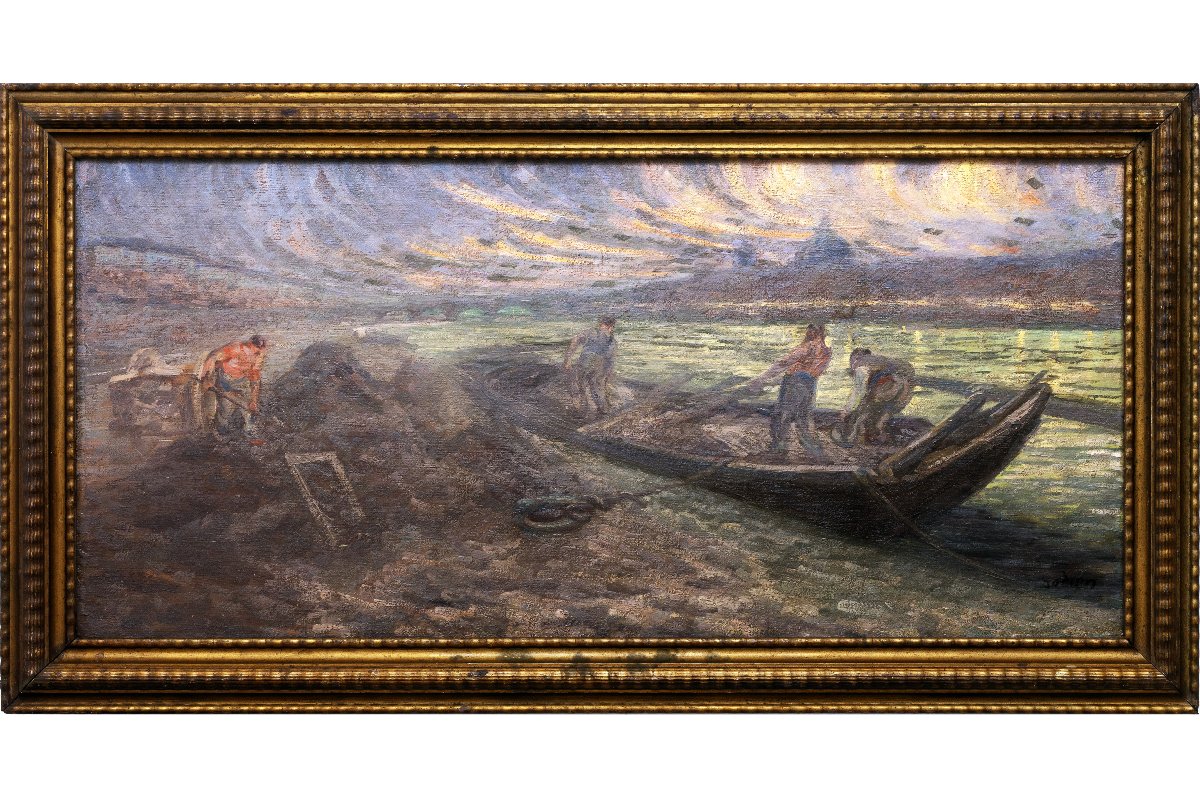
Period frame, in its original condition
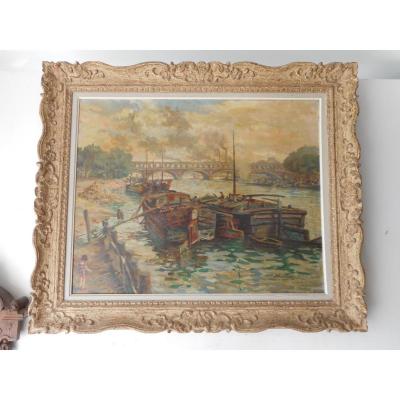
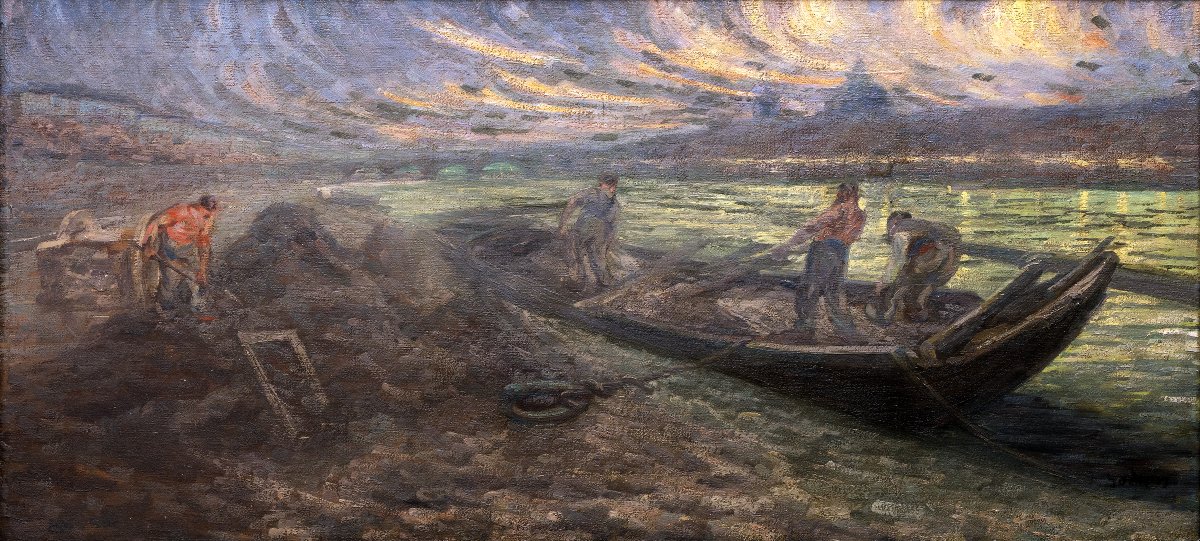
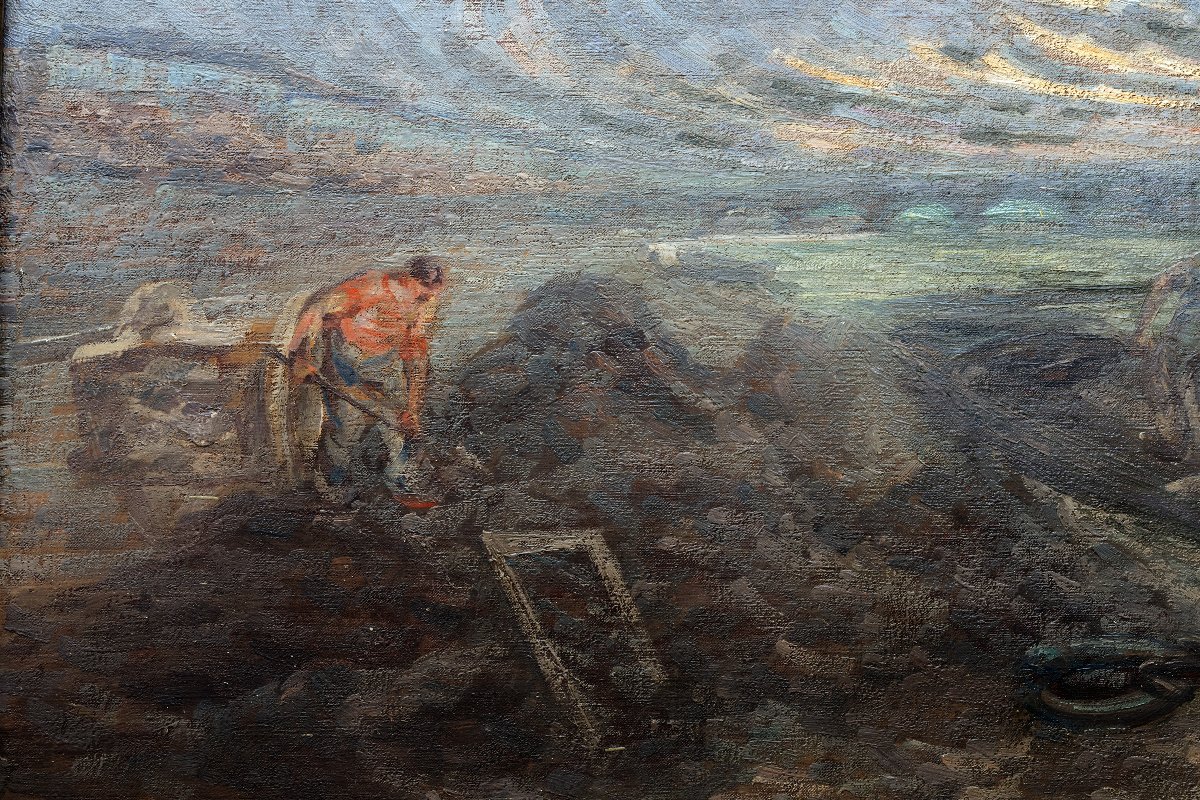
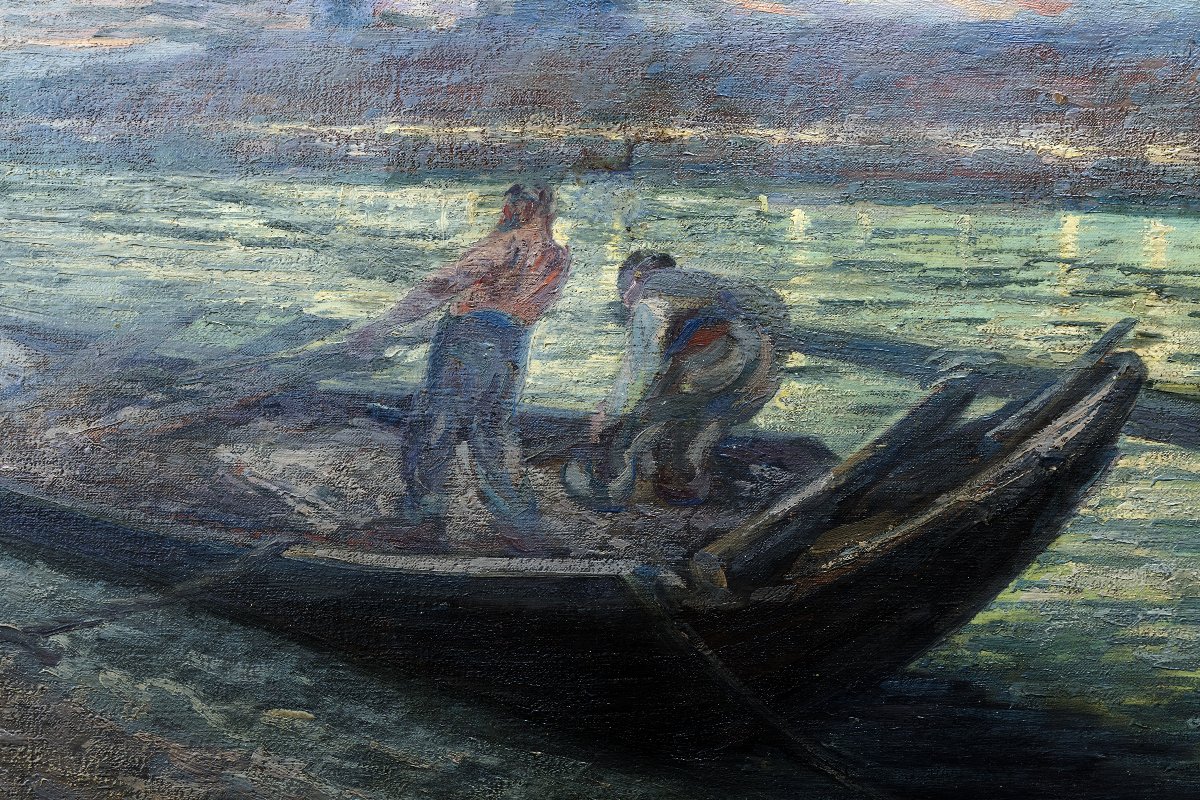
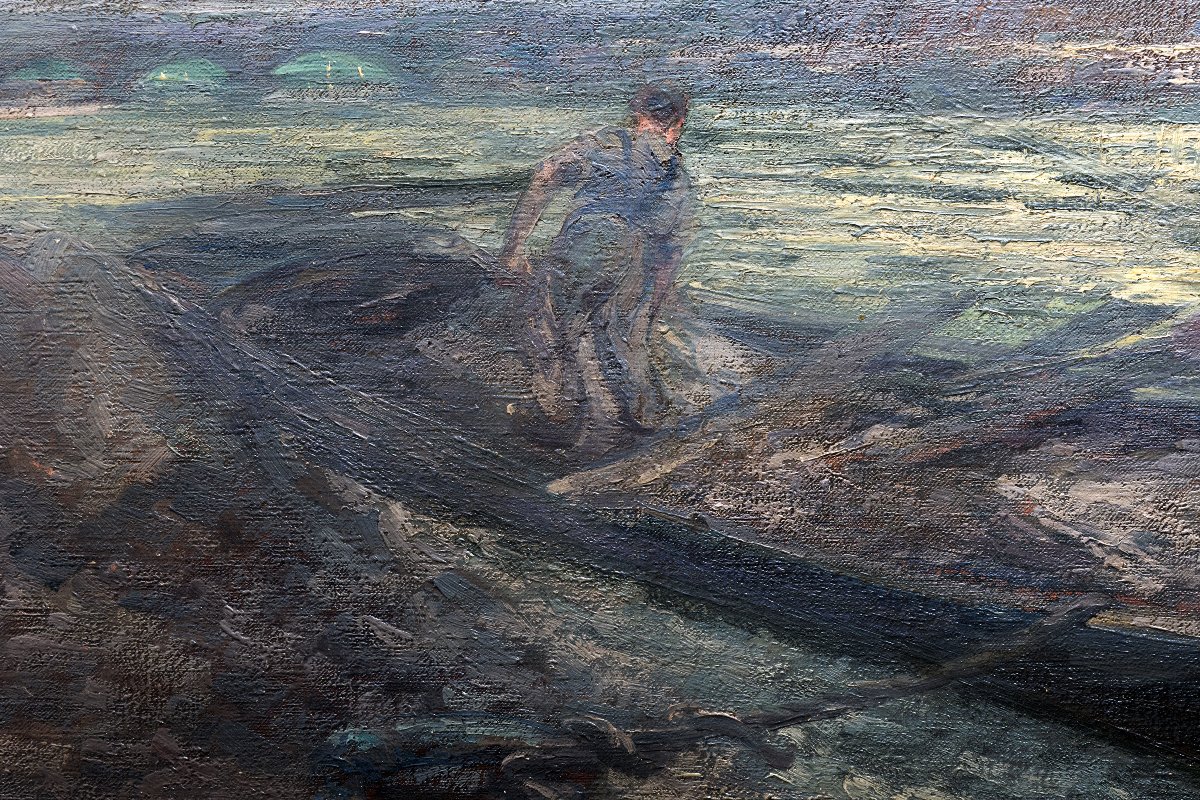
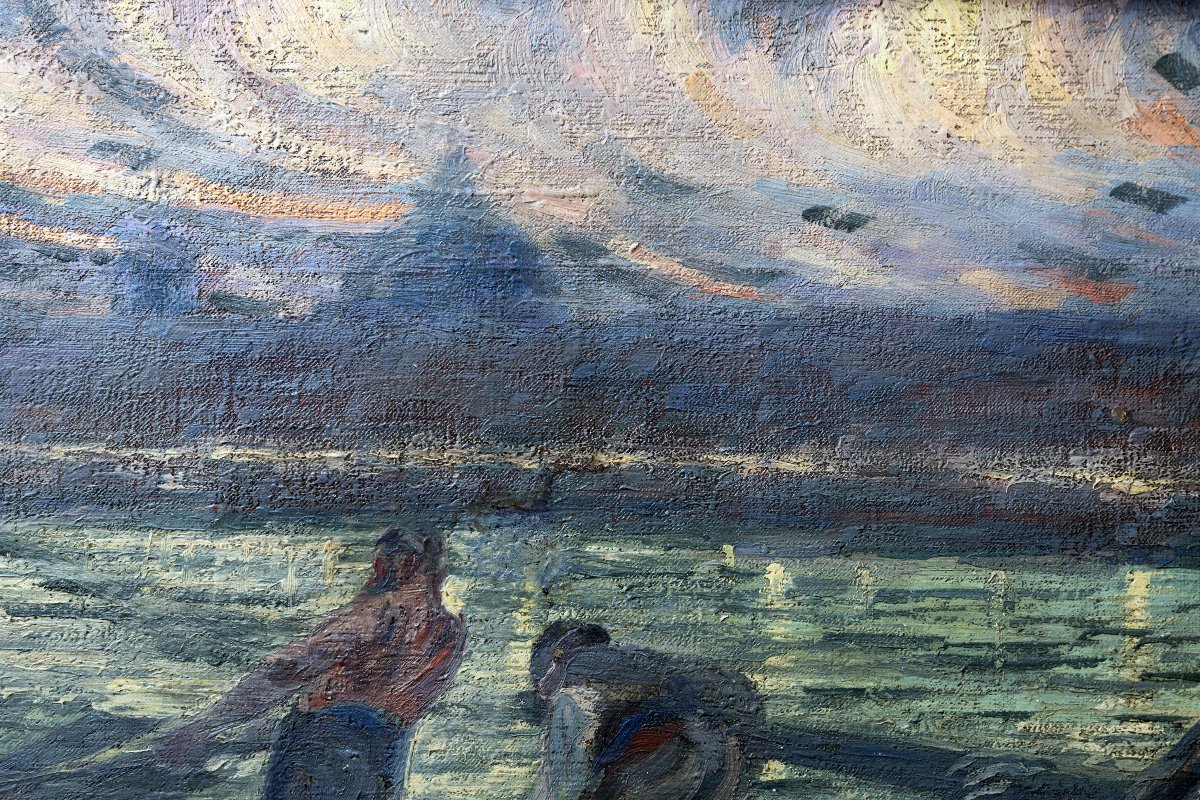
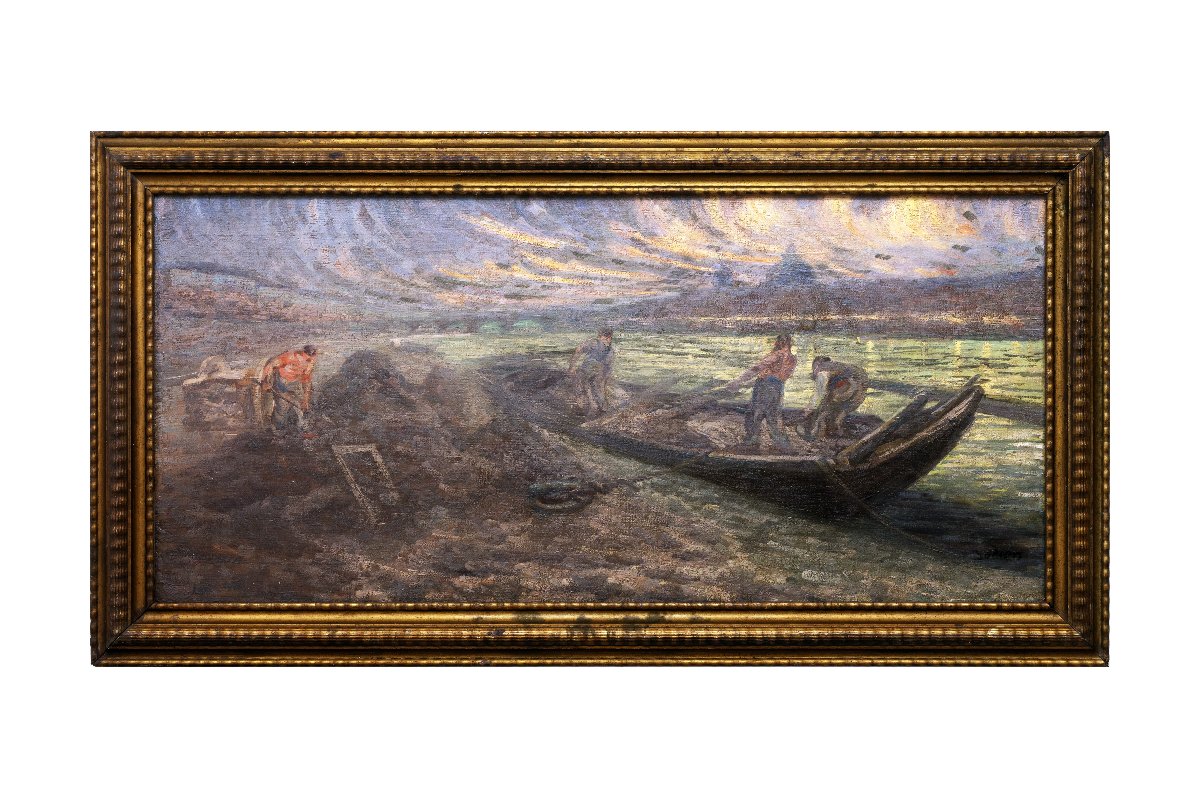
The sky still glows with a final orange hue as the men load the boat. On the riverbank, the shovel plunges into the dark pile; on the water, the Rhône reflects the last glimmers of the sunset in patches of green and gold. In the distance, barely sketched, are the domes of the Hôtel-Dieu and the arches of the Wilson Bridge—inaugurated in 1918, which places the scene in the immediate postwar period. A sieve lies on the ground: these men are not fishing; they are extracting sand from the river—building material for a city in the process of rebuilding itself.
Oil on canvas, signed lower right. Dimensions: 109 x 50 cm (121 x 63 cm with frame). Period frame, in its original condition, with gilding worn by time—never restored, never touched up, and that’s for the best: it bears the painting’s age without betraying it. An old repair is visible on the back of the canvas, but it does not affect the viewing of the composition on the front.
A painting that is anything but academic
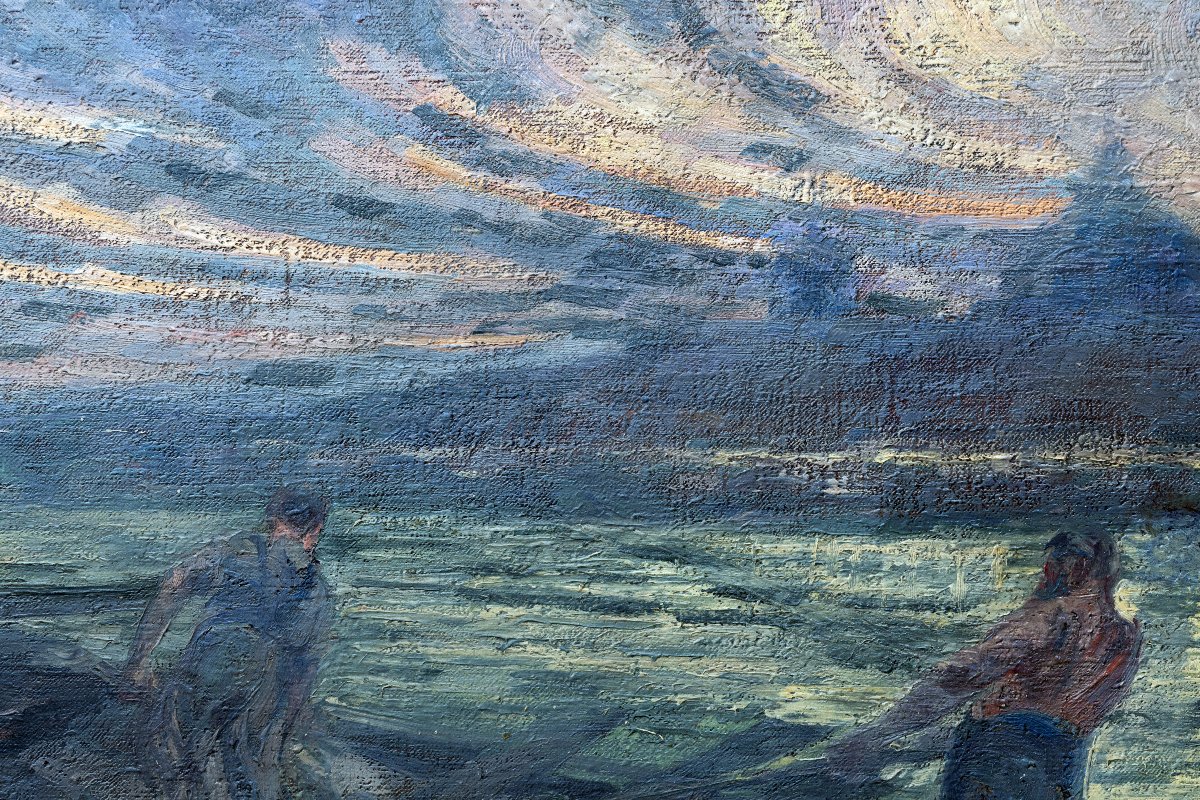
Godien graduated from the École des Beaux-Arts in Lyon, trained by Tollet, Carrand, and Vernay—a demanding school focused on traditional drawing and portraiture. None of that is evident here. The sky is built up with broad, sweeping brushstrokes—almost fan-shaped—that seek to capture the movement of light rather than its exact description. The foreground, meanwhile, is almost monochromatic, earthy, and marked by quick highlights: one must work quickly to capture the workers’ gestures.
And then there is the format, twice as long as it is tall. Godien literally presents us with a panorama: the men’s work stretches across the entire width of the foreground, while the eye travels all the way to the horizon, toward the city that is barely discernible. The composition follows the geography of the river—we are less looking at a composed painting than at a view taken from the riverbank itself, the eye sweeping across the dock just as one would sweep a real landscape with one’s gaze.
It is a plein air painting, conceived in the moment, and a rare subject for Godien: though he is primarily associated with theater scenes, music hall, and society portraits, here he chooses to depict the gestures of labor—anonymous river workers, captured in the midst of their work. One might compare it to the naturalist style of a Lhermitte or a Raffaëlli, painters of urban labor, but with a freer, more vibrant touch that owes as much to Impressionism as to social observation. Neither a refined genre scene nor a pure exercise in light: something in between, and that is precisely what makes the painting so compelling.
The Artist
Adrien Godien was born on May 14, 1873, in Sathonay-Village, near Lyon, and died in Lyon on July 28, 1949. At the age of fifteen, he enrolled at the École nationale supérieure des Beaux-Arts in Lyon, where he received a classical education under Tony Tollet, Carrand, and Vernay. He began exhibiting as early as 1896 at the Société Lyonnaise des Beaux-Arts, then in Paris at the Salon de la Société Nationale des Beaux-Arts from 1899 to 1903—years during which he rubbed shoulders, among other young artists passing through, with a certain Pablo Picasso.
A portraitist, watercolorist, and pastel artist, as well as a ceramicist and engraver, Godien distinguished himself above all in painting scenes from the theater and music hall, which earned him a reputation in the Lyon press of the time. He also created stained-glass windows for the chapel at Édouard-Herriot Hospital, and was commissioned to create a work for the Bourse du Travail in Lyon. Two of his paintings are housed at the Musée des Beaux-Arts in Lyon. He spent his final years on the Quai de la Boucle in the 4th arrondissement—a quay that now bears his name, on the banks of the river he painted here.
Work on view at the gallery (07240)
Shipping: Please contact us for shipping costs within France and internationally.
Loading Sand on the Banks of the Rhône at Dusk
Oil on canvas
109 × 50 cm — 121 × 63 cm (framed)
Signed lower right
1 visible repair on the back
Period frame, in its original condition
The sky still glows with a final orange hue as the men load the boat. On the riverbank, the shovel plunges into the dark pile; on the water, the Rhône reflects the last glimmers of the sunset in patches of green and gold. In the distance, barely sketched, are the domes of the Hôtel-Dieu and the arches of the Wilson Bridge—inaugurated in 1918, which places the scene in the immediate postwar period. A sieve lies on the ground: these men are not fishing; they are extracting sand from the river—building material for a city in the process of rebuilding itself.
Oil on canvas, signed lower right. Dimensions: 109 x 50 cm (121 x 63 cm with frame). Period frame, in its original condition, with gilding worn by time—never restored, never touched up, and that’s for the best: it bears the painting’s age without betraying it. An old repair is visible on the back of the canvas, but it does not affect the viewing of the composition on the front.
A painting that is anything but academic
Godien graduated from the École des Beaux-Arts in Lyon, trained by Tollet, Carrand, and Vernay—a demanding school focused on traditional drawing and portraiture. None of that is evident here. The sky is built up with broad, sweeping brushstrokes—almost fan-shaped—that seek to capture the movement of light rather than its exact description. The foreground, meanwhile, is almost monochromatic, earthy, and marked by quick highlights: one must work quickly to capture the workers’ gestures.
And then there is the format, twice as long as it is tall. Godien literally presents us with a panorama: the men’s work stretches across the entire width of the foreground, while the eye travels all the way to the horizon, toward the city that is barely discernible. The composition follows the geography of the river—we are less looking at a composed painting than at a view taken from the riverbank itself, the eye sweeping across the dock just as one would sweep a real landscape with one’s gaze.
It is a plein air painting, conceived in the moment, and a rare subject for Godien: though he is primarily associated with theater scenes, music hall, and society portraits, here he chooses to depict the gestures of labor—anonymous river workers, captured in the midst of their work. One might compare it to the naturalist style of a Lhermitte or a Raffaëlli, painters of urban labor, but with a freer, more vibrant touch that owes as much to Impressionism as to social observation. Neither a refined genre scene nor a pure exercise in light: something in between, and that is precisely what makes the painting so compelling.
The Artist
Adrien Godien was born on May 14, 1873, in Sathonay-Village, near Lyon, and died in Lyon on July 28, 1949. At the age of fifteen, he enrolled at the École nationale supérieure des Beaux-Arts in Lyon, where he received a classical education under Tony Tollet, Carrand, and Vernay. He began exhibiting as early as 1896 at the Société Lyonnaise des Beaux-Arts, then in Paris at the Salon de la Société Nationale des Beaux-Arts from 1899 to 1903—years during which he rubbed shoulders, among other young artists passing through, with a certain Pablo Picasso.
A portraitist, watercolorist, and pastel artist, as well as a ceramicist and engraver, Godien distinguished himself above all in painting scenes from the theater and music hall, which earned him a reputation in the Lyon press of the time. He also created stained-glass windows for the chapel at Édouard-Herriot Hospital, and was commissioned to create a work for the Bourse du Travail in Lyon. Two of his paintings are housed at the Musée des Beaux-Arts in Lyon. He spent his final years on the Quai de la Boucle in the 4th arrondissement—a quay that now bears his name, on the banks of the river he painted here.
Work on view at the gallery (07240)
Shipping: Please contact us for shipping costs within France and internationally.
600 €
Period: 20th century
Style: Art Deco
Condition: Excellent condition
Material: Oil painting
Width: 109 cm / 121 cm encadré
Height: 50 cm / 63 cm encadré
Reference (ID): 1796343
Availability: In stock
Print