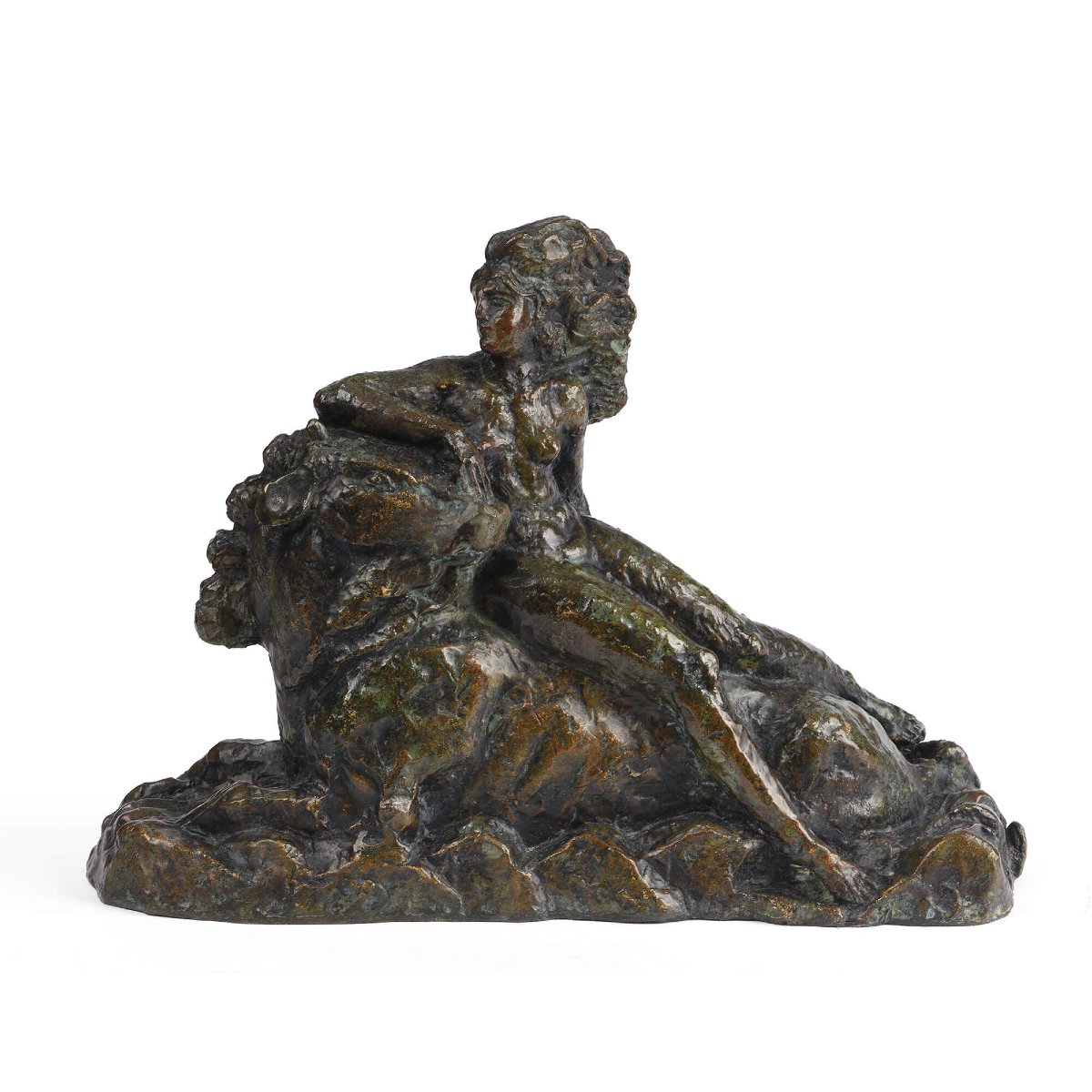

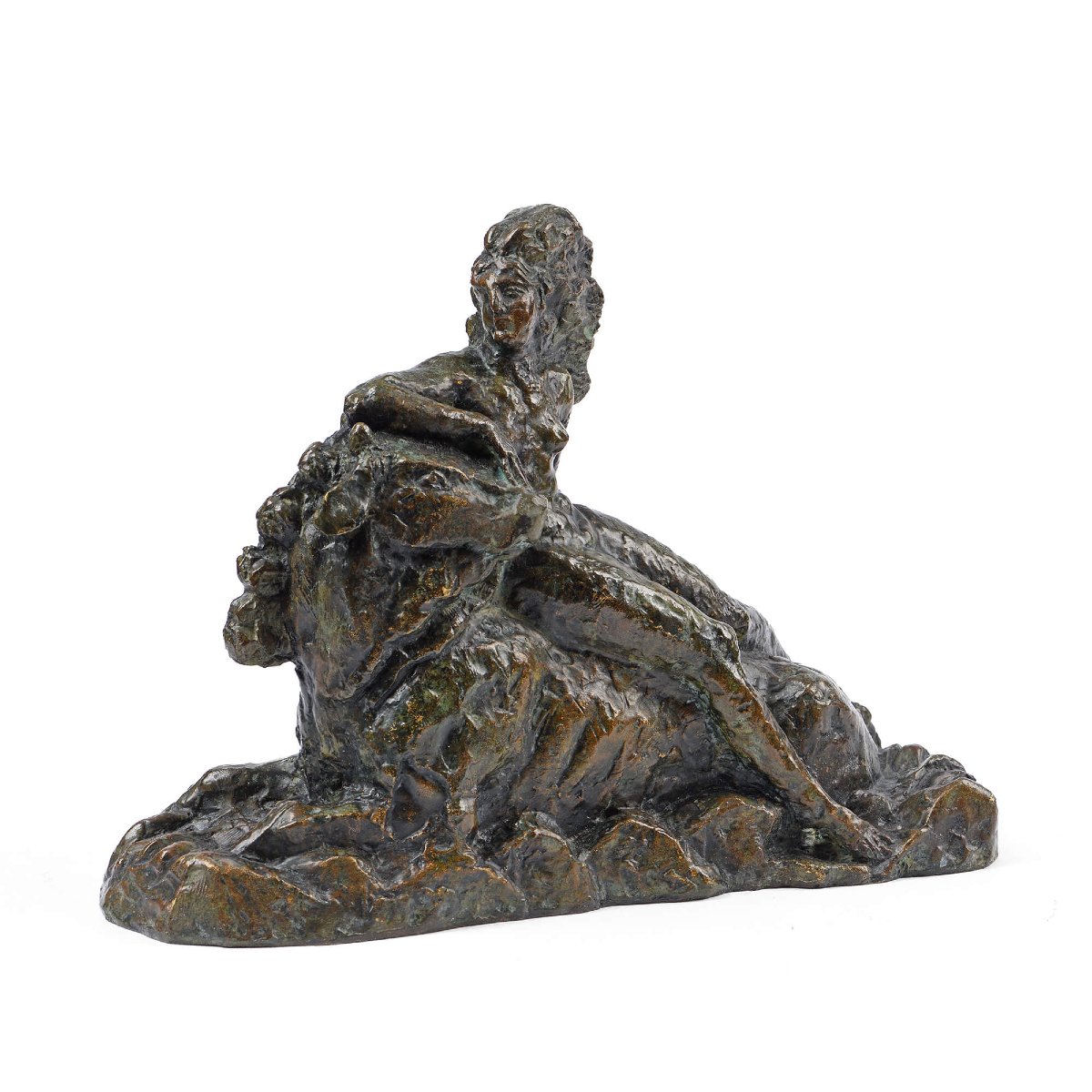
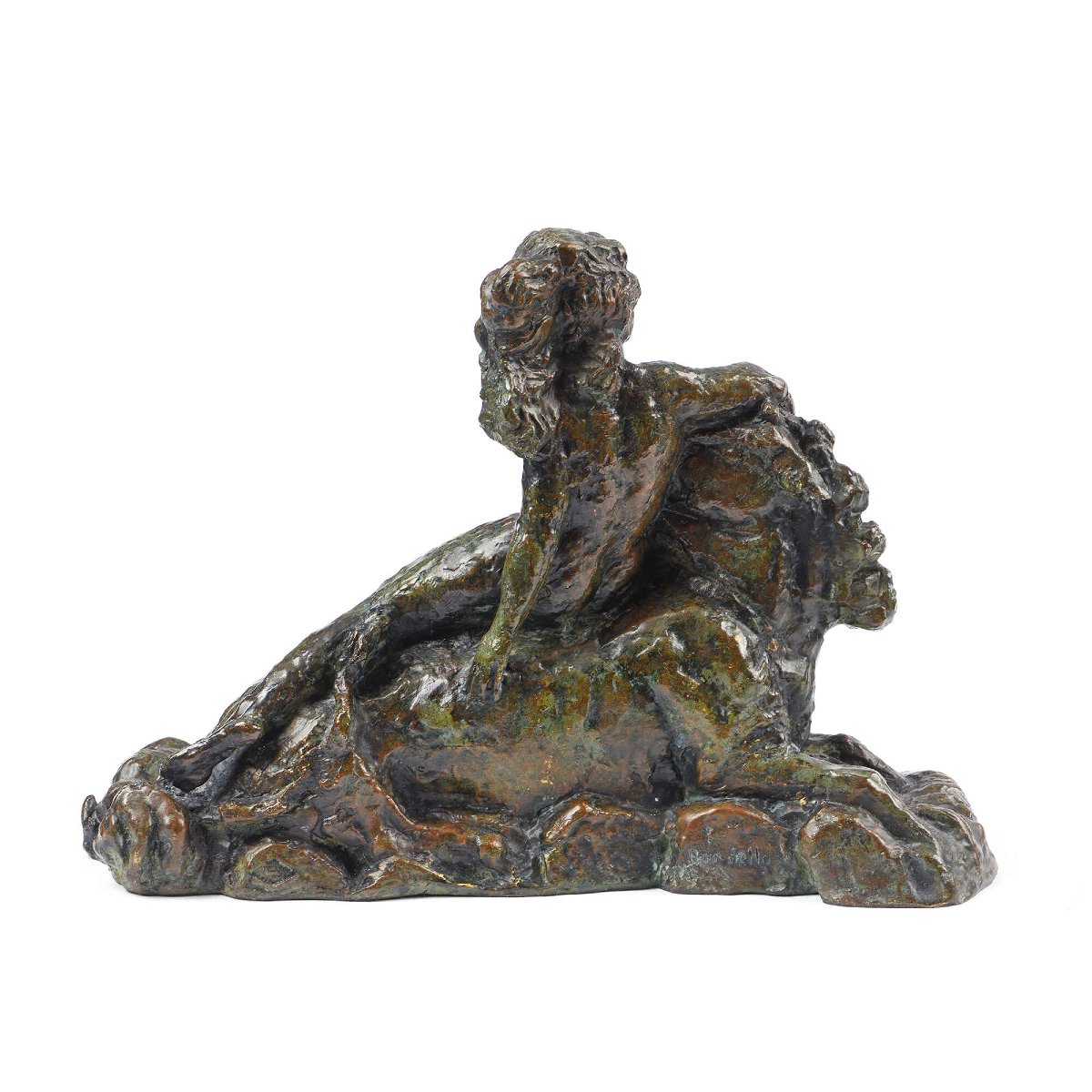




émile-antoine Bourdelle (1861–1929) — "the Abduction Of Europa"
Beautiful bronze cast with a nuanced green patina
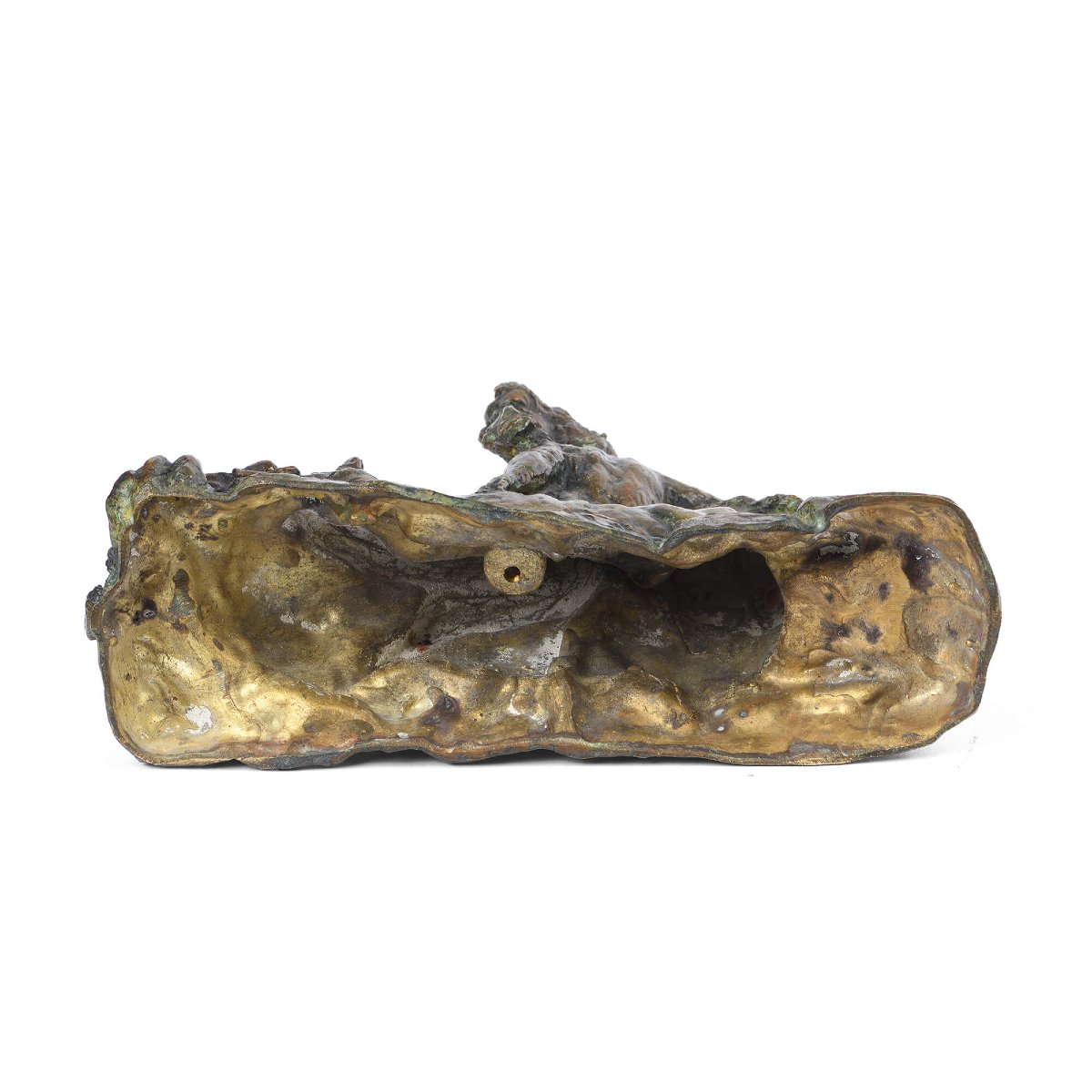
Lost-wax casting by Attilio Valsuano based on the original 1929 plaster model
The foundry’s mark is on the naturalistic pedestal at the back, beneath the left foot
Signed “Bourdelle” on the naturalistic pedestal at the rear right
Circa 1929/1930
Dimensions:
Height: 20.8 cm
Length: 28.7 cm
Depth: 10 cm
***********
The Abduction of Europa, The Legend
Legend has it that Europa, a Phoenician princess and daughter of Agenor, king of Tyre, was one day strolling along the seashore with her companions when she caught the eye of Zeus. Enraptured by her beauty, he transformed himself into a bull with horns shaped like a crescent moon and lay down at the young woman’s feet. At first frightened, she plucked up her courage, stroked the animal, and sat on its back. Immediately, the bull rose to his feet and charged toward the sea. Despite the cries of Europa, who clung to his horns, the bull plunged into the waves and swam away from the shore. The two thus reached Crete, where Zeus took the young girl as his wife. From this union, three sons were born: Minos, Sarpedon, and Rhadamanthus.
Bibliography: The book *Bourdelle* by Ionelle Janiou and Michel Dufet, page 141,
Exhibition catalog from the Musée Ingres – E.A. Bourdelle (1861–1929) – by F. Viguier-Dutheil – Montauban – July 1–October 15 2000 – Page 75
Paris-Manaus Gallery
Sold with invoice and certificate
In excellent condition
General Delivery Terms:
We arrange worldwide shipping.
A quote will be provided upon request at the time of your purchase.
Biography:
Émile-Antoine BOURDELLE (1861–1929)
Émile Antoine Bourdelle, born in Montauban on October 30, 1861, was the son of Antoine Bourdelle, a carpenter and cabinetmaker, and Émilie Reille. He showed an aptitude for drawing and sculpture from an early age. His father introduced him to woodworking at the age of 13.
He studied at the École des Beaux-Arts in Toulouse, then, in 1884, at the École nationale supérieure des Beaux-Arts in Paris, where he was a student of Alexandre Falguière. It was during this period that he became part of“Schnegg’s gang.”
Two years later, he left the École des Beaux-Arts to regain his independence and supported himself by selling his drawings.
In 1893, he was hired as a technician in the studio of his friend Auguste Rodin, with whom he collaborated for 15 years.
Between 1895 and 1902, he created “The Monument to the Combatants and Defenders of the Tarn and Garonne, 1870–1871”; it was thanks to A. Rodin that he secured this commission for the city of Montauban.
Antoine Bourdelle held his very first exhibition in 1905, and it was a success. It was also during this period that he began to move away from his master’s style and toward ancient and medieval sculpture.
His “Hercules the Archer” was presented in 1910 at the Salon of the Société Nationale des Beaux-Arts, where it was a resounding success and opened the doors to an international career.
In 1914, he achieved recognition at the Venice Biennale, where thirty of his works were exhibited, including “The Dying Centaur.”
Bourdelle was also a passionate educator. He taught for 20 years at the Académie de la Grande Chaumière, where he trained many students, including Alberto Giacometti, Aristide Maillol, and Germaine Richier…
Founder and vice president of the Salon des Tuileries
In 1929, while ill, he passed away in Le Vésinet, at the home of his friend, the sculptor Eugène Rudier, and was buried at Montparnasse Cemetery.
In 1931, a major retrospective of Bourdelle’s work at the Musée de l’Orangerie brought together 128 paintings, drawings, and watercolors as well as 200 sculptures
Period: 20th century
Style: Other Style
Condition: Perfect condition
Material: Bronze
Length: 28,7 cm
Height: 20,8 cm
Depth: 10 cm
Reference (ID): 1789553
Availability: In stock