

Woodcut Block “memento Mori,” France Or Flanders, Late 17th–18th Century
Rare woodcut block finely carved from wood, likely intended for printing devotional imagesor moral edification leaflets, engraved on both sides.
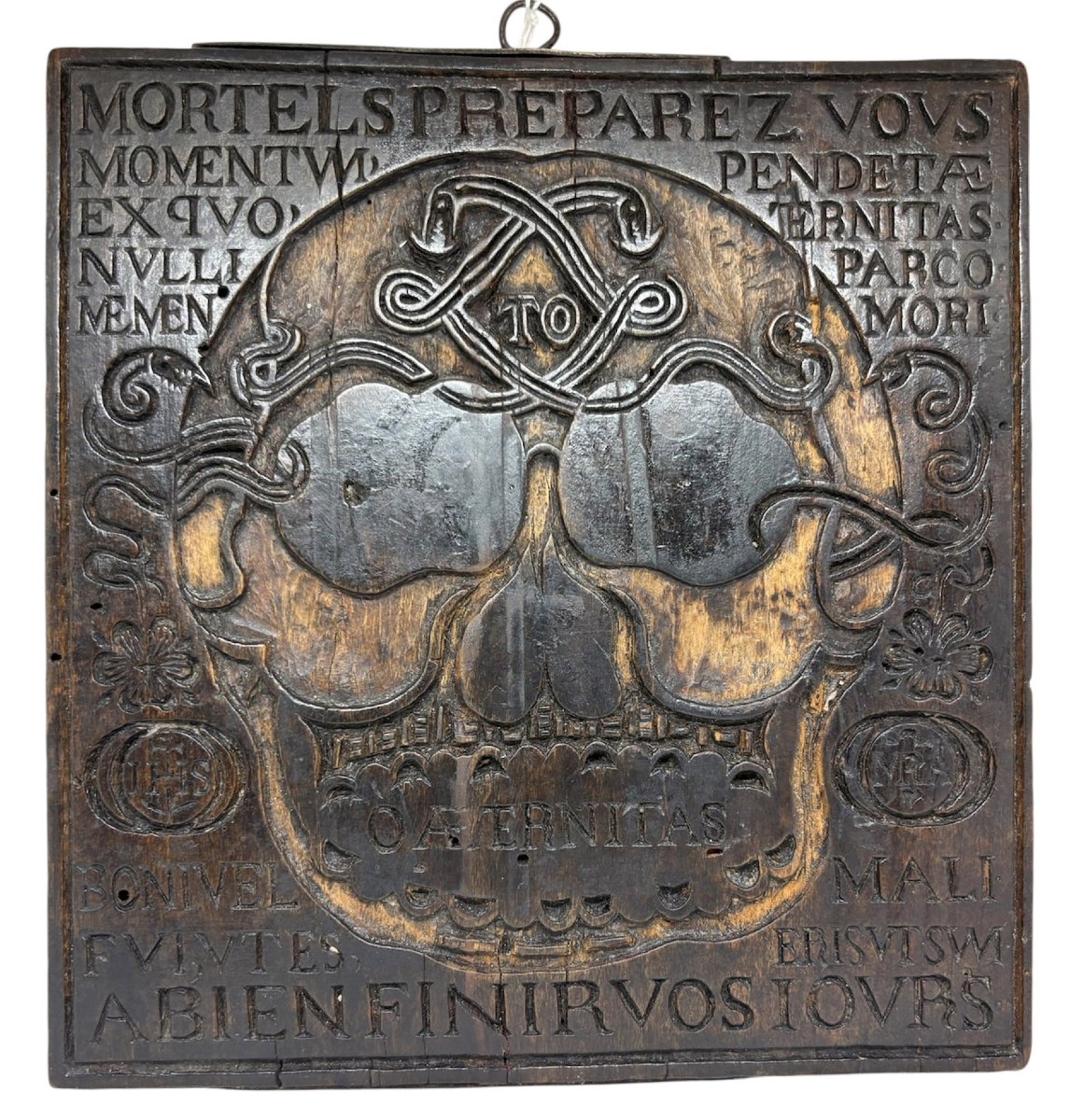
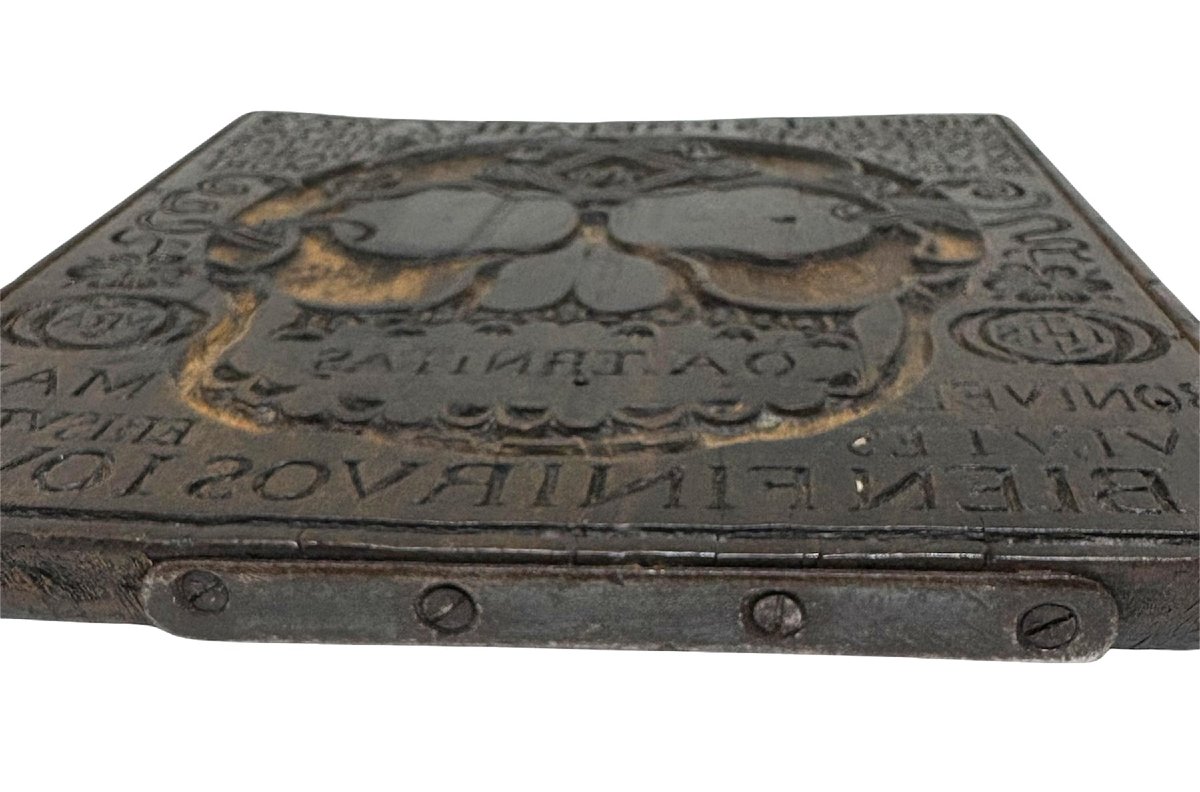
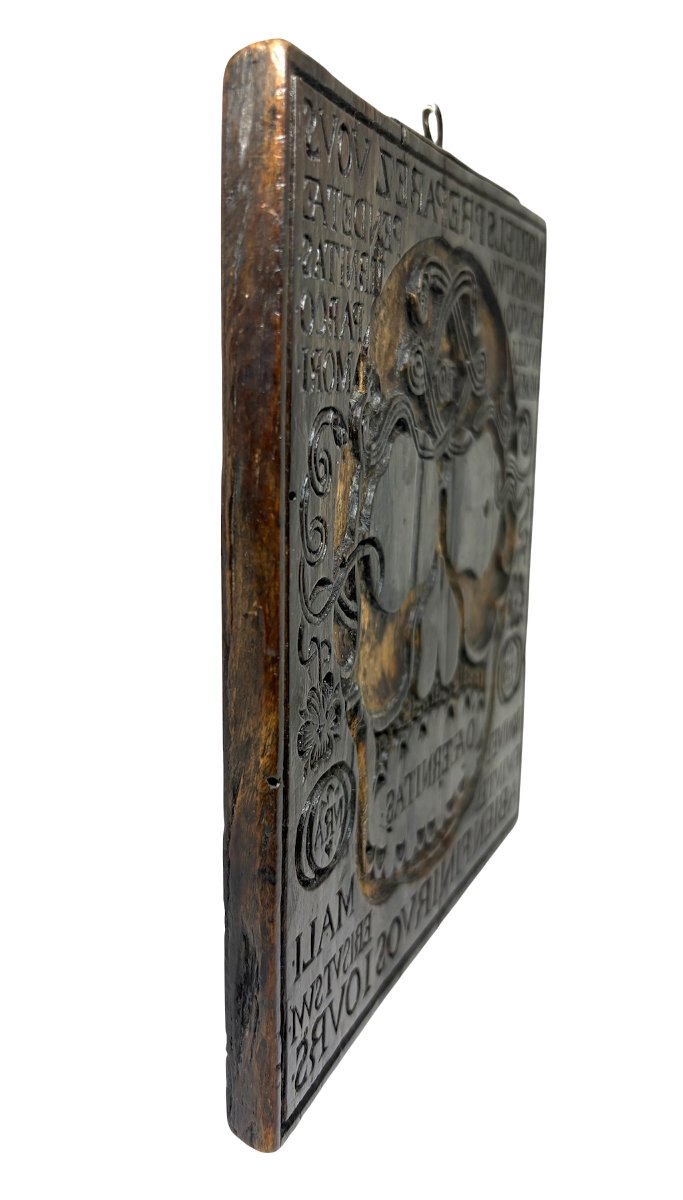
The obverse is dominated by alarge stylized skull, a universal symbol of the fragility of life and the inevitability of death, surrounded by a rich iconographic and epigraphic program in French and Latin, drawing on the Christian tradition of the Memento mori. The upper part of the skull is adorned with an elegant interlacing of ribbons within which is inscribed a portion of the famous inscription “NULLI PARCO – MEMENTOMORI,” literally: “I spare no one. Remember that you must die,” an explicit reminder of the universal nature of death, from which no one can escape.
On either side of the skull are two medallions bearing the Christogram IHS, the monogram of the Name ofJesus, also repeated in the center of the reverse side of the die—a detail that suggests a devotional purpose.
The design is accompanied by a series of moral inscriptions in which the skull addresses directly to the viewer, inviting them to meditate on death and the eternal destiny of the soul.
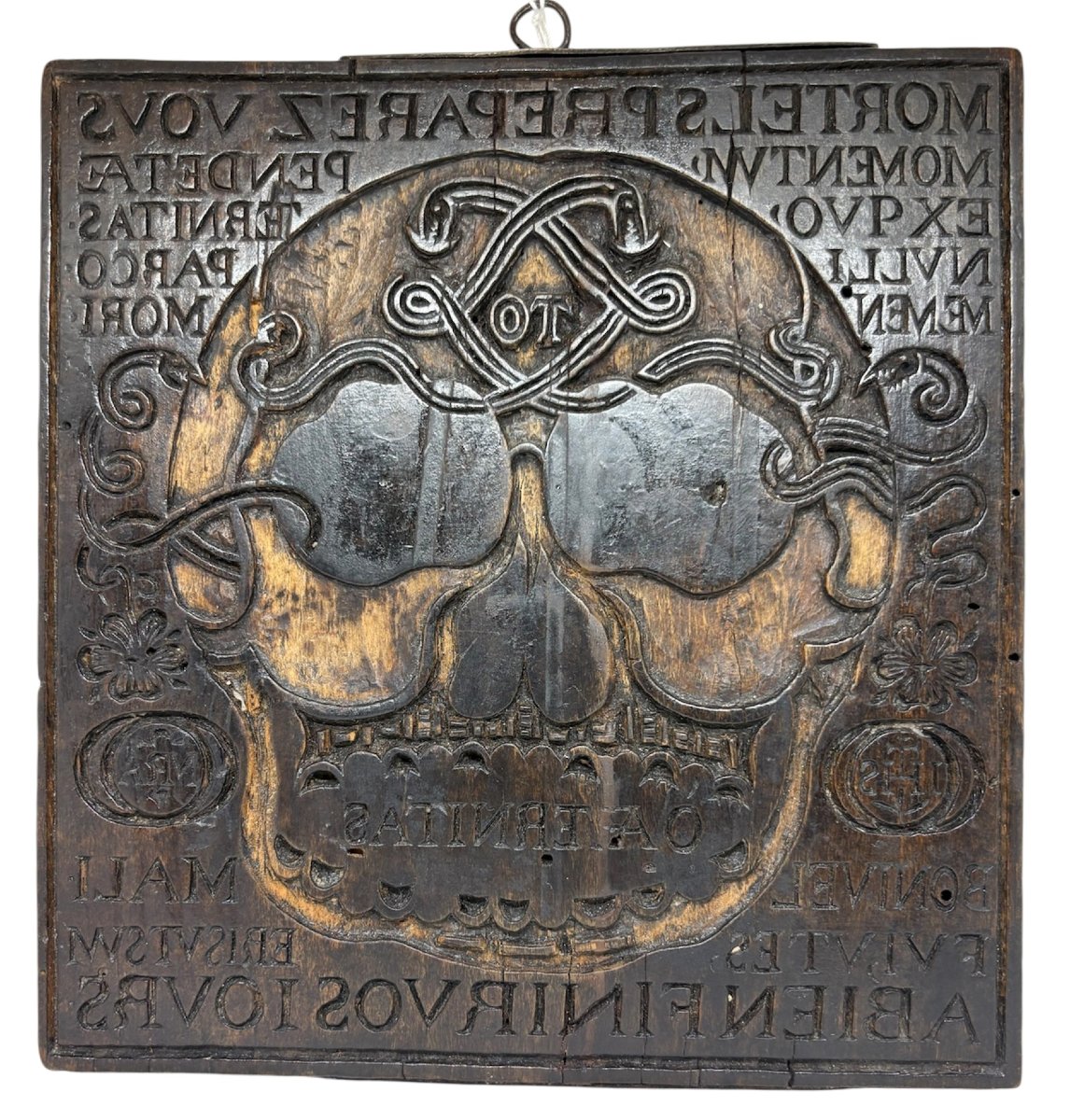
Since the inscriptions are engraved in mirror image due to their printing function, reading them is made easier by the accompanying mirror image.
The main inscription proclaims: MORTALS, PREPARE YOURSELVES. It is followed by the Latin phrase: MEMENTUM EX QUO NULLI PARCO,PENDET ÆTERNITAS, which, despite some spelling irregularities characteristic of popular dies from that era, can be interpreted to mean “Remember this moment; I spare no one: eternity depends on it.”
Inside the mouth of the skull appears the invocation: O ÆTERNITAS “O Eternity!” which is the true culmination of the entire composition.
In the lower partis engraved another Latin maxim: BONI VEL MALI ERITIS UT SUM which can be translated as: “Good or bad, you will be like me. ”
The skull thus addresses the living directly, reminding them that all, without distinction, are destined to meet the same fate.
The final phrase, in French, À BIEN FINIR VOS JOURS, can be understood as: “So that you may bring your days to a good end.”
The entire iconographic and textual program thus constitutes a true meditation on death and the salvation of the soul, which can be summarized by the following message: “Mortals, prepare yourselves.Remember that death spares no one and that eternity depends on the moment of death. O Eternity! Whether good or evil, you will be like me: so prepare yourselves to bring your days to a good end. ”
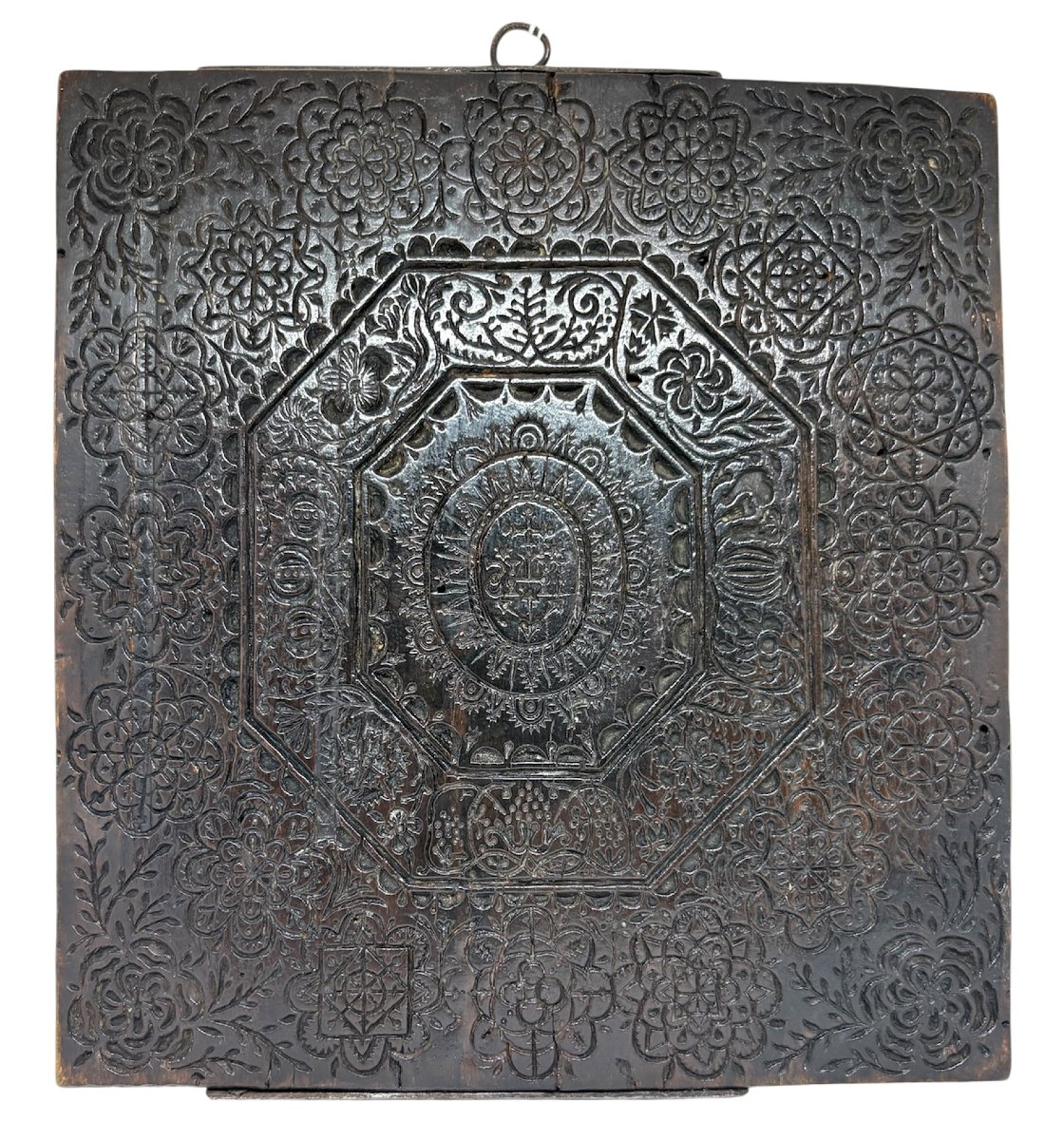
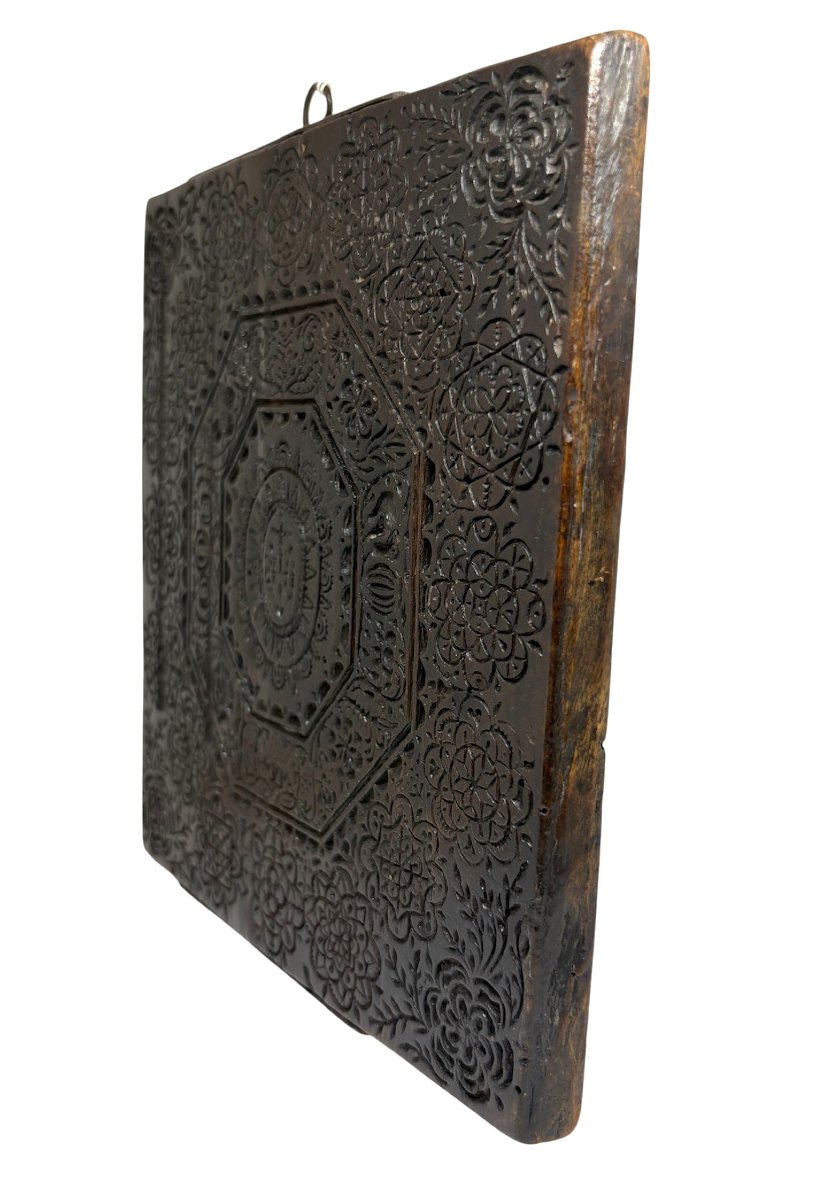
The reverse side of the die is entirely engraved with a rich ornamental design composed of geometric rosettes, stylized floral motifs, foliage scrolls, interlacing patterns, and phytomorphic motifs, arranged around a central octagonal medallion containing the Christogram IHS inscribed within a radiant halo. The high quality of theen graving attests to the craftsman’s remarkable skill and lends this die an artistic significance that far exceeds its mereutilitarian function.
Through its iconographic design, its moral language, and the repeated use of the IHS monogram, this die is part of the European devotional art of the late 17th and 18th centuries, intended to disseminate religious images and exhortation sencouraging reflection on the brevity of life, preparation for a good death, and man’s eternal destiny. It constitutes a rare example of the enduring presence and wide spread dissemination of the Memento mori theme in European Christian culture
Dimensions: H 17 x W 16 x D 1 cm.
The obverse is dominated by alarge stylized skull, a universal symbol of the fragility of life and the inevitability of death, surrounded by a rich iconographic and epigraphic program in French and Latin, drawing on the Christian tradition of the Memento mori. The upper part of the skull is adorned with an elegant interlacing of ribbons within which is inscribed a portion of the famous inscription “NULLI PARCO – MEMENTOMORI,” literally: “I spare no one. Remember that you must die,” an explicit reminder of the universal nature of death, from which no one can escape.
On either side of the skull are two medallions bearing the Christogram IHS, the monogram of the Name ofJesus, also repeated in the center of the reverse side of the die—a detail that suggests a devotional purpose.
The design is accompanied by a series of moral inscriptions in which the skull addresses directly to the viewer, inviting them to meditate on death and the eternal destiny of the soul.
Since the inscriptions are engraved in mirror image due to their printing function, reading them is made easier by the accompanying mirror image.
The main inscription proclaims: MORTALS, PREPARE YOURSELVES. It is followed by the Latin phrase: MEMENTUM EX QUO NULLI PARCO,PENDET ÆTERNITAS, which, despite some spelling irregularities characteristic of popular dies from that era, can be interpreted to mean “Remember this moment; I spare no one: eternity depends on it.”
Inside the mouth of the skull appears the invocation: O ÆTERNITAS “O Eternity!” which is the true culmination of the entire composition.
In the lower partis engraved another Latin maxim: BONI VEL MALI ERITIS UT SUM which can be translated as: “Good or bad, you will be like me. ”
The skull thus addresses the living directly, reminding them that all, without distinction, are destined to meet the same fate.
The final phrase, in French, À BIEN FINIR VOS JOURS, can be understood as: “So that you may bring your days to a good end.”
The entire iconographic and textual program thus constitutes a true meditation on death and the salvation of the soul, which can be summarized by the following message: “Mortals, prepare yourselves.Remember that death spares no one and that eternity depends on the moment of death. O Eternity! Whether good or evil, you will be like me: so prepare yourselves to bring your days to a good end. ”
The reverse side of the die is entirely engraved with a rich ornamental design composed of geometric rosettes, stylized floral motifs, foliage scrolls, interlacing patterns, and phytomorphic motifs, arranged around a central octagonal medallion containing the Christogram IHS inscribed within a radiant halo. The high quality of theen graving attests to the craftsman’s remarkable skill and lends this die an artistic significance that far exceeds its mereutilitarian function.
Through its iconographic design, its moral language, and the repeated use of the IHS monogram, this die is part of the European devotional art of the late 17th and 18th centuries, intended to disseminate religious images and exhortation sencouraging reflection on the brevity of life, preparation for a good death, and man’s eternal destiny. It constitutes a rare example of the enduring presence and wide spread dissemination of the Memento mori theme in European Christian culture
Dimensions: H 17 x W 16 x D 1 cm.
3 500 €
Period: 17th century
Style: Other Style
Condition: Excellent condition
Material: Solid wood
Reference (ID): 1787727
Availability: In stock
Print