

Traveling Sun Frame From Southern Germany, Circa 1790, From The Circle Of
Folding travel sundial with compass
Nuremberg or Fürth (Southern Germany), workshop of Ernst Christoph Stockert (1730–1806), circa 1790.
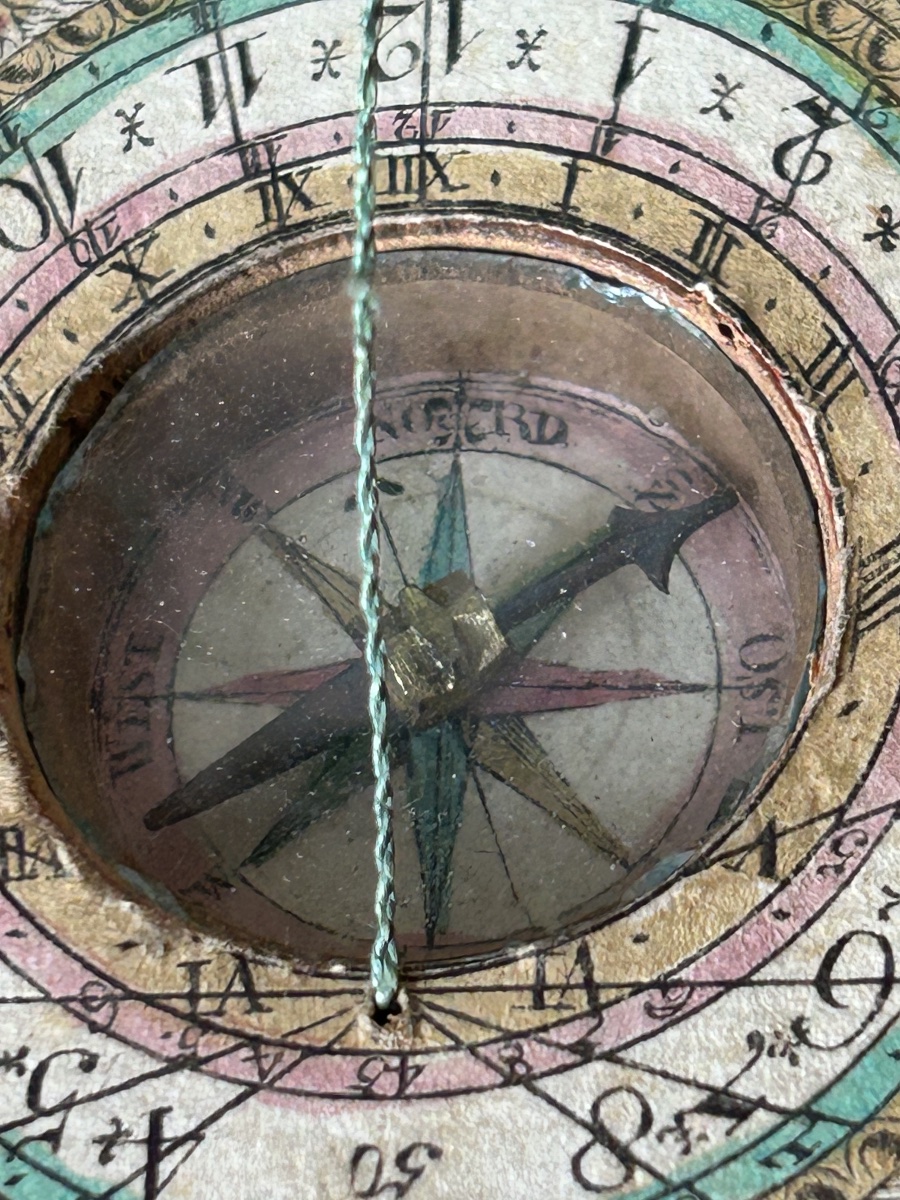
A rare and charming portable folding sundial made of sturdy cardboard covered with engraved paper and hand-painted in shades of aqua, pink, and yellow, retaining its central compass under glass as well as its original gnomon thread.
The instrument takes the form of a small hinged booklet. When opened, it reveals a graduated horizontal sundial that allows the solar time to be read using a thread gnomon, the position of which can be adjusted according to latitude. A scale graduated from 36 to 54 degrees allows the instrument to be adapted to different regions of Europe.
The opposite flap features a printed table listing major European cities along with their respective latitudes: Amsterdam, Augsburg, Barcelona, Basel, Berlin, Bologna, Cologne, Copenhagen, Danzig, Dresden, Dublin, Frankfurt an der Oder, Geneva, Hamburg, Hanover, Königsberg, Lisbon, Leipzig, London, Marseille, Munich, Nuremberg, Ofen, Prague, Pressburg, Rome, Strasbourg, Vienna, Warsaw, Zurich, etc. This table allowed travelers to precisely adjust their instrument according to their geographical location.
The central compass is adorned with an elegant polychrome compass rose bearing the cardinal directions in German, confirming that it was manufactured for the German market. The piece is enlivened by meticulous engraving and watercolor decoration characteristic of popular scientific works produced in the Nuremberg region in the late 18th century.
Comparisons with several examples held in the collections of the British Museum, the Smithsonian Institution, and the Bayerisches Nationalmuseum suggest that this instrument was produced by Nuremberg workshops specializing in printed sundials, and more specifically to the circle of Ernst Christoph Stockert, one of the leading manufacturers and distributors of this type of instrument in the final decades of the 18th century.
Since the 17th century, Nuremberg had been one of Europe’s most important centers for the manufacture of scientific, mathematical, and astronomical instruments. These pocket sundials were intended for travelers, officers, merchants, scholars, and enlightened amateurs who wished to have a portable instrument for accurately determining solar time.
Complete examples that retain their original compass, gnomon thread, and original colors have become rare on the market today. This particular example is appealing not only for its excellent condition but also for the vibrancy of its colors and its historical significance, bearing witness to the spread of practical sciences at the end of the Age of Enlightenment.
Period: 18th century
Style: Louis 16th, Directory
Condition: Excellent condition
Material: Cardboard
Reference (ID): 1784946
Availability: In stock