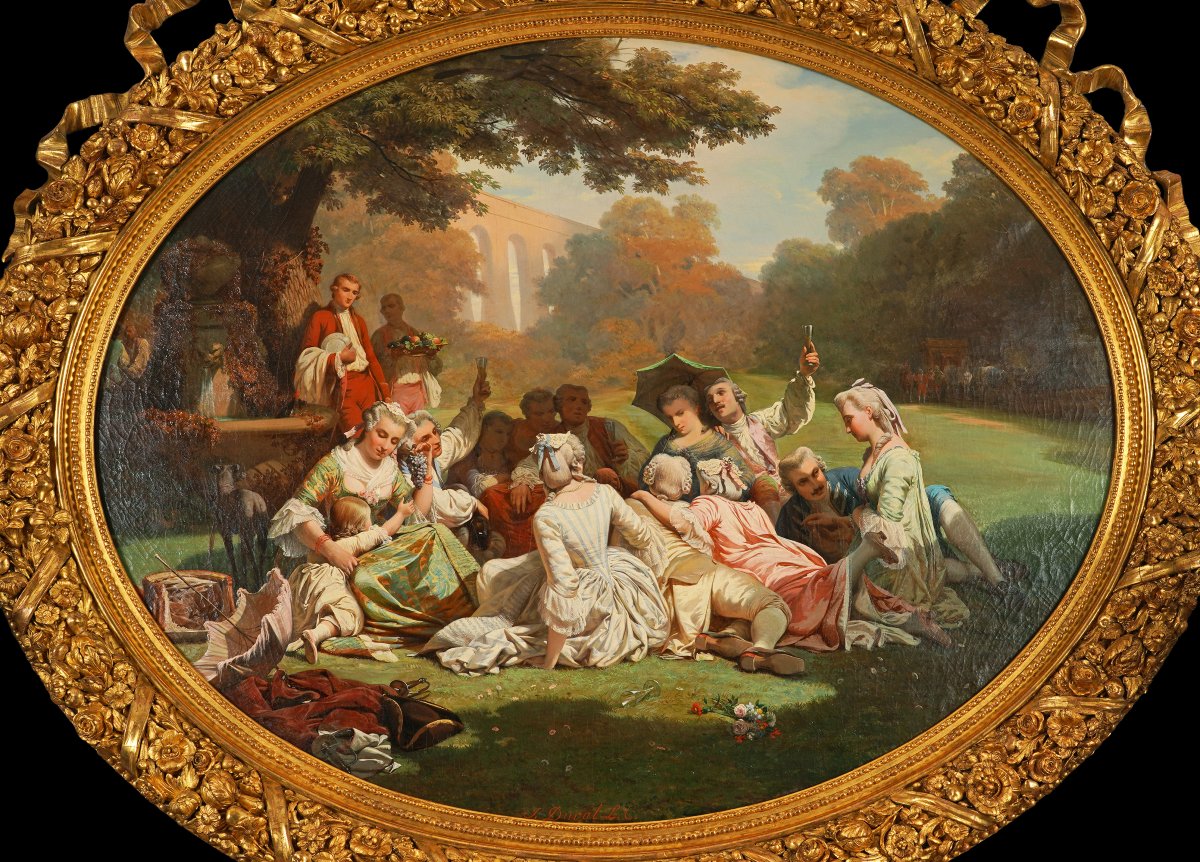


J.-a. Duval Le Camus, "fête Galante In A Park", France, Circa 1880
Artist: J.-a. Duval Le Camus
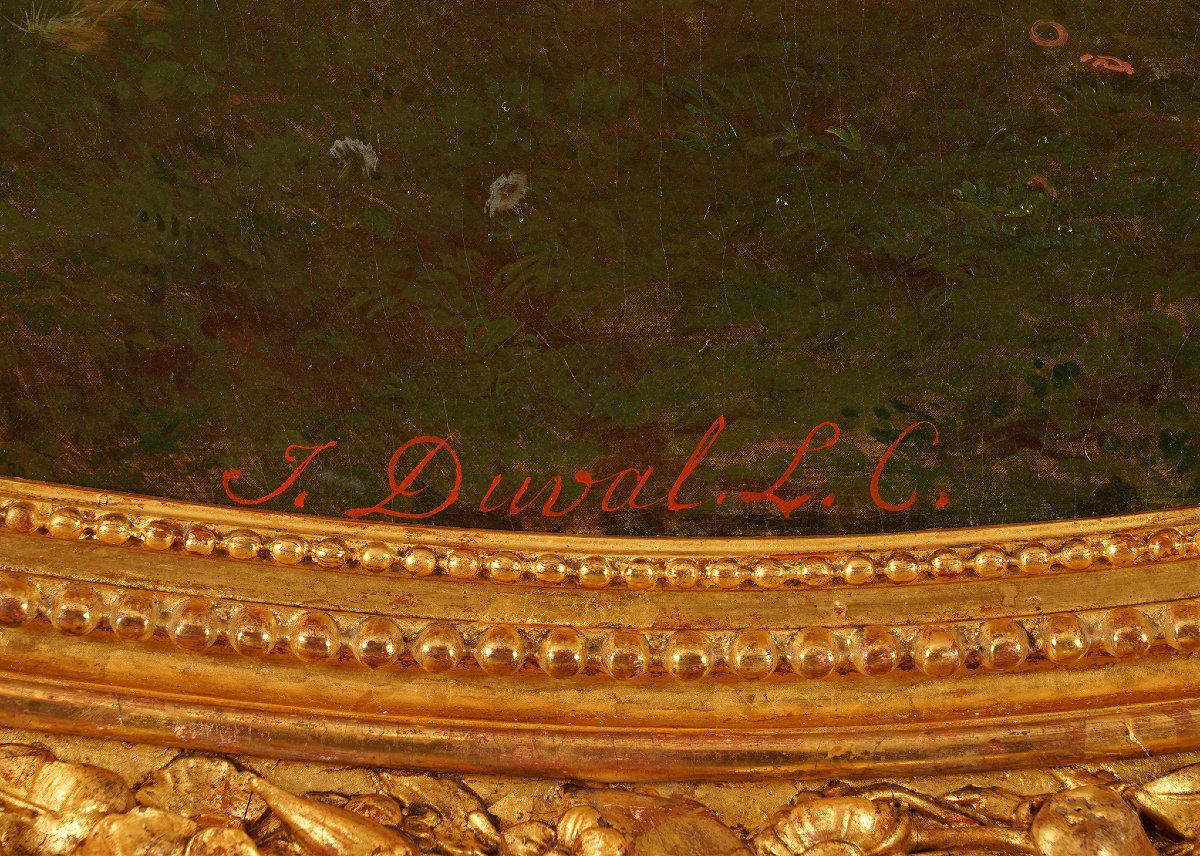
Signed J. Duval.L.C.
Dimensions with frame – Height : 157 cm (61,8 in.) ; Width : 170 cm (67 in.)
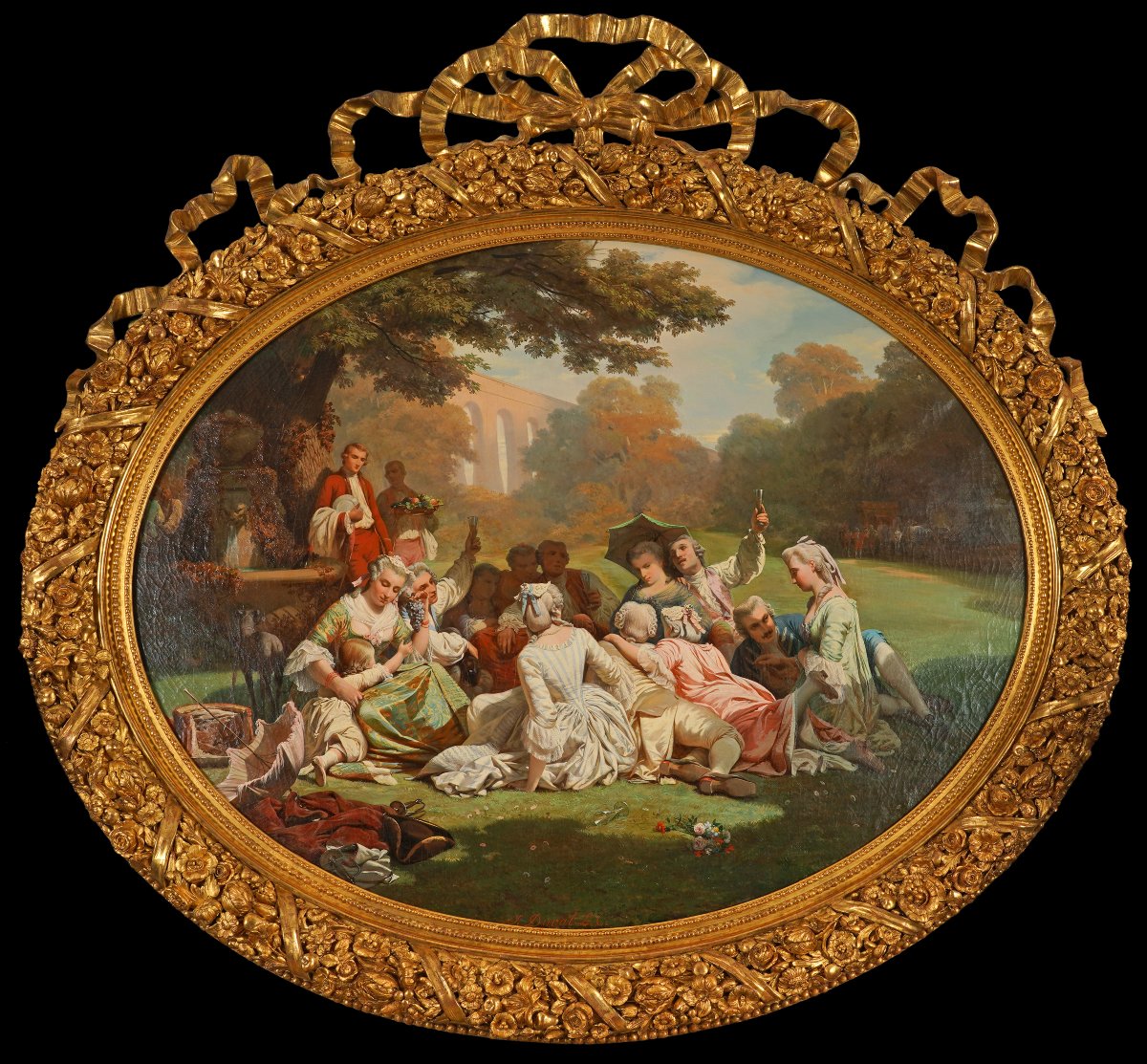
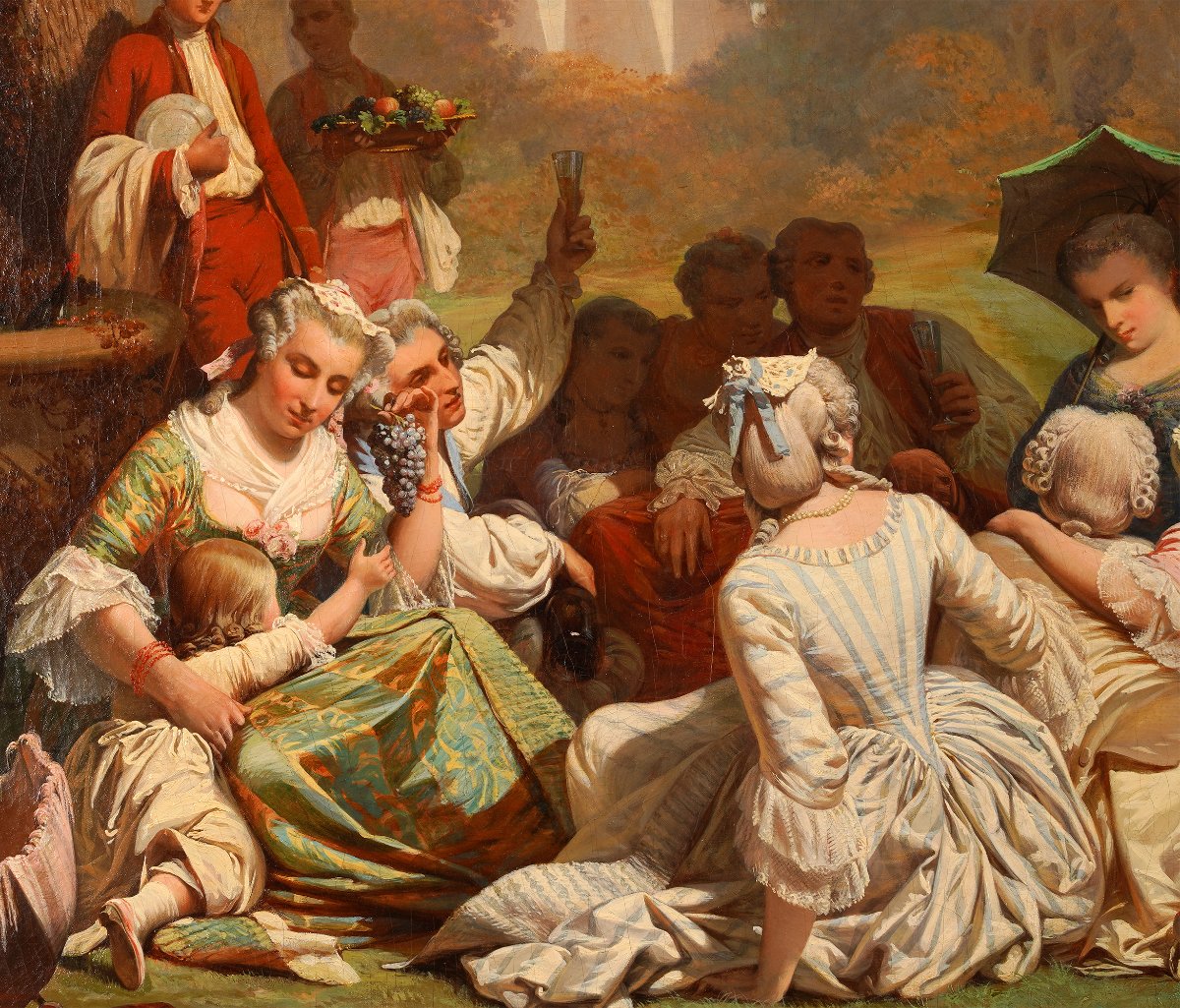
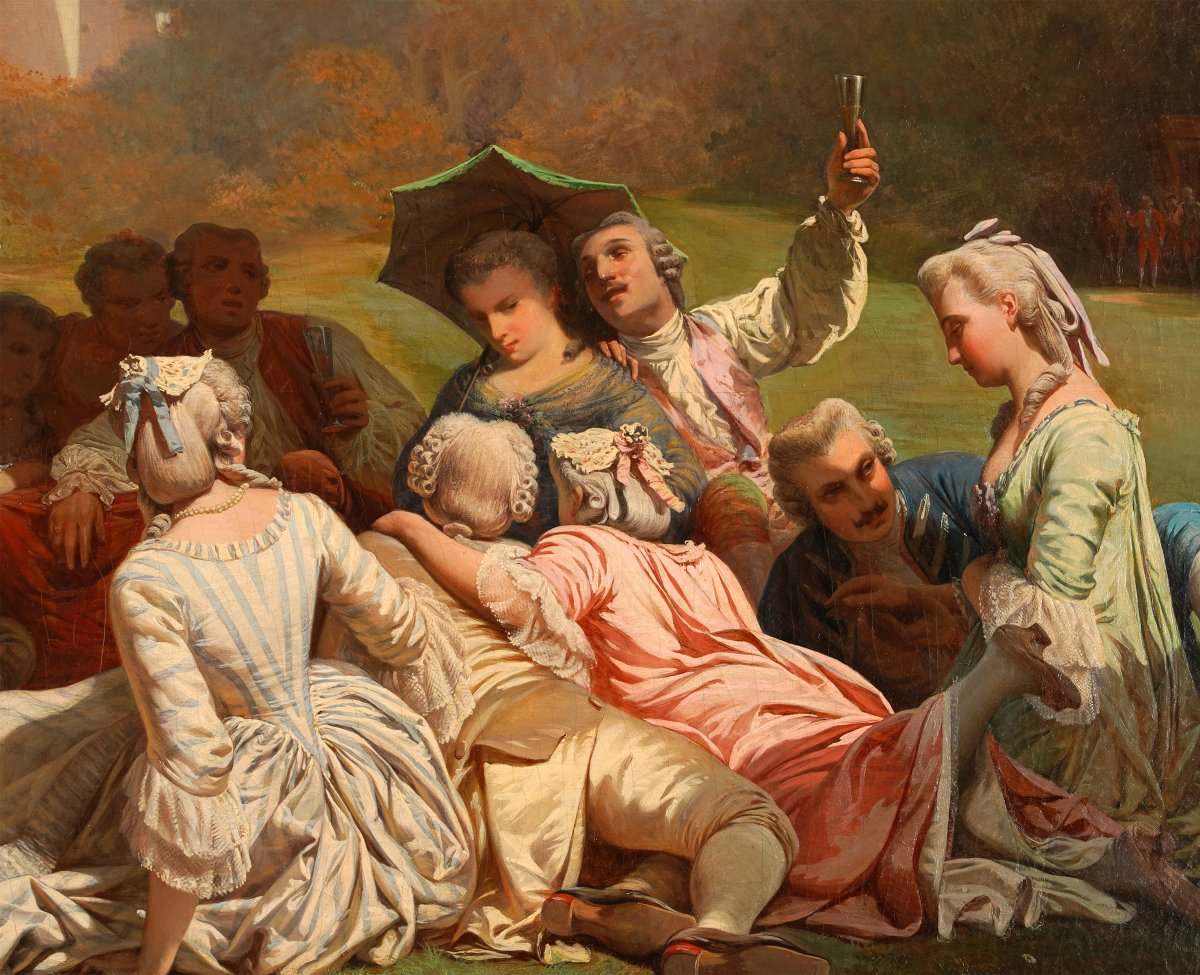
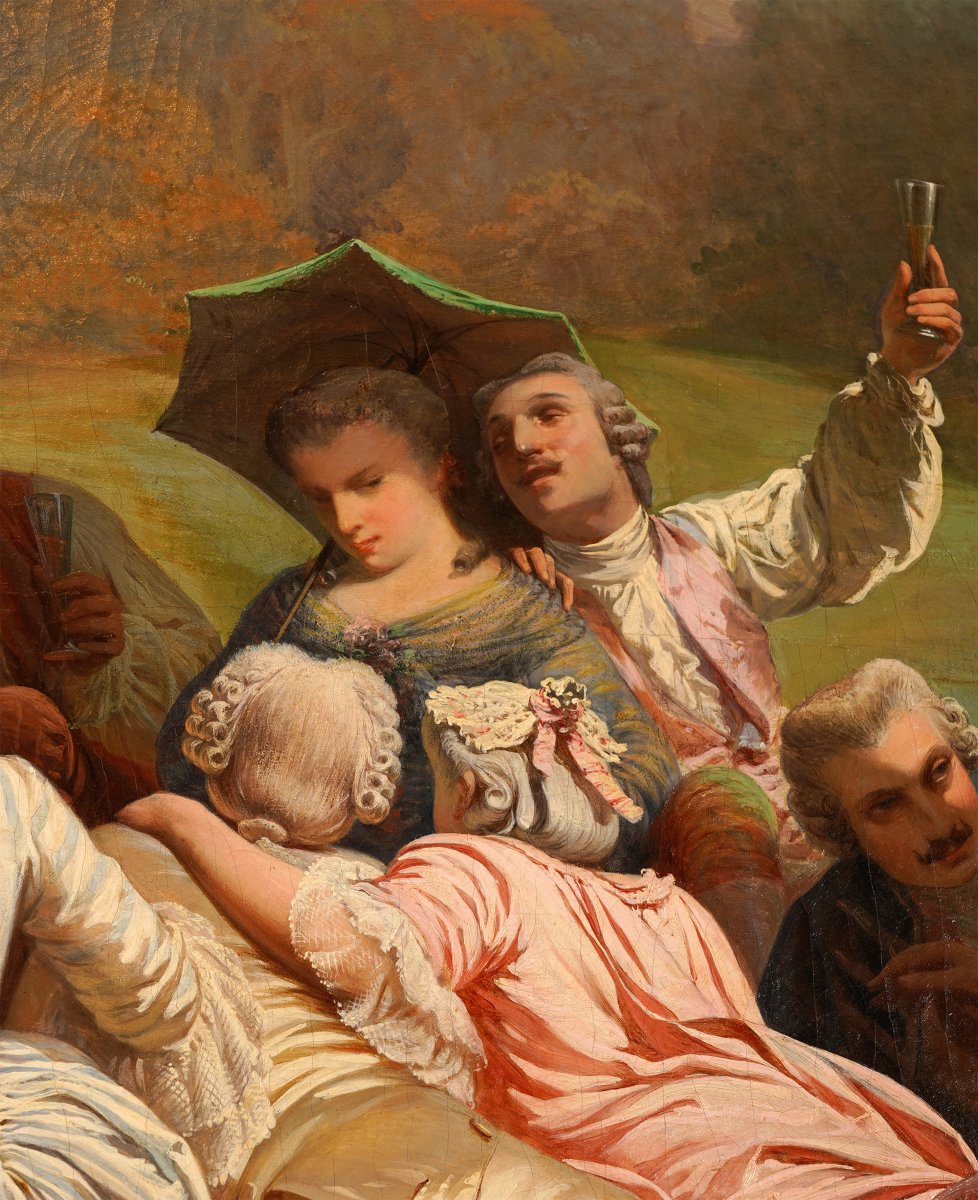
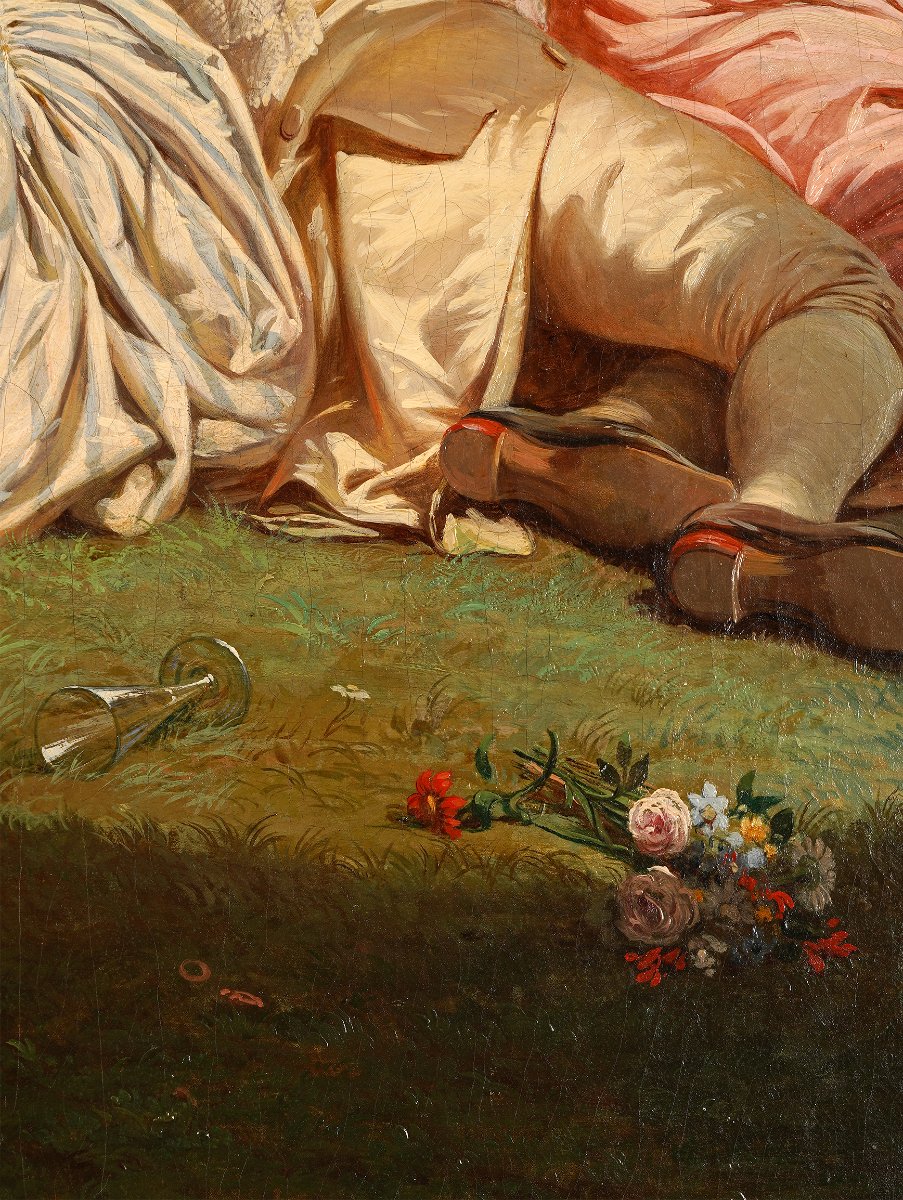
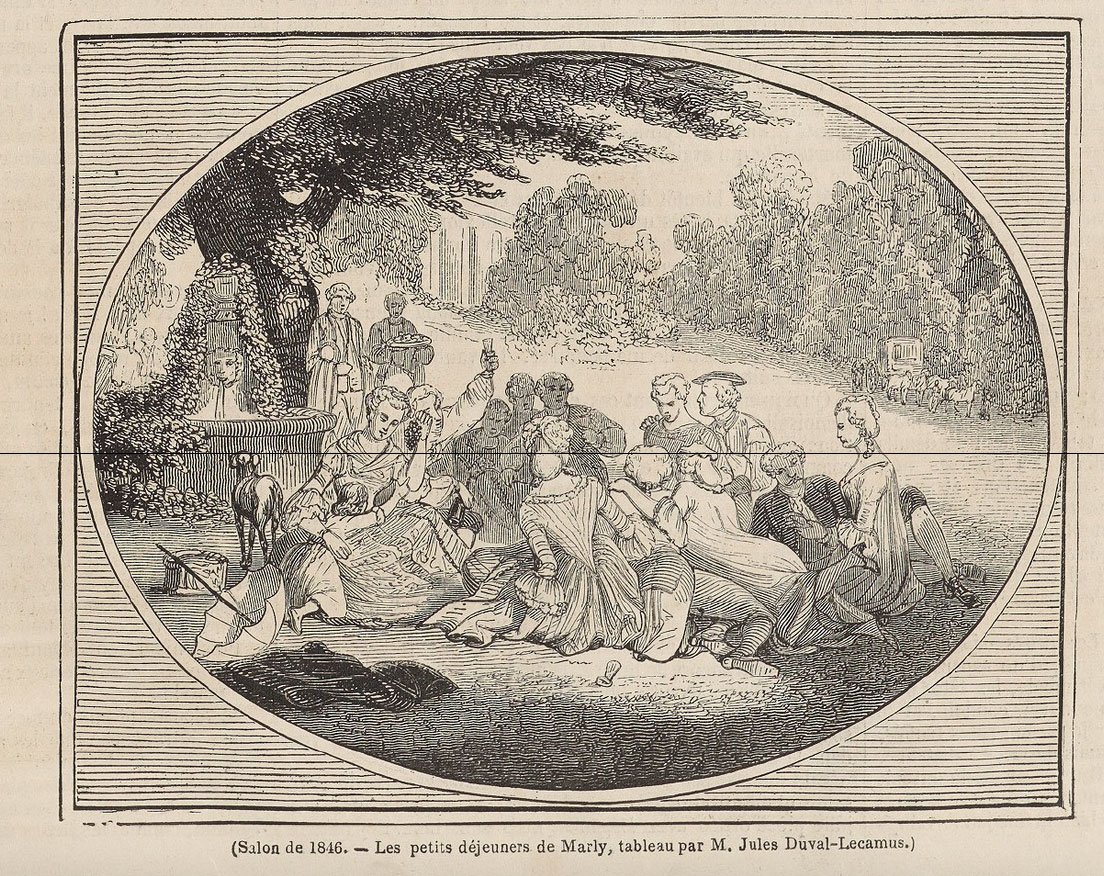
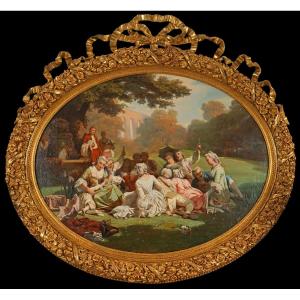
Large oval painting depicting a romantic gathering in a park on a sunny afternoon. The guests, seated in a circle on the grass, are enjoying the pleasant summer weather, glasses of wine in hand. Perhaps they are already tipsy, as suggested by a gentleman’s belongings carelessly abandoned in the foreground, the overturned glass and the proximity of the group with rosy cheeks, where each person is almost slumped against their neighbor. This revelry, however, is not permitted for the youngest among them: the child, drawn to the bunch of grape, a symbol of wine, is held back by his mother on the edge of the circle, who takes the fruit away from him. Not far behind flows a fountain where the next bottle is kept cool, ready to be brought by the attentive servants. A greyhound, a symbol of loyalty, looks away from the group, foreshadowing the events to come.
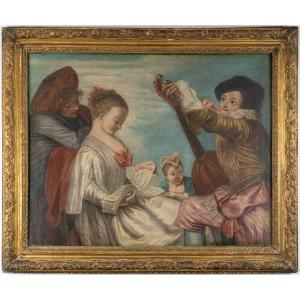
This painting follows in the pictorial tradition of “fêtes galantes,” a genre that emerged in France in the 18th century through the works of Watteau, Boucher, and Fragonard. The Age of Enlightenment was characterized by a liberation from social and moral constraints and from the rigors of etiquette; consequently, scenes depicting the good life, far removed from the austerity imposed by the court, were celebrated. Thus, the figures in our painting are all dressed in 18th-century fashion and wear wigs typical of the period. It is noteworthy that he mastered the harmony ofcolors, acid green, pale pink, and powder blue, and of light, a mastery alreadyrecognized by the jury of the Salon in 1838. This “personal palette” surelyresponded to the sensibilities of the 1850s.
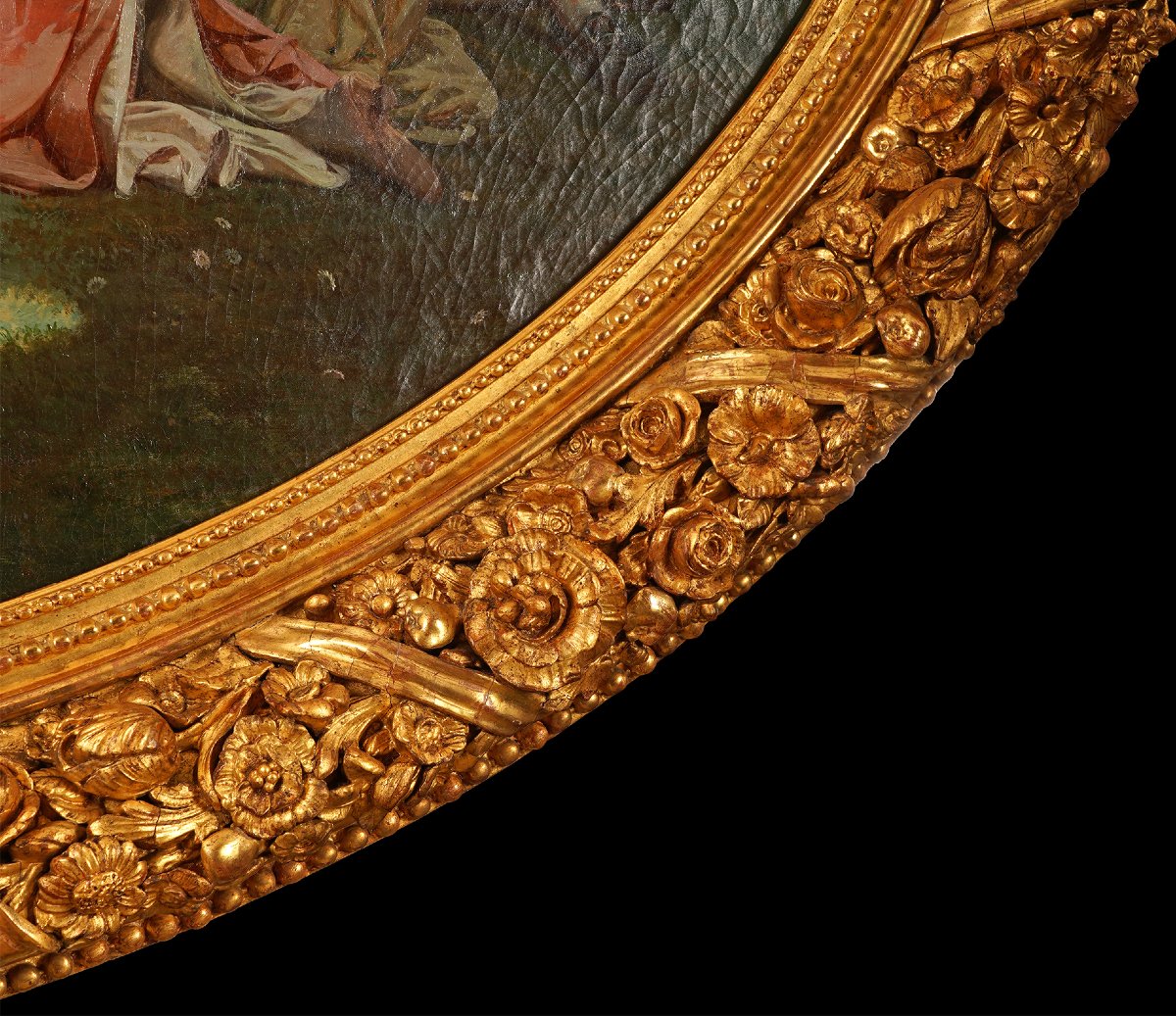
The original gilded frame adds to the work’s splendor: a garland of roses, daisies, fruits, and leaves, tied with a ribbon, extends the painting’s pastoral theme through a delightful interplay of volumes. The whole appears to be suspended by a pleated ribbon and bordered on either side by a frieze of pearls.
Biography :
Jules-AlexandreDuval Le Camus (1814–1878) was a French painter who received his training inthe studio of his father, Pierre Duval Le Camus, and later studied at the Écoledes Beaux-Arts in Paris in the studios of Drölling and Delaroche. In 1838, heplaced second in the 1838 Prix de Rome for painting, and then exhibited at theSalon from 1840 through 1867. His particular focus was religious painting andhistory painting, which were frequently featured at the Salon as well as inseveral churches in France where his works are still on display. Following inhis father’s footsteps, however, he also produced several genre scenes. He wasalso a major collector of drawings, which are now scattered among the world’smajor museums.
Dimensions with frame – Height : 157 cm (61,8 in.) ; Width : 170 cm (67 in.)
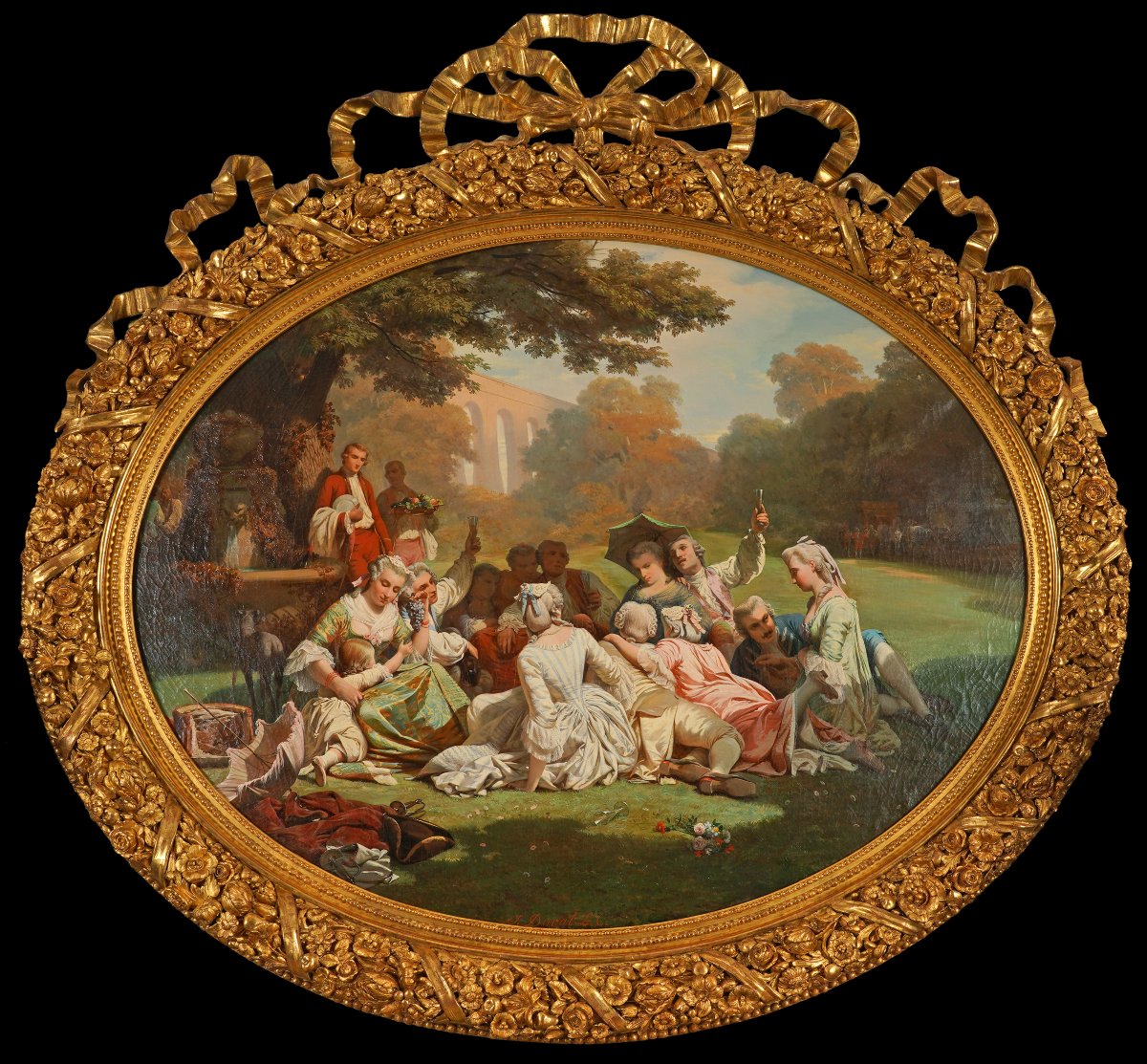
Large oval painting depicting a romantic gathering in a park on a sunny afternoon. The guests, seated in a circle on the grass, are enjoying the pleasant summer weather, glasses of wine in hand. Perhaps they are already tipsy, as suggested by a gentleman’s belongings carelessly abandoned in the foreground, the overturned glass and the proximity of the group with rosy cheeks, where each person is almost slumped against their neighbor. This revelry, however, is not permitted for the youngest among them: the child, drawn to the bunch of grape, a symbol of wine, is held back by his mother on the edge of the circle, who takes the fruit away from him. Not far behind flows a fountain where the next bottle is kept cool, ready to be brought by the attentive servants. A greyhound, a symbol of loyalty, looks away from the group, foreshadowing the events to come.
This painting follows in the pictorial tradition of “fêtes galantes,” a genre that emerged in France in the 18th century through the works of Watteau, Boucher, and Fragonard. The Age of Enlightenment was characterized by a liberation from social and moral constraints and from the rigors of etiquette; consequently, scenes depicting the good life, far removed from the austerity imposed by the court, were celebrated. Thus, the figures in our painting are all dressed in 18th-century fashion and wear wigs typical of the period. It is noteworthy that he mastered the harmony ofcolors, acid green, pale pink, and powder blue, and of light, a mastery alreadyrecognized by the jury of the Salon in 1838. This “personal palette” surelyresponded to the sensibilities of the 1850s.
The original gilded frame adds to the work’s splendor: a garland of roses, daisies, fruits, and leaves, tied with a ribbon, extends the painting’s pastoral theme through a delightful interplay of volumes. The whole appears to be suspended by a pleated ribbon and bordered on either side by a frieze of pearls.
Biography :
Jules-AlexandreDuval Le Camus (1814–1878) was a French painter who received his training inthe studio of his father, Pierre Duval Le Camus, and later studied at the Écoledes Beaux-Arts in Paris in the studios of Drölling and Delaroche. In 1838, heplaced second in the 1838 Prix de Rome for painting, and then exhibited at theSalon from 1840 through 1867. His particular focus was religious painting andhistory painting, which were frequently featured at the Salon as well as inseveral churches in France where his works are still on display. Following inhis father’s footsteps, however, he also produced several genre scenes. He wasalso a major collector of drawings, which are now scattered among the world’smajor museums.
120 000 €
Period: 19th century
Style: Louis 15th - Transition
Condition: Good condition
Material: Oil painting
Width: 170
Height: 157
Reference (ID): 1784637
Availability: In stock
Print