

Circle Of Jean-germain Drouais, Philoctetes. Oil On Canvas, 92 × 73 Cm
Artist: Jean-germain Drouais (entourage)
Circle of Jean-Germain Drouais
(Paris, 1763 – Rome, 1788)
Philoctetes
Oil on canvas, 92 × 73 cm
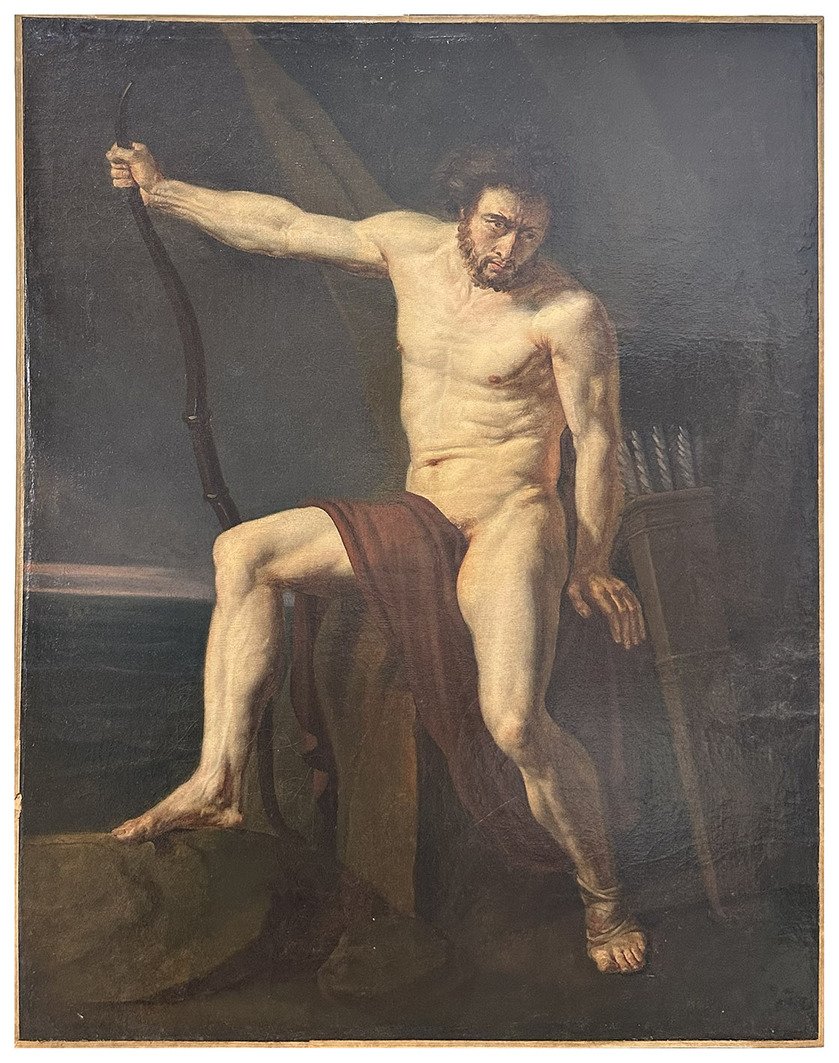
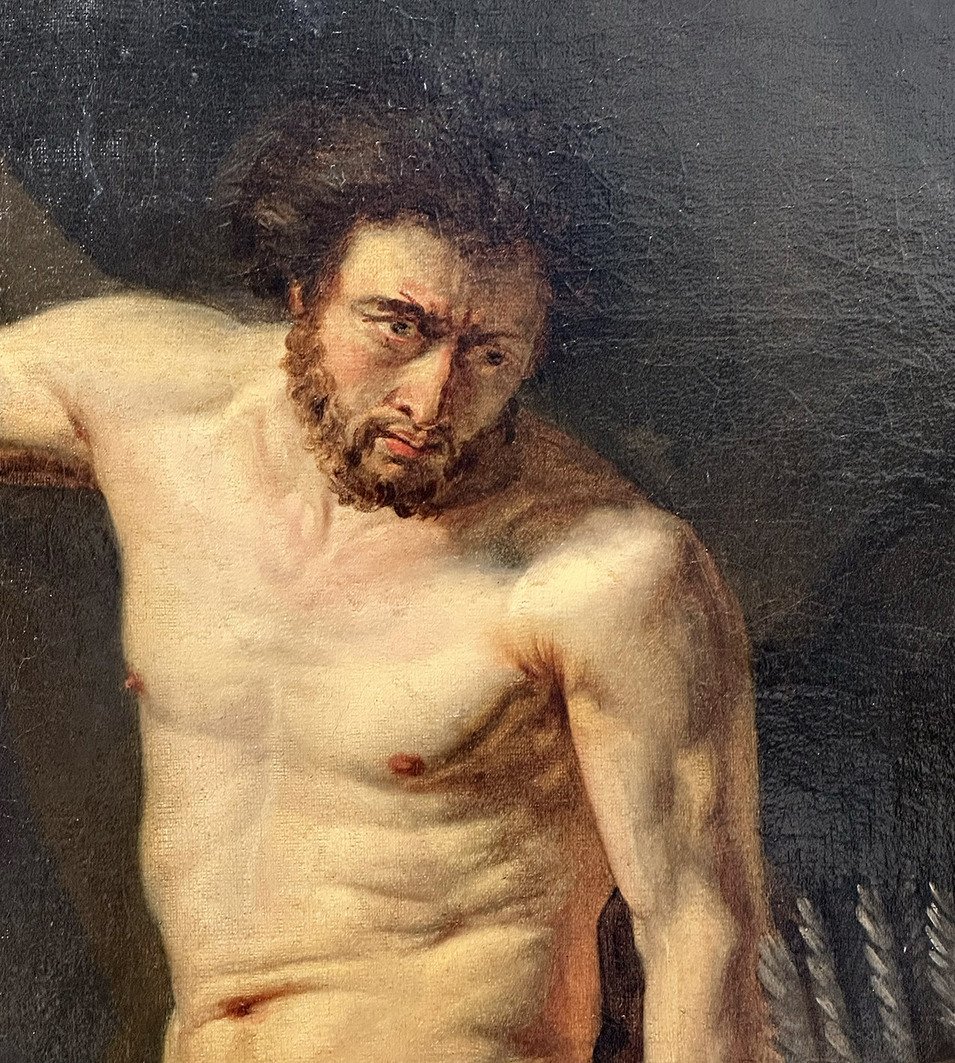
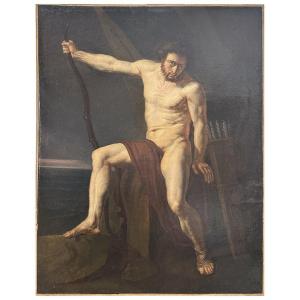
The painting depicts Philoctetes in full figure, seated on a gray, rocky tree in a rocky setting reminiscent of the cave refuge on the island of Lemnos. The figure—a man of extraordinary anatomical plasticity—occupies nearly the entire surface of the canvas, asserting itself with the force of a sculptural fragment isolated from the surrounding darkness. His right arm is outstretched horizontally upward, his right hand firmly gripping the bow—the primary attribute for the figure’s iconographic identification—in a perpetually possessed, almost obsessive manner. The left arm, by contrast, hangs limply at his side, the open hand wearily brushing against the rock: a counterpoint of great expressive power that captures the character’s intrinsic duality—heroically proud yet at the same time marked by exhaustion.
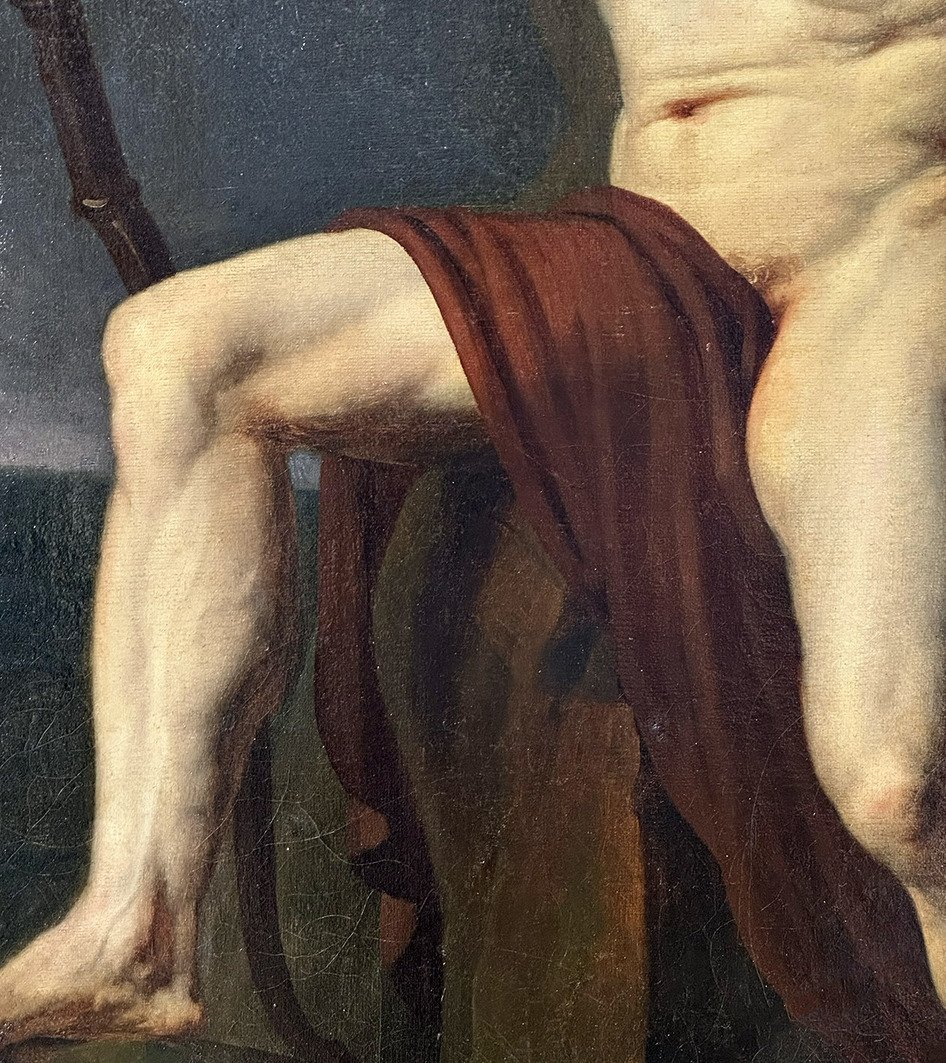
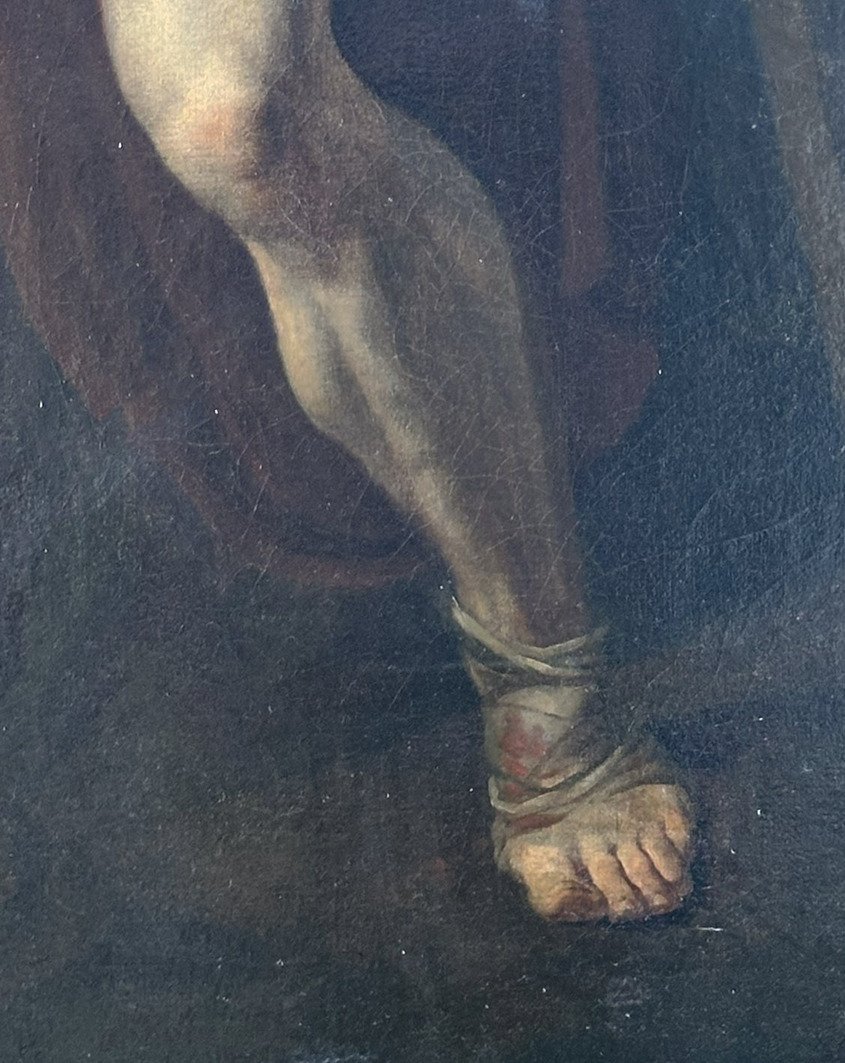
The face is depicted in three-quarter profile, turned toward the viewer with a sombre yet fiery gaze, charged with an emotional tension that never descends into pathos but instead crystallizes into an expression of proud resistance. On the right side, resting against the rock, is the quiver containing Heracles’ arrows. The left foot—the site of the wound—is bandaged with a piece of linen, the only explicit sign of chronic pain. A rich dark-red fabric is draped over his thighs, a singular concession to warm colors in a color scheme dominated by cool, muted tones. In the background, to the left, the light from the golden sky and the lead-gray sea filters through the word “rocky.” The light, coming from the left, sculpts the muscles with a striking plasticity inherited from antiquity: breasts, busts, and thighs are modeled with an attention to anatomical relief that evokes the direct study of classical sculpture.
Jean-Germain Drouais, son of the famous portraitist François-Hubert Drouais, was the spitting image of Jacques-Louis David, whom the master called “my son.” In 1784, he once again won the Prix de Rome with *The Canaanite Woman at the Feet of Christ* (Paris, Louvre Museum). In Rome, he presented *Marion at the Minturnae* (1786, Louvre) and studied the great Philoctetes, who died prematurely. David died of smallpox in February 1788, at the age of twenty-five. David wrote that he had lost “the greatest painter of the century.” The story of Philoctetes is not merely an episode in Drouais’s portfolio; it constitutes one of the cornerstones for reflecting on the pathos inherent in neoclassical expressive norms. The most apt comparison is with the unfinished Philoctetes of Chartres (Musée des Beaux-Arts, 1787–1788): a male nude seated against a rocky backdrop, the bow as a distinctive element, the same expression of suffering borne with heroic dignity, and the same anatomical precision characteristic of David. Mario’s *Minturnae* (1786, Louvre) offers a second point of direct comparison in terms of anatomical quality and the handling of chiaroscuro. This work—due to the quality of its execution, its composition, and its ability to capture emotion—stands in close proximity to the project, as well as to the advanced preparatory work and the creation of the artist’s most valuable works.
The quality of the execution cannot be attributed to a second master: the anatomical construction of the figure, the mastery of composition, and the handling of shadows attest to the skill of a painter who received a solid French academic training and was thoroughly familiar with David’s principles. Attributing the work to the painter’s inner circle is consistent with the stylistic and thematic coherence found in the most celebrated artist of this brief classical period.
Main bibliographic reference:
J. Bertrand Marchand (ed.), Jean-Germain Drouais 1763–1788, exhibition catalog, Rennes–Chartres 1985.
(Paris, 1763 – Rome, 1788)
Philoctetes
Oil on canvas, 92 × 73 cm
The painting depicts Philoctetes in full figure, seated on a gray, rocky tree in a rocky setting reminiscent of the cave refuge on the island of Lemnos. The figure—a man of extraordinary anatomical plasticity—occupies nearly the entire surface of the canvas, asserting itself with the force of a sculptural fragment isolated from the surrounding darkness. His right arm is outstretched horizontally upward, his right hand firmly gripping the bow—the primary attribute for the figure’s iconographic identification—in a perpetually possessed, almost obsessive manner. The left arm, by contrast, hangs limply at his side, the open hand wearily brushing against the rock: a counterpoint of great expressive power that captures the character’s intrinsic duality—heroically proud yet at the same time marked by exhaustion.
The face is depicted in three-quarter profile, turned toward the viewer with a sombre yet fiery gaze, charged with an emotional tension that never descends into pathos but instead crystallizes into an expression of proud resistance. On the right side, resting against the rock, is the quiver containing Heracles’ arrows. The left foot—the site of the wound—is bandaged with a piece of linen, the only explicit sign of chronic pain. A rich dark-red fabric is draped over his thighs, a singular concession to warm colors in a color scheme dominated by cool, muted tones. In the background, to the left, the light from the golden sky and the lead-gray sea filters through the word “rocky.” The light, coming from the left, sculpts the muscles with a striking plasticity inherited from antiquity: breasts, busts, and thighs are modeled with an attention to anatomical relief that evokes the direct study of classical sculpture.
Jean-Germain Drouais, son of the famous portraitist François-Hubert Drouais, was the spitting image of Jacques-Louis David, whom the master called “my son.” In 1784, he once again won the Prix de Rome with *The Canaanite Woman at the Feet of Christ* (Paris, Louvre Museum). In Rome, he presented *Marion at the Minturnae* (1786, Louvre) and studied the great Philoctetes, who died prematurely. David died of smallpox in February 1788, at the age of twenty-five. David wrote that he had lost “the greatest painter of the century.” The story of Philoctetes is not merely an episode in Drouais’s portfolio; it constitutes one of the cornerstones for reflecting on the pathos inherent in neoclassical expressive norms. The most apt comparison is with the unfinished Philoctetes of Chartres (Musée des Beaux-Arts, 1787–1788): a male nude seated against a rocky backdrop, the bow as a distinctive element, the same expression of suffering borne with heroic dignity, and the same anatomical precision characteristic of David. Mario’s *Minturnae* (1786, Louvre) offers a second point of direct comparison in terms of anatomical quality and the handling of chiaroscuro. This work—due to the quality of its execution, its composition, and its ability to capture emotion—stands in close proximity to the project, as well as to the advanced preparatory work and the creation of the artist’s most valuable works.
The quality of the execution cannot be attributed to a second master: the anatomical construction of the figure, the mastery of composition, and the handling of shadows attest to the skill of a painter who received a solid French academic training and was thoroughly familiar with David’s principles. Attributing the work to the painter’s inner circle is consistent with the stylistic and thematic coherence found in the most celebrated artist of this brief classical period.
Main bibliographic reference:
J. Bertrand Marchand (ed.), Jean-Germain Drouais 1763–1788, exhibition catalog, Rennes–Chartres 1985.
6 900 €
Period: 18th century
Style: Other Style
Condition: Good condition
Material: Oil painting
Length: 73 cm.
Height: 92 cm.
Reference (ID): 1782290
Availability: In stock
Print