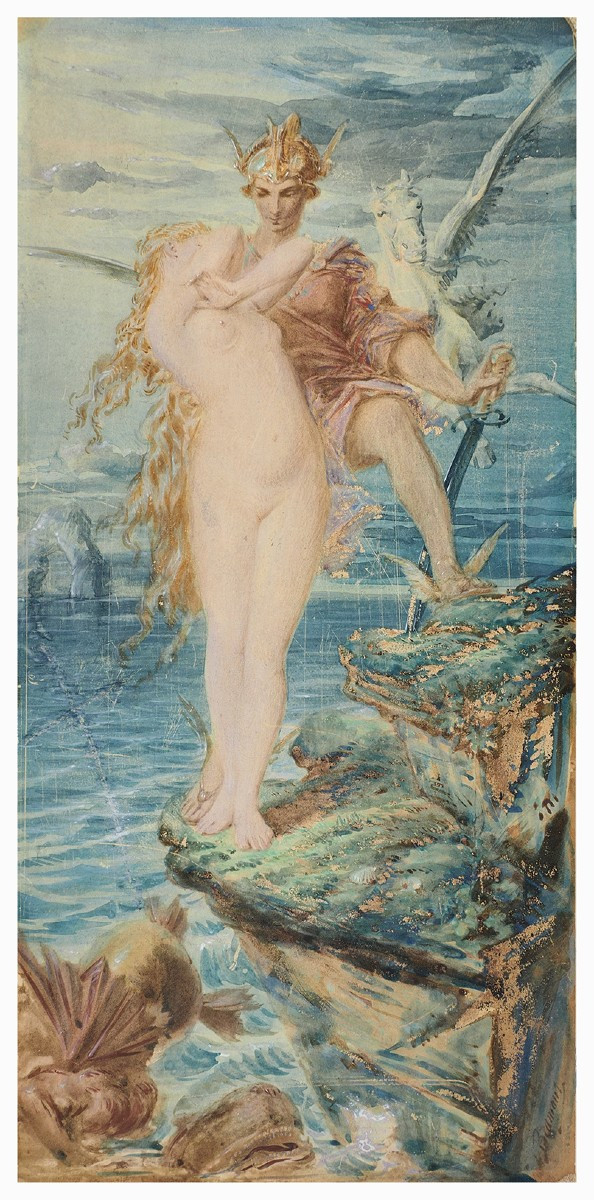


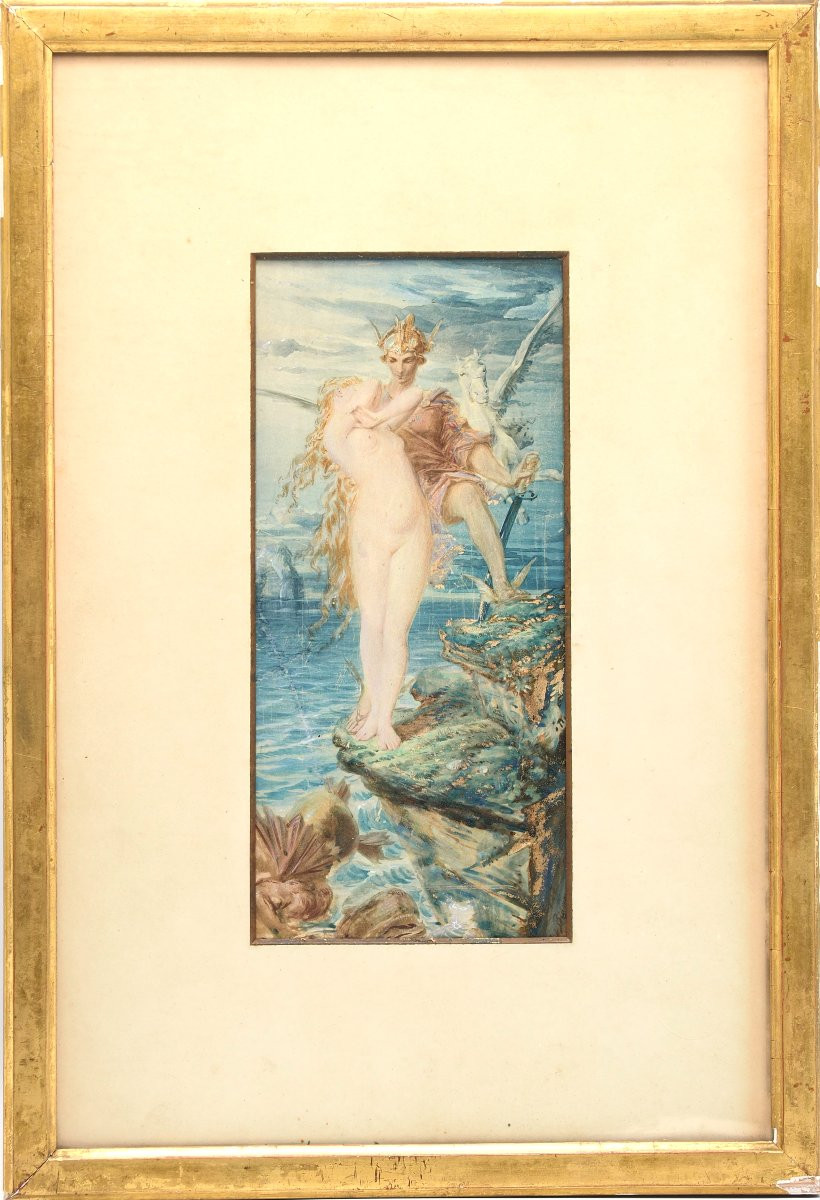


Charles-édouard De Beaumont (1812-1888), Perseus And Andromeda, Mixed Technique
Charles-Édouard de Beaumont
(1812-1888)
Perseus and Andromeda
mixed technique (tempera, watercolor) and gold on cardboard, cm. 24.7 x 12
Signed lower right In good state of conservation, with natural signs of aging of the paper support
Charles-Édouard de Beaumont (Lannion, 1812 - Paris, 1888) was a French painter, illustrator and decorator active during the Romantic period and the Second French Republic.
A student at the Académie des Beaux-Arts in Paris, Beaumont distinguished himself through his artistic versatility, working both as a painter of historical and mythological subjects and as a book illustrator and interior decorator. He was particularly appreciated at the court of Napoleon III, where he carried out important commissions for palaces and noble residences.
He exhibited regularly at the Paris Salon from 1836 and received numerous official commissions, becoming one of the most sought-after artists of his time for wall decorations and decorative panels.
The small painting, probably the sketch for a large-scale wall decoration, presents a mythological scene of great executive refinement, organized according to a vertical scheme that emphasizes the main figure of Andromeda at the center of the composition.
Andromeda is depicted as a nude young woman of extraordinary classical beauty, with diaphanous and delicate complexion, rendered with subtle glazes, and long wavy blonde hair that flows sinuously down her body to her hips. Her posture is erect and composed on the marine rock, her gaze serene and distant, almost contemplative.
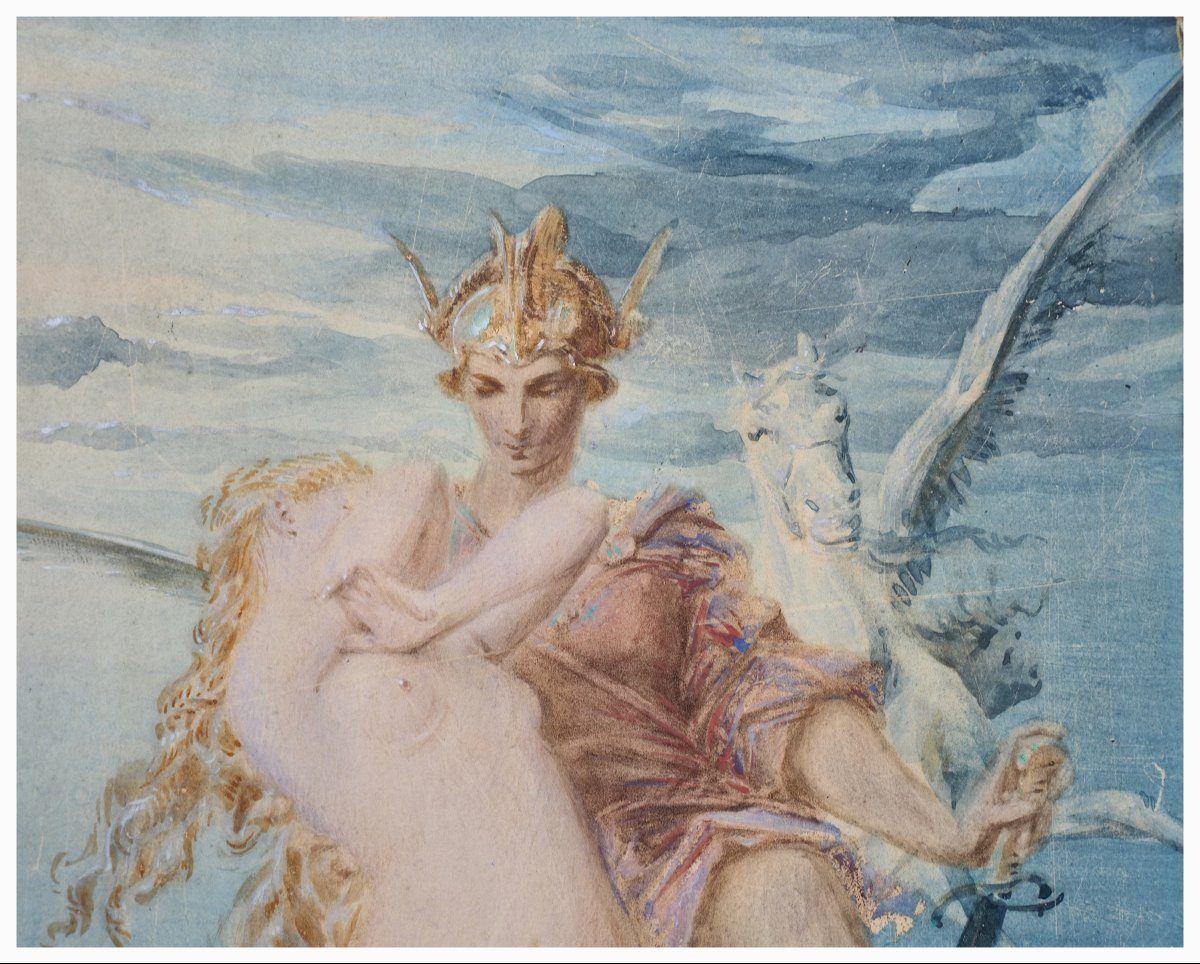
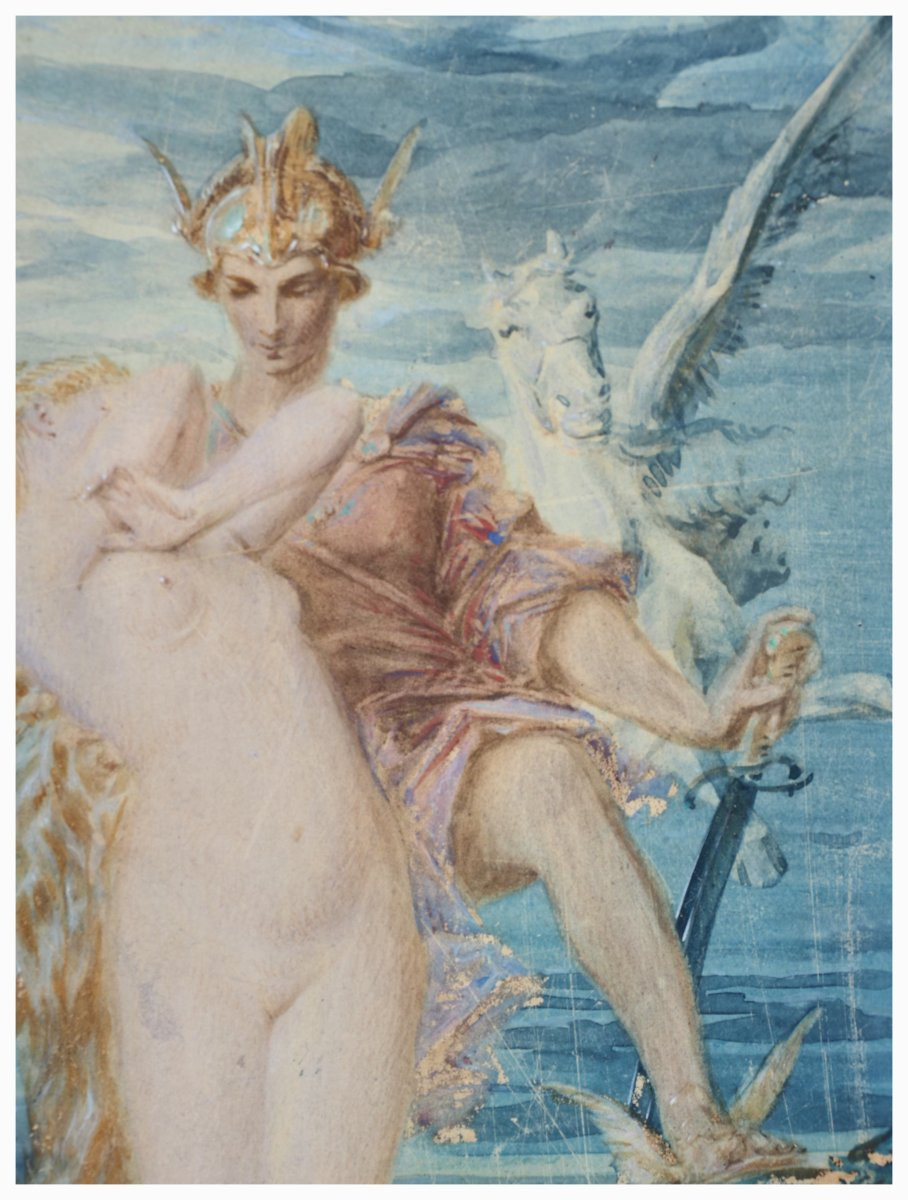
Behind her Perseus, the semi-nude Hero with reddish-brown drapery partially covering his body. On his head the gilded winged helmet, divine attribute lent by Athena or received from the Nymphs, symbol of protection. On his feet the high sandals, the talaria of Mercury / Hermes, which allow flight. His left hand holds the sword, the weapon with which he beheaded Medusa.
In the background Pegasus, the white winged horse born from Medusa's blood.
The work is executed on quality cardboard support, presumably prepared with a light ground to improve pigment adhesion and create a uniform base. On a foundation of preparatory pencil drawing, the artist then applied a watercolor base on which he subsequently intervened with tempera and gold applications to give an effect of three-dimensionality and richness, almost confirming the important destination and prestigious commission of the work.
The myth of Perseus
Perseus, son of Zeus and Danae, was tasked by King Polydectes of Seriphos with an impossible mission: to bring him the head of Medusa, the only mortal among the three Gorgons, whose gaze petrified anyone who looked at her directly.
To accomplish the feat, Perseus received gifts from the gods:
From Hermes/Mercury: The winged sandals (talaria) for flying and the curved sword (harpe) From Athena: The polished shield like a mirror to see Medusa reflected From Hades: The helmet of invisibility (kunee) From the Nymphs: The kibisis, magical bag to contain the severed head
Guided by Athena and Hermes, Perseus found the Gorgons asleep. Looking at Medusa only through the shield's reflection, he succeeded in beheading her. From her neck gushed blood from which were born Pegasus, the winged horse, and Chrysaor, the warrior with the golden sword.
Andromeda was the beautiful daughter of Cepheus, king of Ethiopia, and Cassiopeia. Her mother, proud of her daughter's beauty, dared to boast of being more beautiful than the Nereids (sea nymphs). Offended, Poseidon sent a sea monster (ketos) to devastate the kingdom. The oracle revealed that only Andromeda's sacrifice would appease the god's wrath: the young woman was therefore chained naked to a rock, waiting to be devoured by the monster.
Perseus, returning from his victorious feat against Medusa and flying with winged sandals (or riding Pegasus, according to some versions), saw the chained young woman. Struck by her beauty, he decided to save her. He asked her parents for Andromeda's hand in exchange for the rescue.
When the monster emerged from the waters, Perseus confronted it in an epic battle. According to some versions he used Medusa's head to petrify the monster; according to others he pierced it with his sword. Andromeda freed, the two fell in love.
In the work in question, the painter chooses to represent the moment immediately after the liberation, when the danger has now passed. There is no violence or drama, but a scene of peaceful classical beauty:
Andromeda is free, no longer in chains, symbolizes saved virtue and innocent beauty rewarded Perseus the protector, behind her, represents heroic valor and love that saves The calm sea indicates that the storm (metaphorical and literal) is over The cupid announces the future union and mutual love Pegasus represents the symbolic connection between the past feat (Medusa) and the present one (the sea monster) The divine attributes remind us that without the help of the gods even the bravest hero cannot prevail
The work falls within the tradition of French academic Romanticism of the mid-nineteenth century, with strong neoclassical reminiscences.
This refined painting by Charles-Édouard de Beaumont represents a perfect example of French decorative art of the mid-nineteenth century, where classical culture merges with romantic sensibility and taste for material preciousness. The choice of the myth of Perseus and Andromeda allows the artist to celebrate ideal beauty, virtuous heroism and love that triumphs over danger, themes dear to the bourgeois and aristocratic society of his time. The mixed technique with gold applications gives the work a precious and unique character, testifying to the versatile skill of a complete artist, capable of mastering different techniques to create a result of great refinement and elegance.
Period: 19th century
Style: Other Style
Condition: Good condition
Material: Cardboard
Length: 12 cm.
Height: 24,7 cm.
Reference (ID): 1631863
Availability: In stock