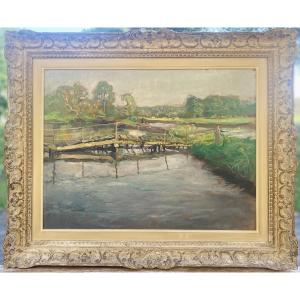


La Flèche Dam Footbridge (sarthe) - Lucien Jonas
Artist: Lucien Jonas (1880-1947)
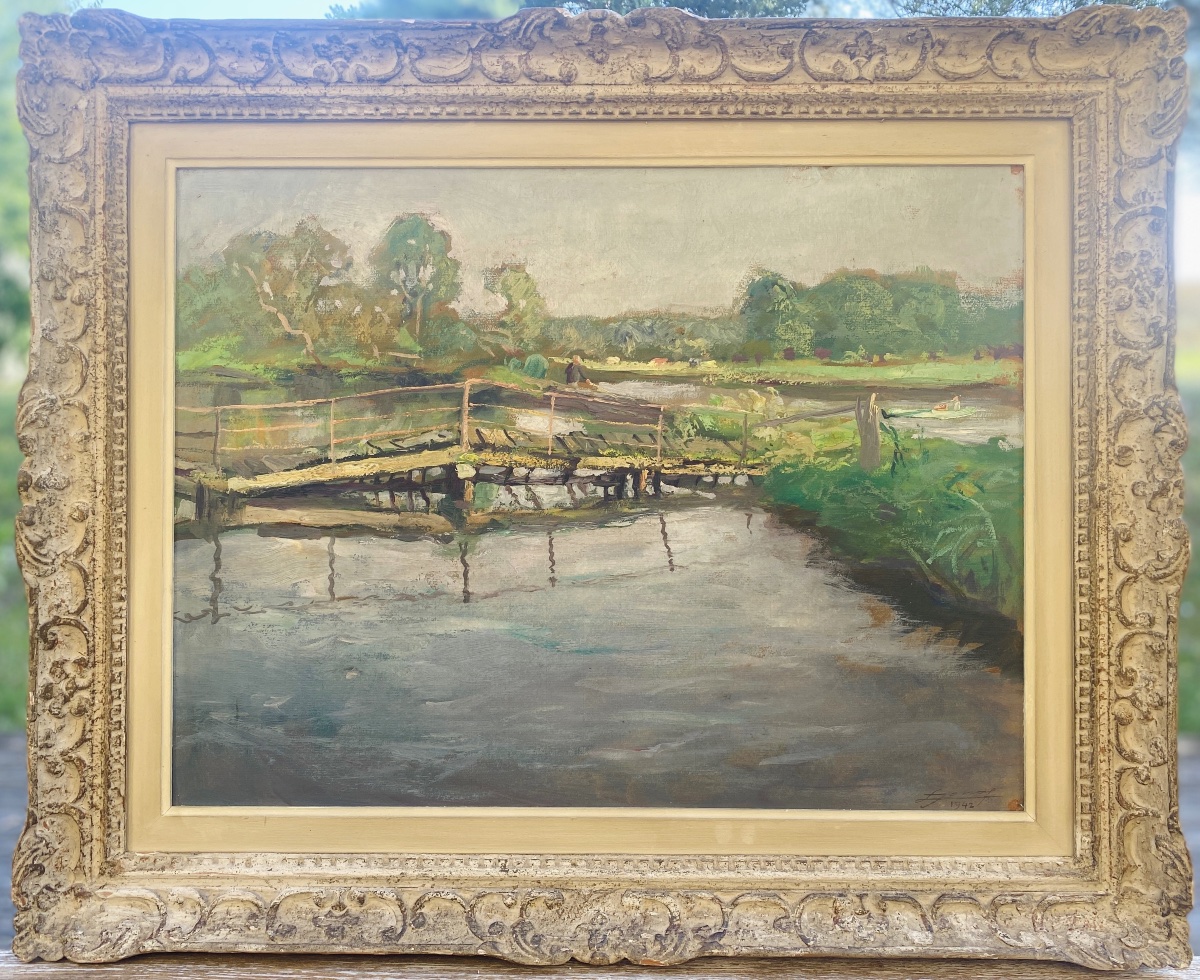
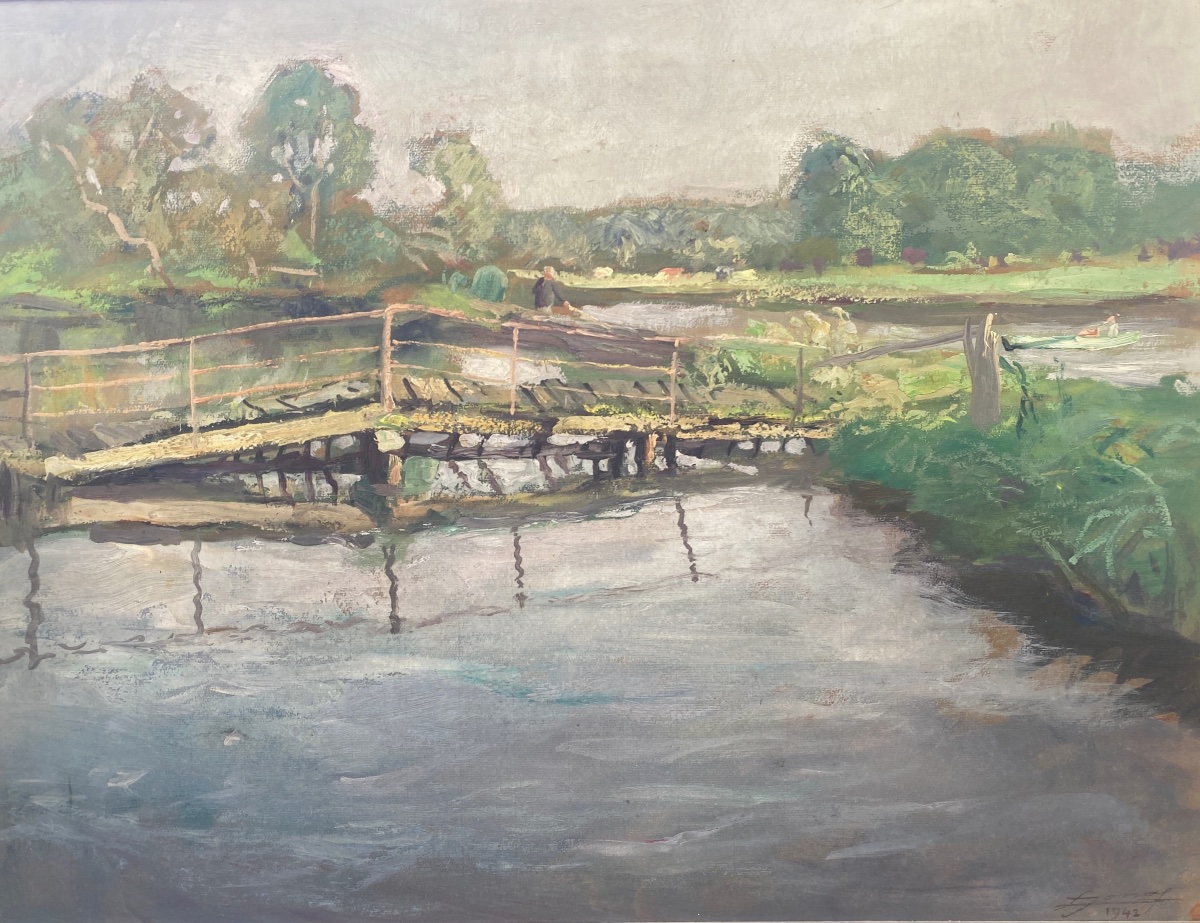
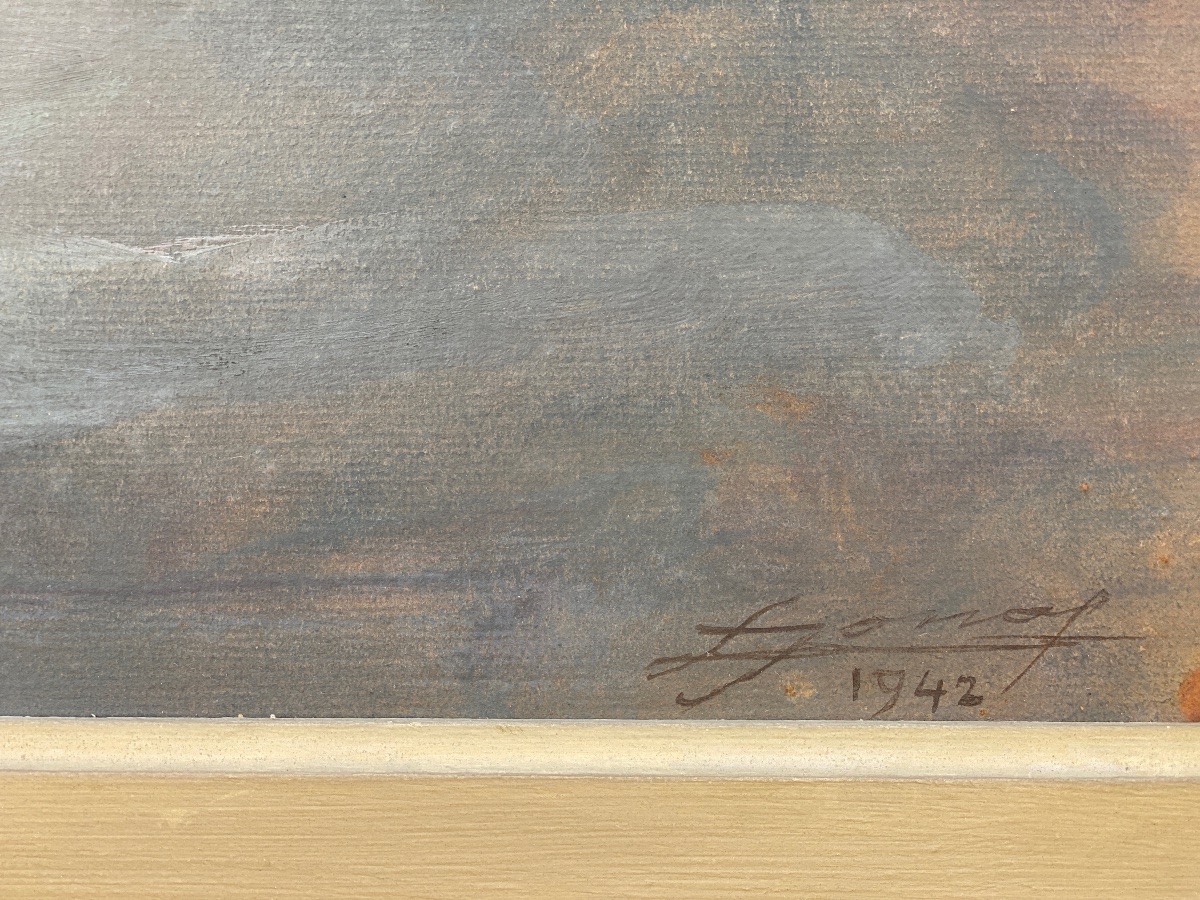
Oil on hardboard signed lower right Lucien Jonas (1880-1947) and dated 1942 (located on the back) representing the footbridge of the La Flèche dam in the Sarthe. Bucolic scene (figures strolling and fishing on the banks of the Loir River in a boat). Several figure studies are on the back of the painting. In its original frame, in very good condition. Dimensions: 63 x 48 cm (excluding frame).
BIOGRAPHY OF LUCIEN JONAS
Lucien Hector Jonas, born April 8, 1880, in Anzin, died September 20, 1947, in the 16th arrondissement of Paris, was a French painter.
Born into a family of industrialists in northern France, Lucien Jonas, a history and genre painter, earned his baccalaureate in literature in June 1898. He continued his studies in Valenciennes with Joseph-Fortuné-Séraphin Layraud and also studied solfège and violin for seven years at the Valenciennes Conservatory. In 1899, he entered the École des Beaux-Arts in Paris. In 1900, he was admitted permanently, and throughout his years at the school, he won a succession of prizes that brought him to the attention of the art world. He became a member of the Société des Artistes Français in 1901.
From 1902, Lucien Jonas also worked in the studio of Albert Maignan, with whom he formed a sincere friendship.
Around the same time, he met Henri Harpignies, who quickly showed affection for the young man he considered his protégé. Harpignies nurtured his love of nature and encouraged him to paint en plein air. Upon his father's death on October 2, 1902, Lucien Jonas left the École des Beaux-Arts to return to Anzin, to be with his mother and help manage the family distillery, which was later taken over by his brother.
Returning to Paris in 1903, He settled at number 3 Rue Lecourbe, in a ground-floor studio opening onto a large courtyard, made available to him by a cousin who was an architect. He used the spacious terrace for plein air painting. In 1904, he took advantage of his stays in Anzin and the vast warehouses of the distillery to paint large compositions inspired by the life around him. A painting depicting a mining tragedy (Les Consolations) earned him the silver medal at the 1905 Salon. Three other prizes—the Chenavard, Trémont, and Stillmann prizes—further encouraged him.
Lucien Jonas won the second Grand Prix de Rome in 1905 (the first prize was not awarded that year). He was celebrated in Valenciennes with his friend Lucien Brasseur, who won the first Grand Prix in sculpture, and then received the gold medal (hors concours) with a travel grant. 1907.
In 1907, the King of Siam acquired one of his works, entitled *Les Rouffions*, which is housed in the Royal Palace in Bangkok.
On May 2, 1908, Lucien Jonas married Suzanne Bedorez, daughter of Georges Bedorez, a Doctor of Law, advisor to the Court of Cassation, and Knight of the Legion of Honor. They had three children: Pierre, Solange (wife of René Guillaume, a magistrate), and Jacques. The couple settled on Boulevard Raspail in Paris. In 1911, the Higher Council of Fine Arts awarded him the national prize for his painting *La Consultation*.
In February 1915, he was appointed "Military Painter attached to the Army Museum." From mission to mission, he traveled the front lines, from Belgium to the Vosges Mountains, and was later specifically commissioned to paint portraits of the commanders. Military figures, such as French (March 15, 1915), Pershing (August 14, 1917, currently in the Metropolitan Museum of Art, New York), and Foch (the day after his appointment as commander-in-chief). In total, seven to eight hundred oil paintings and nearly four thousand drawings, reproduced extensively in L'Illustration, Les Annales politiques et littéraires, Lectures pour tous, and in Allied newspapers. In 1916, he was appointed official painter of the Navy. The war inspired him to create popular compositions that decorated various public buildings. He often depicted the lives of miners and the "Black Country." He also achieved success with Art Deco murals and decorated numerous buildings, notably in Paris (Maison des Centraux) and Valenciennes (town hall, chamber of commerce).
As a war painter, many of his compositions, particularly battle scenes, are adapted into postcards throughout the First World War.
In 1923, he contributed his drawings to Jules Mousseron's book (illustrated by Lucien Jonas), *La terre des Galibots: Poésies patoises* (Lille, Valenciennes and Denain, or available from the author at 2 rue de Villars in Denain, 1923, 147 pp.), Scenes of the Mining Country: - Cafougnette's New Feats - The Journey Along a Pit - Glossary of the "Rouchi" Dialect.
In 1926, he was named an Honorary Rosati, in 1929, he was made a Knight of the Legion of Honor, and on July 6, 1932, he was appointed Painter of the Air Force. In 1933, he began his collaboration with the Bank of France on the design of banknotes, including the 10-franc Miner and the 20-franc Fisherman. In 1934, Lucien Jonas completed a major work intended for the entrance of the Lille seminary, three years after the seminary's inauguration: a triptych entitled "The Response of Souls to the Call of Christ." In 1937, he created decorations for the Paris Universal Exposition and painted a portrait of Louis de Broglie. In 1942, he created a major tapestry cartoon for the Gobelins Manufactory: *Le Travail pour la France* (Work for France). In 1943, he donated seventeen large compositions on the life of the Virgin Mary to the Spanish Church on Rue de la Pompe in Paris. In 1944, he painted portraits of Generals Koenig and De Larminat (Paris, Musée de l'Ordre de la Libération), as well as that of General De Lattre de Tassigny. He was awarded the Order of the Francisque. In 1945, at the Salon des Artistes Français, he was awarded the Medal of Honor for Painting for a fourteen-meter-long fresco featuring some one hundred and twenty figures, entitled *Furor Teutonicus*.
In 1946, Lucien Jonas was very ill and exhausted. Suffering from an eye infection, he was extremely sensitive to light. He finished his fourteen Stations of the Cross paintings for the Church of Saint-Martin in Saint-Amand-les-Eaux. In August 1947, in La Flèche, after a particularly painful crisis, he painted his last outdoor scenes in his in-laws' garden. He returned to Paris, where he died on September 20. He is buried in La Flèche, in a grave located, as he wished, near those of the soldiers of the Souvenir Français (French Remembrance Society). A large part of his Valenciennes works was destroyed by the bombings that struck the city in 1940. However, in the 2000s, the artist's son, Jacques Jonas, donated about a hundred sketches for his wall and ceiling decorations to the Valenciennes Museum of Fine Arts.
The Carnavalet Museum in Paris dedicated an exhibition to him in 2003, as did the Museum of Fine Arts in Valenciennes in 2006. However, the artist's attachment to the city of his youth went far beyond simply acknowledging his mentors. Lucien Jonas constantly paid homage to Valenciennes and its surrounding region, celebrating in large-scale compositions not only the city's artistic past but also its vibrant and close-knit community of artists, intellectuals, industrialists, merchants, and workers. There was no pompous or sentimental glorification: Lucien Jonas's ambition, as he liked to recall, was "to copy, while critiquing, without mockery or malice, the people, the types, the physiognomies, or the minor foibles characteristic of my own time" [citation needed].
One of his paintings, depicting a kneeling miner holding a cap and a lamp, was chosen to illustrate the commemorative stamp entitled "Homage to the Miners - Courrières 1906-2006," for the centenary of the Courrières mining disaster. In January 2009, a three-by-two-meter canvas was acquired by the Porte du Hainaut urban community. This major work, restored and now on display at the Denain Museum of Archaeology and Local History, is entitled "Forges and Steelworks of the North and East." This allegory of the lifeblood of industry represents a Bessemer converter supplying France with electricity. The various trades of the steel industry are depicted in a frieze surrounding the work.
The Théophile-Jouglet Museum in Anzin dedicated an exhibition to Lucien Jonas relating to his works representing scenes of daily or religious life in the town hall, the theatre and the Sainte-Barbe church, in September and October 2009.
From November 2009 to March 2010, the Musée de l'Orangerie in Paris hosted the exhibition "Les enfants modèles, de Jean Renoir à Pierre Arditi" (Model Children, from Jean Renoir to Pierre Arditi), focusing on the children of artists. Among the works exhibited were three by Lucien Jonas: "La Belle Histoire" (1921), "La Sainte Suzanne" (1921), and "La Récitation" (1920). From October 2011 to January 2012, the Museum of Archaeology and Local History in Denain organized the exhibition "La Plume et le Marteau" (The Pen and the Hammer) as part of the "Dessiner-Tracer" (Draw-Trace) cultural season led by the Association of Museum Curators of Nord-Pas de Calais (MUSENOR). Numerous previously unseen works by Lucien Jonas were presented there. In October 2012, the Banque de France received from Lucien Jonas's descendants a collection of drawings and paintings relating to the graphic design of the banknotes he created between 1934 and 1946, such as the 100-franc Sully, the 10-franc Miner, and the 20-franc Fisherman. He was close to the engraver Georges Hourriez, who, like Jonas, was from Valenciennes and worked on engraving banknotes designed by him. From June 18 to July 4, 2013, the Banque de France exhibited, under the title "From Portrait to Banknote: The Art of Lucien Jonas," the 140 detailed studies, pencil and charcoal sketches, and gouache maquettes that revealed the different facets of Lucien Jonas's creations, and particularly the quality of his portraits. Most of these documents, preserved by Lucien Jonas and later by his children and grandchildren, had never before been shown to the public.
From June 26 to September 4, 2016, the town of Perros-Guirec showcased how Brittany has been and continues to be a source of inspiration and joy for painters, particularly Lucien Jonas, with an exhibition entitled "The Beautiful Summer of Painters in Brittany" at the Maison des Traouïero. In preparation for the centenary of the First World War, La Voix du Nord published a feature on Lucien Jonas on November 8, 2018. This war painter created numerous canvases in the trenches, including propaganda works and references to a fresco entitled "The Savior," which has been fully restored and depicts a French soldier in a Christ-like pose. This work will be reinstalled in the Saint-Géry church in Valenciennes. On November 23, 2018, following its restoration, Lucien Jonas's Le Sauveur received the 2018 Pèlerin du Patrimoine special centenary prize, in partnership with the Sauvegarde de l’art français and the Notre-Dame-du-Saint-Cordon basilica.
BIOGRAPHY OF LUCIEN JONAS
Lucien Hector Jonas, born April 8, 1880, in Anzin, died September 20, 1947, in the 16th arrondissement of Paris, was a French painter.
Born into a family of industrialists in northern France, Lucien Jonas, a history and genre painter, earned his baccalaureate in literature in June 1898. He continued his studies in Valenciennes with Joseph-Fortuné-Séraphin Layraud and also studied solfège and violin for seven years at the Valenciennes Conservatory. In 1899, he entered the École des Beaux-Arts in Paris. In 1900, he was admitted permanently, and throughout his years at the school, he won a succession of prizes that brought him to the attention of the art world. He became a member of the Société des Artistes Français in 1901.
From 1902, Lucien Jonas also worked in the studio of Albert Maignan, with whom he formed a sincere friendship.
Around the same time, he met Henri Harpignies, who quickly showed affection for the young man he considered his protégé. Harpignies nurtured his love of nature and encouraged him to paint en plein air. Upon his father's death on October 2, 1902, Lucien Jonas left the École des Beaux-Arts to return to Anzin, to be with his mother and help manage the family distillery, which was later taken over by his brother.
Returning to Paris in 1903, He settled at number 3 Rue Lecourbe, in a ground-floor studio opening onto a large courtyard, made available to him by a cousin who was an architect. He used the spacious terrace for plein air painting. In 1904, he took advantage of his stays in Anzin and the vast warehouses of the distillery to paint large compositions inspired by the life around him. A painting depicting a mining tragedy (Les Consolations) earned him the silver medal at the 1905 Salon. Three other prizes—the Chenavard, Trémont, and Stillmann prizes—further encouraged him.
Lucien Jonas won the second Grand Prix de Rome in 1905 (the first prize was not awarded that year). He was celebrated in Valenciennes with his friend Lucien Brasseur, who won the first Grand Prix in sculpture, and then received the gold medal (hors concours) with a travel grant. 1907.
In 1907, the King of Siam acquired one of his works, entitled *Les Rouffions*, which is housed in the Royal Palace in Bangkok.
On May 2, 1908, Lucien Jonas married Suzanne Bedorez, daughter of Georges Bedorez, a Doctor of Law, advisor to the Court of Cassation, and Knight of the Legion of Honor. They had three children: Pierre, Solange (wife of René Guillaume, a magistrate), and Jacques. The couple settled on Boulevard Raspail in Paris. In 1911, the Higher Council of Fine Arts awarded him the national prize for his painting *La Consultation*.
In February 1915, he was appointed "Military Painter attached to the Army Museum." From mission to mission, he traveled the front lines, from Belgium to the Vosges Mountains, and was later specifically commissioned to paint portraits of the commanders. Military figures, such as French (March 15, 1915), Pershing (August 14, 1917, currently in the Metropolitan Museum of Art, New York), and Foch (the day after his appointment as commander-in-chief). In total, seven to eight hundred oil paintings and nearly four thousand drawings, reproduced extensively in L'Illustration, Les Annales politiques et littéraires, Lectures pour tous, and in Allied newspapers. In 1916, he was appointed official painter of the Navy. The war inspired him to create popular compositions that decorated various public buildings. He often depicted the lives of miners and the "Black Country." He also achieved success with Art Deco murals and decorated numerous buildings, notably in Paris (Maison des Centraux) and Valenciennes (town hall, chamber of commerce).
As a war painter, many of his compositions, particularly battle scenes, are adapted into postcards throughout the First World War.
In 1923, he contributed his drawings to Jules Mousseron's book (illustrated by Lucien Jonas), *La terre des Galibots: Poésies patoises* (Lille, Valenciennes and Denain, or available from the author at 2 rue de Villars in Denain, 1923, 147 pp.), Scenes of the Mining Country: - Cafougnette's New Feats - The Journey Along a Pit - Glossary of the "Rouchi" Dialect.
In 1926, he was named an Honorary Rosati, in 1929, he was made a Knight of the Legion of Honor, and on July 6, 1932, he was appointed Painter of the Air Force. In 1933, he began his collaboration with the Bank of France on the design of banknotes, including the 10-franc Miner and the 20-franc Fisherman. In 1934, Lucien Jonas completed a major work intended for the entrance of the Lille seminary, three years after the seminary's inauguration: a triptych entitled "The Response of Souls to the Call of Christ." In 1937, he created decorations for the Paris Universal Exposition and painted a portrait of Louis de Broglie. In 1942, he created a major tapestry cartoon for the Gobelins Manufactory: *Le Travail pour la France* (Work for France). In 1943, he donated seventeen large compositions on the life of the Virgin Mary to the Spanish Church on Rue de la Pompe in Paris. In 1944, he painted portraits of Generals Koenig and De Larminat (Paris, Musée de l'Ordre de la Libération), as well as that of General De Lattre de Tassigny. He was awarded the Order of the Francisque. In 1945, at the Salon des Artistes Français, he was awarded the Medal of Honor for Painting for a fourteen-meter-long fresco featuring some one hundred and twenty figures, entitled *Furor Teutonicus*.
In 1946, Lucien Jonas was very ill and exhausted. Suffering from an eye infection, he was extremely sensitive to light. He finished his fourteen Stations of the Cross paintings for the Church of Saint-Martin in Saint-Amand-les-Eaux. In August 1947, in La Flèche, after a particularly painful crisis, he painted his last outdoor scenes in his in-laws' garden. He returned to Paris, where he died on September 20. He is buried in La Flèche, in a grave located, as he wished, near those of the soldiers of the Souvenir Français (French Remembrance Society). A large part of his Valenciennes works was destroyed by the bombings that struck the city in 1940. However, in the 2000s, the artist's son, Jacques Jonas, donated about a hundred sketches for his wall and ceiling decorations to the Valenciennes Museum of Fine Arts.
The Carnavalet Museum in Paris dedicated an exhibition to him in 2003, as did the Museum of Fine Arts in Valenciennes in 2006. However, the artist's attachment to the city of his youth went far beyond simply acknowledging his mentors. Lucien Jonas constantly paid homage to Valenciennes and its surrounding region, celebrating in large-scale compositions not only the city's artistic past but also its vibrant and close-knit community of artists, intellectuals, industrialists, merchants, and workers. There was no pompous or sentimental glorification: Lucien Jonas's ambition, as he liked to recall, was "to copy, while critiquing, without mockery or malice, the people, the types, the physiognomies, or the minor foibles characteristic of my own time" [citation needed].
One of his paintings, depicting a kneeling miner holding a cap and a lamp, was chosen to illustrate the commemorative stamp entitled "Homage to the Miners - Courrières 1906-2006," for the centenary of the Courrières mining disaster. In January 2009, a three-by-two-meter canvas was acquired by the Porte du Hainaut urban community. This major work, restored and now on display at the Denain Museum of Archaeology and Local History, is entitled "Forges and Steelworks of the North and East." This allegory of the lifeblood of industry represents a Bessemer converter supplying France with electricity. The various trades of the steel industry are depicted in a frieze surrounding the work.
The Théophile-Jouglet Museum in Anzin dedicated an exhibition to Lucien Jonas relating to his works representing scenes of daily or religious life in the town hall, the theatre and the Sainte-Barbe church, in September and October 2009.
From November 2009 to March 2010, the Musée de l'Orangerie in Paris hosted the exhibition "Les enfants modèles, de Jean Renoir à Pierre Arditi" (Model Children, from Jean Renoir to Pierre Arditi), focusing on the children of artists. Among the works exhibited were three by Lucien Jonas: "La Belle Histoire" (1921), "La Sainte Suzanne" (1921), and "La Récitation" (1920). From October 2011 to January 2012, the Museum of Archaeology and Local History in Denain organized the exhibition "La Plume et le Marteau" (The Pen and the Hammer) as part of the "Dessiner-Tracer" (Draw-Trace) cultural season led by the Association of Museum Curators of Nord-Pas de Calais (MUSENOR). Numerous previously unseen works by Lucien Jonas were presented there. In October 2012, the Banque de France received from Lucien Jonas's descendants a collection of drawings and paintings relating to the graphic design of the banknotes he created between 1934 and 1946, such as the 100-franc Sully, the 10-franc Miner, and the 20-franc Fisherman. He was close to the engraver Georges Hourriez, who, like Jonas, was from Valenciennes and worked on engraving banknotes designed by him. From June 18 to July 4, 2013, the Banque de France exhibited, under the title "From Portrait to Banknote: The Art of Lucien Jonas," the 140 detailed studies, pencil and charcoal sketches, and gouache maquettes that revealed the different facets of Lucien Jonas's creations, and particularly the quality of his portraits. Most of these documents, preserved by Lucien Jonas and later by his children and grandchildren, had never before been shown to the public.
From June 26 to September 4, 2016, the town of Perros-Guirec showcased how Brittany has been and continues to be a source of inspiration and joy for painters, particularly Lucien Jonas, with an exhibition entitled "The Beautiful Summer of Painters in Brittany" at the Maison des Traouïero. In preparation for the centenary of the First World War, La Voix du Nord published a feature on Lucien Jonas on November 8, 2018. This war painter created numerous canvases in the trenches, including propaganda works and references to a fresco entitled "The Savior," which has been fully restored and depicts a French soldier in a Christ-like pose. This work will be reinstalled in the Saint-Géry church in Valenciennes. On November 23, 2018, following its restoration, Lucien Jonas's Le Sauveur received the 2018 Pèlerin du Patrimoine special centenary prize, in partnership with the Sauvegarde de l’art français and the Notre-Dame-du-Saint-Cordon basilica.
1 500 €
Period: 20th century
Style: Modern Art
Condition: Excellent condition
Material: Oil painting on cardboard
Width: 63 cm
Height: 48 cm
Reference (ID): 1781831
Availability: In stock
Print