THIS OBJECT WAS SOLD
18th-century Mahogany Architect's Desk In The Style Of Gillows Of London






English George III Period Mahogany Ratchet Architect’s Desk, in the Manner of Gillows of London
Please do not hesitate to contact us with any questions.
English George III period mahogany ratchet architect’s desk. Late 18th or early 19th century. The piece is not stamped by the cabinetmaker, but its design and craftsmanship are strongly related to the work of the celebrated firm Gillows of Lancaster and London.
Preliminary research in the documentation devoted to Gillows, notably Susan E. Stuart’s reference work, reveals several similarities with Gillows desks from the last quarter of the 18th century. One desk dated 1785 features, in particular, identical secret compartments placed in the same position and fitted with similar pull ribbons; the decoration of the alphabetical lids is also very close.
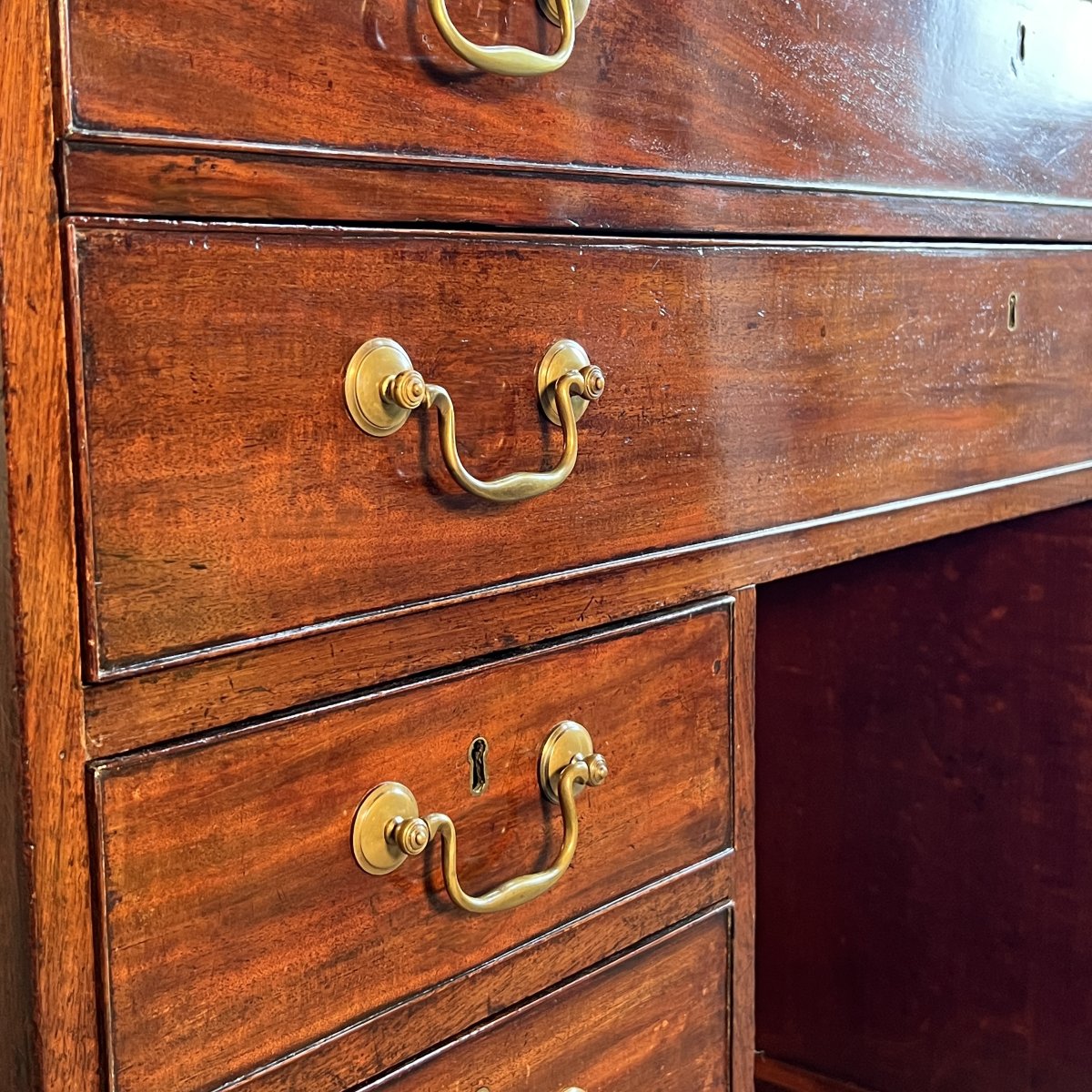
Constructed in softwood, pine, according to English tradition, with visible parts and tops in solid mahogany, and drawers with oak carcasses. Brass hardware including escutcheons, hinges, and later-added swan-neck handles, the latter not being original. The hinges are stamped by the maker H. Tibbats, a documented Wolverhampton workshop active at the end of the 18th century, whose mark is found on high-quality English furniture — a guarantee of quality and a valuable dating reference.
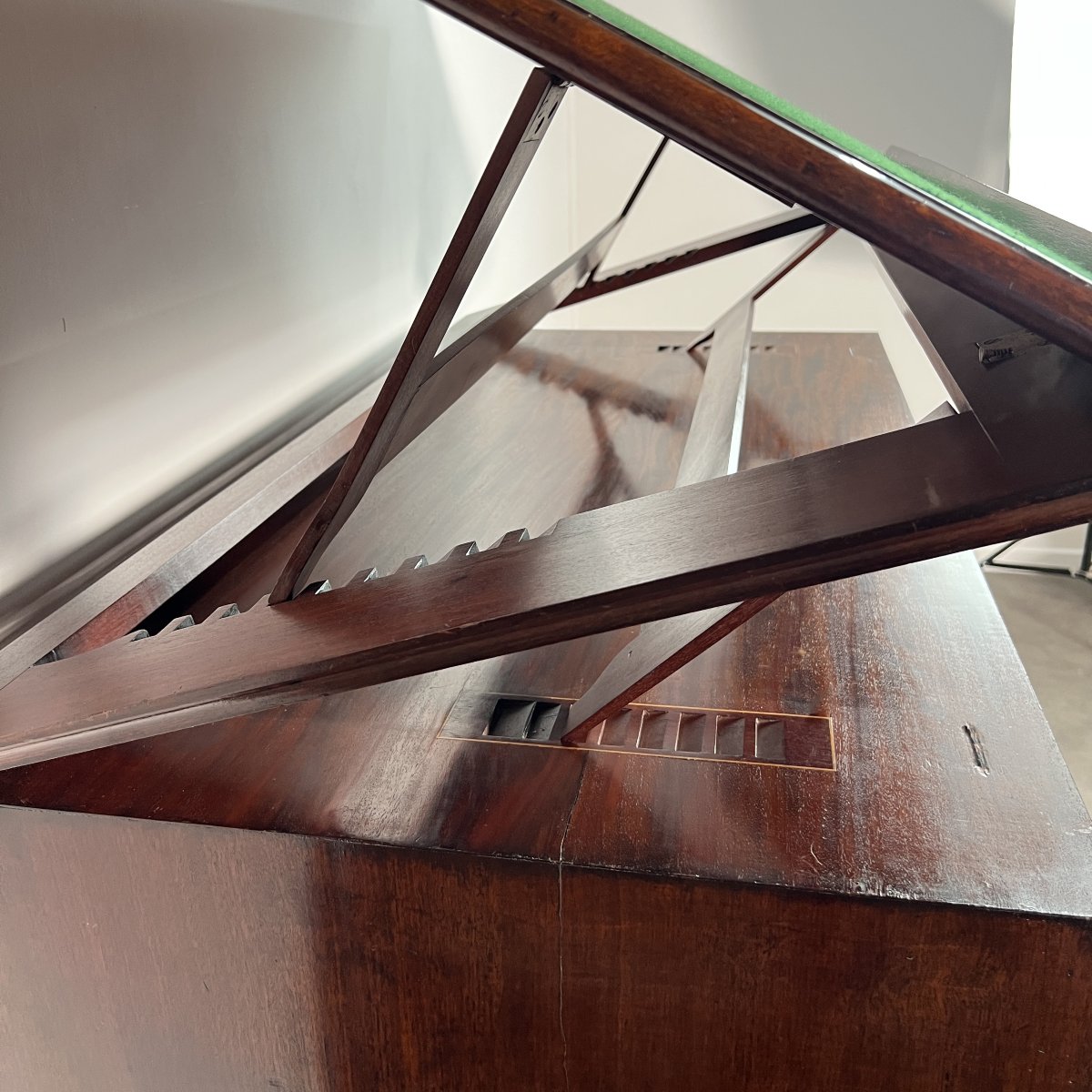
The moulded upper top has been relined with green baize, probably at a later date, and is in perfect condition. Complex mechanical system with double articulation using notched ratchets, allowing the front section, the rear section, or both sections together to be raised or inclined, intended for reading, presentation, or writing while standing. Removable profiled wooden document ledge, fixed by three brass tenons that slot into the top.
The front is arranged around a central kneehole flanked by two pedestals, with false fronts and false escutcheons creating perfect symmetry: eight visible drawer fronts for six actual drawers, including the large frieze drawer. At the lower part of the right-hand pedestal, a large drawer occupies the height of two fronts, its front simulating two superimposed drawers.
The main upper drawer extends across the full width and is fitted with a hinged fall-front. When opened, it reveals a sliding writing surface, also relined with green baize. The compartmentalised interior storage space reveals six letter compartments. The compartment lids are decorated with oval satinwood medallions and inlaid with letters of the alphabet in black ink — a filing arrangement directly inspired by late 18th-century pattern books.
The concealment system incorporates two secret compartments housed behind the interior letter compartments. Access is mechanical, requiring the bottom lids to be lifted and a fabric tab to be pulled in order to extract the hidden boxes.
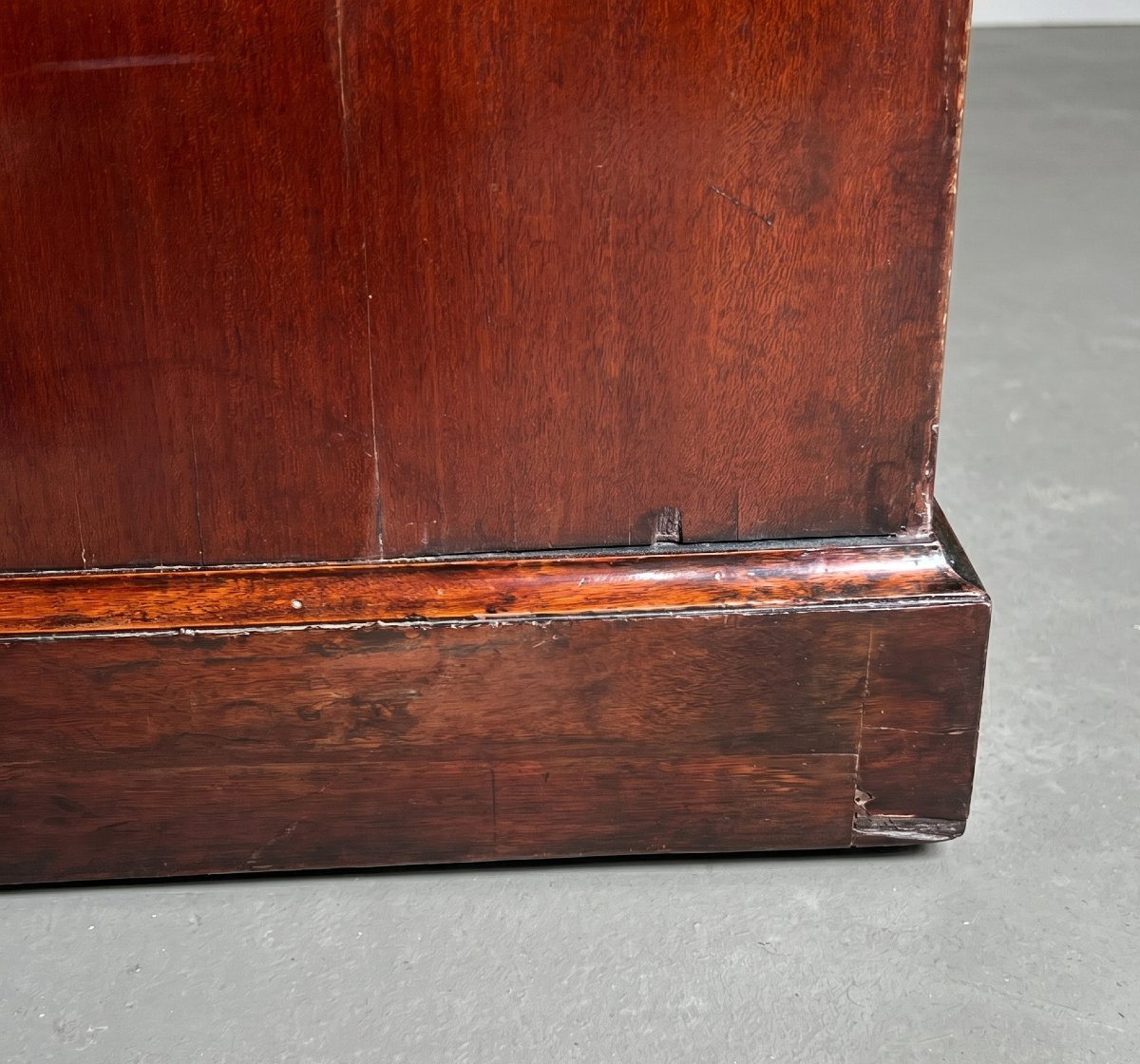
Solid plinth base with moulded plinths, standing on integrated brass castors, allowing the piece to be moved and raising it by approximately 8 millimetres. The castors can be removed on request.
Overall condition is very satisfactory. Normal signs of use consistent with the age of the piece. The hinge, runner, and ratchet mechanisms are all in perfect working order. Single key, probably later, operating all the locks, all of which are functional. The desk has been fully checked by our cabinetmaker, treated as a precaution against wood-boring insects, and is ready to be installed.
Measurements:
• Depth: 64 cm
• Width: 127.5 cm
• Height: 94.5 cm
• Interior width of the central kneehole: 48.5 cm
• Interior height of the central kneehole: 59.5 cm
Safe and secure shipping:
• France: € 180
• Europe and International: Contact us
• Professional packing; each shipment insured for the full value of the piece.
• Authenticity guaranteed; a detailed invoice is provided with every acquisition.
• Returns accepted within 14 days of receipt.
• Our pieces may be viewed by appointment.
• Does this item pique your interest or curiosity? Feel free to contact us, we would be delighted to discuss it with you. We are available from Monday to Saturday, from 8 a.m. to 7 p.m., at +33 652 43 97 82
We correspond fluently in English and have shipped a wide variety of pieces internationally for many years. Please do not hesitate to contact us with any questions. Excellent customer service, we accept returns up to 14 days, 100% positive customer reviews.
Visit our store to check all our amazing products
Explore similar pieces and discover your ideal find:
desks