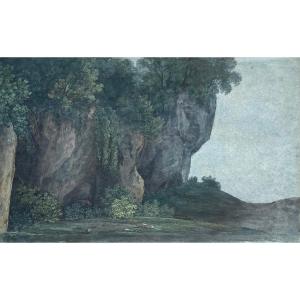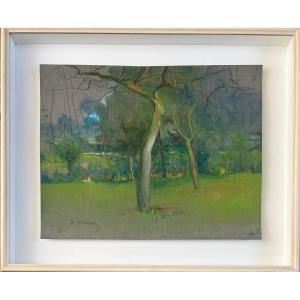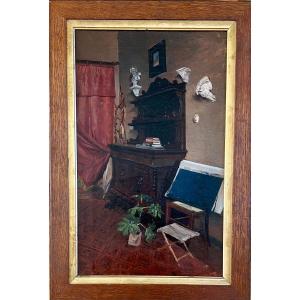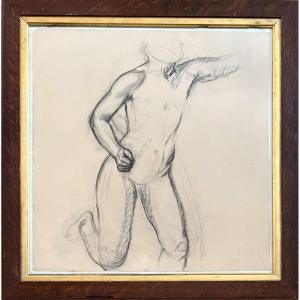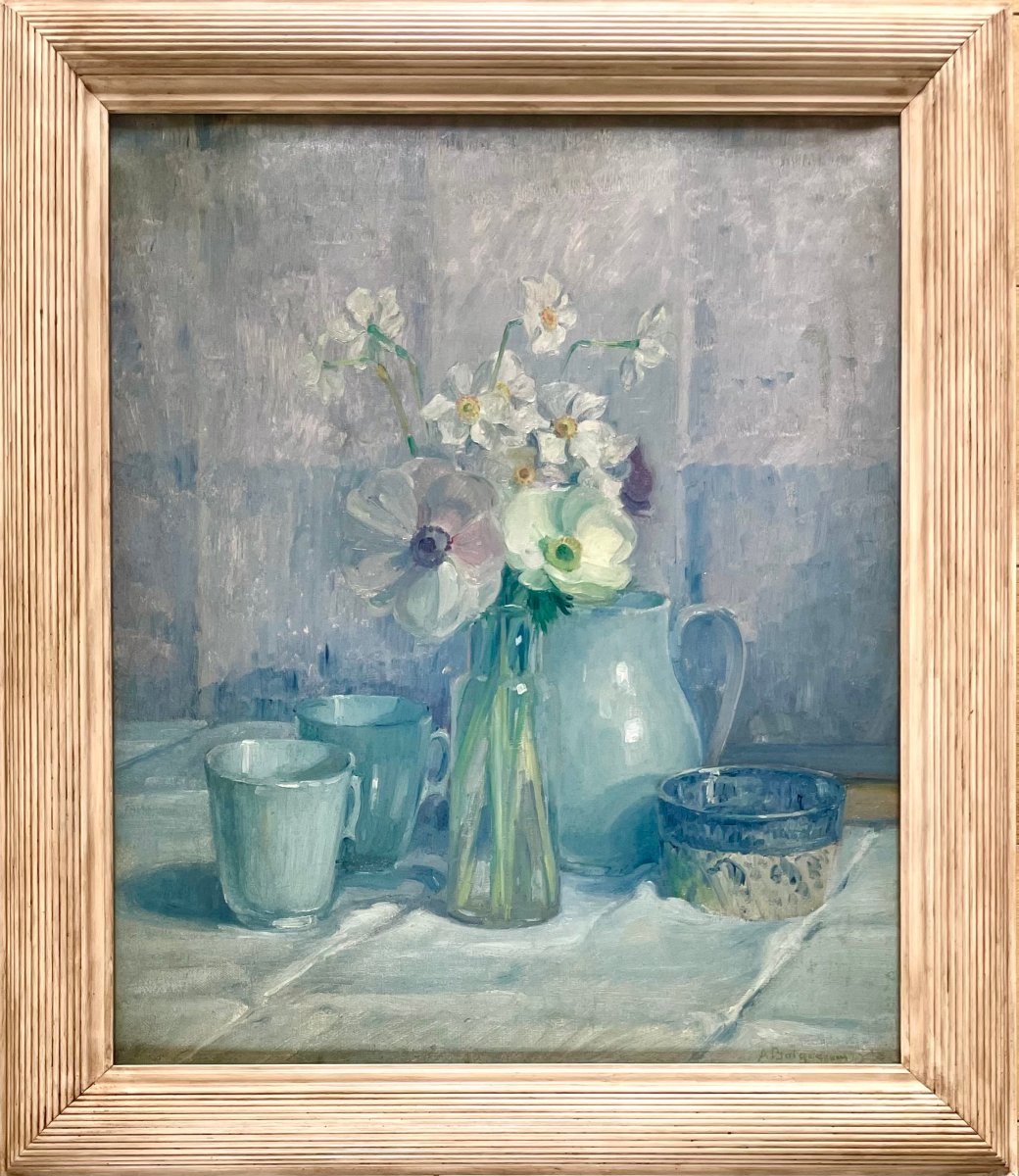

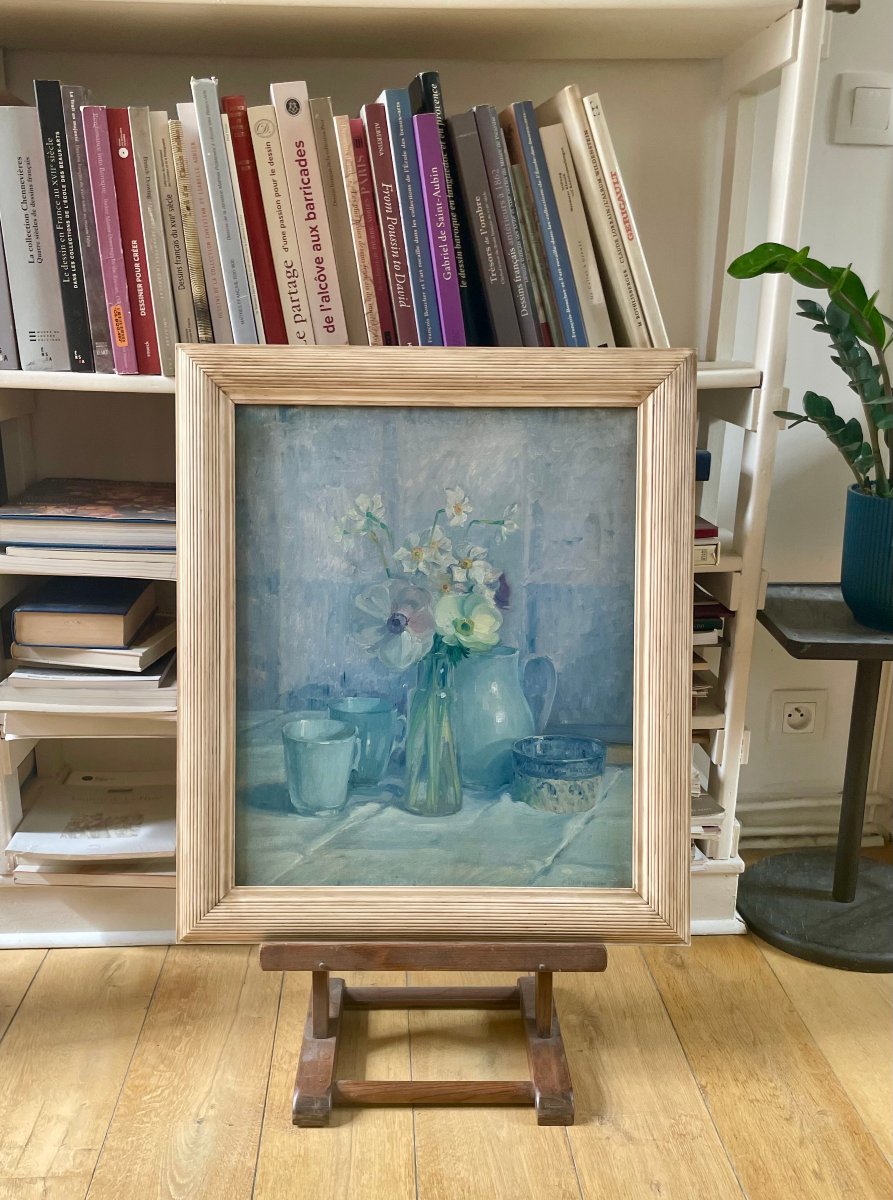
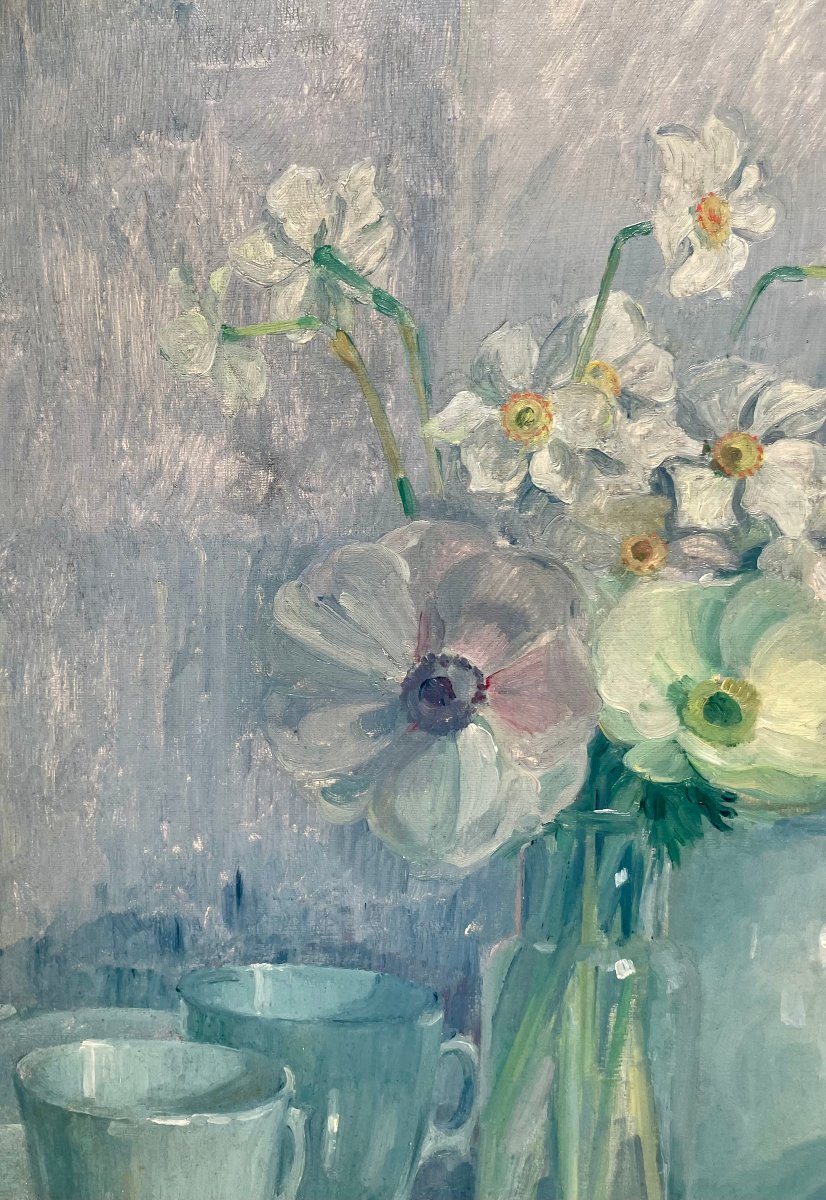
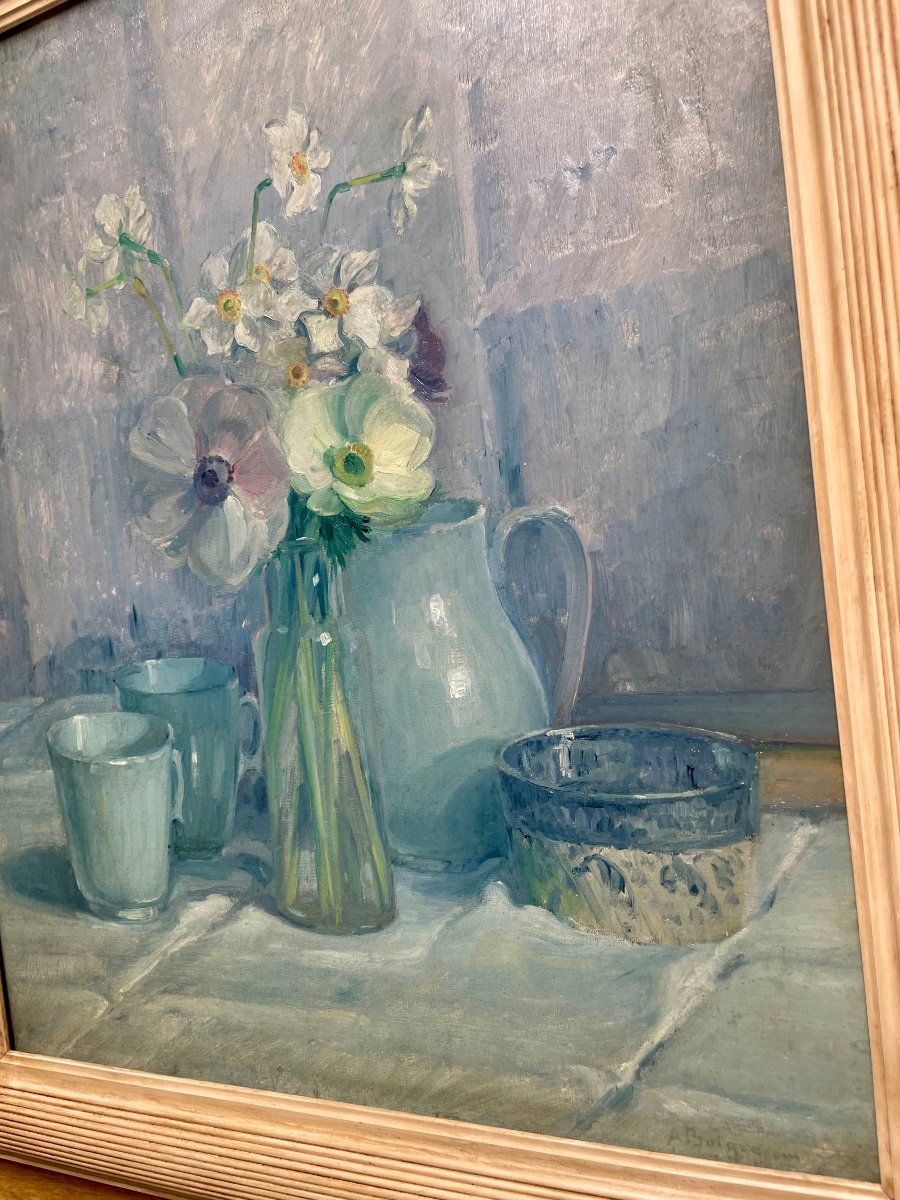
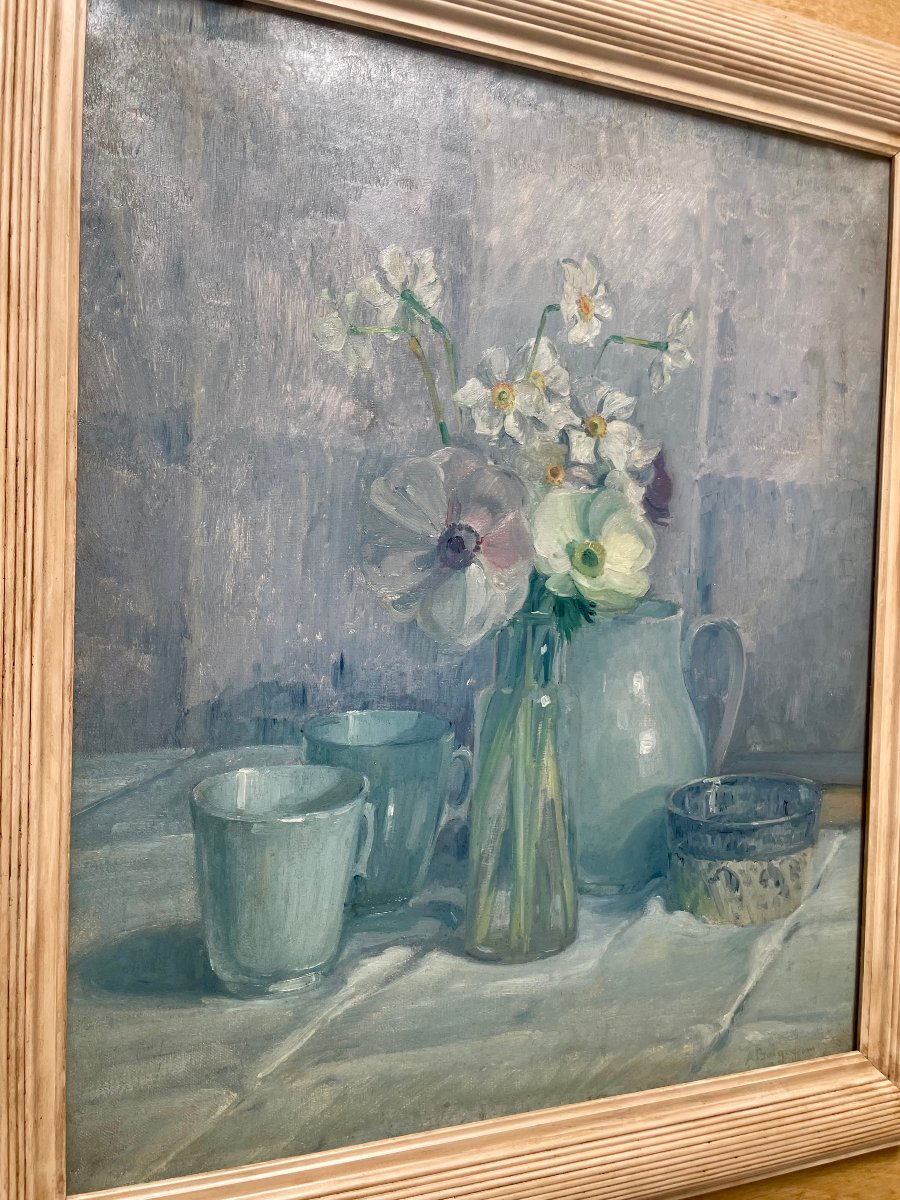
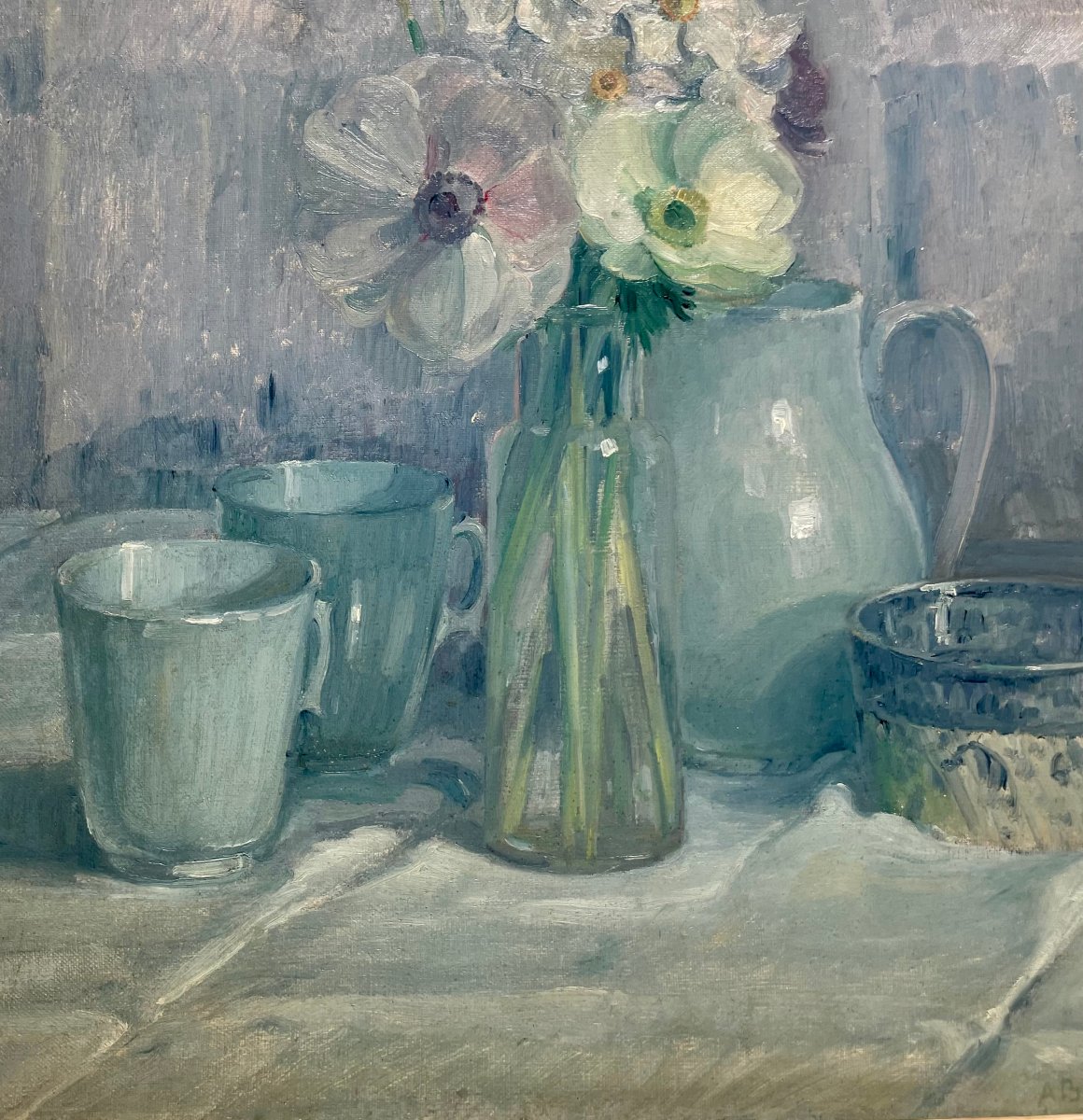


Adolphe Boigegrain (1870–1957) Still Life With Pansies And Glazed Stoneware, Hst, Signed
Artist: Nicolas Adolphe Boigegrain (1870-1957)
Adolphe Nicolas Joseph BOIGEGRAIN
Bourbonne-les-Bains 1870 - Le Kremlin-Bicêtre 1957
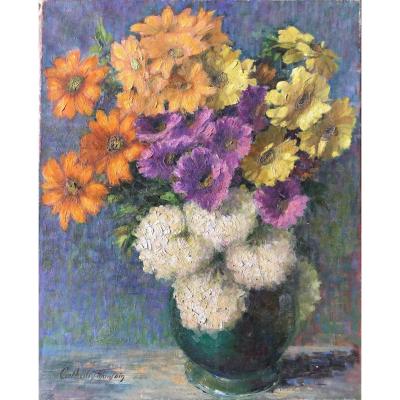
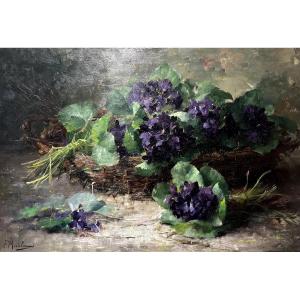
Still Life with Pansies and Glazed Stoneware
Circa 1905
Oil on canvas
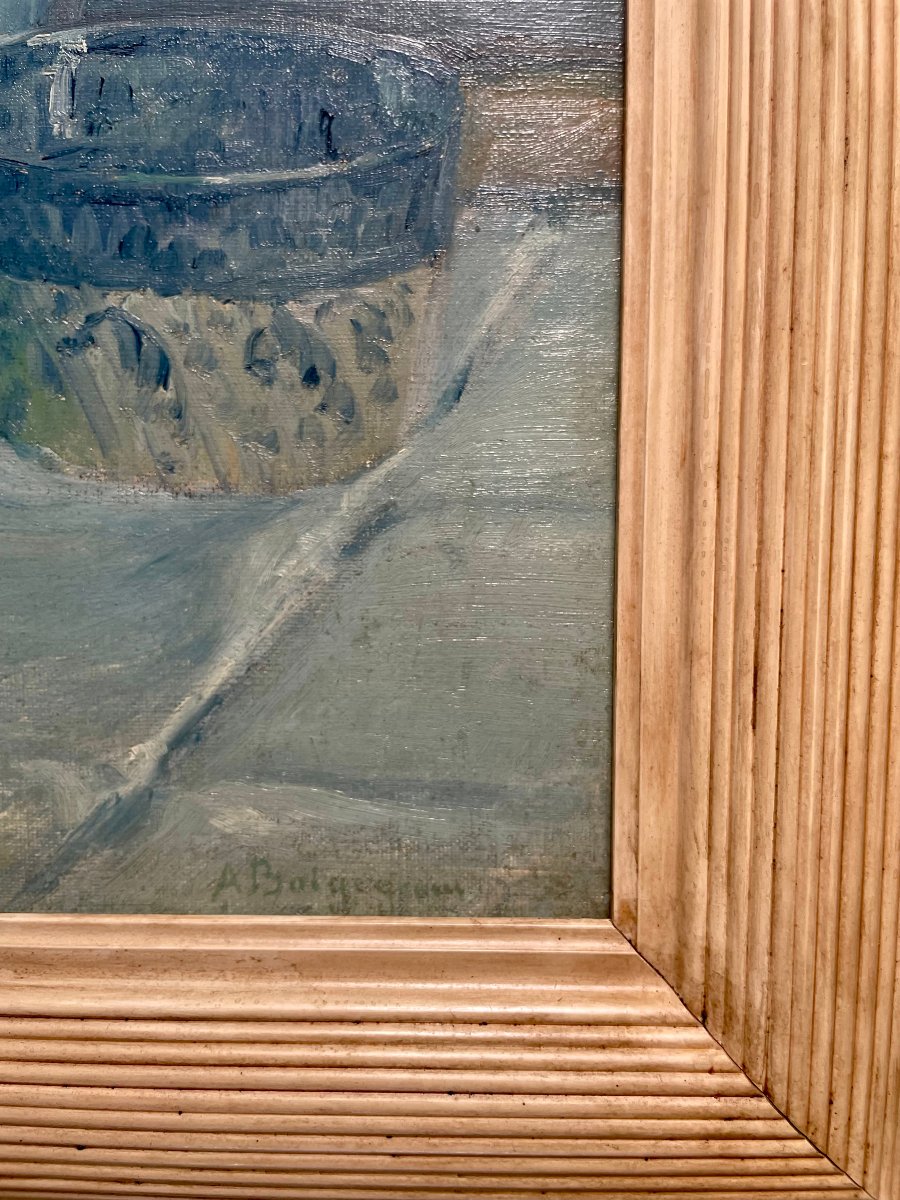
Signed and dated lower right (the date is difficult to read)
52 x 44 cm
66 x 57 cm with frame
Degas frame, ivory color
Very good condition, original canvas, no repainting
Adolphe Boigegrain is a painter, decorator, and ceramist who remains largely unknown today.
He spent his childhood on Rue de Bellevue, now Rue Athanase Renard; his father, Auguste, was a carpenter. He then studied decorative arts at the new School of Industrial Arts in Geneva, for which he applied for a scholarship from the Haute-Marne General Council on August 23, 1889. After completing his military service in the 109th Infantry Regiment stationed in Chaumont until 1894 and finishing his studies in Geneva, he moved to Paris in 1895, frequently changing addresses before establishing his studio in 1905 at 5 Rue Emile Allez, which he shared with his friend, fellow Swiss student, and painter-decorator Victor Menu.
In 1905, the year of the “Fauves” scandal at the Salon d’Automne featuring Henri Matisse, André Derain, and Maurice de Vlaminck, Adolphe Boigegrain exhibited five paintings there, including *Iris* and *Atelier (le soir)*, which was purchased by the State.
Art critic Raymond Bouyer took notice of him there:
“Mr. Maurice Denis, always so charmingly primitive, brings back the minor painters—harmonists or simplists—who haunt the arabesque: Messrs. Bonnard and Vuillard, Ibels, Ranson, Xavier Roussel, Paul Sérusier, F. Vallotton. A similar whisper, more distinct, in the ‘evenings in the studio’ of an unknown artist, Mr. Boigegrain—remember his name!”
He continued to exhibit paintings at the Salon des Indépendants in 1905, 1909, and 1910, garnering some recognition from the Parisian press. These are mainly nudes and interiors, in a style that could be described as intimist and post-impressionist, reminiscent of the Nabis art of Vuillard and Bonnard.
In January 1906, he left for the construction site of the Villa Kérilos in Beaulieu-sur-Mer, where he assisted Gustave Jaulmes with the mural decoration. Perhaps they had met in the Parisian salons where they exhibited, or perhaps they had become acquainted in Geneva, as Jaulmes was a native of Lausanne.
His encounter with Jaulmes—one of the founders of Art Deco in France alongside Louis Süe, André Mare, Paul Véra, and André Groult—led him to shift his career from painting to the decorative arts, particularly painted canvases and ceramics. It is interesting to note that Jaulmes knew another artist living in Bourbonne, André Saglio, known as Jacques Drésa, a close friend of René Xavier Prinet, as both were among the participants in the “art décoratif” group exhibition that founded the Art Deco movement at the 1913 Salon d’Automne in Paris. However, we have found no information regarding a possible connection between Drésa and Adolphe Boigegrain.
Boigegrain’s participation in the Salon des Artistes Décorateurs at the Pavillon de Marsan in 1911 attests to this shift toward the decorative arts. He would go on to participate in the “Rambouillet canvases” project initiated by Gustave Jaulmes with his friend Victor Menu.
These Art Deco fabrics were inspired by 18th-century Jouy fabrics, but with simplified floral patterns suited to modern tastes. These fabrics would become highly appreciated by critics eager for innovation, as evidenced by Guillaume Apollinaire’s comment in *L’Intransigeant* No. 11182 of February 25, 1911 “I wish these Rambouillet fabrics the same success as those of Jouy.” Example of a Rambouillet fabric design published by Yvette Vibert in her article “Grosrouvre and the Rambouillet Fabrics ” Following this success, Boigegrain became a member of the Salon d’Automne in 1913 after exhibiting Rambouillet canvases there in 1912 alongside Gustave Jaulmes and Victor Menu.
He continued to exhibit these canvases after the war, particularly in the years 1920–1923, notably at the Galliera Museum in 1923. He became a shareholder in the Société Anonyme des Toiles de Rambouillet, founded on February 29, 1924, alongside Gustave Jaulmes, Victor Menu, and Paul Leyat, a wood engraver of Swiss origin also born in 1870 and based in Geneva. From 1922 to 1933, the year he turned 63, he designed patterns for the Sèvres porcelain manufactory, while continuing to create upholstery fabrics for the Société des Toiles de Rambouillet. He died in Kremlin-Bicêtre, in the Paris region, in 1957 at the age of 87.
Bourbonne-les-Bains 1870 - Le Kremlin-Bicêtre 1957
Still Life with Pansies and Glazed Stoneware
Circa 1905
Oil on canvas
Signed and dated lower right (the date is difficult to read)
52 x 44 cm
66 x 57 cm with frame
Degas frame, ivory color
Very good condition, original canvas, no repainting
Adolphe Boigegrain is a painter, decorator, and ceramist who remains largely unknown today.
He spent his childhood on Rue de Bellevue, now Rue Athanase Renard; his father, Auguste, was a carpenter. He then studied decorative arts at the new School of Industrial Arts in Geneva, for which he applied for a scholarship from the Haute-Marne General Council on August 23, 1889. After completing his military service in the 109th Infantry Regiment stationed in Chaumont until 1894 and finishing his studies in Geneva, he moved to Paris in 1895, frequently changing addresses before establishing his studio in 1905 at 5 Rue Emile Allez, which he shared with his friend, fellow Swiss student, and painter-decorator Victor Menu.
In 1905, the year of the “Fauves” scandal at the Salon d’Automne featuring Henri Matisse, André Derain, and Maurice de Vlaminck, Adolphe Boigegrain exhibited five paintings there, including *Iris* and *Atelier (le soir)*, which was purchased by the State.
Art critic Raymond Bouyer took notice of him there:
“Mr. Maurice Denis, always so charmingly primitive, brings back the minor painters—harmonists or simplists—who haunt the arabesque: Messrs. Bonnard and Vuillard, Ibels, Ranson, Xavier Roussel, Paul Sérusier, F. Vallotton. A similar whisper, more distinct, in the ‘evenings in the studio’ of an unknown artist, Mr. Boigegrain—remember his name!”
He continued to exhibit paintings at the Salon des Indépendants in 1905, 1909, and 1910, garnering some recognition from the Parisian press. These are mainly nudes and interiors, in a style that could be described as intimist and post-impressionist, reminiscent of the Nabis art of Vuillard and Bonnard.
In January 1906, he left for the construction site of the Villa Kérilos in Beaulieu-sur-Mer, where he assisted Gustave Jaulmes with the mural decoration. Perhaps they had met in the Parisian salons where they exhibited, or perhaps they had become acquainted in Geneva, as Jaulmes was a native of Lausanne.
His encounter with Jaulmes—one of the founders of Art Deco in France alongside Louis Süe, André Mare, Paul Véra, and André Groult—led him to shift his career from painting to the decorative arts, particularly painted canvases and ceramics. It is interesting to note that Jaulmes knew another artist living in Bourbonne, André Saglio, known as Jacques Drésa, a close friend of René Xavier Prinet, as both were among the participants in the “art décoratif” group exhibition that founded the Art Deco movement at the 1913 Salon d’Automne in Paris. However, we have found no information regarding a possible connection between Drésa and Adolphe Boigegrain.
Boigegrain’s participation in the Salon des Artistes Décorateurs at the Pavillon de Marsan in 1911 attests to this shift toward the decorative arts. He would go on to participate in the “Rambouillet canvases” project initiated by Gustave Jaulmes with his friend Victor Menu.
These Art Deco fabrics were inspired by 18th-century Jouy fabrics, but with simplified floral patterns suited to modern tastes. These fabrics would become highly appreciated by critics eager for innovation, as evidenced by Guillaume Apollinaire’s comment in *L’Intransigeant* No. 11182 of February 25, 1911 “I wish these Rambouillet fabrics the same success as those of Jouy.” Example of a Rambouillet fabric design published by Yvette Vibert in her article “Grosrouvre and the Rambouillet Fabrics ” Following this success, Boigegrain became a member of the Salon d’Automne in 1913 after exhibiting Rambouillet canvases there in 1912 alongside Gustave Jaulmes and Victor Menu.
He continued to exhibit these canvases after the war, particularly in the years 1920–1923, notably at the Galliera Museum in 1923. He became a shareholder in the Société Anonyme des Toiles de Rambouillet, founded on February 29, 1924, alongside Gustave Jaulmes, Victor Menu, and Paul Leyat, a wood engraver of Swiss origin also born in 1870 and based in Geneva. From 1922 to 1933, the year he turned 63, he designed patterns for the Sèvres porcelain manufactory, while continuing to create upholstery fabrics for the Société des Toiles de Rambouillet. He died in Kremlin-Bicêtre, in the Paris region, in 1957 at the age of 87.
1 600 €
Period: 20th century
Style: Modern Art
Condition: Perfect condition
Material: Oil painting
Length: 52
Width: 44
Reference (ID): 1777860
Availability: In stock
Print