THIS OBJECT WAS SOLD
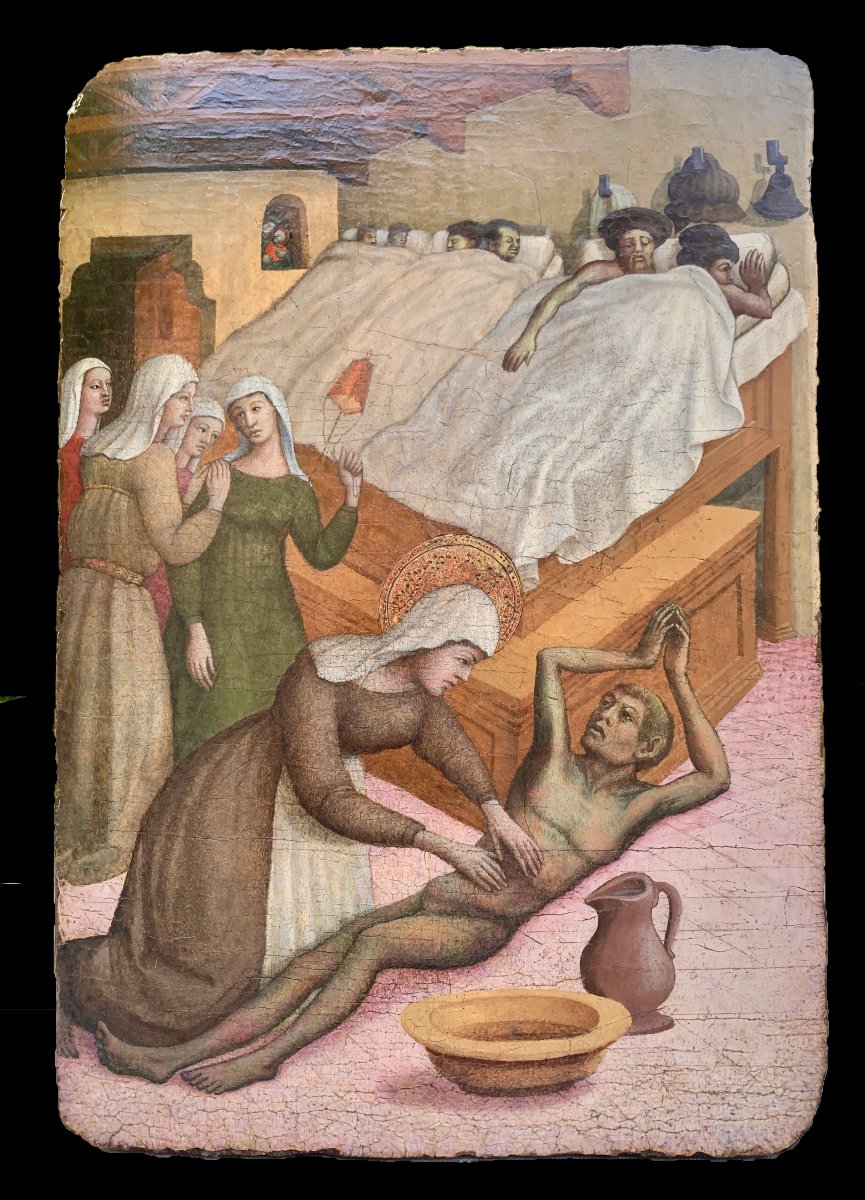
Primitive Italian Painting, Lombard School Circa 1450/70, St. Elizabeth Of Hungary


PRIMITIVE ITALIAN PAINTING
Lombard School (Brescia / Cremona / Bergamo), from a workshop influenced by Vincenzo FOPPA
Around 1450 / 1470
This panel clearly fits into the visual culture of hospital charity from the late 14th or early 15th century. Hospital themes were widespread and led to many commissions for Italian workshops, especially in Northern Italy. Vecchietta in Siena can also be mentioned, a true specialist of the genre.
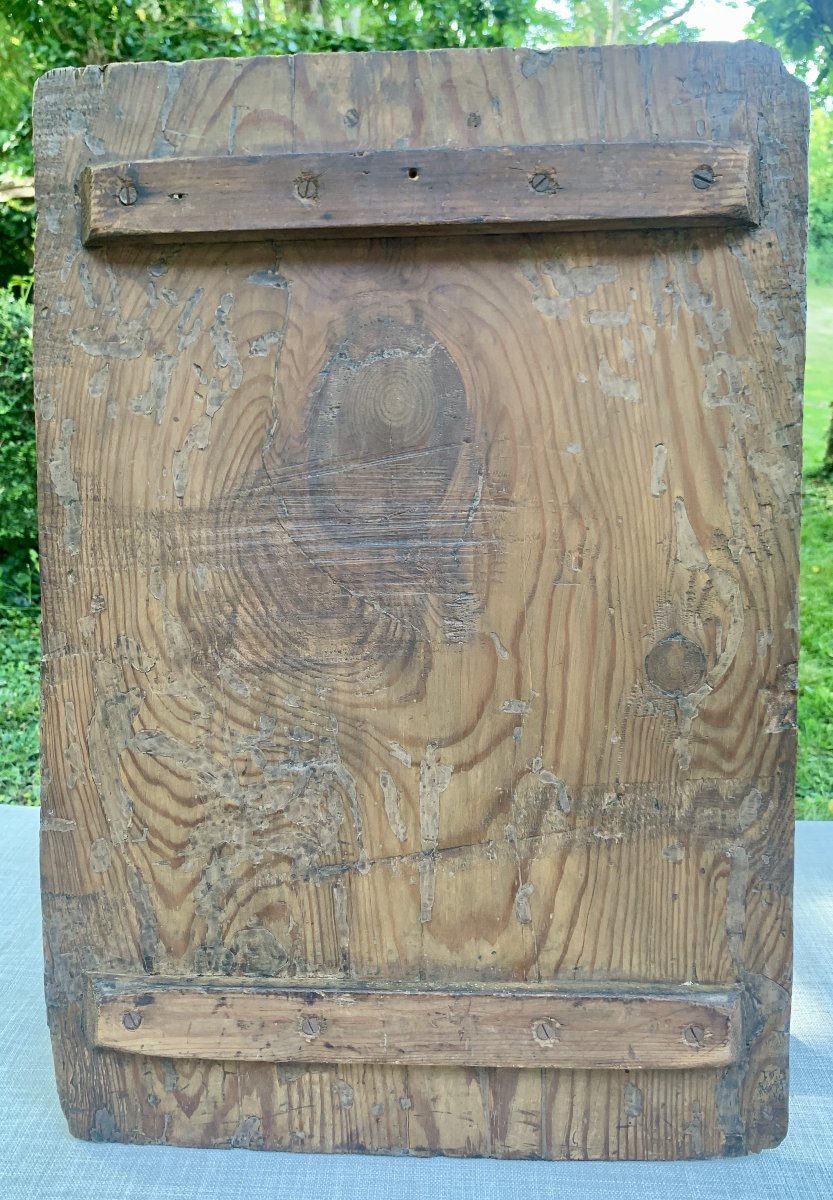
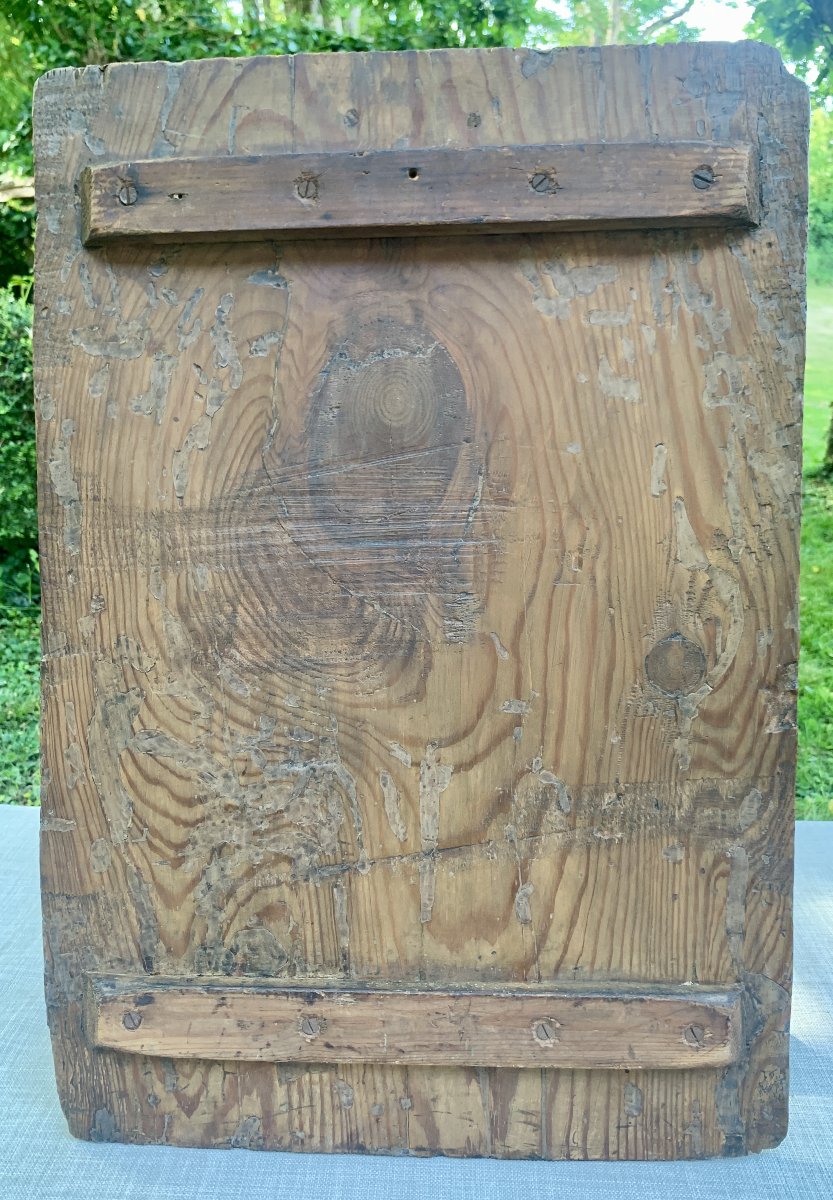
Exceptional tempera painting on poplar panel (this wood was often used in 15th-century Lombard paintings; 2 vertical crossbars were added to the panel to prevent warping.) Tempera on panel is an ancient painting technique where pigments are mixed with a binder, often egg-based, and applied on wood prepared with gesso to create bright and durable works.
Lombard workshops generally use a very thick, bright white gesso, giving a slightly chalky surface and fine cracks.
Under the paint, in some places, the underlying reddish-brown drawing can be seen, with quick and lively strokes. This feature is common in workshops influenced by Vincenzo FOPPA (Bagnolo Mella, between 1425 and 1430 - Brescia, 1515 or 1516).
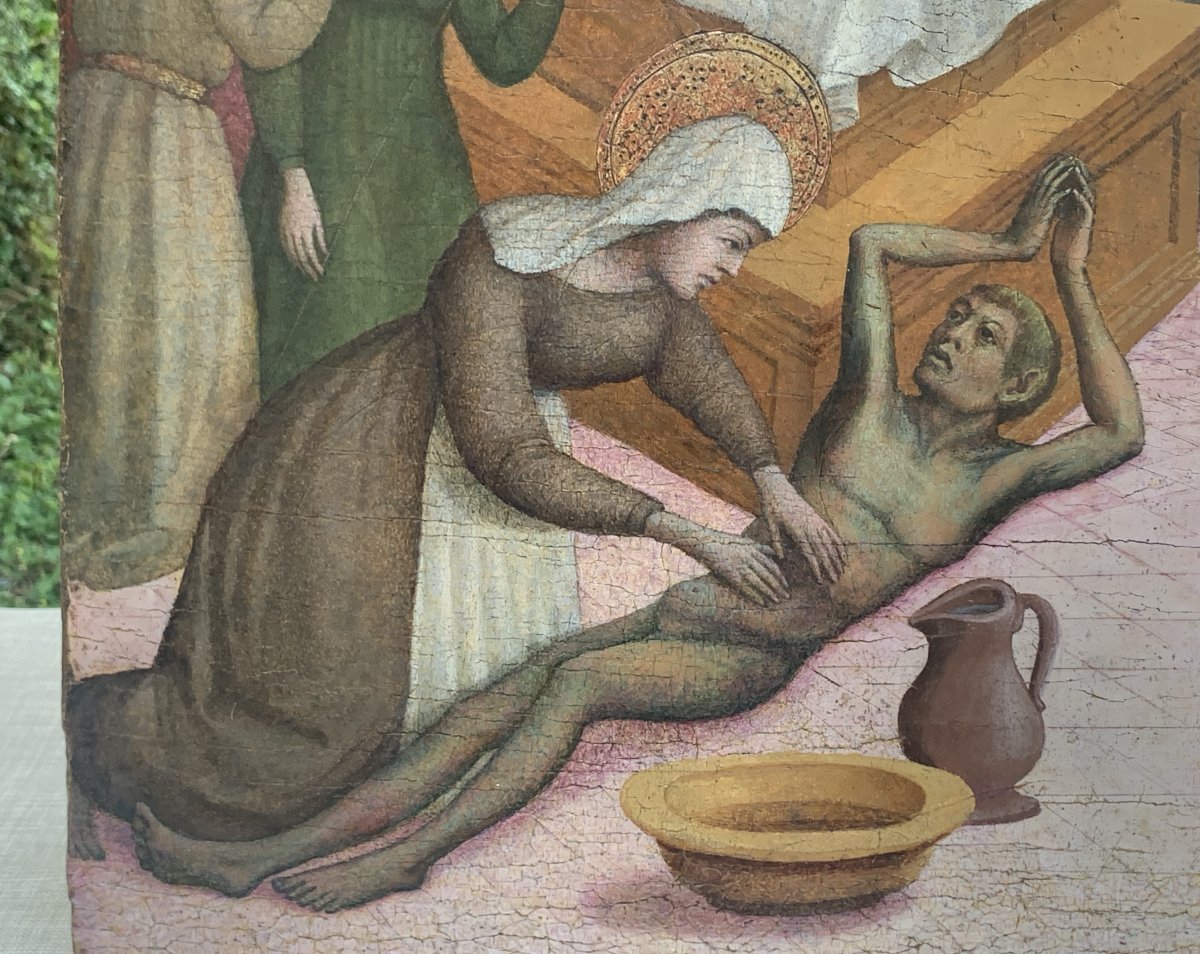
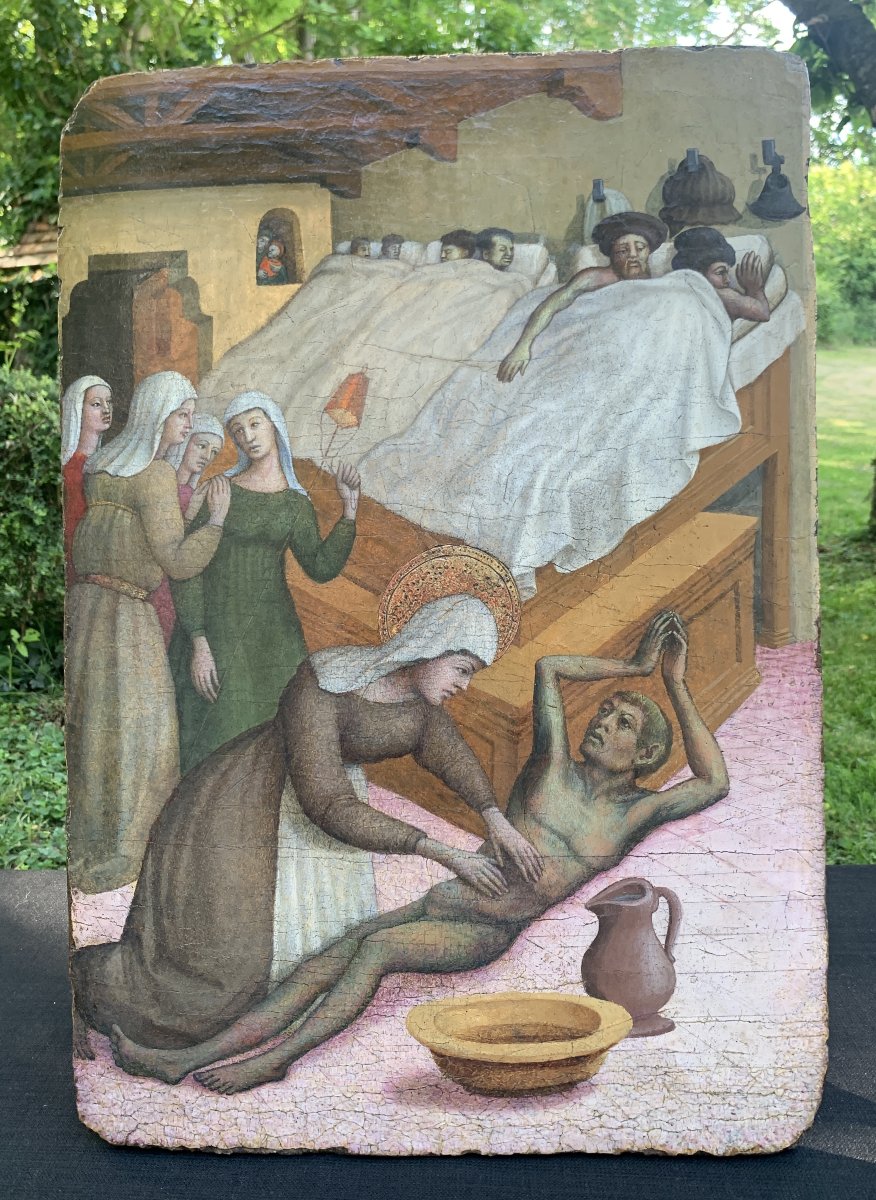
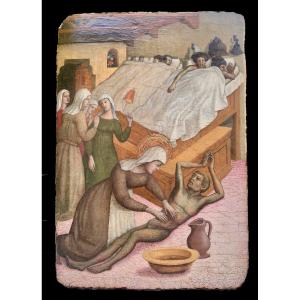
St. Elisabeth of Hungary is kneeling to care for a sick person—probably a leper or a plague victim—by laying hands on them, in an indoor hospital or hospice scene.
In late Gothic art, this theme is frequent and recurring: Saint Elisabeth is famous for personally tending to the poor and lepers, washing and feeding the sick in hospitals.
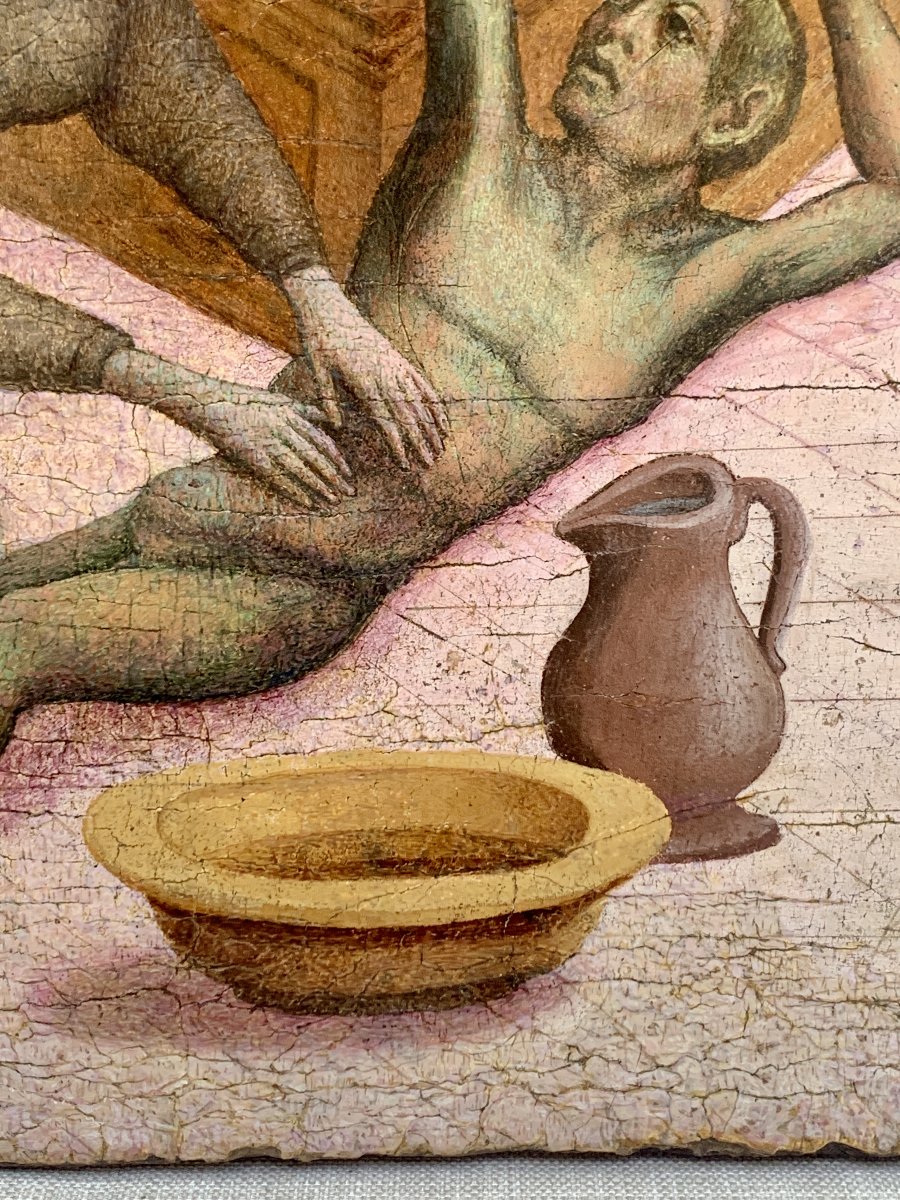
She is often shown, as here, leaning over a very weakened patient, washing a body or wound, surrounded by the poor or bedridden sick. The scene shows next to her a basin of water and a pitcher, symbols of care and purification.
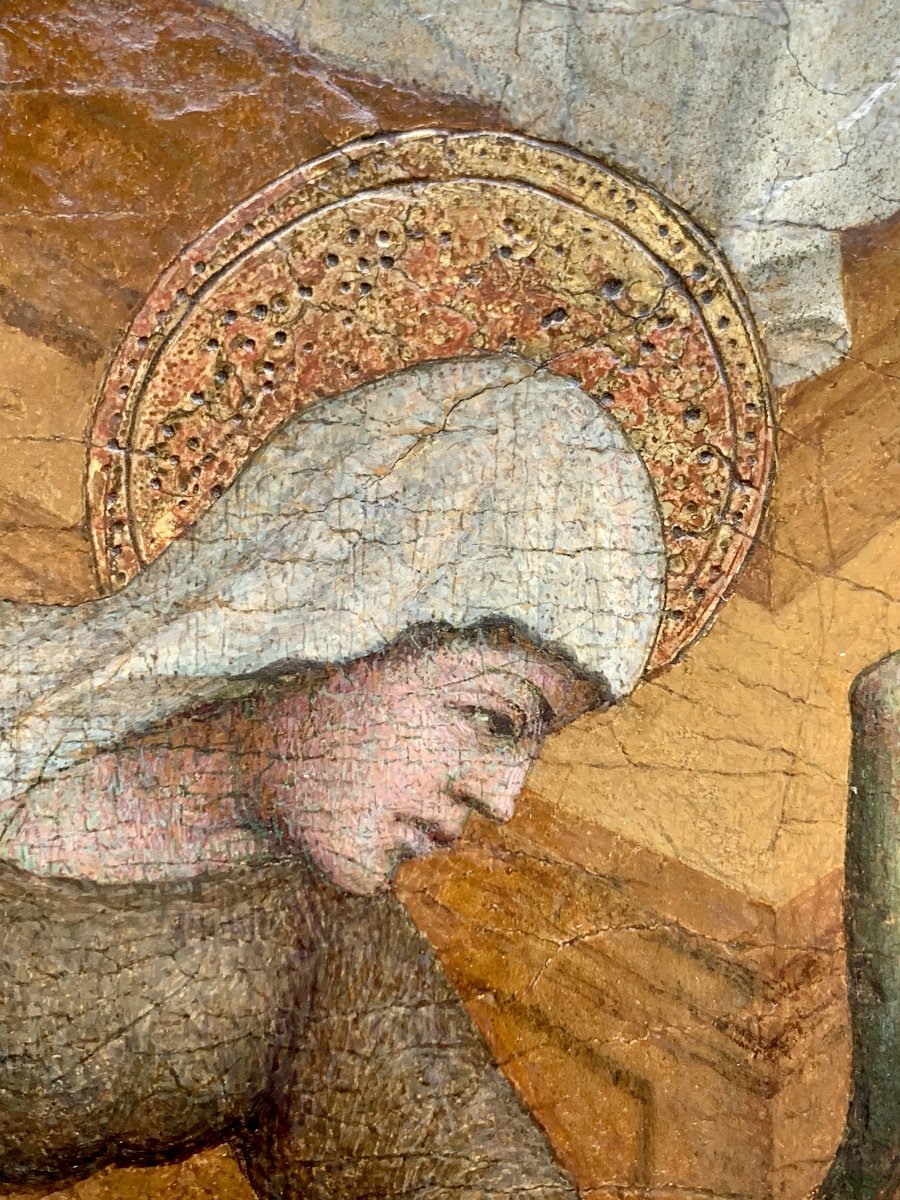
Her halo, nimbus, or aureole is punched and decorated with gold, clearly showing that she is a Saint.
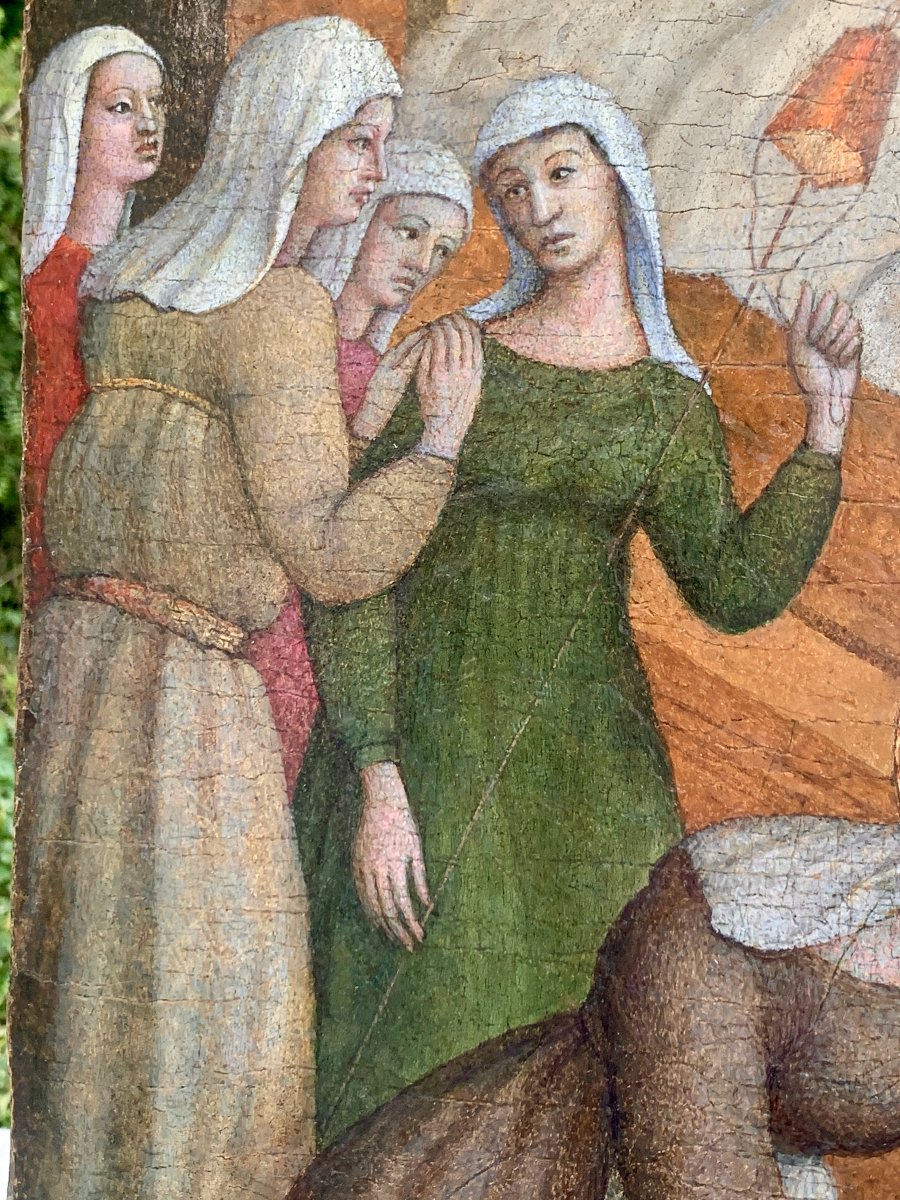
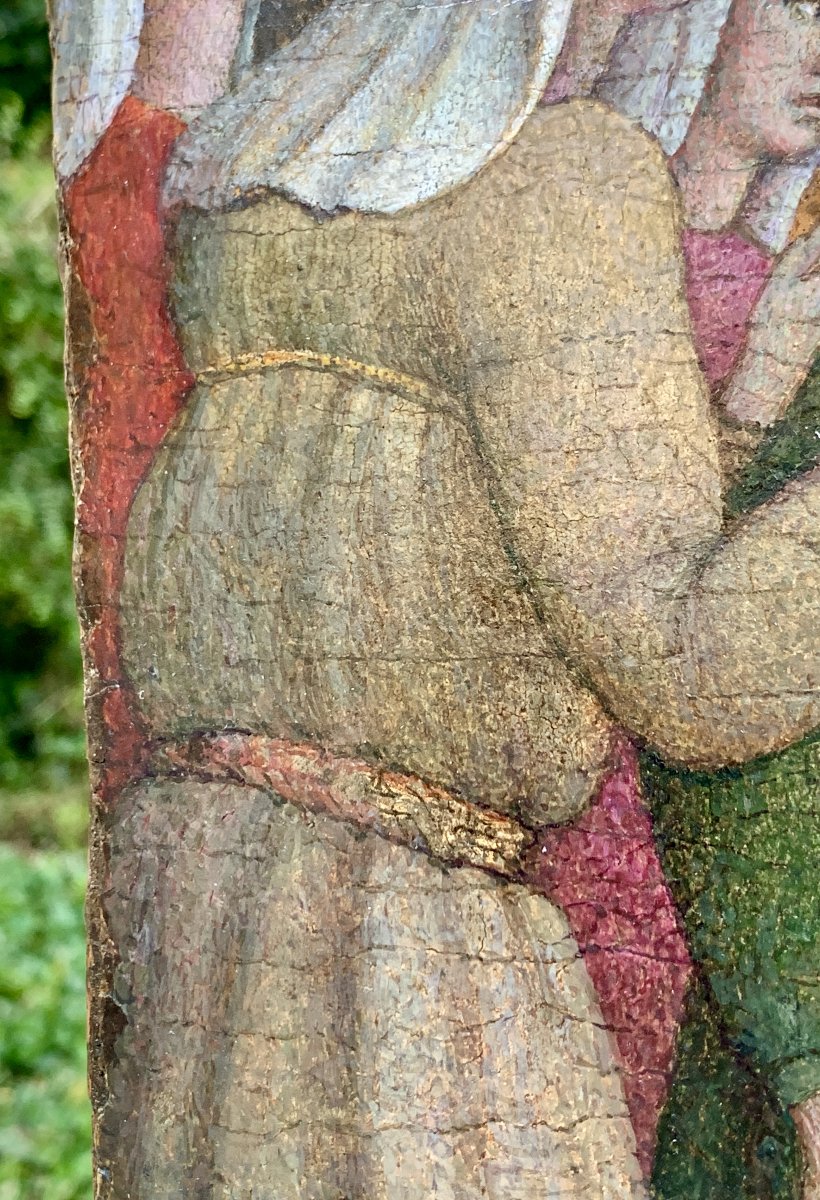
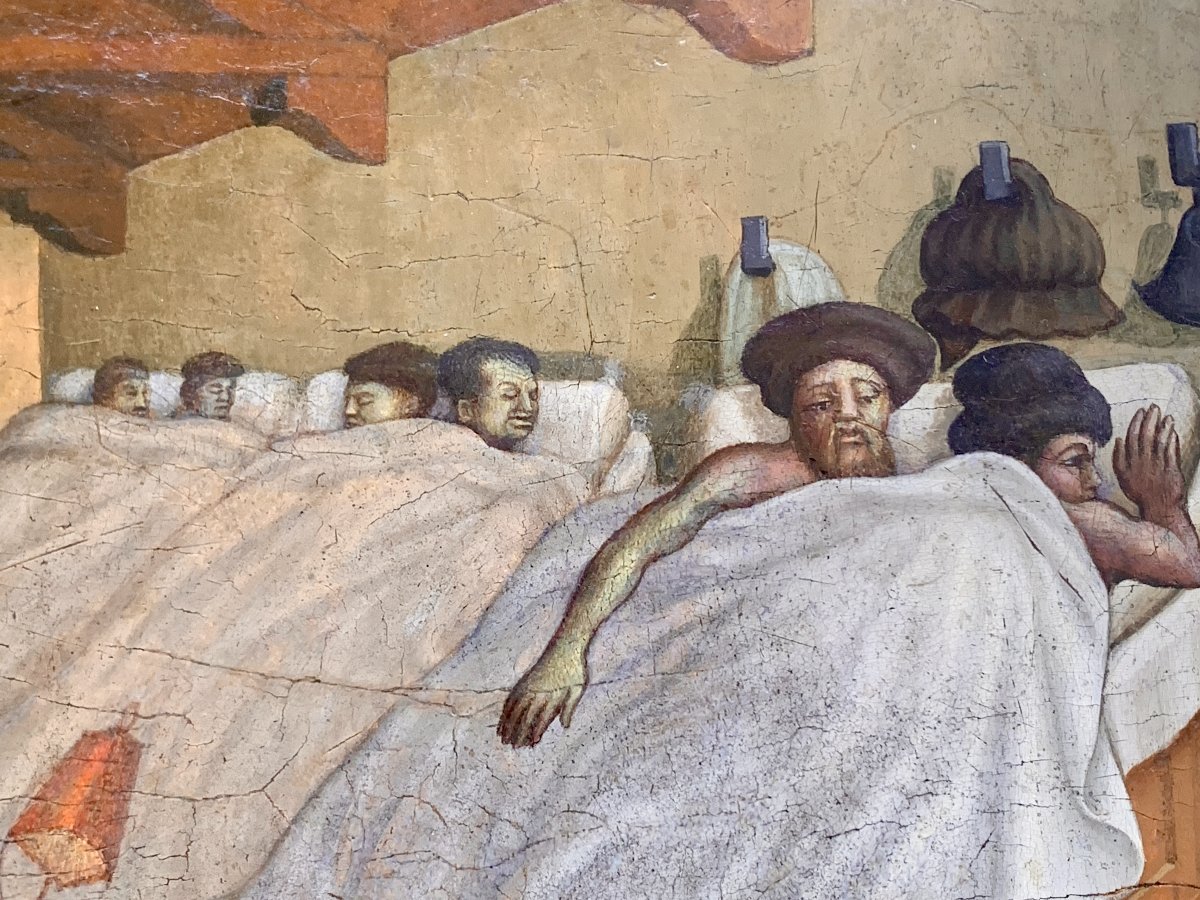
The composition confirms a narrative panel: the scene is typically organized like a Gothic 'historia,' with the main action in the foreground (the saint tending the sick), the group of witnessing women behind on the left as if entering the story, and in the background the communal bed occupied by several sick people, realistically evoking a medieval hospital or a charitable home.
Several stylistic clues allow for a fairly precise attribution hypothesis to the Northern Italian School, particularly the Lombard School of the 15th century:
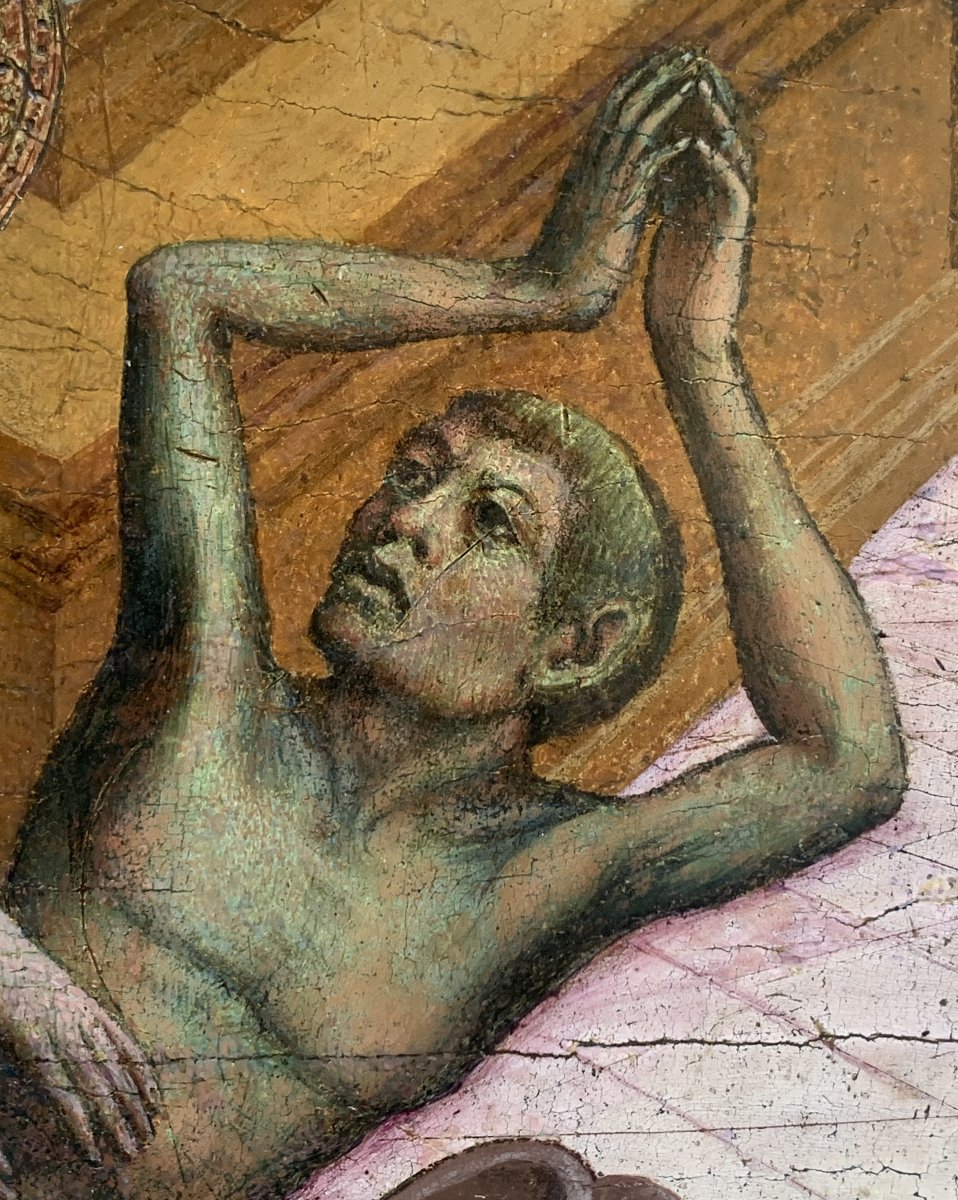
* The colors and flesh tones with greenish shades in the skin of the sick, the warm ochres and brownish reds, perfectly matching the palette of late Gothic painting from this region.
* The drawing of the faces, with long and thin noses, almond-shaped eyes, and pointed chins
*The interior scene, with a large communal bed, in a spacious room with exposed beam ceilings, like a simple, domestic space. The slanted space is typical of Gothic perspective, still somewhat awkward but quite pronounced.
These paintings are very common in Italian narrative altarpieces of the 15th century, and it is highly likely that this painting is an isolated fragment of an altarpiece (polyptych). In medieval altarpieces: the central panel showed the main saint, and around it, other small side scenes told the life of the saint.
For example, an altarpiece of Saint Elizabeth could have included Elizabeth giving bread to the poor, the miracle of the roses, Elizabeth healing the sick (as here), and then her death or canonization…
In this sense, the size of the panel is relatively small, and its borders here seem irregularly cut, with no painted frame, the composition is tight here like a secondary scene.
Altarpieces were often taken apart in this sense in the 18th–19th centuries to sell the panels separately. A very close example is the cycle of Saint Elizabeth (late 15th century), attributed to the Master of the St. Elizabeth Panels, active around 1490.
He painted several scenes from the life of Elizabeth of Hungary, including the saint caring for the sick in a hospice, with features very similar to our panel: the saint is leaning over an extremely thin sick person, with a basin or water container next to her, a shared bed with other sick people, and behind, an interior architectural scene. These scenes were part of narrative altarpieces made up of 6 to 12 panels surrounding a main image of the Saint.
In the Brescia and Bergamo area, workshops influenced by Vincenzo Foppa produced very similar cycles: small rectangular scenes with tight compositions, greenish-complexioned sick people, and hospital interiors.
In medieval polyptychs, the side scenes are often arranged to direct the viewer's gaze toward the center of the altarpiece. In 15th-century painting, artists also frequently use architectural elements to balance the composition toward the inside of the altarpiece.
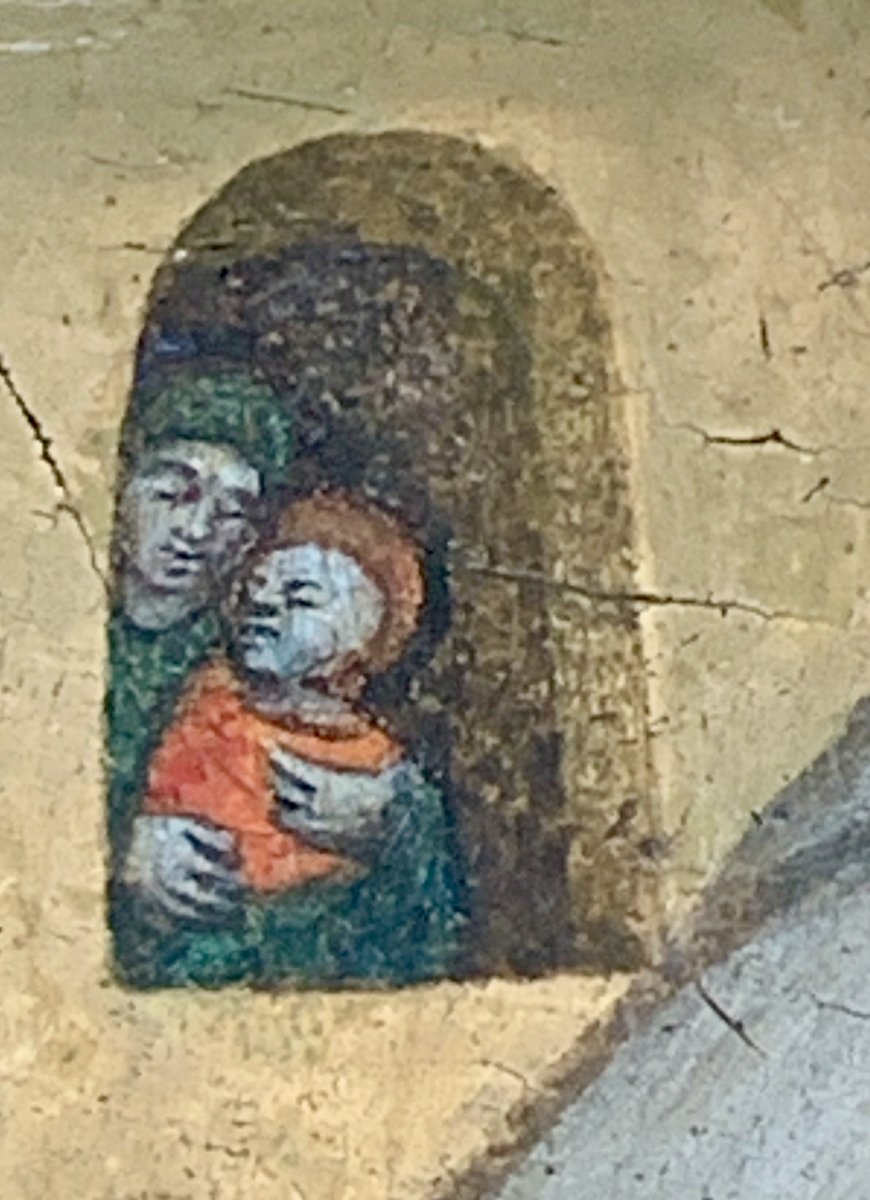
The small window in the architecture is on the left side of the setting and is oriented to the right. If the window is on the left, it's often because the scene was meant to continue visually to the right (toward the other panels).
The group of women witnessing the scene also comes from the left to look toward the right, reinforcing the idea that your panel could be a left-side panel of the predella.
The saint is still placed slightly to the right and oriented to the right…
All these elements of the scene thus perfectly help indicate the direction of the gaze toward the center of the altarpiece and, by extension, the position of this panel in a complete altarpiece (to the left of the set).
This scene, almost identical, can be found in several 15th-century Italian altarpieces dedicated to Elizabeth of Hungary, featuring a very emaciated or thin sick person, with greenish skin, a basin of water on the floor, the communal bed with several patients lying down with expressive faces inside a hospital interior.
This way of depicting the sick is common in works associated with Lombard hospital confraternities. A similar treatment can be seen in the circle of Bonifacio Bembo and in workshops active between Cremona, Brescia, and Bergamo.
Some stylistic details suggest an attribution to a specific area of eastern Lombardy (Brescia, Cremona, or Bergamo) rather than Milan:
*The type of figures, with characters showing features typical of 15th-century Lombard painting: the faces are narrow and elongated, with long, fine noses, slightly melancholic expressions, softly modeled with greenish shadows -This type of physiognomy appears in painters active around Vincenzo Foppa, who had a strong influence on the workshops in Brescia and Bergamo.
* The way the sick person's body is treated is very characteristic: greenish skin, very thin and expressive anatomy, almost dramatic posture.
* There’s also a very telling detail often seen in Lombard altarpieces around 1450-1470: the dramatic position of the sick person's arms raised toward the sky, seen in several workshops around Brescia and Cremona.
Condition:
The painting has been fully cleaned and restored by a professional studio to remove some clumsy additions from a previous restoration, bring back its original vibrant colors that had been dulled by an old yellow varnish, and minimally restore some worn areas of the paint layer.
Dimensions:
59 x 41.5 cm
Lombard School (Brescia / Cremona / Bergamo), from a workshop influenced by Vincenzo FOPPA
Around 1450 / 1470
This panel clearly fits into the visual culture of hospital charity from the late 14th or early 15th century. Hospital themes were widespread and led to many commissions for Italian workshops, especially in Northern Italy. Vecchietta in Siena can also be mentioned, a true specialist of the genre.
Exceptional tempera painting on poplar panel (this wood was often used in 15th-century Lombard paintings; 2 vertical crossbars were added to the panel to prevent warping.) Tempera on panel is an ancient painting technique where pigments are mixed with a binder, often egg-based, and applied on wood prepared with gesso to create bright and durable works.
Lombard workshops generally use a very thick, bright white gesso, giving a slightly chalky surface and fine cracks.
Under the paint, in some places, the underlying reddish-brown drawing can be seen, with quick and lively strokes. This feature is common in workshops influenced by Vincenzo FOPPA (Bagnolo Mella, between 1425 and 1430 - Brescia, 1515 or 1516).
St. Elisabeth of Hungary is kneeling to care for a sick person—probably a leper or a plague victim—by laying hands on them, in an indoor hospital or hospice scene.
In late Gothic art, this theme is frequent and recurring: Saint Elisabeth is famous for personally tending to the poor and lepers, washing and feeding the sick in hospitals.
She is often shown, as here, leaning over a very weakened patient, washing a body or wound, surrounded by the poor or bedridden sick. The scene shows next to her a basin of water and a pitcher, symbols of care and purification.
Her halo, nimbus, or aureole is punched and decorated with gold, clearly showing that she is a Saint.
The composition confirms a narrative panel: the scene is typically organized like a Gothic 'historia,' with the main action in the foreground (the saint tending the sick), the group of witnessing women behind on the left as if entering the story, and in the background the communal bed occupied by several sick people, realistically evoking a medieval hospital or a charitable home.
Several stylistic clues allow for a fairly precise attribution hypothesis to the Northern Italian School, particularly the Lombard School of the 15th century:
* The colors and flesh tones with greenish shades in the skin of the sick, the warm ochres and brownish reds, perfectly matching the palette of late Gothic painting from this region.
* The drawing of the faces, with long and thin noses, almond-shaped eyes, and pointed chins
*The interior scene, with a large communal bed, in a spacious room with exposed beam ceilings, like a simple, domestic space. The slanted space is typical of Gothic perspective, still somewhat awkward but quite pronounced.
These paintings are very common in Italian narrative altarpieces of the 15th century, and it is highly likely that this painting is an isolated fragment of an altarpiece (polyptych). In medieval altarpieces: the central panel showed the main saint, and around it, other small side scenes told the life of the saint.
For example, an altarpiece of Saint Elizabeth could have included Elizabeth giving bread to the poor, the miracle of the roses, Elizabeth healing the sick (as here), and then her death or canonization…
In this sense, the size of the panel is relatively small, and its borders here seem irregularly cut, with no painted frame, the composition is tight here like a secondary scene.
Altarpieces were often taken apart in this sense in the 18th–19th centuries to sell the panels separately. A very close example is the cycle of Saint Elizabeth (late 15th century), attributed to the Master of the St. Elizabeth Panels, active around 1490.
He painted several scenes from the life of Elizabeth of Hungary, including the saint caring for the sick in a hospice, with features very similar to our panel: the saint is leaning over an extremely thin sick person, with a basin or water container next to her, a shared bed with other sick people, and behind, an interior architectural scene. These scenes were part of narrative altarpieces made up of 6 to 12 panels surrounding a main image of the Saint.
In the Brescia and Bergamo area, workshops influenced by Vincenzo Foppa produced very similar cycles: small rectangular scenes with tight compositions, greenish-complexioned sick people, and hospital interiors.
In medieval polyptychs, the side scenes are often arranged to direct the viewer's gaze toward the center of the altarpiece. In 15th-century painting, artists also frequently use architectural elements to balance the composition toward the inside of the altarpiece.
The small window in the architecture is on the left side of the setting and is oriented to the right. If the window is on the left, it's often because the scene was meant to continue visually to the right (toward the other panels).
The group of women witnessing the scene also comes from the left to look toward the right, reinforcing the idea that your panel could be a left-side panel of the predella.
The saint is still placed slightly to the right and oriented to the right…
All these elements of the scene thus perfectly help indicate the direction of the gaze toward the center of the altarpiece and, by extension, the position of this panel in a complete altarpiece (to the left of the set).
This scene, almost identical, can be found in several 15th-century Italian altarpieces dedicated to Elizabeth of Hungary, featuring a very emaciated or thin sick person, with greenish skin, a basin of water on the floor, the communal bed with several patients lying down with expressive faces inside a hospital interior.
This way of depicting the sick is common in works associated with Lombard hospital confraternities. A similar treatment can be seen in the circle of Bonifacio Bembo and in workshops active between Cremona, Brescia, and Bergamo.
Some stylistic details suggest an attribution to a specific area of eastern Lombardy (Brescia, Cremona, or Bergamo) rather than Milan:
*The type of figures, with characters showing features typical of 15th-century Lombard painting: the faces are narrow and elongated, with long, fine noses, slightly melancholic expressions, softly modeled with greenish shadows -This type of physiognomy appears in painters active around Vincenzo Foppa, who had a strong influence on the workshops in Brescia and Bergamo.
* The way the sick person's body is treated is very characteristic: greenish skin, very thin and expressive anatomy, almost dramatic posture.
* There’s also a very telling detail often seen in Lombard altarpieces around 1450-1470: the dramatic position of the sick person's arms raised toward the sky, seen in several workshops around Brescia and Cremona.
Condition:
The painting has been fully cleaned and restored by a professional studio to remove some clumsy additions from a previous restoration, bring back its original vibrant colors that had been dulled by an old yellow varnish, and minimally restore some worn areas of the paint layer.
Dimensions:
59 x 41.5 cm
Explore similar pieces and discover your ideal find:
religious paintings