THIS OBJECT WAS SOLD
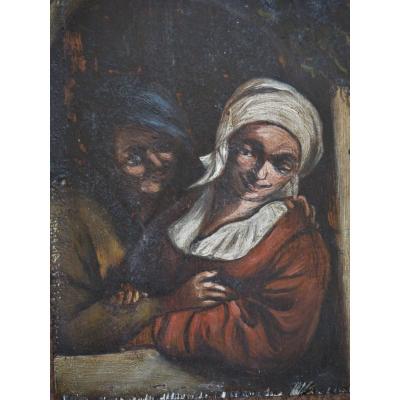
Dutch Oil Painting On Panel 'the Charlatan' 1652 After Gerrit Dou


DUTCH PAINTING
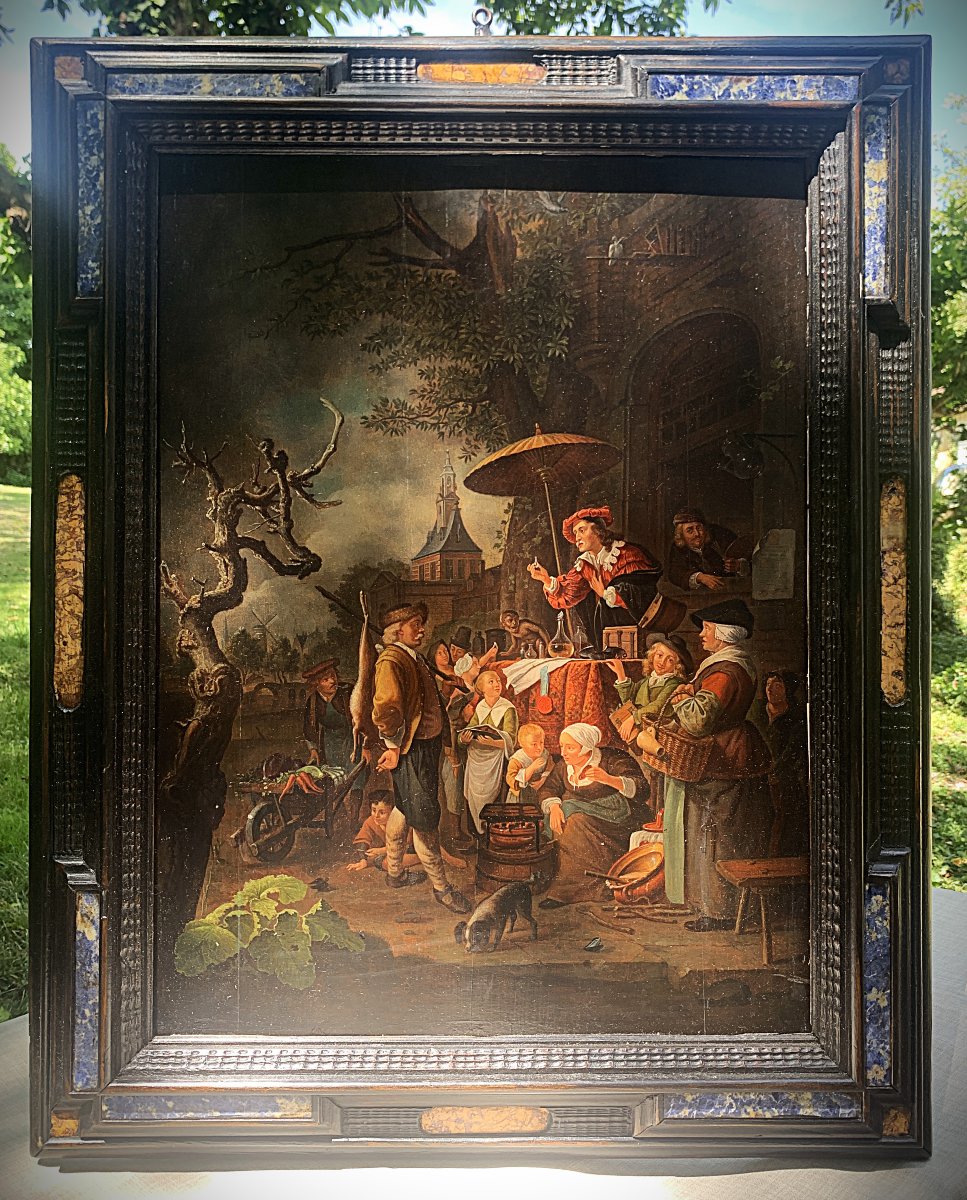
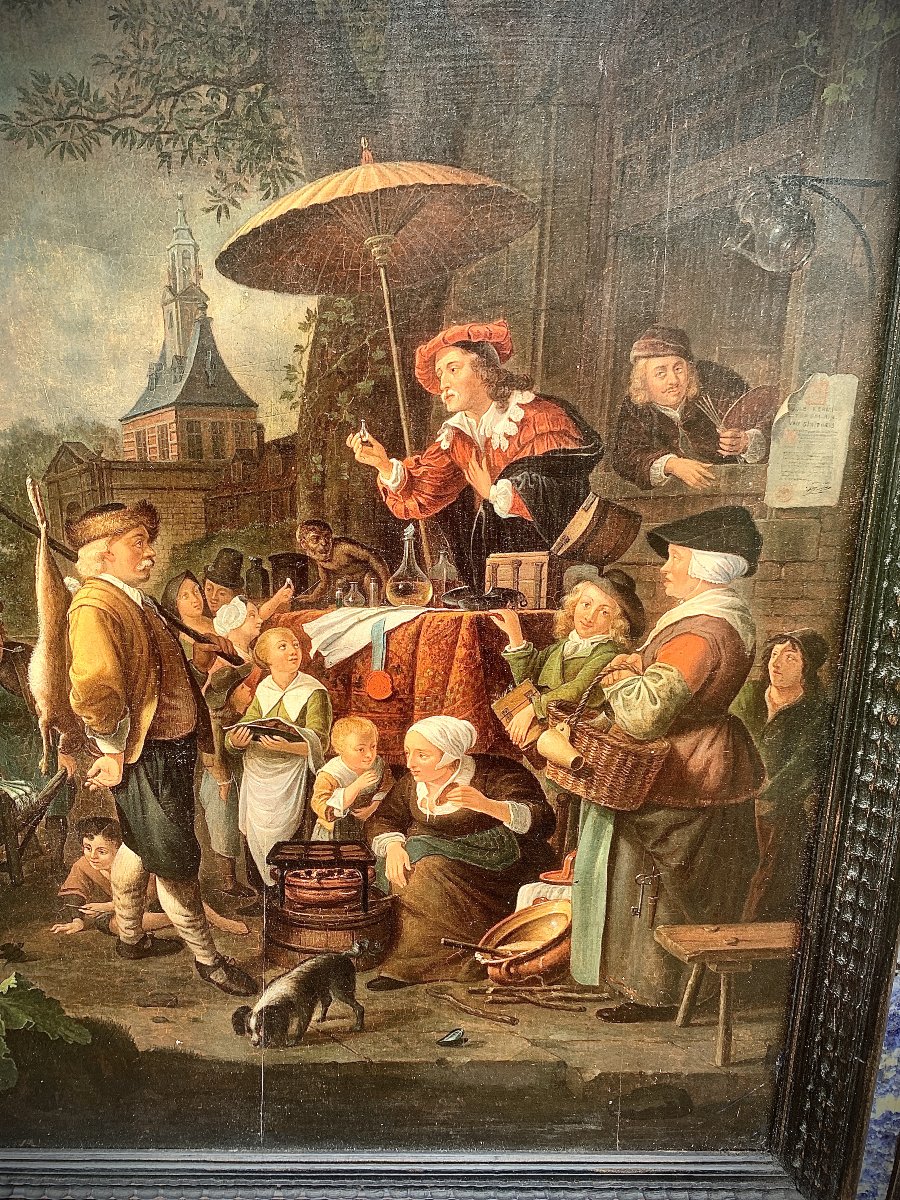
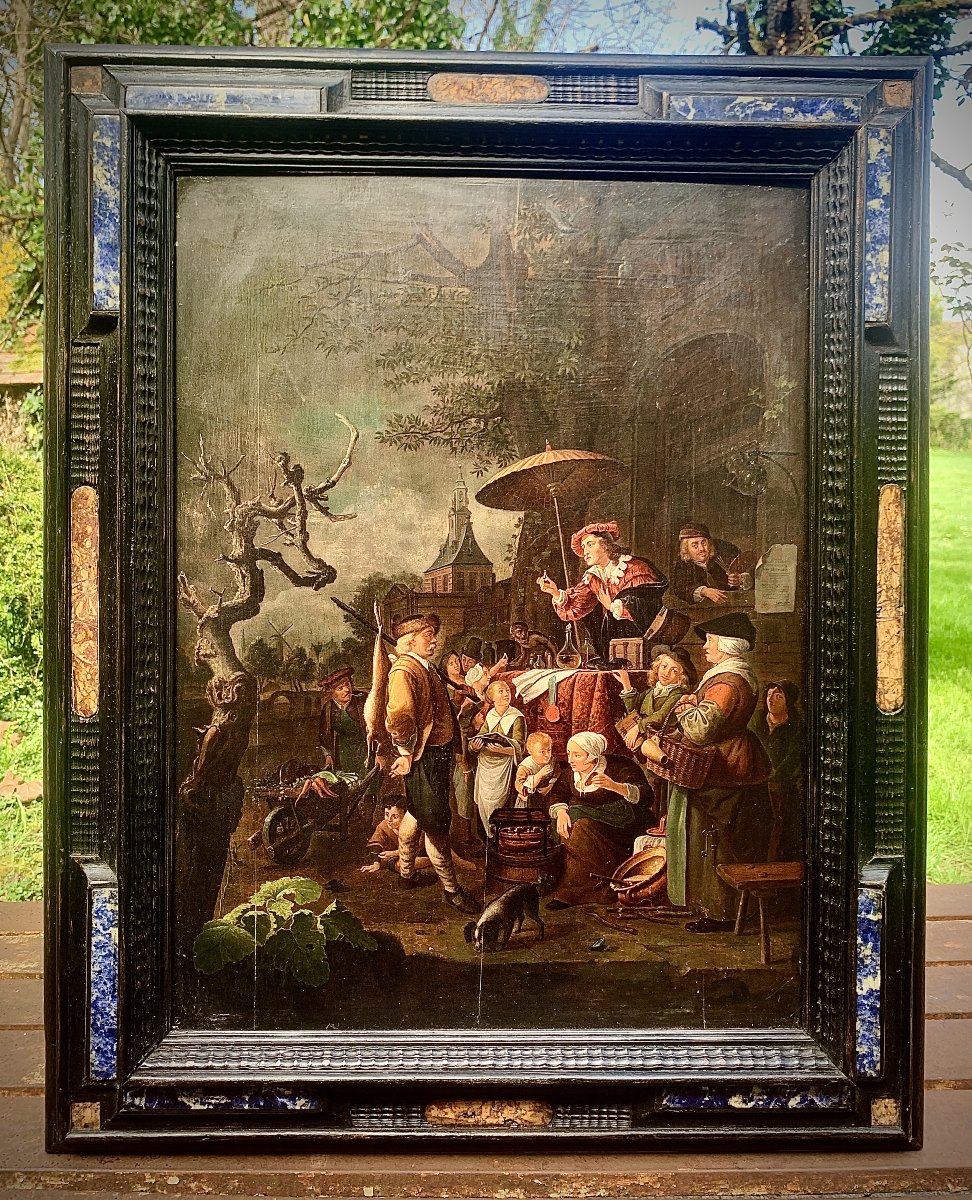
Exceptional painting on a beveled wooden panel (in 3 vertical boards), reproducing the work "The Charlatan" painted in 1652 by Gerrit DOU (1613-1675), and preserved at the Museum Boijmans Van Beuningen in Rotterdam (Netherlands)
19th century
Superb frame in the so-called "Dutch" style, made of blackened guilloché wood and adorned with lapis lazuli and Sienna marble plates
Our painting differs from the original painting in only 2 points:
*its dimensions: 63.5*47cm (82.5 x 66cm with its frame) (The size here is smaller than the original work, 112*82cm)
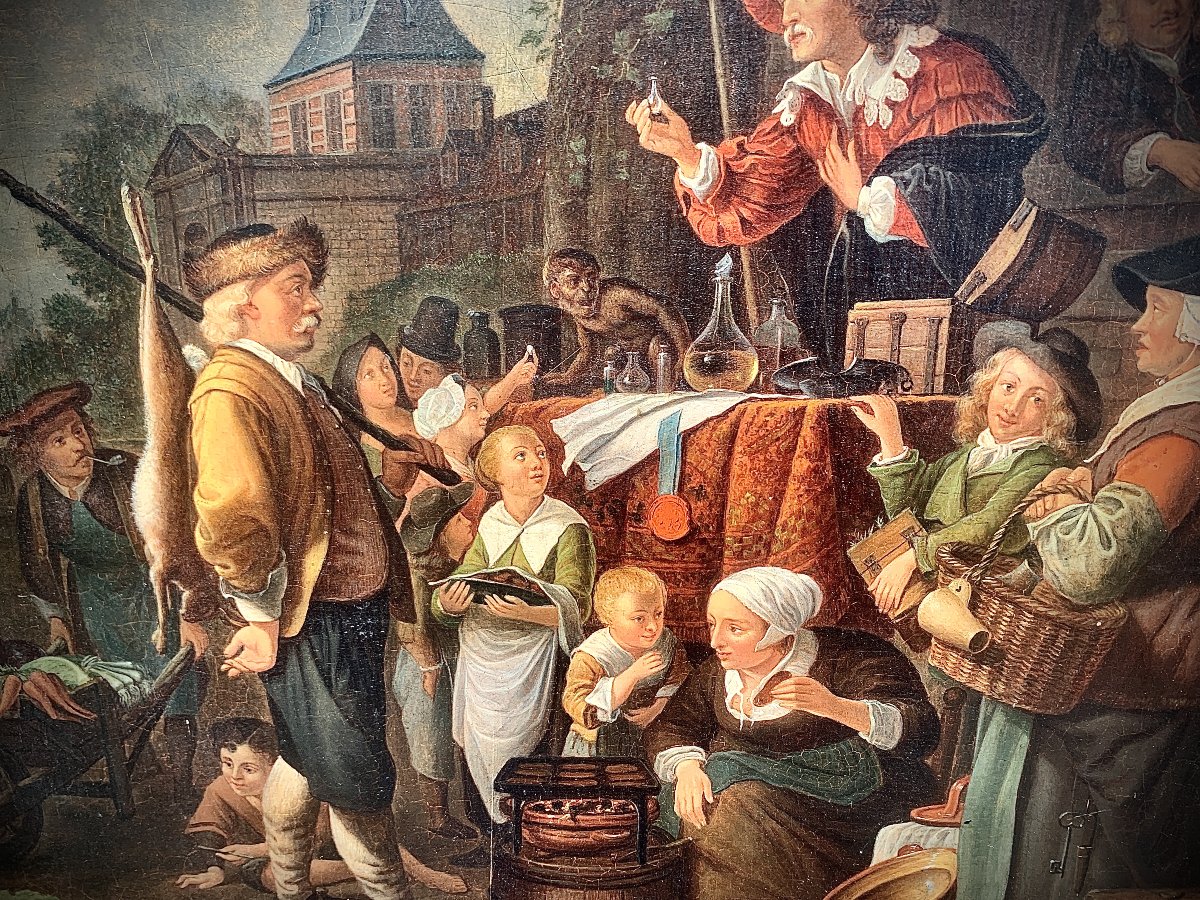
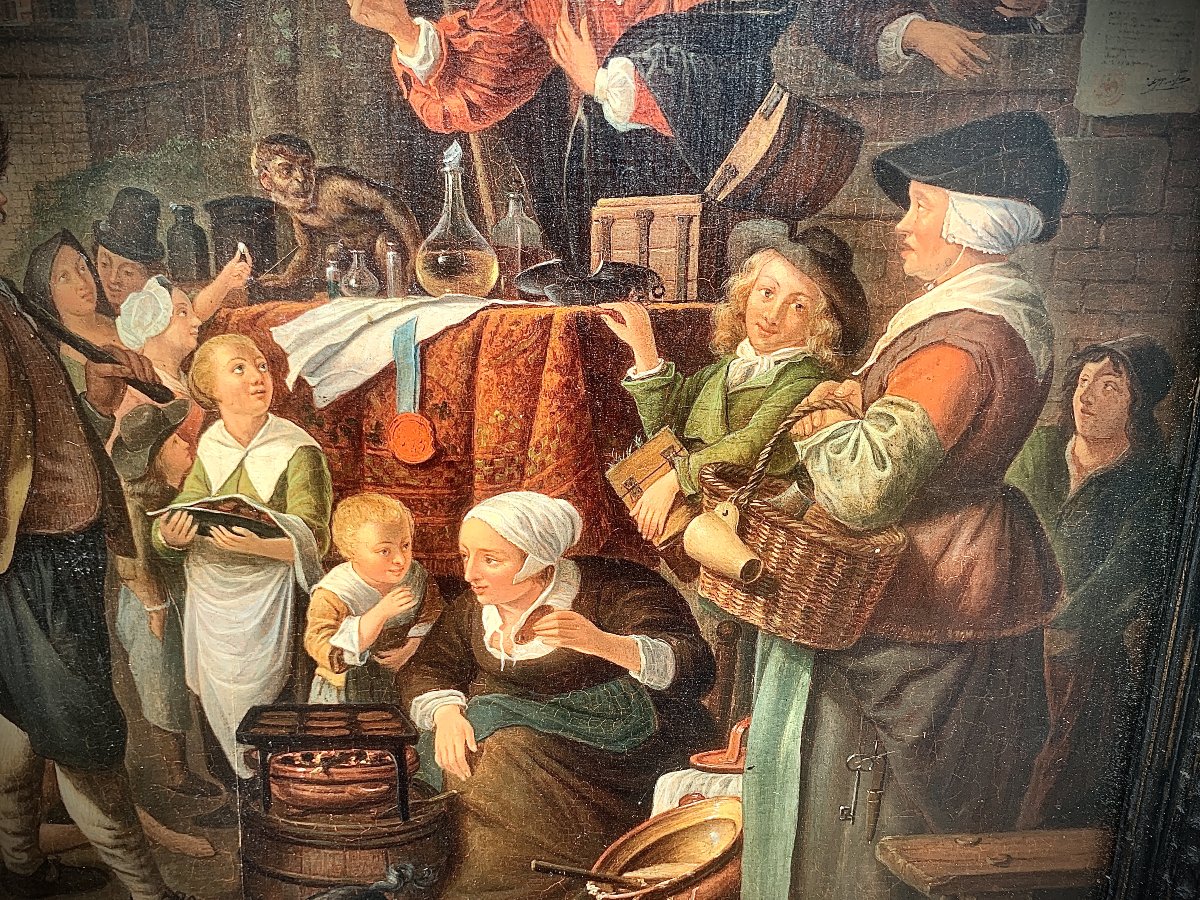
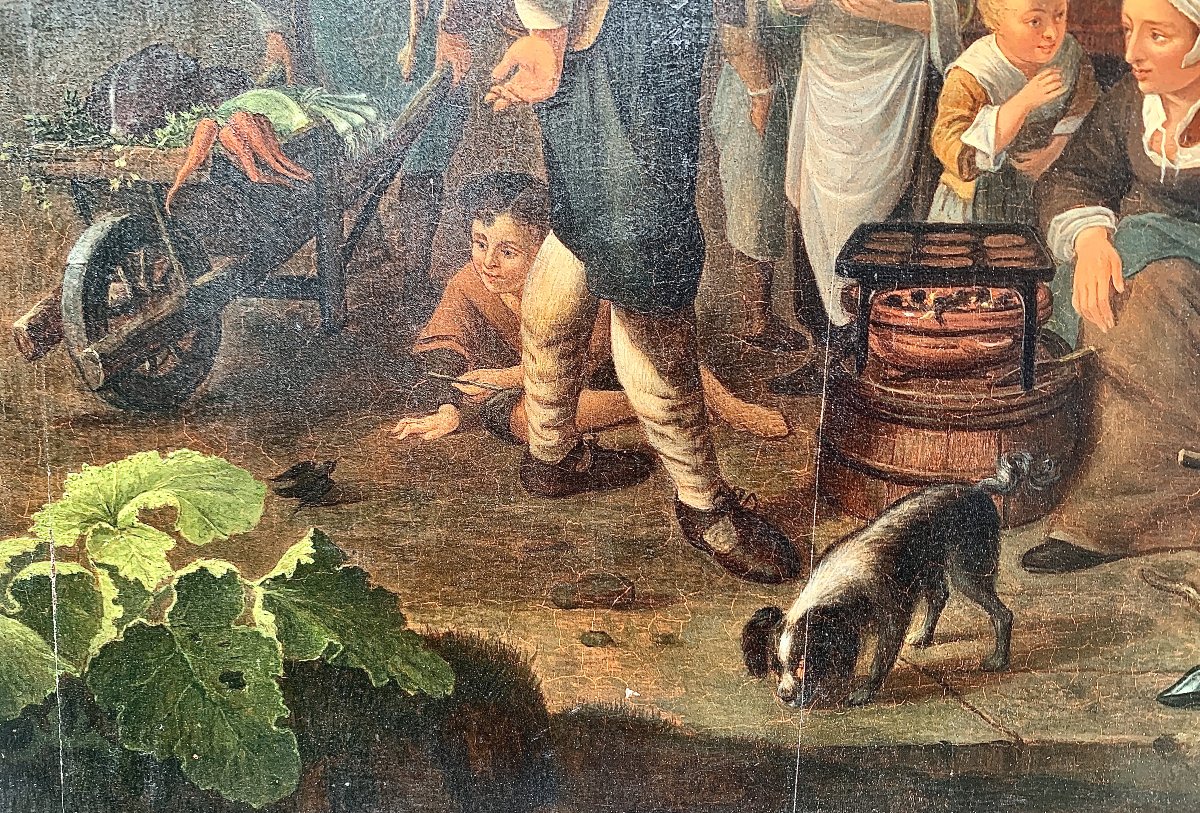
*the composition, characters, and details are exactly identical in every way, except for the woman seated in the center of the painting, next to a wooden laundry tub and seeming to speak to a young boy, who in the original painting is changing a baby’s diaper.
Condition:
The painting was cleaned by a professional workshop to restore the original brightness of colors yellowed by an old varnish, and the cracks related to the support panel were also stabilized.
https://www.lumieresdesetoiles.com/le-charlatan-1652-gerrit-dou/
The painting
This is a street scene: a charlatan extorting money from the gullible. The charlatan’s colorful outfit and ritualized gesture made it easy for the audience at the time to recognize him. It is a 17th-century genre painting depicting typical characters rather than individuals. The foundations of the genre were laid in the 16th century by Bruegel the Elder and others, but it was only in the 17th century that it became a widely popular form.
Composition
It’s an outdoor scene, a public scene: a village street bathed in the natural light of late afternoon.
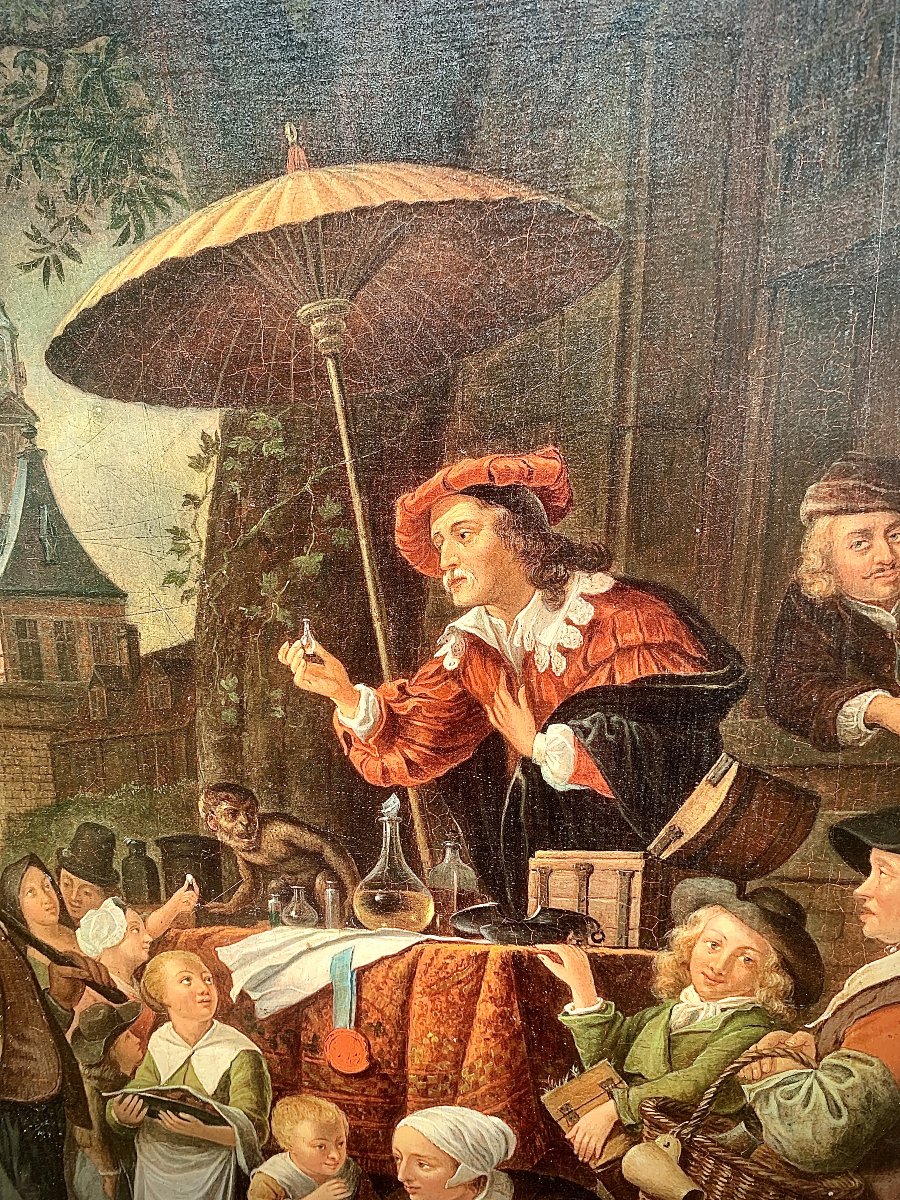
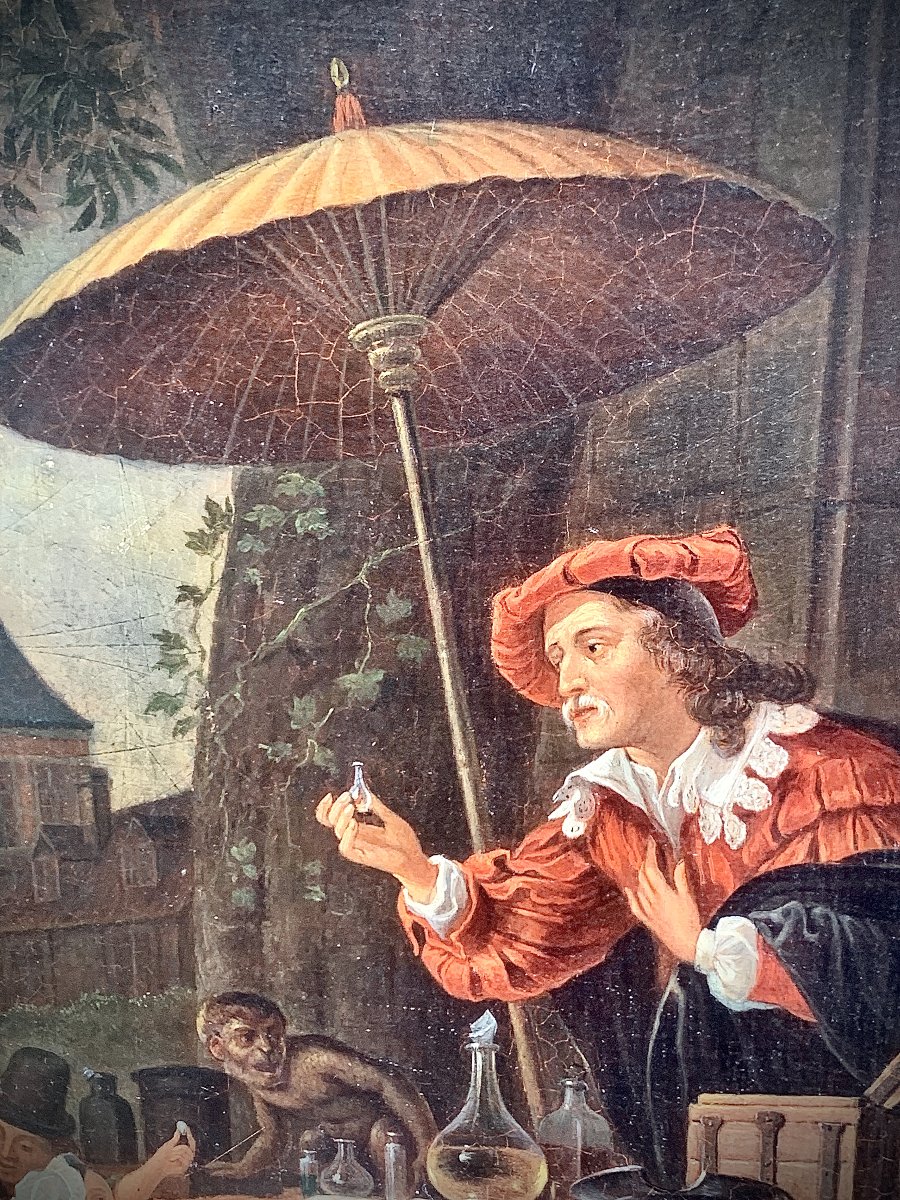
To be recognized from afar, the charlatan wears a large costume.
To appear taller, he stands on a platform set up in front of a house.
To be more believable, he has laid out his tools on a table in front of him, watched over by a monkey.
He stands under an umbrella, like under a plume, brandishing his remedy for the crowd. Young and old listen to him with the utmost attention.
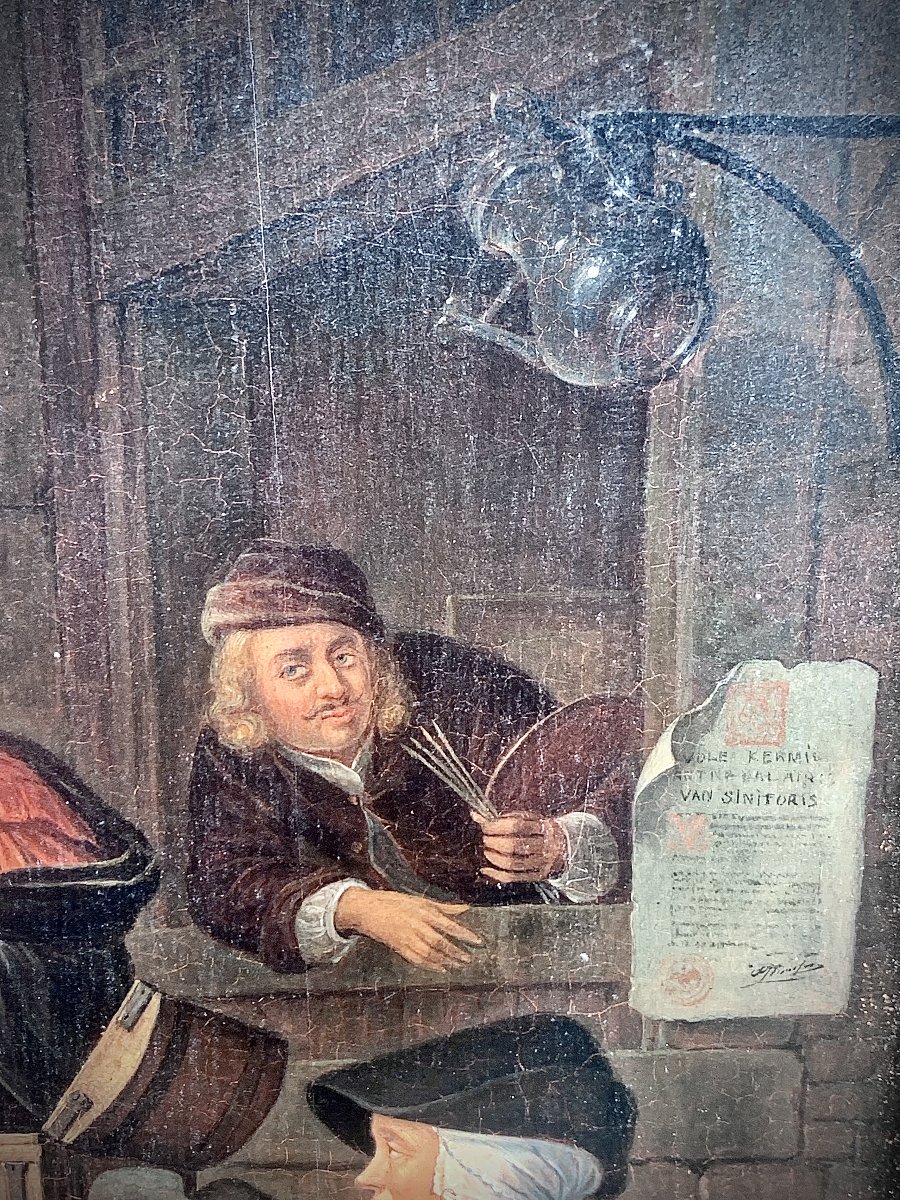
In the back right of the painting, the painter has depicted himself leaning against a window, palette in hand. Dou favors intersecting diagonals and sharp angles. Beyond a shadow line that marks the bottom edge of the painting, a disorder handled with virtuosity is condensed into a frieze: a sniffing dog, a half-tipped cauldron, barrels, a child sitting on the ground attracting a bird with seeds, a farmer holding the handles of a wheelbarrow overflowing with vegetables, (a seated woman cleaning a baby's bottom) … The characters, at the foot of the platform, form a group. The diagonals that pass through the black hat of the lady, the gentleman's cap, and the wide-brimmed hat of the charlatan, enclose the group in a triangle. Their respective positions and different sizes create a layered depth in the composition. There is a hierarchy among the characters; their costumes and attitudes allow them to be distinguished. Two characters are placed clearly in front of the others. They are also shown full-length and in profile, their social rank higher than the rest of the group. The light brings out the textures and colors of their well-made clothing. On the right side of the painting, a lady carries a basket on her arm; in the center of the painting, a gentleman carries a rabbit skewered on a stick that he holds on his left shoulder.
A spatial opening in the upper part on the left side and in the center of the painting, in the background, ventilates the composition.
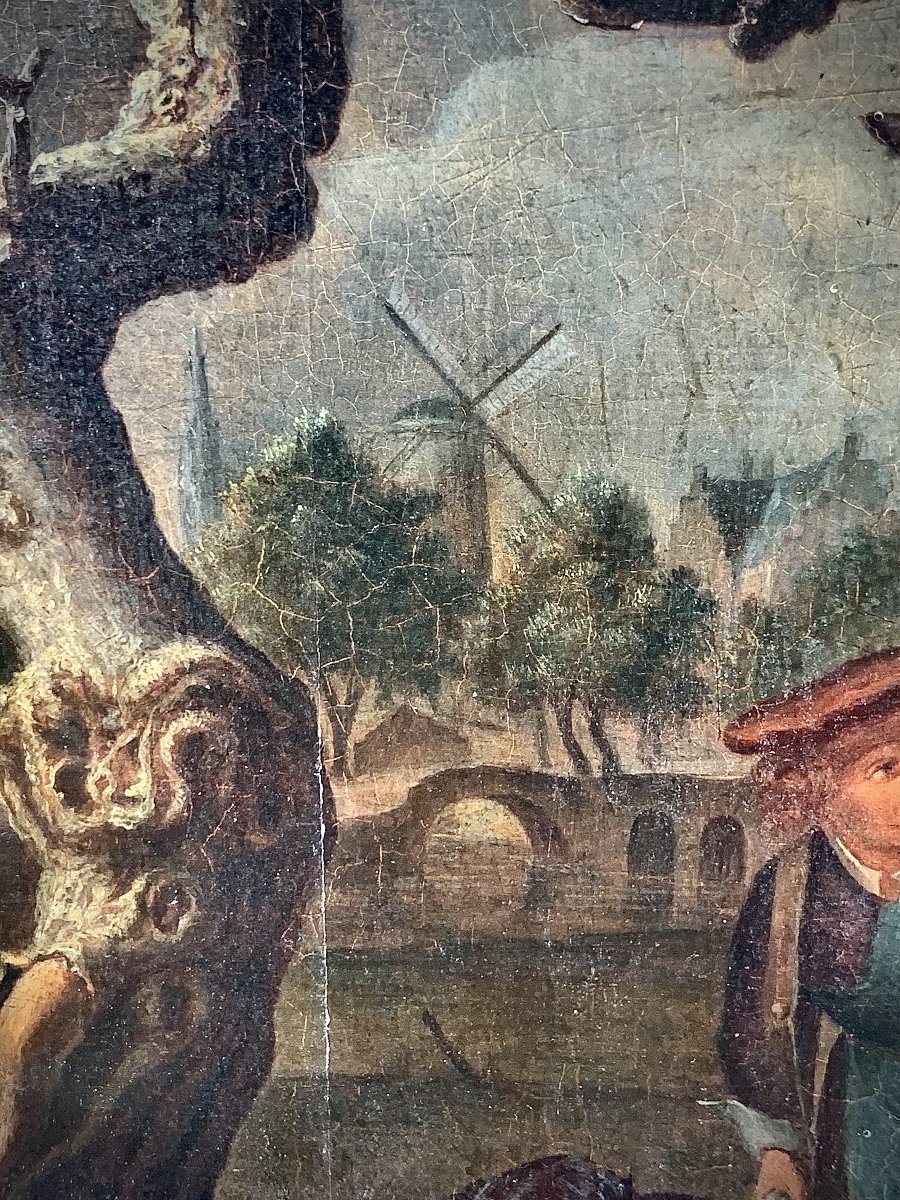
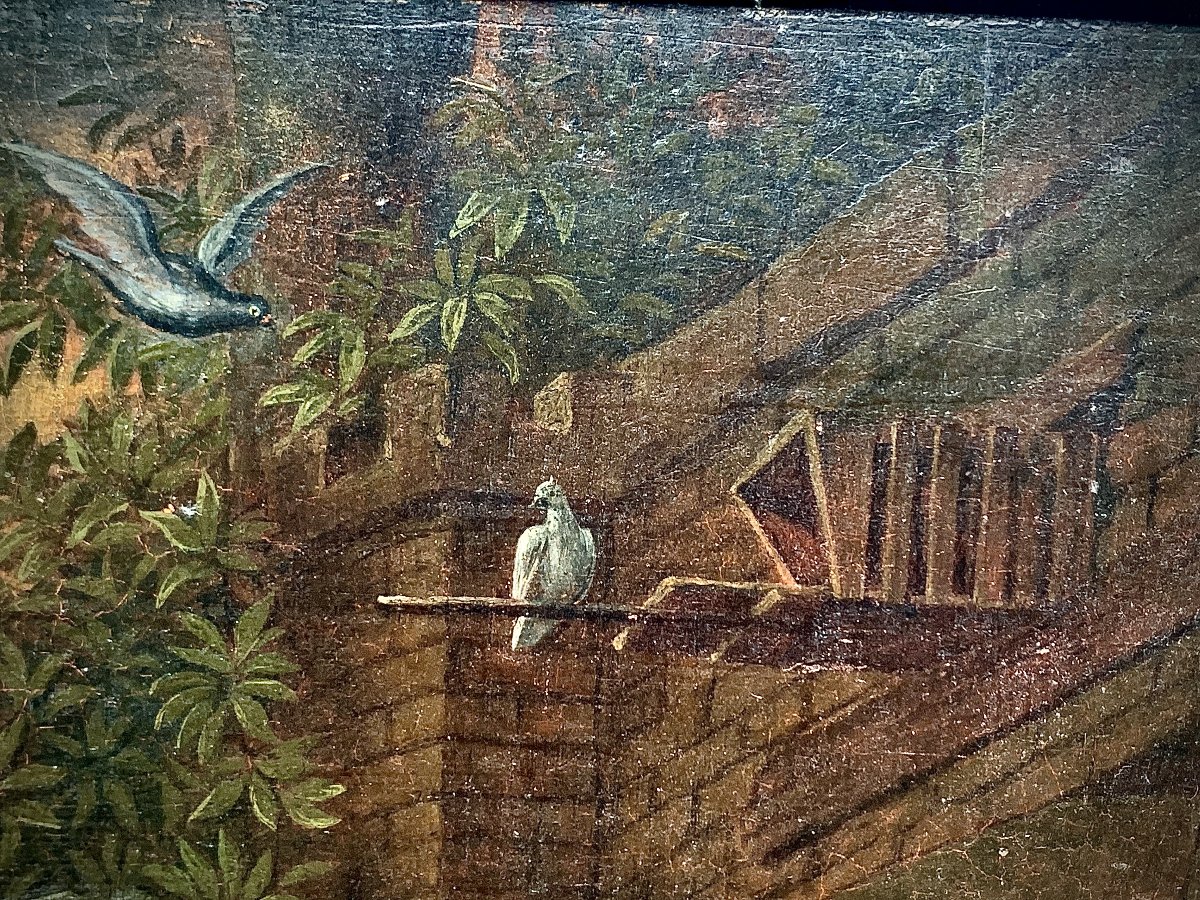
You can make out urban buildings in the distance, the steeple of a church, and the roofs of houses; closer, a windmill, a river, the arch of a bridge, and a large building in the center is topped by a belvedere.
Dou shows extreme skill in handling perspective. The main vanishing line runs through the painting from the lower right corner to the windmill's sails. There is no empty space in this composition. A dead tree bathed in light raises its twisted branches to the sky, closing off the composition on the left side of the painting. The viewer's eye is focused on the center of the painting, drawn by the light reflected on the white cloth laid on the charlatan’s table. The painter focuses the viewer's attention on the characters' postures. The painting gives off a playful atmosphere. Next, the eye follows the river and gets lost in the swirls of clouds carved with light. The light enters the painting from the left, and the shadows in the foreground and of the dog show us its direction. A subtle chiaroscuro sets the painter’s figure at the window. Dou works on her painting with stormy light that highlights the shades of blue and gray and shapes the sky full of clouds up to the dark blue at the top of the composition, against which the foliage of a tree with a metallic finish stands out. She also highlights the paved, uneven, muddy ground. By interspersing areas of shadow and juxtaposing her colors, Dou intensifies the visual chaos. On a background of ochres, browns, and blacks, the light illuminates spots of red, blue, and yellow. The tones are balanced between cool and warm colors.
The subtle play of light and the delicacy of the palette, handled with a vigorous brush, bring out the textures. By painting very meticulously, Dou hides the brushstrokes. The finish is very smooth, and the layer of color is very thin. This highly detailed painting demonstrates an exceptionally refined technique. - On both technical and aesthetic points, the artist, by here revisiting Gerrit Dou's work, perfectly respected these pictorial principles.
Dou and his followers in Leiden seem to have deliberately developed this style, originally inspired by the older works of Rembrandt, which were more intentionally realistic.
Analysis
In The Charlatan, Dou questions his artistic identity. At first glance, the painting depicts a traditional comic scene: a naive audience listens to a fake doctor trying to sell his wares. Familiar motifs, such as the woman cleaning a baby's bottom — here absent — and the dead tree in the foreground, indicate the futility of these remedies and of any attempts to escape death.
Dou depicts himself in the window frame behind the charlatan, aligning his professional identity with the charlatan’s. The painter is an illusionist, a kind of charlatan.
Texts, both comic and serious, referred to the deceptive nature of art, its ability to convince the viewer of the reality of its representations. Dou paints a theatrical exhibition. The charlatan addressing the crowd is the center of attention. The charlatan is a professional deceiver, exploiting popular credulity by misusing the methods of performance to maintain an illusion. Through his false appeal to the eye, painting—especially Dou’s—resembled charlatanry. Expressing this comparison in his painting that mystifies the eye, Dou creates an art of illusion.
The painting opens an imaginary window between the characters and the viewers. The scene seems authentic because of the variety of activities taking place and the characters’ scattered attention. As in all painted comic scenes, there is a deliberate mess of objects: table, barrels, pot, wheelbarrow, baskets… Dou uses low lighting near the ground to highlight this disorder. The countless naturalistic techniques, often contradictory, used by painters show that the term "realism" is often relative and that its meaning depends on the social environment and the pictorial genre from which it originates. The considerable variety of realistic methods used by Dutch painters and draftsmen reflects a more profound naturalistic concern than elsewhere in Europe. Two aspects of realism—the subtle rendering of textures and the preference for comical scenes—fit into an old Dutch tradition that goes back two centuries. Around 1430, Jan van Eyck already appreciated the finesse of textures and the lack of brush marks. This taste for illusion was made possible with the advent of oil painting. While Dutch realism is linked to certain imitative techniques, it is mainly due to its choice of popular themes depicting characters, objects, houses, and streets. This concern for accuracy, both thematically and aesthetically, seems particularly deliberate in comic paintings where people are shown as they are or caricatured. The Charlatan is aimed at a cultivated audience that knows it is different from the stereotypical characters, such as naive peasants and the charlatan, depicted in the painting.
Conclusion
Dou's paintings are realistic and detailed, even illusionistic. Gerrit Dou was lucky to be sponsored by two wealthy patrons, which gave him great freedom in choosing his subjects. This wasn't the case for his contemporaries, who had to conform to commissions and often specialize in a particular area. Dou is considered the greatest artist of all time until the mid-19th century, a period when his "fine" technique contrasted with the brushstrokes of painters, and his meticulous style was the opposite of the focus on capturing light movements. This helps explain why Dou's fame quickly faded. On the other hand, Dou was soon overshadowed by the discovery of Vermeer and the rediscovery of Rembrandt.
Explore similar pieces and discover your ideal find:
Genre Scenes, Nudes