THIS OBJECT WAS SOLD
Moses Saved From The Waters. Attributed To Hans Rottenhammer (1564 - 1625)
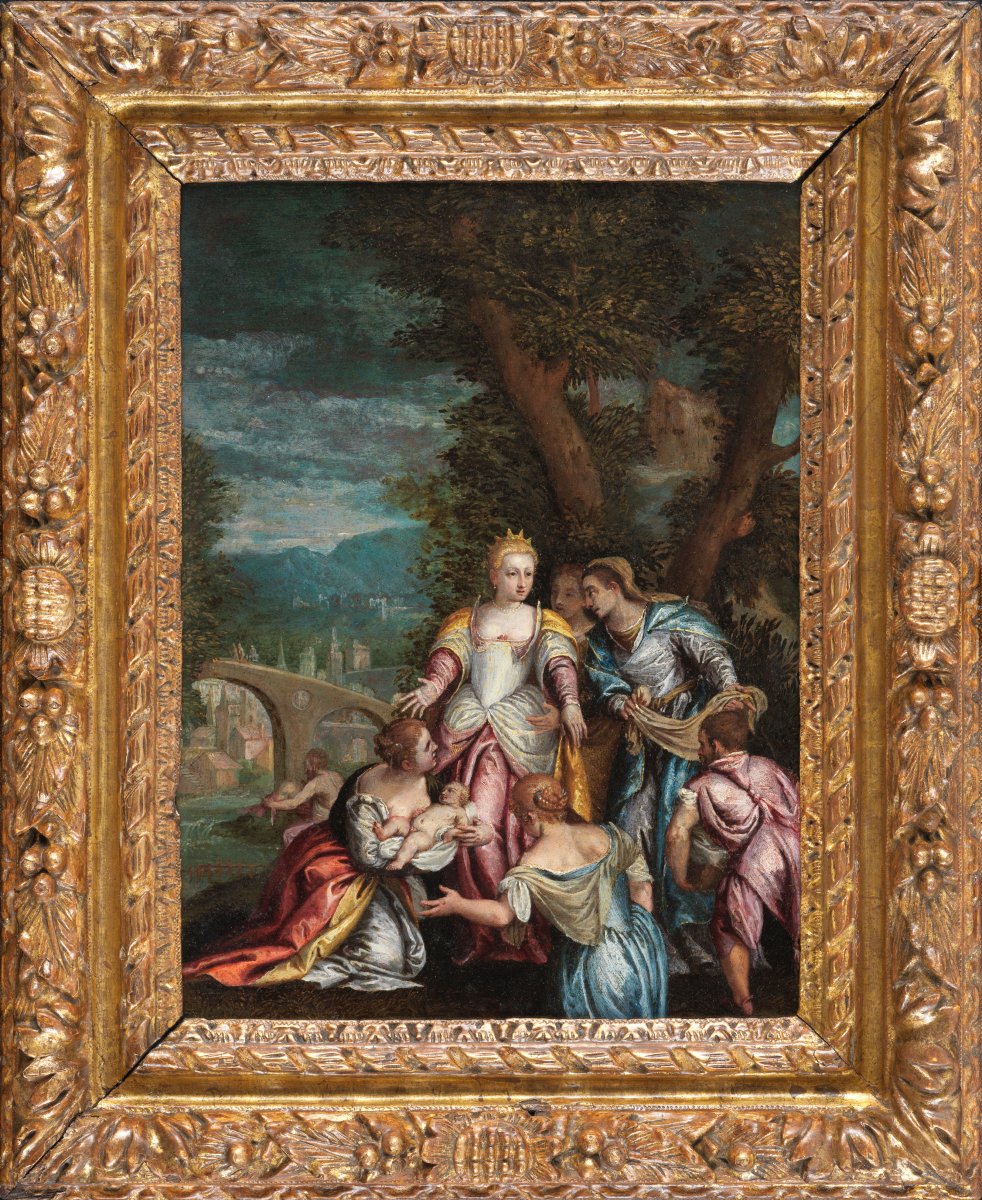
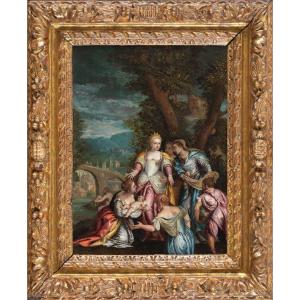


Oil on copper. German-Venetian school circa 1600, attributed to Hans Rottenhammer.
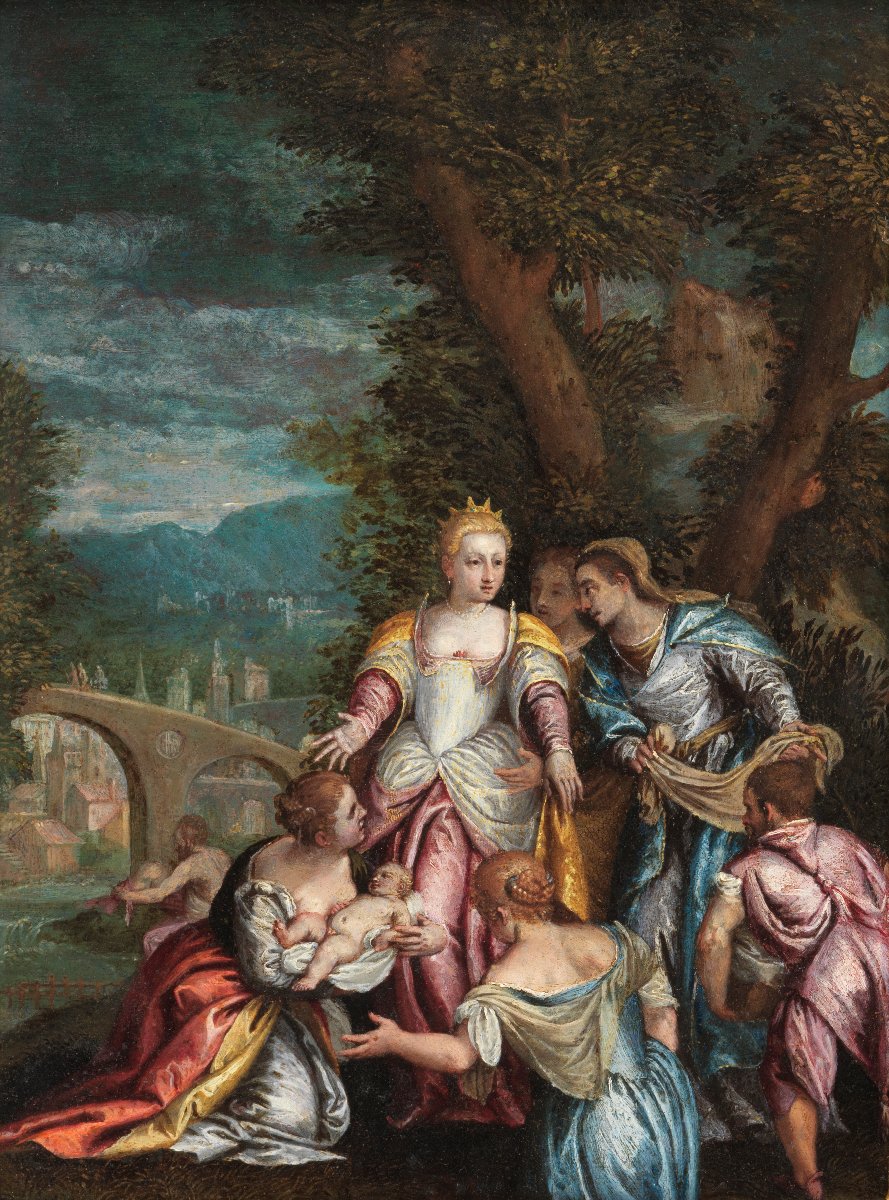
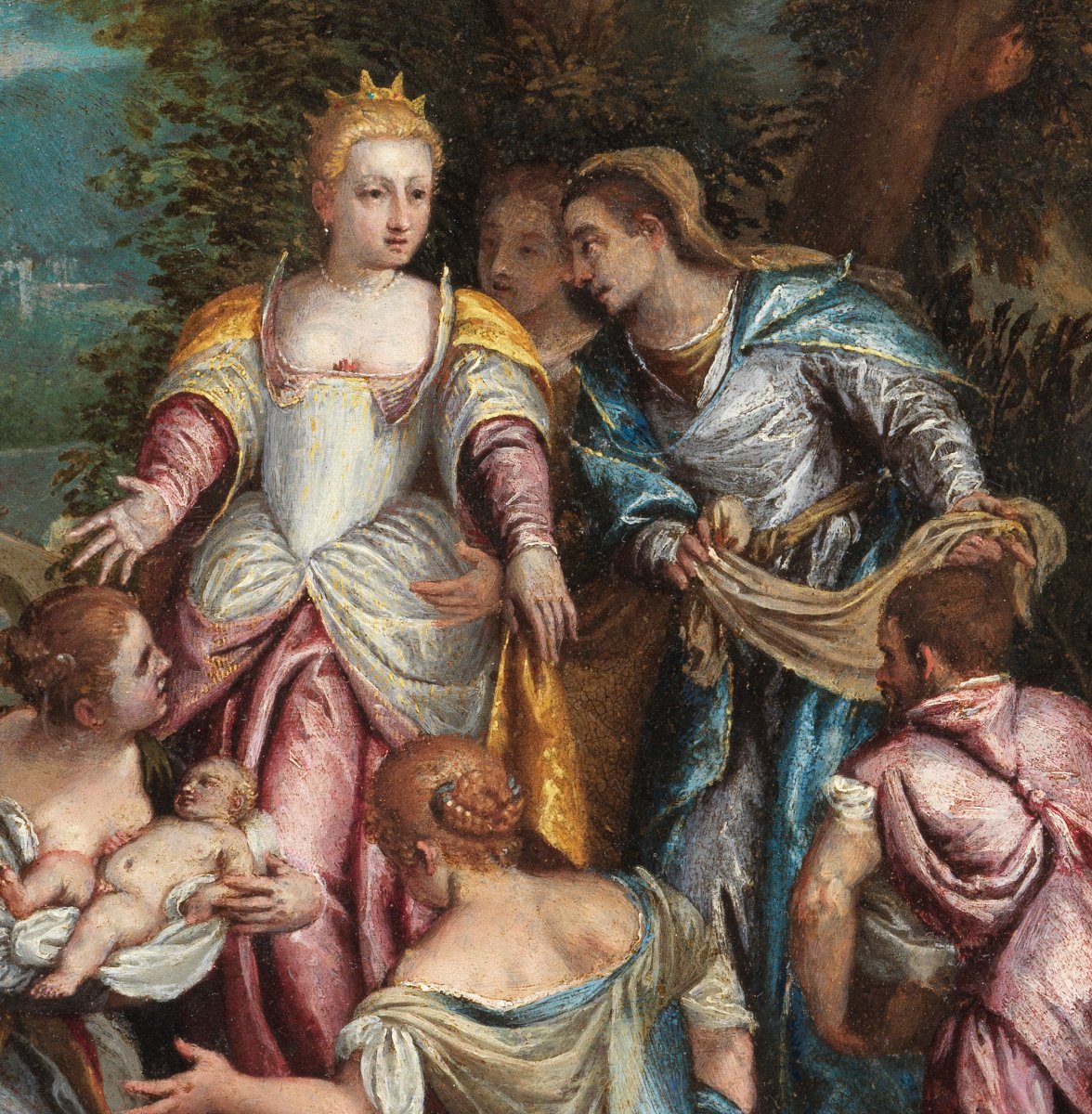
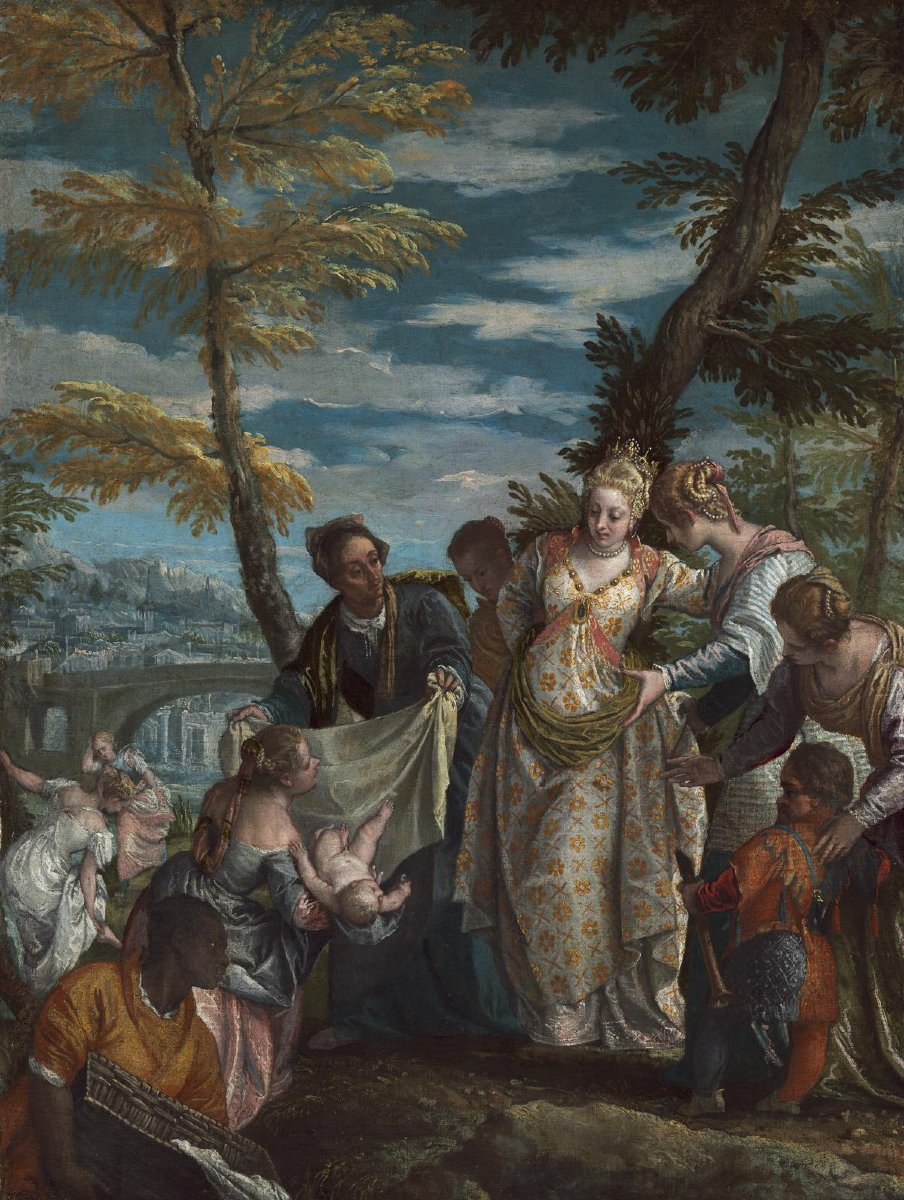
The scene that unfolds before our eyes, while absolutely originalis, reminiscent of the narrative architecture developed by Veronese in a large composition at the National Gallery of Art in Washington (see photos). The subject, taken from Exodus, is treated with delicacy : to escape Pharaoh's decree, Moses' mother hides her child in a basket on the Nile. Pharaoh's daughter discovers him stranded among the reeds and decides to adopt him. This episode evokes the providential survival of Israel's future liberator. Rottenhammer or a close collaborator remembers the moment of revelation and compassion, which he translates into a subtles interplay of gestures and glances.
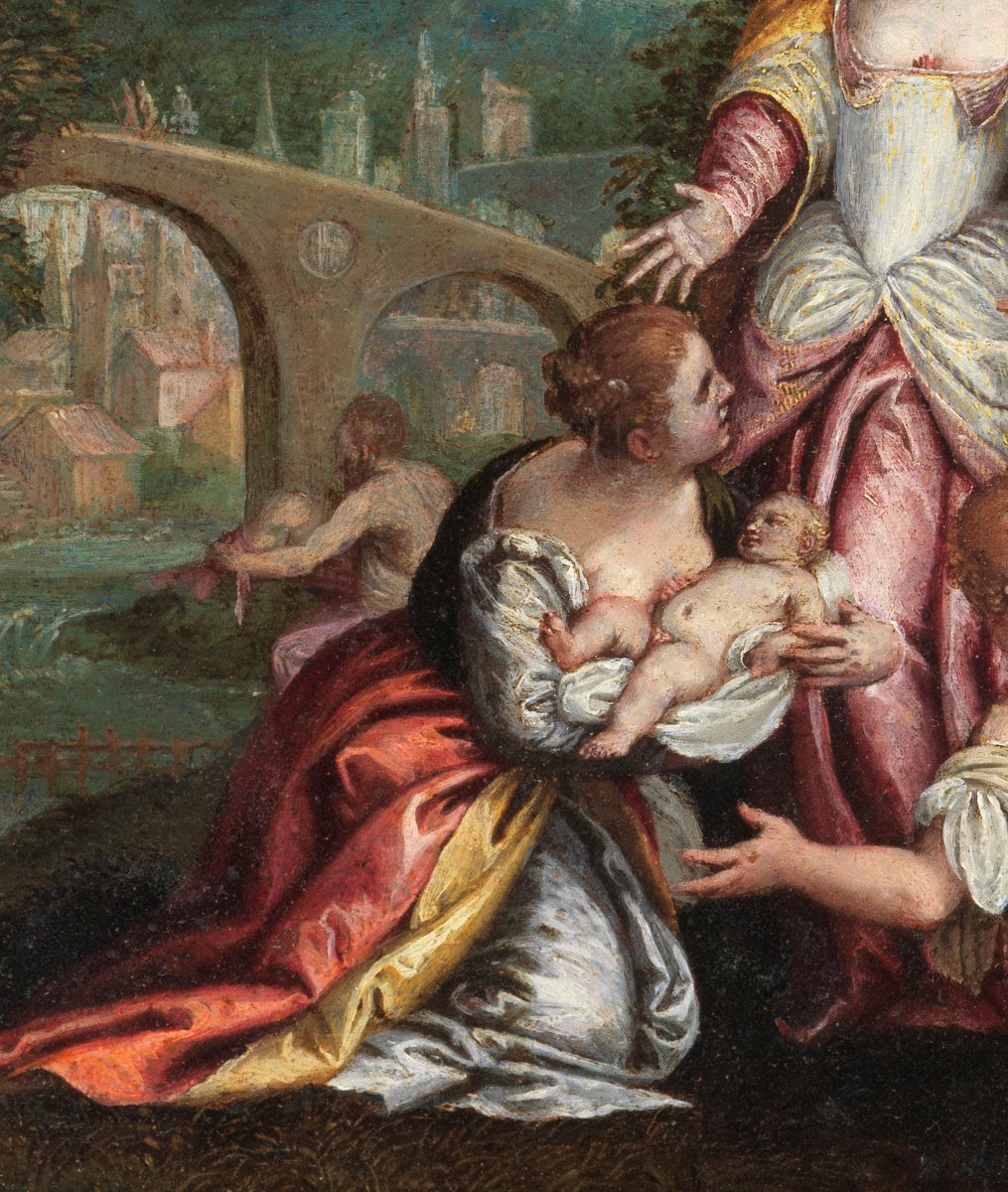
As in Veronese's work, the ensemble of figures is organized around Pharaoh's daughter, placed at the top of a pyramidal whose attendants form the sides, while the infant Moses, presented in a white cloth by a kneeling maid, forms the base. This triangular construction, inherited from the Italian Renaissance, gives the scene a majestic stability that our painter transposes to a more intimate elegance, typical of smaller formats.
To the left, an arched bridge and a distant city open the composition into the distance, echoing another essential motif of Washington's canvas. For Veronese, these elements structure the space and anchor the scene in an idealized urban landscape. In our painting, they are reinterpreted in a more Nordic vocabulary, with massive trees, colder light and a threatening sky. This transposition of a Venetian scheme in a "Germano-Flemish" style is one of the most telling clues of a hybrid visual culture. It is precisely in this hybridization that we recognize Rottenhammer's hand, or that of a close collaborator. Trained in Venice and familiar with the compositions of Veronese, but profoundly influenced by Nordic sensibility, Rottenhammer excelled at to condense the great Italian models into small paintings on copper. Virtuoso brushwork, graceful gestures, rich luminous draperies and miniaturistic details directly reflect his artistic idiom, whose mannerist aesthetic is more northerly.
Provenance: former Raoul Malard collection (1928-2015), wool manufacturer from Northern France.
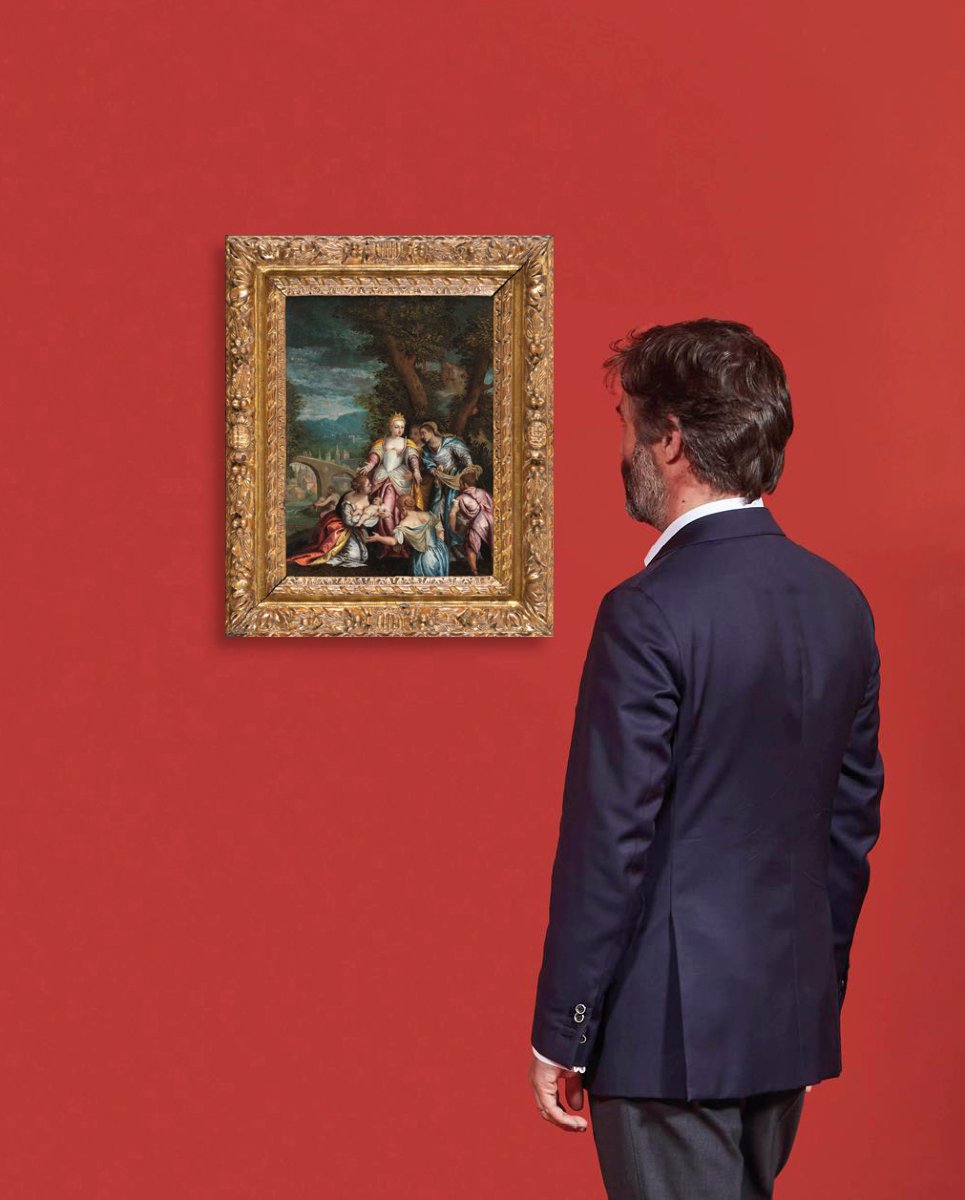
Our precious composition is housed in a rich French frame from Louis XIII period.
Dimensions: 33.5 x 24 cm - 45 x 38 cm with frame
Sold with invoice and certificate of authenticity
Biography: Hans Rottenhammer (Munich 1564 - Augsburg 1625) is one of the most of late German-Italian Mannerism.Born in Munich and trained in the workshop of Hans Donauer, he left Bavaria at an early age to settle in Venice, where he remained for almost fifteen years. There, he assimilated with rare finesse the lessons of the great Venetian masters - Veronese, Tintoretto, Palma il Giovane - while retaining the meticulous precision and cool light of the Nordic tradition. A master of small paintings on copper, he developed a hybrid language of great modernity combining Italian compositions and Flemish execution. His collaboration with Jan Brueghel the Elder and Joos de Momper, for whom he painted figures, are among the finest achievements of the North and South. Back in Augsburg and Munich, he became a court painter, but his style remained marked by Venetian elegance and the narrative virtuosity acquired in Italy. His work is highly sought-after on the international market, embodies one of the peaks of Mannerist copper painting around 1600.
Bibliography:
- Klessmann Rüdiger. Hans Rottenhammer (1564-1625). Mit einem kritischen Verzeichnis der Gemälde und Ölstudien, Berlin, 1979
- Klessmann Rüdiger. Hans Rottenhammer: Gemälde, Ölstudien, Zeichnungen, 2008
- Bayerische Staatsgemäldesammlungen. Hans Rottenhammer : Ein Maler zwischen Venedig und München, Munich, 2008
- Collective work, catalog of the exhibition at the Weserrenaissance-Museum Schloss Brake in Lemgo and the Nationalgalerie in Prague, Hans Rottenhammer, begehrt - vergessen - neu entdeckt, Hirmer Verlag, 2008
The scene that unfolds before our eyes, while absolutely originalis, reminiscent of the narrative architecture developed by Veronese in a large composition at the National Gallery of Art in Washington (see photos). The subject, taken from Exodus, is treated with delicacy : to escape Pharaoh's decree, Moses' mother hides her child in a basket on the Nile. Pharaoh's daughter discovers him stranded among the reeds and decides to adopt him. This episode evokes the providential survival of Israel's future liberator. Rottenhammer or a close collaborator remembers the moment of revelation and compassion, which he translates into a subtles interplay of gestures and glances.
As in Veronese's work, the ensemble of figures is organized around Pharaoh's daughter, placed at the top of a pyramidal whose attendants form the sides, while the infant Moses, presented in a white cloth by a kneeling maid, forms the base. This triangular construction, inherited from the Italian Renaissance, gives the scene a majestic stability that our painter transposes to a more intimate elegance, typical of smaller formats.
To the left, an arched bridge and a distant city open the composition into the distance, echoing another essential motif of Washington's canvas. For Veronese, these elements structure the space and anchor the scene in an idealized urban landscape. In our painting, they are reinterpreted in a more Nordic vocabulary, with massive trees, colder light and a threatening sky. This transposition of a Venetian scheme in a "Germano-Flemish" style is one of the most telling clues of a hybrid visual culture. It is precisely in this hybridization that we recognize Rottenhammer's hand, or that of a close collaborator. Trained in Venice and familiar with the compositions of Veronese, but profoundly influenced by Nordic sensibility, Rottenhammer excelled at to condense the great Italian models into small paintings on copper. Virtuoso brushwork, graceful gestures, rich luminous draperies and miniaturistic details directly reflect his artistic idiom, whose mannerist aesthetic is more northerly.
Provenance: former Raoul Malard collection (1928-2015), wool manufacturer from Northern France.
Our precious composition is housed in a rich French frame from Louis XIII period.
Dimensions: 33.5 x 24 cm - 45 x 38 cm with frame
Sold with invoice and certificate of authenticity
Biography: Hans Rottenhammer (Munich 1564 - Augsburg 1625) is one of the most of late German-Italian Mannerism.Born in Munich and trained in the workshop of Hans Donauer, he left Bavaria at an early age to settle in Venice, where he remained for almost fifteen years. There, he assimilated with rare finesse the lessons of the great Venetian masters - Veronese, Tintoretto, Palma il Giovane - while retaining the meticulous precision and cool light of the Nordic tradition. A master of small paintings on copper, he developed a hybrid language of great modernity combining Italian compositions and Flemish execution. His collaboration with Jan Brueghel the Elder and Joos de Momper, for whom he painted figures, are among the finest achievements of the North and South. Back in Augsburg and Munich, he became a court painter, but his style remained marked by Venetian elegance and the narrative virtuosity acquired in Italy. His work is highly sought-after on the international market, embodies one of the peaks of Mannerist copper painting around 1600.
Bibliography:
- Klessmann Rüdiger. Hans Rottenhammer (1564-1625). Mit einem kritischen Verzeichnis der Gemälde und Ölstudien, Berlin, 1979
- Klessmann Rüdiger. Hans Rottenhammer: Gemälde, Ölstudien, Zeichnungen, 2008
- Bayerische Staatsgemäldesammlungen. Hans Rottenhammer : Ein Maler zwischen Venedig und München, Munich, 2008
- Collective work, catalog of the exhibition at the Weserrenaissance-Museum Schloss Brake in Lemgo and the Nationalgalerie in Prague, Hans Rottenhammer, begehrt - vergessen - neu entdeckt, Hirmer Verlag, 2008
Explore similar pieces and discover your ideal find:
religious paintings