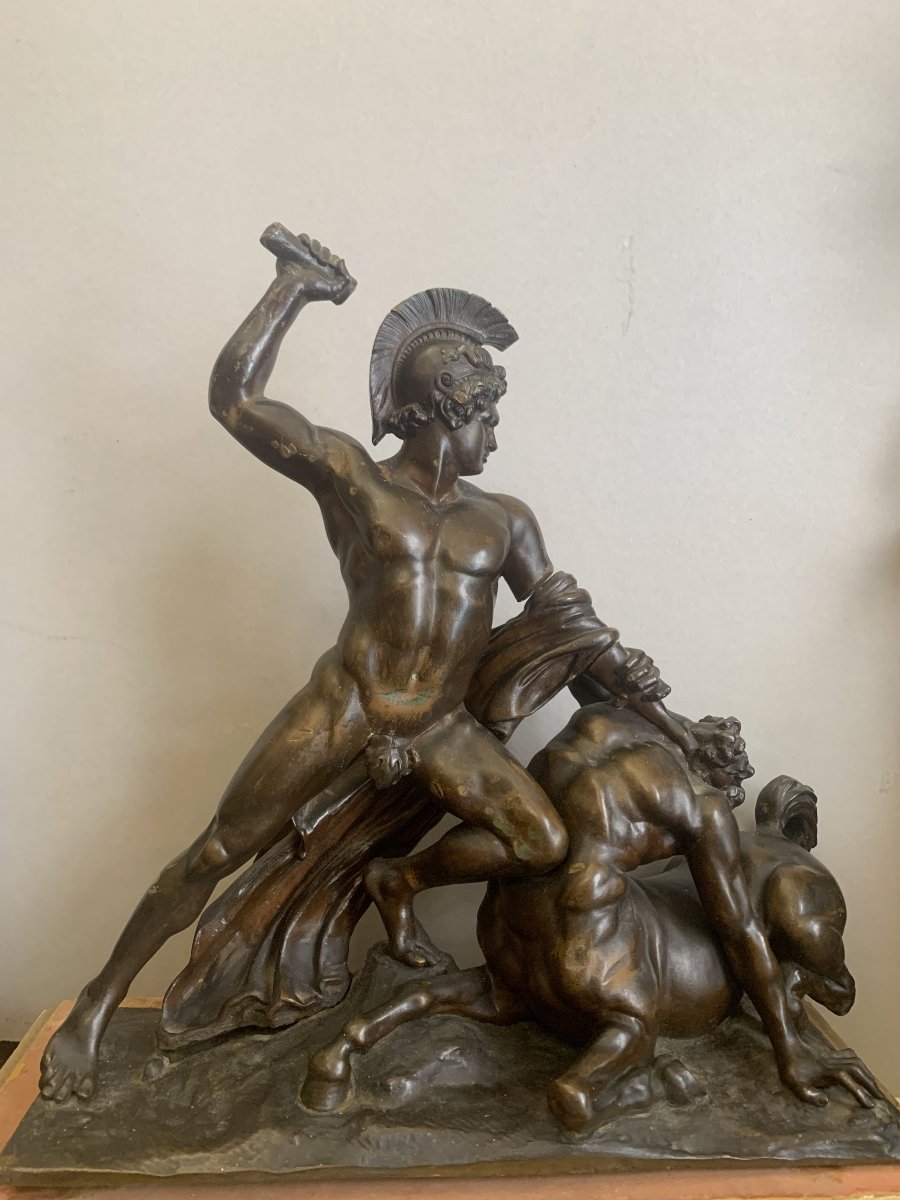
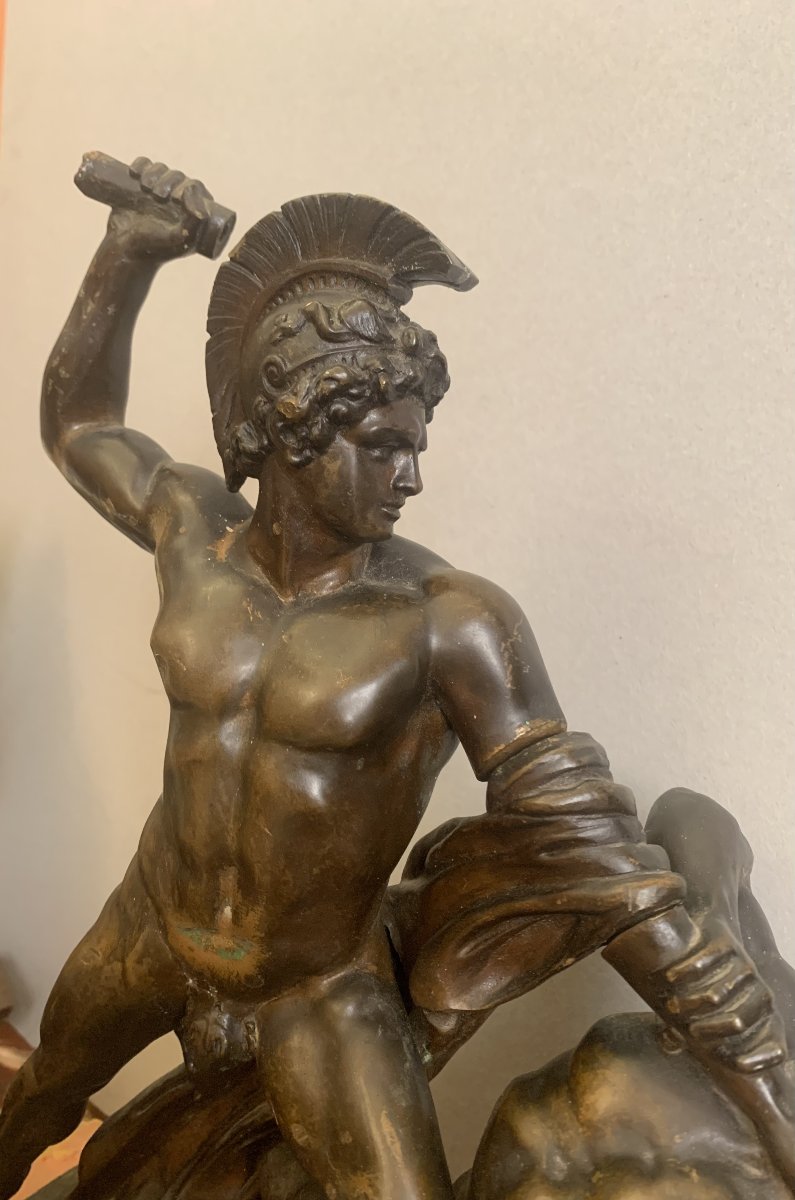
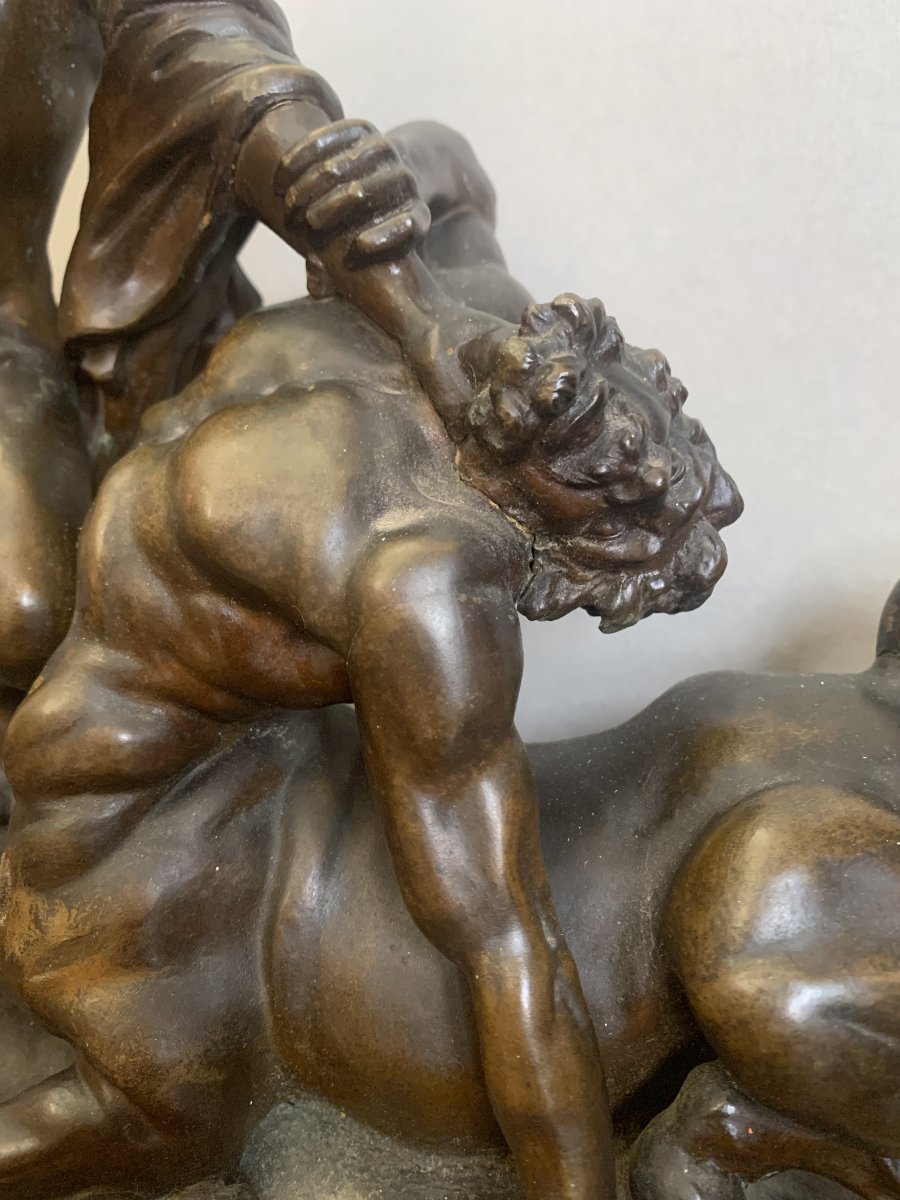
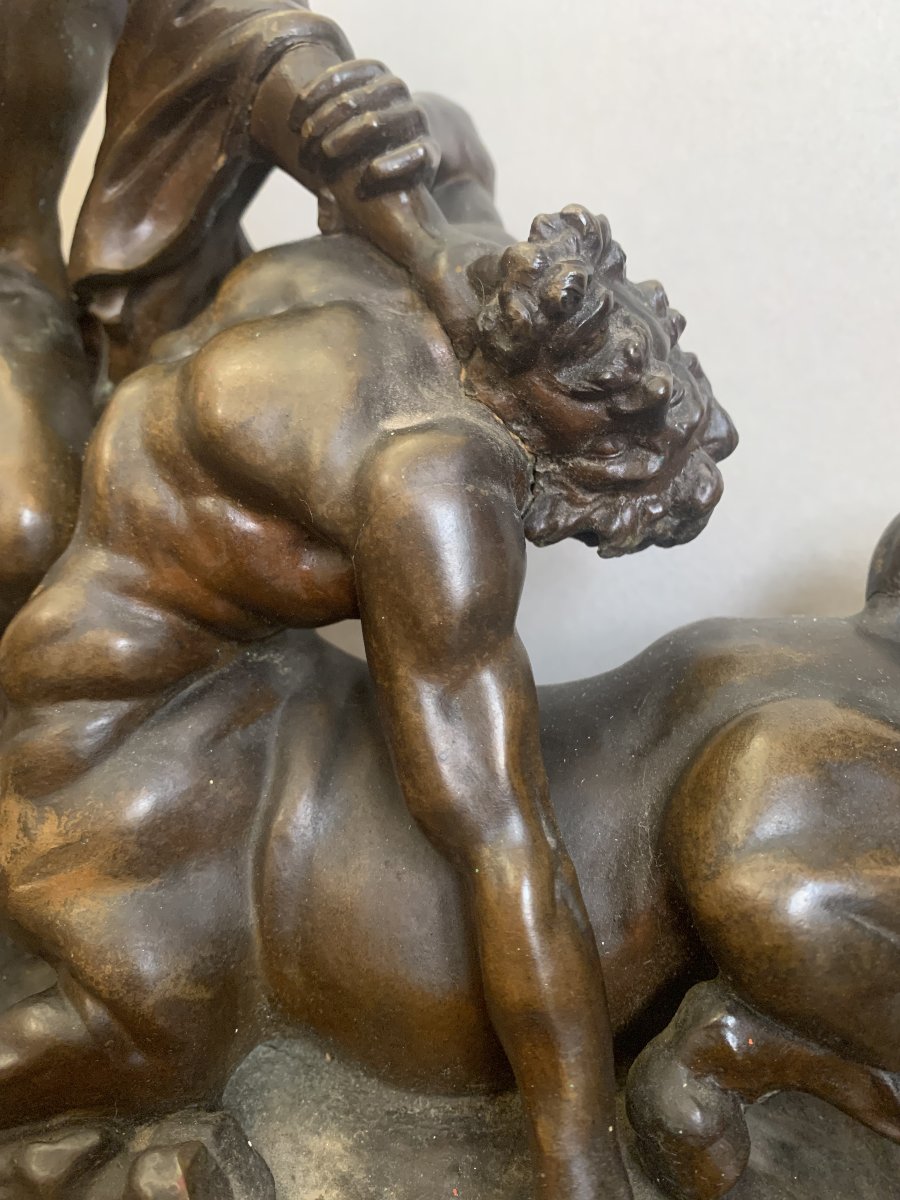
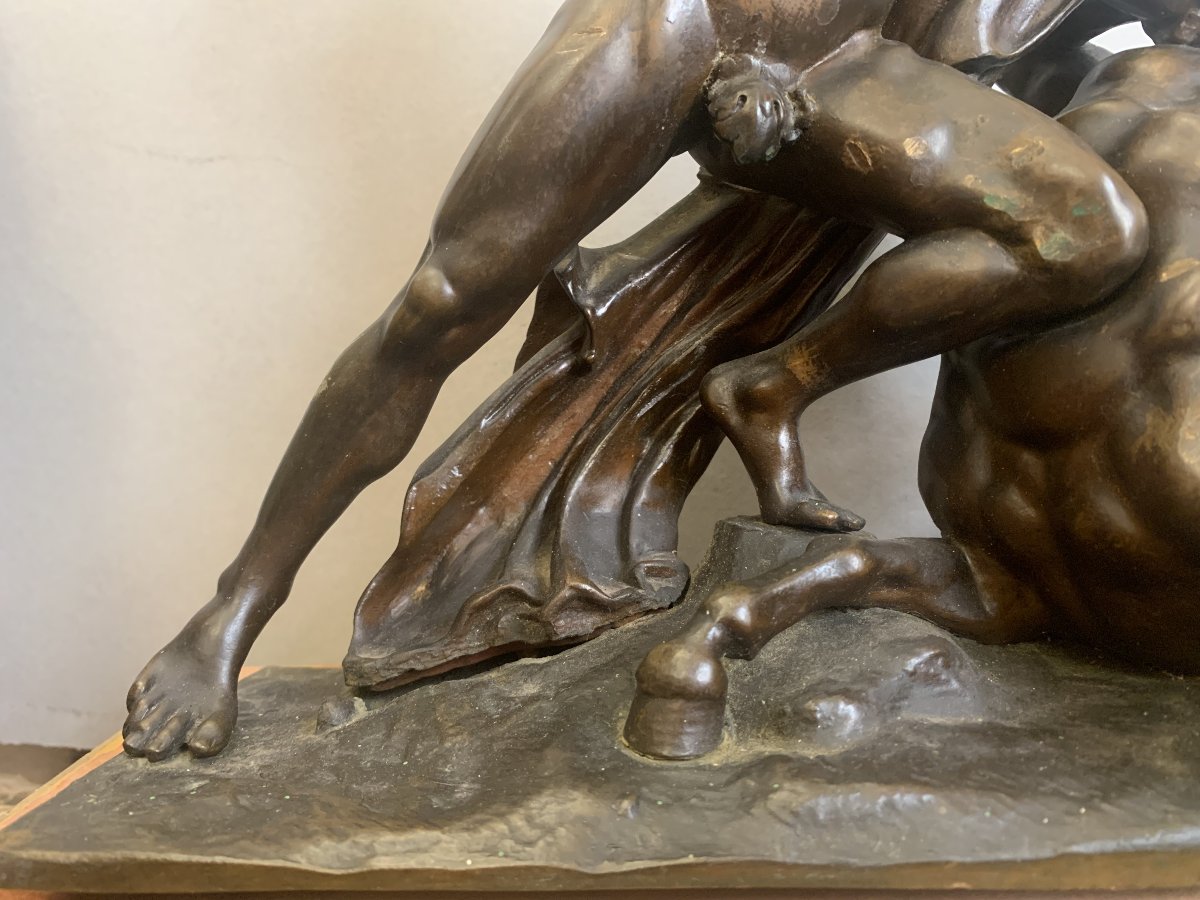
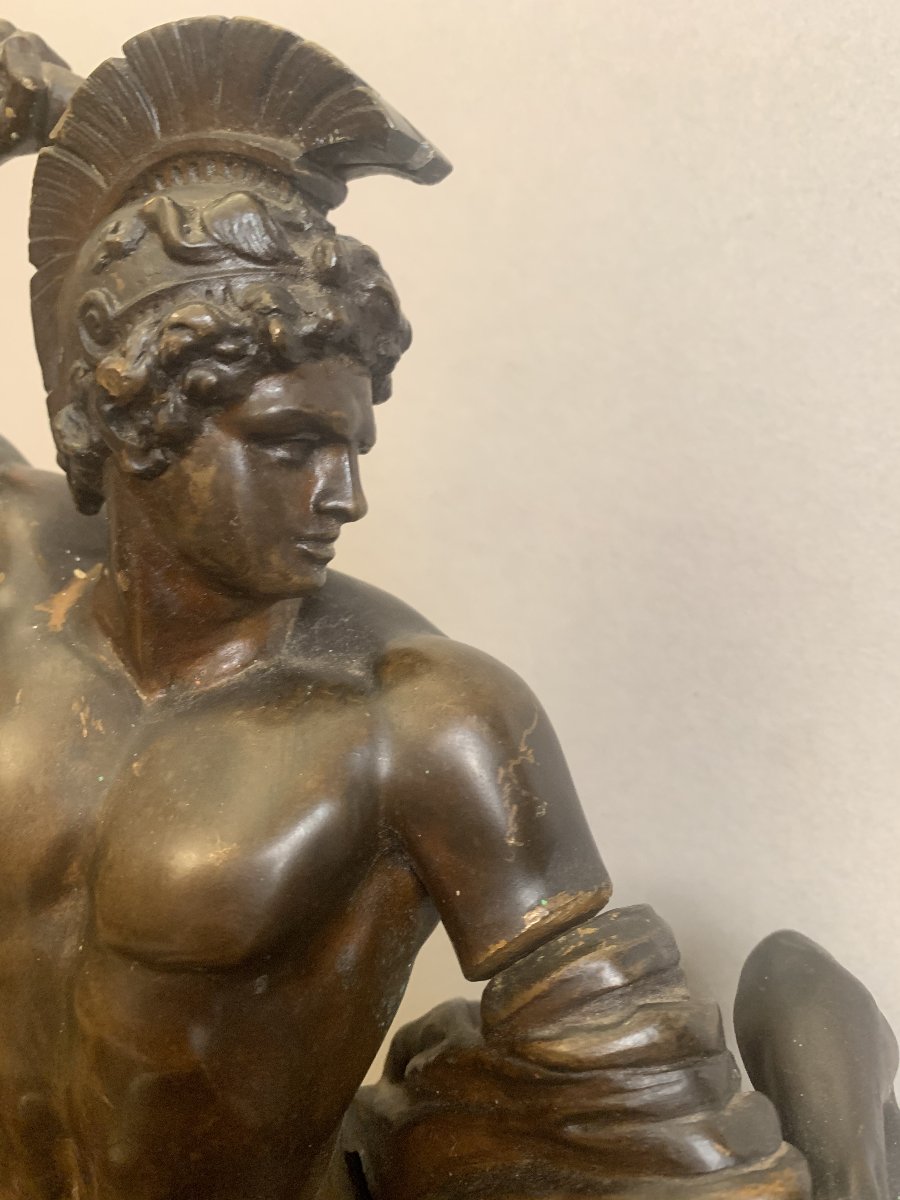
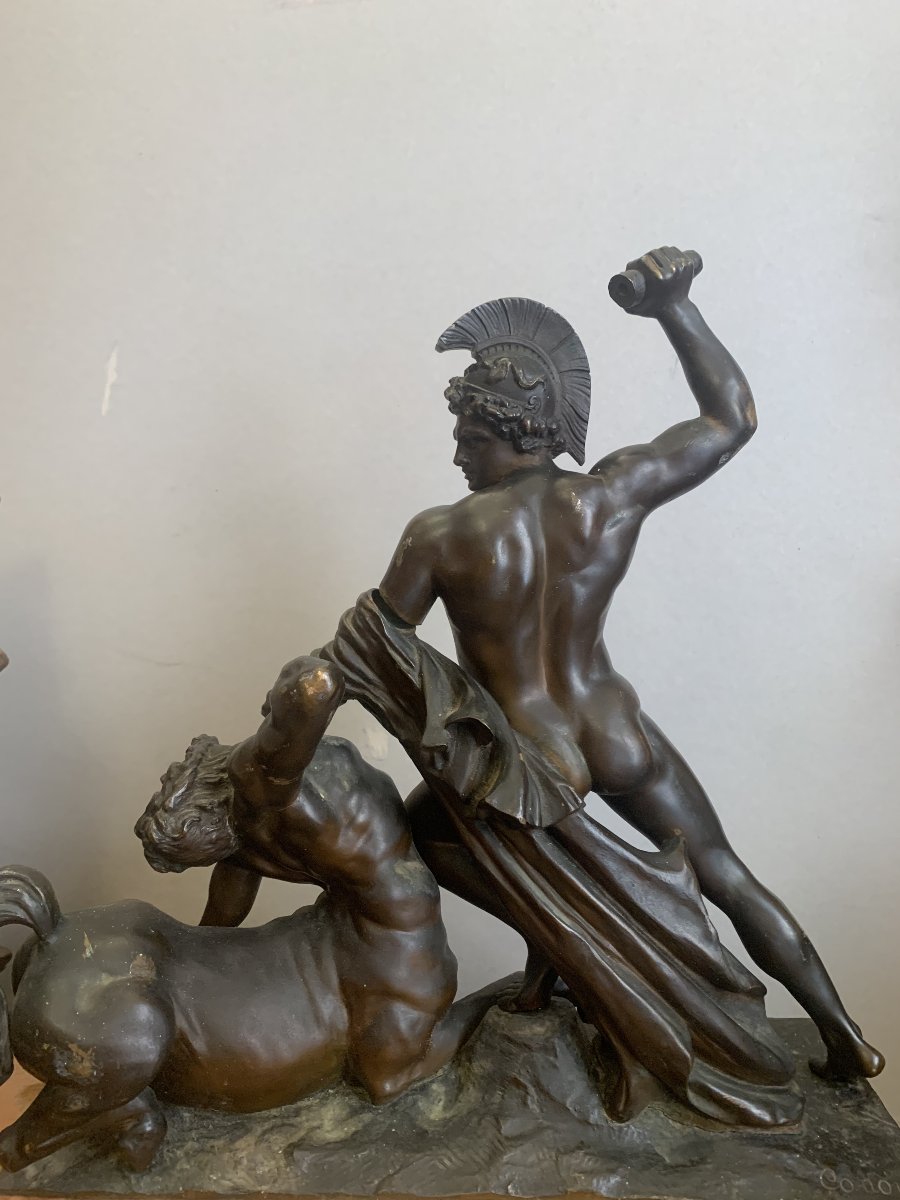
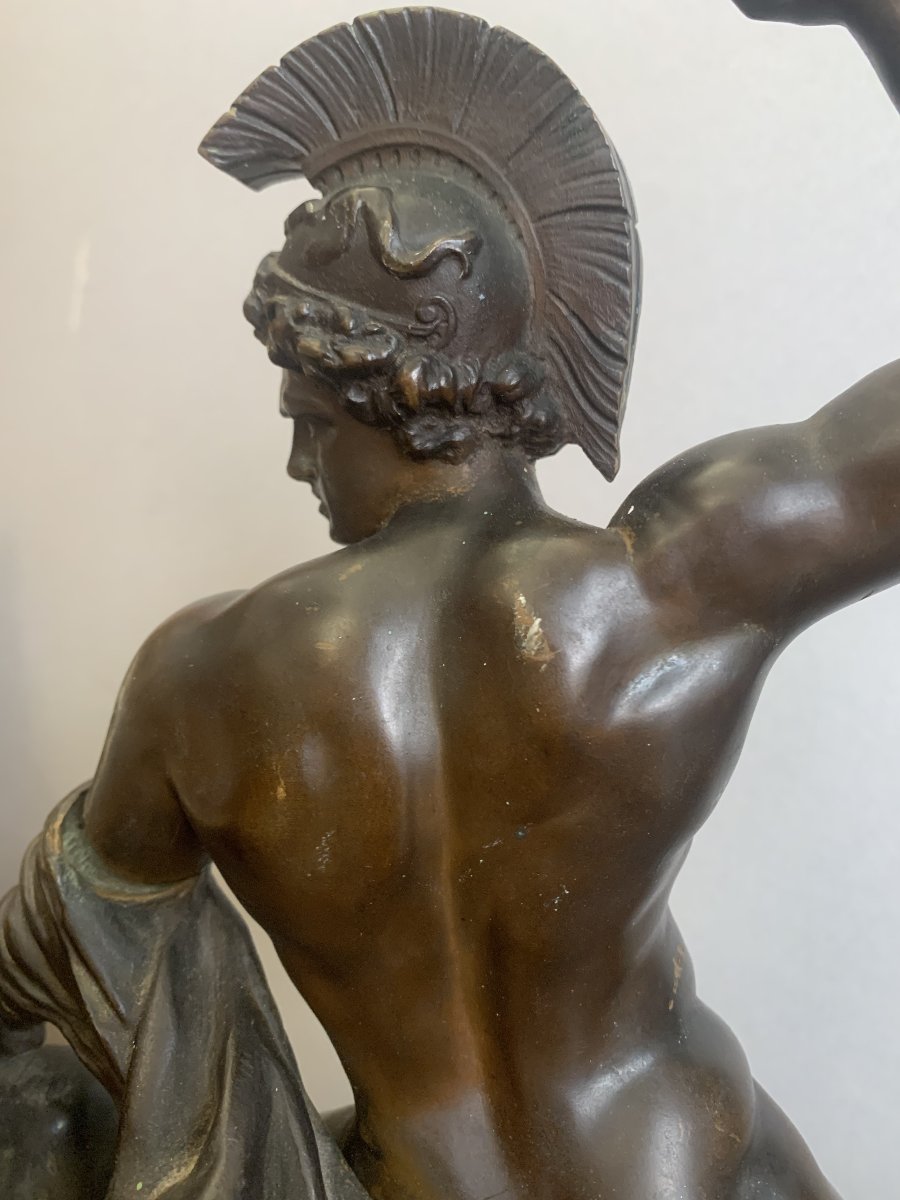


Canova - Theseus And The Centaur Phereus - Circa 1850. Bronze, Italy, Vienna. Neoclassical Style.
Canova - Theseus and the Centaur Pherae - circa 1850. Bronze, Italy, Vienna. Neoclassical style.
Theseus and the Centaur, also known as Theseus Fighting the Centaur or Theseus Triumphant over the Centaur[3], is a marble sculpture created by Antonio Canova in 1805 and housed at the Kunsthistorisches Museum in Vienna. This sculpture is stored in a vacuum-sealed environment at the Canova Gallery of Plaster Casts in Possagno.
History
The work was commissioned in 1804 by the Napoleonic Republic of Italy and dedicated to Napoleon Bonaparte[5]. The Viennese sculptural group appeared in the artist’s studio in Rome in March 1821, was published in September 1821, and was purchased by Emperor Francis I of Austria, along with Theseus (Temple of Theseus), for the Volksgarten in Vienna. The sculpture was transferred to the Kunsthistorisches Museum (Museum of Art History) in 1891.Some sketches of the work are preserved at the Canova Gallery of Plaster Casts in Possagno.
Description
Detail of Theseus.
The sculpture depicts the Greek hero Theseus about to deliver the fatal blow to Eurytion, the king of the centaurs. "Then I was called upon by hundreds of people to listen to Pirithous and Hippodamia. My Eurytion had to be freed, and I tried to kidnap Hippodamia." "But now, with my friends, I will face the centaur to save Hippodamia."[2] “This is what happens when you have complete control over the animal: first, the left hand grabs his throat, while the right holds a club with which he is about to strike him, and the knee presses against Eurytion’s chest.”[3] Eurytion, crouched on the ground, tries to get back up by pushing with his hind leg, his front legs immobilized. With his hand, he attempts to block Theseus’s left arm. Theseus’s guard remains motionless, without the slightest movement.
To capture the beast’s muscle contraction and the effort it is exerting, Antonio Canova had to use a real horse, mounted at a distance. He even went so far as to rivet the animal’s body to shape the statue.
The sculpture reveals a triangular shape on Theseus’s foot, on the centaur’s left hand, and on the top of the hero’s elm tree.
Theseus and the Centaur, also known as Theseus Fighting the Centaur or Theseus Triumphant over the Centaur[3], is a marble sculpture created by Antonio Canova in 1805 and housed at the Kunsthistorisches Museum in Vienna. This sculpture is stored in a vacuum-sealed environment at the Canova Gallery of Plaster Casts in Possagno.
History
The work was commissioned in 1804 by the Napoleonic Republic of Italy and dedicated to Napoleon Bonaparte[5]. The Viennese sculptural group appeared in the artist’s studio in Rome in March 1821, was published in September 1821, and was purchased by Emperor Francis I of Austria, along with Theseus (Temple of Theseus), for the Volksgarten in Vienna. The sculpture was transferred to the Kunsthistorisches Museum (Museum of Art History) in 1891.Some sketches of the work are preserved at the Canova Gallery of Plaster Casts in Possagno.
Description
Detail of Theseus.
The sculpture depicts the Greek hero Theseus about to deliver the fatal blow to Eurytion, the king of the centaurs. "Then I was called upon by hundreds of people to listen to Pirithous and Hippodamia. My Eurytion had to be freed, and I tried to kidnap Hippodamia." "But now, with my friends, I will face the centaur to save Hippodamia."[2] “This is what happens when you have complete control over the animal: first, the left hand grabs his throat, while the right holds a club with which he is about to strike him, and the knee presses against Eurytion’s chest.”[3] Eurytion, crouched on the ground, tries to get back up by pushing with his hind leg, his front legs immobilized. With his hand, he attempts to block Theseus’s left arm. Theseus’s guard remains motionless, without the slightest movement.
To capture the beast’s muscle contraction and the effort it is exerting, Antonio Canova had to use a real horse, mounted at a distance. He even went so far as to rivet the animal’s body to shape the statue.
The sculpture reveals a triangular shape on Theseus’s foot, on the centaur’s left hand, and on the top of the hero’s elm tree.
1 500 €
Period: 19th century
Style: Other Style
Condition: Excellent condition
Material: Bronze
Length: 33 cm
Height: 35 cm
Depth: 12 cm
Reference (ID): 1769640
Availability: In stock
Print