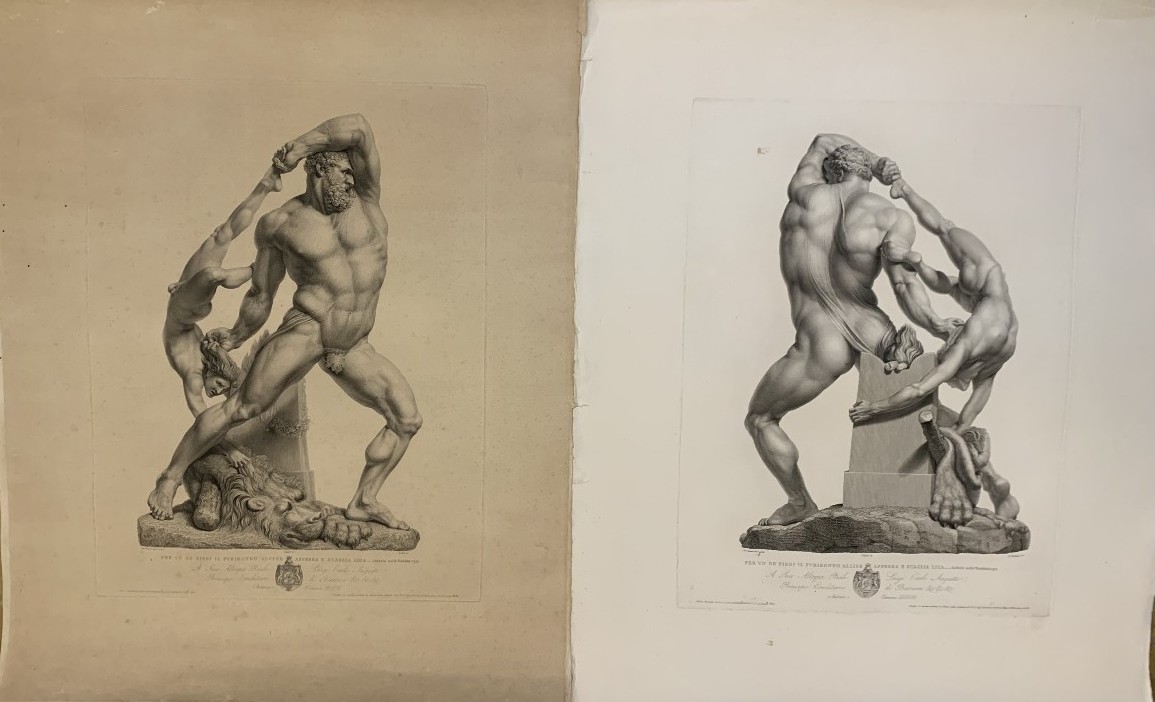
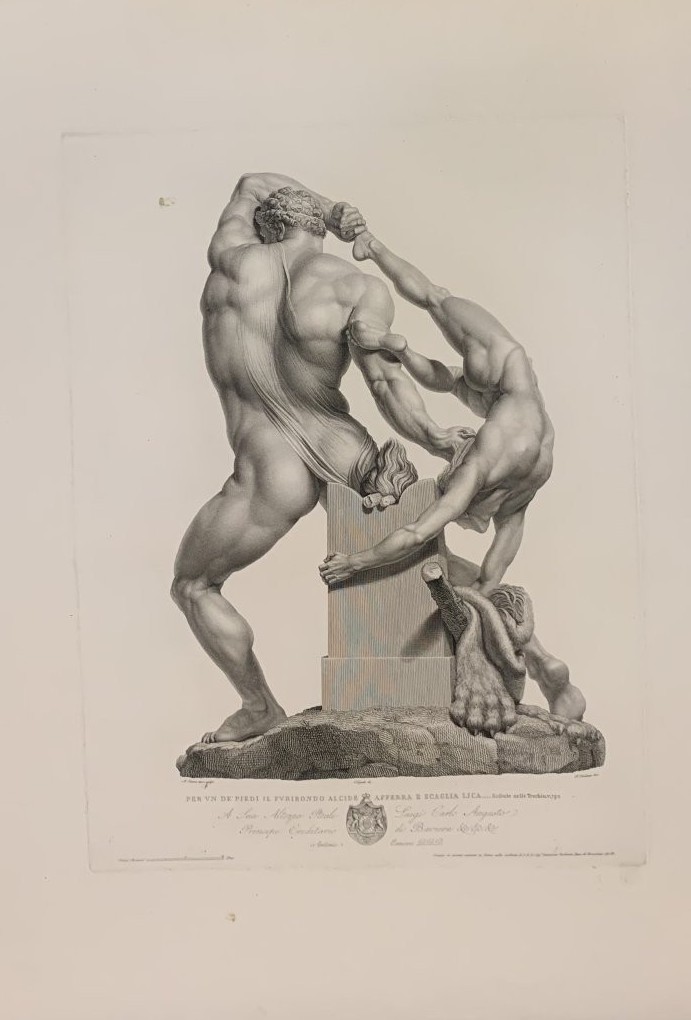

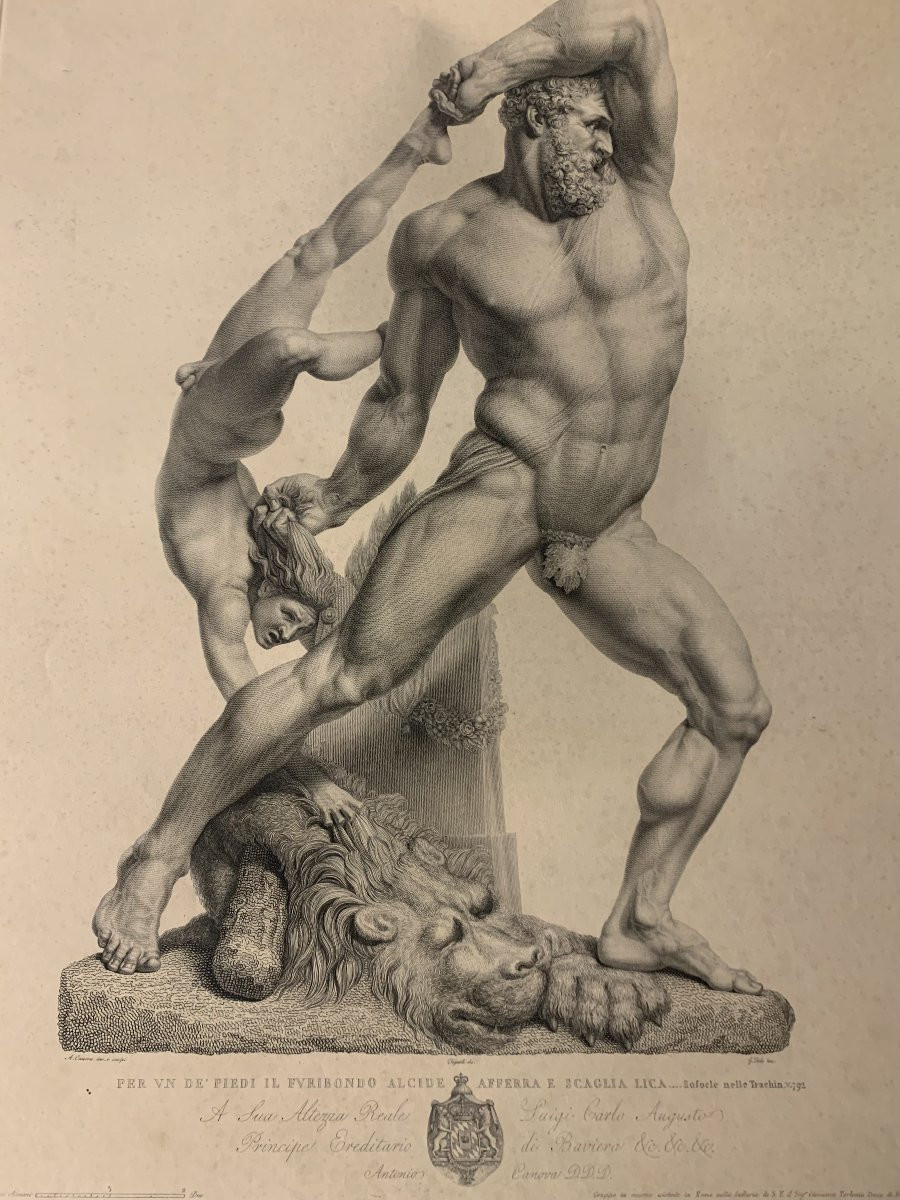
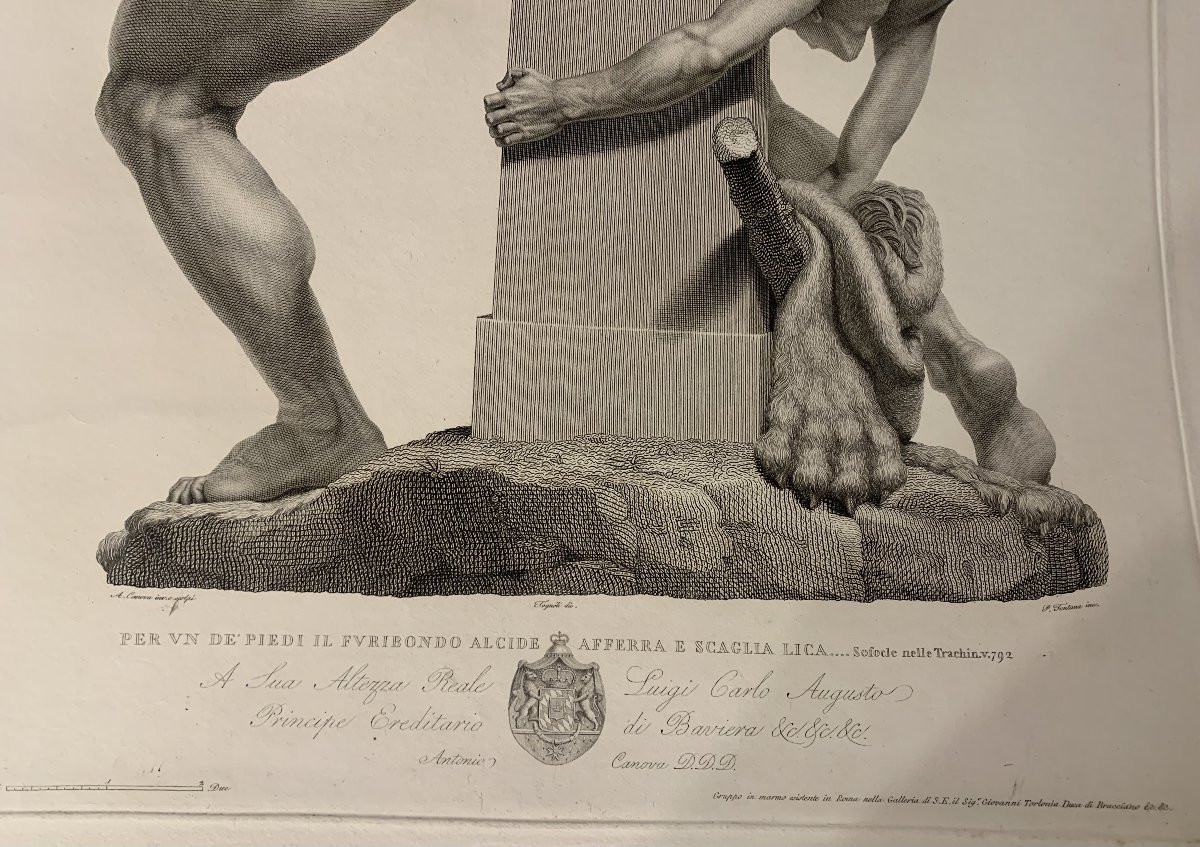
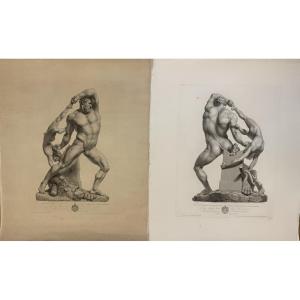


Canova - Hercules And Lichas - Fontana Engraver - Ca. 1820 2 Etchings Of Male Nudes - Italy
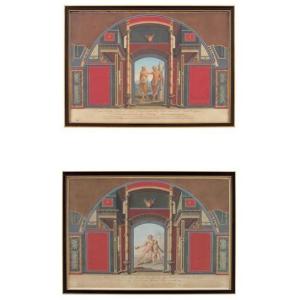
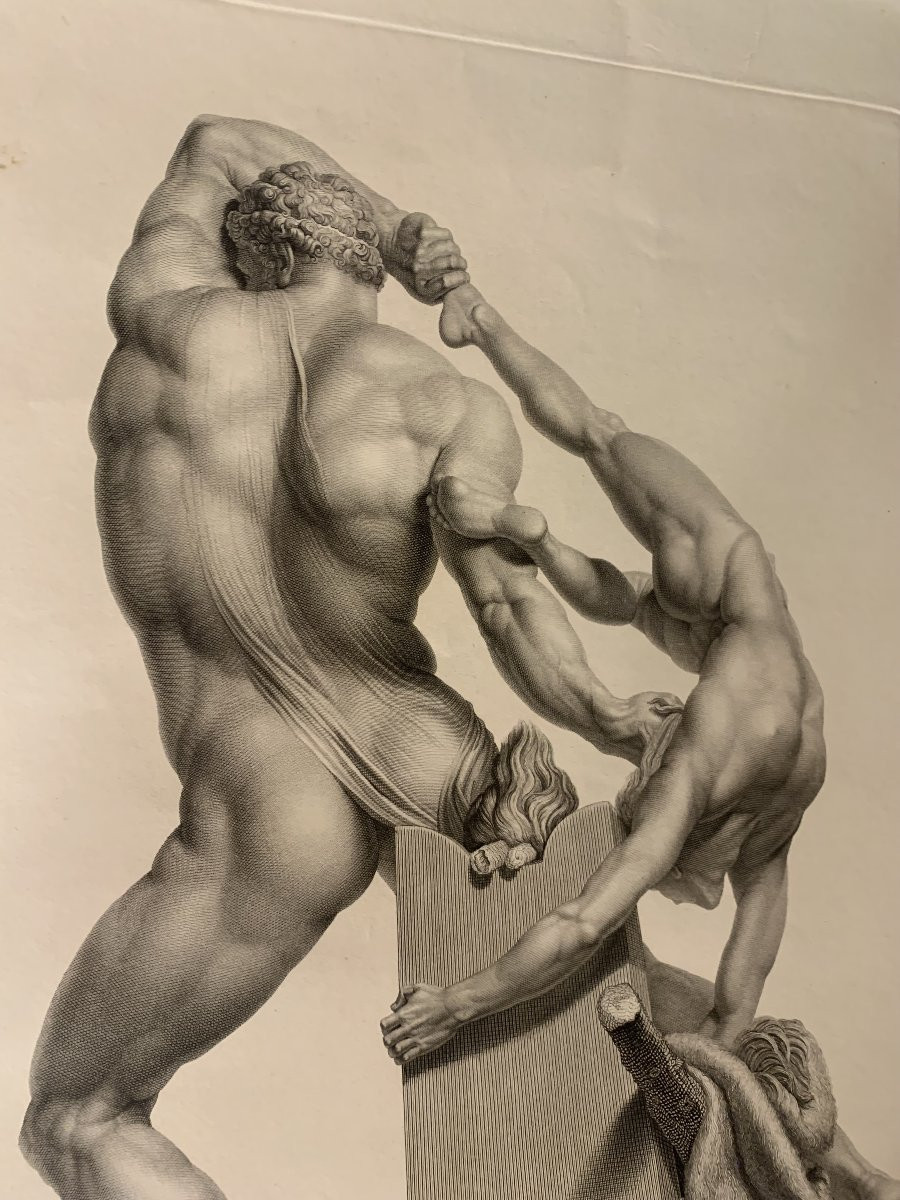
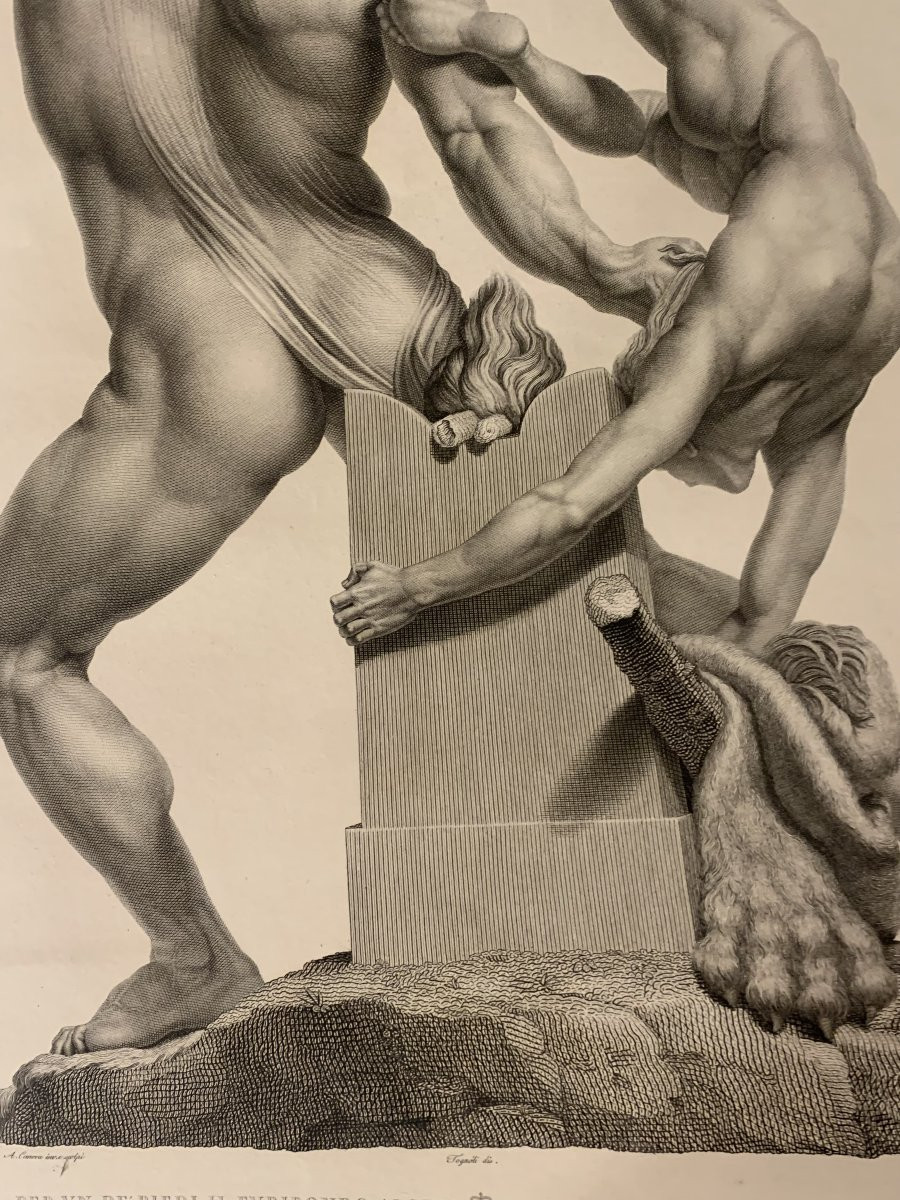
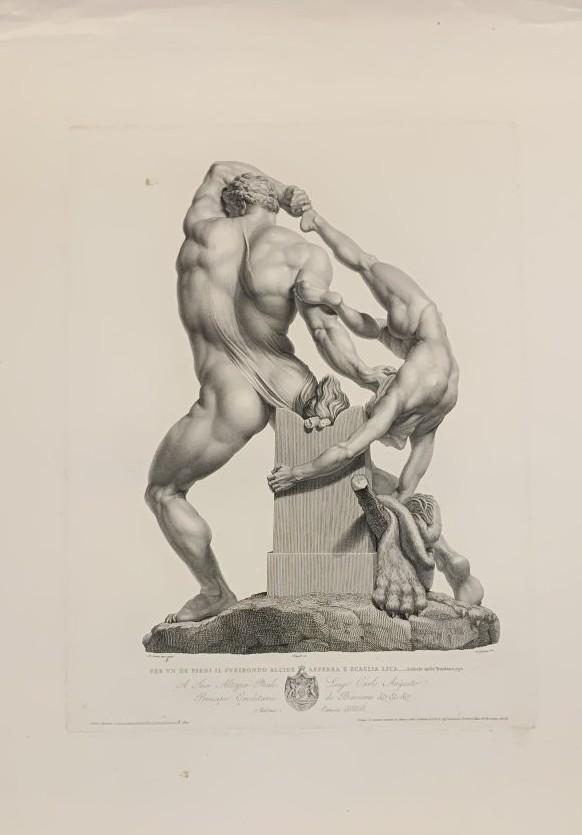
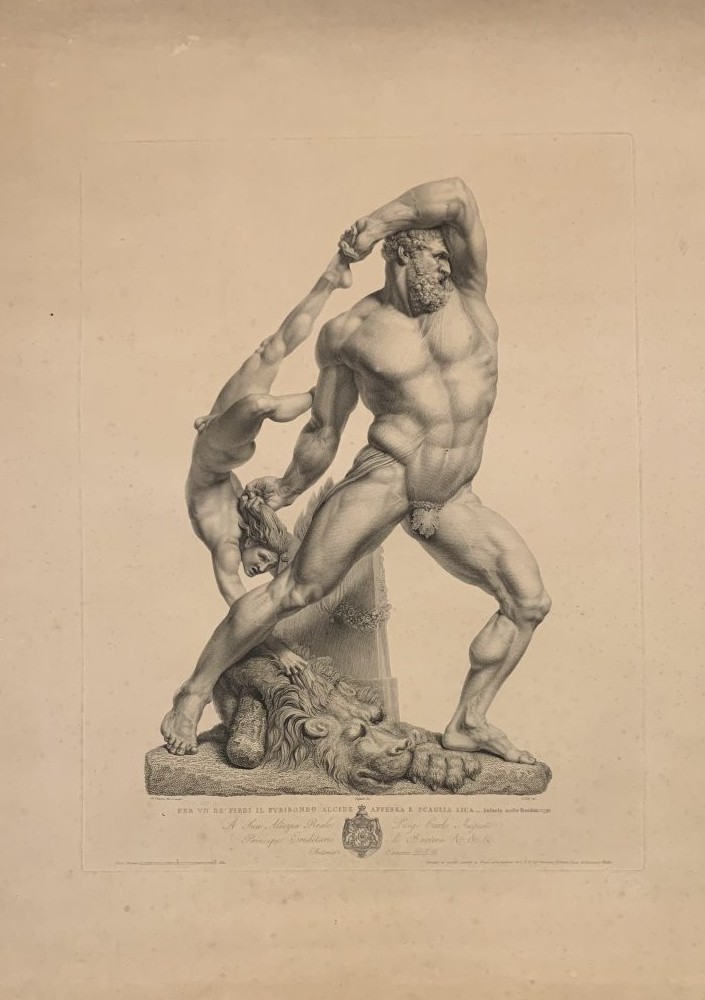
Canova - Hercules and Lichas - Fontana engraver - ca. 1820
2 Etchings of male nudes
One of the two is burnished but easily restorable
Hercules and Lichas is a marble sculptural group created by Antonio Canova between 1795 and 1815 and housed at the Galleria Nazionale d'Arte Moderna in Rome. The plaster cast of this work is housed at the Canova Gipsoteca in Possagno.
Current location: Galleria Nazionale d'Arte Moderna e Contemporanea
The work was commissioned by Onorato Gaetani dei Principi d'Aragona, a distinguished admirer of the Adonis and Venus group, an earlier work by the artist purchased by Marquis Francesco Berio, who placed it in Naples in a small temple specially built in the garden of his palace on Via Toledo. It was admiring this cast that the noble patron decided to commission Canova to create the marble Hercules and Lichas in March 1795.
The sculpture depicts a well-known episode from Greek mythology. Hercules, driven mad by the pain caused by his tunic soaked in the poisoned blood of the centaur Nessus, hurled the young herald Lichas into the air, who, unknowingly, had delivered it to him on the orders of Deianira.
Interrupted and resumed several times, the statue was left in a state of neglect following the harsh political events that engulfed Naples with the arrival of the French. The prince himself withdrew the commission, and after various vicissitudes, the work was purchased by the well-known Roman banker Giovanni Raimondo Torlonia in 1800. The year before, the city of Verona had asked the sculptor for a work that would celebrate the victory of the battle of April 5, 1799, against the French troops. Canova responded that he could not add any further commissions, but proposed the monument of Hercules and Lichas, the latter easily identifiable with France. The monument was to be placed in Piazza Bra, but Emperor Francis II of Habsburg-Lorraine refused to allow it, lest it further burden his people's coffers. The marble group was finally completed in 1815, the year in which the owner placed it in an exedra of his palace and illuminated it with overhead light.
At the time of its first exhibition, Hercules and Lichas was an immediate success, but subsequent critics criticized the work, identifying patterns of academic execution lacking true emotional involvement.
Description
Hercules and Lichas, detail of Lichas's terrified face.
The sculptural group follows absolute geometric precision. The hero appears in a moment of maximum muscular tension, caught in the act of lifting the unfortunate boy's foot. The boy resists in vain, clinging to the altar behind the hero and the lion's skin abandoned at his feet. Lichas appears forcefully lifted from the ground and suspended in the air just before being hurled into the sea.
The group, with the arched twist of the two naked bodies, exudes a great energetic intensity, culminating in the youth's screaming face and the angry features of Hercules, framed by a thick beard of curls. The hero appears completely naked except for the very thin veil Canova used to cover his muscular mass.
The Inspiration
The work derives from Canova's careful study of several famous ancient marbles, such as the Colossi of the Quirinale, the Farnese Hercules, and the celebrated Hellenistic group of the Laocoön in the Vatican; Furthermore, it cannot be ruled out that he carefully studied the group of Achilles and Troilus (also known as Athamas and Learchus), housed at the National Archaeological Museum of Naples.
The French interpreted this work as an allusion to France overthrowing the monarchy; but in Canova's works, unlike David's, there is no ideological reference, nor did the artist make any effort to identify any.
2 Etchings of male nudes
One of the two is burnished but easily restorable
Hercules and Lichas is a marble sculptural group created by Antonio Canova between 1795 and 1815 and housed at the Galleria Nazionale d'Arte Moderna in Rome. The plaster cast of this work is housed at the Canova Gipsoteca in Possagno.
Current location: Galleria Nazionale d'Arte Moderna e Contemporanea
The work was commissioned by Onorato Gaetani dei Principi d'Aragona, a distinguished admirer of the Adonis and Venus group, an earlier work by the artist purchased by Marquis Francesco Berio, who placed it in Naples in a small temple specially built in the garden of his palace on Via Toledo. It was admiring this cast that the noble patron decided to commission Canova to create the marble Hercules and Lichas in March 1795.
The sculpture depicts a well-known episode from Greek mythology. Hercules, driven mad by the pain caused by his tunic soaked in the poisoned blood of the centaur Nessus, hurled the young herald Lichas into the air, who, unknowingly, had delivered it to him on the orders of Deianira.
Interrupted and resumed several times, the statue was left in a state of neglect following the harsh political events that engulfed Naples with the arrival of the French. The prince himself withdrew the commission, and after various vicissitudes, the work was purchased by the well-known Roman banker Giovanni Raimondo Torlonia in 1800. The year before, the city of Verona had asked the sculptor for a work that would celebrate the victory of the battle of April 5, 1799, against the French troops. Canova responded that he could not add any further commissions, but proposed the monument of Hercules and Lichas, the latter easily identifiable with France. The monument was to be placed in Piazza Bra, but Emperor Francis II of Habsburg-Lorraine refused to allow it, lest it further burden his people's coffers. The marble group was finally completed in 1815, the year in which the owner placed it in an exedra of his palace and illuminated it with overhead light.
At the time of its first exhibition, Hercules and Lichas was an immediate success, but subsequent critics criticized the work, identifying patterns of academic execution lacking true emotional involvement.
Description
Hercules and Lichas, detail of Lichas's terrified face.
The sculptural group follows absolute geometric precision. The hero appears in a moment of maximum muscular tension, caught in the act of lifting the unfortunate boy's foot. The boy resists in vain, clinging to the altar behind the hero and the lion's skin abandoned at his feet. Lichas appears forcefully lifted from the ground and suspended in the air just before being hurled into the sea.
The group, with the arched twist of the two naked bodies, exudes a great energetic intensity, culminating in the youth's screaming face and the angry features of Hercules, framed by a thick beard of curls. The hero appears completely naked except for the very thin veil Canova used to cover his muscular mass.
The Inspiration
The work derives from Canova's careful study of several famous ancient marbles, such as the Colossi of the Quirinale, the Farnese Hercules, and the celebrated Hellenistic group of the Laocoön in the Vatican; Furthermore, it cannot be ruled out that he carefully studied the group of Achilles and Troilus (also known as Athamas and Learchus), housed at the National Archaeological Museum of Naples.
The French interpreted this work as an allusion to France overthrowing the monarchy; but in Canova's works, unlike David's, there is no ideological reference, nor did the artist make any effort to identify any.
2 000 €
Period: 19th century
Style: Other Style
Condition: Good condition
Material: Paper
Length: 46 cm
Height: 60 cm
Reference (ID): 1741562
Availability: In stock
Print