

China - Dagger-axe
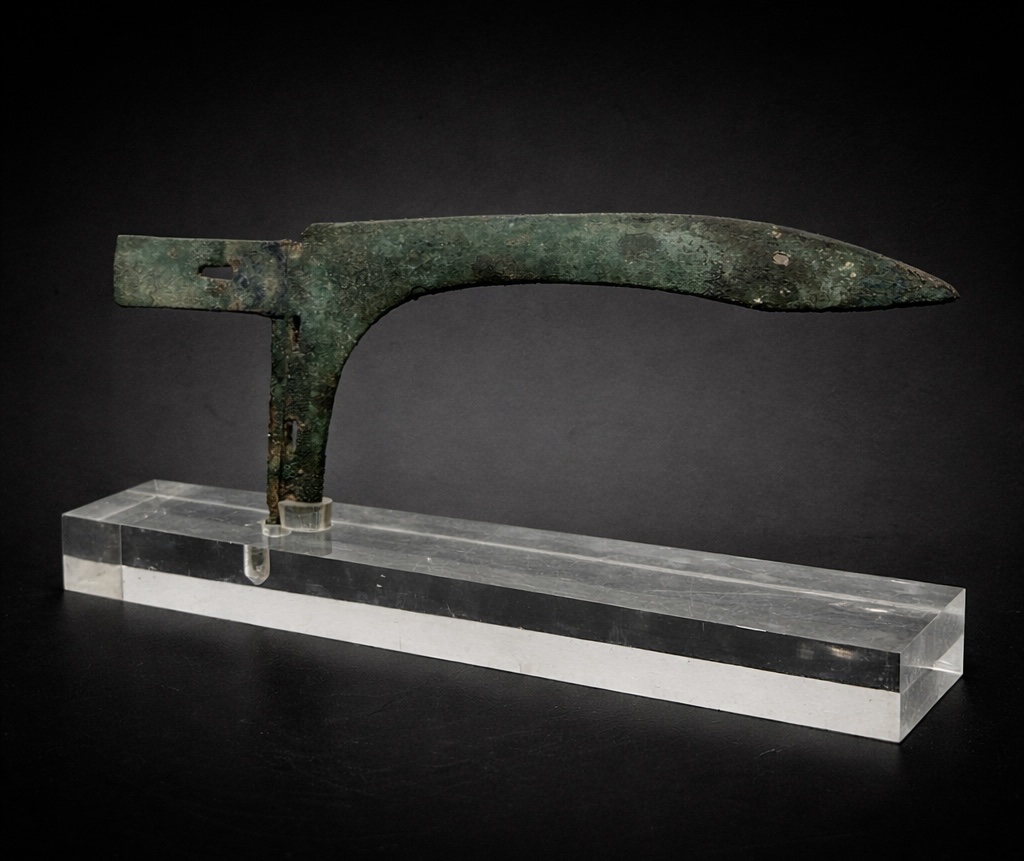
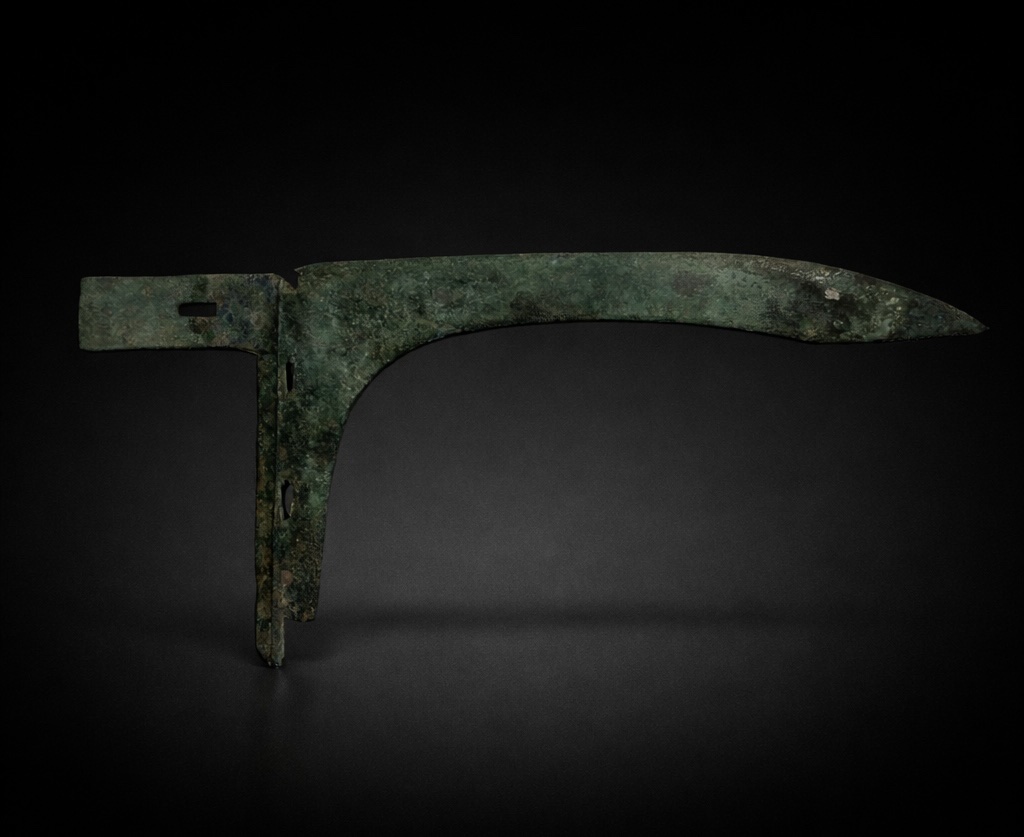
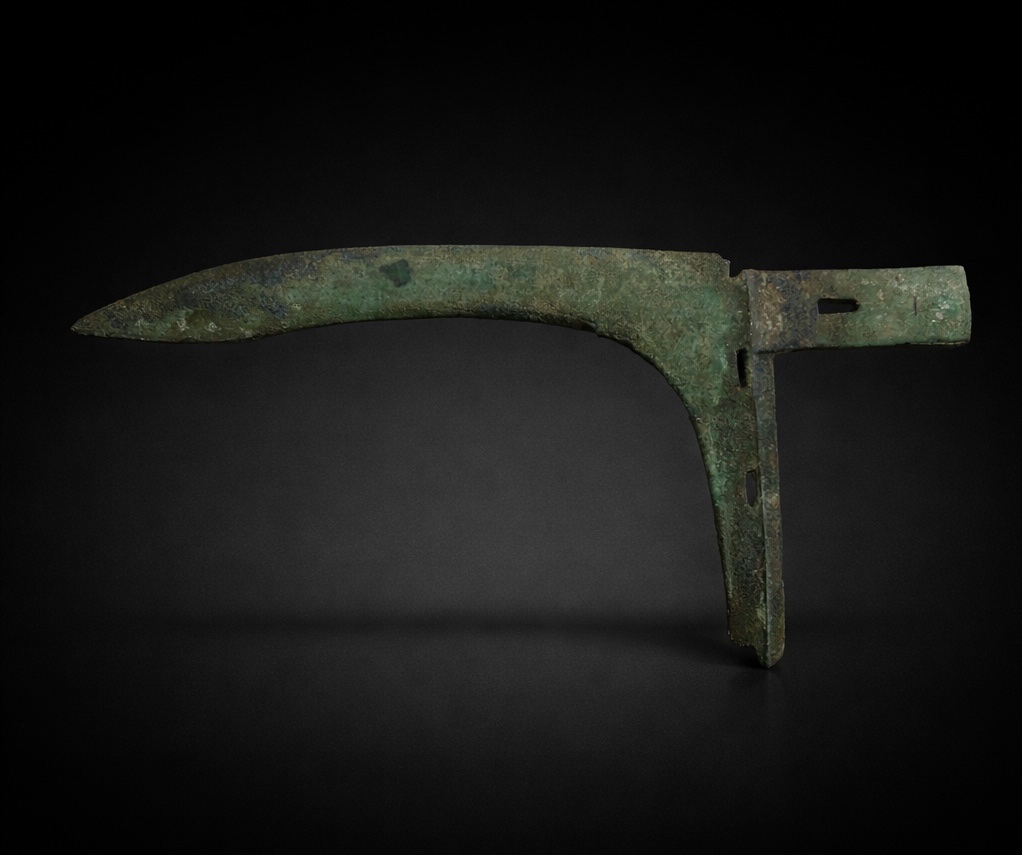
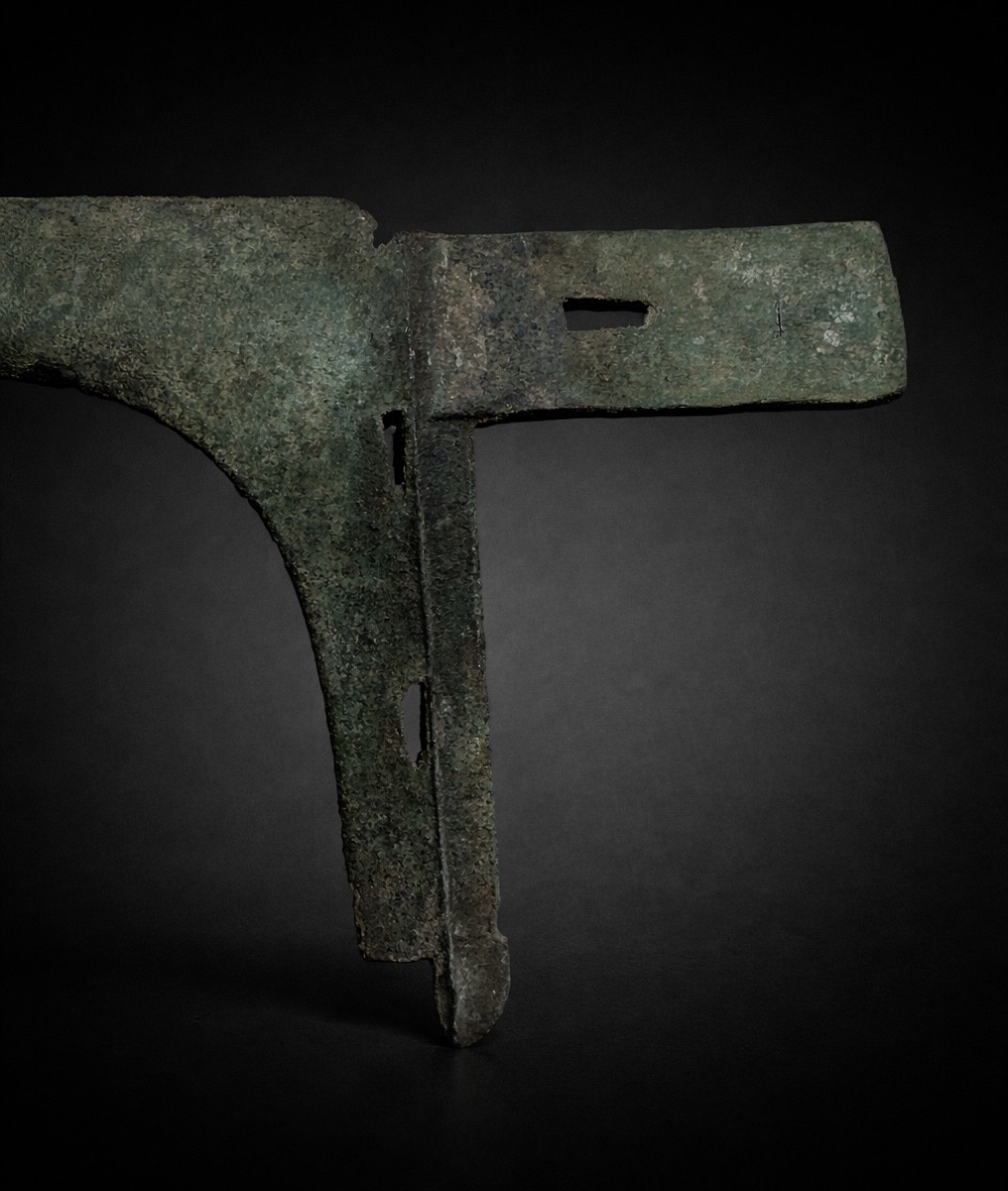
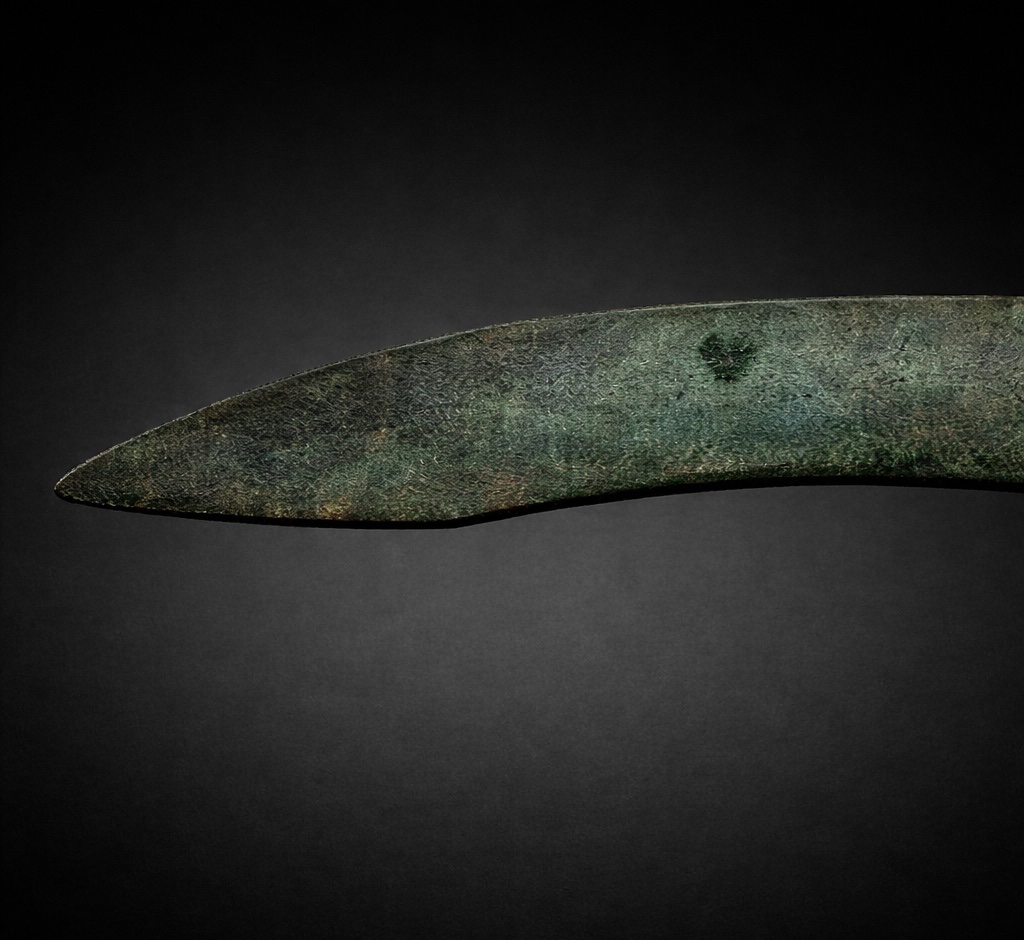
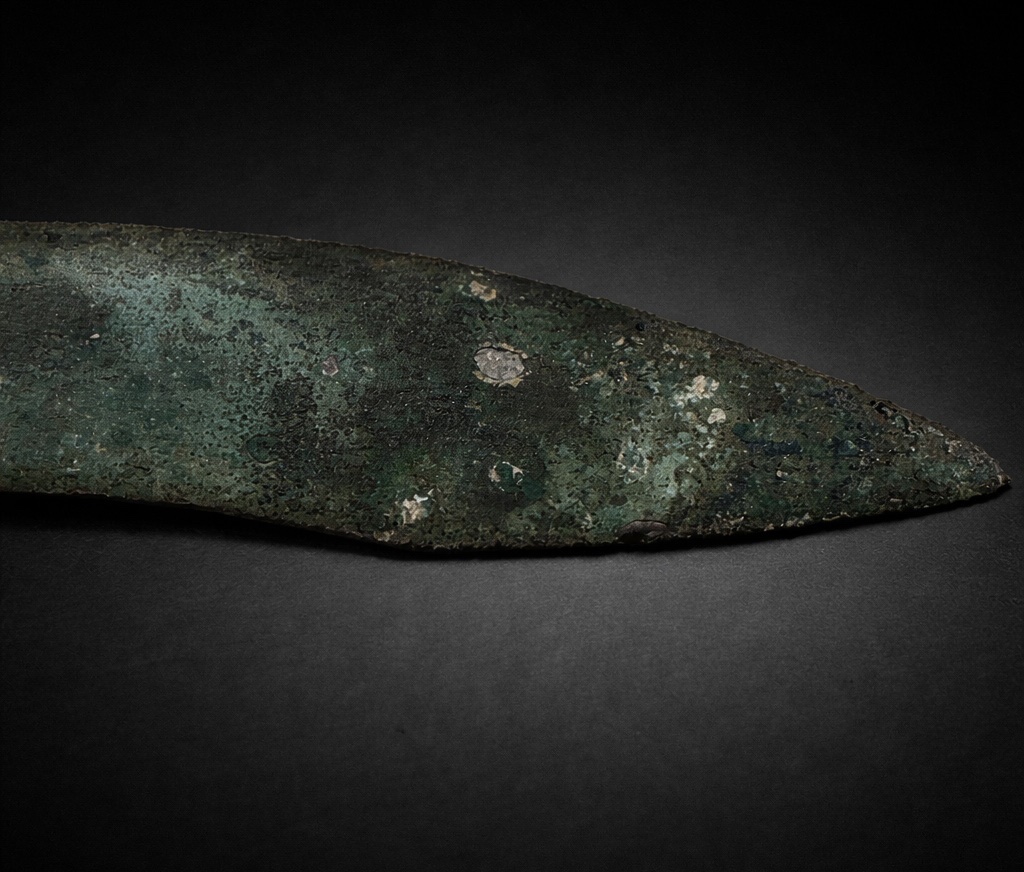
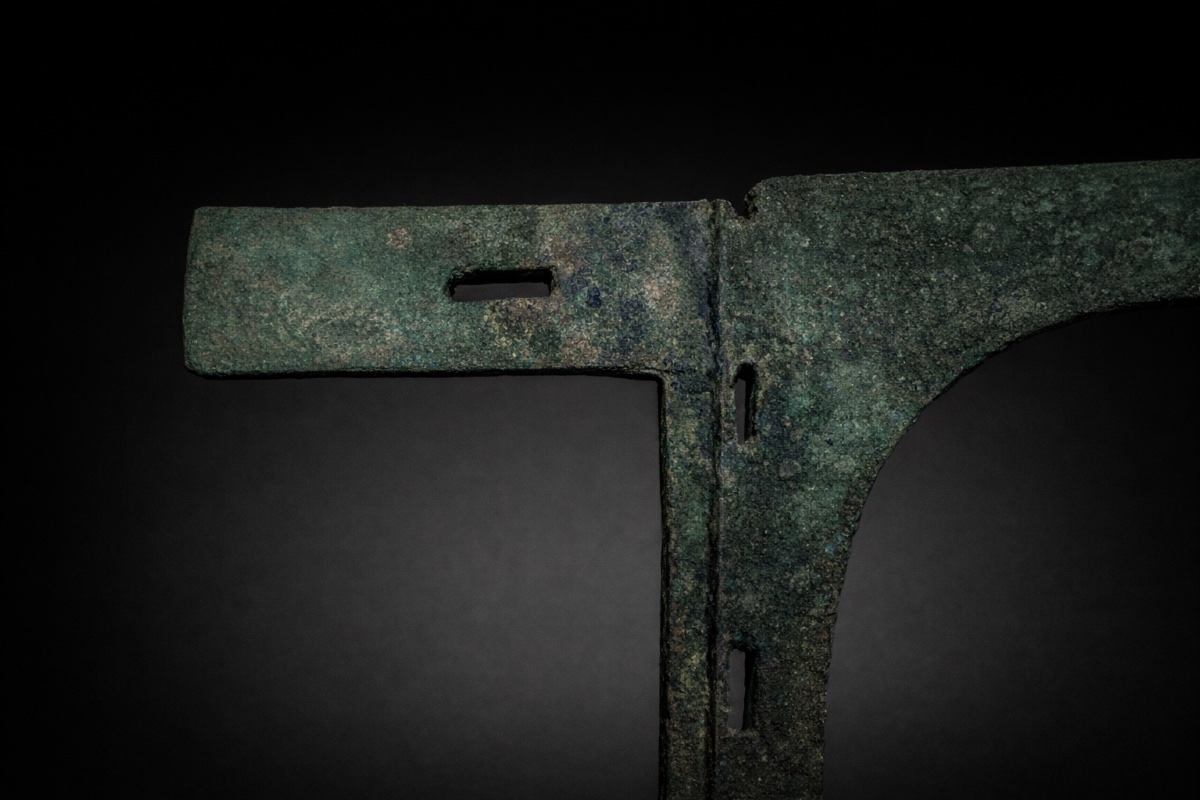
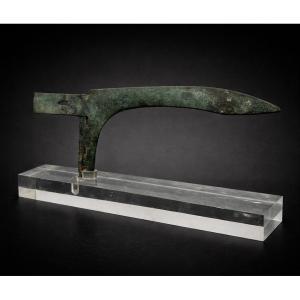
This dagger-axe head is a classic example of the weaponry of ancient China, a period when bronze reached a peak of technical mastery. The Ge was the weapon par excellence of elite troops, attached perpendicularly to a long shaft. The blade (yuan) has an elegant downward curve, tapering to a tapering point that is still very well preserved. The descending vertical part (hu) and rectangular heel (nei) are fitted with horizontal and vertical lacing slots, essential for ensuring the head's stability on its wooden handle during impacts. The object is covered with a deep green "malachite" patina, dotted with brown sedimentary concretions and natural crusty oxidations. This mineralization attests to a long stay in an archaeological context. The structure of the bronze remains sound despite erosion of the cutting edges. Its dimensions of 27.5 cm make it a very important piece. More common models often measure between 18 and 22 cm. The clarity of the lacing cracks here increases its documentary interest.
"Macro" surface analysis:On a bronze of this age (around 2,300 years), the surface is no longer metal, but a succession of complex mineral layers. Here are details of the visible deposits and patinas, which constitute veritable visual certificates of authenticity: The "Malachite" Patina (The dominant green), this is the layer of basic copper carbonate. Deep, matte green, sometimes finely grained. It indicates prolonged residence in an aerated, moist soil. Unlike false patinas (paint or rapid acids), this one is one with the metal. It is "crusty" (known as noble patina), meaning that it has replaced the bronze's original surface through a process of slow mineralization. Azurite (Dark blue dots), near the heel (nei), very dark blue chips. Deep blue crystals, often associated with green. It's the "grail" of the archaeological bronze collector. Azurite only forms under very specific carbonation conditions and over an extremely long period of time. Its presence is a huge marker of antiquity. Cuprite Concretions (The underlying red/brown), beneath the green, we see reddish-brown areas. Copper oxide (Cu2O) that forms in direct contact with the remaining metal core. This is the transition layer. In blade chips, seeing this red beneath the green confirms the stratified structure of the corrosion. A copy will often have only one layer of surface color. Sedimentary Deposits (The ochre/beige areas). These are the remains of the excavated soil (silica, clay, limestone). Hard, almost stony concretions, embedded in the lacing slots and on the blade flats. We can clearly see that these deposits are "amalgamated" with the corrosion of the bronze. They are not simply laid on top (like dried mud), but chemically welded to the metal over time. This is called a "gangue".
Origin:China
Era:Eastern Zhou Dynasty (770-256 BC) / Warring Kingdoms Period (474-221 BC)
Dimensions:Length: 27.5 cm | Height: 12 cm (excluding base)
Conditions:Mineralization attests to a long stay in an archaeological context. The bronze structure remains sound despite erosion of the cutting edges. Provenance:Private Belgian collection.
"Macro" surface analysis:On a bronze of this age (around 2,300 years), the surface is no longer metal, but a succession of complex mineral layers. Here are details of the visible deposits and patinas, which constitute veritable visual certificates of authenticity: The "Malachite" Patina (The dominant green), this is the layer of basic copper carbonate. Deep, matte green, sometimes finely grained. It indicates prolonged residence in an aerated, moist soil. Unlike false patinas (paint or rapid acids), this one is one with the metal. It is "crusty" (known as noble patina), meaning that it has replaced the bronze's original surface through a process of slow mineralization. Azurite (Dark blue dots), near the heel (nei), very dark blue chips. Deep blue crystals, often associated with green. It's the "grail" of the archaeological bronze collector. Azurite only forms under very specific carbonation conditions and over an extremely long period of time. Its presence is a huge marker of antiquity. Cuprite Concretions (The underlying red/brown), beneath the green, we see reddish-brown areas. Copper oxide (Cu2O) that forms in direct contact with the remaining metal core. This is the transition layer. In blade chips, seeing this red beneath the green confirms the stratified structure of the corrosion. A copy will often have only one layer of surface color. Sedimentary Deposits (The ochre/beige areas). These are the remains of the excavated soil (silica, clay, limestone). Hard, almost stony concretions, embedded in the lacing slots and on the blade flats. We can clearly see that these deposits are "amalgamated" with the corrosion of the bronze. They are not simply laid on top (like dried mud), but chemically welded to the metal over time. This is called a "gangue".
Origin:China
Era:Eastern Zhou Dynasty (770-256 BC) / Warring Kingdoms Period (474-221 BC)
Dimensions:Length: 27.5 cm | Height: 12 cm (excluding base)
Conditions:Mineralization attests to a long stay in an archaeological context. The bronze structure remains sound despite erosion of the cutting edges. Provenance:Private Belgian collection.
2 000 €
Period: Before 16th century
Style: Asian art
Condition: Good condition
Material: Bronze
Length: 27,5 cm
Height: 12 cm
Reference (ID): 1768676
Availability: In stock
Print