


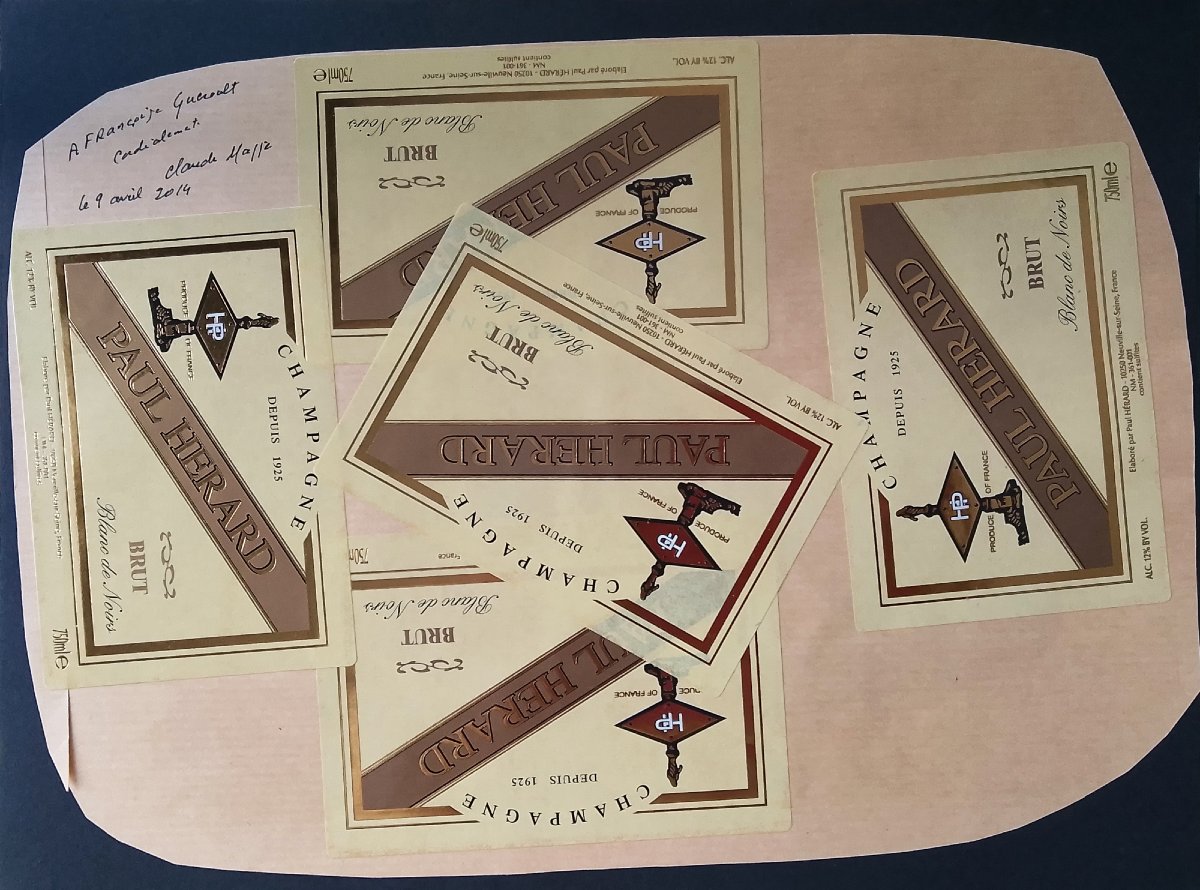
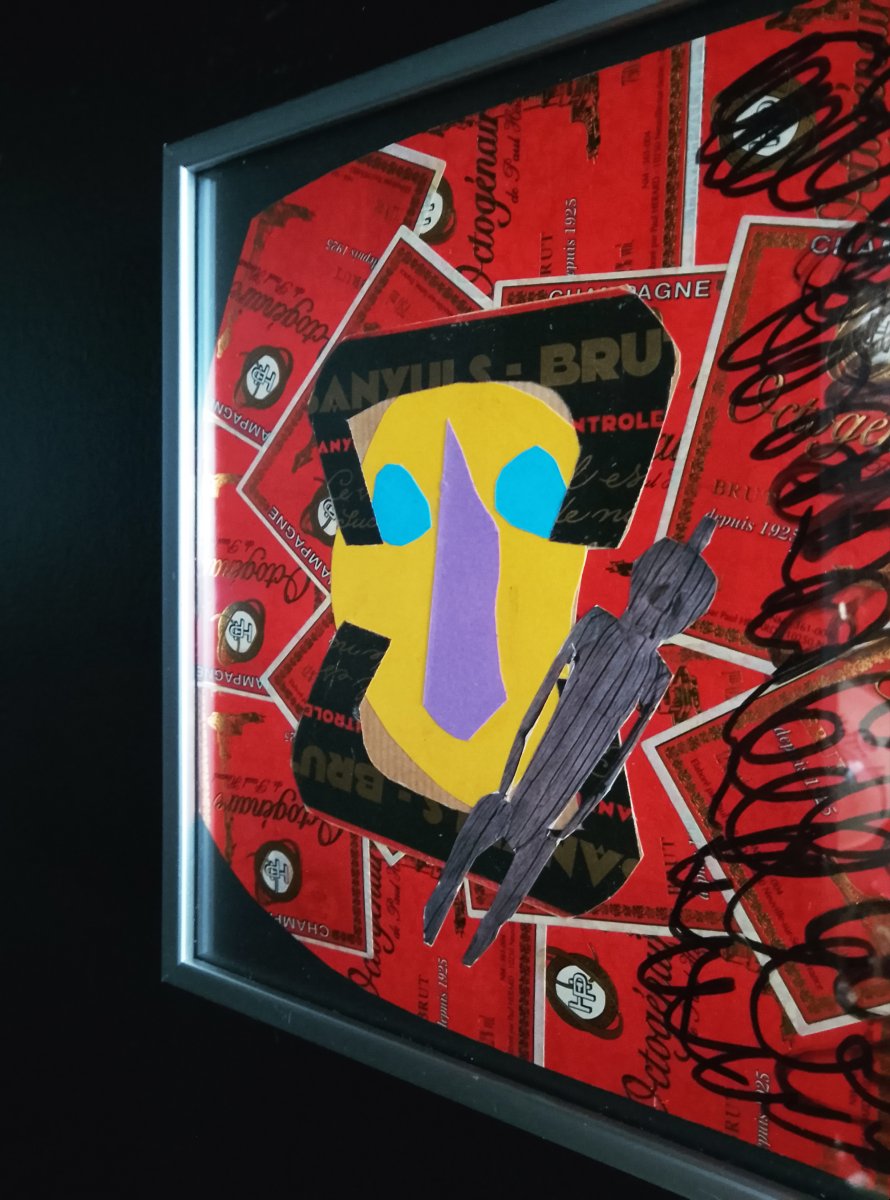


Collage By Claude Massé ( 1934 - 2017 ).
Artist: Claude Massé ( 1934 - 2017 ).
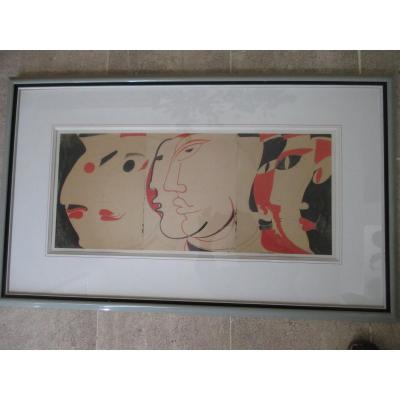
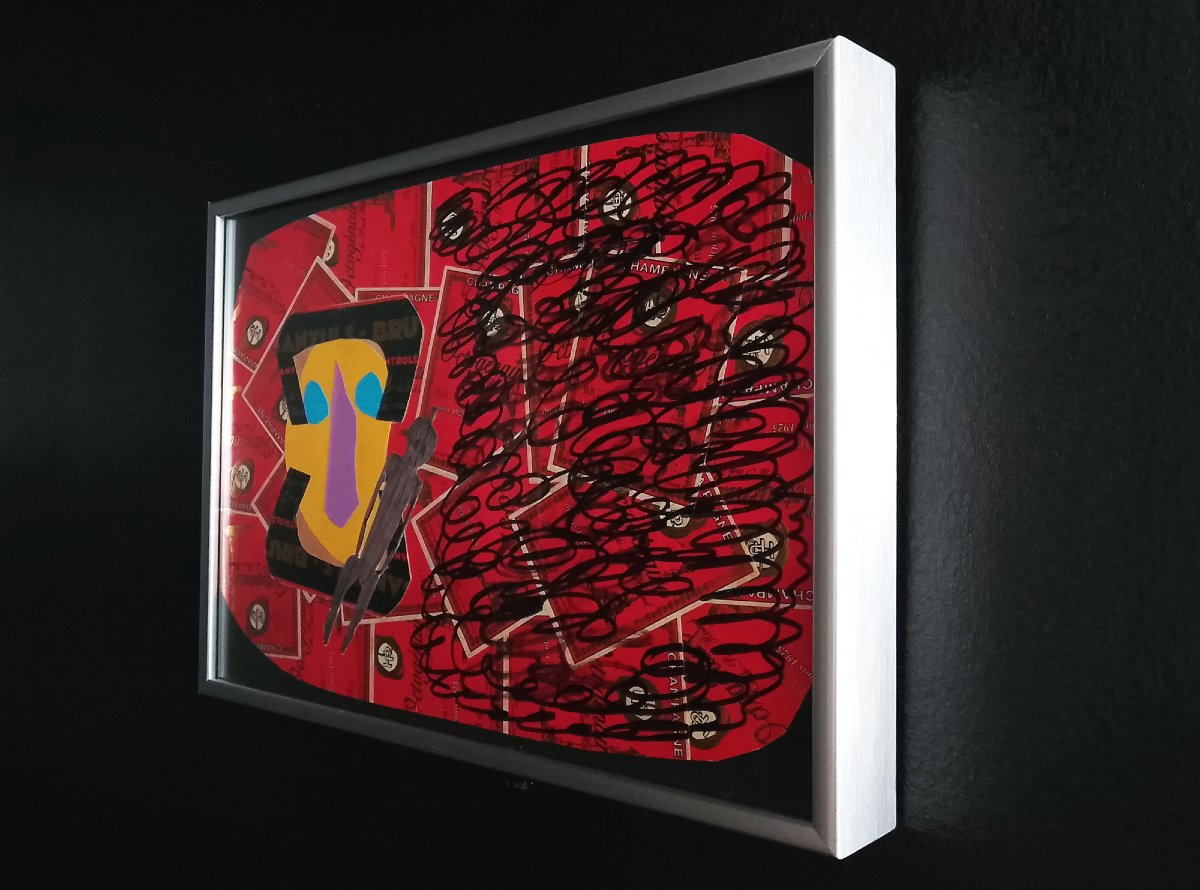
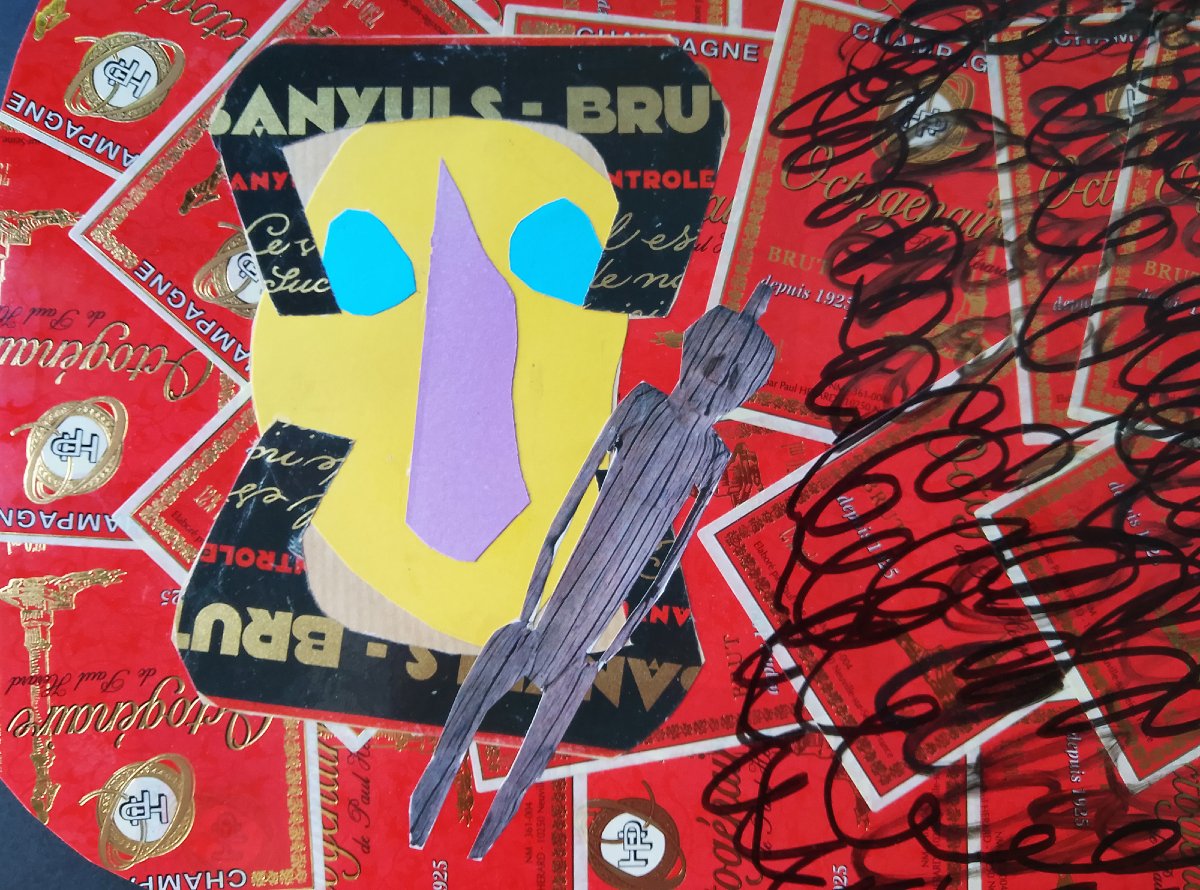
Made with 22 labels from Maison champenoise Octogénaire,
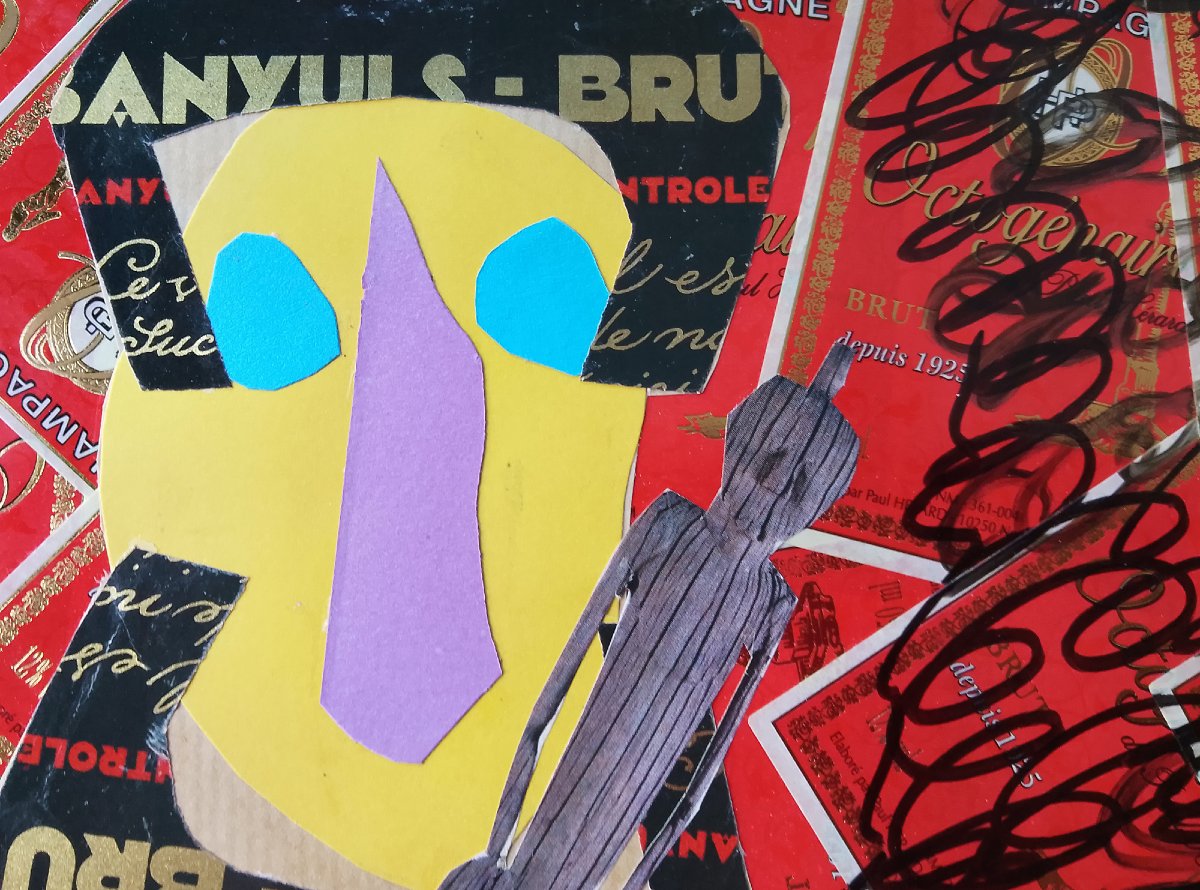
2 labels from BanyulsBrut, several cut-outs forming a stylized face,
a cut-out of an African statuettestatuette.
Important scribbling in black felt pen.
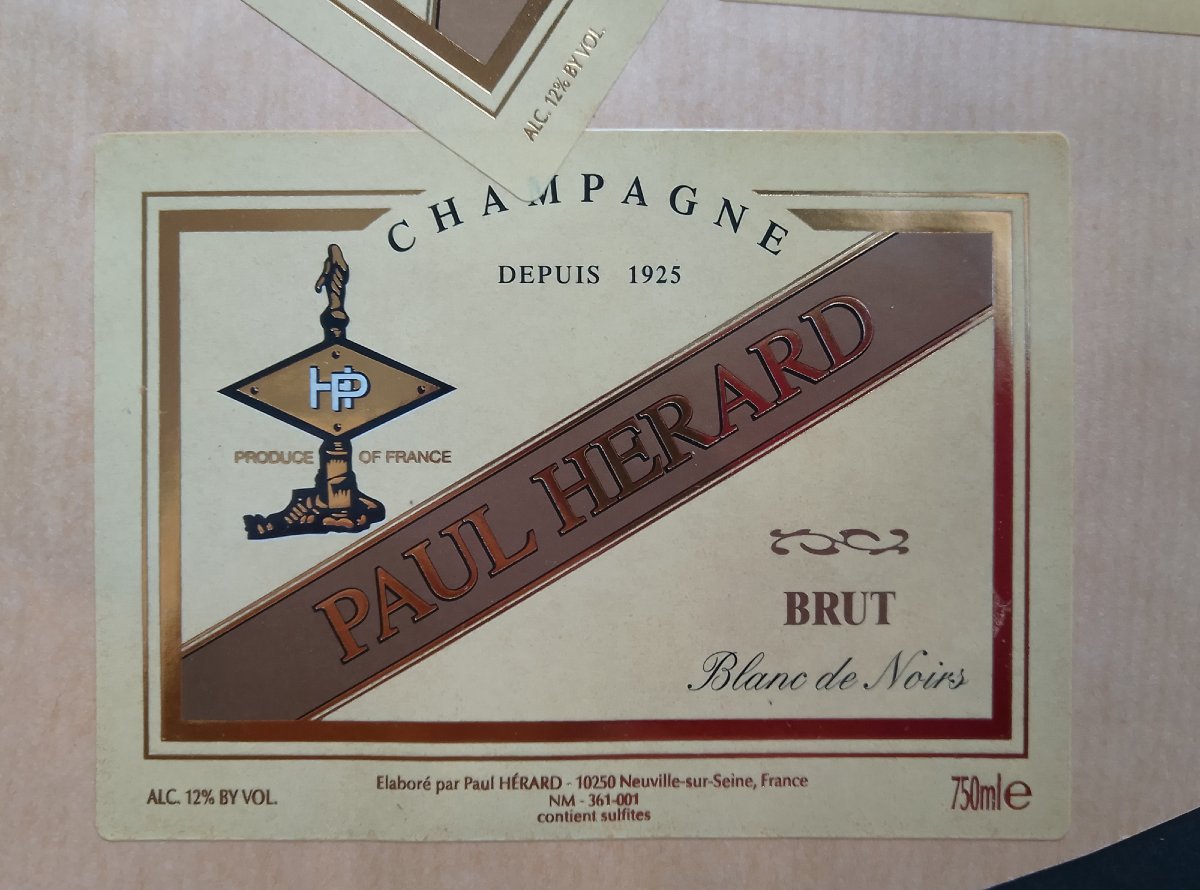
On the back: 5 labels from Maison champenoise Hérard.
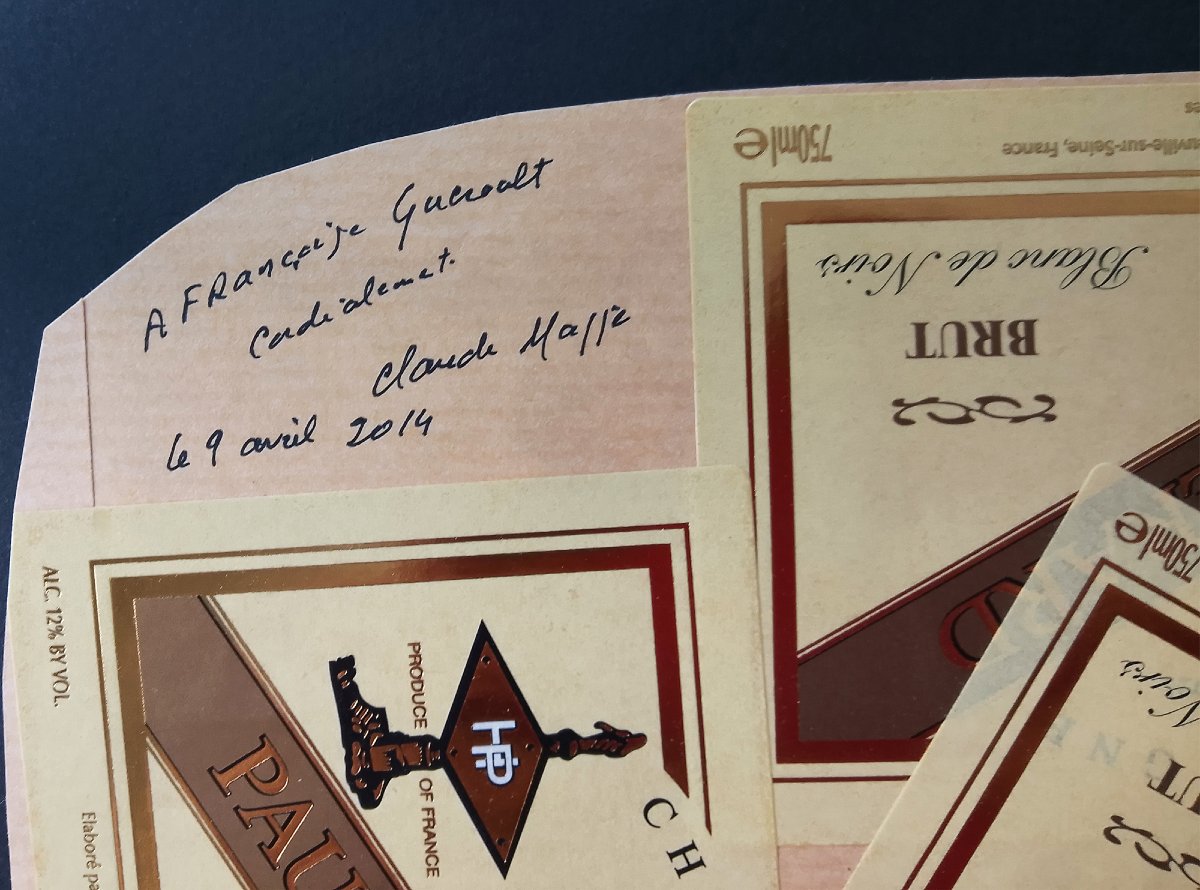
Dedicated, signed and dated April 9, 2014.
Maximum dimensions: 29.7 cm x 21cm.
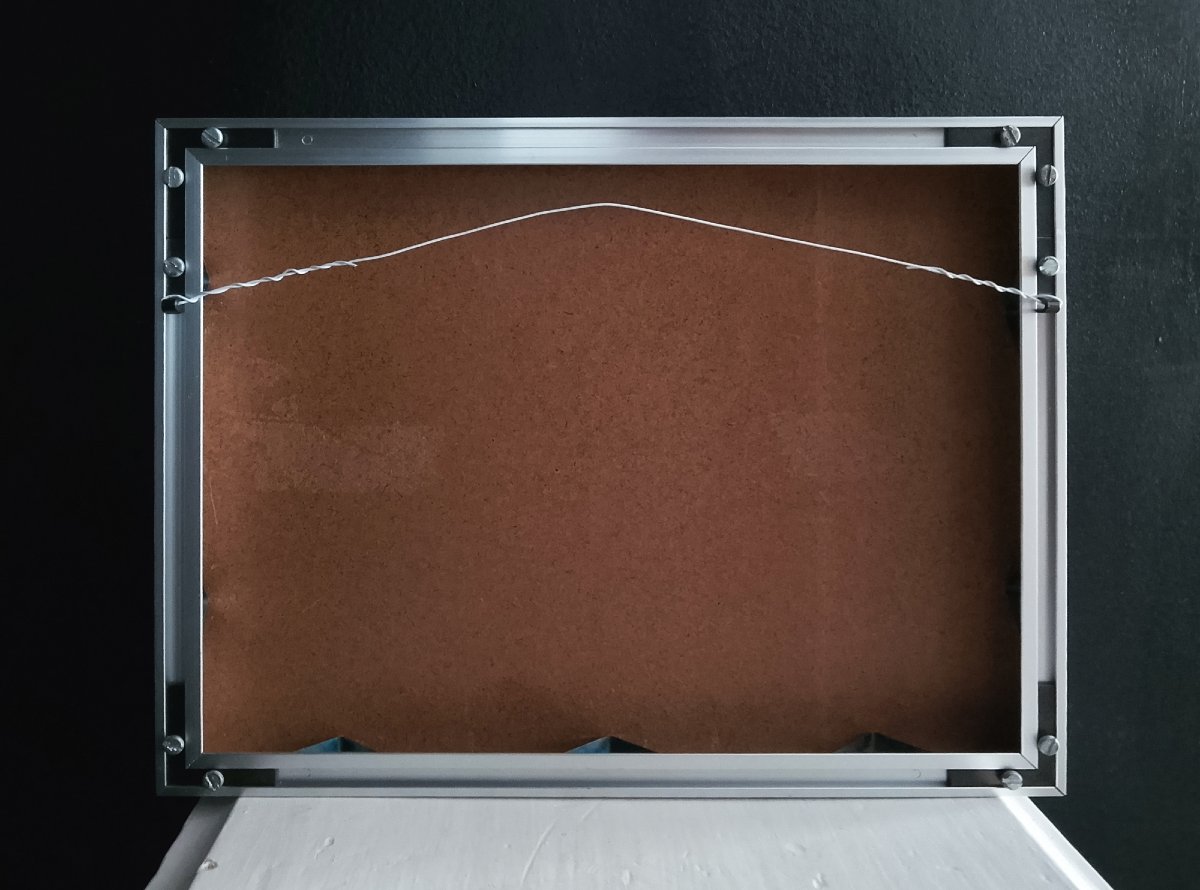
70s brushed aluminum key frame ( 31 cm x 23.6 cm x 3.6 cm ).
Perfect condition.
Claude Massé ( 1934 - 2017 ) visual artist, author, promoter of Art Brut.
Son of writerLudovic Massé (1900-1982) and art enthusiast, he met
dozens of painters, sculptors and writerspainters, sculptors and writers.
Many, like Jean Dubuffet, became his friends. Hisgodfather is Tristan Tzara
and he posed many times for Raoul Dufy from 1947 to 1952.
He became fascinated by Art-Brut and his meeting with Nataska was a revelation.
Beginning in 1959, he built upa very important collection of this marginal Art
which he called "Art Autre", much of which would bepart of which was donated
in 1999 to the Musée de la Création Franche in Bègles.
JeanDubuffet suggested he put together a selection
for presentation at the Fondation de l'Art-Brutde l'Art-Brut in Lausanne.
Director of the Musée d'Art Moderne de Céret from 1966 to 1972,
where he organized fourteen major exhibitions.fourteen major exhibitions, he made friends notably
with Claude Viallat, Marc Chagall andPablo Picasso.
Cork is a rot-proof material that reassures Claude Massé
in his need for the tangible.of the tangible.
Claude Massé began sculpting cork in 1979, giving birth
to a population of singular characters: the Patots, an army of strange
little men with staring eyesand bruised by strange scars.
The Patots represent an impure form of art,
whichwhich makes them more alive than life.
At any moment you expect them to start moving,
to shake en masse like an army.
The Patots are invaders, settling on our territoryon our territory and dominate us.
Smiling, grumbling, sneering corks, peaceful stringy fellows
with begging eyes or tutelary geniuses bloated with straps andnails,
they're there, still staring at us.
This is an art of silent forms, born of the cry of a treeof a tree whose skin is being torn off.
After years of creating with his favorite material, Claude Massé is heading,
in 2010, in a completely different direction, more graphic but just asjust as original:
Champagne labels. "From cork to Champagne, there's only one step."
This is the calming, soothing period of collages, aerial as much as
that of the Patots wasclose to the earth.
"Collage remains first and foremost a game, it's pieces that you fit
one on top of or under the other with moreon or under each other, with varying degrees of success.
A multitude of possibilities are open to this creation.He went on to produce almost 4,000 collages.
An art of papers thickened with raw dramaof blood, earth and gold.
Claude Massé speaks silently of the cries of the world.
"The collageessentially on brown kraft envelopes,
a color that reverberates throughout my work.my work.
I proceed as follows, I draw on the blank right-hand side of the label,
then I cut out without precision...precision..."
Claude Massé speaks to us of the people of those who are the most numerous:
the anonymous, he speaks to us of what unites humanity in diversity
and the multiple, that is to say each one of us.each and every one of us.
Claude Massé celebrates the individual in his or her originality and connection.
Each of his collagesserves as a link with the previous and the next,
as well as with the support.
The material of the collages also makes the link: old wine labels,
old newspaper cut-outs, etc....
Her plastic work is presented in numerous exhibitions
and public and private collectionsand private collections in France and abroad.
An important collection of works (sculptures/collages/books)
ispreserved at La Pinacothèque de Bordeaux, run by her son Christophe Massé.
2 labels from BanyulsBrut, several cut-outs forming a stylized face,
a cut-out of an African statuettestatuette.
Important scribbling in black felt pen.
On the back: 5 labels from Maison champenoise Hérard.
Dedicated, signed and dated April 9, 2014.
Maximum dimensions: 29.7 cm x 21cm.
70s brushed aluminum key frame ( 31 cm x 23.6 cm x 3.6 cm ).
Perfect condition.
Claude Massé ( 1934 - 2017 ) visual artist, author, promoter of Art Brut.
Son of writerLudovic Massé (1900-1982) and art enthusiast, he met
dozens of painters, sculptors and writerspainters, sculptors and writers.
Many, like Jean Dubuffet, became his friends. Hisgodfather is Tristan Tzara
and he posed many times for Raoul Dufy from 1947 to 1952.
He became fascinated by Art-Brut and his meeting with Nataska was a revelation.
Beginning in 1959, he built upa very important collection of this marginal Art
which he called "Art Autre", much of which would bepart of which was donated
in 1999 to the Musée de la Création Franche in Bègles.
JeanDubuffet suggested he put together a selection
for presentation at the Fondation de l'Art-Brutde l'Art-Brut in Lausanne.
Director of the Musée d'Art Moderne de Céret from 1966 to 1972,
where he organized fourteen major exhibitions.fourteen major exhibitions, he made friends notably
with Claude Viallat, Marc Chagall andPablo Picasso.
Cork is a rot-proof material that reassures Claude Massé
in his need for the tangible.of the tangible.
Claude Massé began sculpting cork in 1979, giving birth
to a population of singular characters: the Patots, an army of strange
little men with staring eyesand bruised by strange scars.
The Patots represent an impure form of art,
whichwhich makes them more alive than life.
At any moment you expect them to start moving,
to shake en masse like an army.
The Patots are invaders, settling on our territoryon our territory and dominate us.
Smiling, grumbling, sneering corks, peaceful stringy fellows
with begging eyes or tutelary geniuses bloated with straps andnails,
they're there, still staring at us.
This is an art of silent forms, born of the cry of a treeof a tree whose skin is being torn off.
After years of creating with his favorite material, Claude Massé is heading,
in 2010, in a completely different direction, more graphic but just asjust as original:
Champagne labels. "From cork to Champagne, there's only one step."
This is the calming, soothing period of collages, aerial as much as
that of the Patots wasclose to the earth.
"Collage remains first and foremost a game, it's pieces that you fit
one on top of or under the other with moreon or under each other, with varying degrees of success.
A multitude of possibilities are open to this creation.He went on to produce almost 4,000 collages.
An art of papers thickened with raw dramaof blood, earth and gold.
Claude Massé speaks silently of the cries of the world.
"The collageessentially on brown kraft envelopes,
a color that reverberates throughout my work.my work.
I proceed as follows, I draw on the blank right-hand side of the label,
then I cut out without precision...precision..."
Claude Massé speaks to us of the people of those who are the most numerous:
the anonymous, he speaks to us of what unites humanity in diversity
and the multiple, that is to say each one of us.each and every one of us.
Claude Massé celebrates the individual in his or her originality and connection.
Each of his collagesserves as a link with the previous and the next,
as well as with the support.
The material of the collages also makes the link: old wine labels,
old newspaper cut-outs, etc....
Her plastic work is presented in numerous exhibitions
and public and private collectionsand private collections in France and abroad.
An important collection of works (sculptures/collages/books)
ispreserved at La Pinacothèque de Bordeaux, run by her son Christophe Massé.
250 €
Period: 20th century
Style: Modern Art
Condition: Perfect condition
Material: Paper
Length: 29,7 cm.
Height: 21 cm.
Reference (ID): 1768612
Availability: In stock
Print