

Jules-émile Zingg "val d'Argent (lièpvre ?)" - Alsace
Montbéliard, August 25, 1882 - May 4, 1942, Paris
"Val d'Argent (Lièpvre?)"
Oil on canvas, 54x73cm
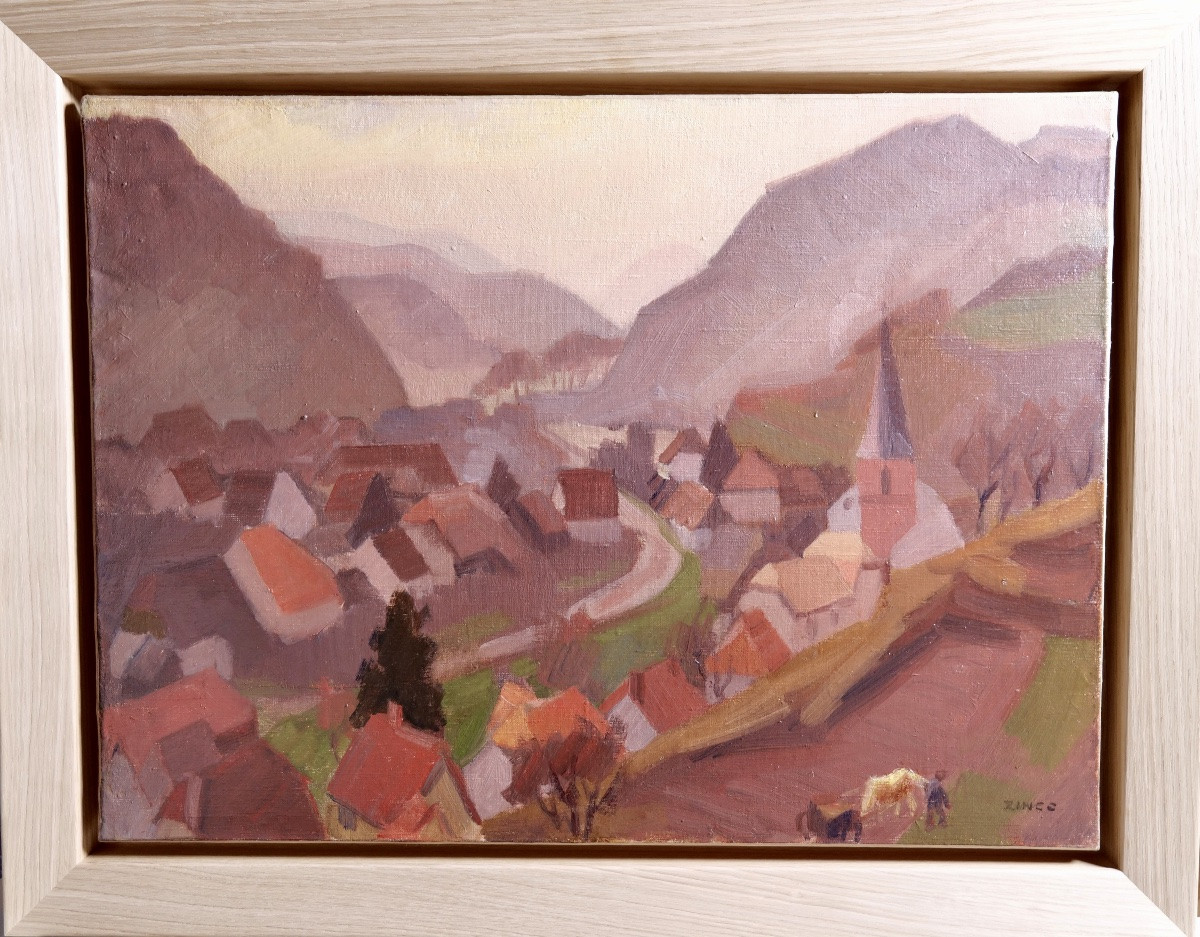
Format with frame: 67x86cm
around 1925
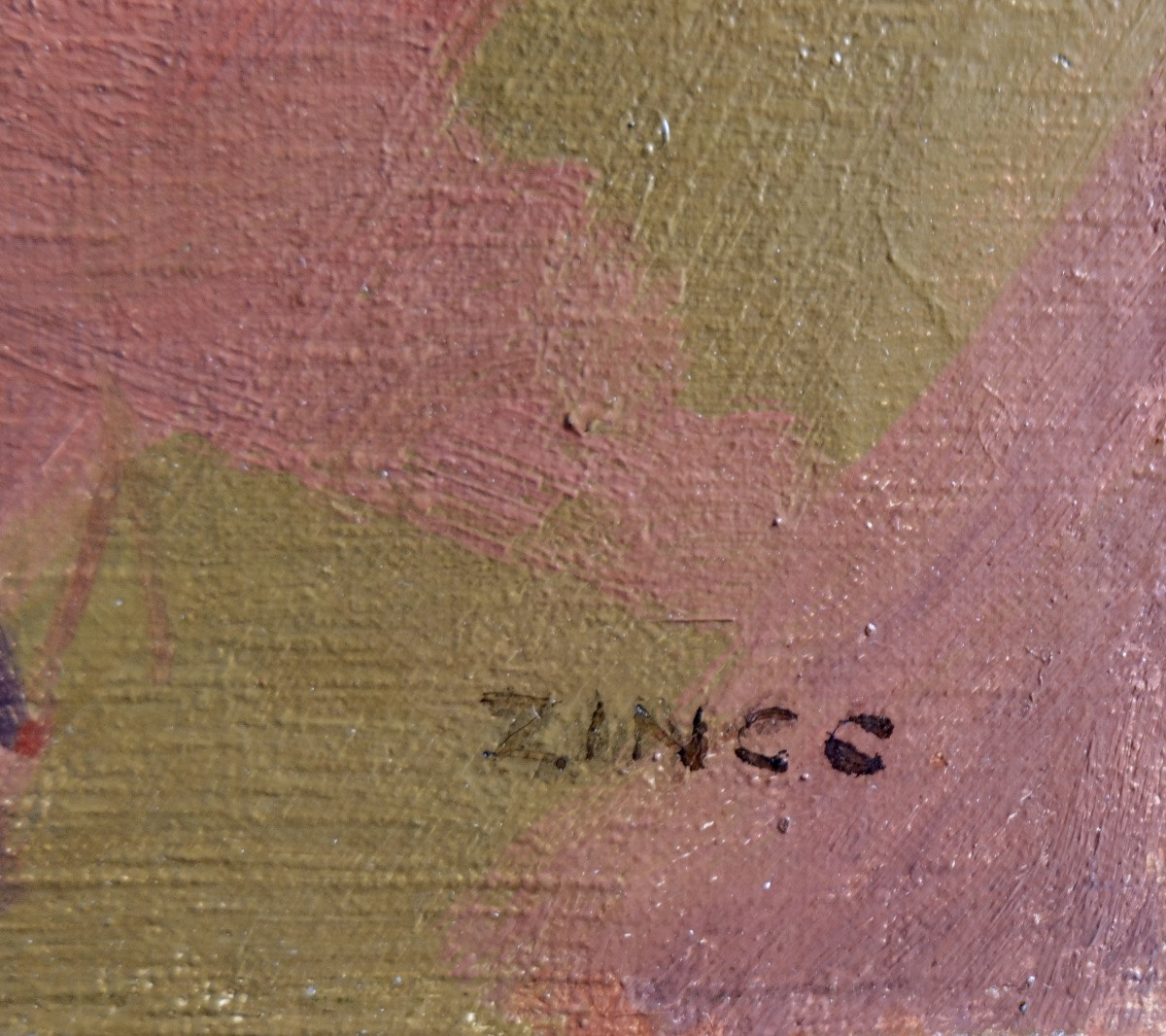
Signed lower right
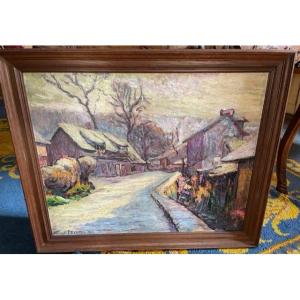
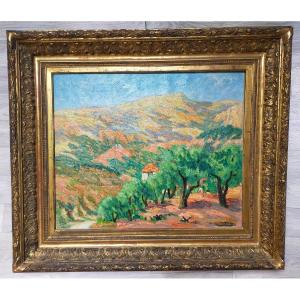
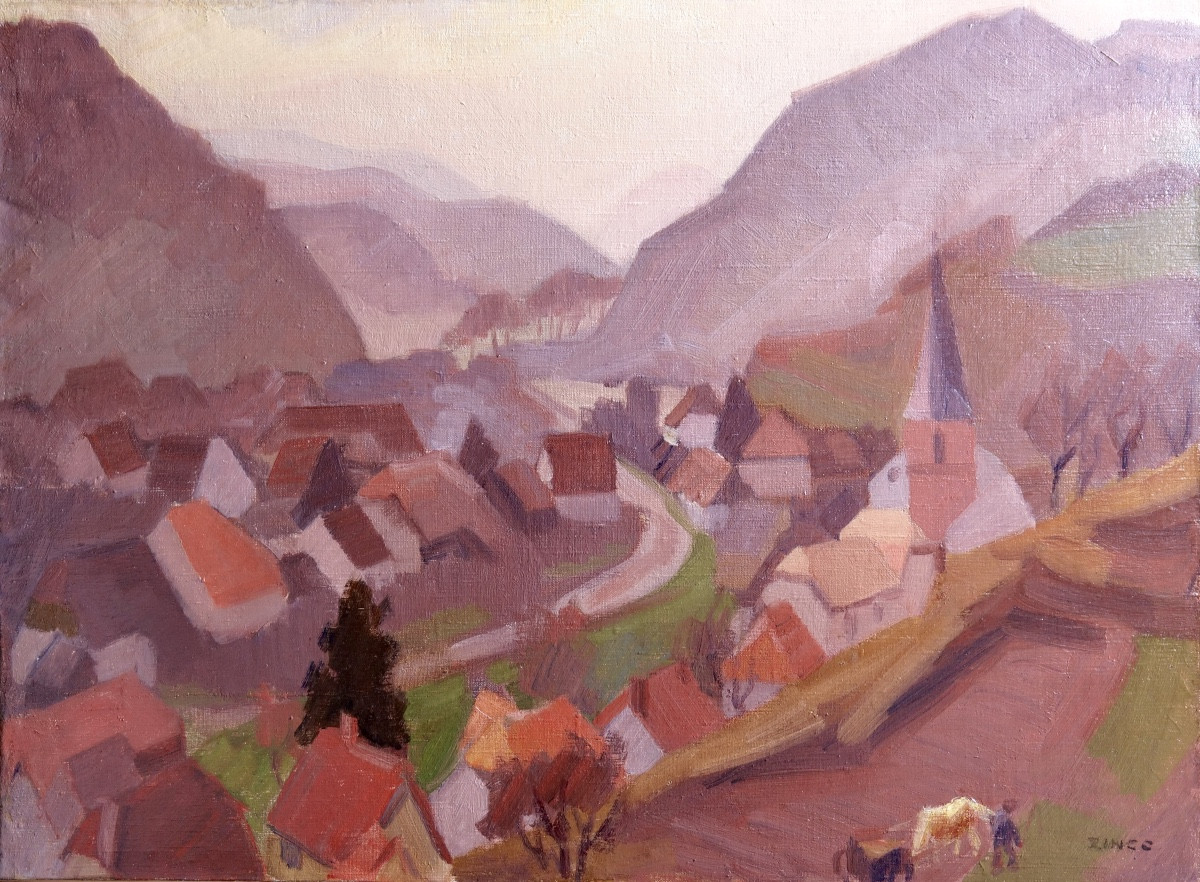
This important oil on canvas by Jules-Émile Zingg (1882-1942), produced around 1925, offers a particularly poetic and synthetic vision of a village tucked away in a Vosges valley, most likely located in the Val d'Argent, perhaps in the vicinity of Lièpvre, a territory to which the artist remained deeply attached throughout his career. Measuring a generous 54 x 73 cm, this composition is a remarkable testimony to the painter's stylistic maturity, at a time when he was fully developing his pictorial style based on simplified forms, soft colors and a deep empathy for the rural world.
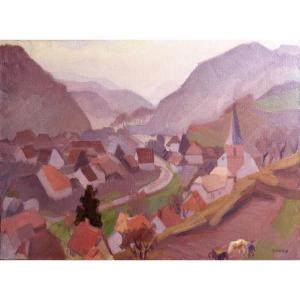
Viewed from a dominant point, the scene unfolds a village with houses tightly grouped around its bell tower, whose slender silhouette forms the main visual axis of the composition. Paths wind between the dwellings before disappearing into the folds of the valley, while the mountains envelop the landscape with a protective, silent presence. In the lower right-hand corner, two modest figures accompanying a horse introduce a discreet human note that recalls Zingg's attachment to everyday life in the Alsatian and Vosges countryside.
The artist avoids any anecdotal description in favor of a synthetic vision of the landscape. The volumes of the houses are reduced to broad geometric masses whose red, pink and brown roofs punctuate the space with a remarkable musicality. This simplification of form brings the work closer to the research carried out by certain modernist regionalist painters of the interwar period, while retaining a deeply personal sensibility.
The palette is particularly characteristic of Zingg's period. Muted tones of mauve, antique pink, purplish gray and light ochre bathe the valley in a diffuse light that evokes morning mists or the softness of a late autumn afternoon. Far from spectacular contrasts, the artist seeks a subtle color harmony where each hue seems to grow naturally from the previous one.
Trained in Paris but deeply rooted in his native land, Jules-Émile Zingg was one of the finest interpreters of the rural world of Eastern France. His landscapes of the Val d'Argent, inland Alsace and the Vosges are never mere topographical transcriptions; they reflect a profoundly human vision of the land, where architecture, nature and people form an inseparable whole. In this work, the village literally seems to emerge from the mountain, as if the houses, paths and hills were all part of the same breath.
This canvas thus stands out as a remarkable example of Jules-Émile Zingg's landscape painting of the 1920s. With its balanced composition, delicate color range and ability to capture the deep soul of the Vosges valleys, it fully illustrates the artist's singular place in the history of twentieth-century French regionalist painting. Between careful observation of reality and poetic interpretation of the landscape, Zingg delivers here an evocation of rare sensitivity, in which the Val d'Argent becomes the stage for a timeless vision of Alsatian rurality.
Period: 20th century
Style: Other Style
Condition: Excellent condition
Material: Oil painting
Width: 73cm
Height: 54cm
Reference (ID): 1767152
Availability: In stock