THIS OBJECT WAS SOLD
Leger In Paris - Louis XVI Style Flat Desk Based On 18th Century Models By Montigny And Reisener
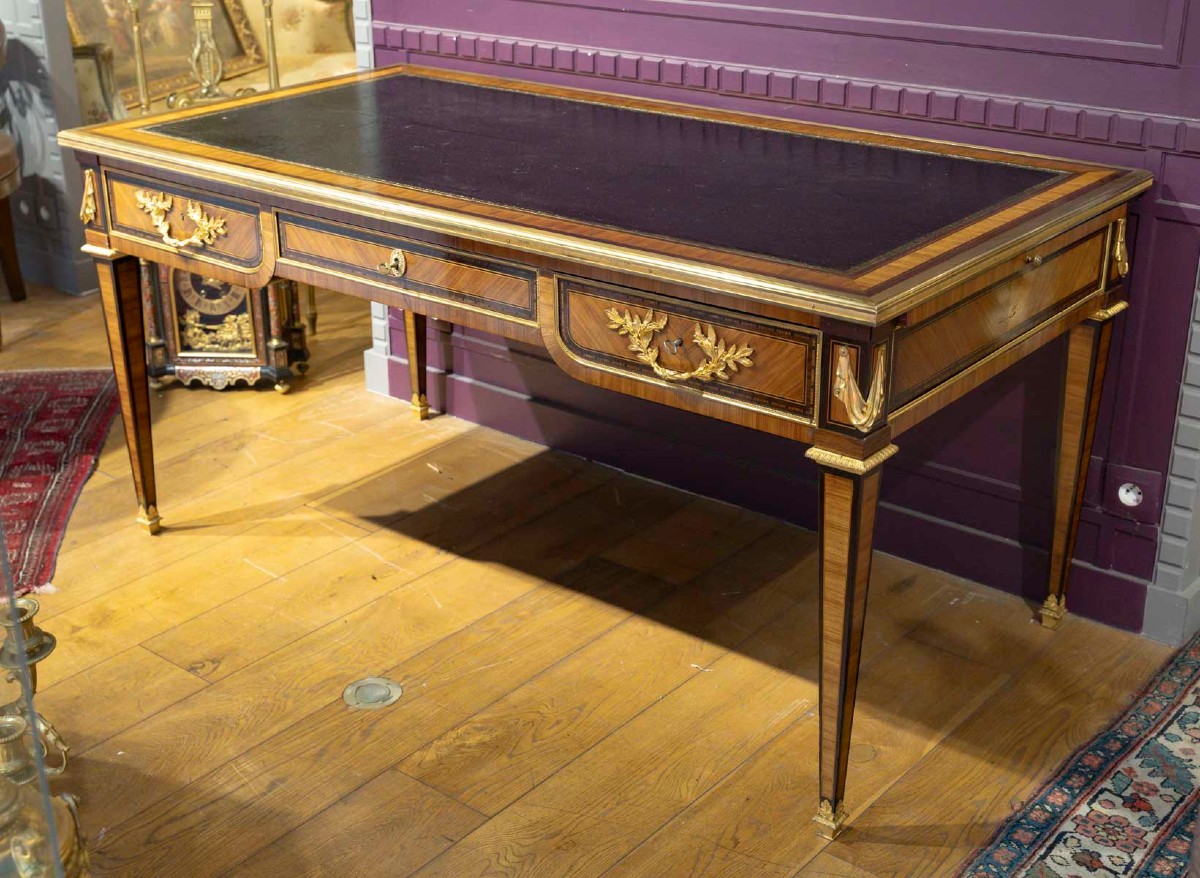
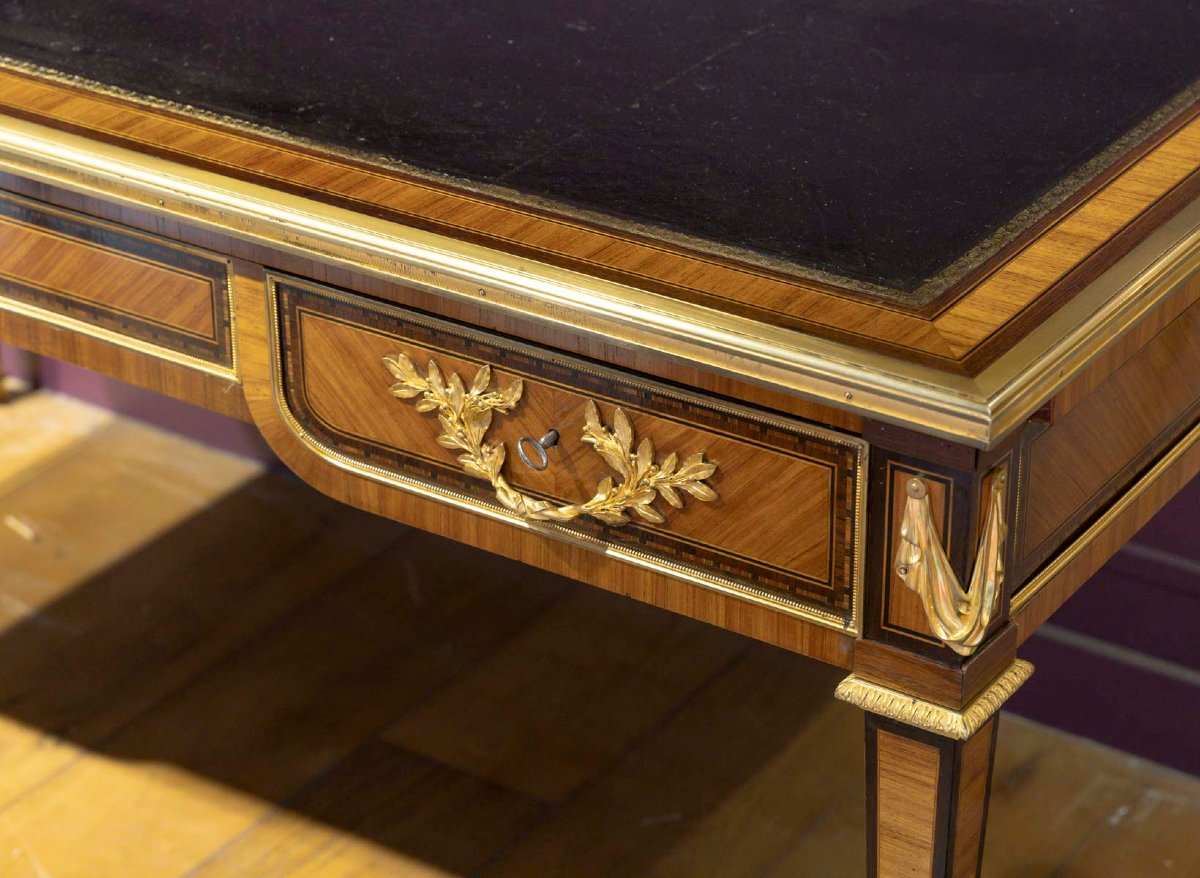
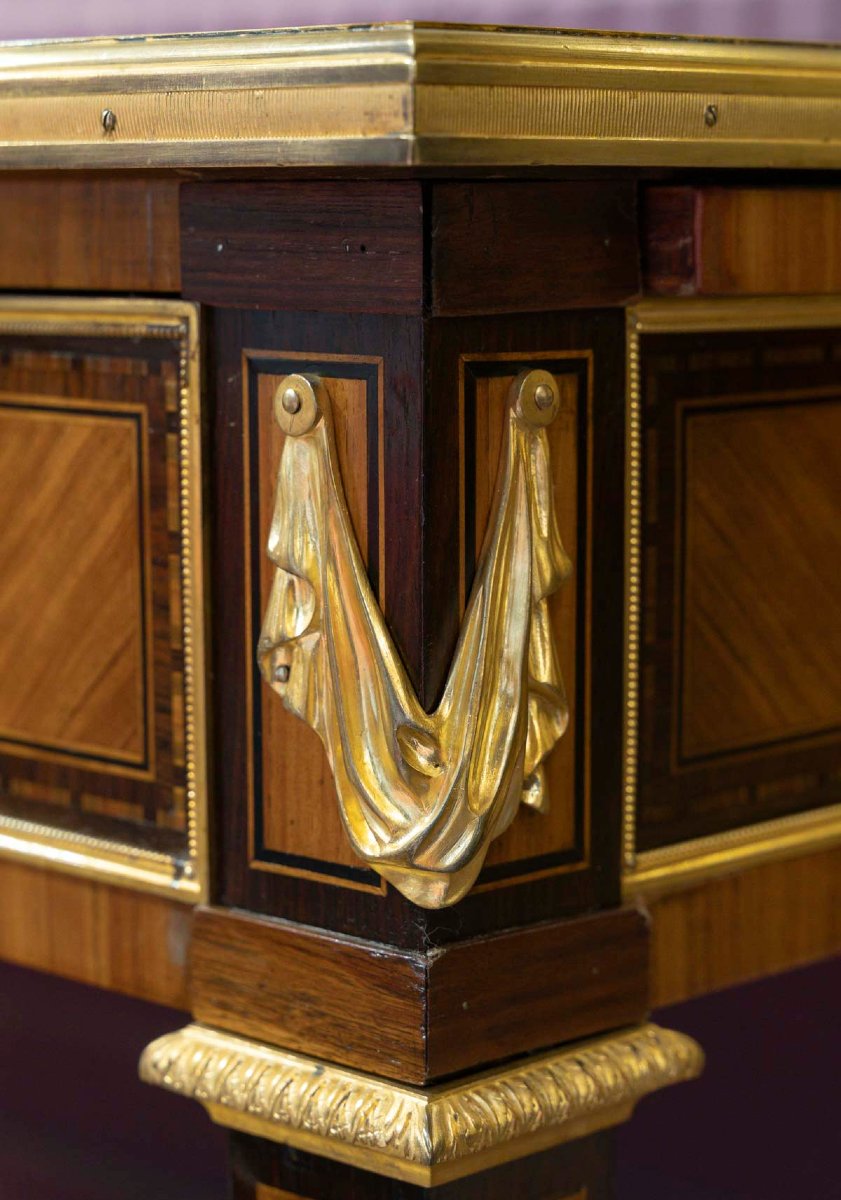
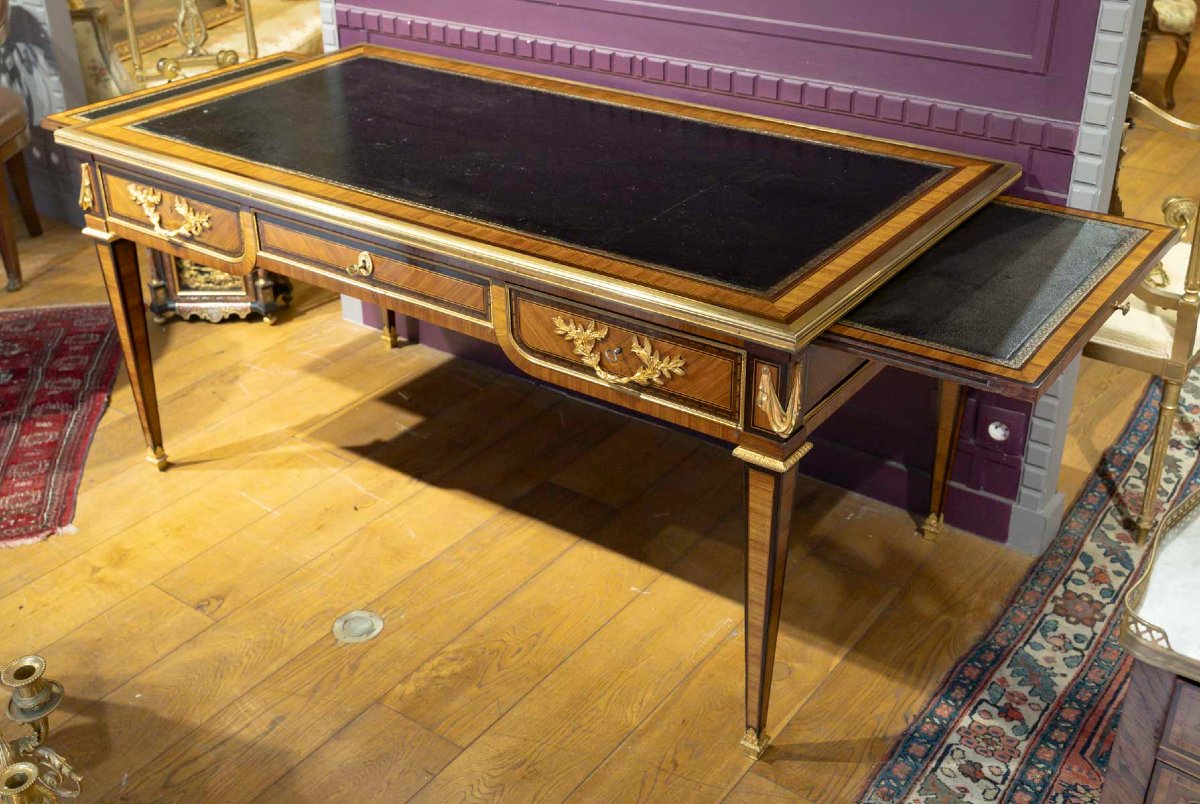
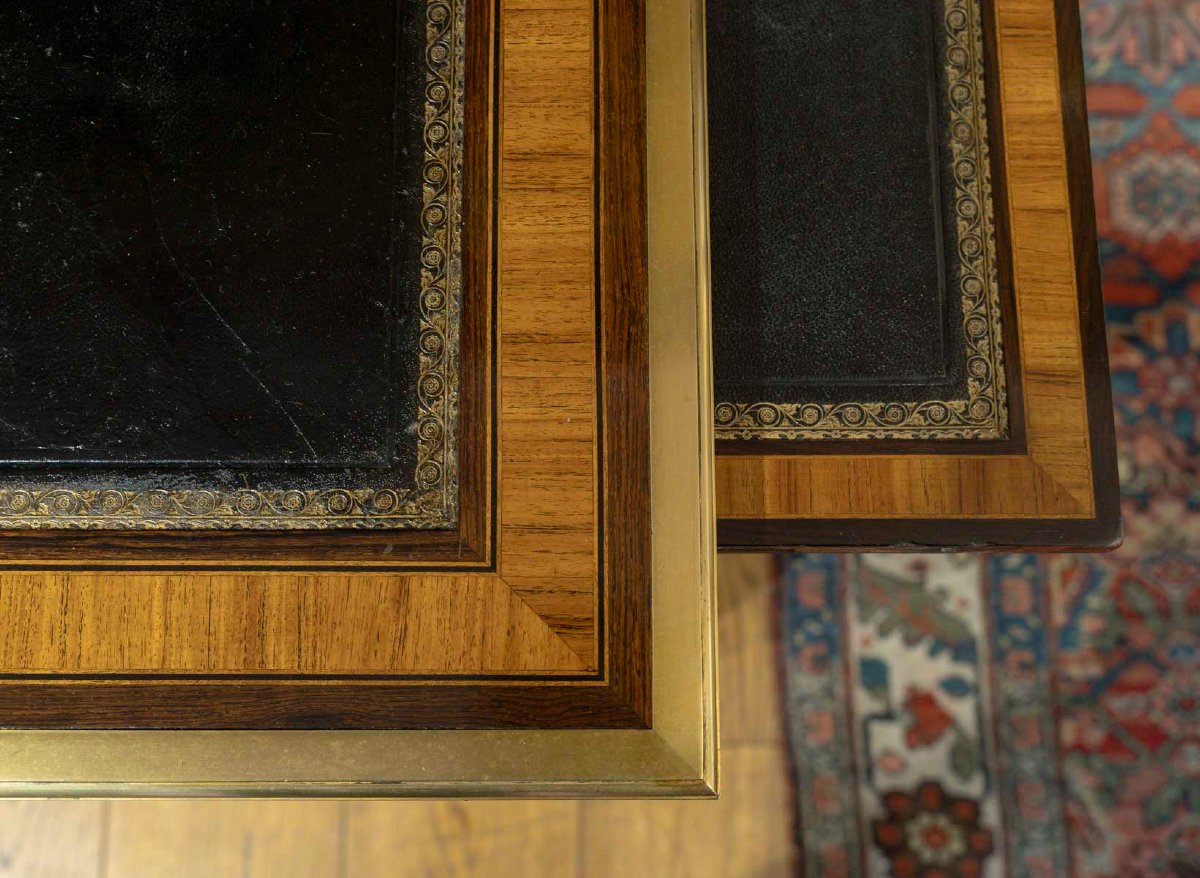
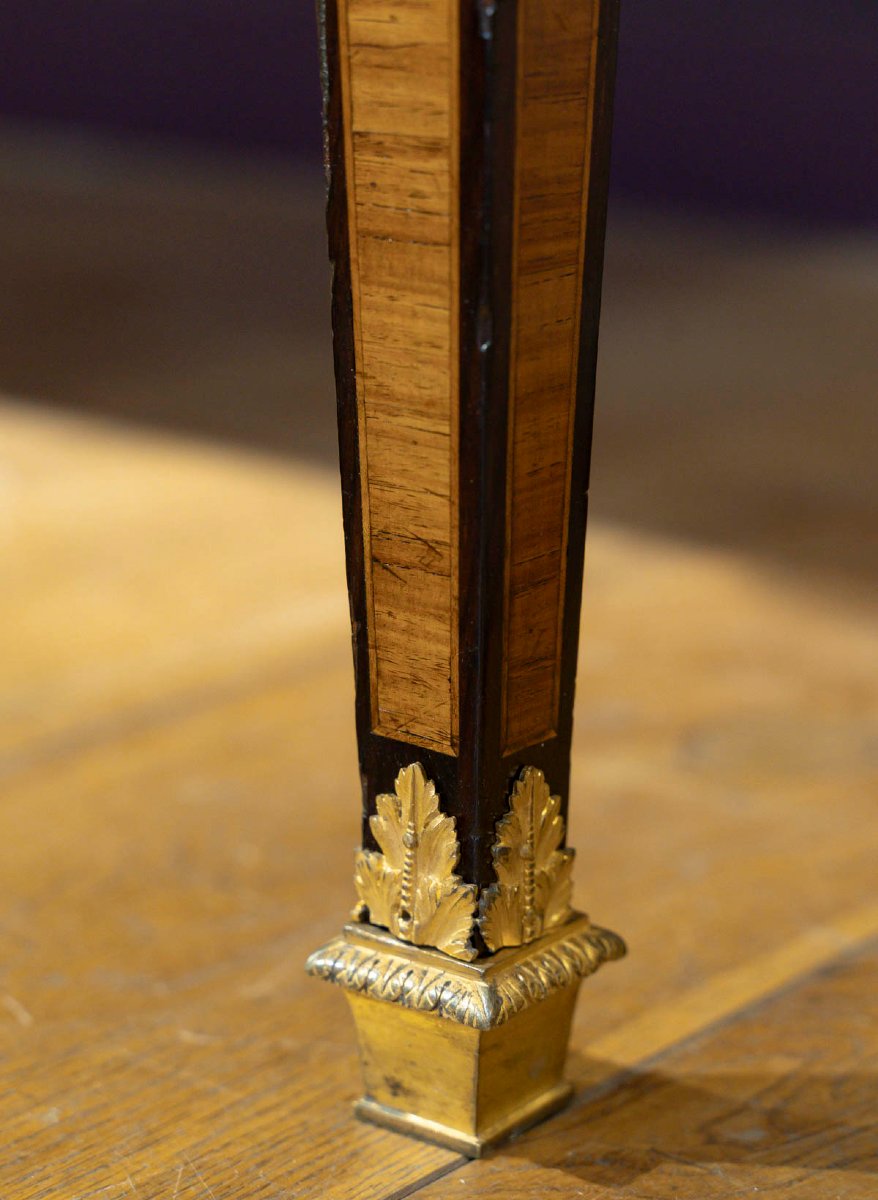


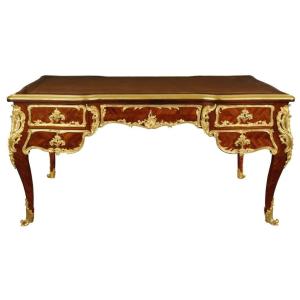
LEGER Emile, Cabinetmaker in Paris (Active between 1866-1895) - Superb Louis XVI style flat desk inlaid with rosewood veneer within amaranth borders highlighted with light wood stringing. The front opens with three drawers, revealing two sliding writing shelves on its sides. These shelves, like the rectangular top encircled by a simple molding, are covered in black leather with gilt tooling. Resting on four quadrangular tapered legs with re-entrant angles, its rigorous silhouette is embellished with gilt bronze mounts featuring finely chased classical motifs of beading, ribboned branches of grained laurel, and acanthus leaves and rosettes. Inverted capitals scalloped with acanthus palmettes adorn the base; drapery, held in place by small discs, punctuates the uprights. A high-quality piece of Parisian cabinetmaking from the second half of the 19th century, stamped with an inked mark under the frame by Emile Léger, located in the capital at "28, Place des Vosges". Based on models by J.-H. Reisener and P.-C. Montigny, leading cabinetmakers of the last third of the 18th century in France. Circa 1880.
THE LOUIS XVI STYLE IN THE SPOTLIGHT
With its understated Louis XVI silhouette, this substantial flat-topped desk, resting on four tapered legs with rigorous quadrangular profiles set in capitals, is surmounted by gilt-bronze rings adorned with chased acanthus leaf motifs and friezes. The entire surface is veneered in luminous rosewood marquetry, judiciously framed by strips of amaranth wood with a rich luster. Framed by a strictly molded molding, its slightly overhanging rectangular top, covered in black leather with a gilt vignette tooled in small letters, surmounts a spacious cabinet fitted with three drawers along its frieze and housing two similarly covered sliding writing tablets on its sides. The slender central drawer is flanked by two other drawers with elegantly rounded corners. A balanced arrangement of chased and gilded bronze mounts, featuring beaded motifs (framing strips), ribboned branches of grained laurel (drawer handles), and acanthus rosettes (keyhole escutcheon, knobs), punctuates their pleasing distribution, a motif repeated—simulated—on the visitors' side. Lending it a most measured majesty, a drape held by small discs festoons the uprights of this piece of fine furniture, of remarkable craftsmanship and execution, stamped by Emile Léger*, a cabinetmaker representative of Parisian furniture production in the second half of the 19th century. Endowed with genuine formal sophistication, this flat desk, in which luxurious wood species with carefully chosen chromatic contrasts are consciously harmonized beneath an apparent austerity, bears a striking resemblance to models of this type designed in the 1780s and 1790s by Jean-Henri Reisener (1734-1806) – notably his Flat Desk, 1793, now in Versailles, Inv. OA.6637 – and his contemporary Philippe-Claude Montigny (1734-1800), key figures in the field. Parisian cabinetmaking at the end of the reign of Louis XVI.
Thus, in this desk, E. Léger skillfully combines the aesthetic "canons" characteristic of his illustrious predecessors, eminent champions of the Louis XVI style. From the former, he retains the architectural forms of the frame, enhanced by a unified surface veneer of luxurious wood, the strict frieze of drawers, albeit here subtly curved, and the elegant balance of the gilt bronze mounts. From the latter, he incorporates the tapered legs with square sections and inverted capitals, the beading adorning the drawers, and the distinctive use of the draped motif inspired by designs of the ornamentalist Claude Delafosse (1734-1791).
Alongside similar models directly inspired by the aforementioned work of J.-H. Reisener, or equally relevantly, by masterpieces by P.-C. Montigny desks, executed with minute structural and ornamental variations by Gervais-Maximilien Durand (1839-1911), Paul Sormani (1848-1926), and the Krieger firm (1826-1930), designed for the Carlhian-Beaumetz firm (1867-1920), a renowned Parisian firm specializing in the international trade of 18th-century French furniture and objets d'art, our flat desk signed by Emile Léger pays fitting tribute to the Louis XVI style, still celebrated by connoisseurs who appreciate its brilliance and timeless elegance.
A rare signature on the art market.
*Emile LEGER & Cie: Listed in reference works relating to the Parisian luxury furniture and cabinetmaking industry in the 19th century, Emile Léger (?-?) - whose career should be established more precisely - partnered in 1866 with Albert ALBRECHT, son and successor of his father of German origin Jean-Marc-Albert ALBRECHT (1786-1860) established in the Parisian capital in the first half of the 19th century as "Manufacturer of French and foreign wood furniture" and holder of a business located at 18, rue de Charonne (1820-1830) then at 3, Boulevard Richard-Lenoir. Under this partnership, operating under the name LEGER, A.ALBRECHT & Cie, the company, later relocated to 64, rue Amelot (1874), participated in the Universal Exhibitions of 1867 and 1878—major events where it received an Honorable Mention (L'Exposant de 1867, p.3) and was subsequently awarded a Silver Medal (L'Année Artistique, January 1, 1878, p.257).
During the 1880s, now the sole owner of the company, Emile Léger moved the business, which at that address housed a "factory and store of furniture of all styles, sculptures, seating, cabinetmaking, and fine joinery," first to 12 Place des Vosges (1883) and then to number 28 of the same prestigious location. He also had a branch and workshops in Honfleur (Normandy). His furniture exhibited at the 1889 Universal Exhibition was once again awarded a Silver Medal.
Bibliographical references: - Kjellberg, Pierre, Le Mobilier français du XVIIIe siècle-Dictionnaire des Ebénistes et des Menuisiers, Paris: Ed. de L'Amateur, 1998;- Ledoux-Lebard, Denise, Le mobilier français du XIXe siècle, dictionnaire des ébénistes et des menuisiers, Ed. de L'Amateur, 2000, pp. 24, 406; --Payne, Christopher, Paris, La Quintessence du meuble au XIXe siècle, Ed. Monelle-Hayot, 2018, pp. 193, 422;- Vignon, Charlotte; London-New York, Paris: The International Trade of Duveen-Frères between 1880 and 1910," in: Revue de L'Art no. 206, 2019, pp. 35-44.
Signature and Mark: Stamped mark on the frame: "AMEUBLEMENTS/ E.LEGER/PARIS/ 28, Place des Vosges"
Materials: Softwood frame; Rosewood and amaranth veneer (both figured and straight grain); stained sycamore wood trim; chased and gilded bronze; black leather tooled in gilt.
Dimensions: H.: 76 cm; W.: 154 cm; D.: 84 cm
A work of fine Parisian cabinetmaking in the Louis XVI style, from the last third of the 19th century, stamped by the Emile Léger Furniture Company, after... 18th-century models by J.H. Reisener and C.P. Montigny. Circa 1880.
Note: in Furniture of the Nissim de Camondo Museum, Cat. 37 Flat desk stamped by J.H. Reisener, circa 1780
THE LOUIS XVI STYLE IN THE SPOTLIGHT
With its understated Louis XVI silhouette, this substantial flat-topped desk, resting on four tapered legs with rigorous quadrangular profiles set in capitals, is surmounted by gilt-bronze rings adorned with chased acanthus leaf motifs and friezes. The entire surface is veneered in luminous rosewood marquetry, judiciously framed by strips of amaranth wood with a rich luster. Framed by a strictly molded molding, its slightly overhanging rectangular top, covered in black leather with a gilt vignette tooled in small letters, surmounts a spacious cabinet fitted with three drawers along its frieze and housing two similarly covered sliding writing tablets on its sides. The slender central drawer is flanked by two other drawers with elegantly rounded corners. A balanced arrangement of chased and gilded bronze mounts, featuring beaded motifs (framing strips), ribboned branches of grained laurel (drawer handles), and acanthus rosettes (keyhole escutcheon, knobs), punctuates their pleasing distribution, a motif repeated—simulated—on the visitors' side. Lending it a most measured majesty, a drape held by small discs festoons the uprights of this piece of fine furniture, of remarkable craftsmanship and execution, stamped by Emile Léger*, a cabinetmaker representative of Parisian furniture production in the second half of the 19th century. Endowed with genuine formal sophistication, this flat desk, in which luxurious wood species with carefully chosen chromatic contrasts are consciously harmonized beneath an apparent austerity, bears a striking resemblance to models of this type designed in the 1780s and 1790s by Jean-Henri Reisener (1734-1806) – notably his Flat Desk, 1793, now in Versailles, Inv. OA.6637 – and his contemporary Philippe-Claude Montigny (1734-1800), key figures in the field. Parisian cabinetmaking at the end of the reign of Louis XVI.
Thus, in this desk, E. Léger skillfully combines the aesthetic "canons" characteristic of his illustrious predecessors, eminent champions of the Louis XVI style. From the former, he retains the architectural forms of the frame, enhanced by a unified surface veneer of luxurious wood, the strict frieze of drawers, albeit here subtly curved, and the elegant balance of the gilt bronze mounts. From the latter, he incorporates the tapered legs with square sections and inverted capitals, the beading adorning the drawers, and the distinctive use of the draped motif inspired by designs of the ornamentalist Claude Delafosse (1734-1791).
Alongside similar models directly inspired by the aforementioned work of J.-H. Reisener, or equally relevantly, by masterpieces by P.-C. Montigny desks, executed with minute structural and ornamental variations by Gervais-Maximilien Durand (1839-1911), Paul Sormani (1848-1926), and the Krieger firm (1826-1930), designed for the Carlhian-Beaumetz firm (1867-1920), a renowned Parisian firm specializing in the international trade of 18th-century French furniture and objets d'art, our flat desk signed by Emile Léger pays fitting tribute to the Louis XVI style, still celebrated by connoisseurs who appreciate its brilliance and timeless elegance.
A rare signature on the art market.
*Emile LEGER & Cie: Listed in reference works relating to the Parisian luxury furniture and cabinetmaking industry in the 19th century, Emile Léger (?-?) - whose career should be established more precisely - partnered in 1866 with Albert ALBRECHT, son and successor of his father of German origin Jean-Marc-Albert ALBRECHT (1786-1860) established in the Parisian capital in the first half of the 19th century as "Manufacturer of French and foreign wood furniture" and holder of a business located at 18, rue de Charonne (1820-1830) then at 3, Boulevard Richard-Lenoir. Under this partnership, operating under the name LEGER, A.ALBRECHT & Cie, the company, later relocated to 64, rue Amelot (1874), participated in the Universal Exhibitions of 1867 and 1878—major events where it received an Honorable Mention (L'Exposant de 1867, p.3) and was subsequently awarded a Silver Medal (L'Année Artistique, January 1, 1878, p.257).
During the 1880s, now the sole owner of the company, Emile Léger moved the business, which at that address housed a "factory and store of furniture of all styles, sculptures, seating, cabinetmaking, and fine joinery," first to 12 Place des Vosges (1883) and then to number 28 of the same prestigious location. He also had a branch and workshops in Honfleur (Normandy). His furniture exhibited at the 1889 Universal Exhibition was once again awarded a Silver Medal.
Bibliographical references: - Kjellberg, Pierre, Le Mobilier français du XVIIIe siècle-Dictionnaire des Ebénistes et des Menuisiers, Paris: Ed. de L'Amateur, 1998;- Ledoux-Lebard, Denise, Le mobilier français du XIXe siècle, dictionnaire des ébénistes et des menuisiers, Ed. de L'Amateur, 2000, pp. 24, 406; --Payne, Christopher, Paris, La Quintessence du meuble au XIXe siècle, Ed. Monelle-Hayot, 2018, pp. 193, 422;- Vignon, Charlotte; London-New York, Paris: The International Trade of Duveen-Frères between 1880 and 1910," in: Revue de L'Art no. 206, 2019, pp. 35-44.
Signature and Mark: Stamped mark on the frame: "AMEUBLEMENTS/ E.LEGER/PARIS/ 28, Place des Vosges"
Materials: Softwood frame; Rosewood and amaranth veneer (both figured and straight grain); stained sycamore wood trim; chased and gilded bronze; black leather tooled in gilt.
Dimensions: H.: 76 cm; W.: 154 cm; D.: 84 cm
A work of fine Parisian cabinetmaking in the Louis XVI style, from the last third of the 19th century, stamped by the Emile Léger Furniture Company, after... 18th-century models by J.H. Reisener and C.P. Montigny. Circa 1880.
Note: in Furniture of the Nissim de Camondo Museum, Cat. 37 Flat desk stamped by J.H. Reisener, circa 1780
Explore similar pieces and discover your ideal find:
desks