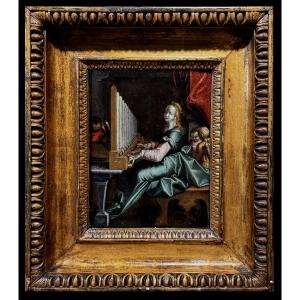


Frans Francken The Younger (1581-1642) Workshop Of - Sainte Cécile Se Délecte De La Musique Céleste
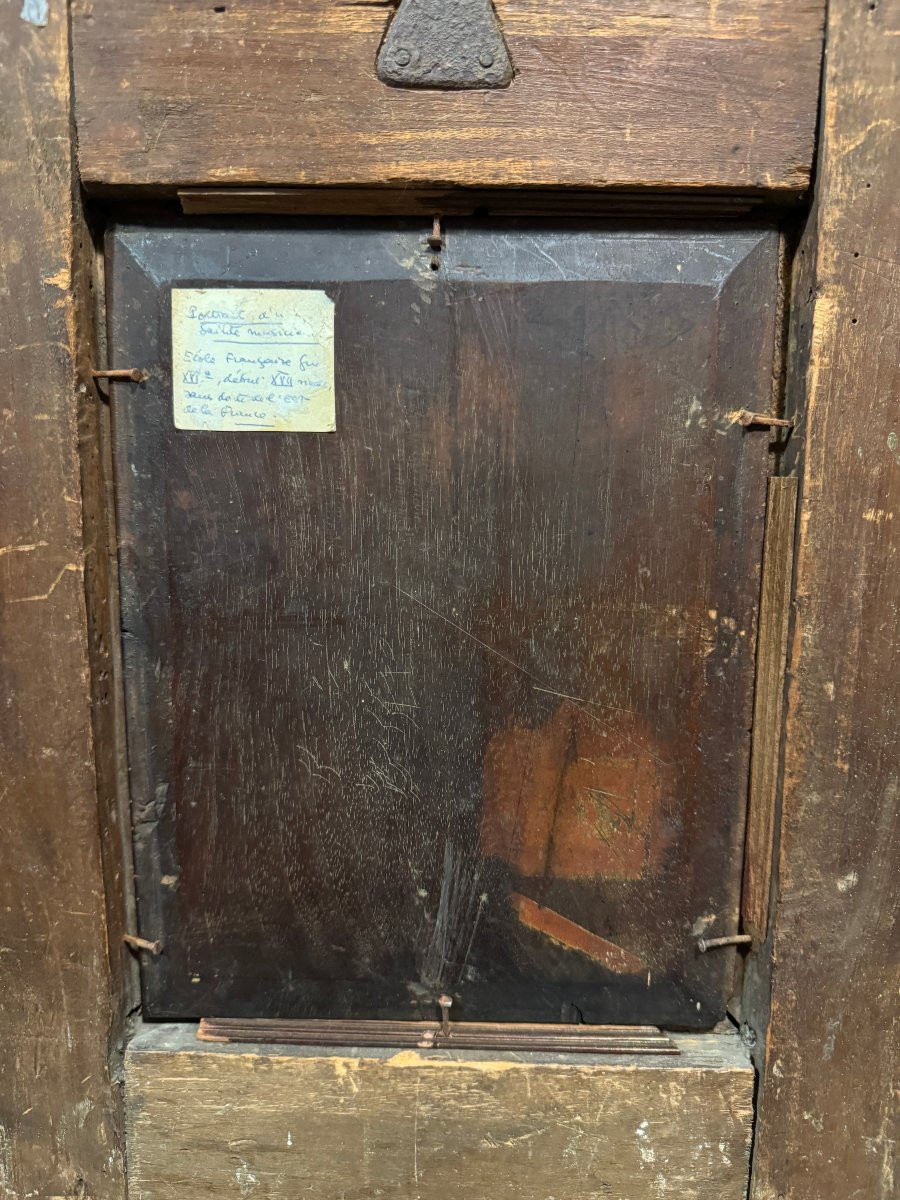
Oil on oak panel. Label on back.
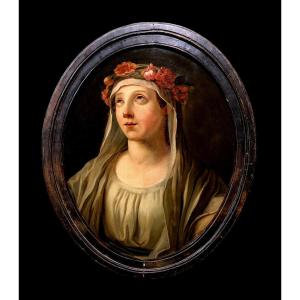
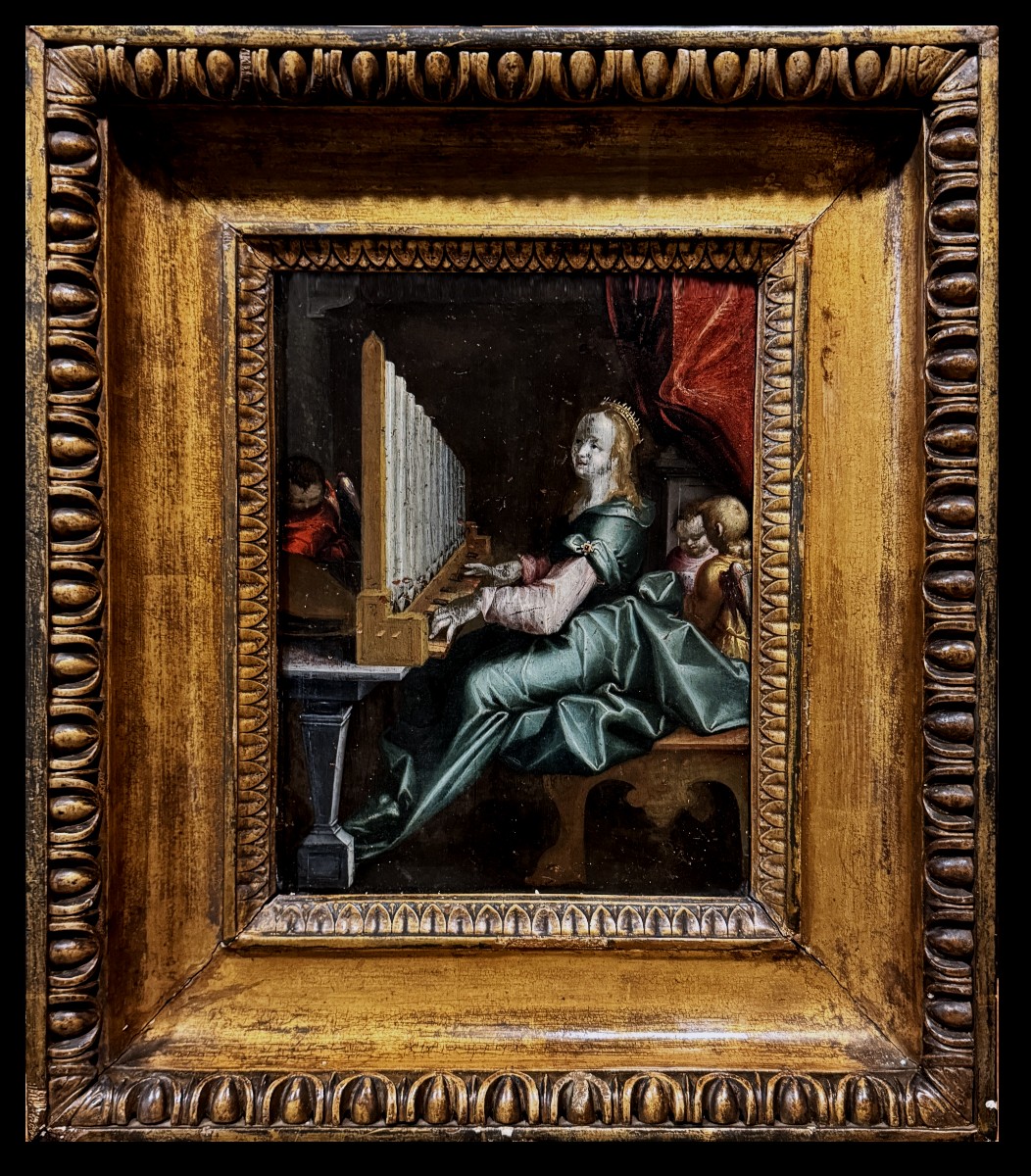
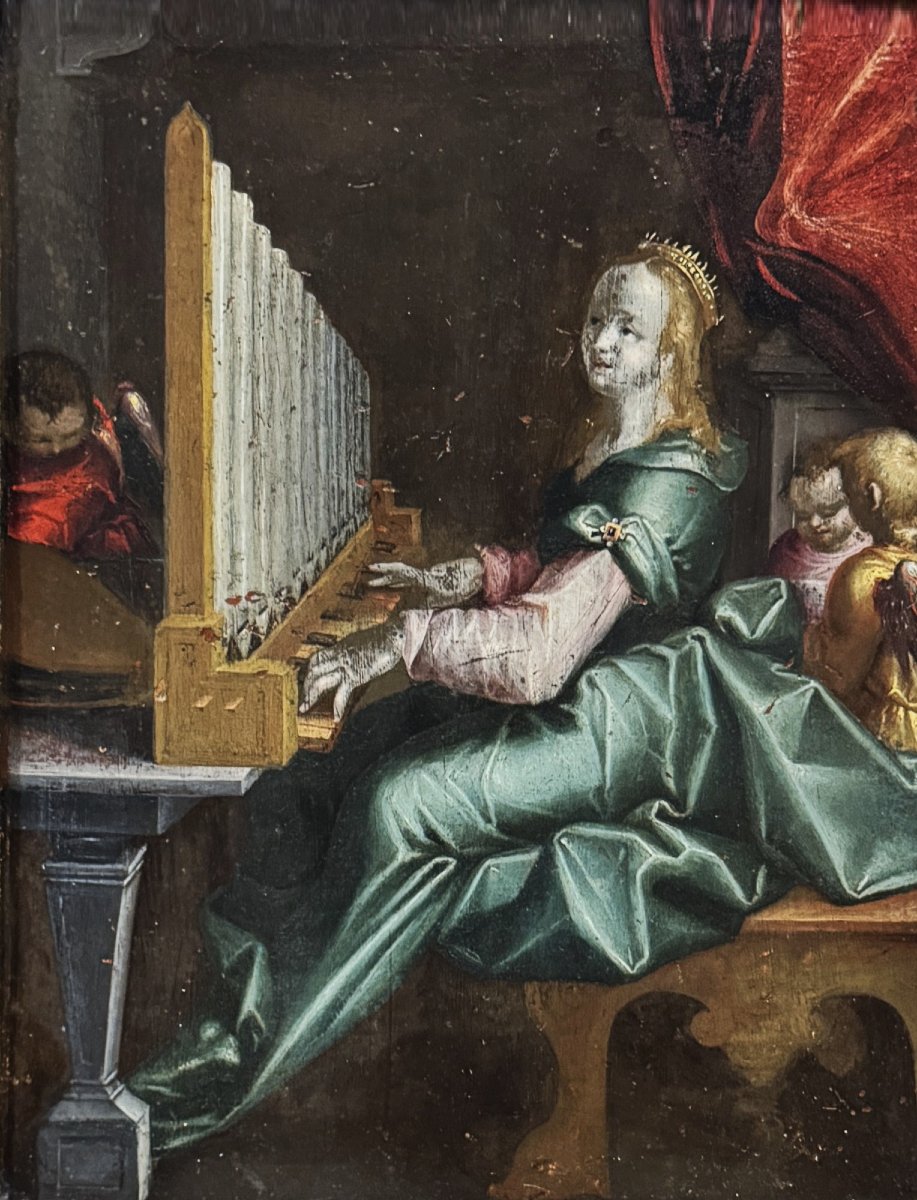
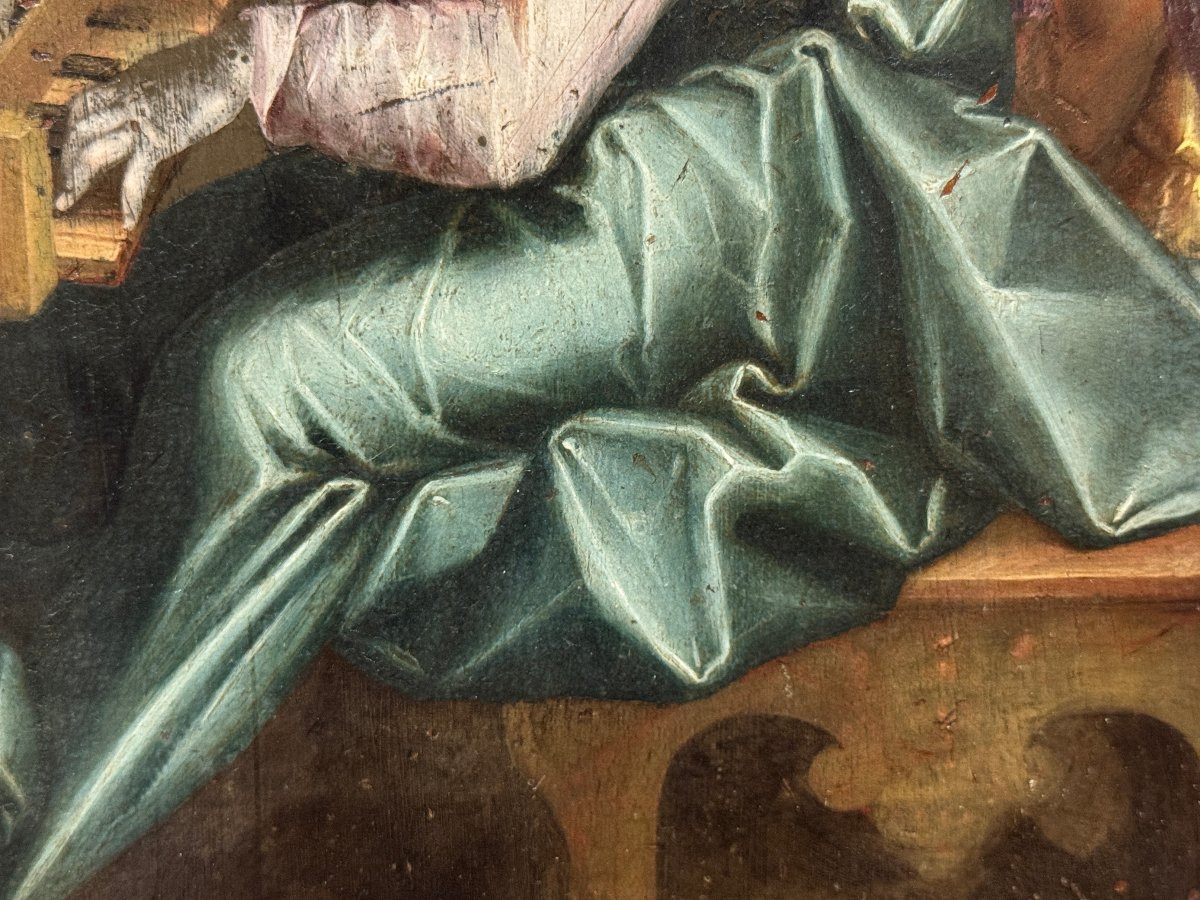
In the production of the Antwerp school around 1600, and in particular in the catalog linked to the workshop of Frans Francken le Jeune, the representation of Saint Cecilia acquires a sophistication that transcends hagiography to become an exaltation of total art. The composition captures the mystical moment of her betrothal to Valerian, when, in the face of the tumult of earthly festivities, the saint withdraws into transcendent silence; it is the visual embodiment of the cantabat in corde suo Domino, the silent song of the soul that rises to the divine when her fingers brush the keyboard. The scene is wrapped in an exquisite drapery that, with its vibrant metallic and iridescent folds, seems to visually orchestrate the celestial harmony that the angels, in a delicate play of foreshortenings, accompany from the ethereal plane.
Beyond its religious significance, this panel is a precious testimony to organology in the Southern Netherlands, reflecting the Flemish fascination with technical precision. The wind organ - an instrument at the height of its popularity in European music at the time - is depicted with almost scientific accuracy: from the arrangement of the alloy pipes to the bellows operated with rhythmic patience, the viewer can almost perceive the flow of air transformed into sound. In Francken's composition, the music of earth and the music of heaven converge in an architecture of wood and metal, reminding us that for Antwerp's Christian humanism, perfection of form was the most direct means of representing the harmony of the spheres.
- Image size unframed: 18 x 24 cm / 34 x 40.5 cm with a unique carved and gilded wood frame, custom-made in the mid-18th century.
In the production of the Antwerp school around 1600, and in particular in the catalog linked to the workshop of Frans Francken le Jeune, the representation of Saint Cecilia acquires a sophistication that transcends hagiography to become an exaltation of total art. The composition captures the mystical moment of her betrothal to Valerian, when, in the face of the tumult of earthly festivities, the saint withdraws into transcendent silence; it is the visual embodiment of the cantabat in corde suo Domino, the silent song of the soul that rises to the divine when her fingers brush the keyboard. The scene is wrapped in an exquisite drapery that, with its vibrant metallic and iridescent folds, seems to visually orchestrate the celestial harmony that the angels, in a delicate play of foreshortenings, accompany from the ethereal plane.
Beyond its religious significance, this panel is a precious testimony to organology in the Southern Netherlands, reflecting the Flemish fascination with technical precision. The wind organ - an instrument at the height of its popularity in European music at the time - is depicted with almost scientific accuracy: from the arrangement of the alloy pipes to the bellows operated with rhythmic patience, the viewer can almost perceive the flow of air transformed into sound. In Francken's composition, the music of earth and the music of heaven converge in an architecture of wood and metal, reminding us that for Antwerp's Christian humanism, perfection of form was the most direct means of representing the harmony of the spheres.
- Image size unframed: 18 x 24 cm / 34 x 40.5 cm with a unique carved and gilded wood frame, custom-made in the mid-18th century.
2 600 €
Period: 17th century
Style: Renaissance, Louis 13th
Condition: Excellent condition
Material: Oil painting on wood
Reference (ID): 1738439
Availability: In stock
Print