

Allegory Of The Four Elements. Antwerp School, Early XVIIᵉ Century
Oil on cradled panel. Antwerp school of the first third of the 17th century, entourage of Jan Brueghel le Jeune and Hendrick van Balen.
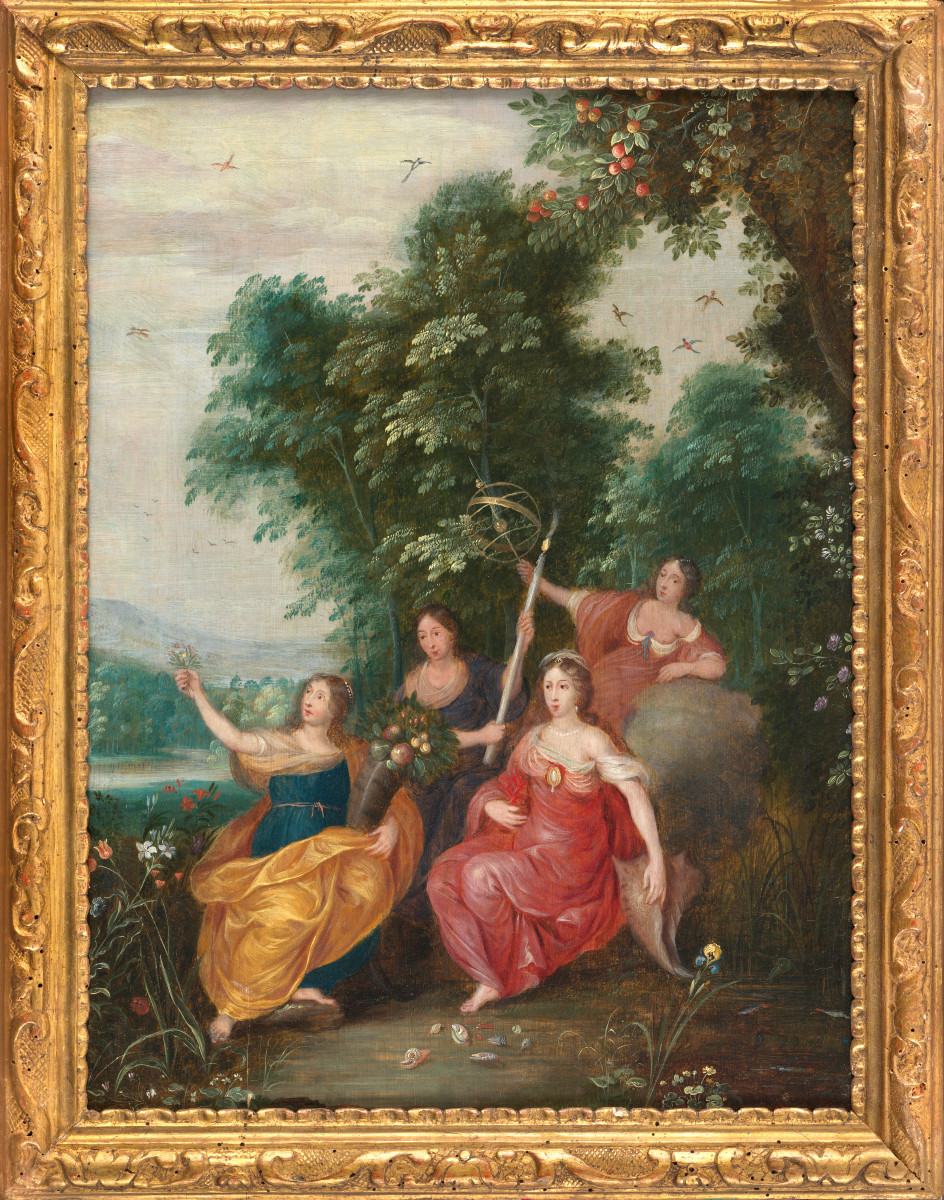
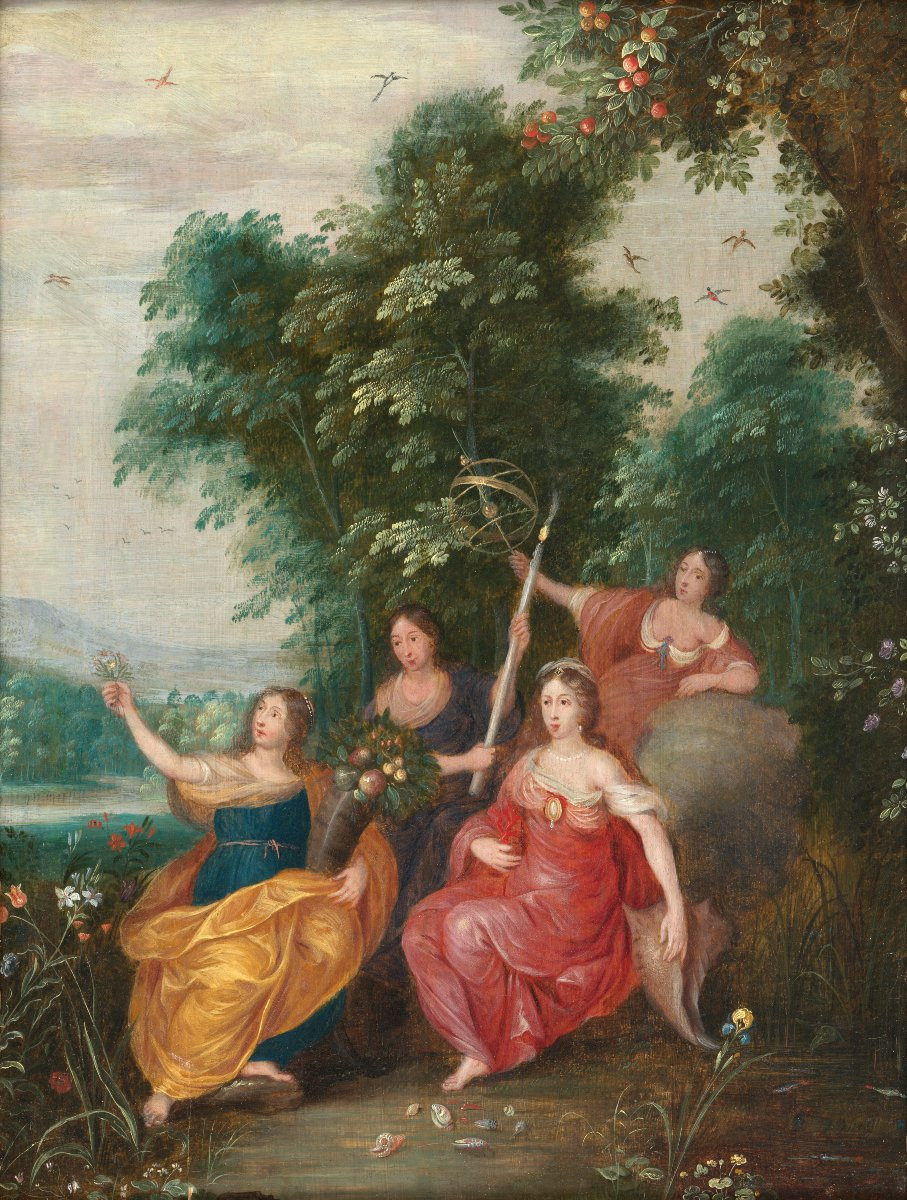
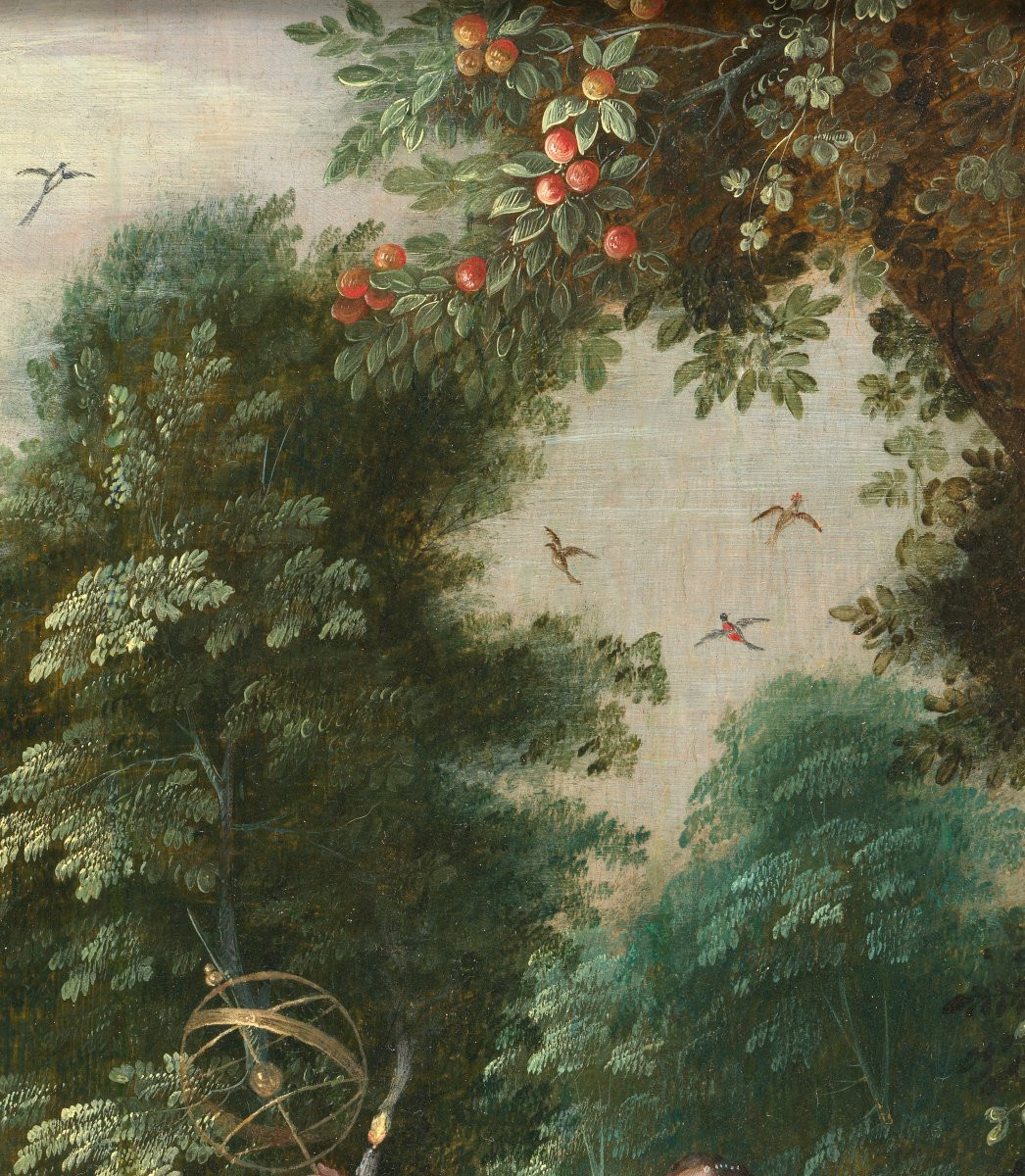
Our delicate composition is fully in the tradition of the tradition of "multi-voiced" or "multi-handed" works that abounded in Antwerp's artistic breeding ground in the first half of the 17th century. Gathered in a wooded clearing, female figures converse in an almost musical harmony, embodying the fundamental elements of nature : Air, Earth, Water and Fire. Our four protagonists are immersed a plant world of slender trees and foliage hemmed in light. They surrounded by a multitude of naturalistic details, sprinkled here and there like slivers of life, like bursts of life, all of which hark back to the landscape vocabulary developed by Jan Brueghel the Younger and his circle in the 1620s and 1630s. Figures, with their elegant, elongated forms and Mannerist grace, the influence of Hendrick van Balen, placing the work in the figurative tradition of his workshop.
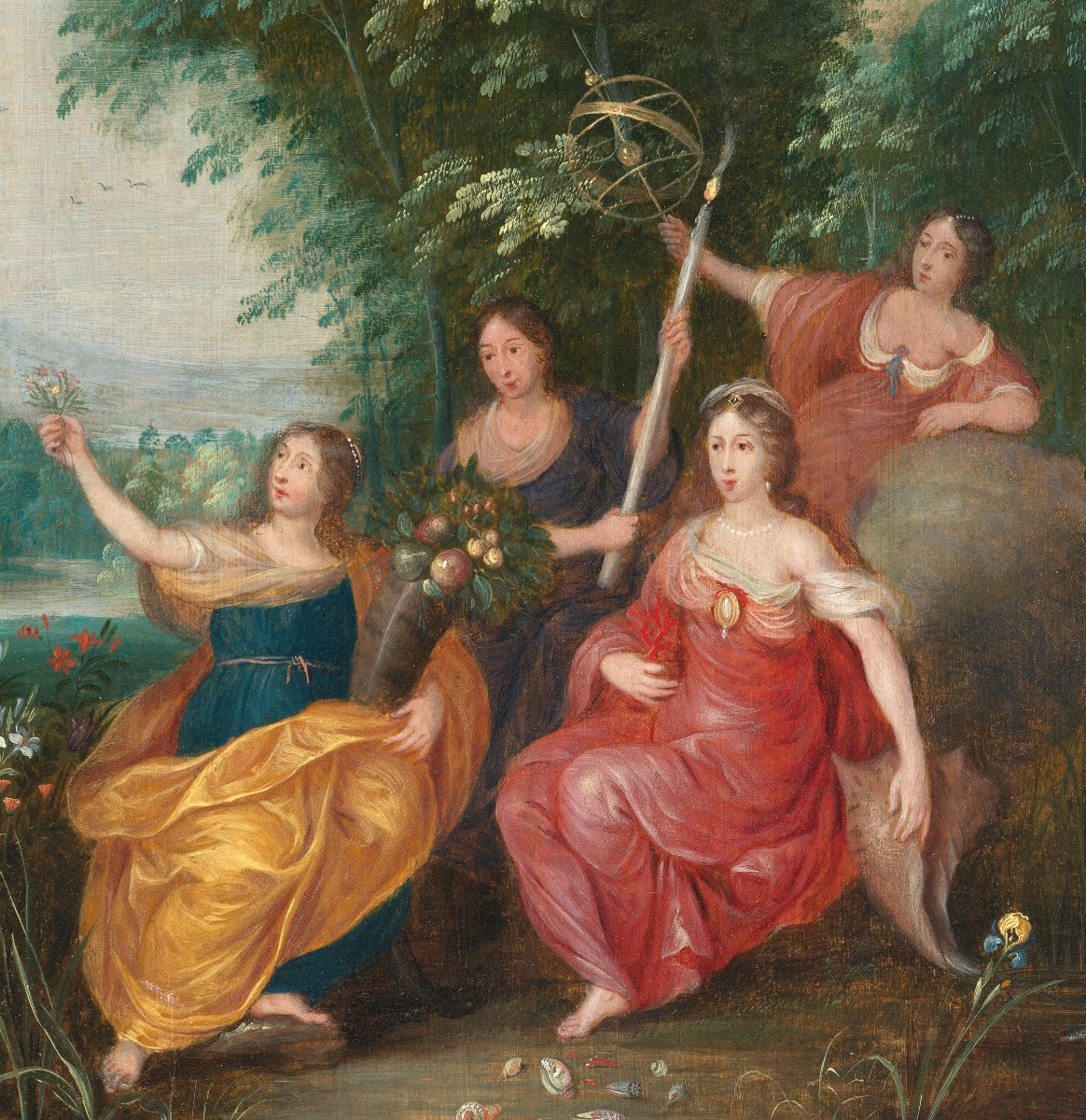
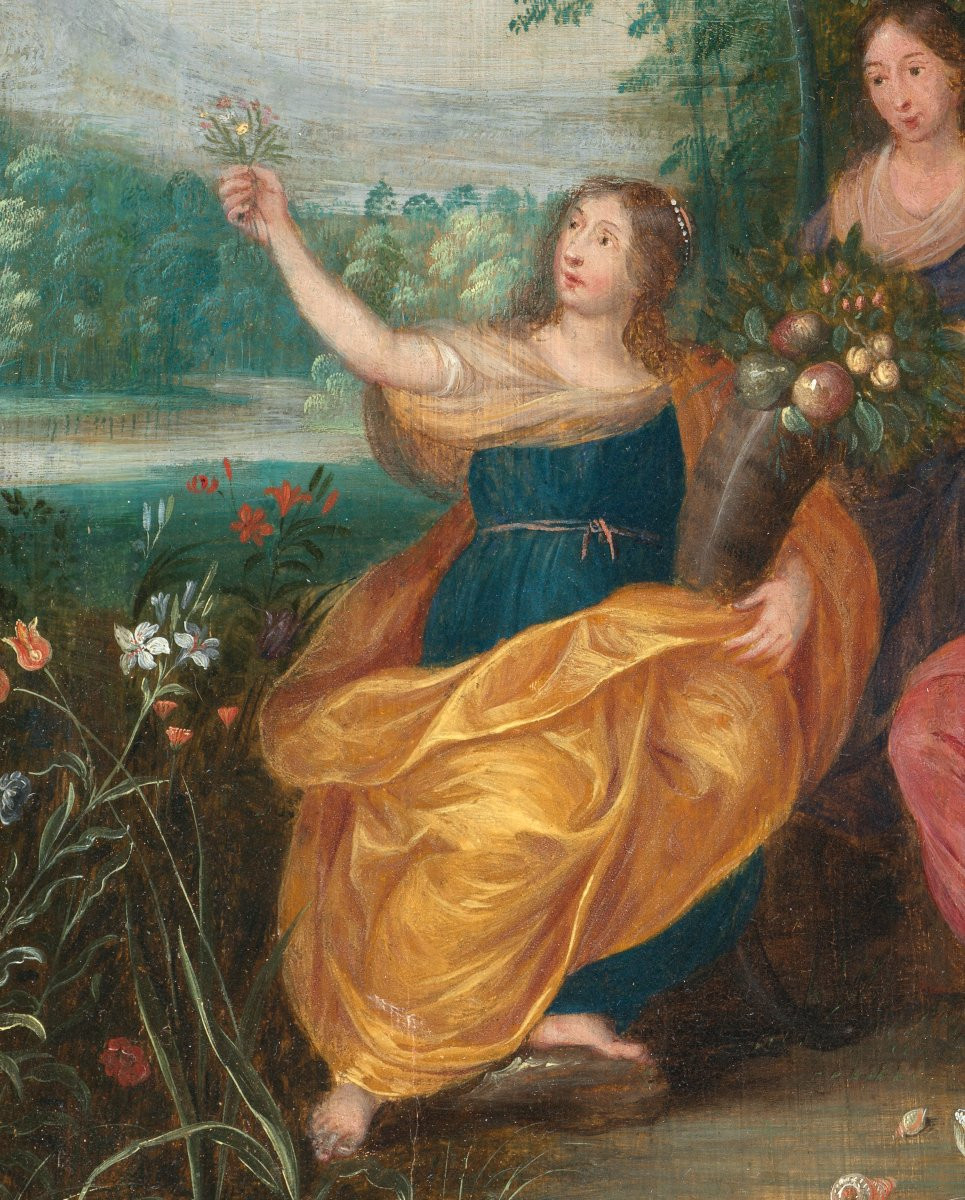
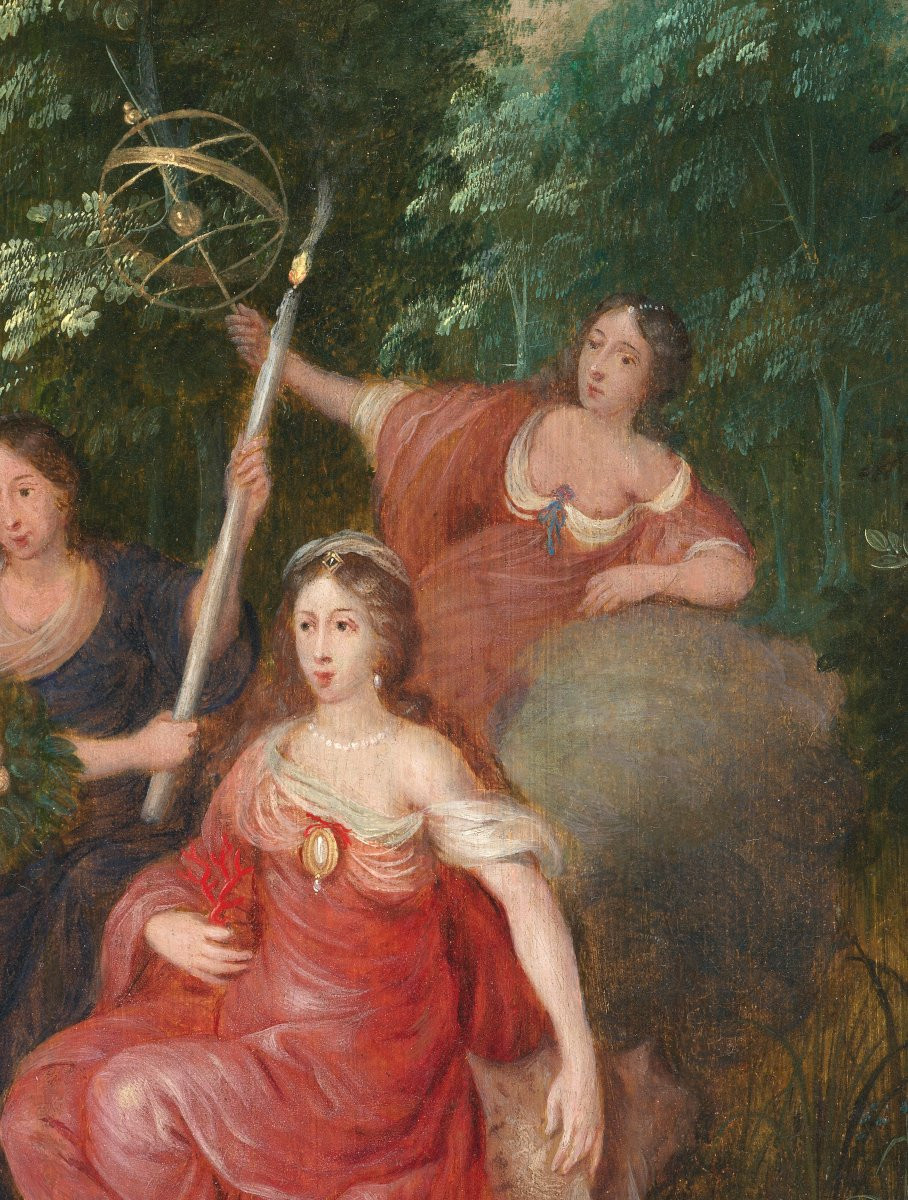
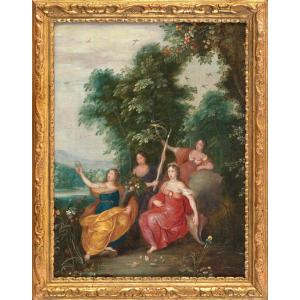
The identification of the Elements is based on a perfectly codified iconographic repertoire: Air is represented by the figure holding an armillary sphere, symbolizing celestial movements. Earth is represented by a woman brandishing a bouquet of flowers and holding a cornucopia, a symbol of fertility evoking inexhaustible resources. Water is suggested by the large conch on which the figure seated in the center is leaning, as well as by the coral branch and the shells scattered at her feet. Finally, Fire is represented by the large candle or torch that the last young woman raises, completing the symbolic balance of the scene. Allegorical subjects were popular in Antwerp at the beginning of the Siècle d'Or, they enabled artists to combine erudition, narrative charm and technical virtuosity.
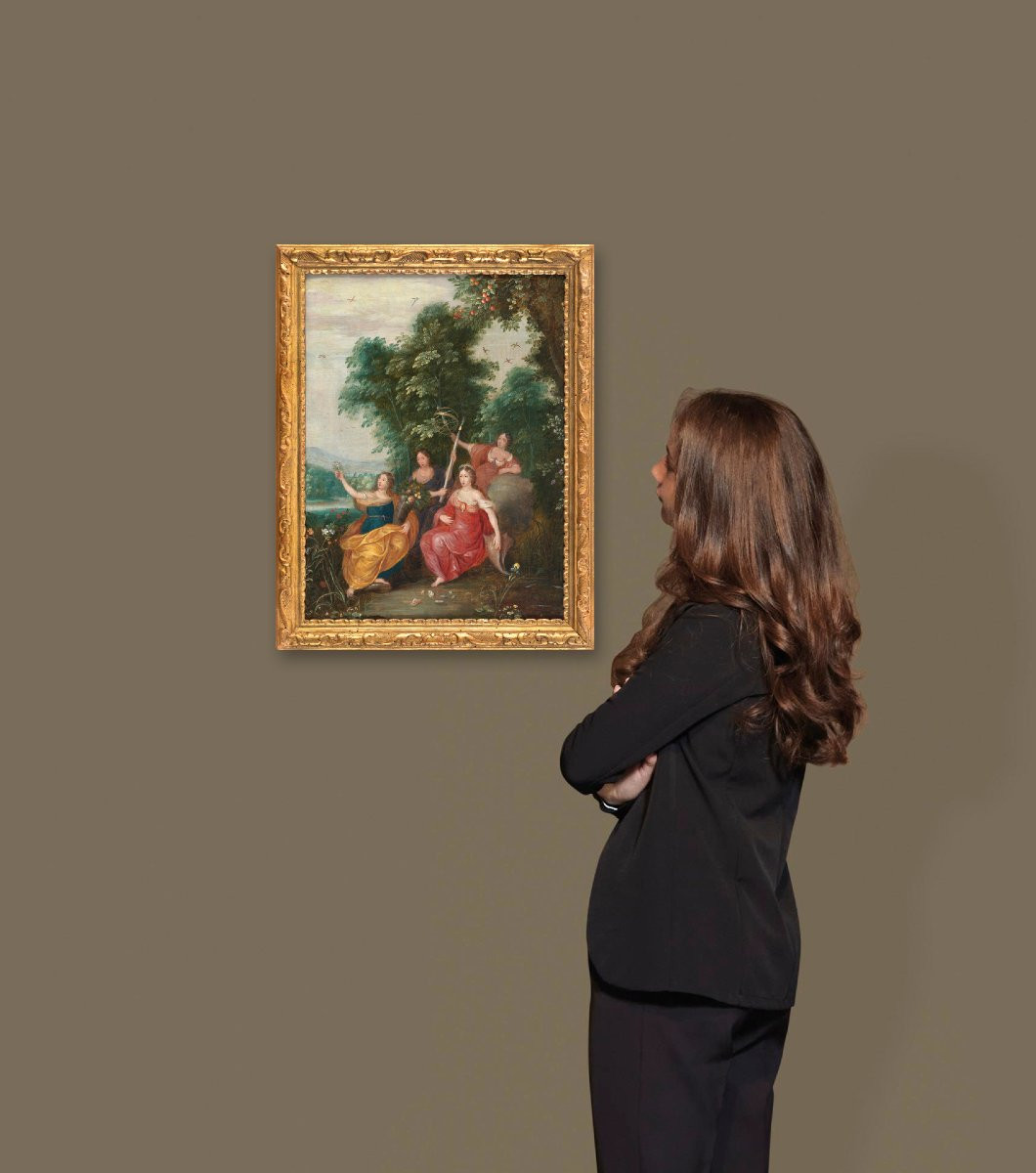
Bérain's carved and gilded wood baguette harmonizes perfectly with our delicate composition.
Dimensions : 49 x 36.5 cm - 55 x 43 cm with frame
Sold with invoice and certificate of authenticity
Jan Brueghel the Younger (1601-1678) and Hendrick van Balen(1575-1632) belonged to this Baroque Antwerp where workshops of exchange and circulation. Heir to a prestigious lineage, Brueghel the Younger continued the art of meticulous landscapes, populated allegories with while Van Balen, respected master of the guild, imposed his luminous figures, nymphs and putti with graceful gestures. Their paths naturally converged in the years 1610-1630, in the heart of a city where painting was often done by several hands. Van Balen lends his elegant figures, Brueghel his chiseled landscapes: a dialogue of shapes and colors inherited from collaborations with Jan Brueghel the Elder. Both gravitated in Rubens' orbit, sharing his patronage and models, and shared the same open studio culture where talents respond to each other.
Bibliography:
- Balis Arnout, The Age of Rubens, Museum of Fine Arts, Boston, 1993
- Brueghel and Van Balen. Artists and accomplice. Catalog of the exhibition presented at the Museum of Flanders in Cassel, May 17 toSeptember 28, 2025, Snoeck Gent, 2025
- ErtzKlaus, Jan Brueghel der Jüngere. Die Gemälde, Lingen, 1984
- ErtzKlaus, Nitze-Ertz Christa, Die Malerfamilie Brueghel, Lingen, 2008-2014
- Ertz Klaus, Hendrick van Balen (1575-1632). DieGemälde, Lingen, 2003
- LiedtkeWalter, Flemish Paintings in the Metropolitan Museum of Art, New York, 1984
- VliegheHans, Flemish Art and Architecture 1585-1700, Yale University Press, 1998
- WoollettAnne, Van Suchtelen Ariane, Rubens & Brueghel: A Working Friendship, GettyMuseum, 2006
Our delicate composition is fully in the tradition of the tradition of "multi-voiced" or "multi-handed" works that abounded in Antwerp's artistic breeding ground in the first half of the 17th century. Gathered in a wooded clearing, female figures converse in an almost musical harmony, embodying the fundamental elements of nature : Air, Earth, Water and Fire. Our four protagonists are immersed a plant world of slender trees and foliage hemmed in light. They surrounded by a multitude of naturalistic details, sprinkled here and there like slivers of life, like bursts of life, all of which hark back to the landscape vocabulary developed by Jan Brueghel the Younger and his circle in the 1620s and 1630s. Figures, with their elegant, elongated forms and Mannerist grace, the influence of Hendrick van Balen, placing the work in the figurative tradition of his workshop.
The identification of the Elements is based on a perfectly codified iconographic repertoire: Air is represented by the figure holding an armillary sphere, symbolizing celestial movements. Earth is represented by a woman brandishing a bouquet of flowers and holding a cornucopia, a symbol of fertility evoking inexhaustible resources. Water is suggested by the large conch on which the figure seated in the center is leaning, as well as by the coral branch and the shells scattered at her feet. Finally, Fire is represented by the large candle or torch that the last young woman raises, completing the symbolic balance of the scene. Allegorical subjects were popular in Antwerp at the beginning of the Siècle d'Or, they enabled artists to combine erudition, narrative charm and technical virtuosity.
Bérain's carved and gilded wood baguette harmonizes perfectly with our delicate composition.
Dimensions : 49 x 36.5 cm - 55 x 43 cm with frame
Sold with invoice and certificate of authenticity
Jan Brueghel the Younger (1601-1678) and Hendrick van Balen(1575-1632) belonged to this Baroque Antwerp where workshops of exchange and circulation. Heir to a prestigious lineage, Brueghel the Younger continued the art of meticulous landscapes, populated allegories with while Van Balen, respected master of the guild, imposed his luminous figures, nymphs and putti with graceful gestures. Their paths naturally converged in the years 1610-1630, in the heart of a city where painting was often done by several hands. Van Balen lends his elegant figures, Brueghel his chiseled landscapes: a dialogue of shapes and colors inherited from collaborations with Jan Brueghel the Elder. Both gravitated in Rubens' orbit, sharing his patronage and models, and shared the same open studio culture where talents respond to each other.
Bibliography:
- Balis Arnout, The Age of Rubens, Museum of Fine Arts, Boston, 1993
- Brueghel and Van Balen. Artists and accomplice. Catalog of the exhibition presented at the Museum of Flanders in Cassel, May 17 toSeptember 28, 2025, Snoeck Gent, 2025
- ErtzKlaus, Jan Brueghel der Jüngere. Die Gemälde, Lingen, 1984
- ErtzKlaus, Nitze-Ertz Christa, Die Malerfamilie Brueghel, Lingen, 2008-2014
- Ertz Klaus, Hendrick van Balen (1575-1632). DieGemälde, Lingen, 2003
- LiedtkeWalter, Flemish Paintings in the Metropolitan Museum of Art, New York, 1984
- VliegheHans, Flemish Art and Architecture 1585-1700, Yale University Press, 1998
- WoollettAnne, Van Suchtelen Ariane, Rubens & Brueghel: A Working Friendship, GettyMuseum, 2006
11 000 €
Period: 17th century
Style: Renaissance, Louis 13th
Condition: Good condition
Material: Oil painting on wood
Width: 43
Height: 55
Reference (ID): 1762504
Availability: In stock
Print