THIS OBJECT WAS SOLD
Maximilien Fiot (1886-1953) Greyhound Race
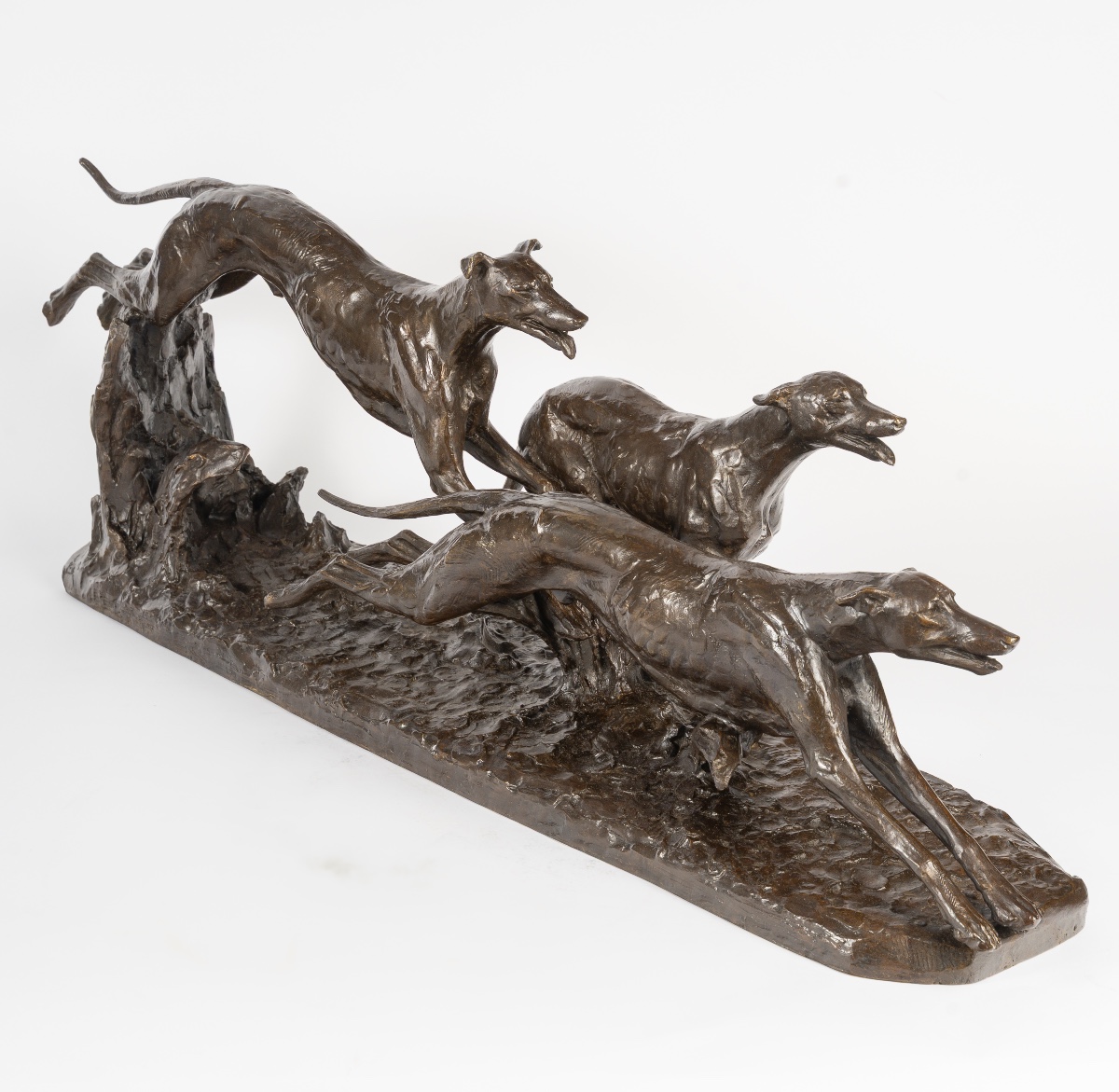

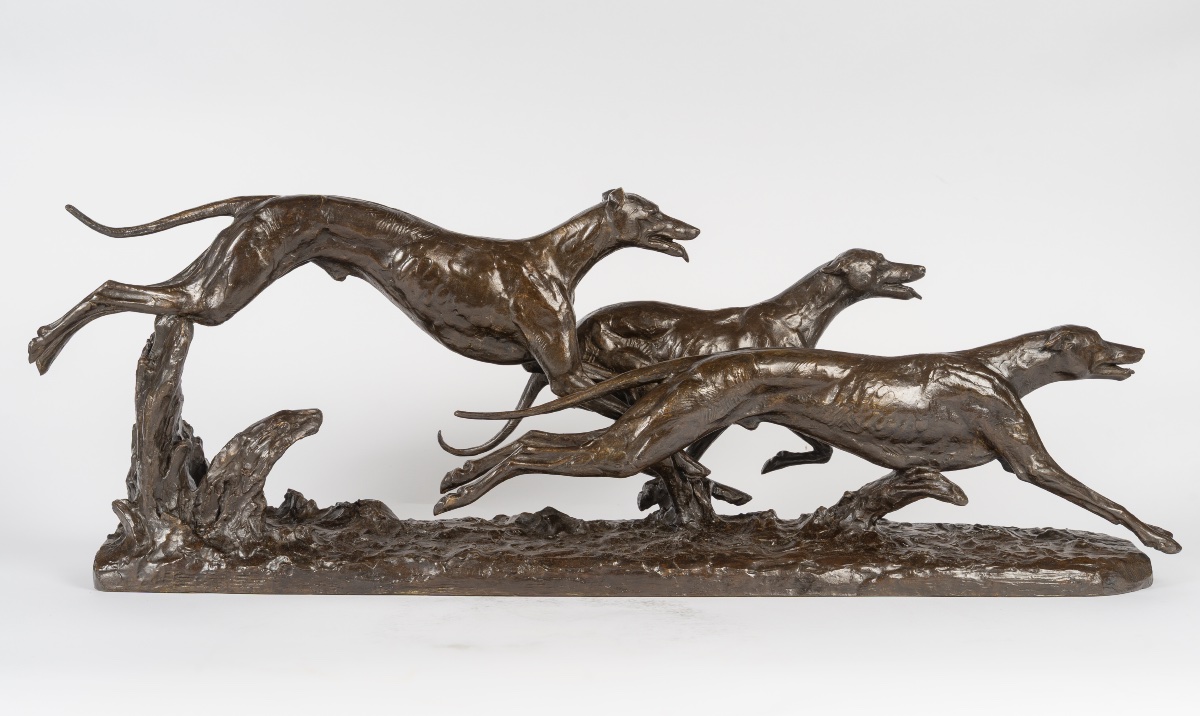
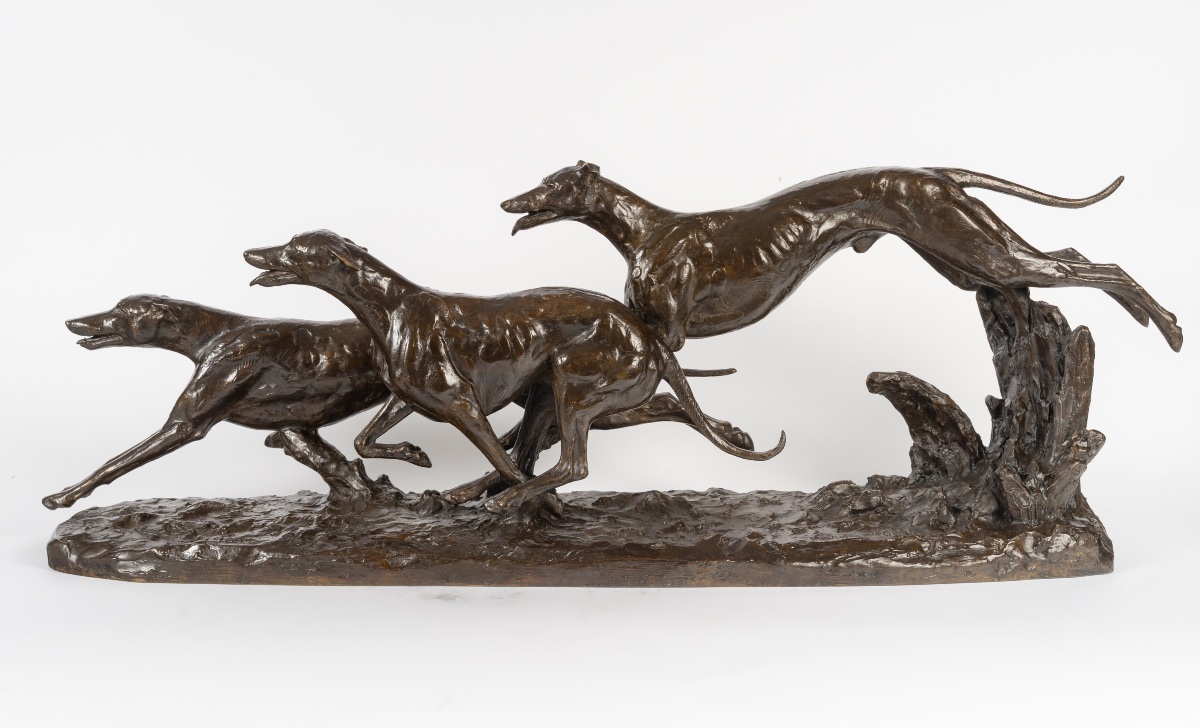


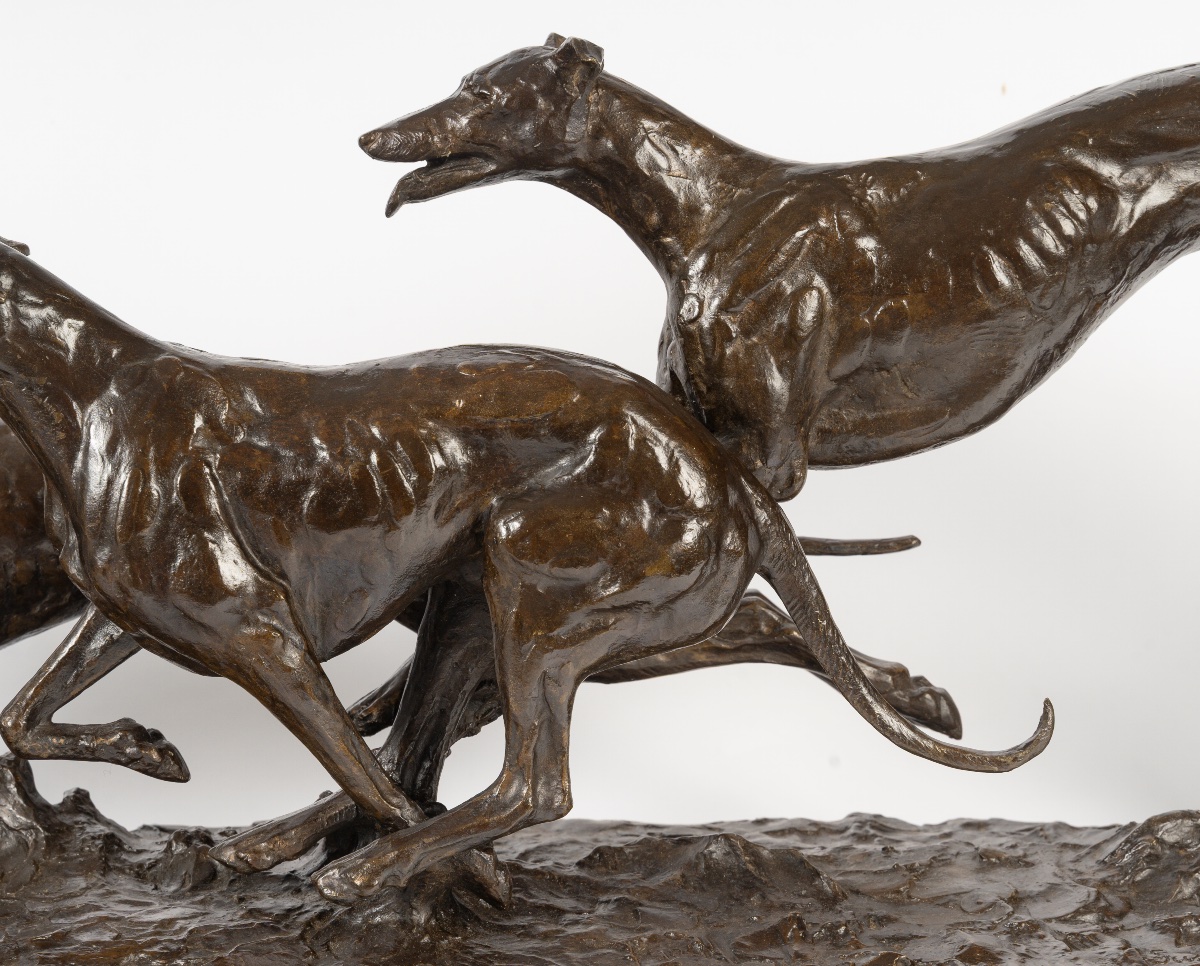


Race of three greyhounds.
Bronze with dark brown patina, signed M. Fiot on the base.
Old cast, during the artist's lifetime, with lost wax from the house of Susse Frères.
Circa 1930
Features
Signature of sculptor M. Fiot on the base.
Pastille of founder Susse Frères and numbered 1.
Mention "Susse Frères Editeurs Paris".
Mention "cire perdue" indicating the casting technique.
"Bronze" stamp.
Dimensions
Width 94 cm
Height 32 cm
Depth 21 cm
Maximilien Fiot biography.
Maximilien Fiot was born in 1886 in Touraine (Le Grand-Pressigny). Fiot began an apprenticeship with the sculptor Prosper Lecourtier, who had himself studied with Fremiet, and pursued a career as an animal sculptor, with dogs being his main specialty. For his first appearance at the Salon des Artistes Français in 1904, Fiot exhibited a plaster dog. At the time, he was only eighteen and led a very modest existence, living in a small house in Nogent-sur-Marne, a village in the countryside just outside Paris, a region much favored by Impressionist painters. The following year, he was awarded a Medal of Honor. This was followed by a bronze medal in 1911 and a silver one in 1913.
After the First World War, Fiot worked on several war memorials. He continued to exhibit at the "Salon des Artistes Français", becoming a member in the 1920s. Fiot created birds, horses, dogs, felines and wild animals from French forests: in particular, he created his wild boar group and a Fawn, which he exhibited at the 1928 Salon.
He was a naturalist sculptor, a contemporary of Pompon. He did not stylize his models, but depicted them in the serene attitudes of their daily lives. His style is modern, dynamic and refined, distinguishing him from other sculptors of his time, whose more static works are marked by the Art Deco style. Fiot's bronzes are distinguished by their observation of movement, which gives his subjects vitality and a striking likeness.
The majority of his works were reproduced in bronze, by the Susse foundry, using the lost-wax process. Some of his early bronzes were cast by other foundries. He also produced original terracottas, which may have been preparatory studies for his stone pieces. He often depicts animals in pairs or groups. At the 1933 Salon, he won a gold medal, which placed him out of the competition, i.e. excluded from future competitions. He continued to work until his death in 1953 in Corbeil, Essonne.
Biography of the Susse Frères foundry:
The house of Susse Frères, originally founded in 1758 in Paris, evolved in the 19th century into one of France's most important art foundry-publishers. The Susse brothers developed bronze casting from the 1830s-1840s, acquired a foundry and signed publishing contracts with major sculptors; the company was particularly renowned for the finesse of its prints and the careful application of patinas. Susse has published and reproduced works and models by sculptors such as Pierre-Jules Mêne, Jean-Baptiste Carpeaux and Jules Dalou, and remains a benchmark for nineteenth- and twentieth-century bronzes.
Bronze with dark brown patina, signed M. Fiot on the base.
Old cast, during the artist's lifetime, with lost wax from the house of Susse Frères.
Circa 1930
Features
Signature of sculptor M. Fiot on the base.
Pastille of founder Susse Frères and numbered 1.
Mention "Susse Frères Editeurs Paris".
Mention "cire perdue" indicating the casting technique.
"Bronze" stamp.
Dimensions
Width 94 cm
Height 32 cm
Depth 21 cm
Maximilien Fiot biography.
Maximilien Fiot was born in 1886 in Touraine (Le Grand-Pressigny). Fiot began an apprenticeship with the sculptor Prosper Lecourtier, who had himself studied with Fremiet, and pursued a career as an animal sculptor, with dogs being his main specialty. For his first appearance at the Salon des Artistes Français in 1904, Fiot exhibited a plaster dog. At the time, he was only eighteen and led a very modest existence, living in a small house in Nogent-sur-Marne, a village in the countryside just outside Paris, a region much favored by Impressionist painters. The following year, he was awarded a Medal of Honor. This was followed by a bronze medal in 1911 and a silver one in 1913.
After the First World War, Fiot worked on several war memorials. He continued to exhibit at the "Salon des Artistes Français", becoming a member in the 1920s. Fiot created birds, horses, dogs, felines and wild animals from French forests: in particular, he created his wild boar group and a Fawn, which he exhibited at the 1928 Salon.
He was a naturalist sculptor, a contemporary of Pompon. He did not stylize his models, but depicted them in the serene attitudes of their daily lives. His style is modern, dynamic and refined, distinguishing him from other sculptors of his time, whose more static works are marked by the Art Deco style. Fiot's bronzes are distinguished by their observation of movement, which gives his subjects vitality and a striking likeness.
The majority of his works were reproduced in bronze, by the Susse foundry, using the lost-wax process. Some of his early bronzes were cast by other foundries. He also produced original terracottas, which may have been preparatory studies for his stone pieces. He often depicts animals in pairs or groups. At the 1933 Salon, he won a gold medal, which placed him out of the competition, i.e. excluded from future competitions. He continued to work until his death in 1953 in Corbeil, Essonne.
Biography of the Susse Frères foundry:
The house of Susse Frères, originally founded in 1758 in Paris, evolved in the 19th century into one of France's most important art foundry-publishers. The Susse brothers developed bronze casting from the 1830s-1840s, acquired a foundry and signed publishing contracts with major sculptors; the company was particularly renowned for the finesse of its prints and the careful application of patinas. Susse has published and reproduced works and models by sculptors such as Pierre-Jules Mêne, Jean-Baptiste Carpeaux and Jules Dalou, and remains a benchmark for nineteenth- and twentieth-century bronzes.
Explore similar pieces and discover your ideal find:
Bronze Animal Sculptures