

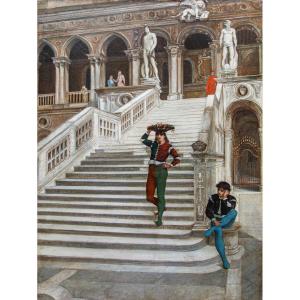


19th Century, The Giants' Staircase Of The Ducal Palace Of Venice
19th century
The Giants' Staircase of the Ducal Palace of Venice
Oil on canvas, 69 x 98 cm – with frame, 107 x 80 cm
Signed bottom left Alex …
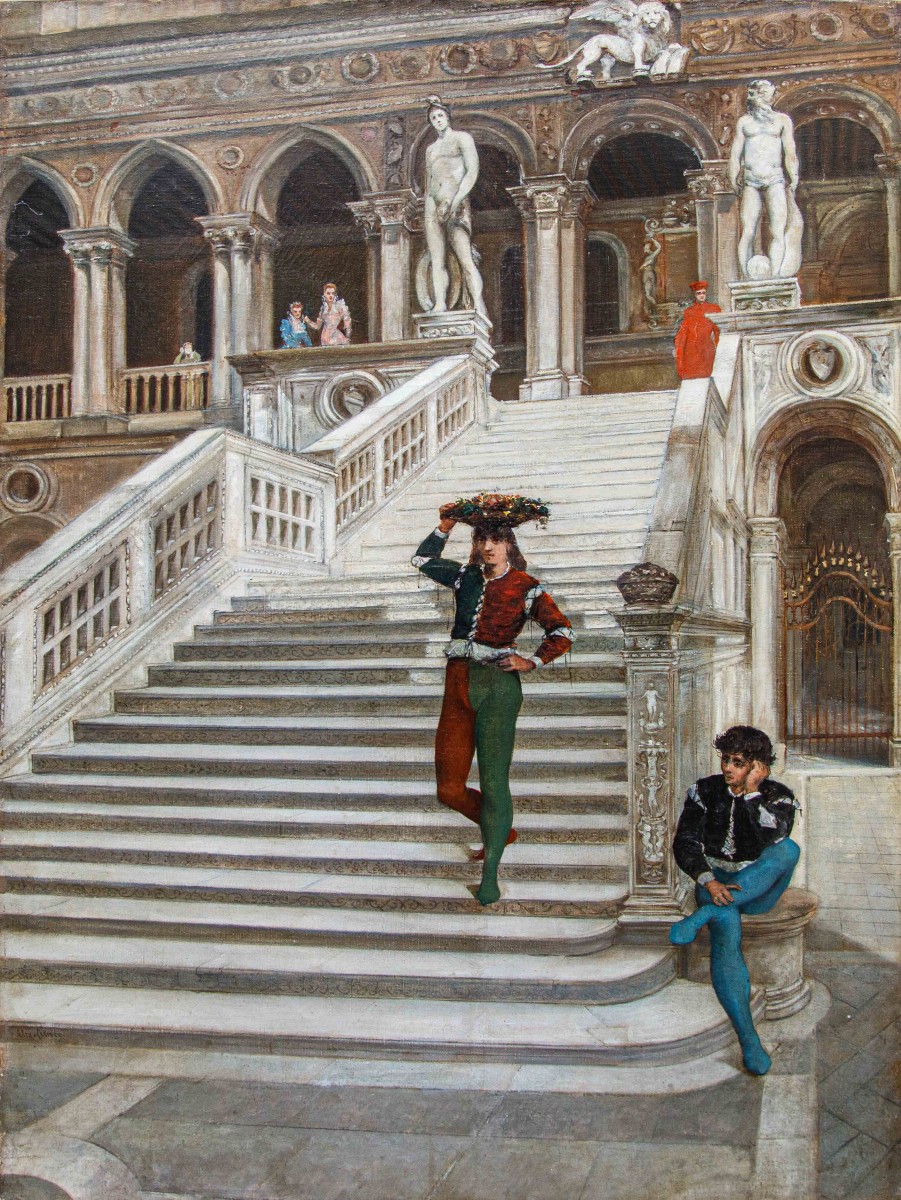
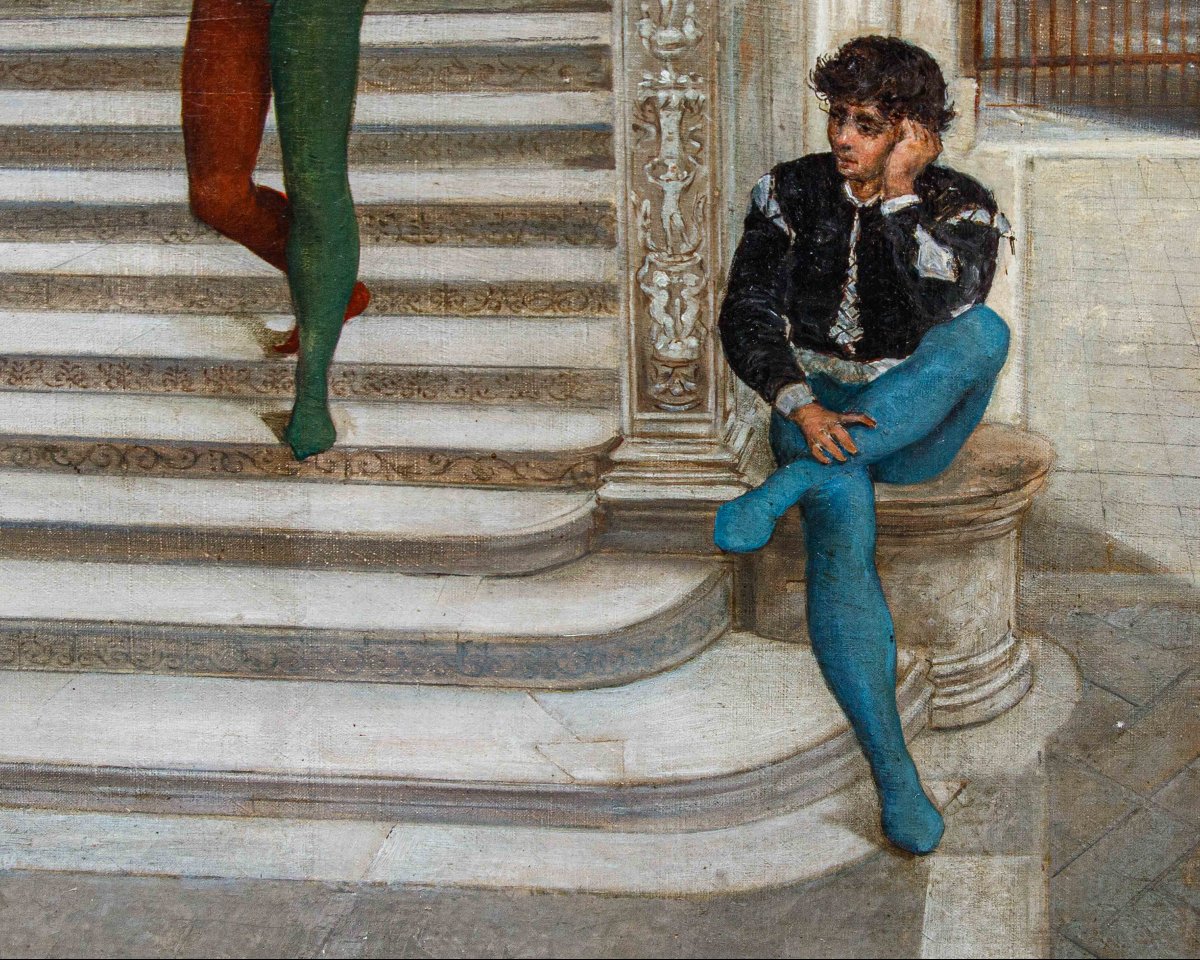
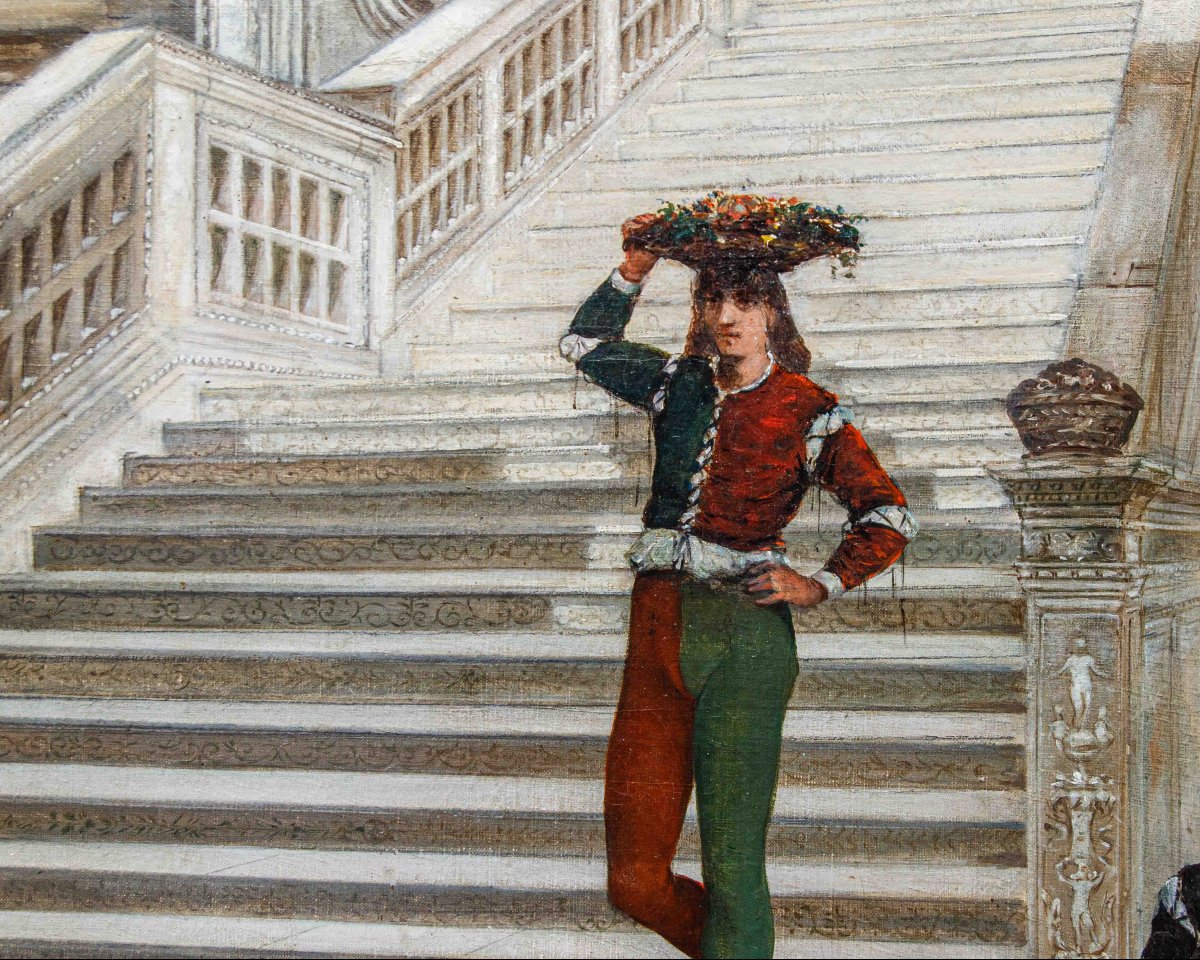
This 19th-century painting represents an evocative genre scene set on the famous Giants' Staircase of the Doge's Palace in Venice. The work fits into that vein of nineteenth-century academic and historicist painting that loved to recall the glories of the Serenissima, mixing observation from life with an idealized and melancholic reconstruction of the past. The composition is dominated by the powerful marble architecture of the staircase. In the center, a young man in Renaissance costumes –a two-tone red and green jacket and matching tights– descends the steps carrying a basket on his head, a detail that lends a touch of everyday, popular life to the solemnity of the place. At the bottom right, a second young man sits on the balustrade in a pensive, languid pose typical of romantic sensibilities. In the background, between the arches of the loggia, other figures in period dress can be glimpsed, suggesting a narrative suspended in time. The painting technique reveals a meticulous attention to the rendering of materials: the marble of the staircase, the Istrian stone of the palace and the fabrics of the clothes are described with an almost photographic precision, typical of 19th-century academic training. The painting reflects the legacy of Italian Neoclassicism, which in the 19th century evolved towards Purism and Historicism. If eighteenth-century Neoclassicism sought an aesthetic and moral canon of absolute perfection in the ancient (Greek and Roman), the painting of the following century carried out a recovery of the ancient understood as the "national past". In Italy, this meant looking nostalgically not only at classical antiquity, but also at the Renaissance. The sculpted figures above the staircase in the painting represent the ideal of classical beauty integrated into Venetian architecture, a symbol of cultural continuity that nineteenth-century painters celebrated to reaffirm Italian artistic identity in a century of great political transformation. The Giants' Staircase, the monumental heart of the Doge's Palace, was designed at the end of the 15th century by Antonio Rizzo. It is the place where the solemn coronation ceremony of the Doge took place, who received the "Zoglia" (the ducal horn) right at the top of the podium, to be visible to all present in the courtyard. The name of the staircase derives from the two colossal Carrara marble statues placed at its top in 1567, works by Jacopo Sansovino: they depict Mars and Neptune. The deities symbolize the dominion of the Republic of Venice over land and sea respectively. The architecture of the staircase itself is a triumph of Renaissance decoration, with marble inlays and reliefs making it one of the finest examples of a celebration of the Doge's power. In the painting, the presence of these imposing statues behind the human figures serves to underline the contrast between the eternal grandeur of the myth (and history of Venice) and the transience of everyday life.
The Giants' Staircase of the Ducal Palace of Venice
Oil on canvas, 69 x 98 cm – with frame, 107 x 80 cm
Signed bottom left Alex …
This 19th-century painting represents an evocative genre scene set on the famous Giants' Staircase of the Doge's Palace in Venice. The work fits into that vein of nineteenth-century academic and historicist painting that loved to recall the glories of the Serenissima, mixing observation from life with an idealized and melancholic reconstruction of the past. The composition is dominated by the powerful marble architecture of the staircase. In the center, a young man in Renaissance costumes –a two-tone red and green jacket and matching tights– descends the steps carrying a basket on his head, a detail that lends a touch of everyday, popular life to the solemnity of the place. At the bottom right, a second young man sits on the balustrade in a pensive, languid pose typical of romantic sensibilities. In the background, between the arches of the loggia, other figures in period dress can be glimpsed, suggesting a narrative suspended in time. The painting technique reveals a meticulous attention to the rendering of materials: the marble of the staircase, the Istrian stone of the palace and the fabrics of the clothes are described with an almost photographic precision, typical of 19th-century academic training. The painting reflects the legacy of Italian Neoclassicism, which in the 19th century evolved towards Purism and Historicism. If eighteenth-century Neoclassicism sought an aesthetic and moral canon of absolute perfection in the ancient (Greek and Roman), the painting of the following century carried out a recovery of the ancient understood as the "national past". In Italy, this meant looking nostalgically not only at classical antiquity, but also at the Renaissance. The sculpted figures above the staircase in the painting represent the ideal of classical beauty integrated into Venetian architecture, a symbol of cultural continuity that nineteenth-century painters celebrated to reaffirm Italian artistic identity in a century of great political transformation. The Giants' Staircase, the monumental heart of the Doge's Palace, was designed at the end of the 15th century by Antonio Rizzo. It is the place where the solemn coronation ceremony of the Doge took place, who received the "Zoglia" (the ducal horn) right at the top of the podium, to be visible to all present in the courtyard. The name of the staircase derives from the two colossal Carrara marble statues placed at its top in 1567, works by Jacopo Sansovino: they depict Mars and Neptune. The deities symbolize the dominion of the Republic of Venice over land and sea respectively. The architecture of the staircase itself is a triumph of Renaissance decoration, with marble inlays and reliefs making it one of the finest examples of a celebration of the Doge's power. In the painting, the presence of these imposing statues behind the human figures serves to underline the contrast between the eternal grandeur of the myth (and history of Venice) and the transience of everyday life.
4 000 €
Period: 19th century
Style: Other Style
Condition: Good condition
Material: Oil painting
Width: 98
Height: 69
Reference (ID): 1726364
Availability: In stock
Print