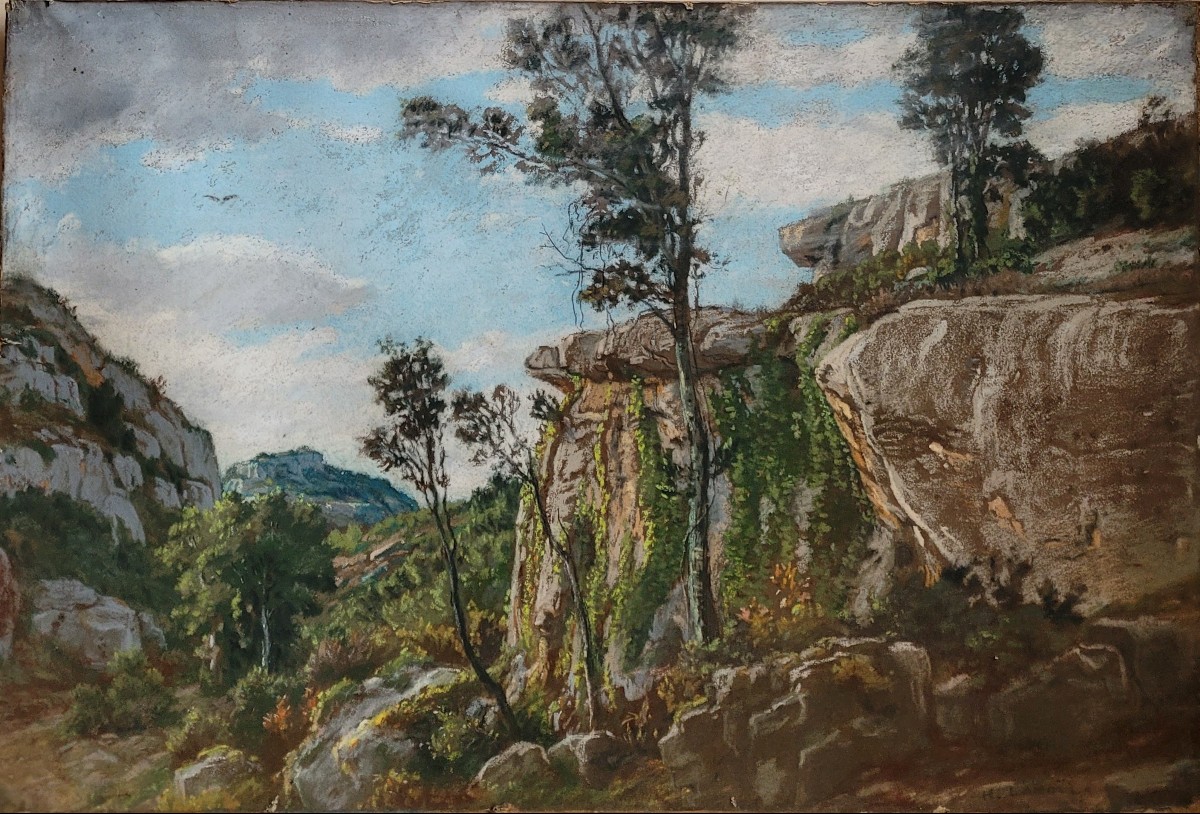
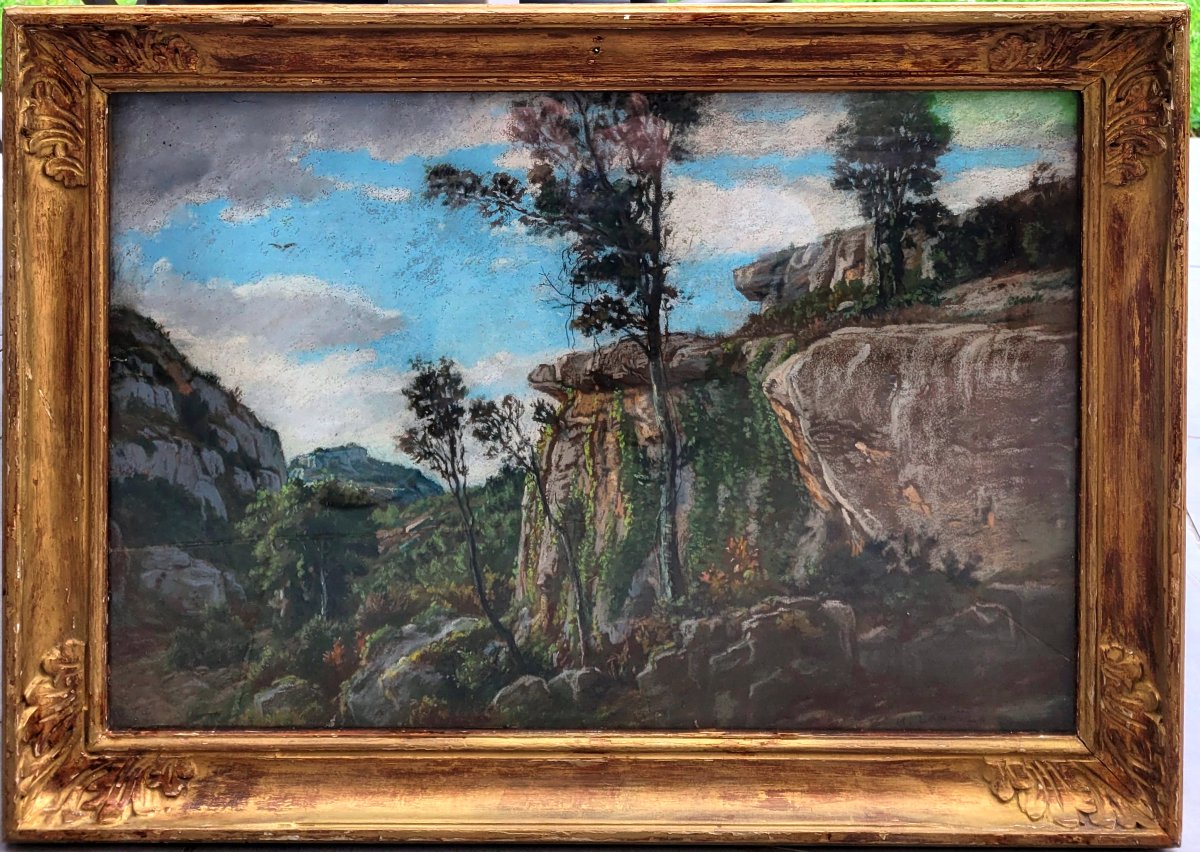



Félix-hippolyte Lanoüe (1812-1872) The Valley
Artist: Félix-hippolyte Lanoüe (1812-1872)
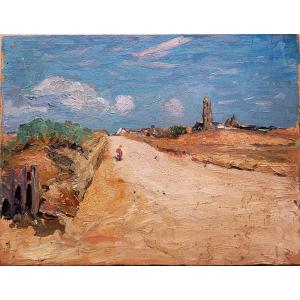
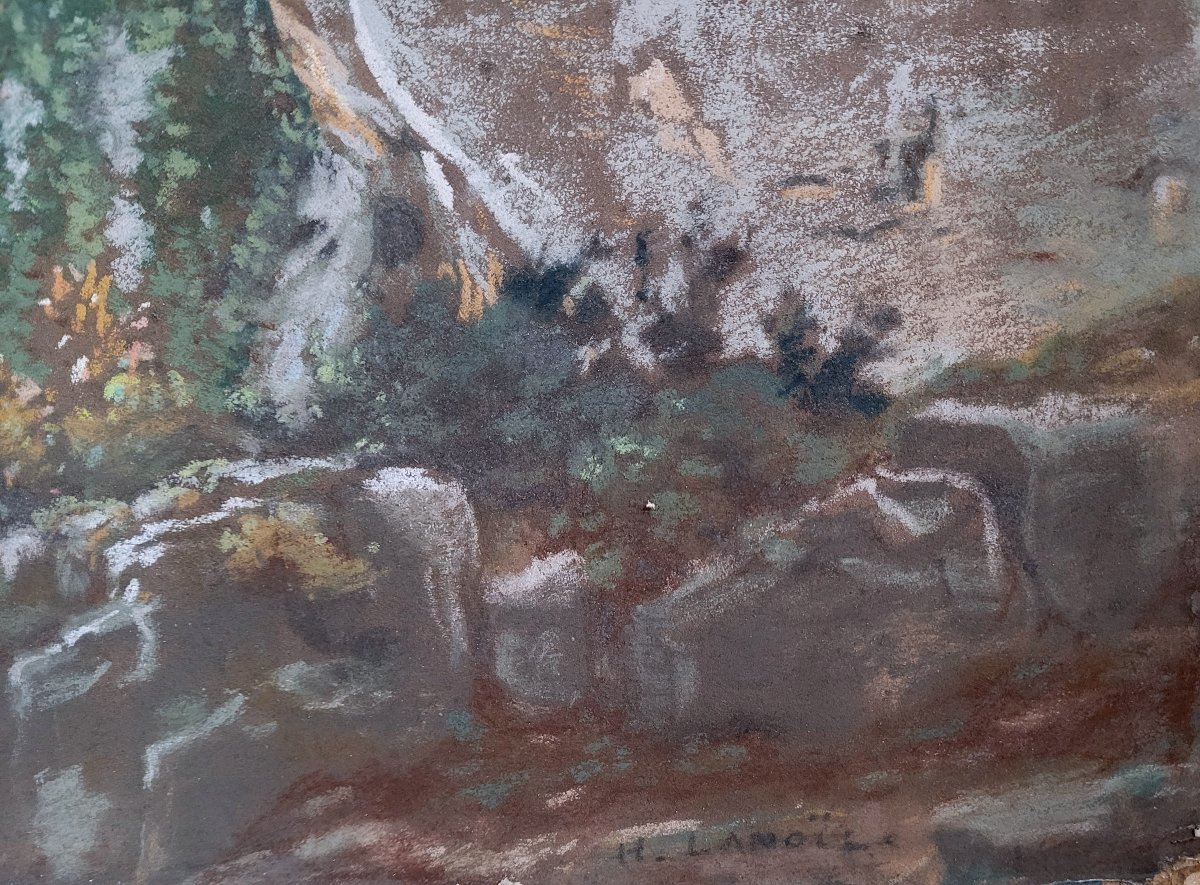
Félix-Hippolyte Lanoüe (1812-1872) The Valley, pastel, 36 x 54 cm, signed lower right. Framed dimensions 45 x 63 cm.
Félix-Hippolyte Lanoüe, born on October 14, 1812 in Versailles and died in the same city on January 21, 1872, was a French landscape painter.
Around 1830, Félix-Hippolyte Lanoüe was a student of Jean-Victor Bertin, then entered the studio of Horace Vernet upon his admission to the École des Beaux-Arts in Paris. He won a prize for perspective in 1832 and a second prize for historical landscape at the Prix de Rome competition in 1837.
He won the grand prize for historical landscape in 1841 with his painting depicting Adam and Eve being expelled from the Garden of Eden by an angel wielding a flaming sword. He debuted at the Paris Salon in 1833 and made his first trip to Rome. His time in Rome interrupted his submissions to the Salons until 1847.
After returning to France, he traveled to the Isère Valley in the South of France, then in 1850 to Holland, and in 1853 to Russia, where he painted landscapes from nature. He won second prize at the Salons of 1847 and 1861 as a naturalist landscape painter. These paintings were appreciated by the bourgeoisie at the height of the Romantic movement. The French state purchased several of his paintings. He produced a series of landscapes of the Fontainebleau forest, which became accessible by rail in 1849. He did not seek to depict an imposing nature, but a more modest image of it, with a certain schematization and a simplification of line and form.
Félix-Hippolyte Lanoüe was made a Knight of the Legion of Honour in 1864.
Félix-Hippolyte Lanoüe, born on October 14, 1812 in Versailles and died in the same city on January 21, 1872, was a French landscape painter.
Around 1830, Félix-Hippolyte Lanoüe was a student of Jean-Victor Bertin, then entered the studio of Horace Vernet upon his admission to the École des Beaux-Arts in Paris. He won a prize for perspective in 1832 and a second prize for historical landscape at the Prix de Rome competition in 1837.
He won the grand prize for historical landscape in 1841 with his painting depicting Adam and Eve being expelled from the Garden of Eden by an angel wielding a flaming sword. He debuted at the Paris Salon in 1833 and made his first trip to Rome. His time in Rome interrupted his submissions to the Salons until 1847.
After returning to France, he traveled to the Isère Valley in the South of France, then in 1850 to Holland, and in 1853 to Russia, where he painted landscapes from nature. He won second prize at the Salons of 1847 and 1861 as a naturalist landscape painter. These paintings were appreciated by the bourgeoisie at the height of the Romantic movement. The French state purchased several of his paintings. He produced a series of landscapes of the Fontainebleau forest, which became accessible by rail in 1849. He did not seek to depict an imposing nature, but a more modest image of it, with a certain schematization and a simplification of line and form.
Félix-Hippolyte Lanoüe was made a Knight of the Legion of Honour in 1864.
600 €
Period: 19th century
Style: Other Style
Condition: Good condition
Material: Pastel
Length: 54
Height: 36
Reference (ID): 1722964
Availability: In stock
Print