


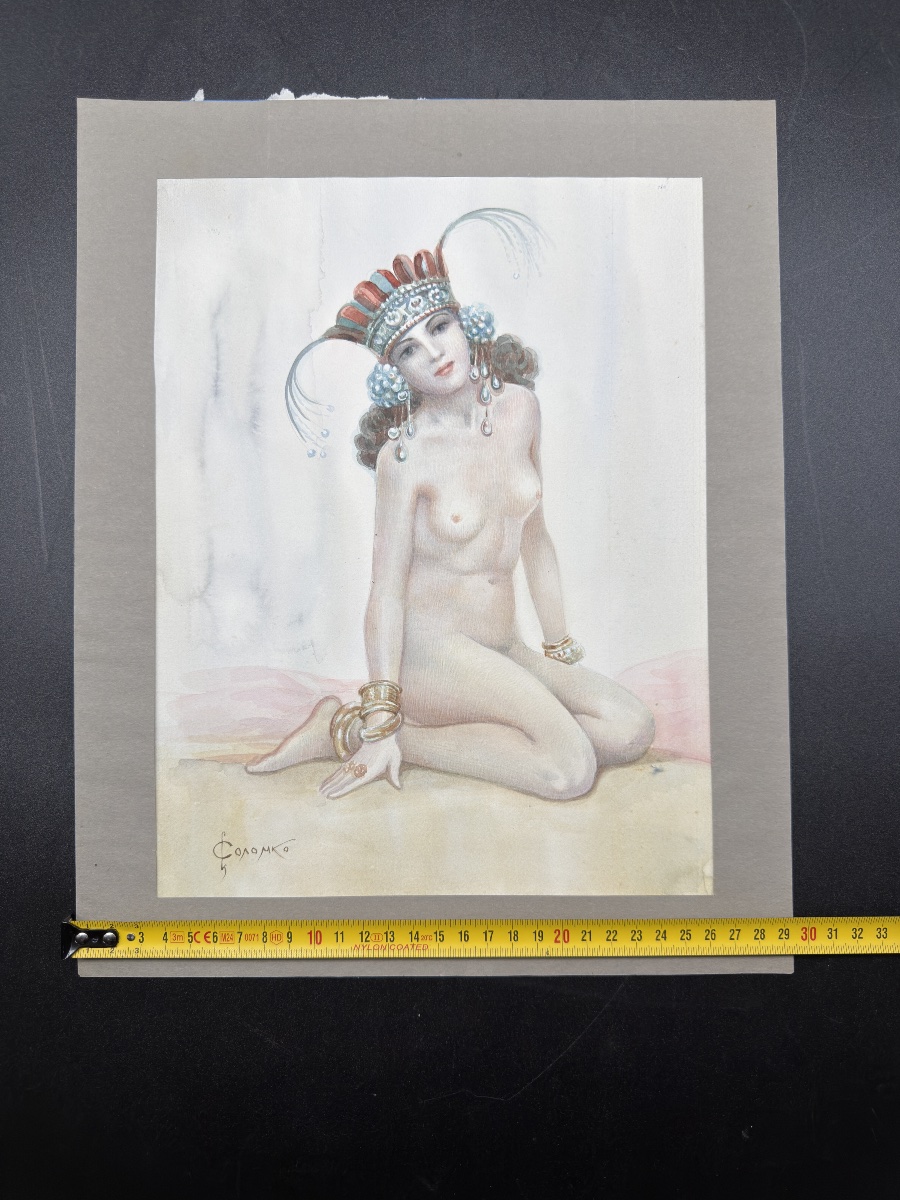
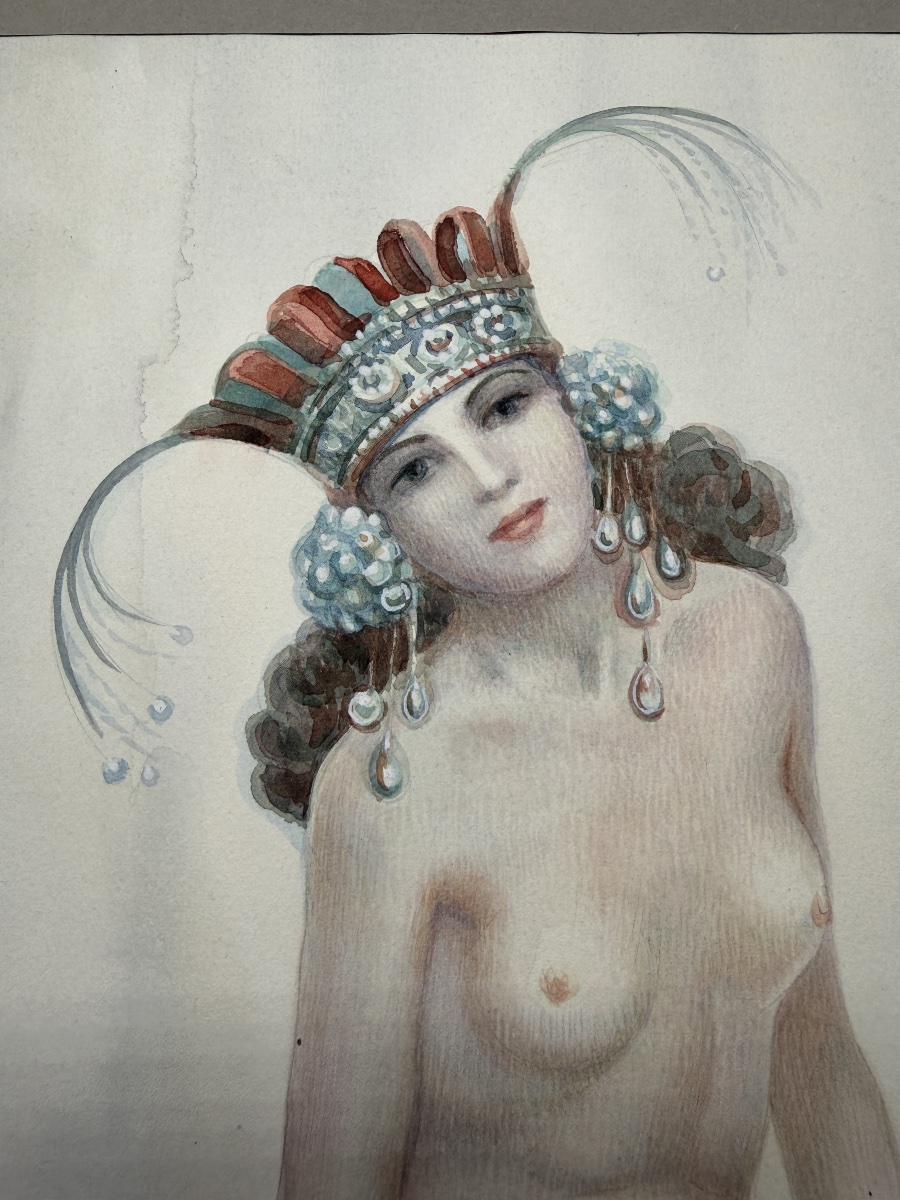

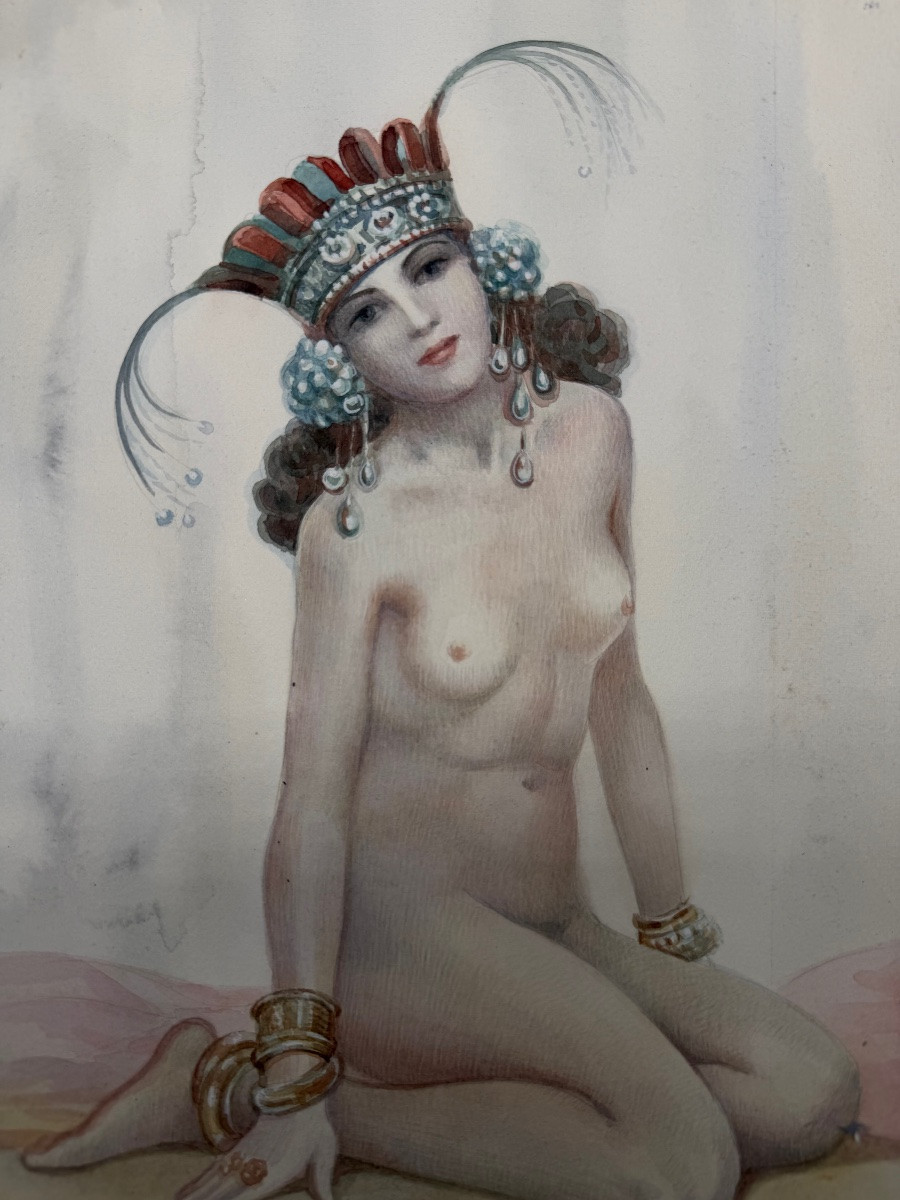
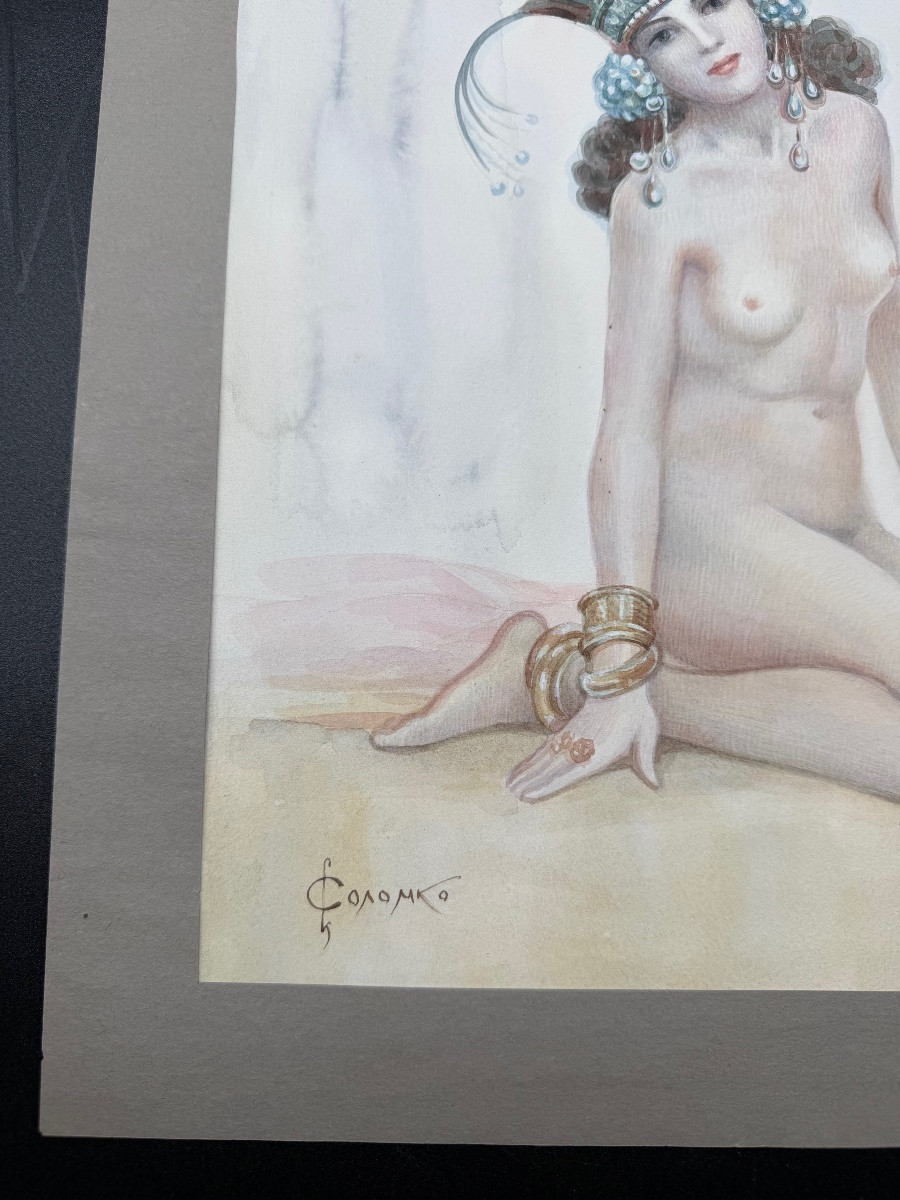


Sergei Solomko Painting Depicting The Naked Princess,19century
Sergej Sergeevic SOLOMKO (1859/67–1926/28)
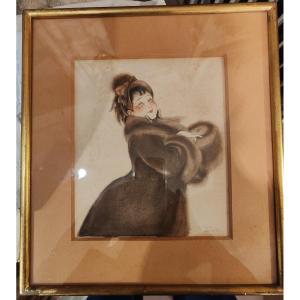
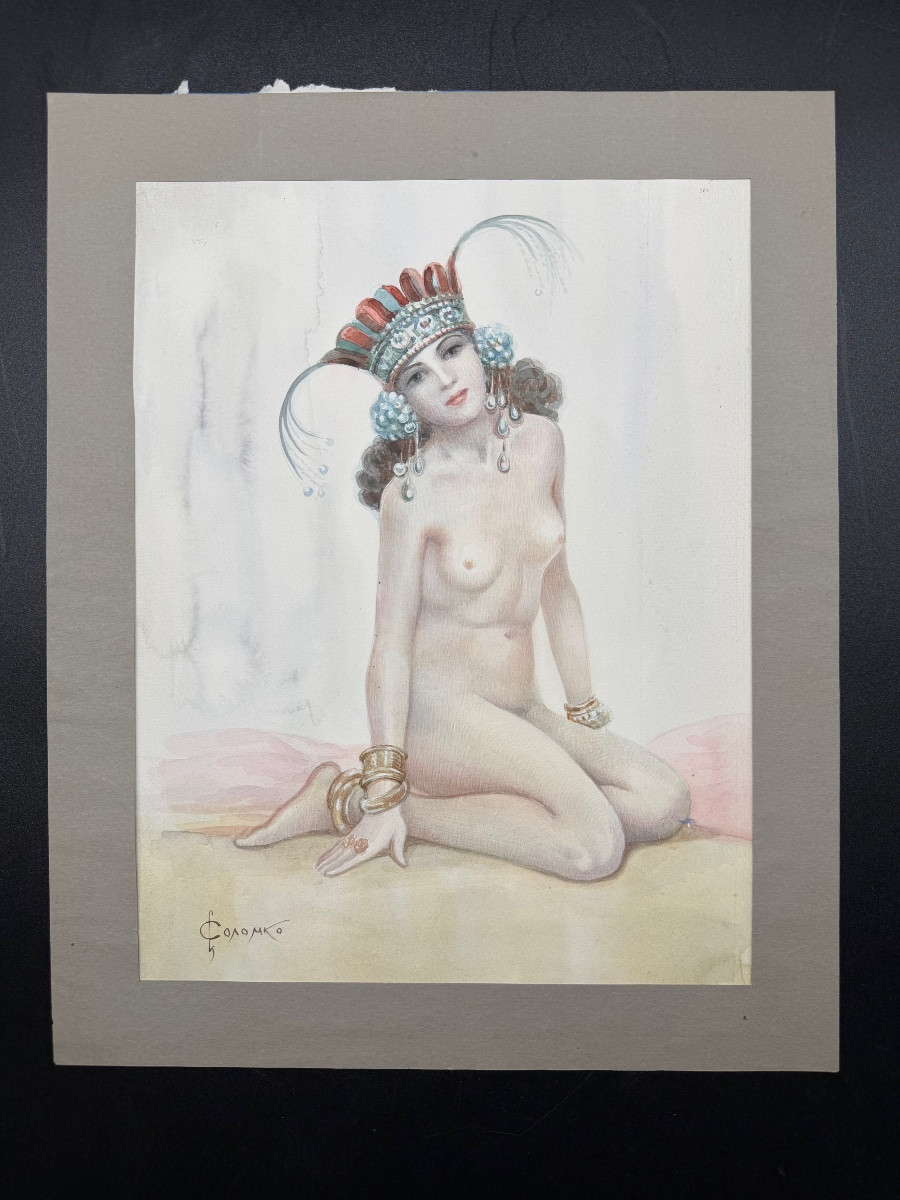
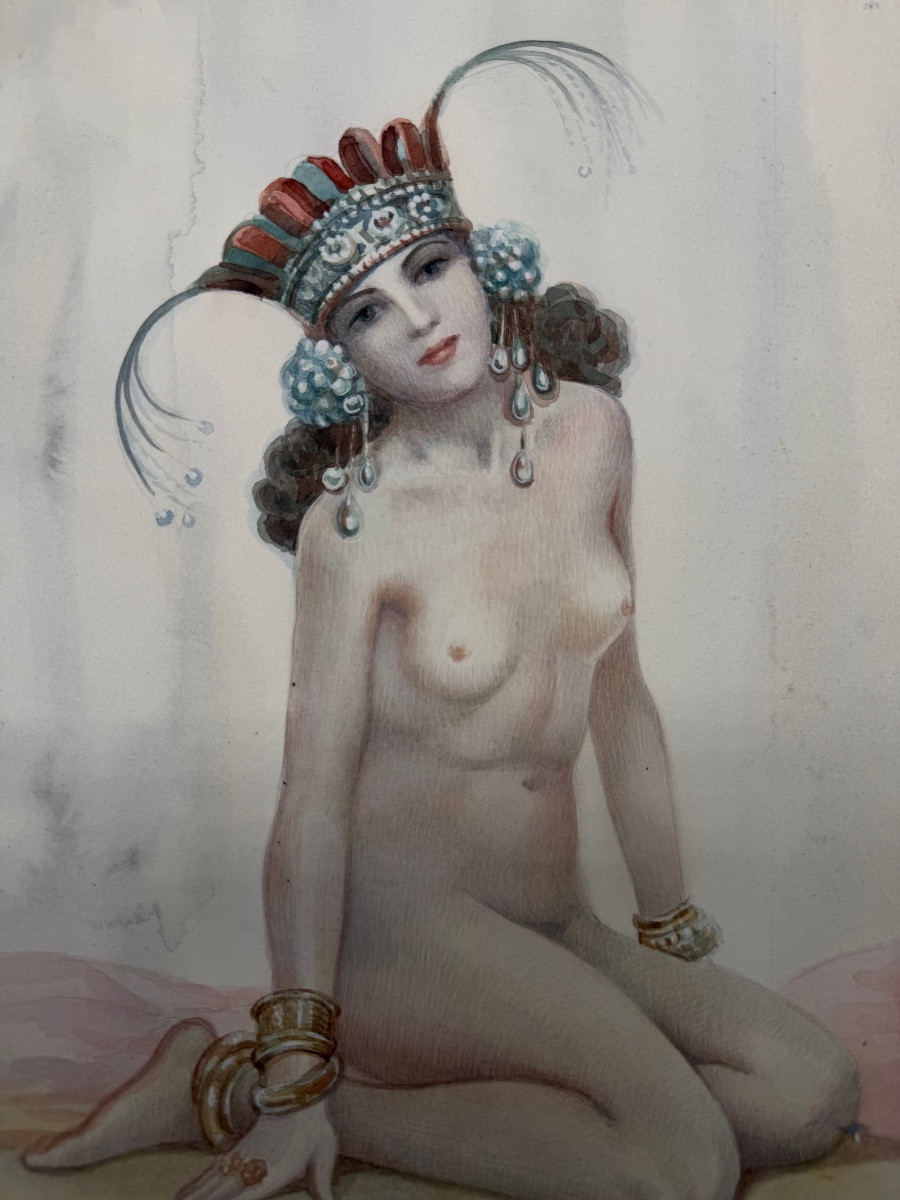
Portrait of a Nude Princess.
Watercolour and pencil.
Signed.
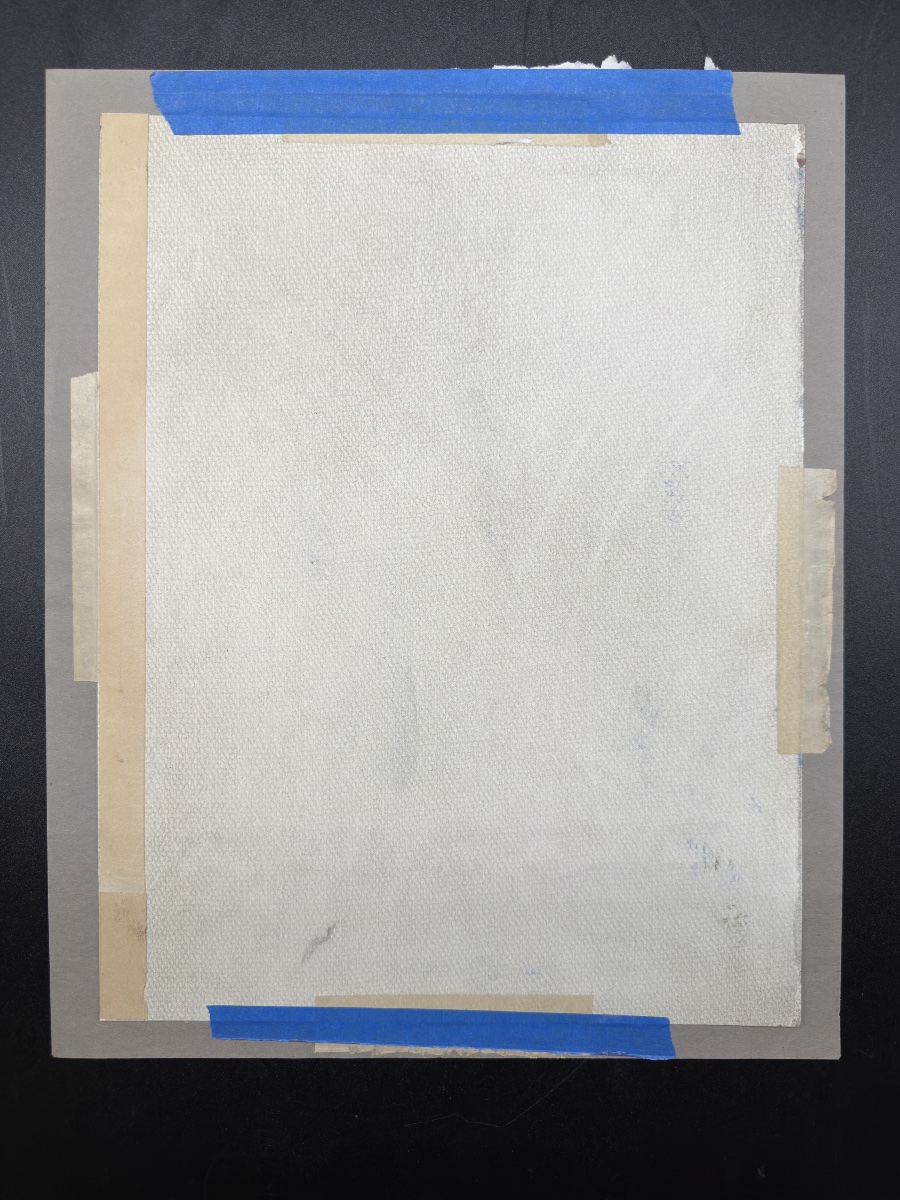
Framed under glass.
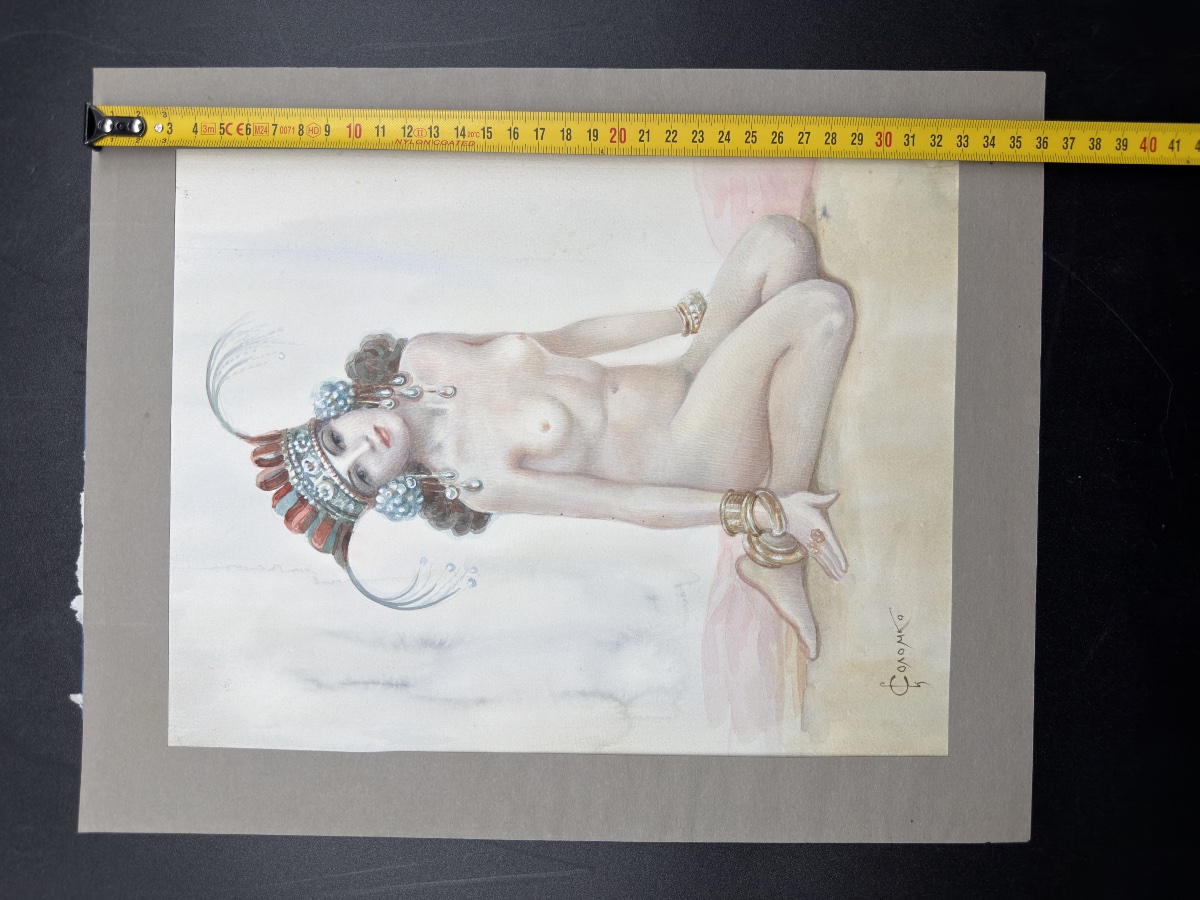
H 30 cm; W 21.5 cm.
Very good condition.
Sergei Solomko - graphic artist, watercolourist, book illustrator, representative of the ‘Russian style’ in painting, collector.
From the 1880s onwards, S. S. Solomko collaborated as an artist with literary and artistic journals: ‘Niva’, ‘Mir iskusstva’ (The World of Art), ‘Zhivopisnoe obozrenie’ (Pictorial Review), "Vsemirnoe obozrenie (World Review), and Stolitsa i usadba (The Capital and the Estate). His illustrations were first published in 1882 in the weekly illustrated magazine Sever – illustrations for the dramatic study by poet and translator O.N. Chumina, ‘The Temptation,’ and the drawing ‘Cleopatra.’ The genre of magazine illustration was then new in Russia, and S.S. Solomko, along with E.M. Böhm, became its most famous representative. Subsequently, many of his drawings published in magazines were issued in the form of postcards. He also produced sketches of plays for magazines.
At the beginning of the 20th century, S.S. Solomko was actively involved in the work of F.I. Ryukert's enamelling workshop in Moscow, famous for its cloisonné enamel products. He produced gouache and watercolour models for this workshop, which were then transformed into enamelled miniatures. These were then sent to the ‘Fabergé House’, where they were inserted into silver objects: boxes, cups, pill boxes, caskets and other decorative works of art. In addition, S.S. Solomko produced sample designs for tableware, vases and decorative plates for the Imperial Porcelain Manufactory. The artist also made sketches of plays for publication in theatre magazines and drew posters on commission for theatres.
Illustrated magazines, postcards, porcelain tea sets, vases and silver boxes featured images of Russian life in the 17th century. The theme of the Russian Middle Ages, including the way of life of the people, inspired not only S.S. Solomko. In the second half of the 19th century and the first decade of the 20th century, many works were created dedicated to the people and events of the pre-Petrine era. Many artists painted pictures on the theme of Russian history: K.V. Lebedev, N.V. Nevrev, G.G. Myasoedov, K.E. Makovsky, I.E. Repin, V.I. Surikov, A.M. Vasnetsov, M.V. Nesterov. The pictorial works of K.E. Makovsky, I.S. Goryushkin-Sorokopudov, V.G. Shvarts, K.V. Lebedev, S.V. Ivanov and many other artists were devoted to the theme of the life of the boyars. At the same time, many historical novels, stories and plays about the history of Russia in the 17th century were published. They were created by M.N. Zagoskin, I.I. Lazhechnikov, F.V. Bulgarin, A.K. Tolstoy, G.P. Danilevsky. In the spirit of 17th-century Russian architecture, N.V. Sultanov built churches and mansions. The history of pre-Petrine Russia, of ancient Russia, aroused great interest among different strata of the Russian urban population, in the estates and palaces of landowners. In the national culture of the second half of the 19th century, a process of reinterpretation of the historical past was underway. The artistic avant-garde who initiated it believed that Russia should abandon the European path of development, which it had consciously chosen in the 18th century, and return to national traditions, interrupted by the reforms of Emperor Peter I. They regarded the era of medieval Russia, particularly the 16th and 17th centuries, as a period of heyday in the country for original architecture, decorative and applied arts, and iconography, as well as a period of formation of the Russian national style.
S.S. Solomko, as an artist, was less interested in the historical events of that period than in the everyday life of the people of the 17th century. The heroes of his genre paintings, dressed in colourful Russian costumes, visit each other, drink tea, walk the streets, have fun, chat, fall in love: “Evening Walk”, “In Search of Happiness”, “She Plays the Coquette”, “The Proud One”, etc. The artist particularly liked to depict romantic relationships between people. The heroes of these romantic images, such as ‘The Seducer’, ‘Waiting for the Answer’, ‘A Serious Question’, ‘The Meeting’, ‘Declaration of Love’, ‘Near the Fence’, etc. are usually two characters: a handsome young man dressed in a gold-embroidered caftan and a beautiful young girl dressed in a brocade or silk dress, with a headdress adorned with gold thread embroidery, pearls and precious stones. They make advances towards each other, seek to attract each other's attention, flirt, and get angry. On his postcards, S.S. Solomko also depicted the heroines of Russian bylina. Vasilisa Mikulishna, Apraksia Korolevichna, Nastasia Korolevichna, Zabava Putyatishna, Princess Azvyakovna, Maria Lebed Belaya Likhodéevna ─ all of them, as in the bylina, are beautiful heroines: ‘Her face is white as snow / Her buttocks are smooth as poppies / Her black eyebrows are black as sable / Her clear eyes are clear as a falcon's / She is cunning and wise, with a fiery heart.’ All of S.S. Solomko's works, which depict the daily life of people in the 16th and 17th centuries, the heroines of legends, and the beauties of fairy tales, are full of romantic admiration. They evoked in viewers a sense of nostalgia for the long-gone world of beautiful ancient Russia, reminding people of their indissoluble link with a distant and authentic past.
S.S. Solomko was well acquainted with 17th-century Russian costumes, both those of peasants and boyars. He had a large collection of traditional Russian clothing from the late 18th and mid-19th centuries, as well as a number of 17th-century ‘boyar items’. However, his collection was little known to his contemporaries, as it had never been exhibited. S.S. Solomko probably began building his collection in the 1880s, when he started working actively with magazines and publishing houses on Russian themes. He most certainly purchased these objects at antique markets in Saint Petersburg, Moscow and provincial towns. According to lists from 1921, S.S. Solomko, like many other artist-collectors in the second half of the 19th century, bought not only monuments of ‘Russian antiquity’ there, but also traditional objects from the everyday life of different peoples of Russia and foreign countries, as well as objects of Buddhist worship.
By the beginning of the 20th century, he already had a reputation as an expert in ancient Russian costumes. In 1902, the artist was asked to make sketches of 17th-century Russian costumes for a court costume ball dedicated to the 290th anniversary of the House of Romanov at the Winter Palace. All the participants in the celebration, which took place in February 1903, were dressed in sumptuous costumes designed by S.S. Solomko. On this basis, in 1911, the German factory ‘Dondorf’ produced sketches for playing cards in the ‘Russian Style’ series with characters dressed in the costumes of the ball participants. In 1913, on the occasion of the 300th anniversary of the Romanov dynasty, playing cards were printed from these sketches at the Alexandrovskaya factory. They were reprinted several times during the Soviet era and are still on sale today.
In 1910, S.S. Solomko left for Paris, where he lived until his death in 1928, without severing his ties with Russia until 1914. He participated in numerous exhibitions of the Imperial Society of Watercolourists, founded in Saint Petersburg in 1887, in exhibitions of the Saint Petersburg Artists' Society and in those of the Society of Travelling Art Exhibitions. In Paris, he took part in the exhibition ‘Artists of the Imperial Academy of Arts of Petrograd’ and, in 1925, he was one of the initiators of the creation of the Russian Institute of Arts and Industry in Paris.
In France, S.S. Solomko continued to paint watercolours and illustrate books. He worked on illustrations for the works of A. France, P. Verlaine, A. Musset, T. Gautier and E. Renan. In 1913, a catalogue of S. Solomko's postcards was published in Paris, accompanied by his biography and a detailed description of his work. The artist's watercolours, reproduced on postcards by the publishers ‘Richard’ and ‘A.F. Felten’, were reproduced in the magazines "Solntse Rossii (The Sun of Russia) and Iskra (The Spark). In 1921, Solomko created a series of postcards on the theme of ancient Russia for the French publisher I.S. Lapin. During the First World War, S.S. Solomko published numerous postcards on the theme of war, working in 1916 on commission from the Commission for the Collection and Preservation of War Trophies. He also painted portraits of knights of the Order of the Russian Expeditionary Force in France.
Period: 19th century
Style: Art Nouveau
Condition: Excellent condition
Material: Water color
Reference (ID): 1719664
Availability: In stock