THIS OBJECT WAS SOLD
Gilt Bronze Clock "the Reader" By J.a. Reiche, Empire Period




Jean-André Reiche (1752-1817),
Empire period, circa 1805.
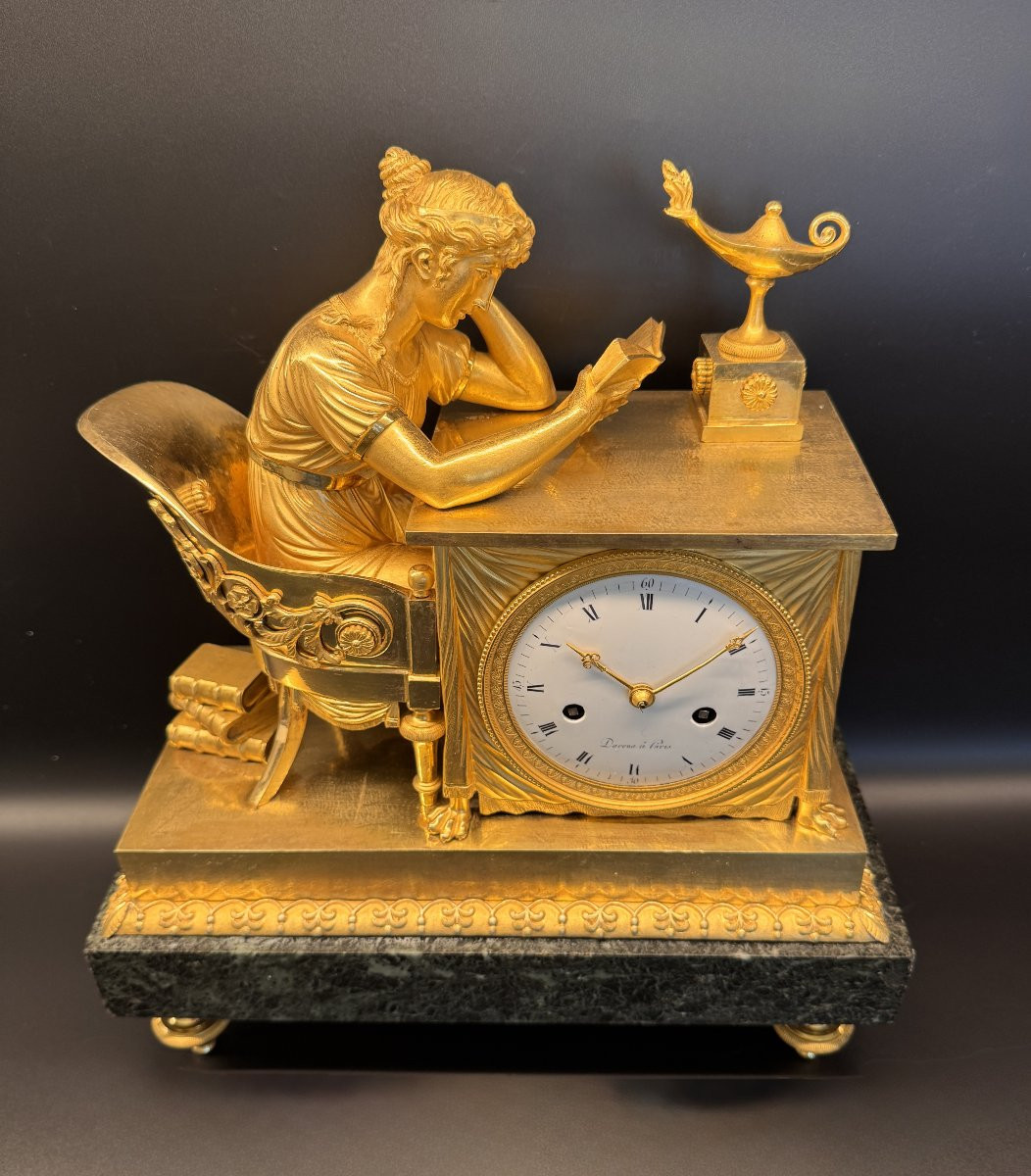
A chased and gilt bronze clock, known as "The Reader."
Depicting a woman in classical dress reading at a draped table with claw feet, illuminated by an oil lamp.
She is seated in a finely crafted Empire armchair, adorned with acanthus scrolls and palmettes.
Behind the armchair, a stack of books rests on the floor.
This model was created by Jean-André Reiche, based on a watercolor drawing deposited at the Imperial Library on February 19, 1805.
The movement, with its enamel dial, is inscribed under the table and signed Darena in Paris.
The base, decorated with a palmette frieze, rests on a sea-green marble plinth, supported by gilt bronze toupie feet.
The figure and decoration are of superb quality.
The original mercury gilding retains its beautiful luster.
Complete movement, anchor escapement with silk thread suspension.
In perfect working order, serviced by a specialist watchmaker.
Strikes the hours and half-hours.
Gilt bronze fleur-de-lis hands.
Height: 33 x Width: 28.5 x Depth: 14 cm.
The "La Lieuse" clock is undoubtedly the best-known clock by the sculptor Jean-André Reiche (1752-1817), a bronze worker and draftsman born in Leipzig who became famous in Paris.
A similar model is in the Mobilier National collection. See catalog p. 73.
Bibliography:
Listed in Kjellberg's "Encyclopédie de la pendule française" p. 398.
Elke Niehüser: French Bronze Clocks, p. 86.
Wannenes - Les plus belles pendules françaises p. 358.
Empire period, circa 1805.
A chased and gilt bronze clock, known as "The Reader."
Depicting a woman in classical dress reading at a draped table with claw feet, illuminated by an oil lamp.
She is seated in a finely crafted Empire armchair, adorned with acanthus scrolls and palmettes.
Behind the armchair, a stack of books rests on the floor.
This model was created by Jean-André Reiche, based on a watercolor drawing deposited at the Imperial Library on February 19, 1805.
The movement, with its enamel dial, is inscribed under the table and signed Darena in Paris.
The base, decorated with a palmette frieze, rests on a sea-green marble plinth, supported by gilt bronze toupie feet.
The figure and decoration are of superb quality.
The original mercury gilding retains its beautiful luster.
Complete movement, anchor escapement with silk thread suspension.
In perfect working order, serviced by a specialist watchmaker.
Strikes the hours and half-hours.
Gilt bronze fleur-de-lis hands.
Height: 33 x Width: 28.5 x Depth: 14 cm.
The "La Lieuse" clock is undoubtedly the best-known clock by the sculptor Jean-André Reiche (1752-1817), a bronze worker and draftsman born in Leipzig who became famous in Paris.
A similar model is in the Mobilier National collection. See catalog p. 73.
Bibliography:
Listed in Kjellberg's "Encyclopédie de la pendule française" p. 398.
Elke Niehüser: French Bronze Clocks, p. 86.
Wannenes - Les plus belles pendules françaises p. 358.
Explore similar pieces and discover your ideal find:
Mantel Clocks