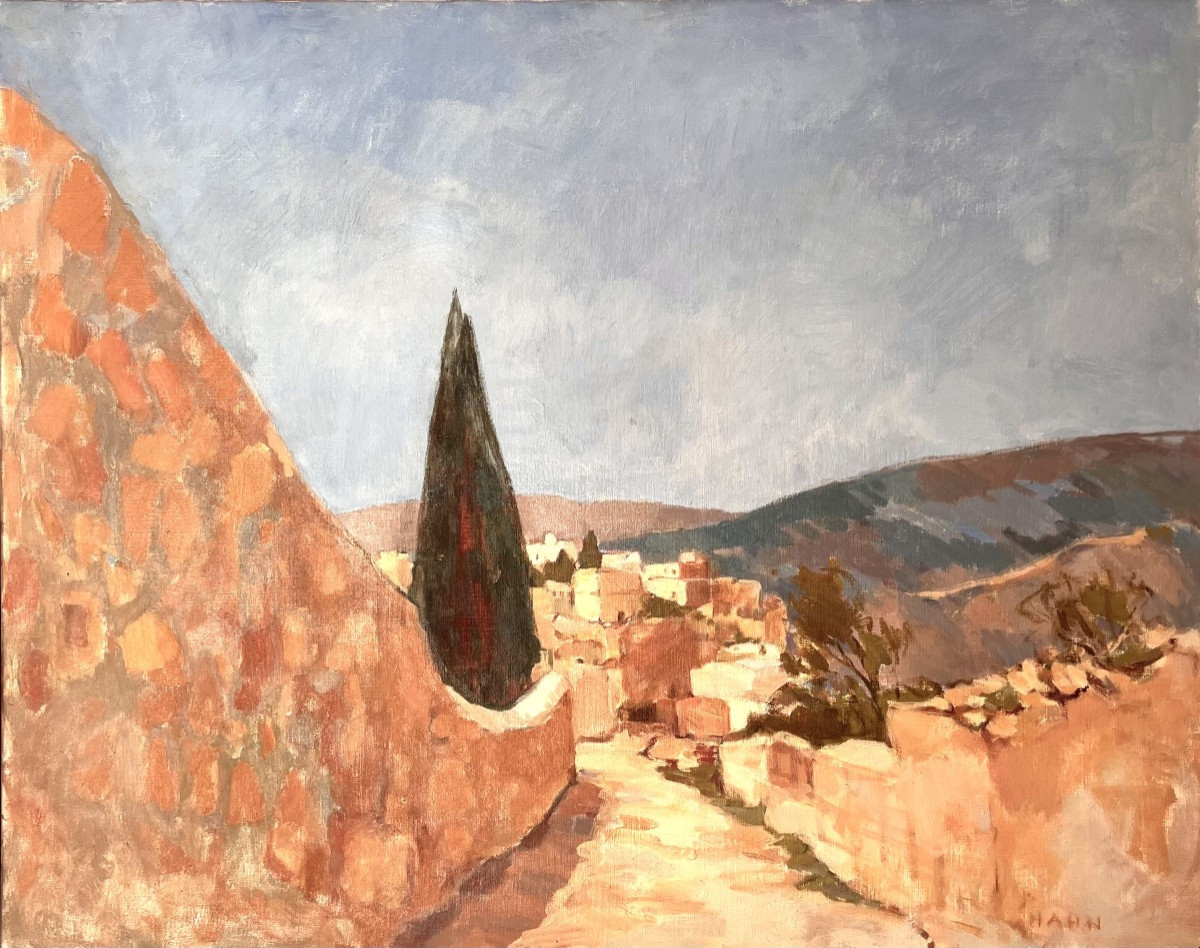
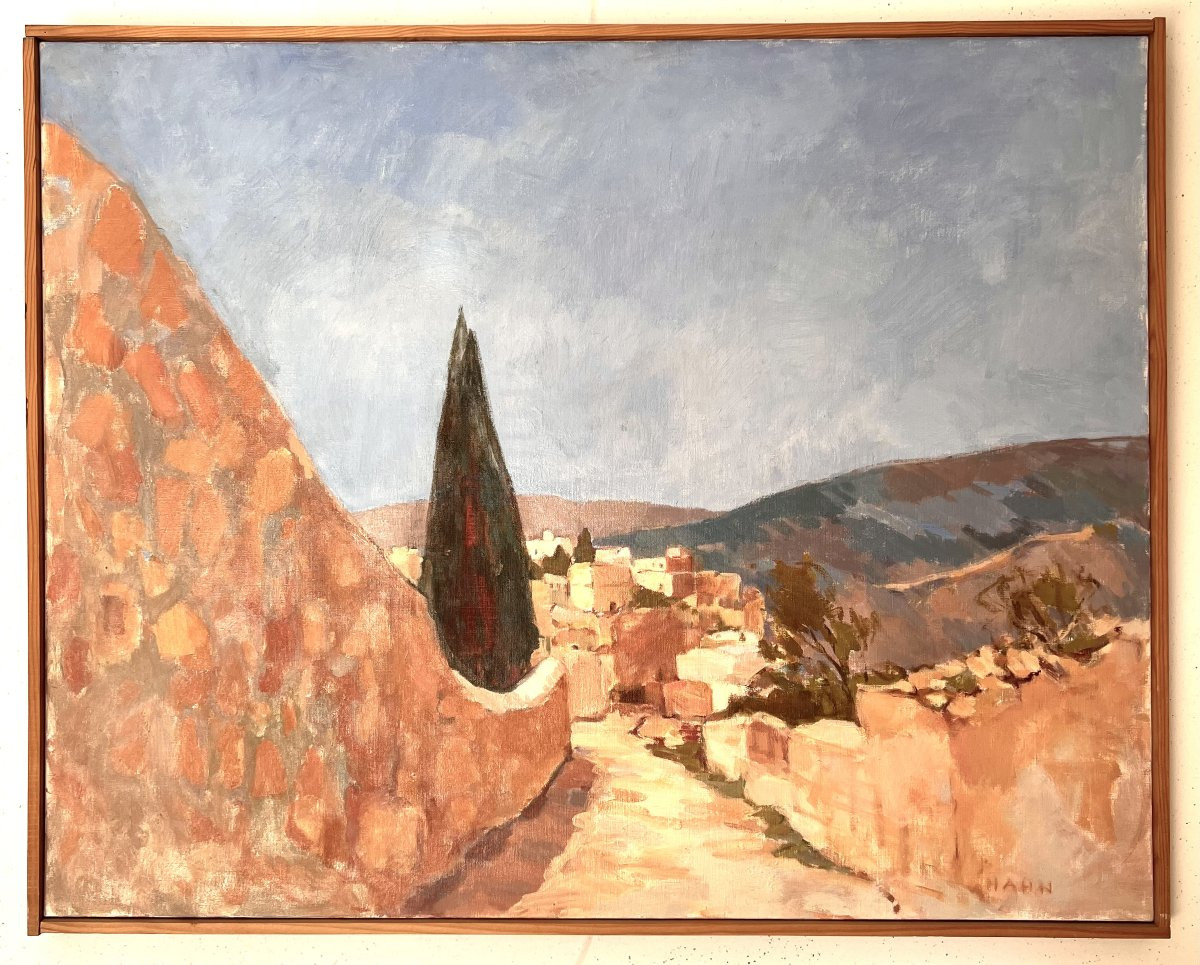


Cypress Path - Oil On Canvas - Elisabeth Hahn, 20th Century
Artist: Elisabeth Hahn
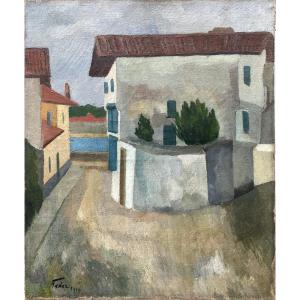
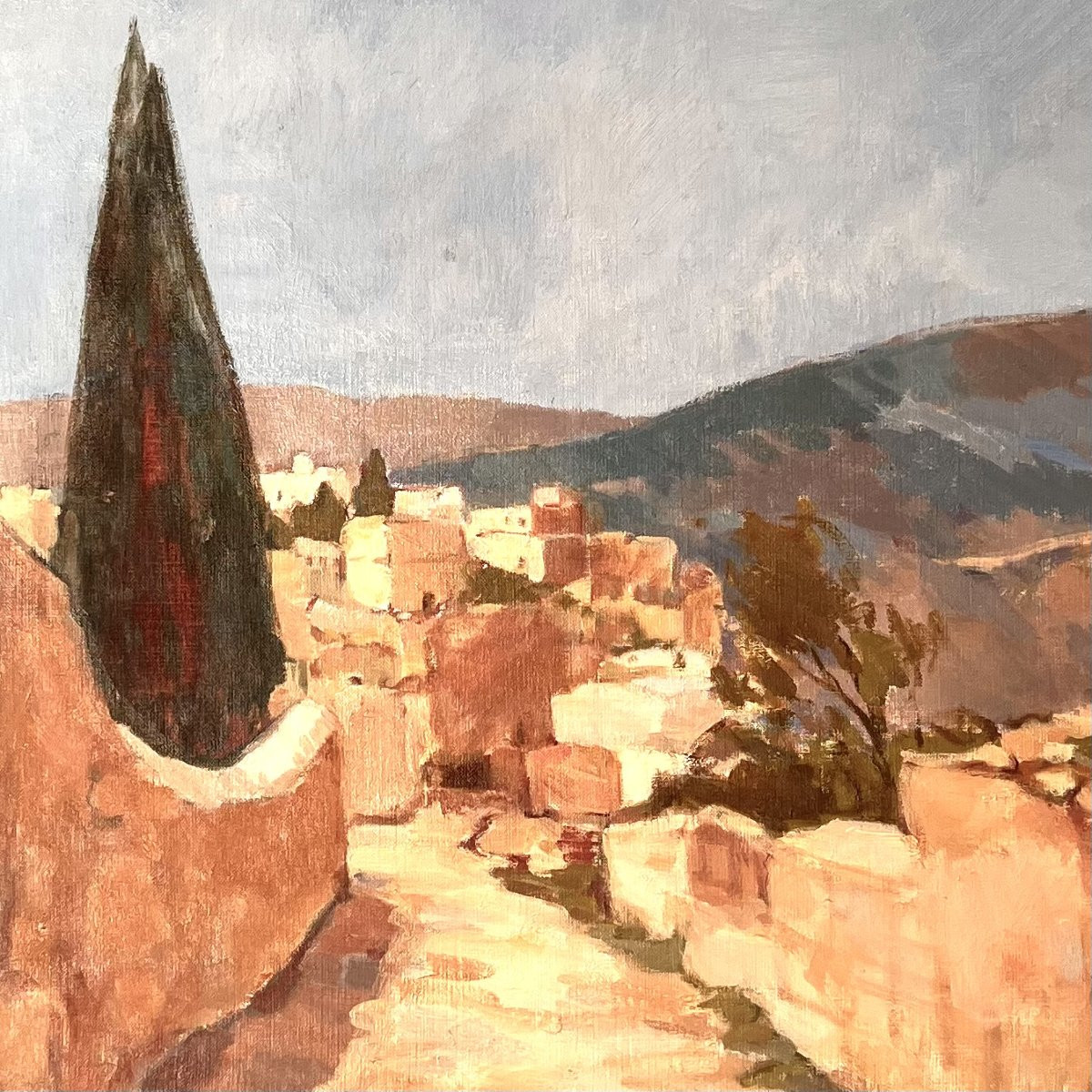
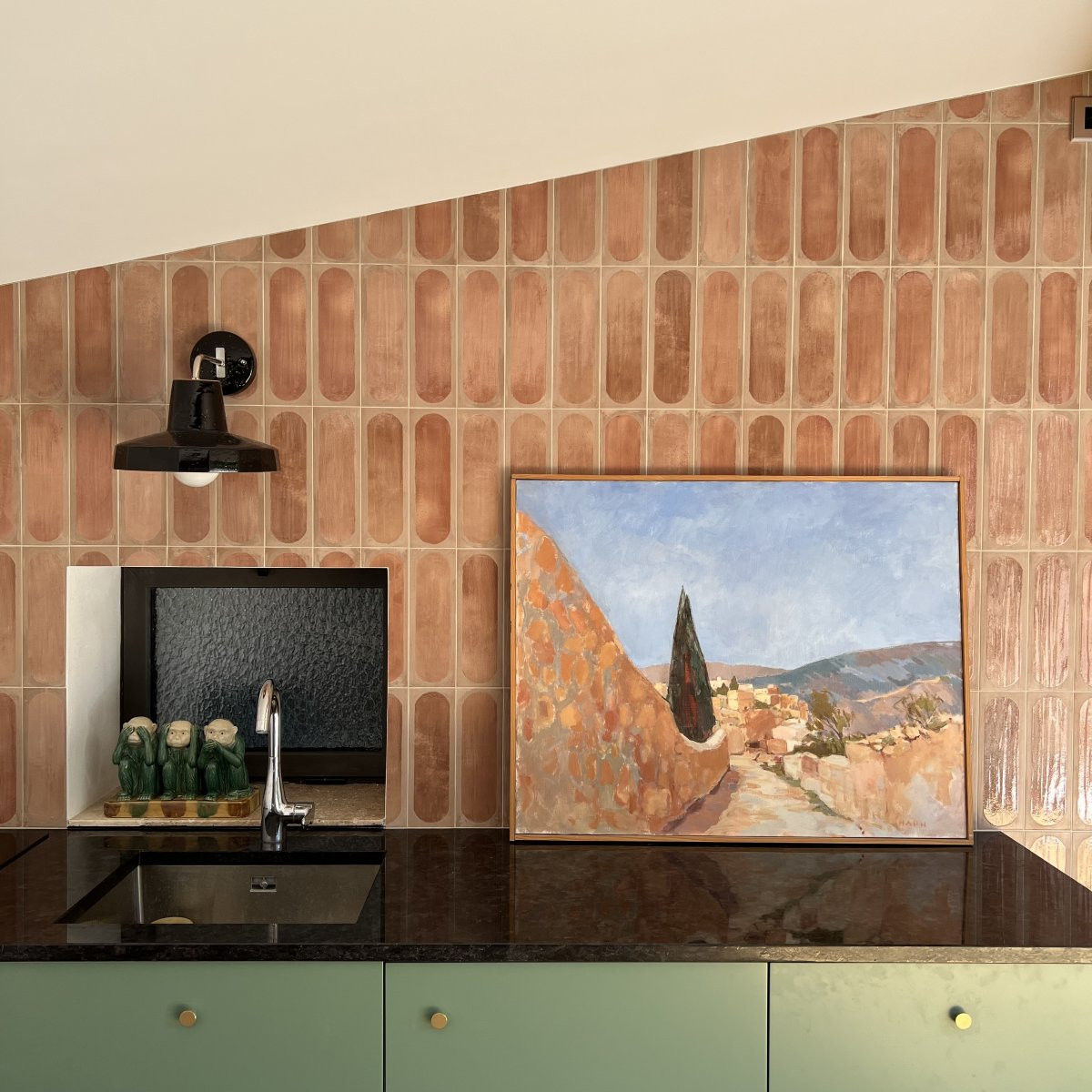
ARTIST: Elisabeth HAHN TECHNIQUE: Oil on canvas PERIOD: 20th century DIMENSIONS: 93 x 73 cm (unframed) COPY: Original work signed lower right. Artist's frame. Entitled "Chemin aux cyprès" (Cypress Path), this unique and signed oil on canvas by Elisabeth Hahn depicts a Provençal landscape bathed in Mediterranean light. The composition is organized around a luminous path bordered by ochre walls, guiding the eye towards a perched village and the gentle hills of the hinterland. The color palette favors warm ochres, rosy earth tones, golden beiges, and a sky with delicate blue-gray hues, conveying the vibrant atmosphere of the South. The slender, vertical, and dark cypress tree structures the space and creates a strong graphic contrast with the horizontal lines of the landscape. The paint is applied in soft, blended layers, revealing the canvas weave in places. Visible, lightly brushed strokes lend the surface a vibrant texture, while the volumes are simplified in a synthetic approach characteristic of 20th-century modern art. This work belongs to the tradition of Mediterranean landscapes, evoking the light of Paul Cézanne, the chromatic vibrancy of Provençal painters, and the solar intensity so dear to artists who celebrated Provence and the Mediterranean. Elisabeth Hahn develops a personal vision here, balanced between expressive figuration and the structured construction of space. "Chemin aux cyprès" (Path with Cypresses) is an ideal piece to enrich a modern art collection, particularly for lovers of Provençal landscapes and 20th-century Mediterranean painting. Elisabeth Hahn was born in Dortmund, Germany, where she began her artistic studies. In 1953, she settled in Paris. She continued her studies at the École des Beaux-Arts in the studios of Jean Souverbie and Edmond Heuzé between 1954 and 1959. Since 1962, she has exhibited regularly at the Salon de l'Art Libre, the Salon de l'Union des Artistes, and in important Parisian galleries: Galerie Raymond-Creuze, Galerie Cimaise de Paris, and Galerie Everarts. She also exhibits regularly in Germany at Königswinter-Oberpleis. In her figurative paintings, she always seeks to place color and line at the service of the subject, eliminating any details that might detract from the overall expression. Elisabeth Hahn's painting fully deserves to be rediscovered. This is all that can be found about Elisabeth Hahn's life, which is very little considering she was active throughout the second half of the 20th century and perhaps even longer. The essentials are there: she benefited from rigorous training at the École des Beaux-Arts with renowned professors, at a time when France was a leading force in the art world. She also exhibited in major galleries, some of which brought their artists to the Musée d'Art Moderne and into major collections. Beyond that, her works speak for themselves, first and foremost the color, the colors! The harmony of her palette is ever-present, and while it may change or evolve over the years, the balance remains. Her compositions are always perfectly balanced; Elisabeth Hahn masterfully uses space in her paintings. And while she may not dwell on details, her drawing is confident, sometimes vigorous; some of her paintings have an expressionist quality, perhaps due to her background. She tackles all the themes of painting: portraits, nudes, scenes of daily life, still lifes, landscapes. She is an observer of the world around her, able to capture gestures and emotions, and shares them with us on her canvases. We can recognize her workers, whether fishermen or laborers; there is no exaggeration or caricature, no allegory. Her characters are familiar to us; she reveals their essence.
1 250 €
Period: 20th century
Style: Modern Art
Condition: Good condition
Material: Oil painting
Length: 93
Width: 73
Reference (ID): 1710960
Availability: In stock
Print