THIS OBJECT WAS SOLD
Cloisonné Enamel And Bisque Porcelain Clock With The Bust Of Diana, After Houdon
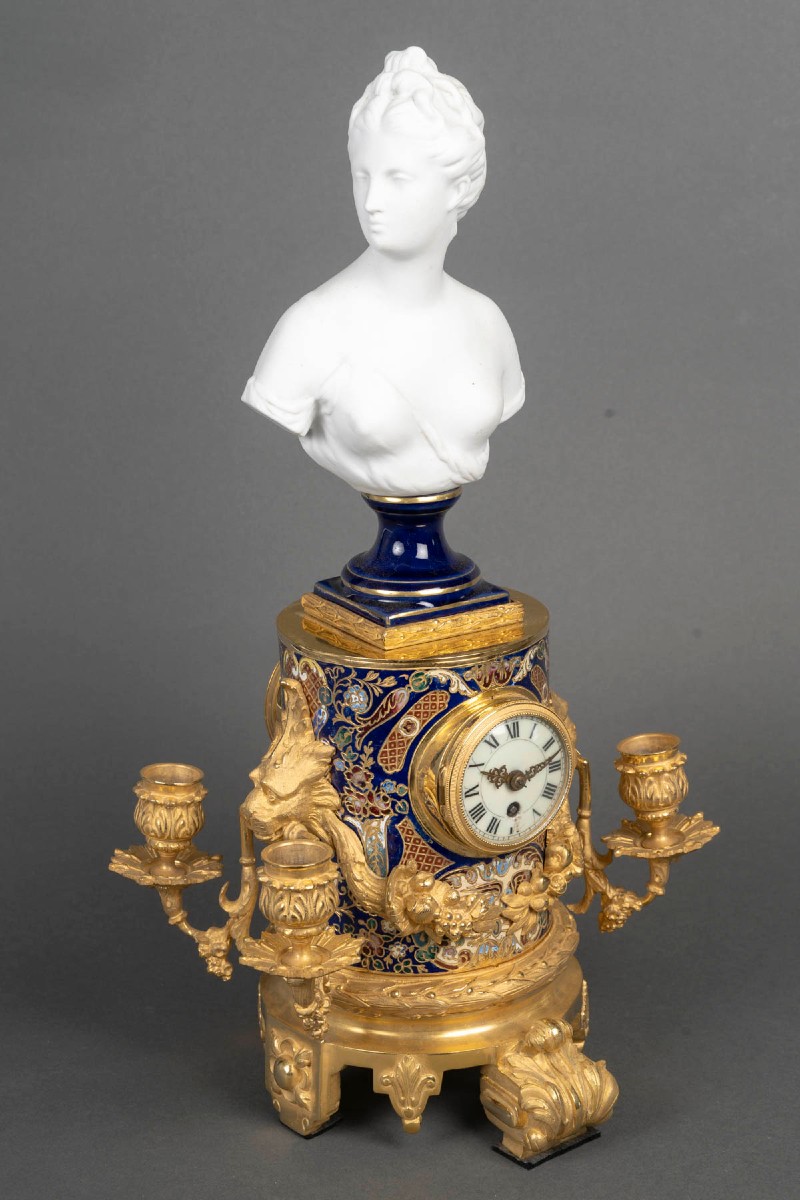
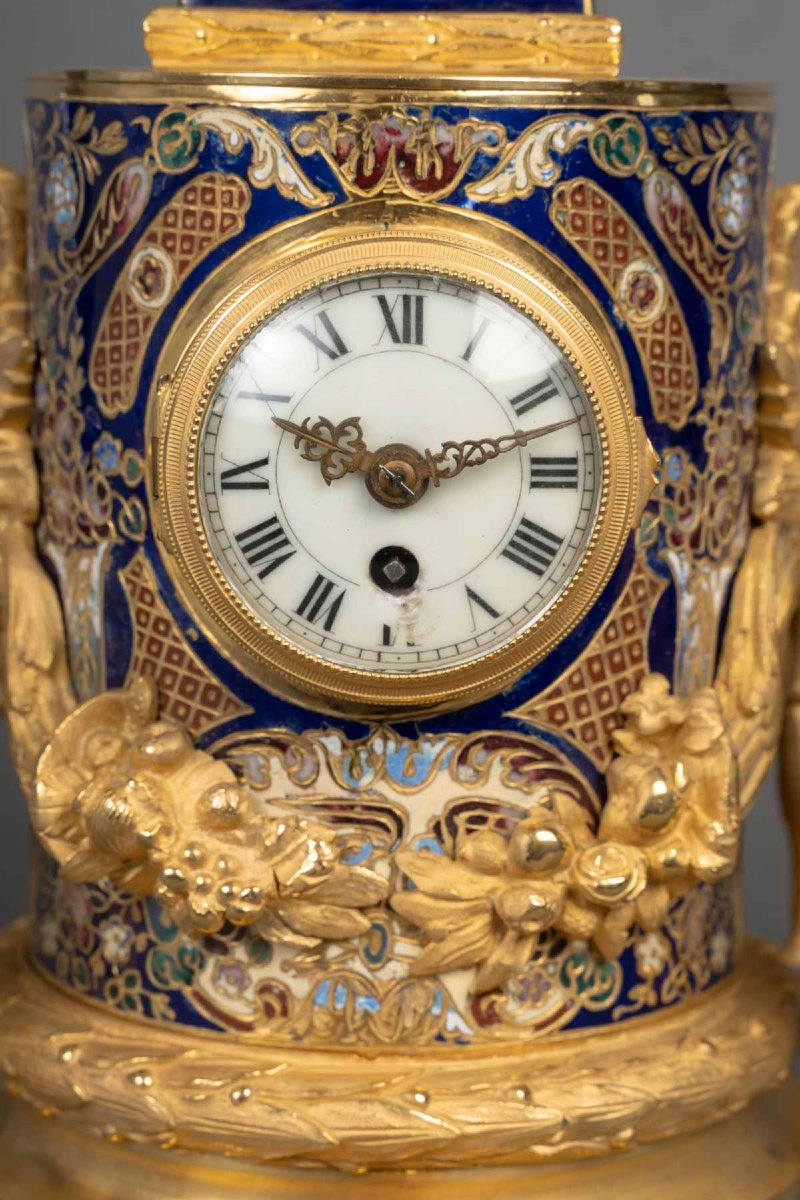
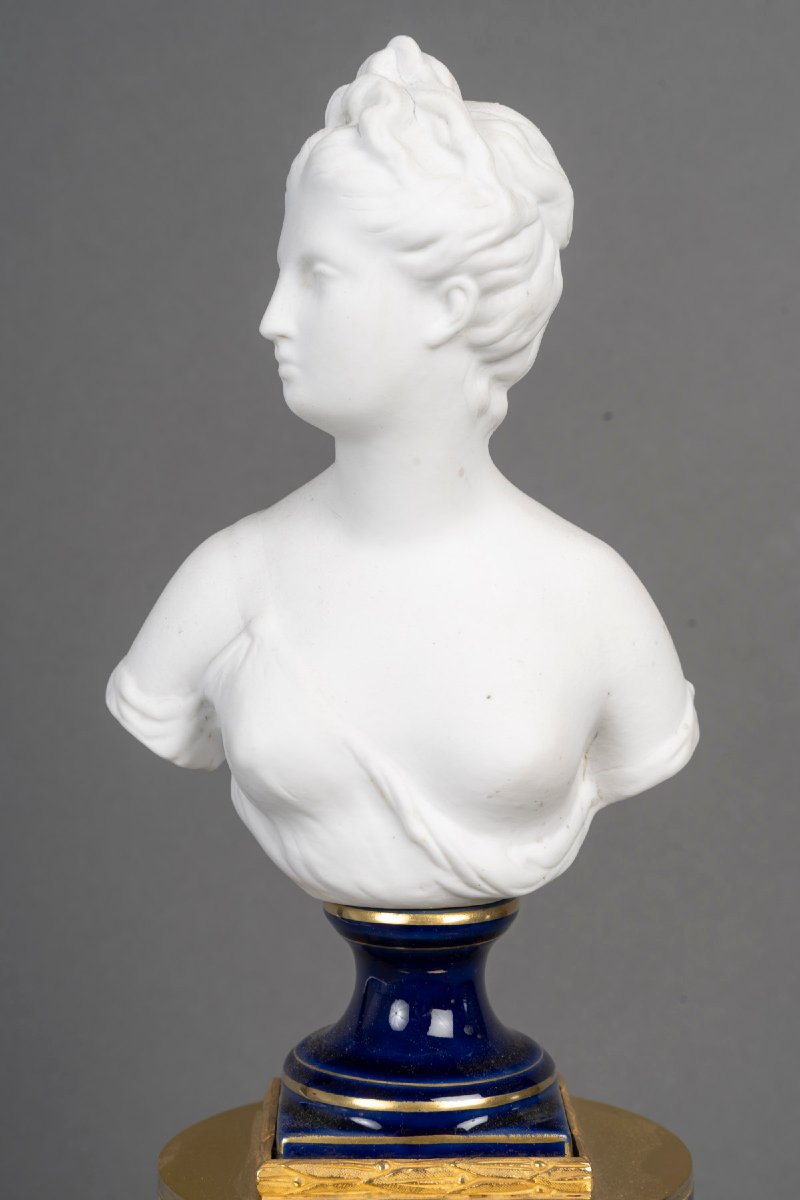
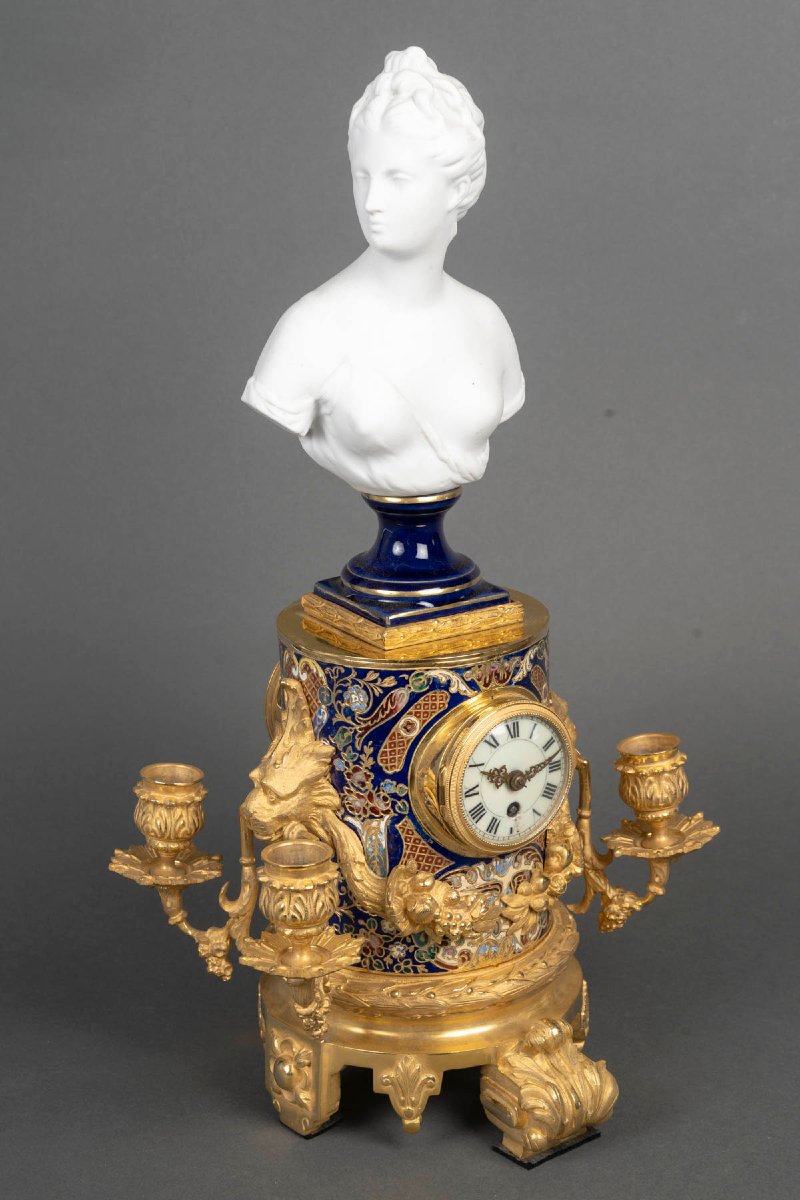
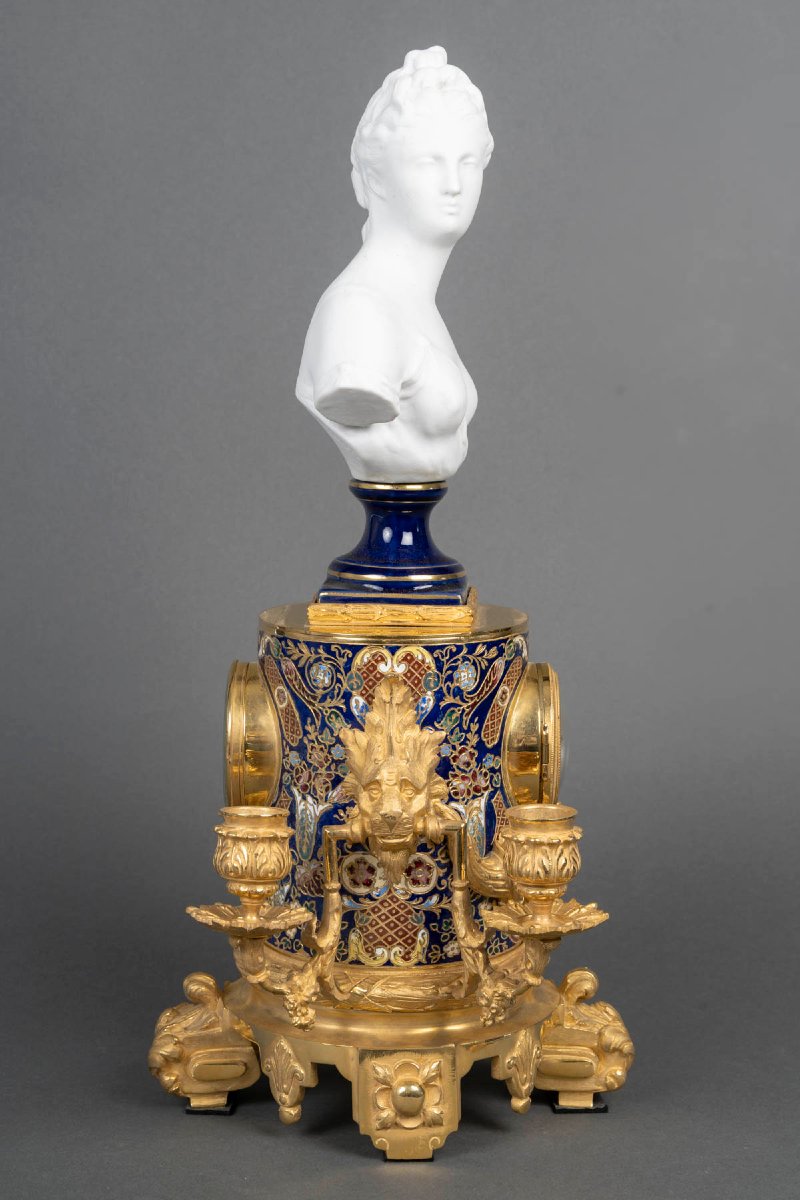
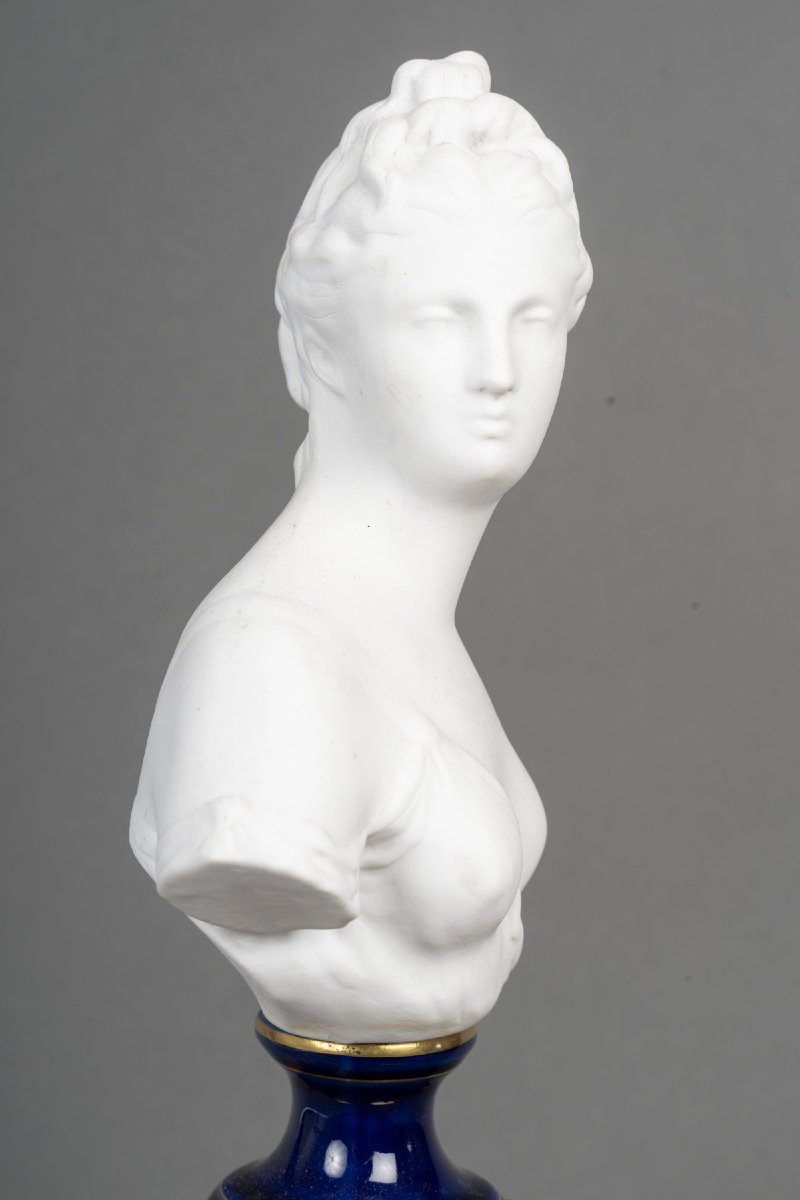
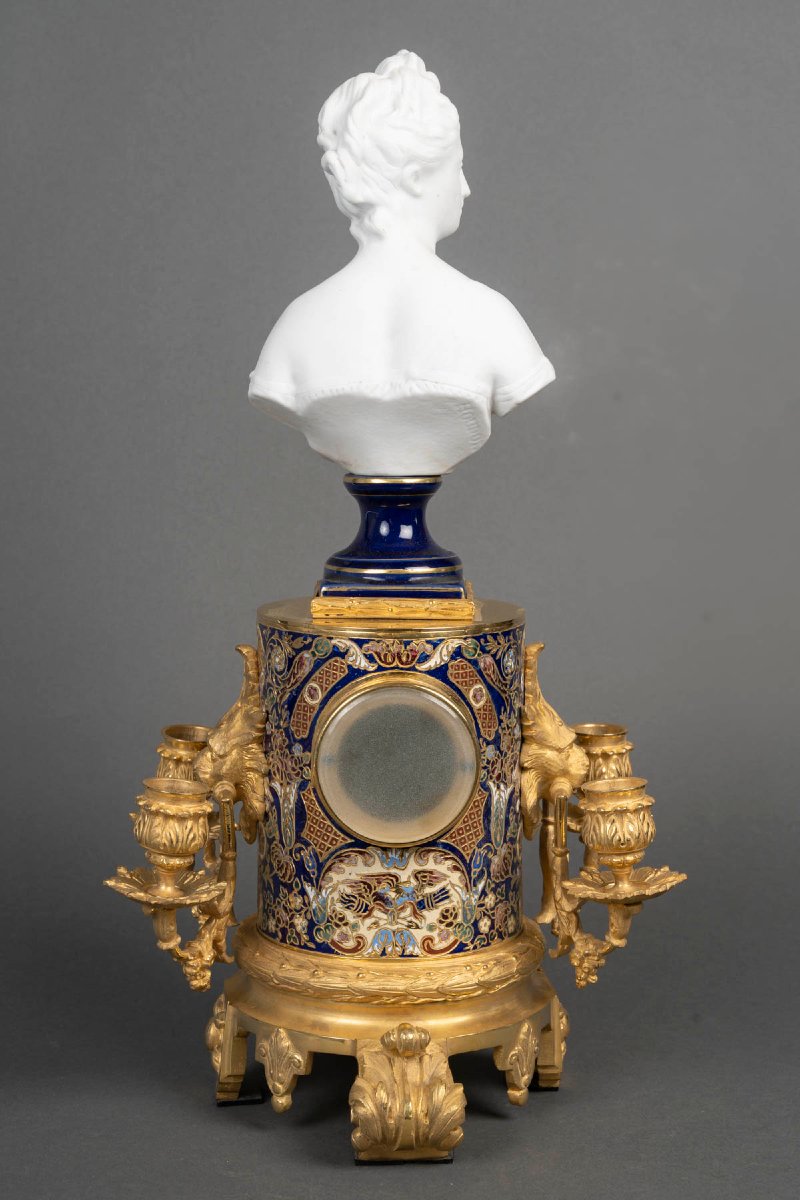
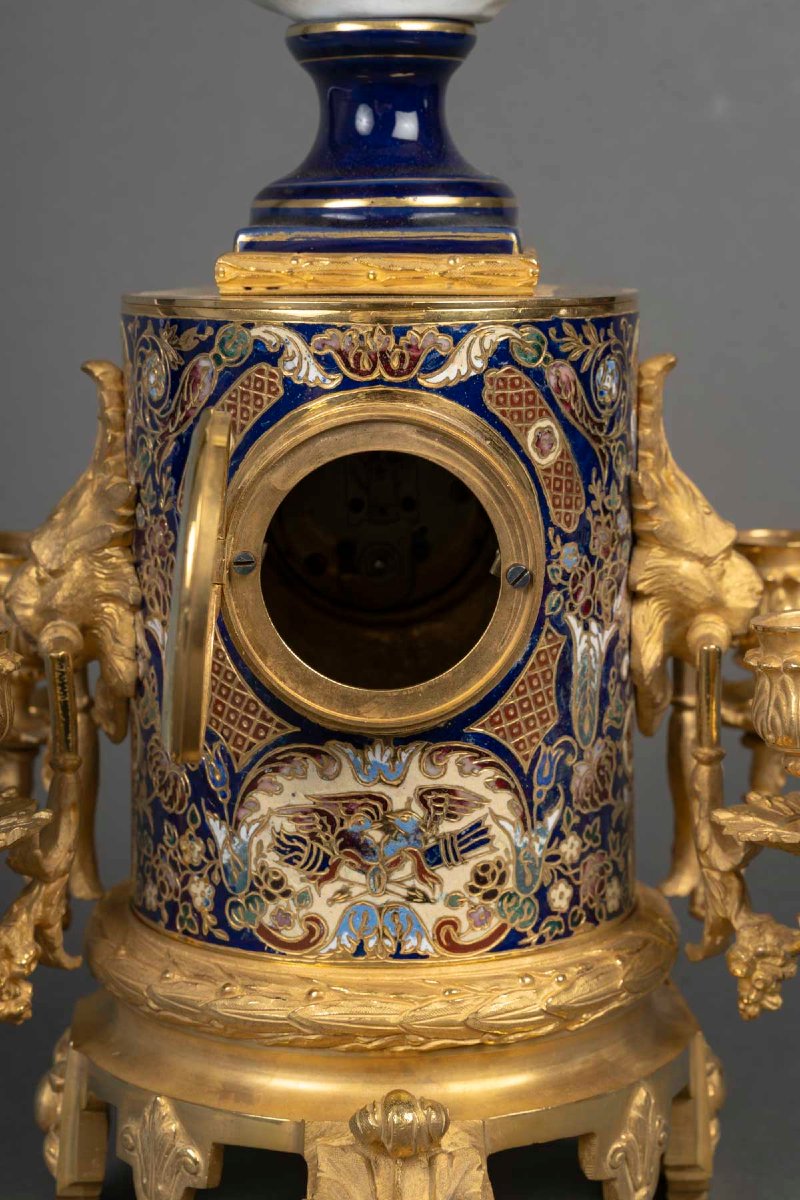
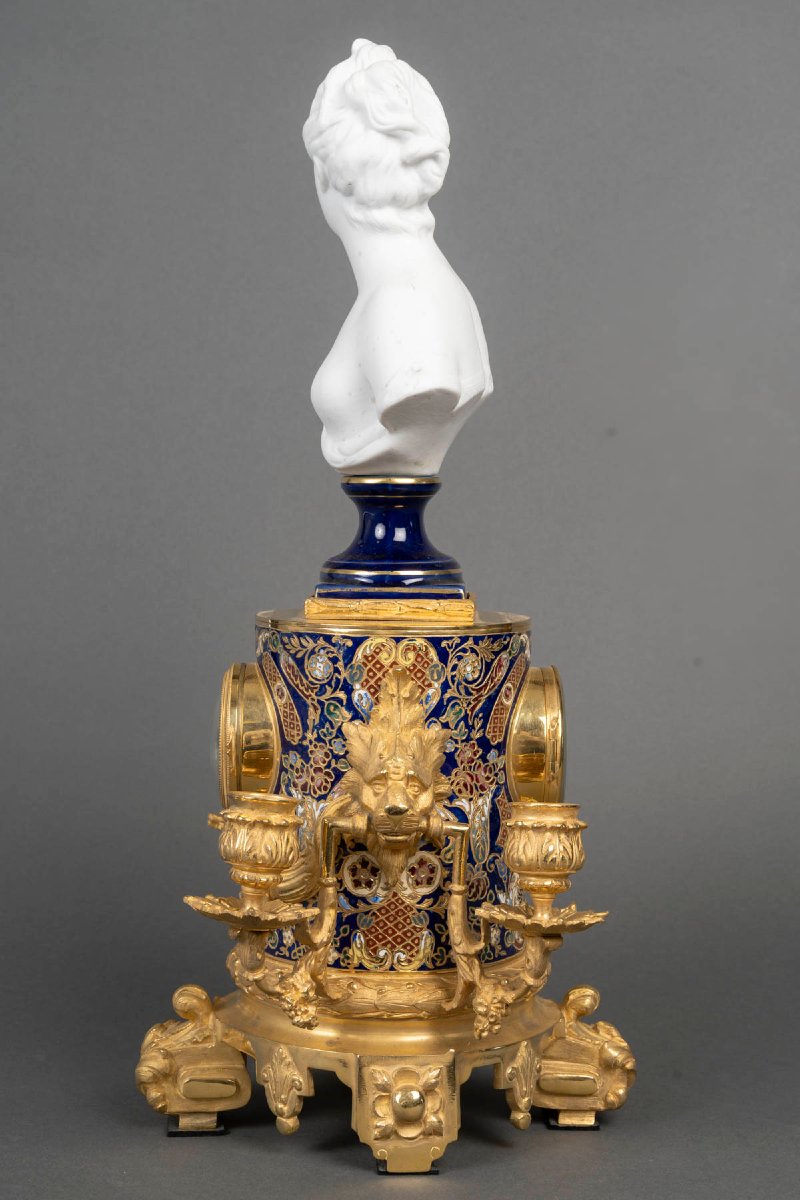


An original Louis XVI style mantel or boudoir clock, its half-column-shaped body covered in champlevé and cloisonné enamels with polychrome decoration on a midnight blue background depicting a sentimental trophy, foliage, and floral motifs. Adorned on the front with finely chased and gilded bronze floral garlands, this clock, flanked by mascarons with lion's heads each holding in their half-open mouths two candle arms with acanthus leafy scrolls studded with florets, serves as a pedestal for a bust of Diana the Huntress after Jean-Antoine Houdon (1741-1828). This miniature version of this emblematic work of the neoclassical aesthetic of the last third of the 18th century, presented here in biscuit porcelain on a pedestal, rests on a base enclosed by a laurel wreath. The entire piece is set within a gilt bronze mount with a molded base highlighted by a generous laurel wreath and a four-legged stand punctuated by antique-style ornamental motifs (scroll brackets, rosette dice, foliate clasps, acanthus palmettes). Beading and beadwork adorn the white enamel dial of the clock, which features Roman numerals for the hours. A high-quality Parisian piece from the last third of the 19th century. Circa 1880;
A LOUIS XVI REVISITED
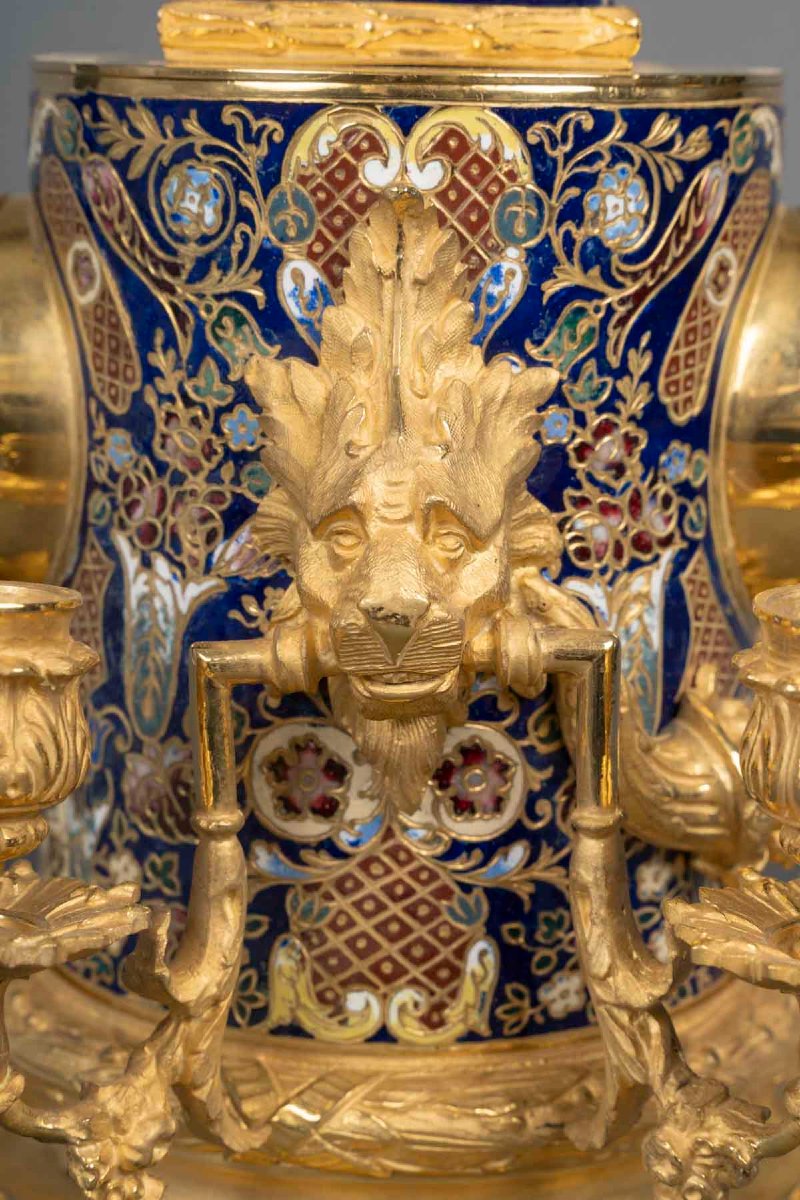
Of astonishing sophistication, this mantel or boudoir clock, with its elegant Louis XVI features a semi-column-shaped body adorned with a precious tracery of cloisonné champlevé enamels in a dazzling, polychrome finish. Against a midnight blue background, oblong reserves centered with a quatrefoil flower or lozenges with small geometric motifs in gold on a garnet ground encircle the rear bezel. The white enamel dial of the clock is set around its perimeter with beading alternating with a frieze of chevrons. Below these, enclosed in a cartouche haloed in delicate ivory-white, an exquisite trophy of sentimental significance depicts two turtledoves frolicking with outstretched wings, perched on ribboned amorous attributes (a quiver with fletched arrows intertwined with a torch and a burning brand), adding a sweet note of dreaminess to the vegetal and floral composition that envelops and embellishes the body of the clock. Scrolls, palmettes, and acanthus blossoms, bell-shaped flowers, tiny bells, flowering stems, and peonies in bud or in full bloom, in vibrant colors (white, garnet, emerald green) or iridescent tones (azure blue, powder pink), unfold in a captivating harmony.
Set within a finely chased and gilded bronze mount, adorned with a generous laurel wreath, this enameled body features two mascarons on its sides, each with a chimerical leonine muzzle. From their flamboyant manes, decorated with acanthus palmettes, spring two opulent festoons of floral garlands studded with rosebuds. In their half-open mouths, each holds two leafy arms of light adorned with spring blossoms. Their sockets and candle holders are crafted with a corolla of stylized petals, gadroons, and acanthus palmettes. Erected on a four-legged base with robust scrolled console motifs and rosette-shaped acanthus leaf motifs punctuated by dangling, floral keys, the clock is advantageously adorned at its finial with the chaste and delicate bust of one of Jean-Antoine Houdon's (1741-1828) emblematic works—alongside his famous The Kiss (1772): Diana the Huntress, whose model, conceived by the eminent Enlightenment sculptor around 1776 (plaster), was later executed in marble (1780) and then in bronze (1790). Crafted from biscuit porcelain, this clock rests on a pedestal base with a luminous cobalt blue background accentuated by gold fillets resting on a small die inscribed with a laurel wreath, which enhances its refined neoclassical profile.
Boasting both original design and meticulous craftsmanship, this clock, with its remarkable formal plasticity, immediately captivates with its elegant silhouette, its judicious Neo-Louis XVI style, and its ornamental refinement, which plays with contrast and the preciousness of its materials with an exquisite touch of coquettishness.
Of an unusual design, the clock presented here testifies, among other things, to the inexhaustible inventiveness of Parisian furniture bronze manufacturers in the second half of the 19th century. They created, for a select clientele attuned to the Louis XVI Neoclassicism and its iconic figures, high-quality timepieces that were both respectful of the aesthetics of yesteryear and, if not innovative, certainly highly distinctive.
With its striking presence, this clock will grace any elegant interior with its delicate yet radiant touch.
___________________ Marks and signatures: Apocryphal signature in relief on the reverse of the bust: HOUDON
Materials: gilt bronze; polychrome enamels; Limoges porcelain with a cobalt blue ground and gold highlights: bi
A LOUIS XVI REVISITED
Of astonishing sophistication, this mantel or boudoir clock, with its elegant Louis XVI features a semi-column-shaped body adorned with a precious tracery of cloisonné champlevé enamels in a dazzling, polychrome finish. Against a midnight blue background, oblong reserves centered with a quatrefoil flower or lozenges with small geometric motifs in gold on a garnet ground encircle the rear bezel. The white enamel dial of the clock is set around its perimeter with beading alternating with a frieze of chevrons. Below these, enclosed in a cartouche haloed in delicate ivory-white, an exquisite trophy of sentimental significance depicts two turtledoves frolicking with outstretched wings, perched on ribboned amorous attributes (a quiver with fletched arrows intertwined with a torch and a burning brand), adding a sweet note of dreaminess to the vegetal and floral composition that envelops and embellishes the body of the clock. Scrolls, palmettes, and acanthus blossoms, bell-shaped flowers, tiny bells, flowering stems, and peonies in bud or in full bloom, in vibrant colors (white, garnet, emerald green) or iridescent tones (azure blue, powder pink), unfold in a captivating harmony.
Set within a finely chased and gilded bronze mount, adorned with a generous laurel wreath, this enameled body features two mascarons on its sides, each with a chimerical leonine muzzle. From their flamboyant manes, decorated with acanthus palmettes, spring two opulent festoons of floral garlands studded with rosebuds. In their half-open mouths, each holds two leafy arms of light adorned with spring blossoms. Their sockets and candle holders are crafted with a corolla of stylized petals, gadroons, and acanthus palmettes. Erected on a four-legged base with robust scrolled console motifs and rosette-shaped acanthus leaf motifs punctuated by dangling, floral keys, the clock is advantageously adorned at its finial with the chaste and delicate bust of one of Jean-Antoine Houdon's (1741-1828) emblematic works—alongside his famous The Kiss (1772): Diana the Huntress, whose model, conceived by the eminent Enlightenment sculptor around 1776 (plaster), was later executed in marble (1780) and then in bronze (1790). Crafted from biscuit porcelain, this clock rests on a pedestal base with a luminous cobalt blue background accentuated by gold fillets resting on a small die inscribed with a laurel wreath, which enhances its refined neoclassical profile.
Boasting both original design and meticulous craftsmanship, this clock, with its remarkable formal plasticity, immediately captivates with its elegant silhouette, its judicious Neo-Louis XVI style, and its ornamental refinement, which plays with contrast and the preciousness of its materials with an exquisite touch of coquettishness.
Of an unusual design, the clock presented here testifies, among other things, to the inexhaustible inventiveness of Parisian furniture bronze manufacturers in the second half of the 19th century. They created, for a select clientele attuned to the Louis XVI Neoclassicism and its iconic figures, high-quality timepieces that were both respectful of the aesthetics of yesteryear and, if not innovative, certainly highly distinctive.
With its striking presence, this clock will grace any elegant interior with its delicate yet radiant touch.
___________________ Marks and signatures: Apocryphal signature in relief on the reverse of the bust: HOUDON
Materials: gilt bronze; polychrome enamels; Limoges porcelain with a cobalt blue ground and gold highlights: bi
Explore similar pieces and discover your ideal find:
Mantel Clocks