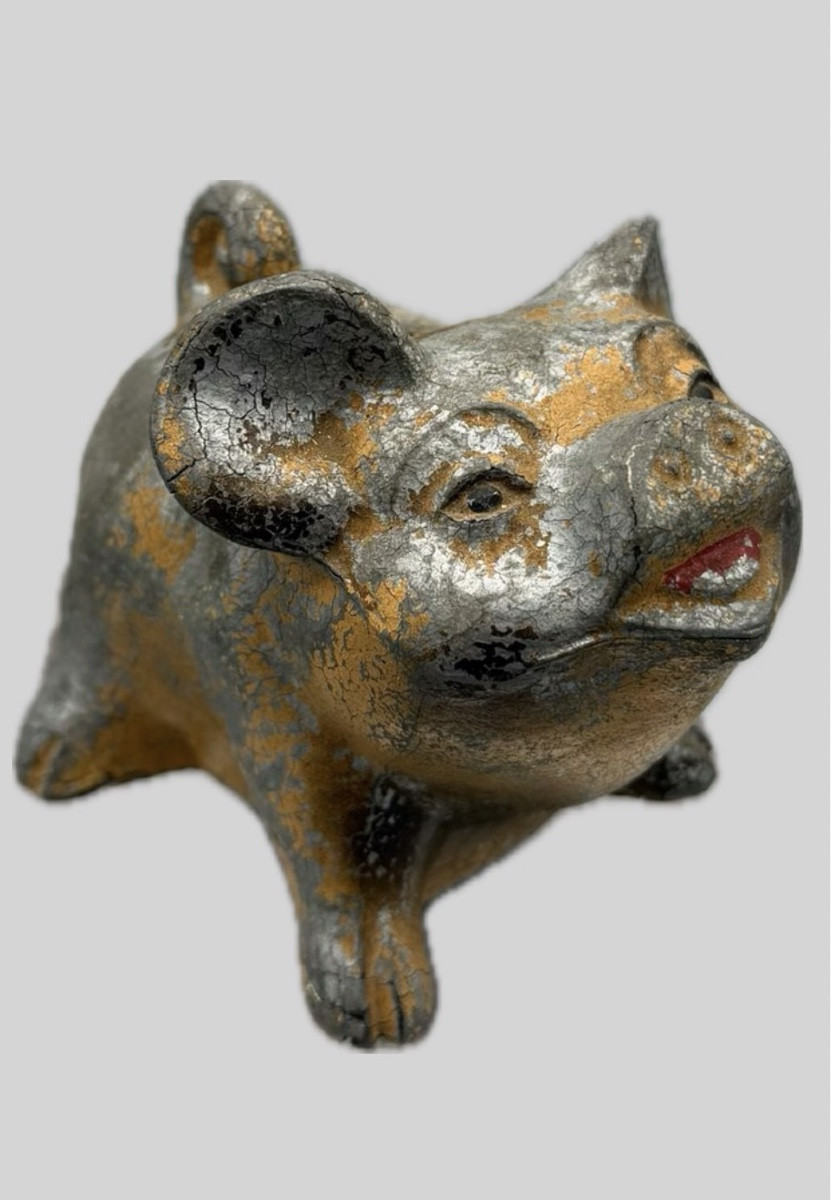
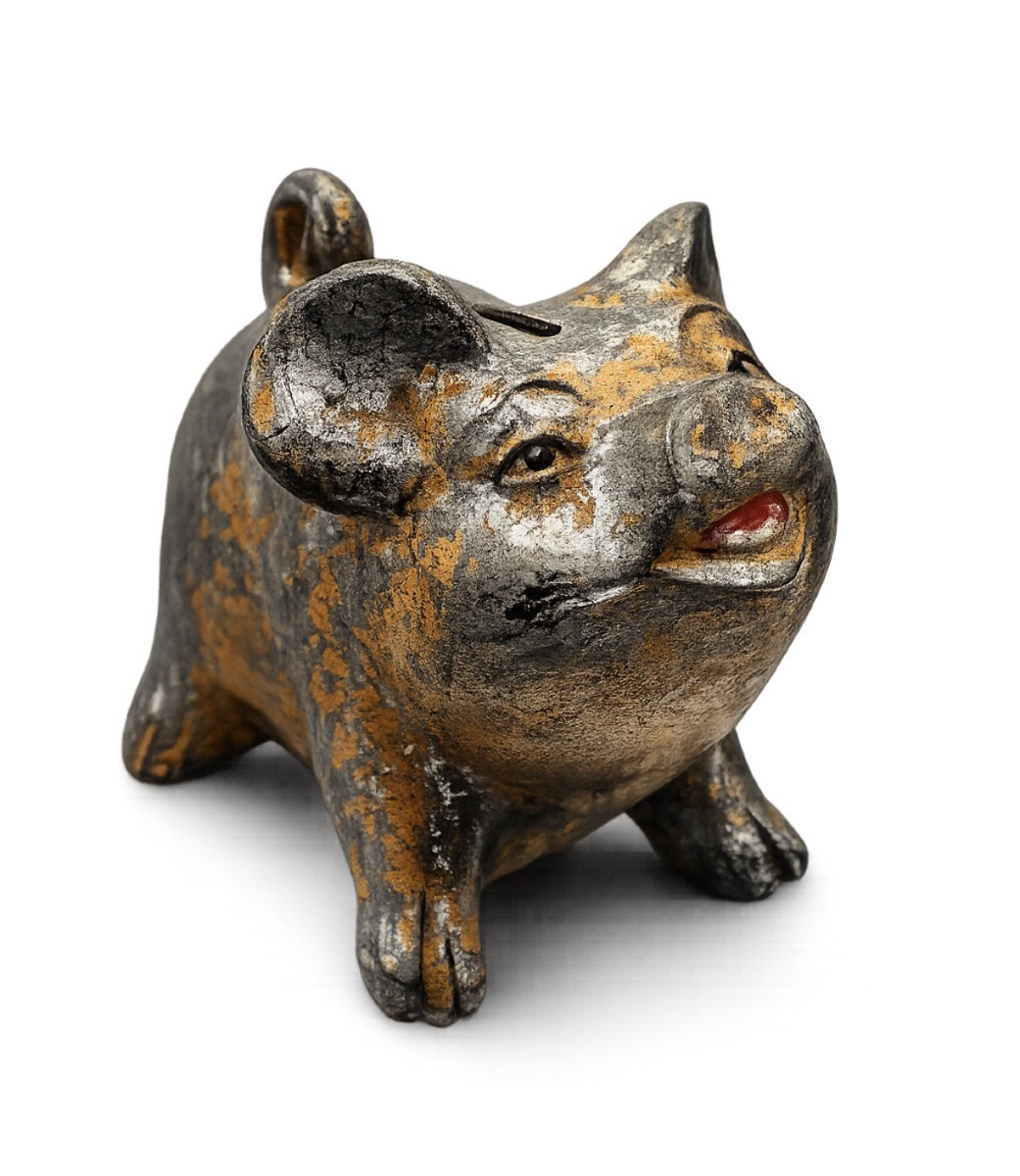
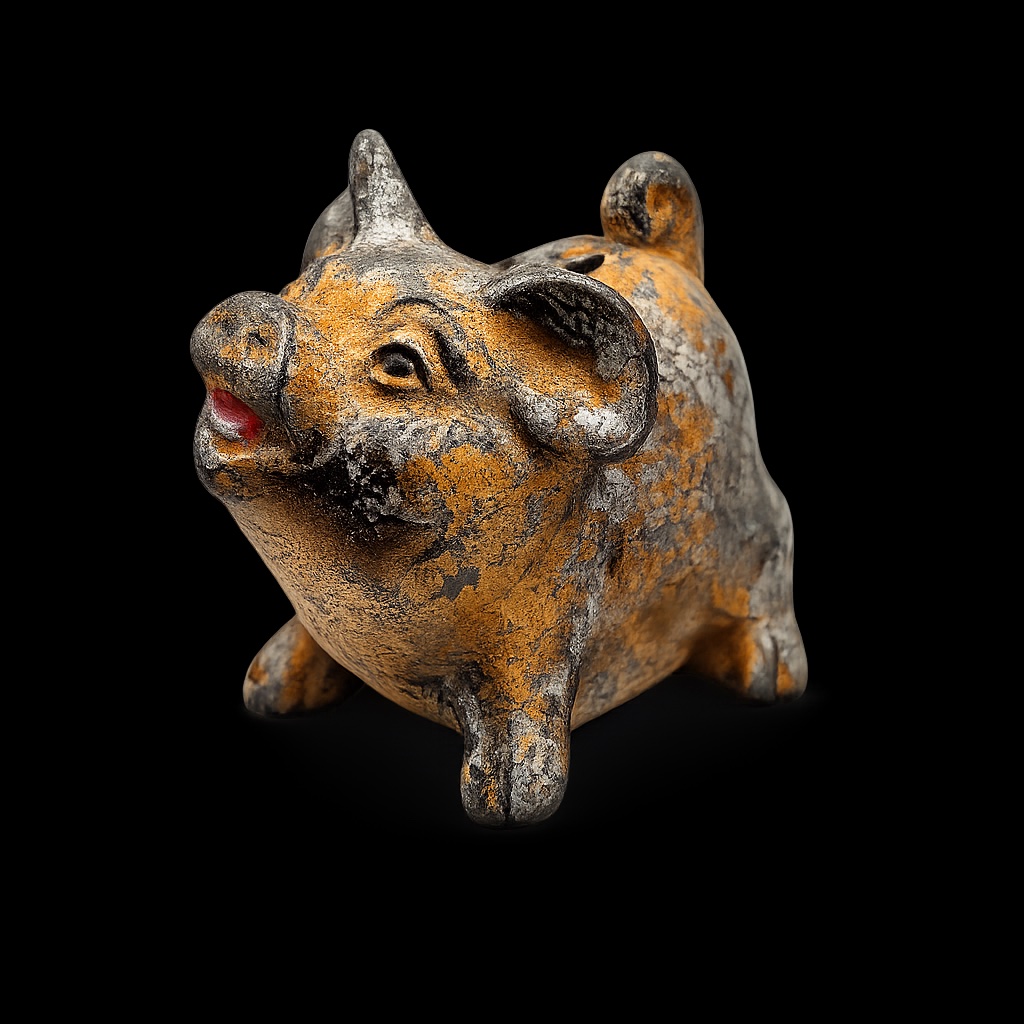
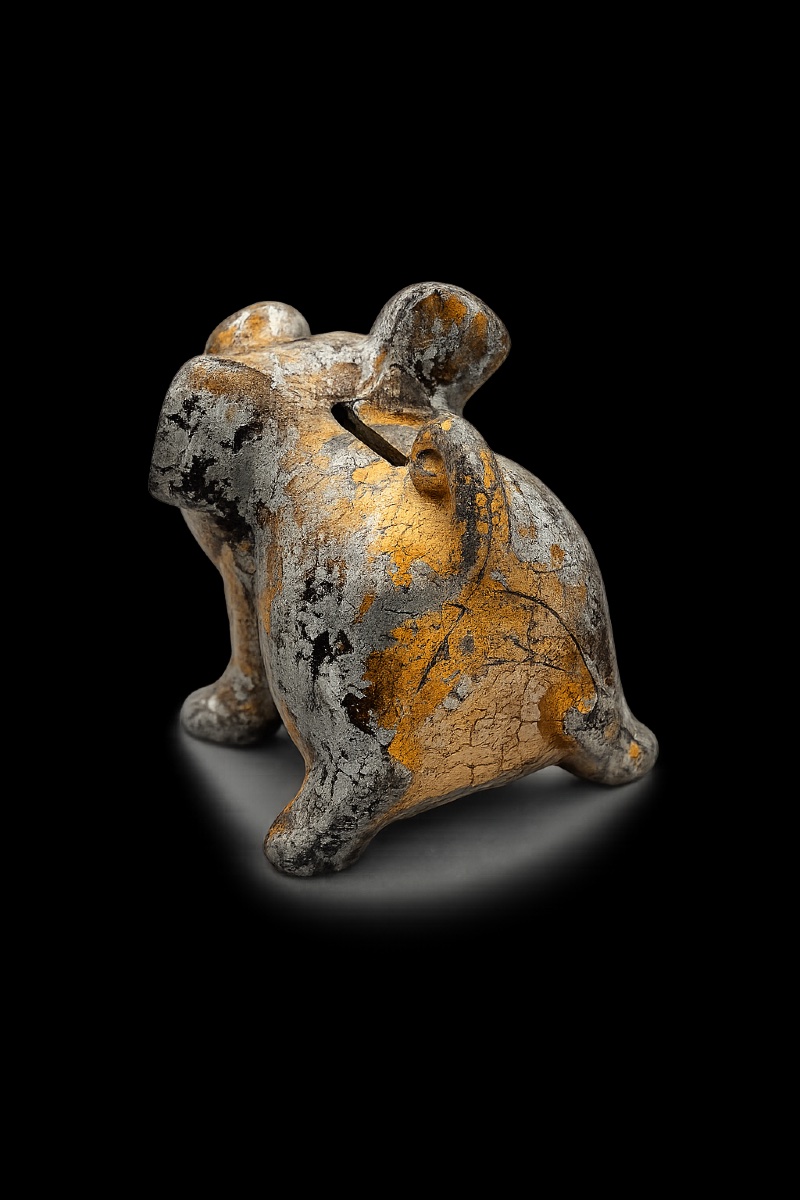
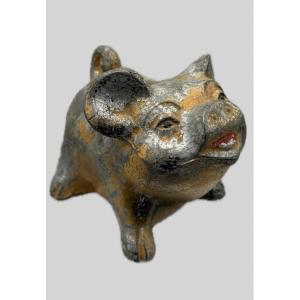


"Piggy Bank — United States, Circa 1900"
At the turn of the 20th century, the American production of small household cast iron objects gave rise to a typology of objects situated at the boundary between folk sculpture and utilitarian object. This piggy bank belongs to this visual universe where the familiar animal becomes the vehicle for an imaginary world that is both playful and symbolic, linked to saving and prosperity. Modeled with great economy of means, the volume is characterized by a compact and almost archaic construction: short legs, a rounded muzzle, simplified ears. This deliberate stylization gives the figure a strong sculptural presence, akin to certain expressions of late 19th-century American folk art. The absence of a mechanism—typical of "still banks"—reinforces this artistic interpretation, the object presenting itself more as a small household sculpture than as a complex toy. Careful examination of the surface reveals traces of an original polychromy, likely a bright orange, typical of late 19th-century American cast iron. The combined aging of the paint binder, pigments, and casting has gradually transformed this initial hue into a nuanced patina blending metallic grays, golden ochres, and dark areas of oxidation. This phenomenon, far from altering the object, now constitutes a major aesthetic quality, the paint taking on an almost mineral dimension that reinforces the sculptural interpretation of the piece. In the American context, these animal-shaped piggy banks were produced by numerous industrial foundries, intended for everyday domestic use. However, some examples, through the quality of their formal presence and the beauty of their patina, now transcend their original function to enter the realm of folk art. This piece fits precisely within this contemporary reinterpretation: a naive figure that has become, over time, a true miniature sculpture. Condition: Old polychromy with wear, cracking, and chromatic transformations consistent with age; stable surface. Original dorsal crack. No major structural damage observed. 










 Le Magazine de PROANTIC
 TRÉSORS Magazine
 Rivista Artiquariato