THIS OBJECT WAS SOLD
A Greek-style Marquetry Commode, After A Model By Pierre Roussel.


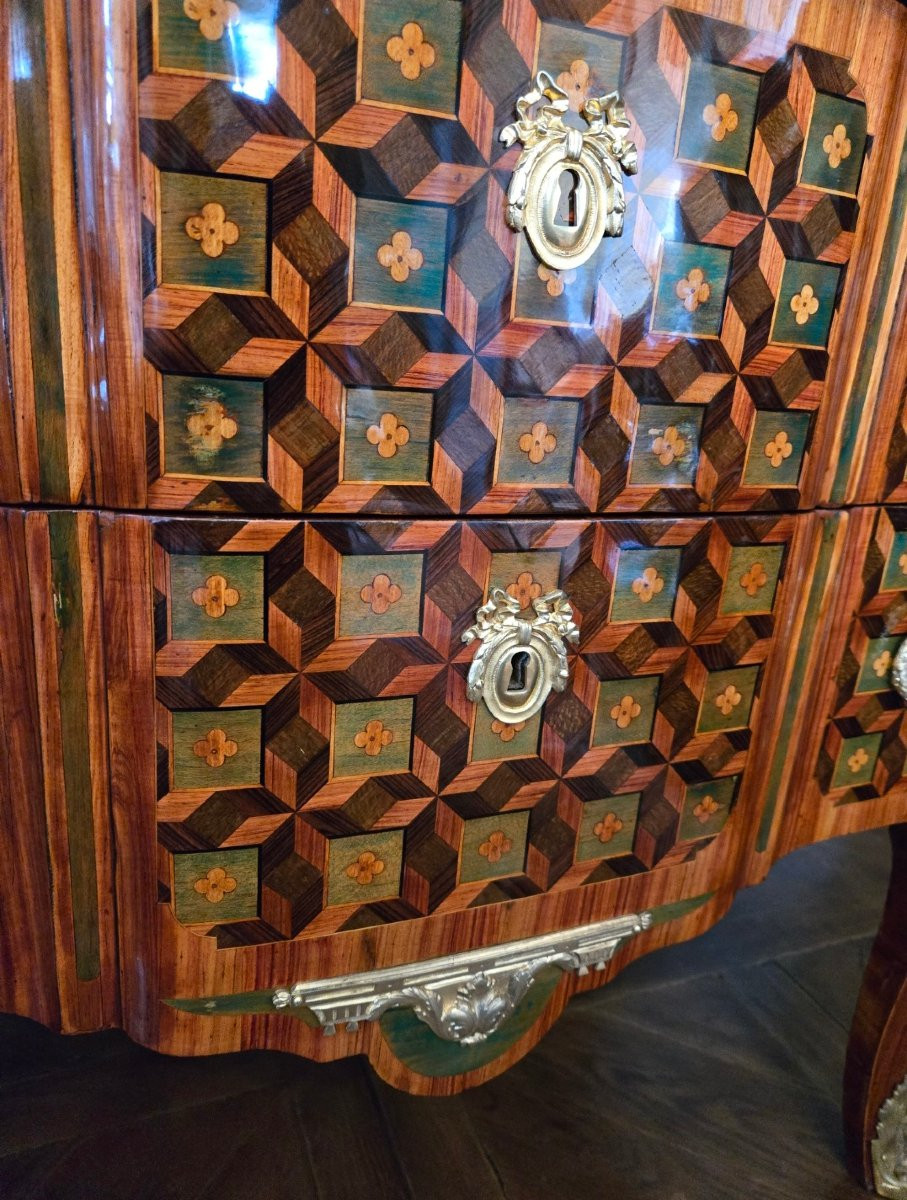
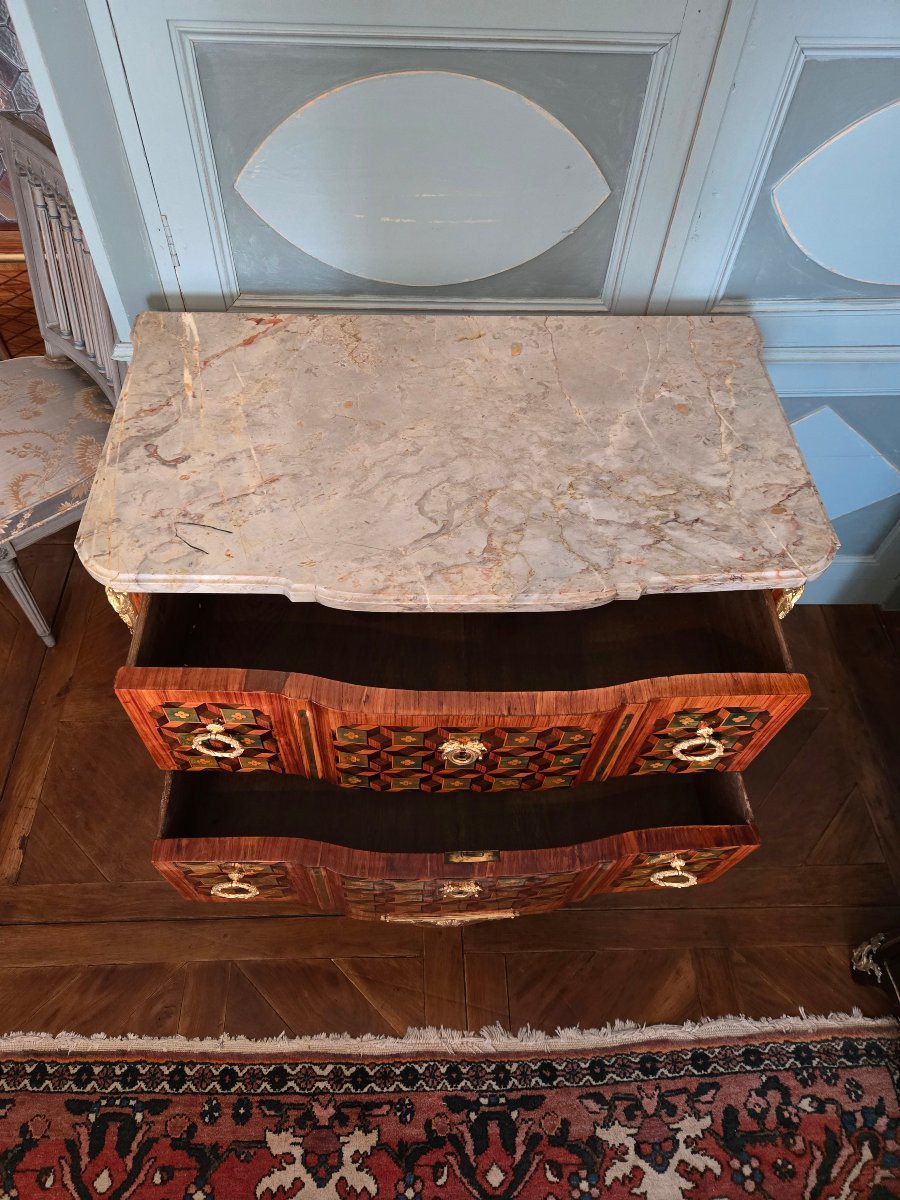

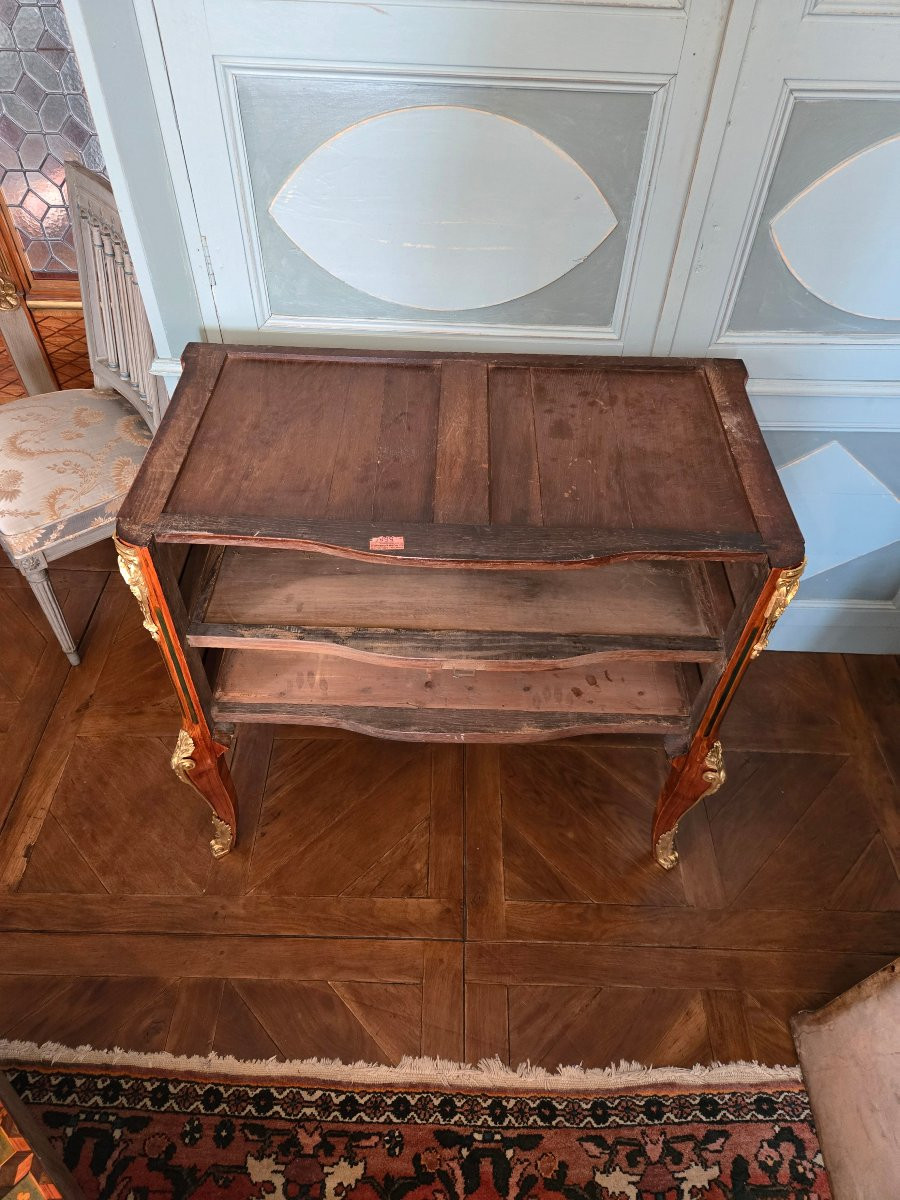


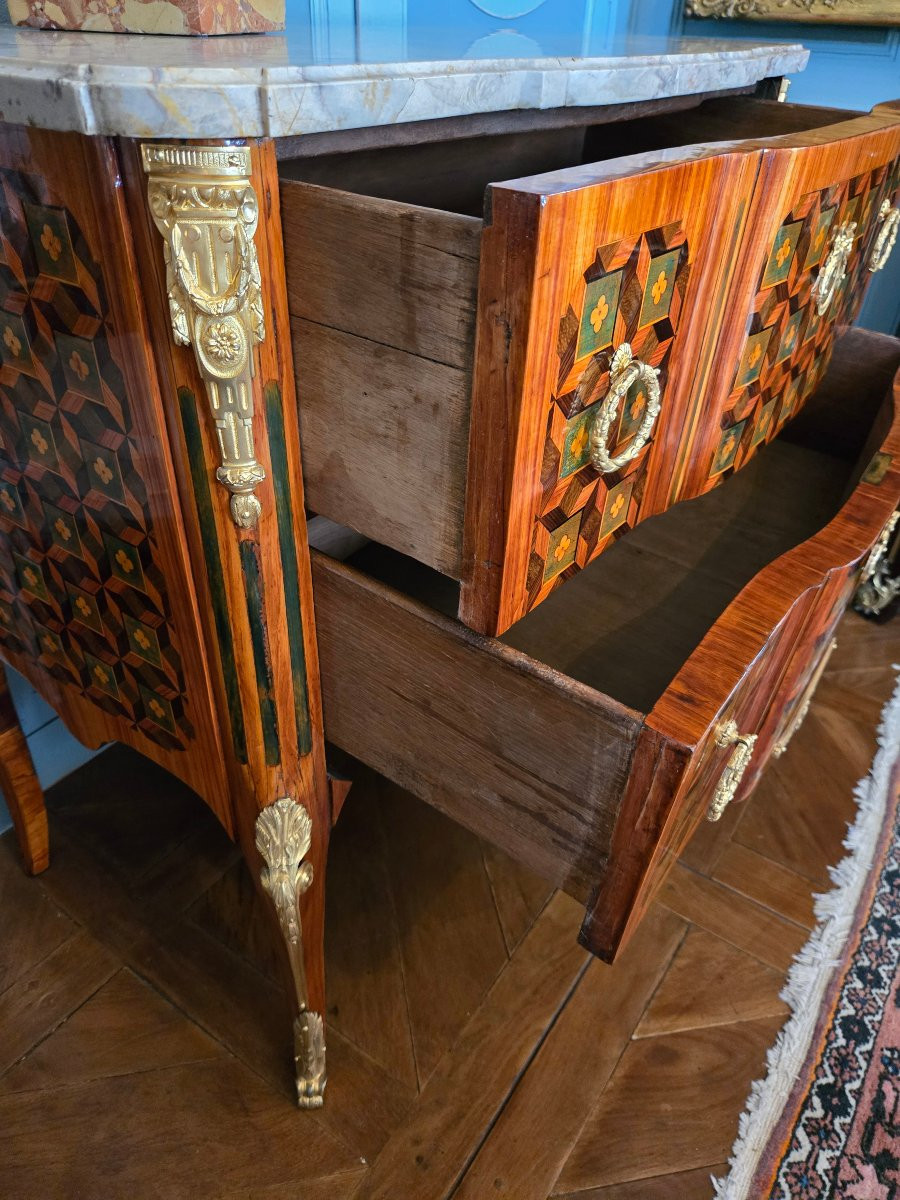


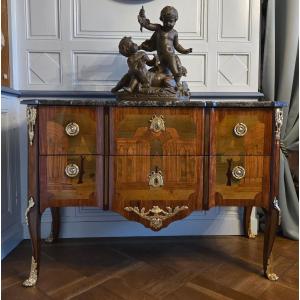
This elegant commode with a double projection belongs to the typology of models known as "in the Greek style," an emblematic form of the Transition period when the still-curved Louis XV architecture gradually submitted to the principles of rectitude and compartmentalization derived from Greek taste. Its orthodromic frame, enlivened by a central projection and resting on cabriole legs still deeply inherited from Louis XV, corresponds precisely to these Transition models, which 18th-century inventories frequently referred to as "Regency commodes"—not in reference to the Regency style of the early century, but to characterize a commode without a visible crossbar. This terminological nuance, rarely explained, fully illuminates the interpretation of our piece. We are here in what François Quéré describes as the assimilation of Greek taste by Parisian workshops around 1770: a still-curved but disciplined architecture, where geometric marquetry with compartmentalized elements takes precedence over rocaille, while the bronze ornamentation adopts a more structured vocabulary. The front features two large drawers without a central rail, punctuated by a double projection and framed by uprights highlighted with green-stained fluting. The panels are entirely covered with cubic mosaic marquetry, creating a striking optical relief effect, composed of rosewood, violet wood, amaranth, sycamore, and stained woods. Each central compartment is adorned with a small stylized flower (four leaves) inscribed within a green square, reinforcing the geometric rigor of the whole. The sides, with their rear projection and shaped lower rail, are treated with the same exacting standards, each receiving an identical marquetry panel, precisely conforming to the models published in François Quéré's work on the Roussel family. Comparison with commodes stamped P. Roussel, particularly those reproduced around 1770-1775 featuring mosaic marquetry and a projecting architectural design, reveals a clear formal kinship: the same compact proportions, the same design of cabriole legs, the same lateral cut, and the same logic of compartmentalization. This double-recessed orthopedic construction, described by Guillaume Janneau and adopted by Quéré to characterize Rousselian productions reflecting the assimilated Greek taste, is also found here. The bronzes, of fine quality, fully participate in this style: architectural corner mounts, foliate sabots, ribbon-knotted keyhole escutcheons, and vegetal wreath-shaped pull rings. Their design falls within the Neoclassical repertoire prevalent in the 1760s and 1770s, while their finely oxidized, aged patina harmonizes perfectly with the overall design. The top is crowned with a molded antique marble slab in nuanced hues, following the line of the recess. The construction deserves special mention. The frame is crafted using traditional 18th-century Parisian cabinetmaking techniques: hand-joined construction, oak uprights and rails, drawers fitted in the traditional style, veneered softwood fronts, and fir side panels. Antique woods were used in the piece's construction, giving it a rich and consistent patina. The veneers have been intentionally aged, displaying subtle wear and variations that naturally evoke the passage of time. The piece has been cleaned and polished with a French polish, respecting its character and spirit. It is a late 19th-century or perhaps early 20th-century work executed with remarkable technical skill, in the spirit of the Transitional "Greek" style models, as described by Pierre Roussel. The quality of the marquetry, the precision of the design, and the adherence to traditional techniques attest to a high-end reproduction, conceived with a perfect understanding of 18th-century principles. Our chest of drawers can certainly be compared to the most accomplished works of forgers like André Mailfert in his early period. It is also possible that this chest of drawers was made to be the counterpart of another from the same era, but in this case, with a highly refined attention to detail! Dimensions: Width: 96 cm Depth: 55 cm Height: 87 cm This chest of drawers is a particularly accomplished example of a learned reinterpretation of Parisian Greek style, combining disciplined Louis XV architecture, neoclassical marquetry, and 18th-century-inspired bronze ornamentation in a highly coherent aesthetic interpretation.
Explore similar pieces and discover your ideal find:
Chests of Drawers