THIS OBJECT WAS SOLD
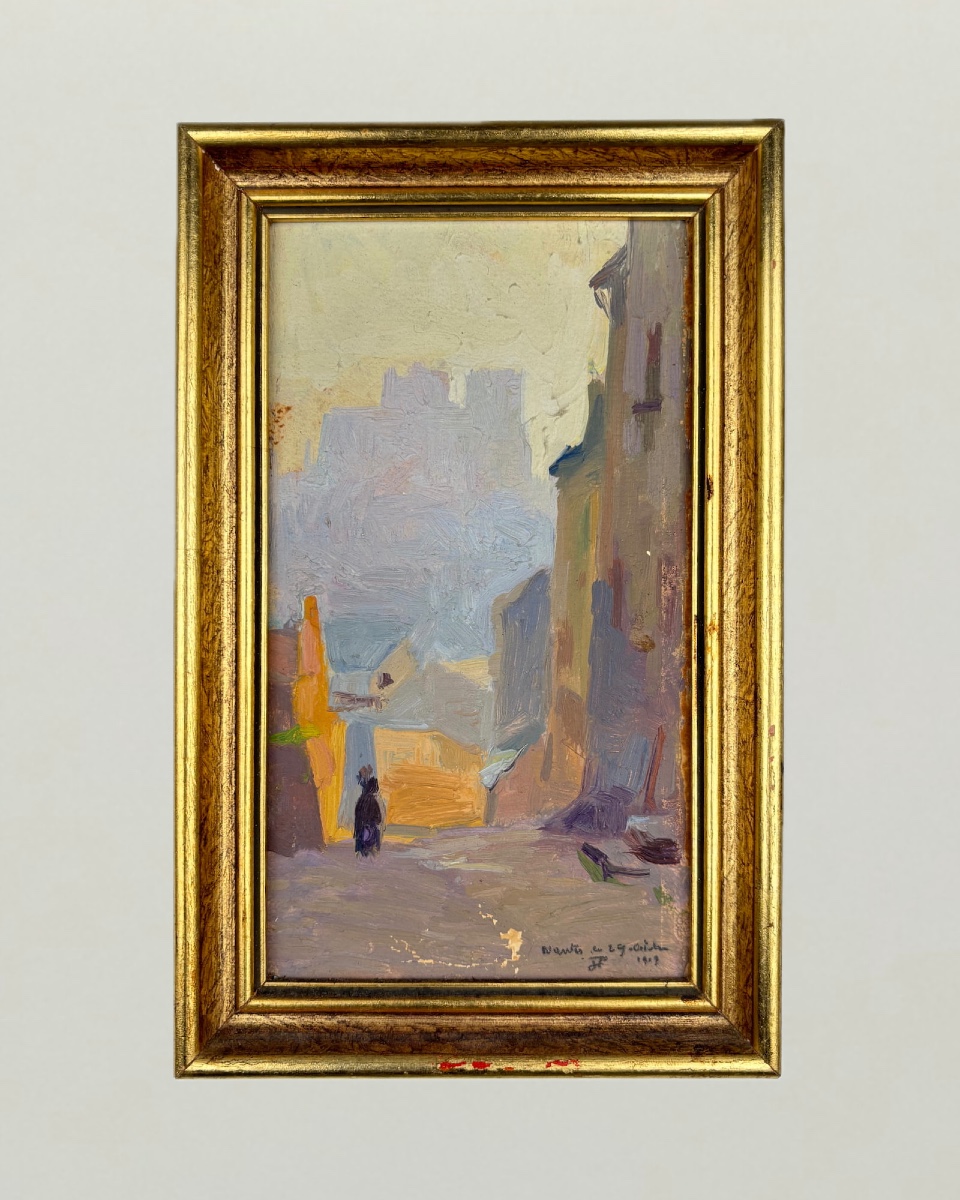
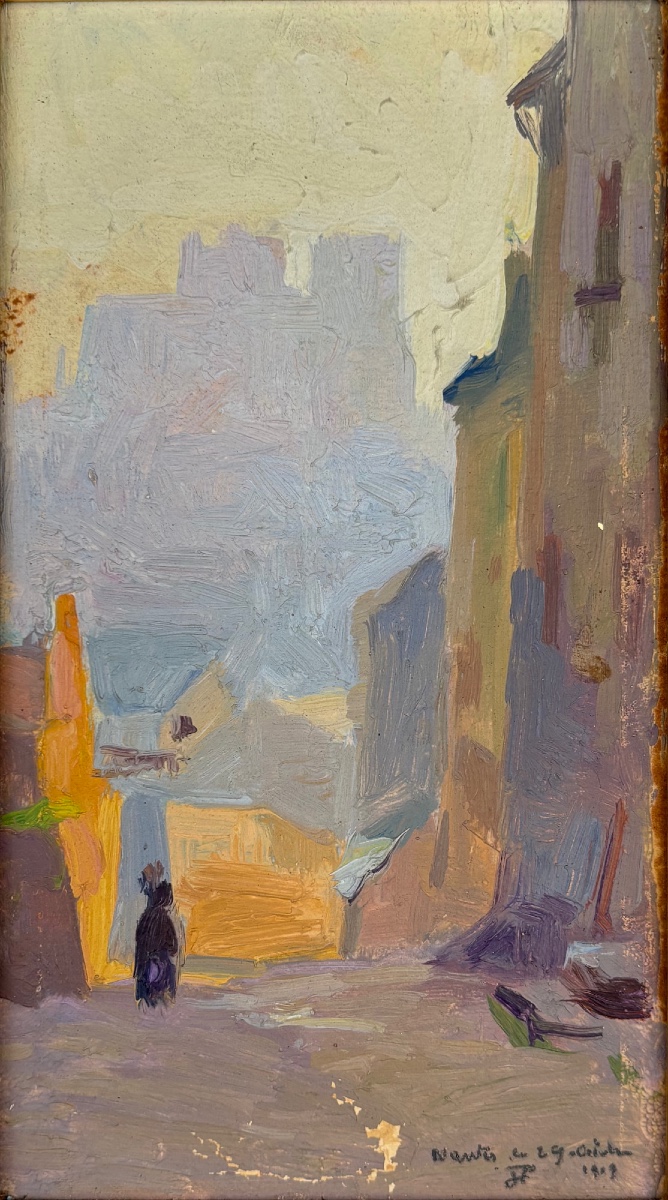
Jules Ponceau (1881-1961), Nantes At Sunset, 1909, Oil On Cardboard

Jules PONCEAU
1881, Nantes – 1961, Sainte-Marie-sur-Mer (Loire-Atlantique)
Nantes at Sunset, 1909
oil on cardboard
20 × 11 cm
monogrammed, located and dated 29 October 1909, lower right
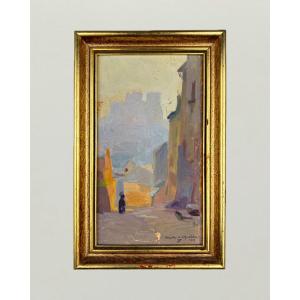
framed
some losses in the lower section
Born in Nantes in 1881 to a sculptor father and a dressmaker mother, Jules Ponceau trained as a painter and engraver under Luc-Olivier Merson, Paul Gervais, and Maurice Chabas. A member of the Société des Artistes Français from 1908 onward, he exhibited regularly at the Salon, where he received an honorable mention for engraving in 1910. Mobilized in 1914 and wounded at Verdun in 1916, he experienced frontline combat in the Meuse region. From this period emerged a set of 202 wartime sketches produced between 1915 and 1919, a poignant testimony to the violence of combat and the destruction of landscapes. Compiled after the war into an album dedicated to his son, these drawings are now preserved in the collections of the Nantes History Museum.
After the war, the artist deliberately pursued a career rooted in his native city and region, exhibiting repeatedly at the Moyon-Avenard gallery in the Passage Pommeraye, without seeking to establish himself on the Parisian scene. Alongside his activity as a painter, Jules Ponceau was also a drawing teacher. He began teaching in 1907, first in Honfleur, then in Bordeaux and Rouen, before being appointed to the Lycée Clémenceau in Nantes in 1919. “Former students of the Lycée have not forgotten his silhouette: wide-brimmed hat, tightly fitted black jacket buttoned high, lavallière tie, upturned moustache and blond musketeer-style goatee,” nor “the kindly turbulence of his classes,” recalls Jean Le Brun, a former head of an annex lycée.
His views of Nantes, often small in format, convey an atmosphere immediately recognizable to its inhabitants. He painted the ports and quays, deserted streets, working-class districts, and the banks of the Loire, paying less attention to monumentality than to the city’s distinctive tonality. Bluish mists, impending rain, post-storm skies, floods, and winter light compose a painting of the weather as much as of the passage of time, in which the city appears suspended in an almost unreal silence, familiar to the people of Nantes, “accustomed to this aquarium-like day” (Le Phare de la Loire, 1928).
Dated 29 October 1909, this oil on cardboard offers an emblematic vision of Jules Ponceau’s Nantes, with the Château des Ducs de Bretagne barely emerging from the mist in the background. The composition, tightly framed and almost austere, favors architectural masses over descriptive detail: tall façades, simplified volumes, and a narrow perspective guiding the eye toward the silhouette of the monument. The palette—ochres, bluish grays, mauves, and muted yellows—conveys a humid and unstable climate characteristic of the Loire city. Human presence, reduced to a single dark and isolated figure, heightens the sense of solitude and suspended time. More than a topographical view, Ponceau delivers a sensitive impression of Nantes, in which the castle becomes a silent landmark within a city rendered through atmosphere.
During the Second World War, Ponceau fully answered General de Gaulle’s call to resistance. He distributed de Gaulle’s portrait and aided British airmen shot down during air raids over the city. His commitment led to imprisonment, from which he was released thanks to the intervention of the headmaster of the Lycée Clémenceau. The greatest ordeal, however, was the disappearance of his son Yves, arrested after being denounced while belonging to a resistance network. Thirty years after dedicating an album of First World War sketches to him, Ponceau endured the tragic loss of that same son, who likely died in deportation.
Public collections
Musée d'histoire de Nantes, Château des ducs de Bretagne
Explore similar pieces and discover your ideal find:
modern paintings