THIS OBJECT WAS SOLD
Japanese Bronze Sculpture By Tsuda Eiju - Walking Panther




Tsuda EIJU (津田永寿, 1915–2001) is considered the most important Japanese bronze sculptor of the second half of the 20th century. Adopted son and successor of the imperial artist Tsuda (Daiju) SHINOBU (津田信夫, 1875–1946), he studied under the latter and subsequently inherited the surname Tsuda – his birth name, before his adoption by the famous sculptor, being Matsunuma.
Throughout his illustrious career, Eiju exhibited extensively and received numerous prestigious awards, including the Export Prize at the Arts and Crafts Exhibition, the Ministry of Commerce and Industry's Arts and Crafts Exhibition Prize, the Foundry Masterpiece Award, and the Hokuto Special Prize at the 5th Nitten (Japan Art Exhibition, 1962). He was a member of the Imperial Academy of Fine Arts, a jury member at the Fukushima Art Exhibition, and a professor at the Tokyo University of the Arts.
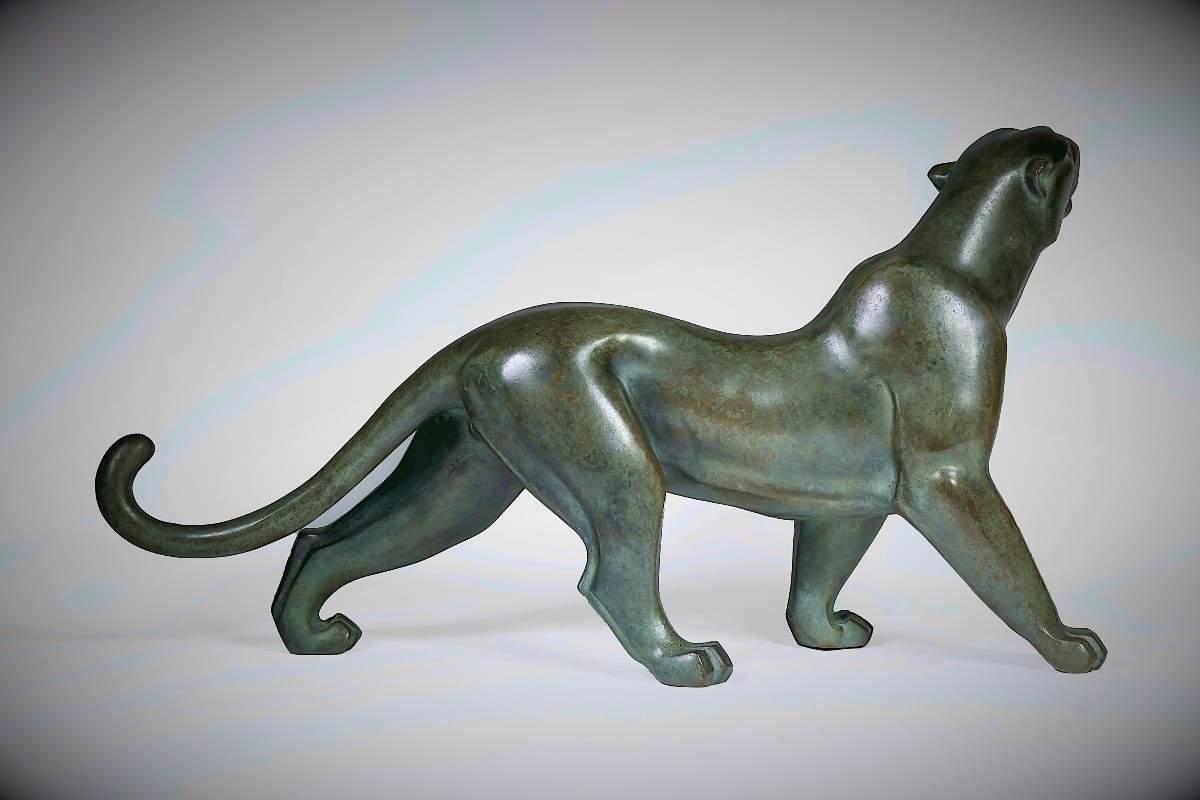
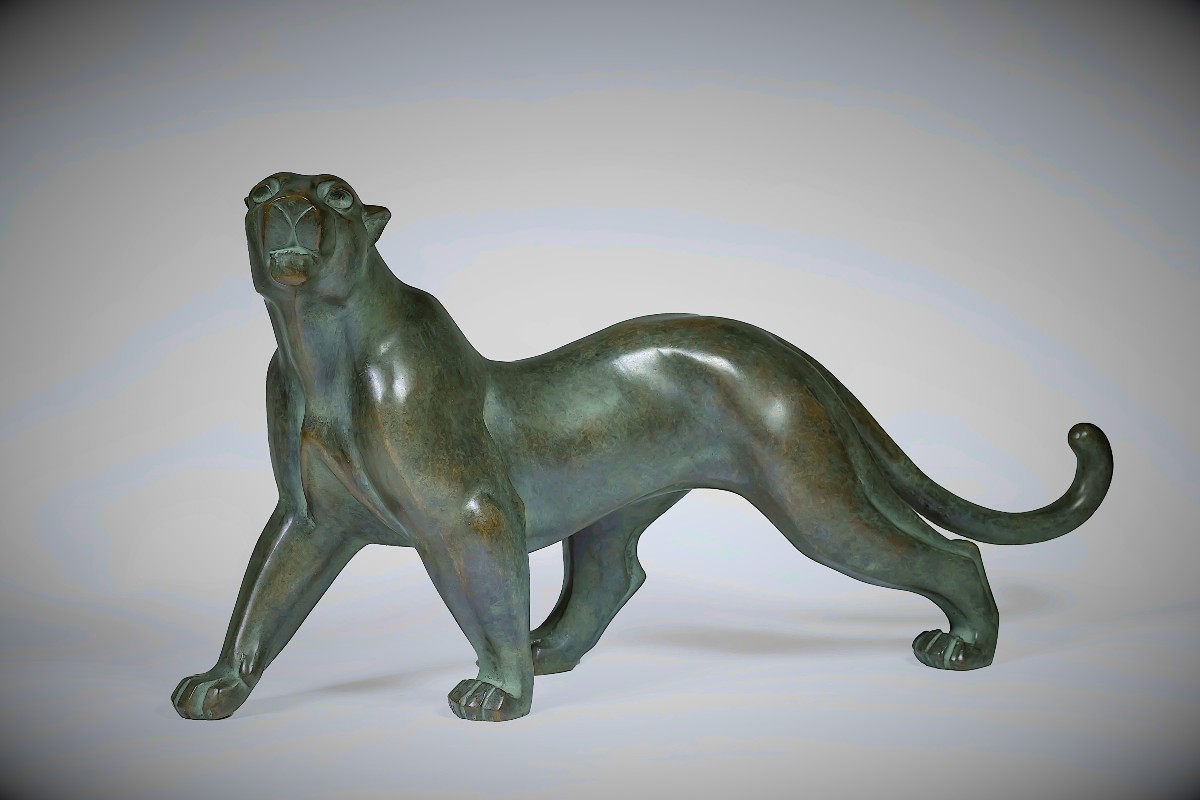
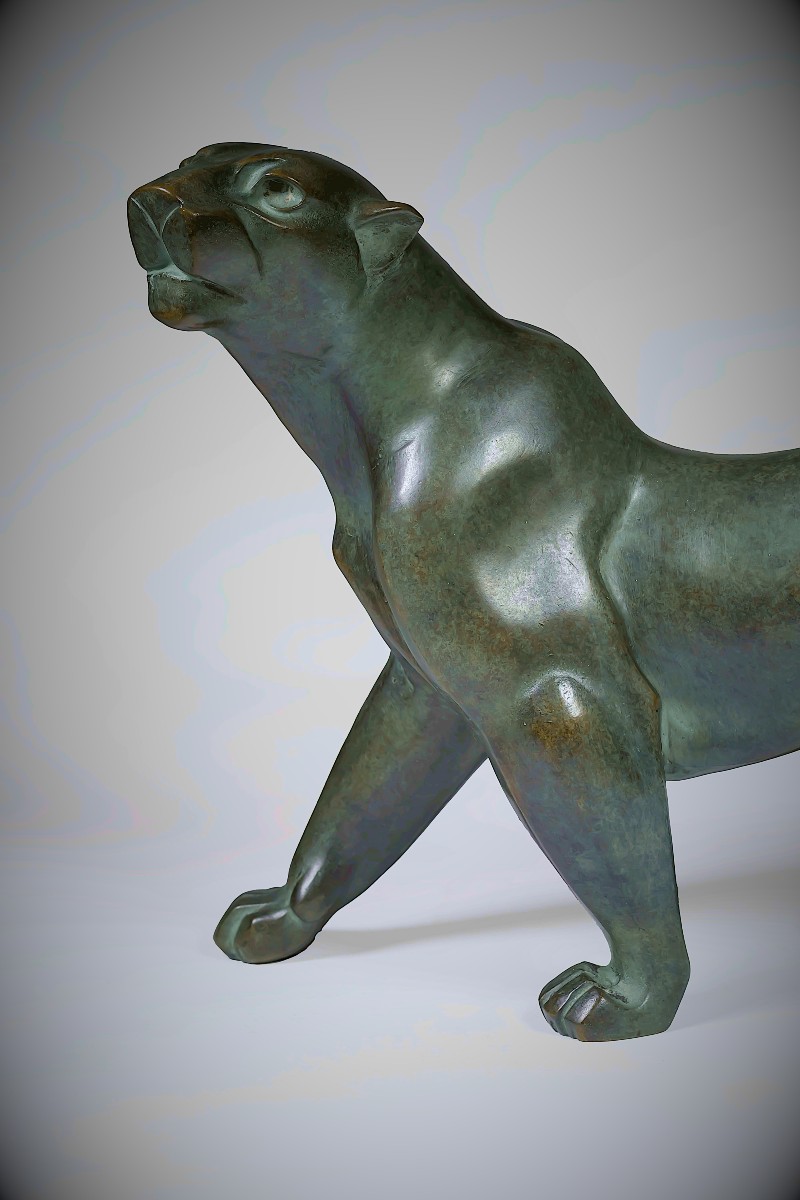
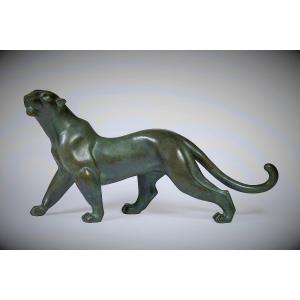
In this striking bronze sculpture, Tsuda Eiju captures not only the form of a panther but also its contained power—the silent, palpable energy that precedes movement. The animal advances with measured authority, its elongated body articulated in a harmonious flow of muscular tension and grace. Every contour is intentional; every surface vibrates with subtle modulation.
The panther's head is slightly raised, alert, almost regal. The slightly open mouth and focused gaze suggest vigilance rather than aggression. Tsuda avoids any excessive dramatization. Instead, he distills the essence of the feline: a contained strength, an understated elegance. The tail forms a controlled arc, balancing the stride and reinforcing the rhythm of the sculpture.
The bronze surface is covered with a deep, nuanced patina in shades of green and brown, lending the work a visual warmth and sculptural depth. Light delicately caresses the polished surfaces of the shoulders and flanks, highlighting the anatomical refinement and the artist's intimate understanding of the animal form. The treatment of the paws and musculature reveals a sculptor trained not only in observation but also in simplification, eliminating anecdotal details in favor of sculptural purity.
This panther is a superb example of 20th-century Japanese bronze sculpture, a work that unites technical mastery with aesthetic restraint. Despite its size, it possesses a serene monumentality and embodies the refined elegance so characteristic of the finest Japanese sculptural traditions.
A powerful presence, both timeless and resolutely modern.
Throughout his illustrious career, Eiju exhibited extensively and received numerous prestigious awards, including the Export Prize at the Arts and Crafts Exhibition, the Ministry of Commerce and Industry's Arts and Crafts Exhibition Prize, the Foundry Masterpiece Award, and the Hokuto Special Prize at the 5th Nitten (Japan Art Exhibition, 1962). He was a member of the Imperial Academy of Fine Arts, a jury member at the Fukushima Art Exhibition, and a professor at the Tokyo University of the Arts.
In this striking bronze sculpture, Tsuda Eiju captures not only the form of a panther but also its contained power—the silent, palpable energy that precedes movement. The animal advances with measured authority, its elongated body articulated in a harmonious flow of muscular tension and grace. Every contour is intentional; every surface vibrates with subtle modulation.
The panther's head is slightly raised, alert, almost regal. The slightly open mouth and focused gaze suggest vigilance rather than aggression. Tsuda avoids any excessive dramatization. Instead, he distills the essence of the feline: a contained strength, an understated elegance. The tail forms a controlled arc, balancing the stride and reinforcing the rhythm of the sculpture.
The bronze surface is covered with a deep, nuanced patina in shades of green and brown, lending the work a visual warmth and sculptural depth. Light delicately caresses the polished surfaces of the shoulders and flanks, highlighting the anatomical refinement and the artist's intimate understanding of the animal form. The treatment of the paws and musculature reveals a sculptor trained not only in observation but also in simplification, eliminating anecdotal details in favor of sculptural purity.
This panther is a superb example of 20th-century Japanese bronze sculpture, a work that unites technical mastery with aesthetic restraint. Despite its size, it possesses a serene monumentality and embodies the refined elegance so characteristic of the finest Japanese sculptural traditions.
A powerful presence, both timeless and resolutely modern.
Explore similar pieces and discover your ideal find:
Asian Bronze Sculptures