THIS OBJECT WAS SOLD
Circle Of Sir Peter Lely (1618-1680) - Portrait Of A Beauty In A Blue Silk Dress C.1665.
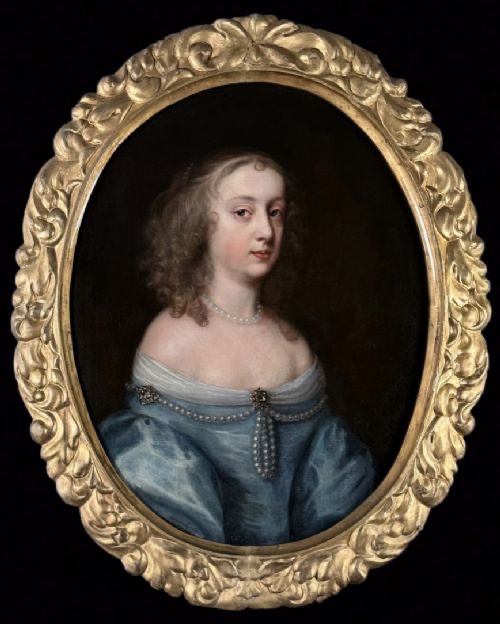
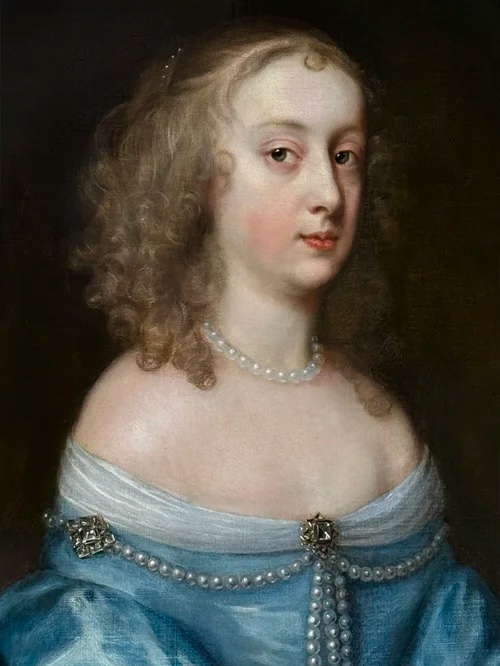
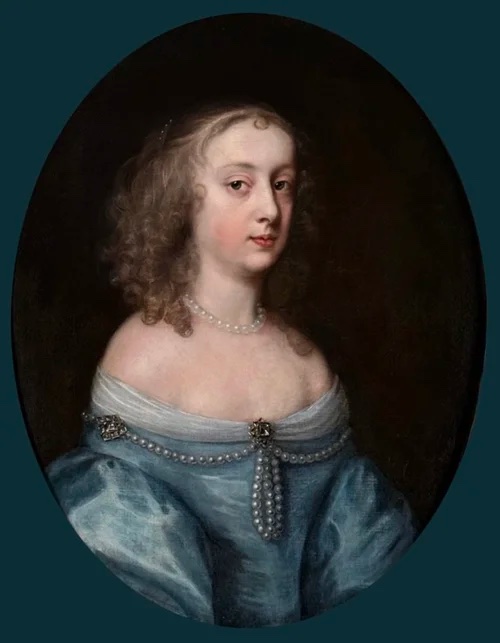
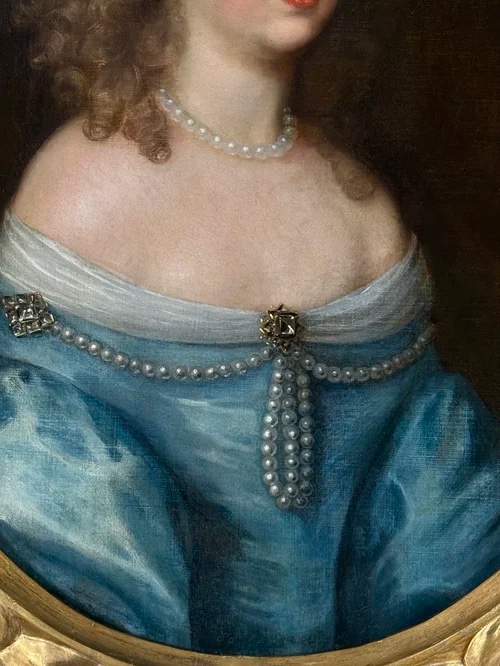
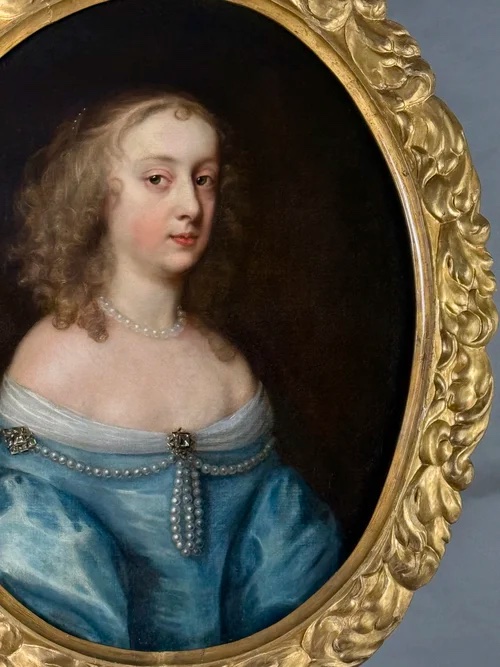
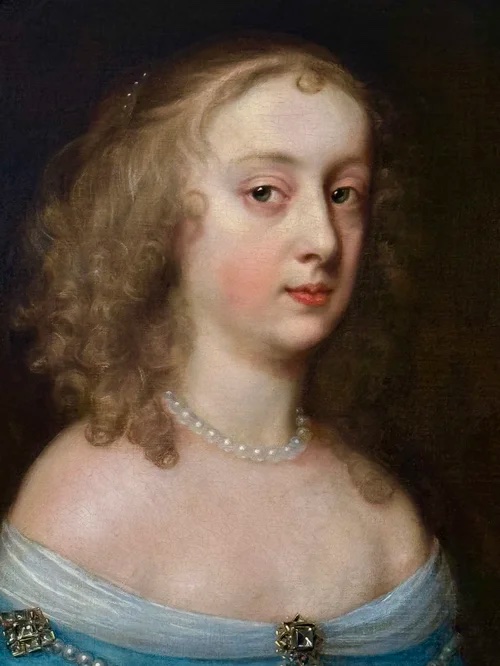
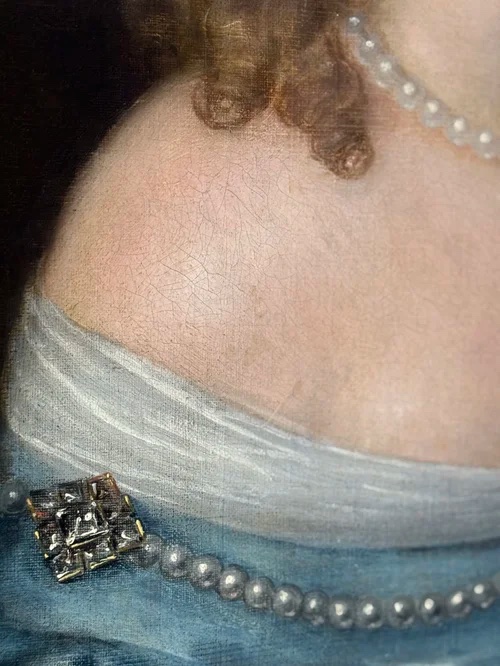
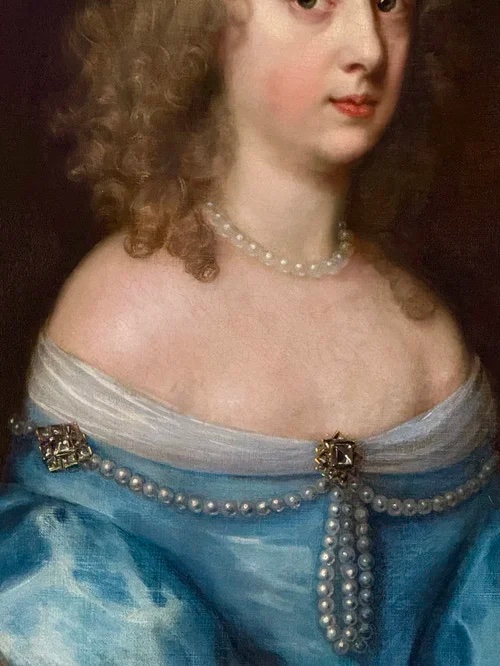
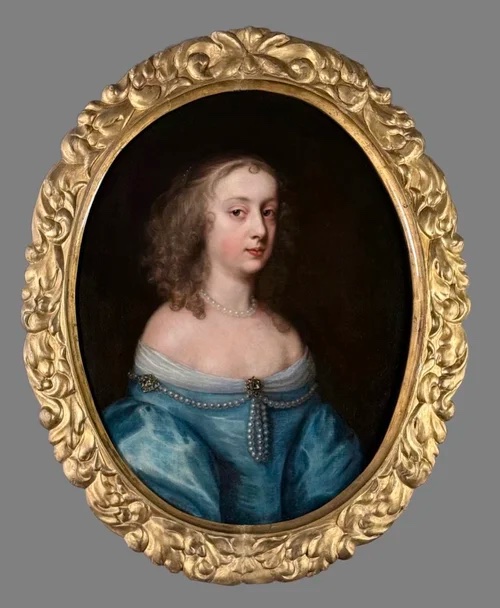
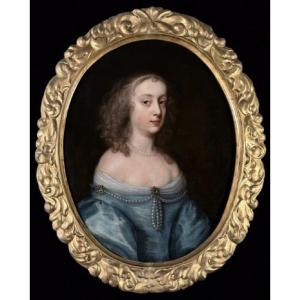


Fine 17th oil on canvas portrait of a young lady in a blue silk dress painted in the oval by an artist in the circle of Sir Peter Lely (1618-1680)This exquisite and insightful work, is a highly accomplished example of the type of portrait that was popular in court circles, in the third quarter of 17th century England.The attractive young sitter is extravagantly and expensively dressed in the height of fashion. Her gem studded, lustrous, cornflower blue silk dress is festooned with pearls and diamonds, and falls away at her shoulders to reveal her décolletage, creating the delightfully deshabilit look of the period.We are left in no doubt as to this beauty's status, she has ropes of pearls (the quintessential baroque ornament) prominently displayed and these are held in place with table cut diamond brooches. A single strand pearl necklace completes her look and her hairstyle is pinned effortlessly upwards, with curls tumbling upon her shoulders. This loose treatment of the sitters hair displays a painterly enjoyment in the use of the medium.This intimate and sensitively rendered work encourages us to pause a while and consider this well characterized sitter, who in turn gazes back at us with the most calm and beguiling expression.Sir Peter Lely (1618-1660) (Born Soest, Westphalia, 14 September 1618; died London, 30 November 1680). Painter of Dutch origin who spent almost all his career in England and was naturalized in 1662. His family name was originally van der Faes, and the name Lely is said to have come from a lily carved on the house in The Hague where his father was born. Lely was born in Germany (where his father, a captain of infantry, was stationed) and trained in Haarlem. He moved to England in the early 1640s (early biographers say 1641 or 1643), and although he first painted figure compositions in landscapes (Sleeping Nymphs, c.1650, Dulwich Picture Gal., London), he soon turned to the more profitable field of portraiture. Fortune shone on him, for within a few years of his arrival the best portraitists in England disappeared from the scene: van Dyck and William Dobson died in 1641 and 1646 respectively, and Cornelius Johnson returned to Holland in 1643. In 1654 he was described as 'the best artist in England'. Lely portrayed Charles I and his children, Oliver Cromwell and his son Richard, and other leading figures of the Interregnum, but he is associated chiefly with the Restoration court of Charles II. He was made principal painter to the king in 1661 and enjoyed a lavish lifestyle, described in the Diary of Samuel Pepys, who called him 'a mighty proud man, and full of state'. With the help of a team of assistants he maintained an enormous output, and his fleshy, sleepy beauties clad in exquisite silks and his bewigged brokers have created the popular image of Restoration England. Van Dyck was the strongest influence on his style, but Lely was more earthy and less refined. Much of his work is repetitive (it is sometimes hard to tell sitters apart), but he was a fluent and lively colourist and had a gift for impressive composition. He completely dominated English painting in his time, and his tradition of society portraiture, developed by Kneller and Richardson, endured well into the 18th century until it was challenged by Hogarth. Lely was a notable connoisseur and amassed one of the finest collections of Old Master drawings ever assembled; it was sold after his death.Text source: The Oxford Dictionary of Art and Artists (Oxford University Press)This fine work is in an excellent state of conservation and is ready to hang and enjoy in lots original and rare, hand carved and gilded 17th century auricular frame, which is itself a work of art.Higher resolution images on request. Worldwide shipping available.Canvas: 28.5” x 22” / 72cm x 56cm. Frame: 36.25” x 26.25’ / 92cm x 74cm.
Explore similar pieces and discover your ideal find:
Portraits