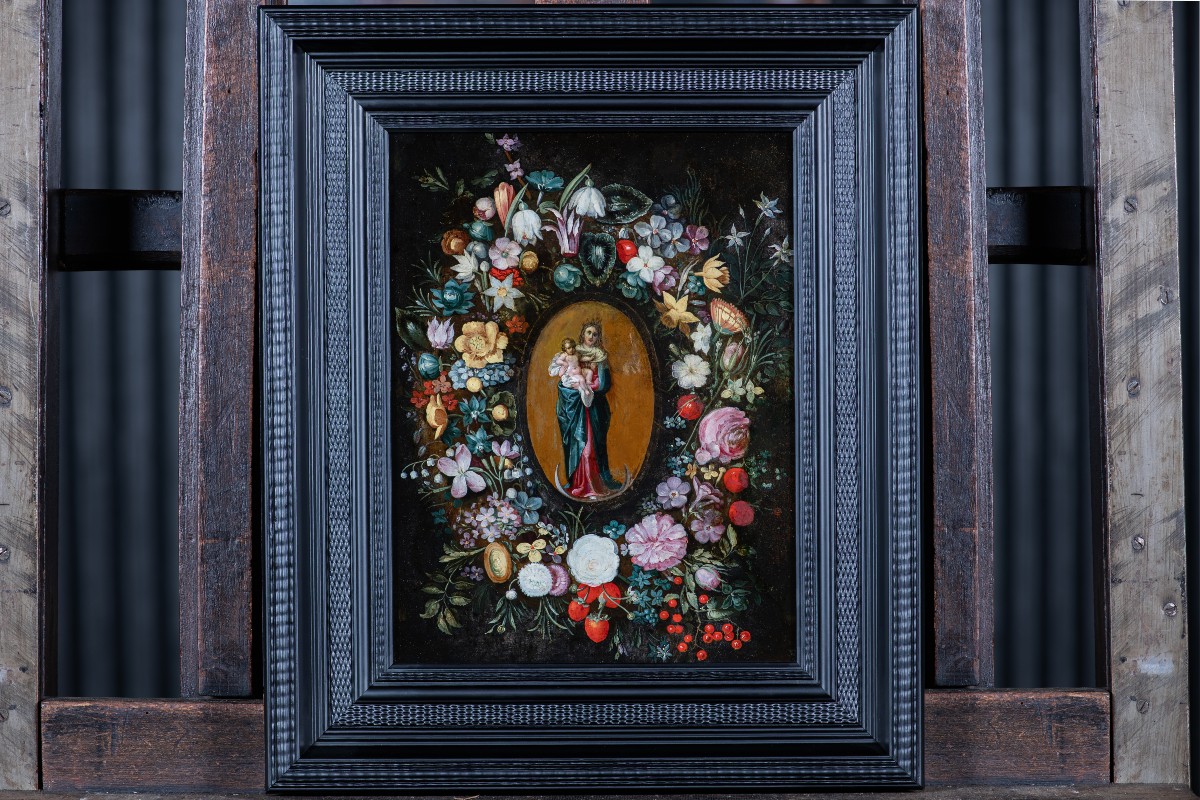
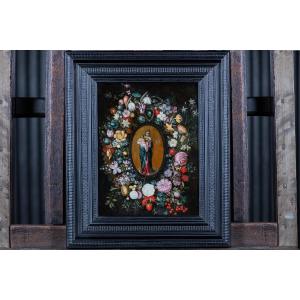


Artist: Circle of Andries Daniels (c. 1580–after 1640)
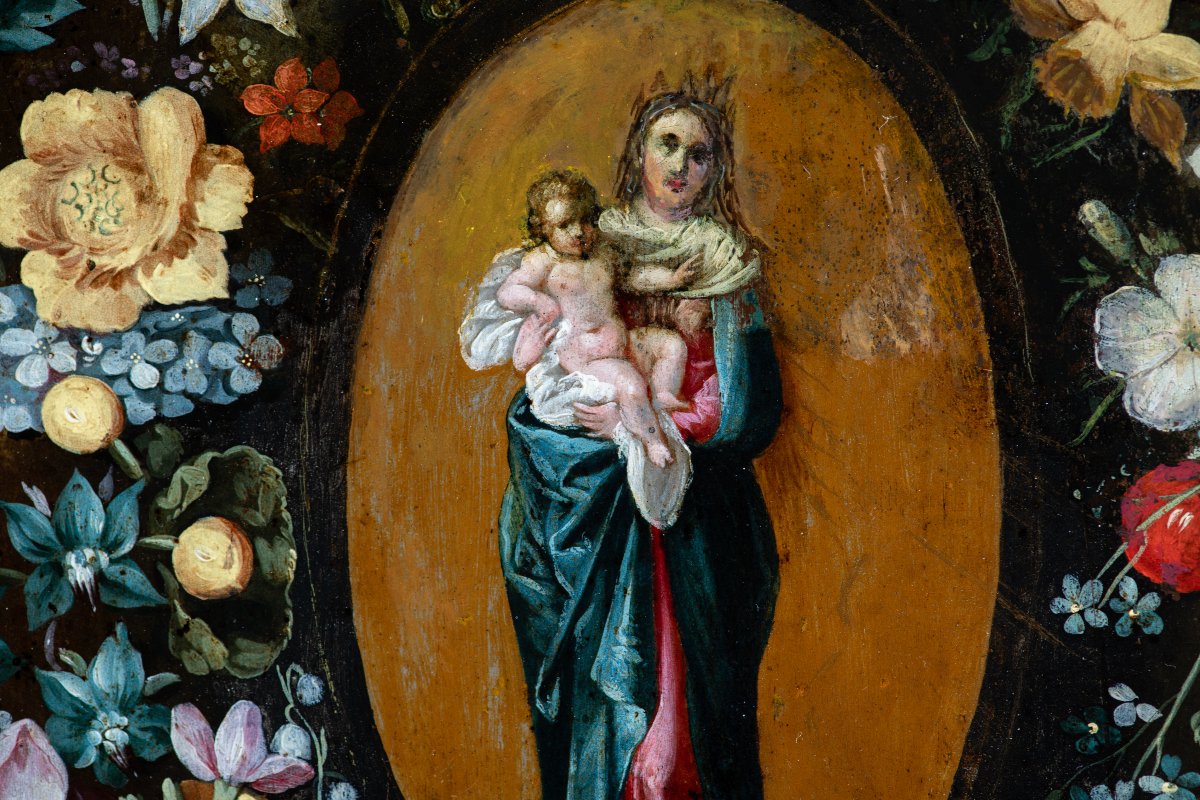
Title: Virgin and Child in a Floral Garland
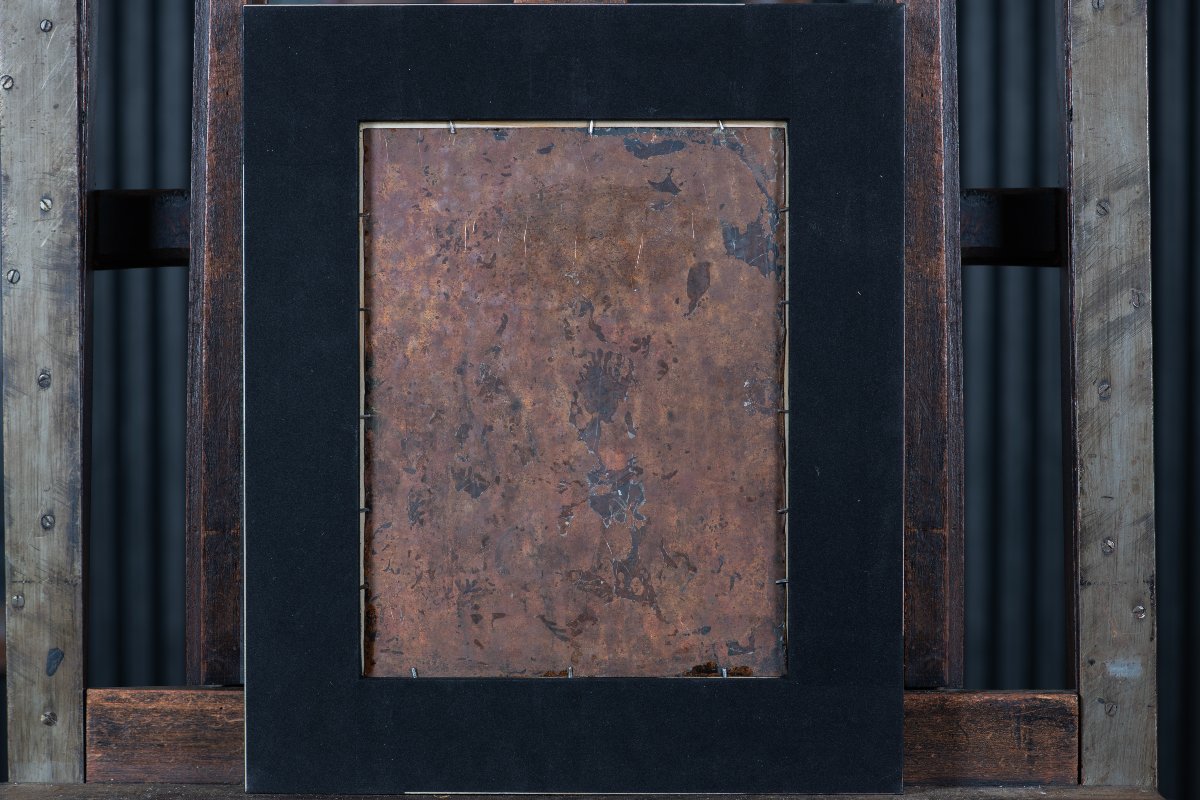
Medium: Oil on copper
Dimensions: 31 × 29 cm (framed: 45 × 37.5 cm)
Style: Flemish Baroque, devotional garland painting
Signature: Unsigned
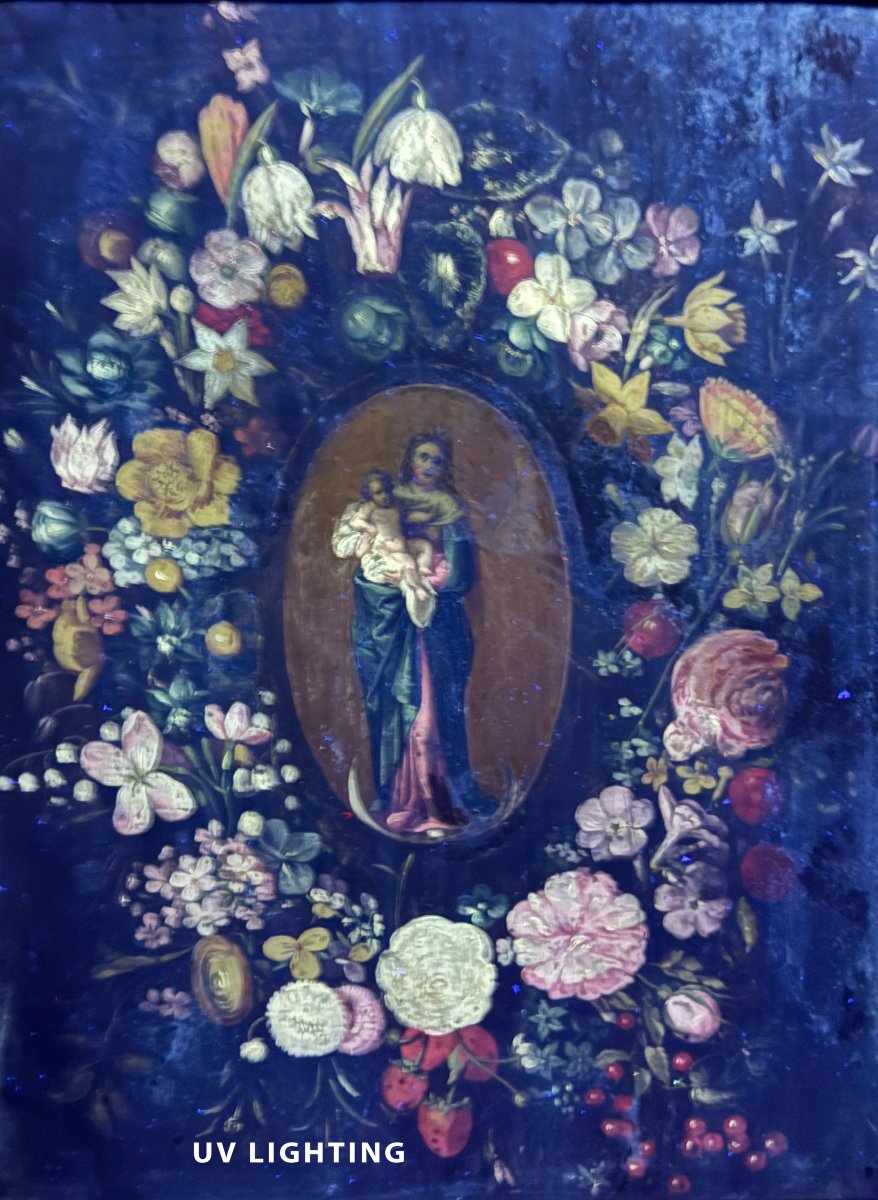
Condition: Recently professionally restored (cleaning, treatment of copper corrosion, retouching, consolidation/restoration by Atelier Simonis)
Provenance: Private collection
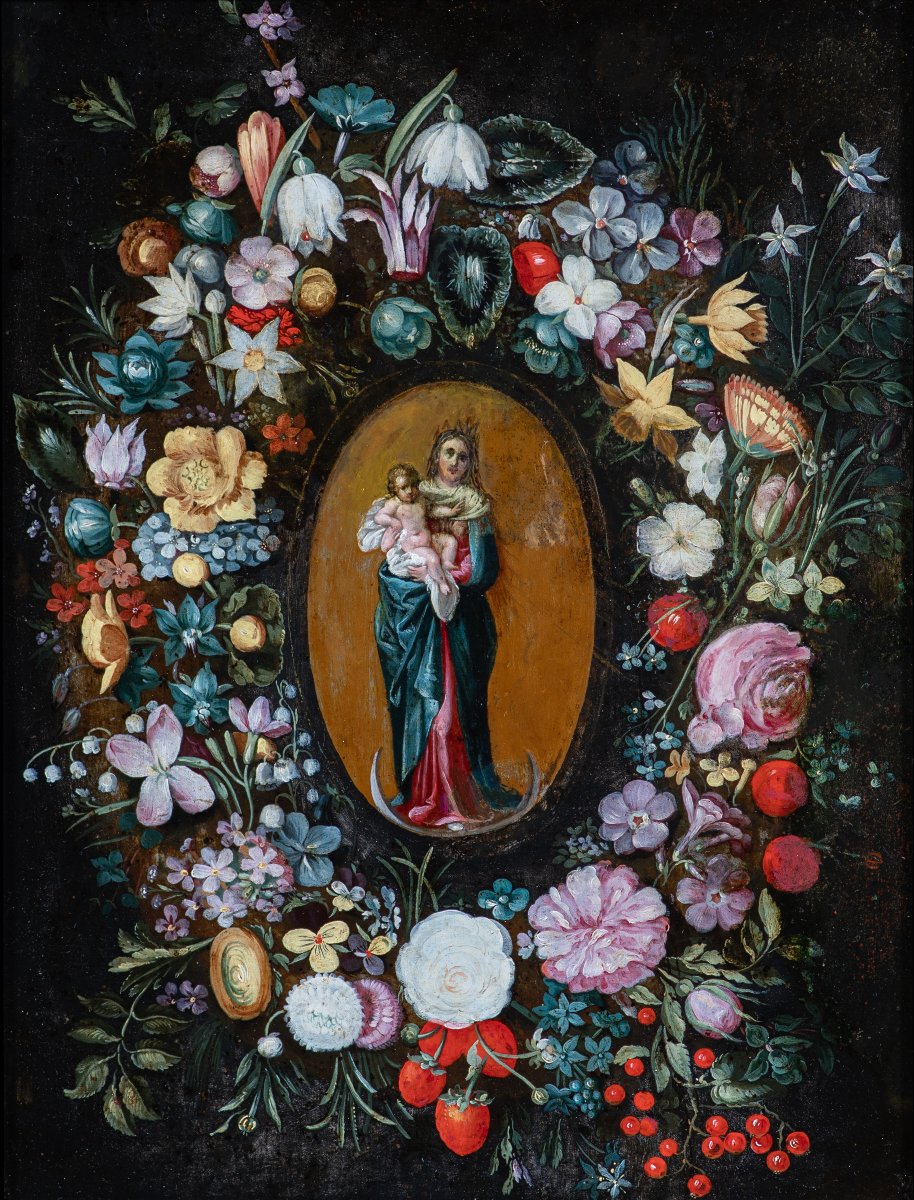
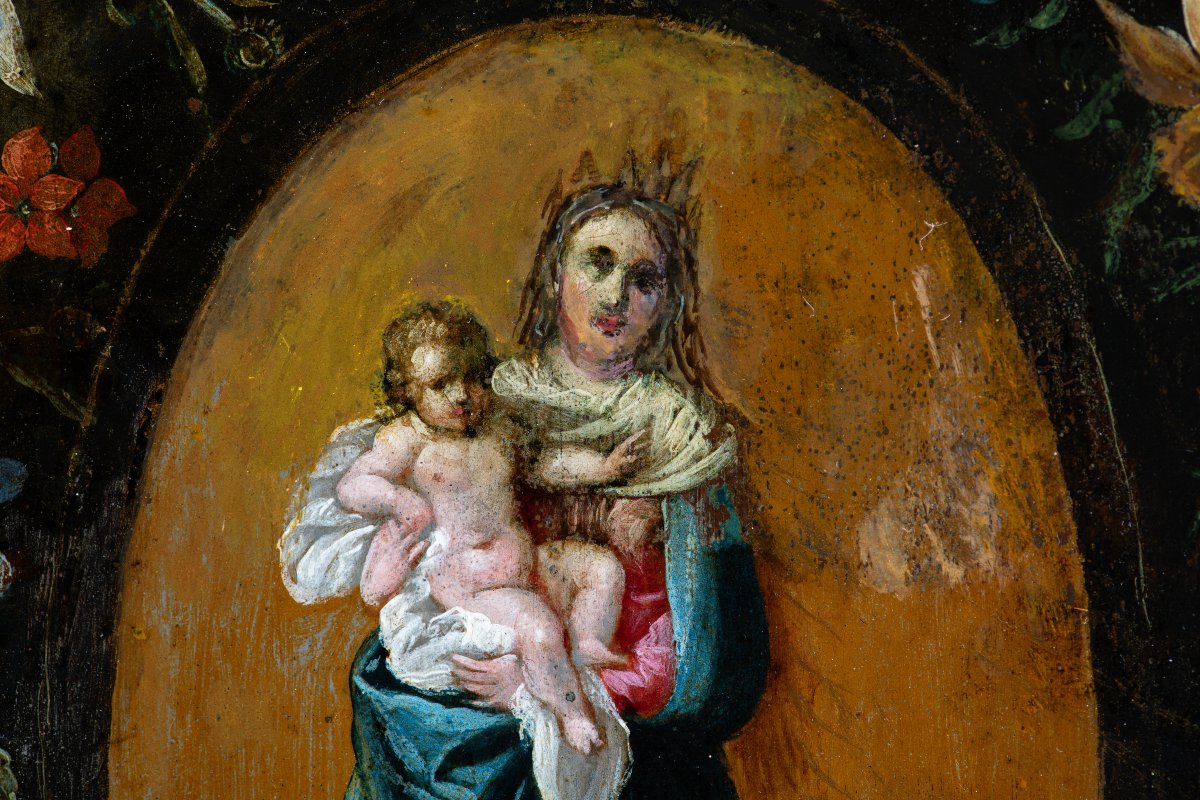
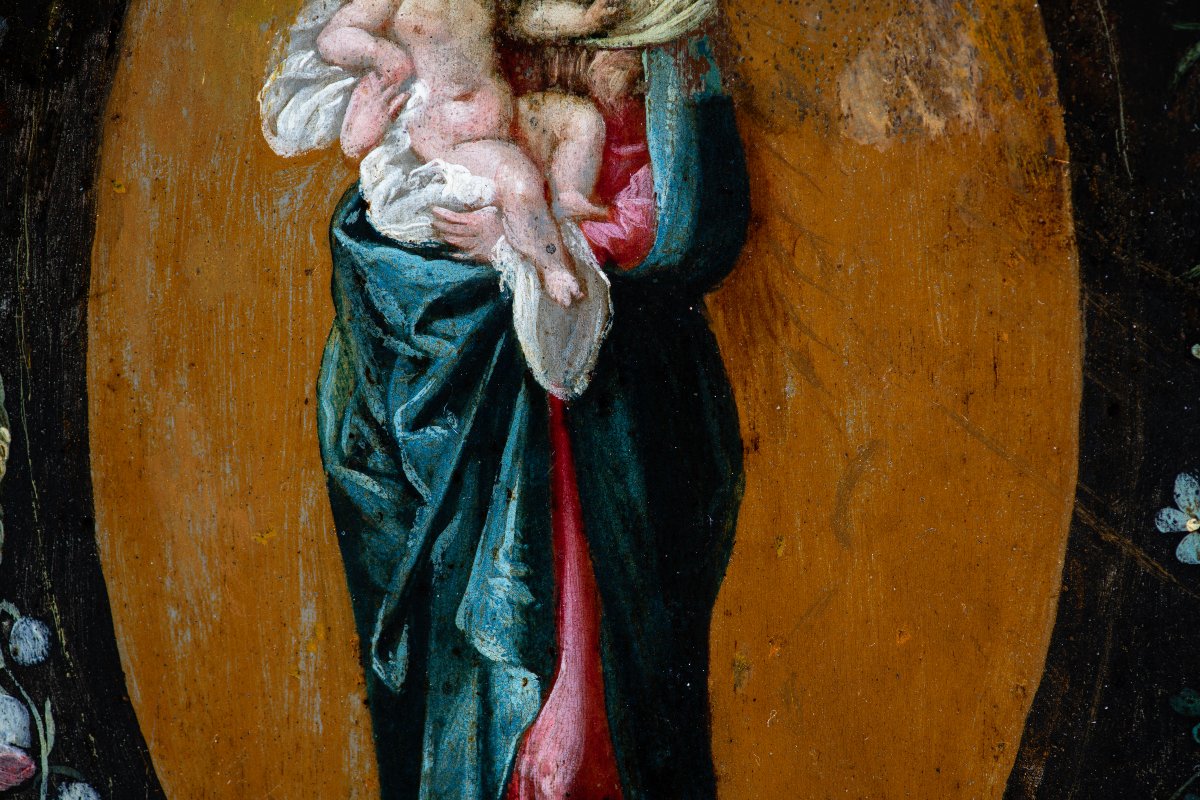
IntroductionThis refined painting on copper presents a devotional oval of the Virgin and Child at its center, encircled by a richly composed garland of flowers and fruit. The combination of sacred imagery and floral framing places the work firmly within the Antwerp tradition of the early seventeenth century. Its stylistic characteristics are consistent with the circle of Andries Daniels, an artist associated with highly accomplished floral still lifes and garland compositions.
The Artist and His ContextAndries Daniels (c. 1580–after 1640) was active in Antwerp, one of the principal artistic centers of the Southern Netherlands in the Baroque period. Archival references indicate that he was registered in the Guild of Saint Luke in 1599 as a pupil and admitted as a master in 1602. Within this environment, a specialized practice emerged in which flower painters and figure painters often collaborated on complex devotional works.
Daniels is closely linked to the early development of garland painting: compositions in which a floral wreath frames a sacred image, cartouche, or medallion. Because securely attributed works by Daniels are comparatively rare and attribution within this genre can be nuanced, the designation “circle of” is art-historically careful and appropriate for this painting.
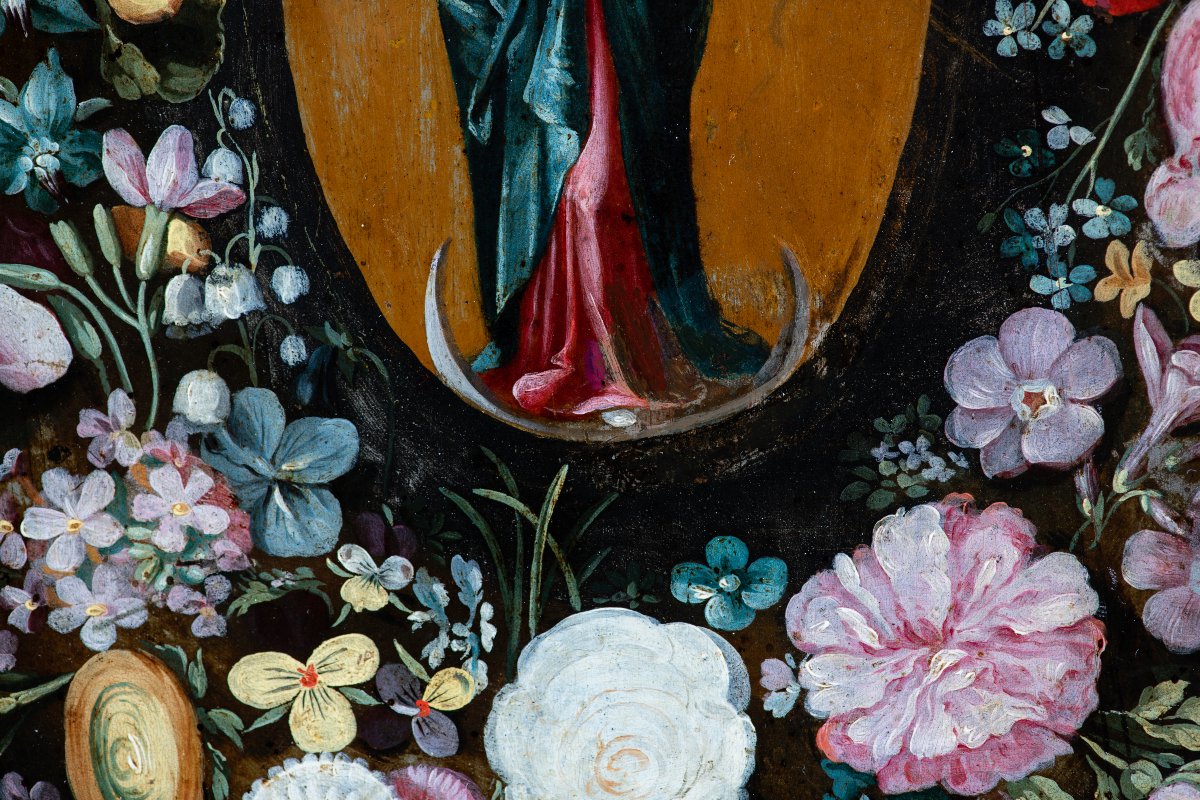
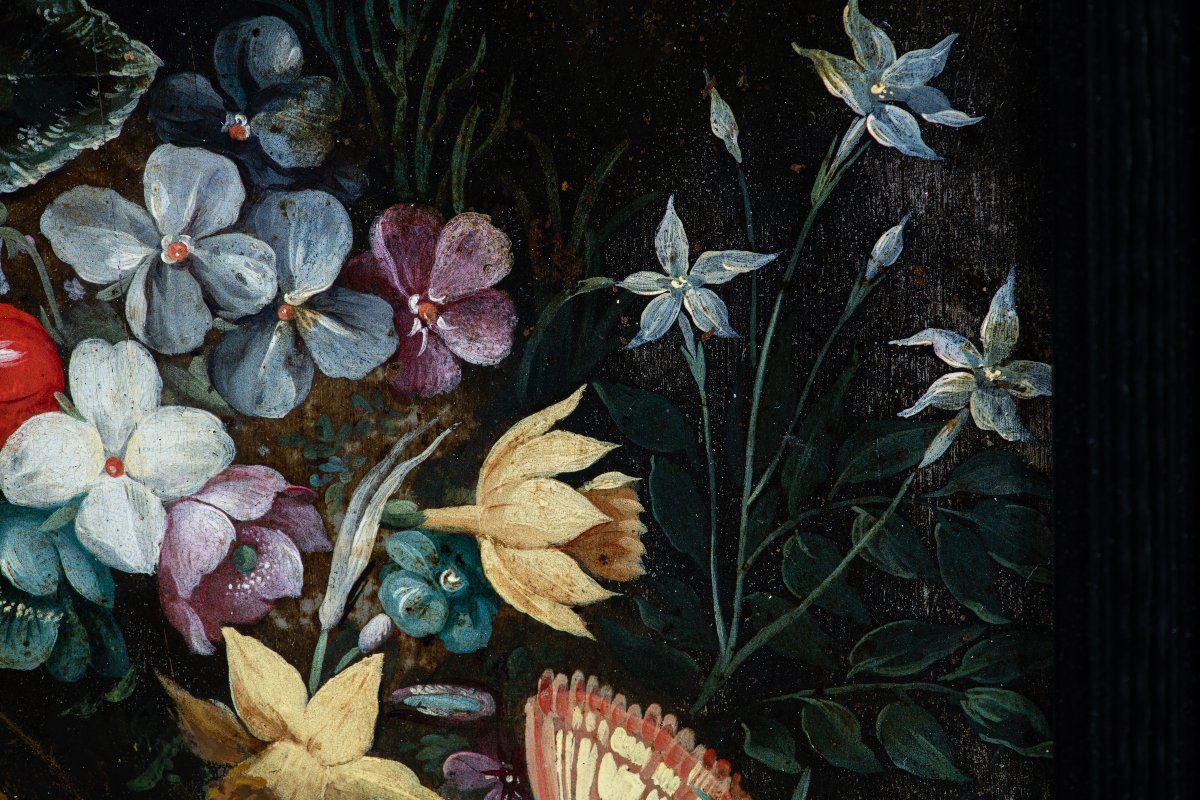
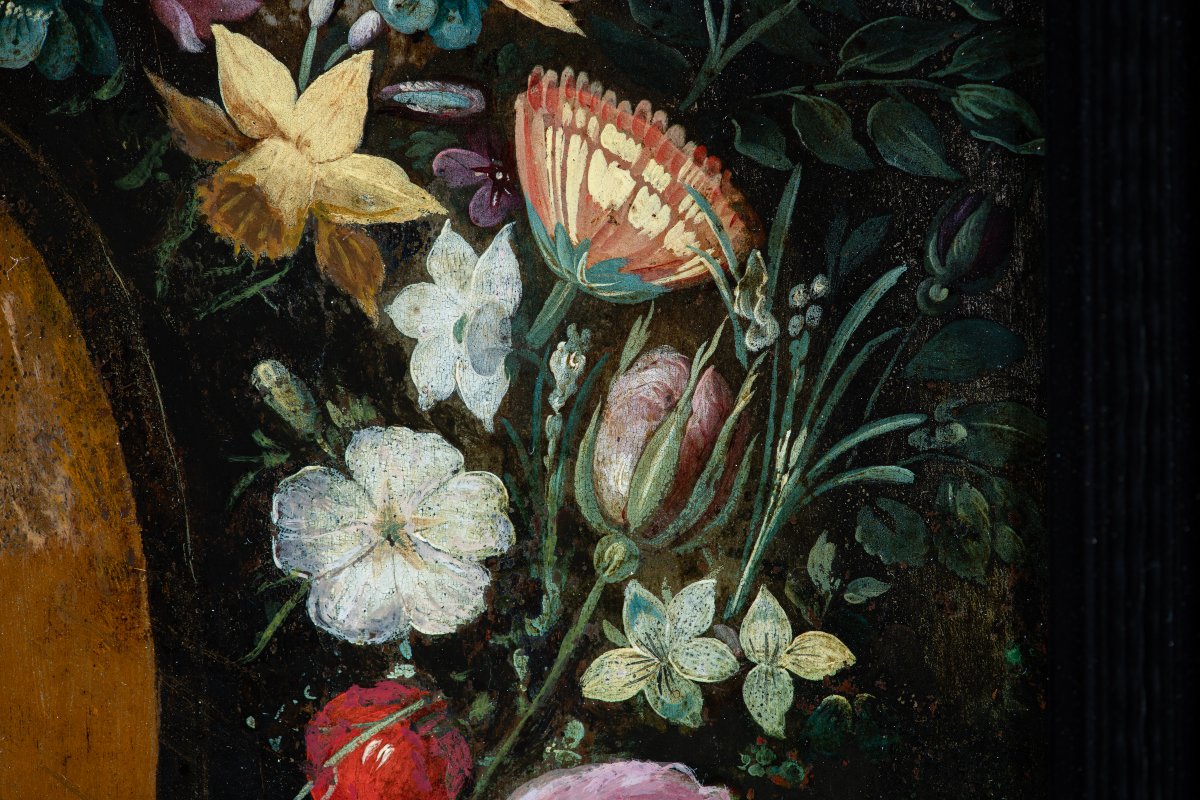
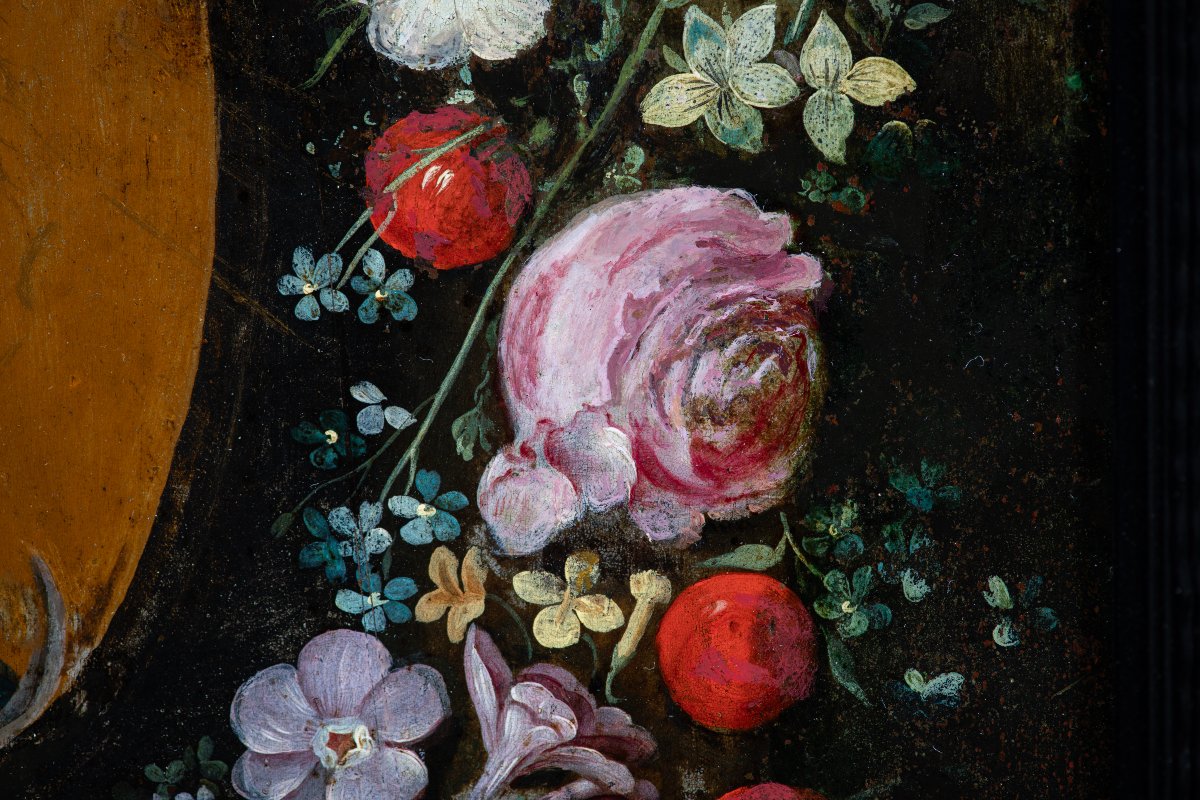
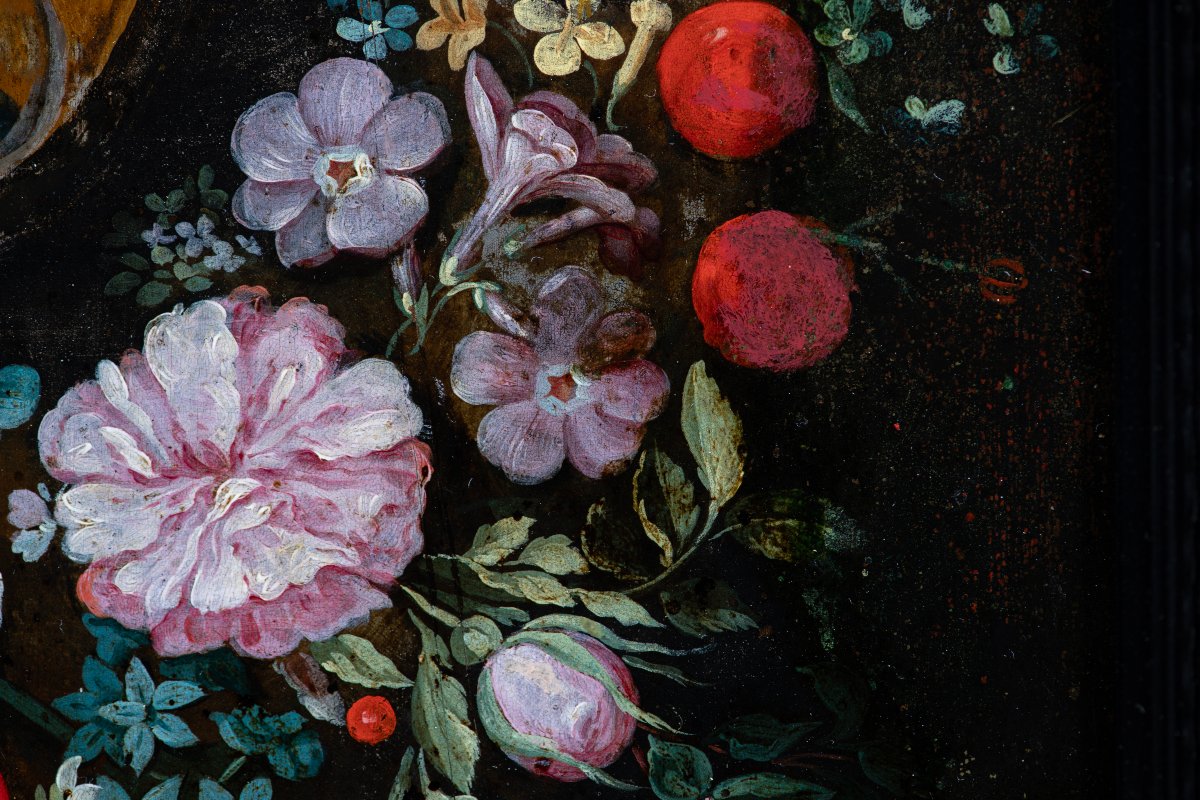
Technique and MaterialityPainting on copper in the seventeenth century was a deliberate high-quality choice. The smooth, non-absorbent support allows for precise brushwork, crisp contours, fine detailing, and luminous color effects. These qualities are clearly visible here in the botanical passages: petals, leaves, buds, and small fruits are differentiated with notable control and delicacy.
The recent restoration by Atelier Simonis has improved legibility and structural stability: surface grime was removed, areas affected by copper corrosion were treated, and fragile passages were consolidated and retouched. As a result, the interplay between the dark ground, the chromatic brilliance of the garland, and the central devotional image reads with renewed clarity.
Composition and StyleThe composition is both disciplined and visually rich: an oval Marian core set within an almost continuous floral wreath, all placed against a dark ground that functions as a visual stage. This contrast—light against darkness, chromatic accents against depth—is characteristically Baroque and intensifies the viewer’s focus on the sacred center.
Stylistically, the work belongs to Flemish Baroque devotional garland painting, where naturalistic observation and symbolic meaning are closely intertwined. Hallmarks include:
a carefully orchestrated decorative rhythm of floral forms;
a balance between miniaturist detail and compositional unity;
a devotional nucleus elevated by its floral surround.
The central image of the Virgin and Child signifies protection, intercession, and sacred maternity. In the Catholic visual culture of the Southern Netherlands, the floral surround functions not merely as decoration but as an act of homage and veneration.
The garland carries layered symbolic meaning:
Veneration: the floral wreath as an offering around the sacred image.
Purity: pale blossoms traditionally associated with Marian purity.
Abundance of grace: floral and fruit motifs suggesting spiritual fecundity.
Transience and eternity: ephemeral bloom contrasted with the enduring sacred presence at the center.
This synthesis of sensory richness and devotional concentration is one of the defining achievements of Antwerp garland painting in the age of the Counter-Reformation.
Stylistic AffinitiesJan Brueghel the Elder, Frans Francken II, Daniel Seghers, Mario Nuzzi, Juan de Arellano.
ConclusionThis painting is a compelling example of early seventeenth-century Flemish garland art: technically refined, iconographically rich, and stylistically coherent. The copper support, balanced Baroque structure, and devotional focus on the Virgin and Child together create both historical depth and strong visual presence. As a work from the circle of Andries Daniels, it offers a particularly attractive combination of rarity, tradition, and artistic sophistication.







 Le Magazine de PROANTIC
 TRÉSORS Magazine
 Rivista Artiquariato