THIS OBJECT WAS SOLD
Greek Ottoman Cartridge Box "palaska"


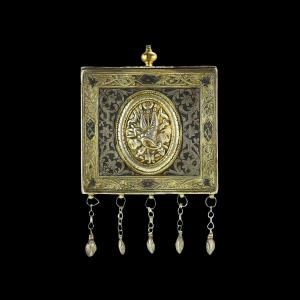


A key element of firearms combat in the early modern period was the use of cartridges. These contained predetermined doses of gunpowder wrapped in paper, which facilitated handling and ensured a consistent charge, thus guaranteeing stability and effectiveness when firing. In Ottoman Greece and throughout the Balkans, cartridges were typically stored in a specialized container called a "palaska." Usually made of copper, bronze, brass, or silver, the "palaska" had a ring for attaching it to the belt, ensuring its accessibility in combat.
The decorative style of "palaska" boxes varied considerably according to regional traditions. Many examples, including this one, are partially gilded and richly decorated with floral motifs executed using the niello technique, complemented by engraved or embossed details. This particular example is square in shape and has a hinged lid surmounted by a baluster-shaped knob. The obverse features a central medallion depicting military attributes: banners, spears, and cannons, symbolizing a military identity. Surrounding the medallion is a field of niello decoration with rocaille motifs, framed by a gilt silver border adorned with floral designs and small niello elements. The sides rest on a gilt silver ground and are decorated with symmetrical lozenge-shaped cartouches containing lilies rendered in niello.
The underside of the palaska is further embellished with five small silver chains terminating in matching shell-shaped ornaments. Based on its decorative details and quality of execution, this palaska can be attributed to the Greek regions of the Ottoman Empire and dated to the late 18th or early 19th century.
The decorative style of "palaska" boxes varied considerably according to regional traditions. Many examples, including this one, are partially gilded and richly decorated with floral motifs executed using the niello technique, complemented by engraved or embossed details. This particular example is square in shape and has a hinged lid surmounted by a baluster-shaped knob. The obverse features a central medallion depicting military attributes: banners, spears, and cannons, symbolizing a military identity. Surrounding the medallion is a field of niello decoration with rocaille motifs, framed by a gilt silver border adorned with floral designs and small niello elements. The sides rest on a gilt silver ground and are decorated with symmetrical lozenge-shaped cartouches containing lilies rendered in niello.
The underside of the palaska is further embellished with five small silver chains terminating in matching shell-shaped ornaments. Based on its decorative details and quality of execution, this palaska can be attributed to the Greek regions of the Ottoman Empire and dated to the late 18th or early 19th century.
Explore similar pieces and discover your ideal find:
Antique Firearms