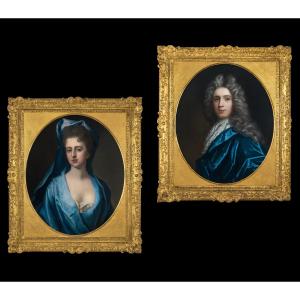


"Portrait Of Sir John Wentworth, 1st Baronet, And Mary Wentworth C.1695-1705, Michael Dahl"
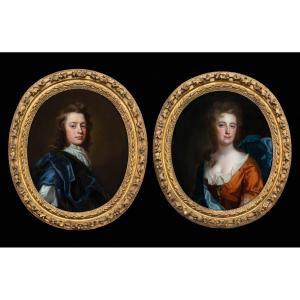
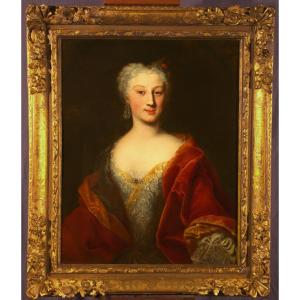
Portrait of Sir John Wentworth, 1st Baronet, and Mary, Lady Wentworth née Lowther c.1695–1705Attributed to Michael Dahl (c.1659–1743) and Attributed to Thomas Murray (1663–1735)
These exquisite portraits formed part of the historic collection of family pictures and heirlooms at Howsham Hall and depict a marriage linking a Yorkshire baronet to one of the most powerful northern dynastic families of late Stuart England, the Lowthers. They exemplify the highest ambitions of English portraiture at the turn of the eighteenth century, when painting functioned not merely as likeness but as a durable expression of lineage, alliance, and social authority.
These imposing early-Georgian portraits form a rare and compelling pendant pair of exceptional presence, quality, and historical resonance, preserved together from the celebrated country-house collection of family portraits and heirlooms at Howsham Hall. Strikingly well preserved, they exemplify the highest ambitions of English portraiture at the turn of the eighteenth century, when painting functioned not merely as likeness but as a durable expression of lineage, alliance, and social authority. Few pairs of this date survive with such coherence of condition, documentation, and contextual depth.
The portraits are best dated to circa 1695–1705, at the transition from the later reign of William III into that of Queen Anne. The gentleman is presented with a long, full-bottomed periwig, softly powdered and arranged in disciplined curls that frame the head with measured dignity. He wears a fine white linen cravat edged with lace and set high at the throat, entirely characteristic of elite male dress in the final decade of the seventeenth century. Draped across the shoulder is a rich blue velvet or satin mantle, whose crisp highlights and deep shadows are deployed less as literal costume than as a pictorial language of rank and wealth. The lady is shown in the fashionable aristocratic “undress” mode that gained prominence at precisely this moment: a low-cut bodice revealing the white chemise beneath, enveloped in luminous blue silk that frames the shoulders and directs attention toward the face. This idiom, far from informal, signalled cultivated ease, confidence, and fluency in the most current courtly taste. Together, the costumes place the sitters squarely within the sophisticated visual rhetoric of late-Stuart England.
The sitters may be identified, with a high degree of plausibility, as Sir John Wentworth (1673–1720), 1st Baronet of North Elmsall in the West Riding of Yorkshire, and his wife Mary, Lady Wentworth (c.1676–16 April 1706), eldest daughter of John Lowther, 1st Viscount Lonsdale, and Lady Katherine Thynne. Their marriage in 1692 coincided with Sir John’s creation as a baronet, elevating the family’s standing at a moment when such advancement was both politically charged and socially visible. Mary’s early death in 1706, commemorated by a monument in Bath Abbey, lends these portraits particular poignancy: they capture the couple in the brief period when youthful promise, dynastic ambition, and social confidence converged.
Sir John Wentworth belonged to a substantial Yorkshire landowning family and represents the archetype of the provincial gentleman newly integrated into the national elite after the Glorious Revolution. His life unfolded at a time when the gentry were increasingly drawn into parliamentary, administrative, and metropolitan networks, even while remaining rooted in their estates. Mary Lowther brought with her one of the most powerful northern aristocratic connections of the age. Her father, Viscount Lonsdale, was a formidable political figure whose influence extended across Cumberland, Westmorland, and beyond, while her mother’s Thynne lineage connected Mary to one of the most socially prominent families in England. Contemporary accounts and family correspondence attest to the Lowthers’ keen awareness of lineage, patronage, and display, cultivating visibility through architecture, collecting, and portraiture. The marriage thus united a newly created baronetcy with entrenched aristocratic power, a union ideally suited to commemoration through ambitious pendant portraits.
The commissioning of such portraits is best understood within the cultural and political climate of England around 1700. The country was consolidating the post-Revolution settlement under William III and then Queen Anne; the Act of Settlement (1701) shaped the succession, the War of the Spanish Succession (1701–1714) dominated political life, and the Act of Union (1707) fundamentally altered the structure of the state. London emerged as the unrivalled centre of an increasingly sophisticated portrait market serving a governing class eager to translate marriage, title, and allegiance into visual form. Portraiture became a language of legitimacy and continuity, particularly for families navigating new titles or advantageous alliances. In this environment, pendant portraits of husband and wife were among the most potent tools of self-definition within the country house.
Although later catalogued under the name of Sir Godfrey Kneller, as was customary in early twentieth-century country-house sales, the present pair is more precisely understood as the work of two leading contemporaries operating within the dominant Kneller idiom. That a pendant pair might be painted by different artists was entirely orthodox at this period. What defined a pendant was unity of scale, format, lighting, colour rhetoric, and framing, not strict identity of authorship. Patrons commissioned portraits to achieve a visual and social effect, and it was common for different specialists to be engaged for male and female sitters, provided the resulting works harmonised as a pair.
The lady’s portrait is attributed to Michael Dahl. The delicately fused flesh tones, luminous handling of the eyes, softly modelled mouth, and refined psychological distance are all characteristic of Dahl’s finest female portraits from the late 1690s and early 1700s. His work often tempers the grandeur of the court style with a gentle intimacy, and his handling of silks and draperies favours optical softness over graphic assertion—qualities clearly present here. The gentleman’s portrait is attributed to Thomas Murray, whose sober authority and architectonic construction of the head align closely with the present likeness. The firmer modelling, controlled treatment of the periwig, and restrained psychological register are hallmarks of Murray’s practice and explain why his works were so frequently subsumed under Kneller’s name in later inventories and sales. Seen together, the pair exemplifies how two distinct but closely related hands could contribute to a unified commission within the same stylistic ecosystem. The matching carved and gilded period frames reinforce this unity.
The provenance firmly anchors the portraits within a historic country-house context. Almost certainly commissioned for the Wentworth marriage, they plausibly descended through the family line—very likely via their daughter Catherine—into the collection at Howsham Hall, where they formed part of the house’s accumulated visual identity. By the nineteenth century they belonged to the Cholmley family, heirs to Howsham’s layered history, and they were sold from the estate in the Christie, Manson & Woods sale of the pictures of Harry Walter Cholmley on 1 February 1902, lot 43, where they were purchased by Gribble and thus left Howsham together, as they had long been kept.
Howsham Hall itself provides an essential interpretive framework. Set above the River Derwent, the house evolved over centuries through inheritance, rebuilding, and improvement, serving as a repository of family memory as much as a residence. Its interiors once displayed portraits not merely as decoration but as assertions of lineage and continuity, and the Wentworth association places these paintings within the formative period of the house’s visual culture. The later Cholmley stewardship preserved that tradition, allowing these portraits to survive as part of a coherent family ensemble until their dispersal in the early twentieth century, a moment that echoes the wider history of English country houses and their collections.
As a unified object, this pendant pair stands apart for its convergence of scale, condition, plausible sitter identification, and country-house provenance. It offers not only two finely painted likenesses but a rare survival of the social logic that produced them: marriage, title, inheritance, and display, articulated through the shared visual language of late-Stuart portraiture. Few portraits of this date combine such authority of presence with such a rich and intelligible historical narrative, making this pair an exceptional testament to the culture that shaped it.
Michael Dahl (c.1659–1743) was a Swedish-born portrait painter who settled in London and emerged as one of the most sought-after alternatives to Kneller in the later Stuart and early Georgian period. Trained in Stockholm and on the Continent, he established a successful London practice by the 1690s, winning aristocratic patronage and particular acclaim for his female portraits. Dahl’s work is distinguished by softly fused flesh tones, luminous eyes, and an intimate psychological register that tempers the grandeur of the court style with sensitivity and refinement.
Thomas Murray (1663–1735), Scottish-born and trained within the English tradition, established himself in London as a respected specialist in male portraiture of rank. Closely aligned with the prevailing Kneller idiom, Murray produced sober, architectonically constructed likenesses well suited to statesmen, scholars, and landed gentlemen. His proximity to Kneller’s style explains why his works were so often absorbed under that name in later inventories and sales, even as modern connoisseurship increasingly recognises his distinct contribution to English portraiture.
Labels:
Contains indistinct labels on verso with text: "Feb 1 .02", "H.W. Cholmley sale", "Howsham Hall".
Provenance:
- (Almost certainly) commissioned for Sir John Wentworth, 1st Bt. (1673–1720) and his wife Mary, Lady Wentworth (née Lowther, d. 1706), circa 1695–1705 (as a pendant pair);
- Thence by descent through the Wentworth family, and plausibly by marriage of their daughter Catherine Wentworth to Hugh Cholmley, into the Cholmley family collection;
- Howsham Hall, Yorkshire, the Cholmley family collection (for several generations);
- Harry Walter Cholmley (d. 1901), Howsham Hall, Yorkshire;
- Christie, Manson & Woods, London, 1 February 1902, “Catalogue of Pictures by Old Masters … of H. W. Cholmley, Esq., deceased; late of Howsham Hall, York,” lot 43 (as “Sir G. Kneller: Portraits of a Lady; and a Gentleman, in blue dresses—a pair; Oval—29 in. by 24 in.”); sold for £33 12s to Gribble;
- Thereafter, private collection, United States











 Le Magazine de PROANTIC
 TRÉSORS Magazine
 Rivista Artiquariato